

Contract Cancellation Policy: Your Rights and Steps
You can be three months into a solar and battery deal, then realise the contract is locking you into a service that no longer suits the way your home runs. Maybe the app is clunky. Maybe the exit terms are buried. Maybe the promised battery value isn't showing up on your bill. In that moment, the contract cancellation policy matters just as much as the price sheet, because it decides how cleanly you can leave, what you may owe, and whether you keep control of your own energy asset.
For Queensland and New South Wales homeowners, this is not a theoretical issue. A battery is a serious household investment, and any agreement that touches it should be readable, fair, and easy to exit if the service stops performing. If the terms are vague, the risk is simple. You can end up paying for flexibility you thought you already had.
Why Contract Cancellation Policies Matter for Energy Customers
A homeowner who signs up for a Virtual Power Plant program usually wants one thing first, better value from the battery already sitting on the wall. They don't want legal noise. They want to know what happens if they change retailer, move house, or decide the service isn't delivering the expected result.
That is where a contract cancellation policy becomes practical, not abstract. In energy, cancellation is not only about leaving a supplier. It also affects timing, final billing, and how quickly you can move to a better arrangement without losing control of your battery output or export rights. If the contract is messy, the homeowner carries the burden.
A simple test before you sign
Ask three questions before you agree to anything:
- Can I leave without a penalty that has nothing to do with actual loss?
- Do I know exactly when notice must be given?
- Will I keep priority use of my battery while the agreement is active?
If the answer to any of those is unclear, the contract needs work. In the energy market, unclear cancellation terms usually help the business, not the customer.
High Flow Energy's tariff comparison page is a useful starting point if you want to compare structure before you commit to a new arrangement. A clean comparison belongs in the decision process, not after the fact. Energy tariff comparisons
Practical rule: if a cancellation clause is hard to find, it is probably hard to use.
Battery owners in NSW and Queensland should treat cancellation terms as part of the value proposition. A good deal is not just about what you earn or save while the service runs. It's also about how easily you can exit if the service stops fitting your household.
Australian Consumer Law and Your Cancellation Rights
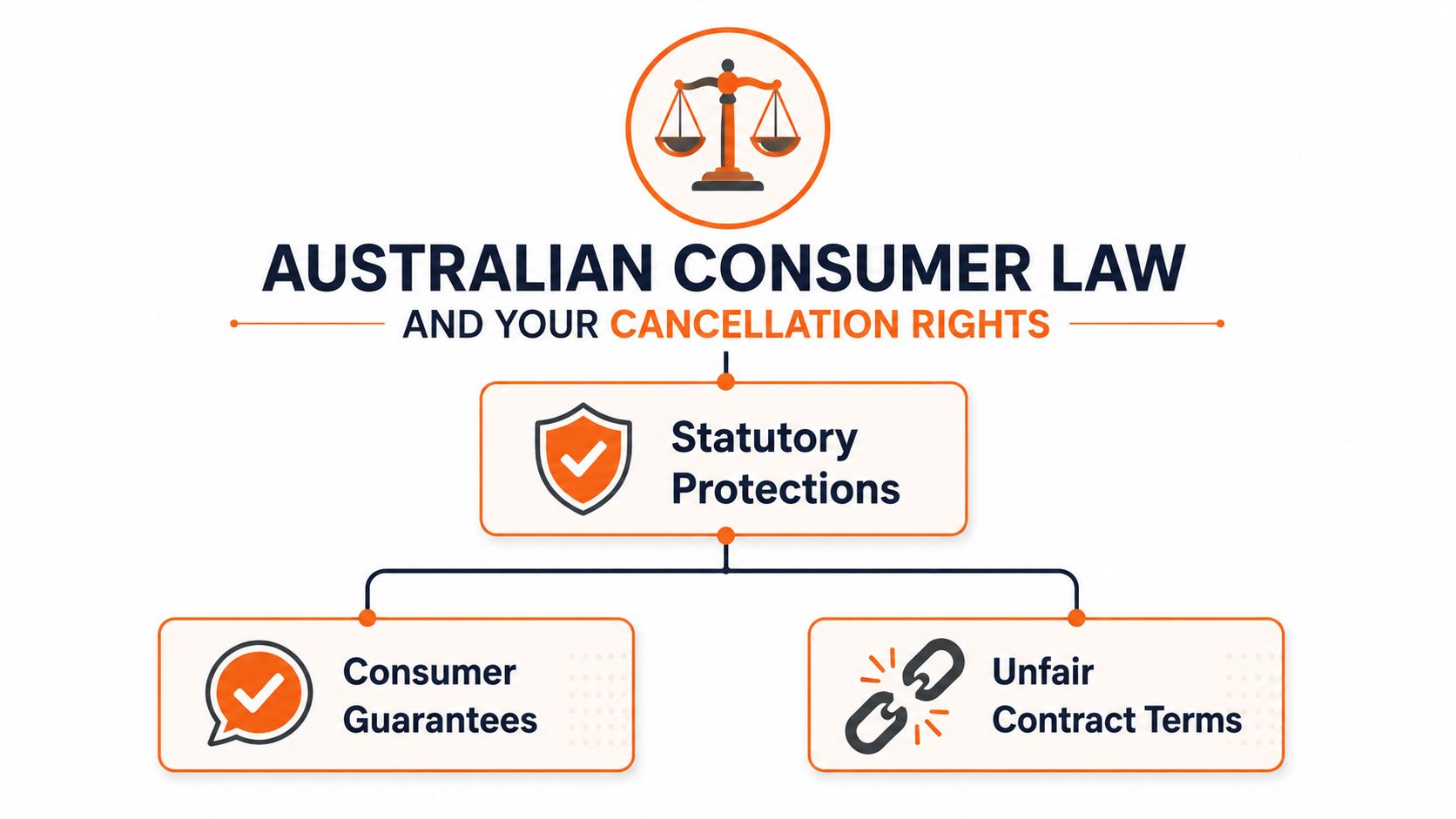
A homeowner dealing with a failed energy or VPP service should start with the legal floor, not the contract wording. The Australian Consumer Law sits above private terms, so a supplier cannot write around mandatory consumer protections. The consumer guarantee framework has applied nationally since 1 January 2011, and the ACCC says that if a service has a major problem, the consumer can cancel the service contract, claim a refund for the unused portion, and seek compensation for reasonably foreseeable loss or damage caused by the failure. That is the rule that matters in practice. Australian Consumer Law cancellation rights
What “major problem” means in practice
The ACCC says a service can have a major failure if the consumer would not have bought it knowing the problem, or if the service is substantially unfit and cannot easily be fixed within a reasonable time. For an energy or VPP-style service, that matters because the customer is buying performance and control, not a stack of paperwork.
If the service fails at the level the customer was relying on, the right to cancel is stronger than a standard terms page suggests. A homeowner should treat the contract as one part of the picture, not the whole picture.
Why unfair terms matter now
Australian Government guidance says unfair contract terms in standard-form consumer and small-business contracts have been banned, with stronger penalties from 9 November 2023. That has changed how cancellation clauses should be written. One-sided terms are much harder to defend when they look like a deterrent instead of a genuine estimate of business loss. The ACCC's current enforcement focus on harmful contract terms points in the same direction. Unfair contract terms reforms and enforcement focus
For homeowners, the point is simple. A cancellation clause is not automatically enforceable just because it appears in the agreement. If it is unfair, disproportionate, or designed to trap the customer, it is on shaky ground. That same principle is why no-lock-in energy and VPP offers fit current regulatory pressure so well, and why battery owners should pay close attention to exit terms before they sign. For a practical comparison of how contract wording can be framed, see this guide for Seattle startups.
The real question is not whether a fee exists. It is whether the supplier can justify it.
Typical Energy Contract Clauses and What to Watch For
Most energy and VPP agreements rely on a small set of clauses that determine how painful an exit will be. Notice periods, renewal mechanics, and fee language do most of the work. The problem is that these terms are often written for the supplier's convenience, not the customer's clarity.
A better way to read the contract is to separate how you leave from what you pay if you leave. Those are not the same thing. A notice period tells you when cancellation takes effect. A refund rule tells you what part of the service, if any, is still payable.
Common Energy Contract Cancellation Clauses
| Clause Type | Traditional Retailer | High Flow Energy |
|---|---|---|
| Notice period | Often stated in dense contract language | Clear and readable |
| Exit fee | May appear as a deterrent charge | No exit fee positioning |
| Renewal terms | Can auto-renew unless notice is given | Designed around flexibility |
| Refund treatment | May be mixed with other billing rules | Separate from cancellation timing |
| Cancellation method | Sometimes limited to one channel | Clear instructions are easier to find |
The main issue with many traditional contracts is not that they mention a fee. It's that the fee is not obviously tied to actual loss. Australian Consumer Law requires fairness, and the ACCC says unfair terms in standard-form consumer and small-business contracts can be void, while penalty-style charges must be proportionate to the business's actual loss rather than used as a blanket deterrent. That's a meaningful distinction for anyone reading a service agreement. ACCC guidance on unfair terms and cancellation fees
If you want a useful legal comparator outside energy, the force majeure clause guide for Seattle startups is a decent example of how clearly defined contract risks should be drafted. Different context, same principle. Good contracts spell out triggers, consequences, and who bears the cost.
What to check before you sign
- Exit fees: Ask what actual loss the fee is meant to cover.
- Automatic renewal: Confirm whether the contract rolls over if you do nothing.
- Cancellation channel: Find out whether email, app, phone, or written notice is required.
- Refund treatment: Check whether unused service is refunded separately from any penalties.
- Hidden conditions: Look for clauses linked to hardware, installation, or bundled services.
A fair energy contract should read like a service agreement, not a trap.
Step-by-Step Guide to Cancelling Your Energy or VPP Service
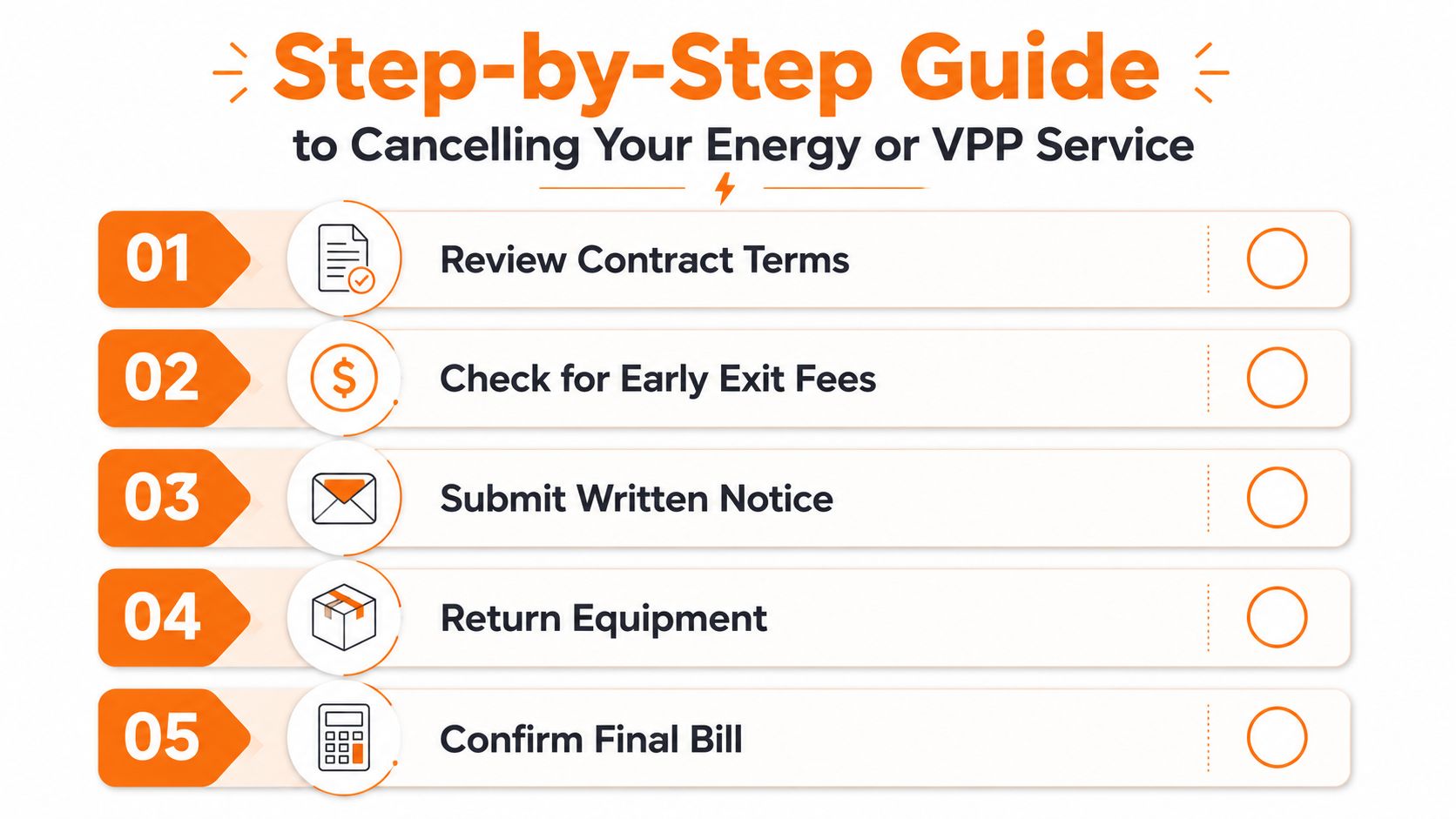
If you're leaving an energy or VPP arrangement, don't improvise. Read the contract, keep copies, and make the cancellation request in writing. That's the cleanest way to protect yourself if the business later disputes timing or claims you missed a notice window. How to change electricity provider
Start with the contract, not the call centre
Look for the notice period, the cancellation method, and anything tied to equipment, billing, or access to the app. If the agreement says notice must be given before a certain date, treat that date as hard, not approximate. Australian legal guidance also recommends defining cut-off times in local time, AEST/AEDT where relevant, so there's no argument about when the request landed. Time-zone precision in cancellation drafting
Then put the request in writing
Your cancellation notice should be short and direct. Use language like this:
“I'm giving notice to cancel my energy or VPP service under the terms of my agreement. Please confirm the effective cancellation date, any final billing amount, and any steps needed to close the account.”
That wording avoids argument. It also creates a record.
Keep the timing clean
If the service has already started, ask whether any part of it will be billed up to the cancellation date. Best-practice guidance for service contracts recommends separating the cancellation deadline from the refund rule, because the outcome depends on whether anything has already been delivered. If the business has already performed part of the service, partial billing may be reasonable, but it should be explained clearly in the contract.
Final checklist
- Review the contract terms and save a copy.
- Note the cancellation deadline in local time.
- Submit written notice through the required channel.
- Ask for confirmation of the effective end date.
- Check the final bill and challenge anything that doesn't match the agreement.
For consumers, the goal is not drama. It's a tidy exit with no surprise charges.
State-Specific Rules for Queensland and New South Wales
Queensland and New South Wales sit inside the same national consumer framework, so the ACL baseline applies in both places. That matters because homeowners sometimes assume state lines create completely different cancellation rights. They don't, at least not at the level that matters most for ordinary consumer guarantees and unfair contract terms.
What does vary is the practical setting. A battery owner in one network area may face different export limits, different service constraints, or different retailer offerings from a homeowner elsewhere. Those operational differences affect the value of the VPP relationship, even when the consumer-law floor stays the same.
Geography shapes the service, not the basic right to leave
In the National Electricity Market, household battery value is influenced by local conditions, not just the contract wording. A service that looks attractive on paper may be less useful in one location if export settings, network constraints, or dispatch conditions change the economics. That makes cancellation rights part of a wider decision about control and flexibility.
For NSW and Queensland customers, the main practical point is this. If the service no longer suits your household or your battery usage pattern, you should know exactly how to exit without having to untangle a separate state-law maze. The national ACL baseline gives you that starting point.
What battery owners should ask locally
- Does the contract explain how local time is used for cut-offs?
- Does the VPP change my ability to prioritise home use of stored energy?
- Are there export limits or network conditions that affect performance?
- Can I leave without losing access to unrelated household energy services?
Those questions matter because battery value isn't only about rates. It's also about control, timing, and whether the agreement works with the way your household uses electricity. In NSW and Queensland, the right contract is the one that fits your network conditions and still lets you exit cleanly if circumstances change.
Why No Lock In Contracts Benefit Battery Owners
A battery owner who signs a no-lock-in contract keeps an exit path open. That matters because battery value changes with dispatch rules, network limits, household usage, and market conditions. A service that suits your home today can become poor value once those conditions shift.
The point is simple. If the agreement stops working for your household, you should be able to leave without friction. That lines up with the ACCC's focus on harmful contract terms, including cancellation conditions, automatic renewals, and exit fees that can trap consumers. Transparent agreements are getting more commercial value in energy and VPP settings because they fit that direction, not because they sound consumer-friendly. ACCC enforcement focus on harmful contract terms
Why flexibility helps the customer and the retailer
A homeowner with a battery should never be stuck in a poor arrangement just because leaving is difficult. A fair contract holds customers because the service performs and the terms are clear, not because the exit is painful. That is better for the customer, and it is better discipline for the retailer too.
HighFlow Energy's Virtual Power Plant Australia page shows a BYOB VPP model built around flexibility rather than lock-in. That kind of structure deserves close attention because it shows how much control the homeowner keeps. If you are comparing energy or VPP offers, check whether the service lets you test the arrangement, review the results, and walk away if the economics or operating style no longer suit you.
The practical advantage is obvious. A battery owner can try the service, assess the outcome, and exit if the deal stops fitting the way the home is used. That keeps the relationship honest and puts pressure on the supplier to earn the stay, not force it.
Common Misconceptions About Energy Contract Cancellation
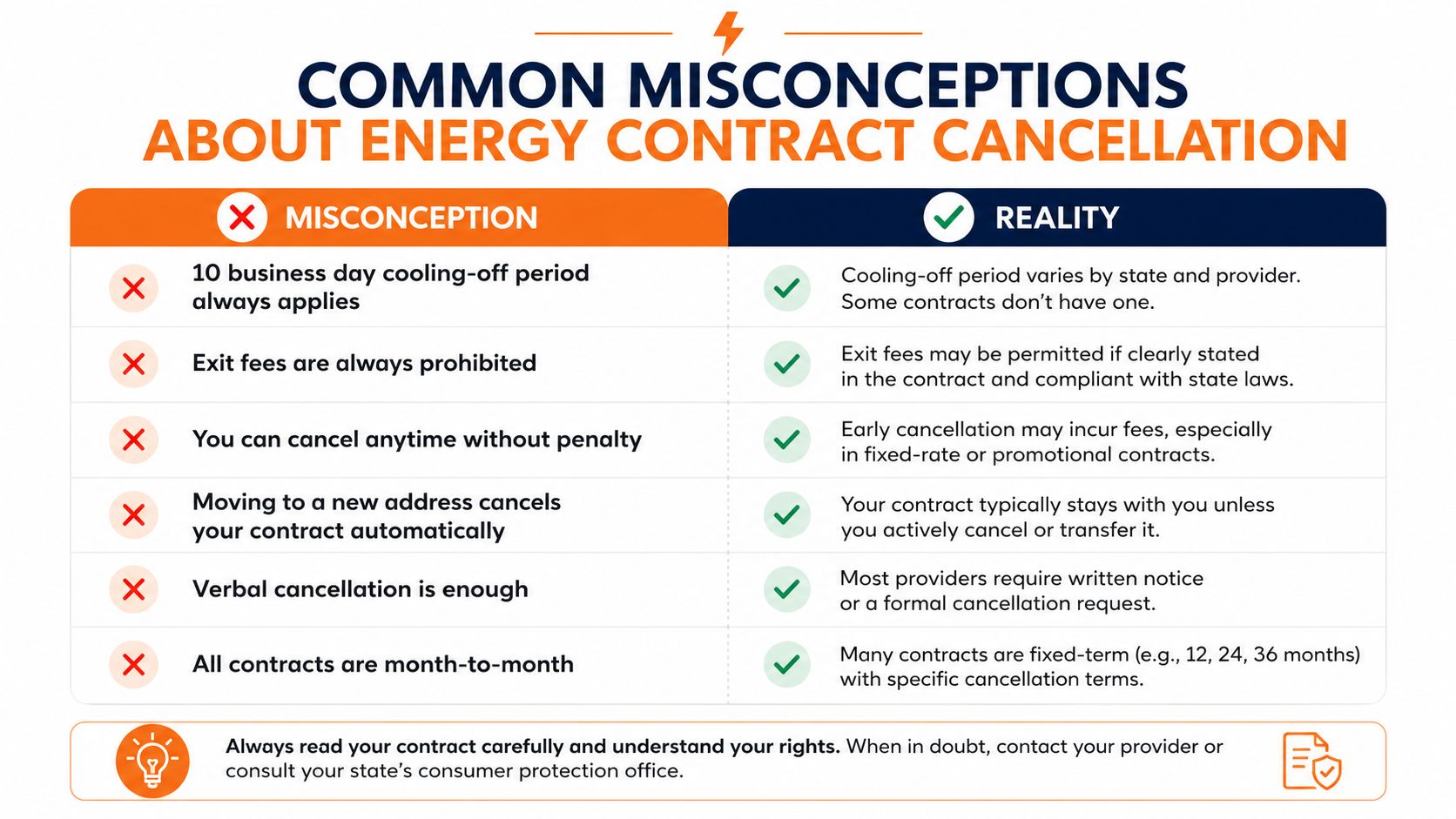
A lot of homeowners assume cancellation rights work the same way across every contract. They don't. A cooling-off period can apply to some unsolicited consumer agreements, but it does not automatically cover every energy deal, and businesses still need to spell out cancellation rights clearly. Cooling-off rights for unsolicited consumer agreements
The most common errors
Misconception: every energy contract has a universal cooling-off period.
Reality: the right depends on the contract type and how it was entered into.Misconception: any exit fee is automatically valid.
Reality: unfair or penalty-style charges can be void if they go beyond real loss.Misconception: if the service has started, cancellation is impossible.
Reality: partial performance changes the refund maths, but it doesn't erase consumer rights.
Remote and digital service contracts create the main headache. The primary issue is usually determining what has already been delivered and what still must be refunded. That is where confusion arises, and written records become most important.
For energy and VPP arrangements, the practical test is simple. Read the cancellation clause, check the timing, and separate the contract terms from the rights the law already gives you. If you are dealing with a battery service, a no-lock-in structure fits that direction because it gives the homeowner a cleaner exit if the service stops performing or the economics change.
The point is straightforward. The cancellation clause is only part of the picture, and the actual service delivered can change the outcome. Homeowners should look at the agreement, the setup, and the performance in practice before assuming they are stuck.