

Battery Discharge Rate Explained for Australian Solar Owners
You've charged your home battery through the afternoon, expecting it to handle dinner, air conditioning and the pool pump after sunset. Instead, the battery supplies some energy, the inverter limits output, and the home draws the balance from the grid. The battery may have plenty of stored energy left. The missing specification is often its battery discharge rate, the speed at which it can deliver power.
For Australian solar owners, this distinction affects evening peak performance, backup capability, electricity bill reduction and participation in a Virtual Power Plant Australia program. A battery's kWh capacity tells you how much energy it stores. Its discharge rate tells you how much of that energy can reach your home at one time.
Why Your Battery Size Is Not the Whole Story
A 10 kWh battery can store a substantial amount of energy, but that figure doesn't tell you whether it can run several large appliances together. Cooking equipment, heating and cooling, pumps and hot water systems can create a short period of high demand. If the battery or inverter can't deliver enough kW, the home imports electricity even though the battery isn't empty.
Think of the battery as a tank. Kilowatt-hours, or kWh, describe the volume in the tank. Kilowatts, or kW, describe how quickly water can leave it. A large tank with a narrow outlet may last a long time under a small load but struggle to supply several appliances at once.
The NSW Home Solar Battery Guide gives a practical interpretation: a battery with a maximum discharge rate of 2 kW should be able to power appliances drawing up to 2 kW at the same time. That makes discharge rate a power limit, not merely a technical label. The NSW Home Solar Battery Guide explains why homeowners should compare output capability with actual household loads.
Capacity and output answer different questions
Ask two separate questions:
- Capacity: How much energy can the battery store and provide over time?
- Discharge rate: How much power can the battery provide right now?
- Inverter output: How much power can the conversion equipment send to household circuits?
- Usable energy: How much of the nominal capacity remains available after operating limits and reserve settings?
A battery with modest capacity but strong output may cope well with a sharp evening demand. A larger battery with a restricted discharge rate may provide energy steadily but fail to cover simultaneous loads.
Practical rule: Never compare home batteries using kWh alone. Check usable capacity, maximum continuous discharge, peak output and inverter limits together.
This matters even more in backup mode. During an outage, the system may prioritise selected circuits, restrict high-load appliances or disconnect equipment that exceeds its output capability. VPP participation adds another consideration. A coordinated system needs enough power to support grid events without compromising the household's priority use or operating outside the battery's approved limits.
Understanding C-Rate and Discharge Rate Calculations
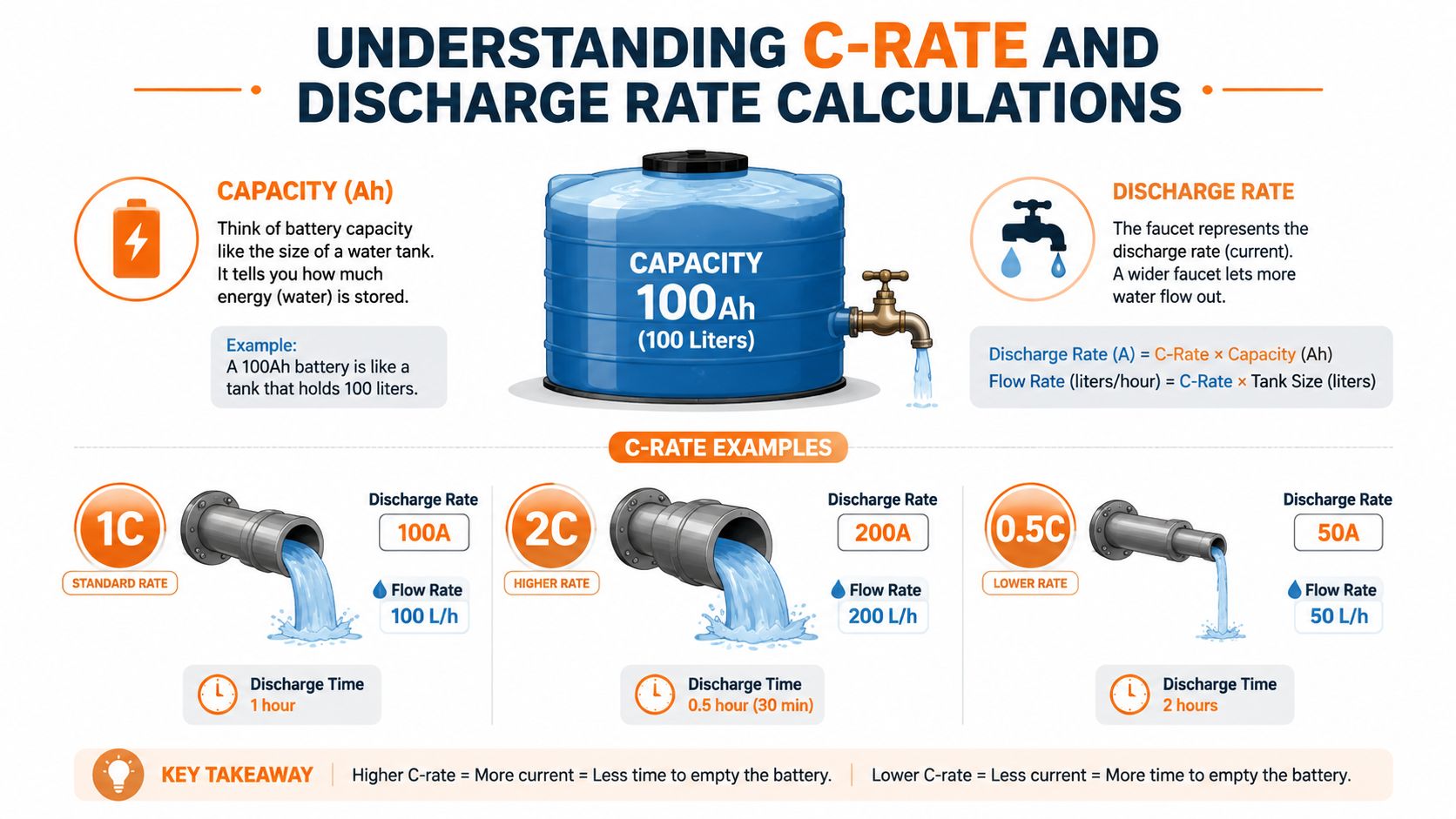
The C-rate converts a battery's stored energy into an indicative power figure. It works like a gear ratio applied to capacity. At 1C, the battery can theoretically discharge its full nominal capacity in about one hour. At 0.2C, that equivalent discharge takes about five hours. At 2C, it takes about 30 minutes. Australian Renewable Energy Agency and CSIRO battery testing material uses this convention to compare performance across battery technologies and test conditions.
Calculate the available power
Use this relationship:
Power output in kW = battery capacity in kWh × C-rate
For a 10 kWh battery:
- At 0.5C, 10 kWh × 0.5 indicates roughly 5 kW continuously.
- At 1C, 10 kWh × 1 indicates roughly 10 kW continuously.
- At 2C, the theoretical output is roughly 20 kW, with a full discharge taking about 30 minutes.
These figures are simplified. Actual output depends on manufacturer specifications, usable capacity, temperature, state of charge, battery management controls, and inverter limits. A system may support a short peak output that it cannot sustain continuously, so the continuous rating matters more for evening household demand and planned VPP dispatch.
A residential lithium-ion system designed at C/4 would deliver about 6.25 kW continuously from a 25 kWh battery, according to this Australian battery backup technical note. The same source cautions that an inverter may support higher power than the battery itself can safely supply.
Check your own system
Review these entries in the battery and inverter datasheets:
- Nominal and usable capacity, shown in kWh.
- Maximum continuous discharge, shown in kW or amps.
- Peak or short-duration discharge, if specified.
- Minimum state of charge, reserve level, or backup reserve.
- Inverter continuous and peak output.
For the difference between energy storage and instantaneous power, this guide to kilowatts explains the distinction. Compare the battery's continuous output with the combined demand of appliances likely to run together. That comparison shows whether the stored energy can become useful power when the home needs it.
How Discharge Rate Affects Performance and Lifespan
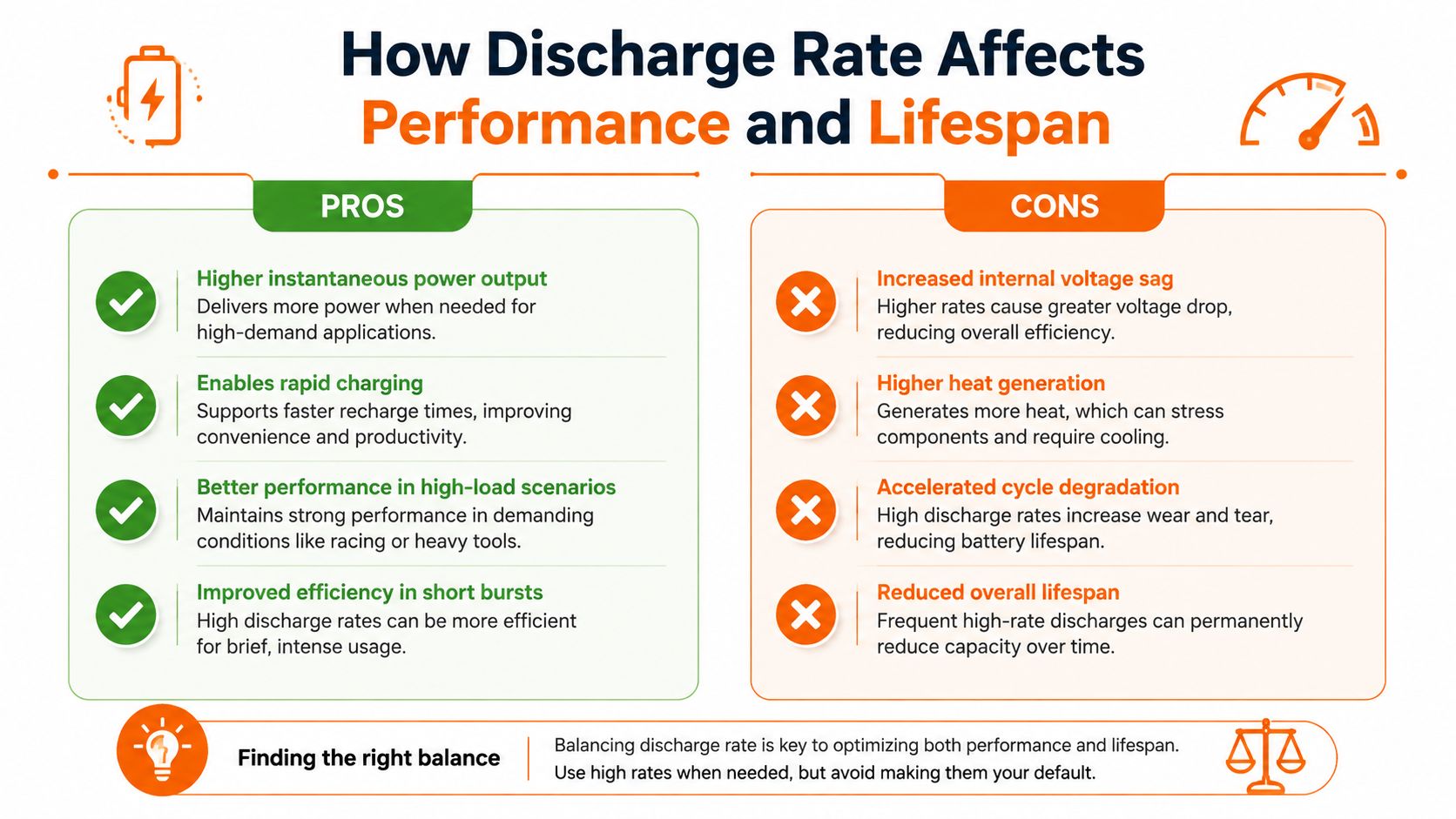
A high discharge rate gives a battery more immediate power, but it also places greater electrical and thermal demand on the cells. As current rises, internal voltage sag becomes more pronounced. The battery's terminal voltage can fall under load, and the system may reduce output or reach its cut-off threshold earlier than expected.
That means a battery can appear to have energy available while delivering less effective capacity at a heavy load. The faster the discharge, the less closely real-world output may match the headline capacity, particularly when temperature, state of charge and battery age are also working against performance.
Why test conditions matter
Australian battery testing guidance treats discharge rate and temperature as important measurement conditions. Century Yuasa DIN cell data shows the same battery can have different current delivery ratings at 1-hour, 2-hour, 5-hour, 6-hour and 10-hour discharge periods. The Australian battery standard preview also describes discharge rate as current normalised to rated capacity, commonly expressed as Cx.
This prevents a manufacturer or consumer from treating one capacity figure as universal. A battery measured under a slower, standardised test may not provide the same effective energy under a fast household load. Temperature controls matter for the same reason. Testing at standardised conditions makes comparisons more meaningful.
The trade-off for VPP and backup systems
A VPP or backup system needs two sizing decisions:
- Energy sizing: enough usable kWh for the intended period.
- Power sizing: enough kW to handle household demand and approved dispatch events.
Aggressive discharge can increase available grid support and may help a retailer respond to a valuable demand event. It can also increase cycling intensity, voltage stress and heat. Conservative settings may protect the battery and preserve reserve energy, but they can leave potential market or bill value unused.
Manufacturers define operating limits and warranty conditions differently. Review the approved depth of discharge, cycle provisions, temperature requirements and VPP eligibility before changing settings. For broader context on battery ageing, this guide to how long solar batteries last is a useful companion resource.
Discharge Rate in the Context of Australia's Energy Market
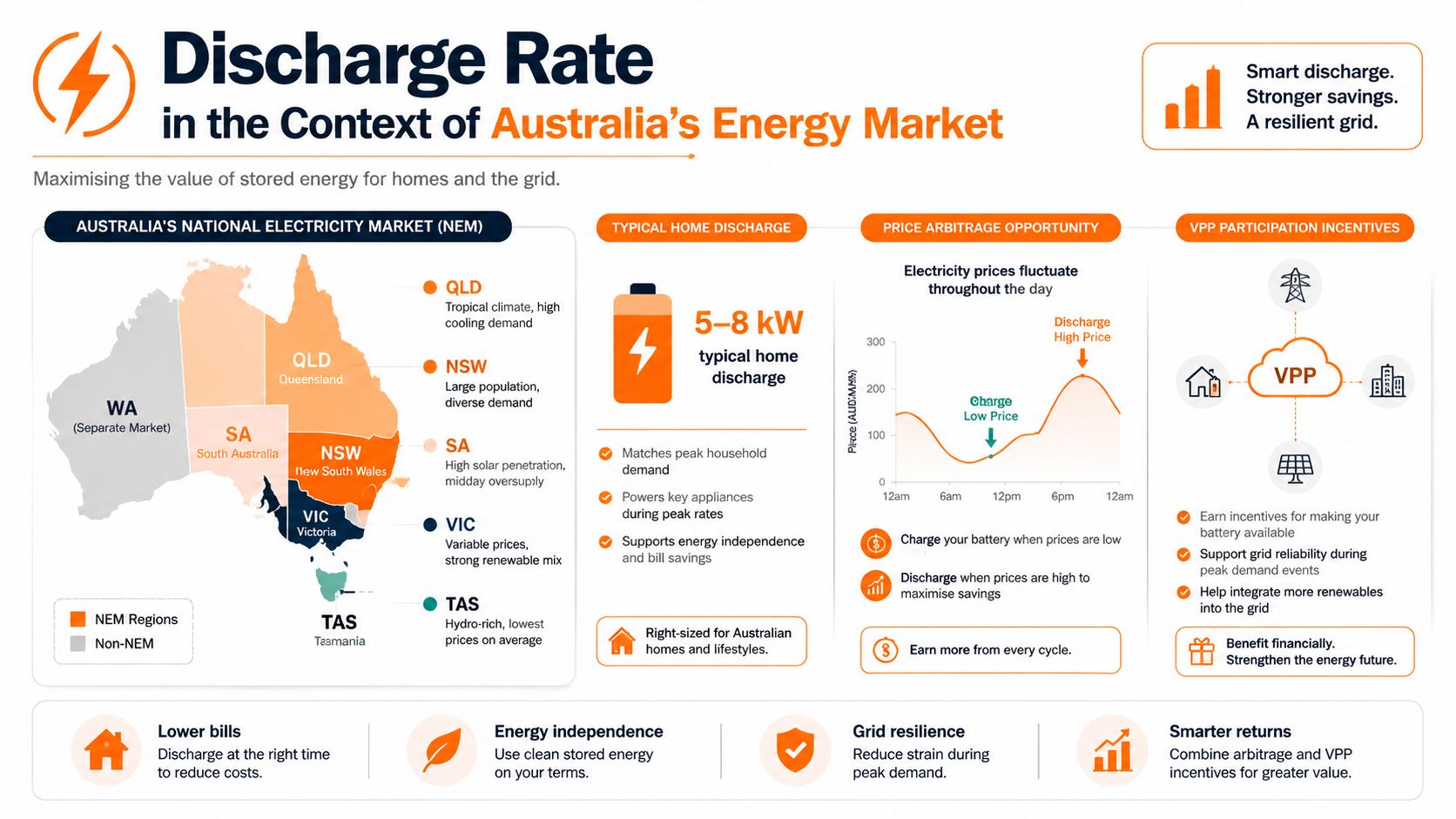
Battery discharge is now a measurable grid resource in Australia's NEM, not just a household backup function. Average quarterly battery discharge increased from 74 MW in Q2 2024 to 162 MW in Q2 2025, an increase of about 119%, while average discharge availability rose from 985 MW to 1,786 MW, up 81%, according to AEMO-linked reporting on NEM battery discharge.
The same reporting records a peak discharge of 1,756 MW in a single half-hour on 12 June 2025, 60% above the previous record of 1,099 MW set in Q1 2025. By Q4 2025, average battery discharge reached 268 MW, a 198% year-on-year rise, with a new peak of 2,885 MW on 29 December 2025.
Timing matters at household scale
Daily dispatch records show how quickly this resource is expanding. Open Electricity Dispatch recorded the NEM's highest battery discharge in a single day, 16,020 MWh on 13 April 2026, exceeding the previous daily record of 12,980 MWh on 10 February by 23%. Renew Economy's coverage of big battery activity also records NSW batteries discharging 2,904 MWh on 25 August 2025, more than 28% above the prior NSW record of 2,252 MWh.
For a household, the principle is straightforward. Solar energy often has greatest availability during the day, while household demand can rise after sunset. A battery with sufficient discharge power can move energy into that evening period. A VPP coordinates many systems, subject to household priorities, network conditions and operating rules.
Value isn't guaranteed by faster dispatch
Wholesale volatility creates opportunities, but battery owners should assess the value of each dispatch strategy. Volume-weighted average battery discharge prices fell from AU$427/MWh in Q2 2025 to AU$101/MWh in Q2 2026, an 85% decline, even as grid-scale deployment expanded, according to reported NEM battery price trends.
That result makes optimisation more important than maximising activity. A retailer-based BYOB VPP can coordinate discharge around prices, demand events and household needs, but the commercial outcome depends on the allowance structure, dispatch rules, network conditions and applicable retail terms.
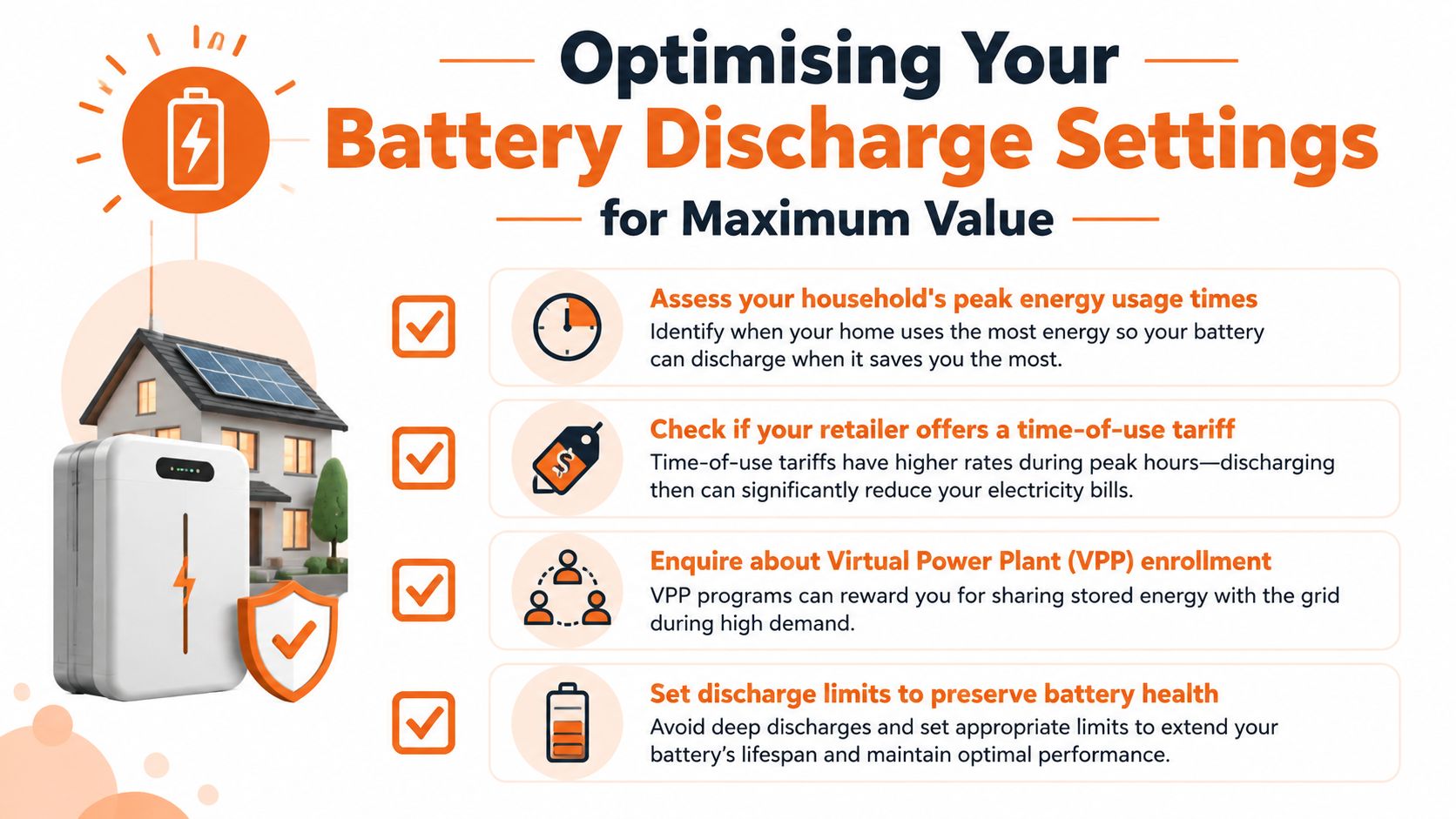
Optimising Your Battery Discharge Settings for Maximum Value
Start with your system's actual limits, not the battery's marketing capacity. Find the maximum continuous discharge rate for the battery, then compare it with the loads that commonly operate together during the evening. If cooking and cooling regularly coincide, a low output limit may explain why the home imports electricity despite having stored energy.
A practical settings check
-
Record the evening pattern. Note when demand rises and which appliances create the largest loads. Refrigeration and medical equipment may deserve priority over flexible loads such as pool pumping.
-
Check the battery and inverter separately. The inverter may have a higher published output than the battery can continuously provide. The lower approved limit controls the usable system output.
-
Set a sensible reserve. A backup reserve protects selected loads during an outage, but it also reduces the energy available for normal bill management or VPP dispatch. The right setting depends on household risk tolerance and system design.
-
Review the tariff. A time-of-use tariff changes the value of charging and discharging at different times. Compare the tariff's peak periods with your household demand and any VPP allowance or dispatch arrangement.
-
Monitor results. Use the companion app, inverter data and electricity bills to check whether discharge occurs when expected. Look for repeated grid imports during high-demand periods, unexplained curtailment or reserve settings that rarely change.
For households reviewing air conditioning demand, an energy saving HVAC guide for Chandler can help identify ways to reduce the load that the battery must cover. Lowering demand can be as useful as increasing discharge capability.
HighFlow Energy operates a retailer-based BYOB VPP for eligible battery owners in Queensland and New South Wales. Its service can coordinate charging and discharging using market information, forecasts and household patterns, while giving the customer priority use and the ability to override automated plans. Read more about the battery energy management system before assessing whether automated dispatch suits your system.
Common Misconceptions About Battery Capacity and Discharge
A bigger battery doesn't automatically deliver more useful power. A 15 kWh battery rated at 0.3C would provide about 4.5 kW, while a 10 kWh battery rated at 1C could provide about 10 kW under the simplified C-rate calculation. During a period when several appliances operate together, the smaller battery may supply more instantaneous power.
That comparison doesn't make the smaller battery universally better. The larger system may store more energy and sustain moderate loads for longer. The correct choice depends on both the household's energy profile and its peak demand.
Faster cycling needs commercial scrutiny
VPP participation isn't automatically profitable because the battery discharges more often. Price spreads can narrow as more storage enters the market. Reported volume-weighted average battery discharge prices fell 85% between Q2 2025 and Q2 2026, from AU$427/MWh to AU$101/MWh. The market coverage supports a careful question: does extra cycling create enough allowance or market value to justify the additional wear?
A sound VPP should explain how dispatch is limited, how household reserve is protected and how warranty requirements are handled. Intelligent control can avoid unnecessary cycling, but it can't remove the physical relationship between current, heat, voltage sag and battery ageing.
Read the complete specification
Check:
- Usable kWh, not only nominal capacity.
- Continuous kW, not only short-term peak output.
- Depth-of-discharge limits and reserve settings.
- Inverter constraints and backup circuit design.
- Warranty rules covering cycling and VPP operation.
- Retail terms, including allowances, export treatment and charges outside the allowance.
The most useful battery comparison is therefore a performance comparison. Ask what the system can deliver during your household's actual peak, how often it can do so, and whether the financial arrangement recognises both energy and power.
Frequently Asked Questions About Battery Discharge Rate
What happens if I exceed the maximum discharge rate?
The battery management system or inverter may limit output, disconnect the battery or draw the shortfall from the grid. Repeated operation outside approved limits can increase heat and stress, so don't override manufacturer controls.
Can I upgrade the inverter to increase discharge capacity?
Not necessarily. The inverter may be capable of more output than the battery cells, battery management system, cabling or installation can safely support. A qualified installer must assess the complete system and applicable Australian requirements.
How does discharge rate affect blackout duration?
A higher rate can run larger loads, but it also uses stored energy faster. Backup duration depends on usable kWh, household demand, reserve settings and the circuits included in the backup system.
Will VPP participation void my battery warranty?
Participation shouldn't be assumed to void a warranty, but eligibility and operating conditions matter. Check the battery manufacturer's warranty, approved operating range and the VPP provider's terms before enrolling.
How do I know if my battery is underperforming?
Compare measured discharge power with the battery and inverter specifications under similar state-of-charge and temperature conditions. Repeated grid imports during expected discharge, early cut-offs or unexplained output limits justify a professional battery health check.
Is C-rate the same as kW?
No. C-rate is relative to capacity, while kW is the actual power output. A given C-rate produces different kW values on batteries with different capacities, and operating conditions can reduce the practical result.
Does discharge rate affect bill savings more than capacity?
It can, particularly when your evening demand is high. Capacity determines how long stored energy lasts, while discharge rate determines whether the battery can cover simultaneous loads at the time electricity use is most valuable.
Key takeaway: A battery's financial performance depends on when it discharges, how much power it can provide, how often it cycles and what your retail arrangement pays or credits for that service.
HighFlow Energy helps eligible solar and battery owners in Queensland and New South Wales assess whether their existing system is being underutilised and connect it to a retailer-based BYOB VPP. Visit HighFlow Energy to review eligibility, understand the applicable allowance structure and assess your battery's discharge performance.