

Battery Optimisation Good or Bad: Benefits and Trade-offs
Battery optimisation is beneficial when it shifts stored energy into the evening peak, protects a household backup reserve and earns more than extra cycling costs, but harmful when it cycles for small gains or discharges at low-value times. Additional optimisation can push cycling to nearly twice that of a conventional time-of-use customer, so more activity isn't automatically better performance.
The popular advice to let smart software maximise battery use misses the commercial question: does each additional discharge improve the battery's lifetime value? For homeowners in Queensland and New South Wales, that requires examining electricity tariffs, battery wear, export permissions and the energy needed at home, not just the controller's features.
What Battery Optimisation Means for Your Home
A battery-monitoring app is like a thermometer: it displays what's happening. A battery optimiser is like a thermostat: it changes what happens to achieve a chosen outcome.
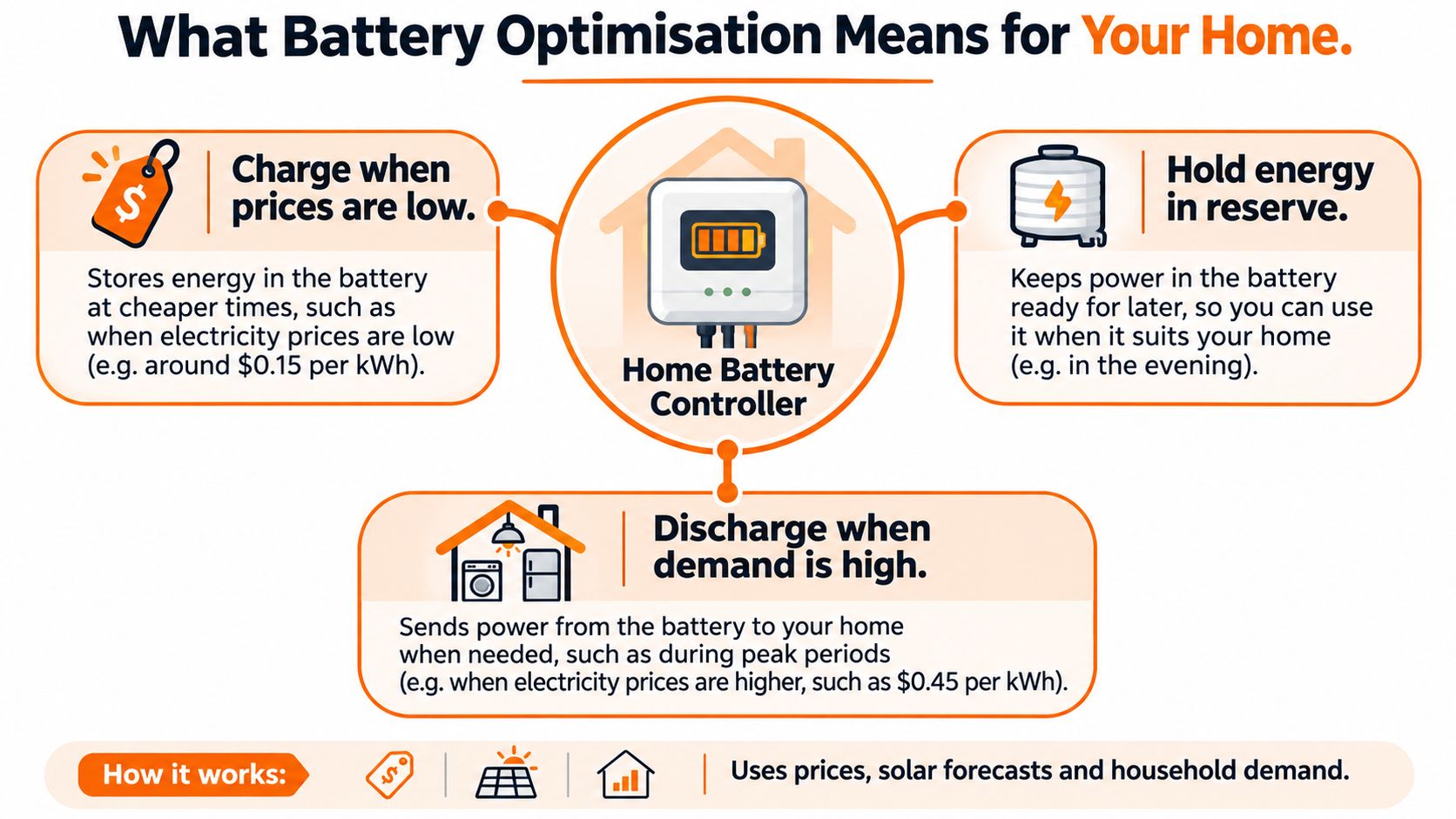
Say your rooftop solar is producing surplus electricity while you're out. A controller decides whether to charge the battery, retain existing stored energy or export electricity. It then revises that plan when solar forecasts, electricity prices or household demand change.
ARENA's smarter homes report distinguishes monitoring from active control, an important difference when assessing software claims. Seeing state of charge doesn't mean the software can coordinate charging and discharging.
The different jobs a controller can perform
- Solar self-consumption: Store your solar electricity for household use instead of exporting it immediately.
- Tariff optimisation: Shift charging and consumption between cheaper and more expensive retail tariff periods.
- Grid services: Respond to wholesale prices, electricity frequency or network requests when spare capacity is available.
A Virtual Power Plant, or VPP, coordinates batteries across multiple properties. ARENA's residential solar-and-battery project describes centrally monitored and controlled systems capable of responding to network requests and receiving payments for services.
The controller's basic decisions are illustrated below.
Why timing matters in Australian homes
Australia had about 33,000 household batteries and more than 300 MWh of residential storage in 2018, while later AEMO reporting found an average evening grid-draw reduction of nearly 1 kW across approximately 600,000 battery-equipped homes, according to RenewEconomy's account of Australian battery development.
For Queensland and NSW households, the practical opportunity is the gap between sunny daytime generation and evening electricity use. An effective controller preserves energy for that gap rather than treating a full battery as an instruction to discharge.
The first test: Is the battery making coordinated decisions, or is the app only reporting what it does?
When Battery Optimisation Pays and When It Costs You
Battery optimisation pays when the value of correctly timed energy exceeds losses, wear and displaced household use. It costs you when software pursues gross revenue without accounting for those deductions.
Likely results by operating setting
| Operating setting | Likely result | Main risk |
|---|---|---|
| Solar self-consumption with evening discharge | Reduces grid imports during the evening peak | Low risk when a reserve is protected |
| Time-of-use arbitrage on a cost-reflective tariff | Adds value where peak and off-peak prices differ | Additional cycling can consume warranty throughput |
| Wholesale market dispatch | Adds market revenue during volatile NEM spot-price periods | Price exposure and higher cycling |
| FCAS participation | Payment for fast grid response | Battery-use costs and service-specific throughput |
| Network peak support | Can earn payment for responding to a network request; household import replacement provides separate bill savings | Export limits, high voltage and communication faults |
| Uncoordinated discharge whenever full | Can create avoidable losses | Energy sold cheaply and bought back at peak prices |
Self-consumption is the simplest starting point, because its value comes from avoiding a household electricity purchase. Time-of-use arbitrage adds another opportunity, but only when the price difference covers charging costs, energy losses and wear.
The Australian Energy Market Commission's residential battery analysis found that additional optimisation could drive cycling to nearly twice that of a conventional time-of-use customer; its NSW modelling produced an average payback of about four years and more than doubled net present value over ten years.
Those are modelled results, not a household savings promise. An existing battery owner should compare incremental optimisation benefits against continuing with the current operating strategy, rather than assuming installation payback equals VPP profitability.
Separate household savings from service revenue
Frequency Control Ancillary Services, or FCAS, help maintain electricity frequency. Network peak support instead addresses demand at particular places and times. Neither should be confused with ordinary savings from using battery energy at home.
ARENA's AEMO VPP demonstrations report discusses an independent Australian VPP analysis that found approximately A$668 per customer annually from battery energy replacing grid imports, an estimated A$25.31 annual battery-use cost for FCAS participation, and 61% dispatch effectiveness.
The import-replacement saving wasn't a network-service payment. Nor should the FCAS battery-use estimate be subtracted from that saving and presented as a universal VPP return.
Export restrictions, excessive voltage and communication problems prevented some requested dispatches. This makes deliverable capacity, rather than installed capacity, the relevant quantity when assessing grid-service income.
Grid benefits don't automatically become customer benefits
AEMO's 2024 Integrated System Plan estimated that effective consumer-battery coordination could avoid approximately A$4.1 billion in additional grid-scale investment, according to RenewEconomy's coverage of AEMO's planning.
That system benefit explains why coordination matters. Your contract determines how much value reaches your bill.
A traditional feed-in tariff pays for exported electricity under the retail tariff. A VPP may create additional service value, but a retailer's involvement alone doesn't establish that your battery is being optimised. In an energy retailer comparison, examine import rates, export credits, allowance conditions and dispatch rights together.
Our guide to solar battery payback provides context for separating system economics from ongoing operating returns.
A profitable grid event can still be a poor household decision if it leaves you buying more expensive electricity later.
How Cycling Shortens Battery Life and Warranty Cover
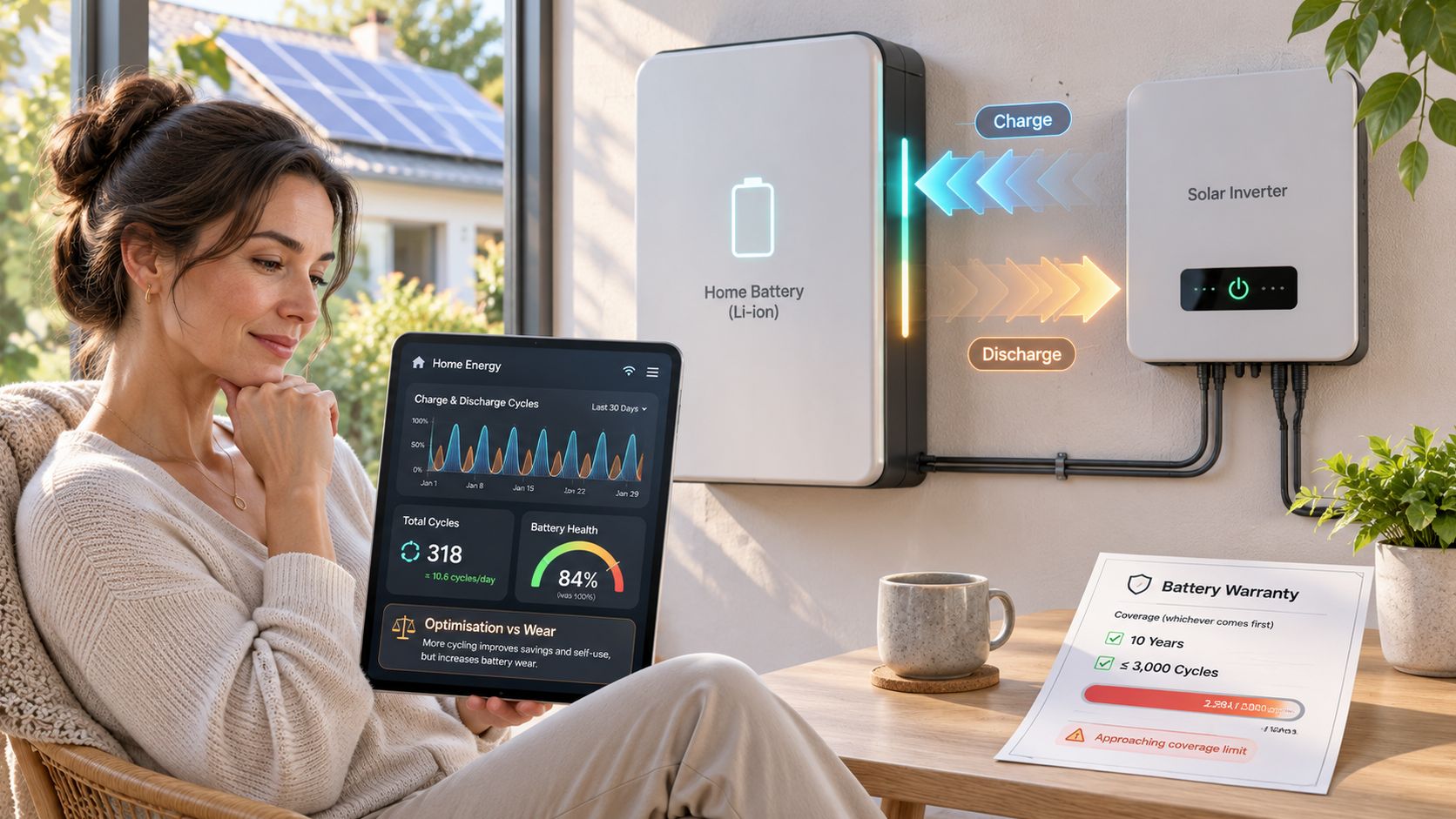
One LG Chem RESU unit reached about 78% of rated capacity after cycling equivalent to roughly 3.2 years of daily use in accelerated Canberra Battery Test Centre testing, as described by Energy Matters' battery degradation review.
That result isn't a prediction for every LG battery or every household. It demonstrates why a generic assumption about battery life isn't sufficient for a model-specific financial assessment.
Battery monitoring should help you assess both energy movement and the remaining useful capacity.
Measure throughput, not just dispatch events
A discharge notification doesn't tell you how much battery life an operating strategy uses. The relevant variables include:
- Depth of discharge: How much stored energy is withdrawn before recharging.
- Reserve state of charge: The energy withheld from discretionary dispatch.
- Temperature: Whether operation remains within manufacturer conditions.
- Equivalent full cycles: Partial discharges combined into full-capacity equivalents.
- Cumulative throughput: Total energy processed against any warranty allowance.
The ARENA battery-storage knowledge-sharing report states that regulation FCAS requires substantially greater throughput than contingency FCAS, and notes a nominal ten-year battery life compared with 20–25-year assessment periods commonly used for solar and wind projects.
These are project-assessment assumptions, not household warranty promises. Their relevance is that degradation belongs in the main financial calculation, not in a footnote.
For background on care and operating conditions, the lithium battery tips from Flex Electric complement, rather than replace, your manufacturer's documentation. Our explanation of battery depth of discharge helps interpret the operating limits.
The accompanying video provides another format for considering battery operation.
Apply a lifetime-value test
Joining HighFlow Energy's Bring Your Own Battery VPP doesn't affect your battery warranty. Owners should still check manufacturer cycling, throughput and operating limits, because permitted participation and compliant operation are separate questions.
Compare additional bill savings and payments with additional charging costs, efficiency losses and earlier capacity loss over the warranty period. Use local tariffs, export prices and a realistic replacement-cost assumption, and avoid counting charging losses twice.
If an optimiser can't earn enough to cover those costs, leaving capacity unused can be the better financial decision.
Who Controls Your Battery During Outages and Grid Events
A 2026 survey of 407 Australian battery owners found only three in ten had joined a VPP, with trust and control identified as concerns, according to Rewiring Australia's home battery flexibility report. Among participants, 60% had joined wholesale VPPs, while the same report presents AEMO's projection that NEM consumer-battery VPP participation will rise from 15% in 2026 to 24% by 2035.
The commercial issue is permission: which decisions can the operator make, and which remain yours?
Household priority under different conditions
The following are assessment scenarios, not promises of a particular reserve level or app feature:
- Normal day: Household demand takes priority. The plan should identify the agreed reserve and make scheduled charging and discharge understandable.
- Heatwave: Higher expected cooling demand should reduce capacity available for discretionary export. Check whether the forecast leaves enough energy for your household's expected use.
- Price spike: A valuable wholesale opportunity shouldn't replace your preferred household allocation without notice. Review the planned discharge and whether you can pause it before execution.
- Power outage: Grid export stops when the site disconnects from the grid. Backup depends on compatible equipment, the circuits it supplies and energy remaining, not merely the reserve entered in a plan.
Our household energy priority doesn't constitute a backup guarantee. Participation doesn't guarantee that a battery will retain a minimum charge or provide backup power during an interruption; remote operation can affect stored energy at any given time.
Control must include the home's other loads
An uncontrolled battery can discharge during an off-peak period while a water heater or electric-vehicle charger consumes cheap electricity, a coordination failure described in ARENA's Rheem Smart Network material.
That's why appliance schedules and battery schedules should be assessed together. Our solar battery Virtual Power Plant guide explains the participation model.
We keep ownership and control with the customer, including manual override. Before authorising dispatch, establish the minimum-charge settings, blackout limitations, notification arrangements, override timing and visibility of completed dispatches.
A written reserve documents an operating intention. It doesn't create energy that isn't available when an outage begins.
How to Check Whether Optimisation Suits Your Home
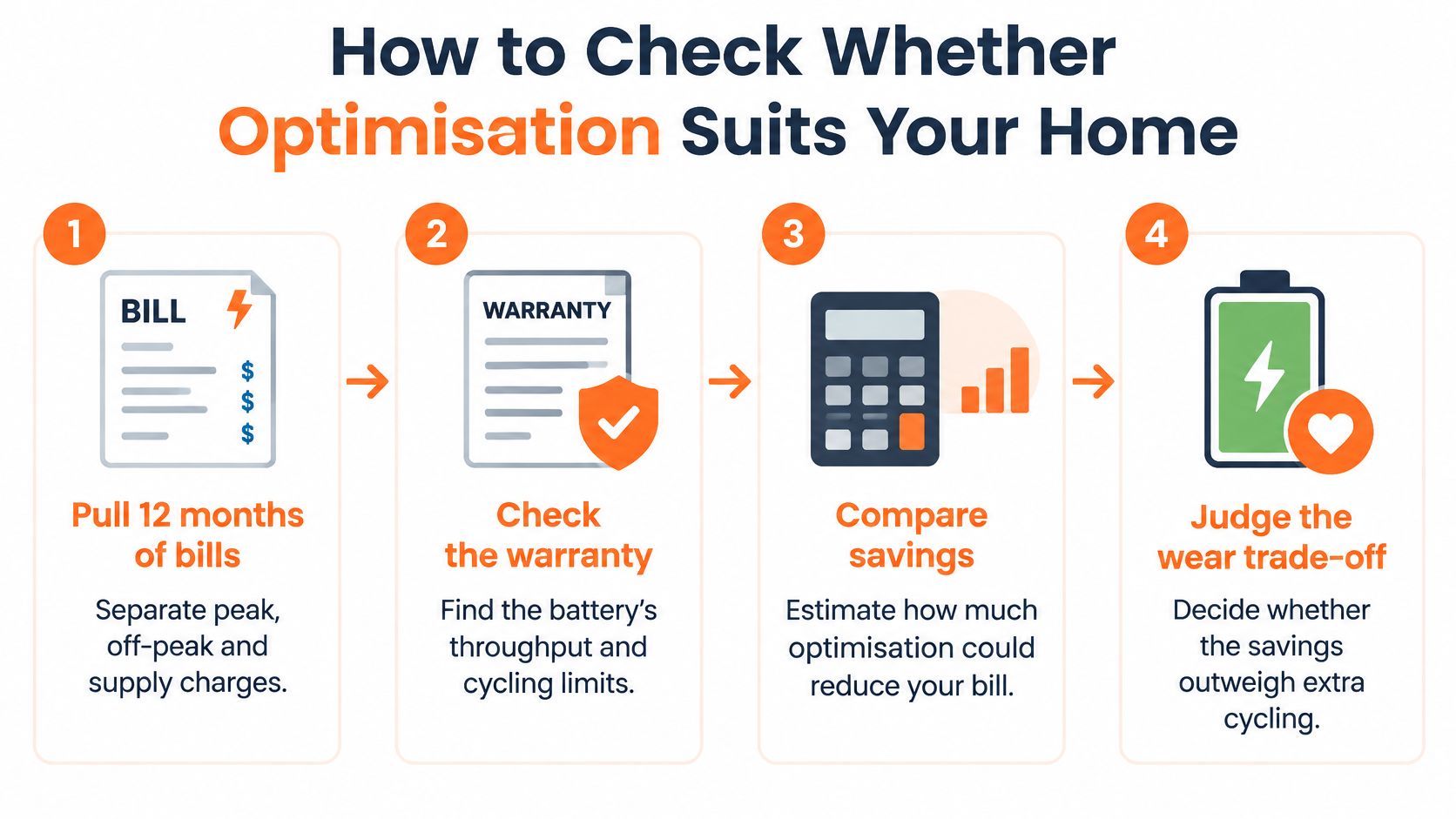
Use an evening to assemble the documents and establish a baseline. Treat the following review periods as a practical assessment routine, not a prediction of savings.
Build the household comparison
- Pull twelve months of electricity bills. Separate peak, off-peak, export and supply charges so you can see which costs battery control can change.
- Find the manufacturer warranty. Record cycling limits, throughput limits, operating conditions and exclusions rather than relying on the headline warranty term.
- Verify the site export limit. Use connection documentation and inverter settings, with installer confirmation where necessary; panel capacity doesn't establish export permission.
- Estimate evening demand and your preferred outage reserve. Use interval consumption records and identify essential circuits, rather than assuming every appliance needs backup.
- Model incremental lifetime value. Compare the proposed strategy with your existing operation, including replacement-cost assumptions and declining usable capacity.
- Check control terms and review after ninety days. We allow manual override at any time; compare bill outcomes and available operating records with the proposed case.
The checklist below summarises the preparation.
Healthy setup and warning signs
| Setting | Healthy setup | Warning sign |
|---|---|---|
| Backup reserve | Minimum state of charge fixed in writing, with limitations disclosed | Reserve set by market dispatch alone |
| Export limit | Verified for the site | Assumed from panel size |
| Cycling | Within applicable warranty daily-cycle and throughput limits | Cycling beyond manufacturer limits |
| Override | Customer can pause dispatch at any time | No clear override terms |
| Dispatch reporting | Dispatch logs visible in the app | No visibility of dispatch success |
Don't confuse a proposed reserve with an unconditional minimum-charge guarantee. Likewise, distinguish app visibility of home energy from a complete record of requested and delivered grid services.
A warning sign doesn't automatically rule out optimisation. Several unresolved warnings are a reason to discount the forecast and seek clarification, not evidence of a particular failure probability.
The decisive comparison is against your existing setup. A proposal can create grid revenue yet leave you worse off if increased import charges, lost export credits or accelerated wear exceed the customer benefit.
Key Takeaways on Battery Optimisation Value
- Operating-profile test: Judge charge and discharge timing, household allocation and costs rather than the software label.
- Evening-value test: Preserve energy when its household value exceeds the available export or service payment.
- Lifetime-value test: Include efficiency losses, incremental wear and warranty throughput when calculating the benefit of additional dispatch.
- Backup test: Separate household-priority policies from any specific promise about charge availability during an interruption.
- Deliverability test: Verify export permissions, communications and successful dispatch before relying on projected service value.
- Contract test: Compare the complete retail arrangement, not a feed-in tariff or VPP payment in isolation.
A concise decision summary
Battery optimisation is beneficial when coordinated charging and discharge improve lifetime household value without compromising agreed operating limits. The main trade-off is between additional electricity value and the costs of energy losses, battery wear and reduced stored-energy availability. Compare the proposed strategy with your current operation using actual tariffs, manufacturer limits and site export permissions. If the additional benefit doesn't exceed those costs under realistic assumptions, more automation isn't financially justified.
Battery Optimisation Questions Owners Ask
Is battery optimisation good or bad?
It's good when correctly timed discharge creates more value than the associated costs. It's bad when low-value cycling or premature discharge forces avoidable electricity purchases.
How much can it save?
There isn't a reliable universal saving for an individual home. Separate savings from replacing imports, payments for grid services and any additional retail charges, then compare the whole result with your current bill.
Does optimisation wear the battery out?
Additional throughput contributes to wear, but the effect depends on the battery model and operating conditions. Evaluate the proposed cycle profile against manufacturer limits rather than treating every VPP event as equally demanding.
Will I lose backup during an outage?
Backup availability depends on your equipment configuration and the energy remaining when the interruption occurs. VPP membership alone doesn't guarantee either, and a reserve setting shouldn't be mistaken for an unconditional backup commitment.
What if my street has export limits?
A battery can be charged and technically available yet unable to deliver the planned export. The financial assessment should use your approved site limits and recognise voltage-related restrictions, rather than assuming the inverter can always export at its rated power.
Do I have to buy a new battery?
A Bring Your Own Battery, or BYOB VPP, uses an existing compatible system. We help check compatibility, and you retain ownership of your battery and priority household use.
Confirm Whether Your Battery Is Worth Optimising
The assessment suits homeowners in Queensland or New South Wales with rooftop solar, a compatible home battery, ongoing electricity bills and a goal of better value from the system they own.
HighFlow Energy will help check whether your system qualifies against minimum usable capacity, inverter requirements and VPP compatibility standards. Ownership alone is not enough.
What the assessment should establish
- Compatibility: Whether your existing solar, battery and inverter meet participation requirements.
- Current performance: How consumption, solar generation and battery operation drive your electricity purchases.
- Potential allowance: The bill-free tier your system supports, currently ranging from 300 kWh up to 1,000 kWh per billing month depending on solar and battery system size, and how usage beyond it is charged.
- Operating profile: The cycling the plan implies, the wear it adds and the reserve it leaves, since value follows the operating profile rather than the software label.
- Continuing eligibility: If the battery fails or is removed and eligibility requirements are no longer met, the allowance stops and standard retail pricing applies unless you leave.
The deciding test is lifetime value: whether the allowance and reduced purchases outweigh the added cycling and any reduction in stored energy.
Why HighFlow Energy
HighFlow Energy is an Australian energy service for homeowners with rooftop solar and a compatible home battery. It connects that battery to a Virtual Power Plant that uses only spare capacity, runs automatically in the background and puts household use first. No new hardware is required, and you keep full ownership and control.
The service exists because many households invested in solar and batteries expecting much lower bills that never fully arrived. You stay connected to the grid and do not need to monitor anything or change day-to-day behaviour. Outcomes depend on your system, its availability and the offer terms, so an assessment does not guarantee bill elimination.
HighFlow Energy offers a Bring Your Own Battery VPP that coordinates spare capacity to support the grid and fund a monthly electricity allowance. To find out whether your battery is underperforming financially, visit HighFlow Energy and request an eligibility assessment today.