

Battery Depth of Discharge Guide for Aussie Homes
Does your battery's advertised depth of discharge tell you how much energy your home can use, or only how far the cells may be discharged under specified conditions? For Australian homeowners, that distinction matters. Backup reserves, inverter settings, warranty cycling limits and VPP dispatch can all reduce the energy available for everyday optimisation, even when the specification sheet displays a high DoD figure.
Battery depth of discharge is therefore more than a technical percentage. It affects usable storage, battery wear, backup security and the financial value of an existing solar and battery system. The right question isn't whether a battery has a high DoD. It's whether the operating settings match your household's priorities, warranty conditions and electricity strategy.
What Battery Depth of Discharge Means
How much energy can your battery deliver before its controls stop discharge? That answer depends on more than the DoD percentage shown in an app or product specification.
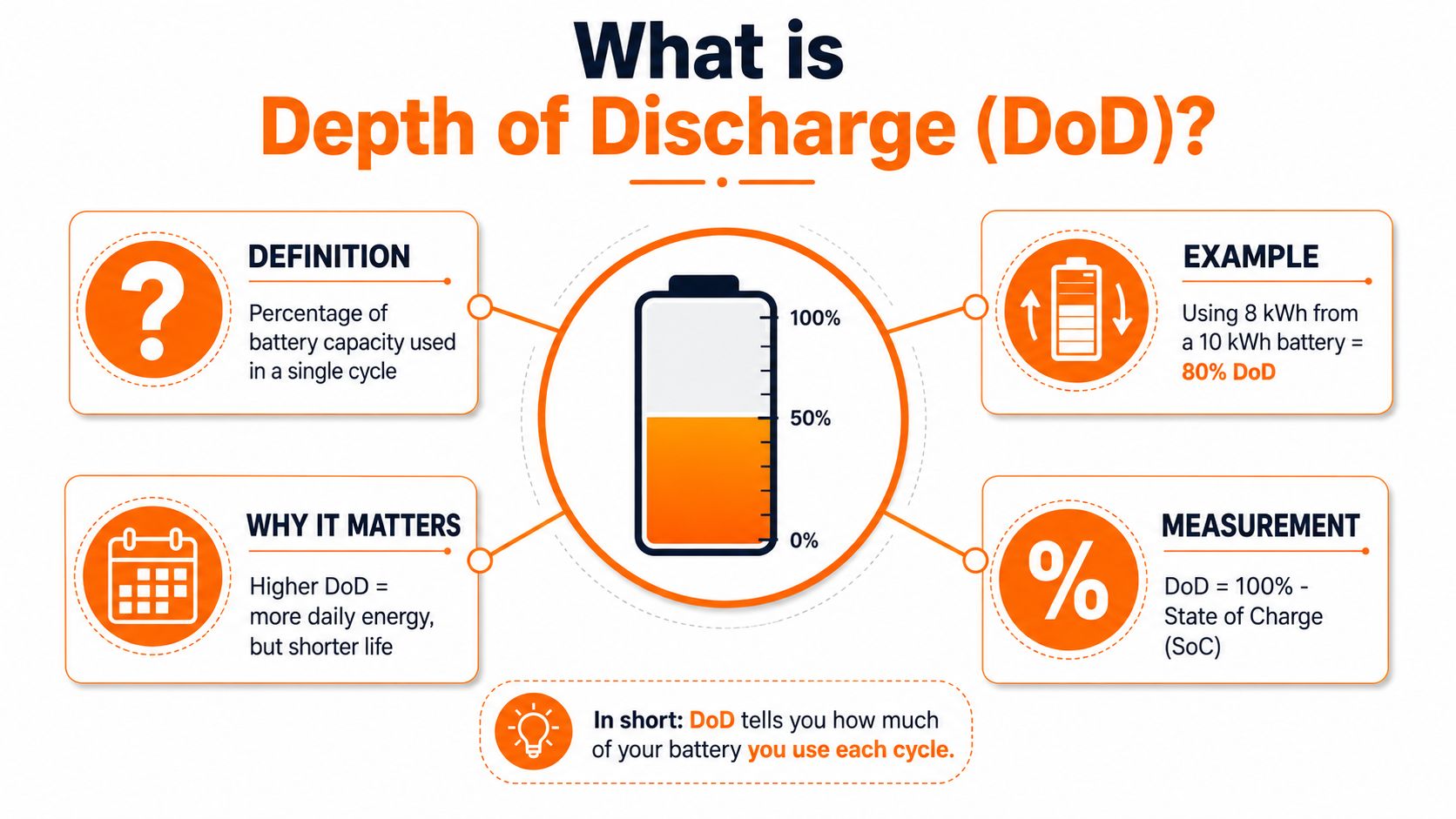
Depth of discharge, or DoD, is the share of a battery's total capacity used before recharging. State of charge, or SoC, describes the energy remaining. They are opposite descriptions of the same storage state. Higher DoD means more stored energy has been delivered, while higher SoC means more energy remains available for later use. For a fuller explanation of battery state of charge, compare the two measures together rather than reading either one in isolation.
The Clean Energy Council's consumer battery storage guide gives a straightforward example. A 10 kWh battery at 80% DoD provides 8 kWh of usable energy. The remaining portion may be protected by the battery management system, held back for operational reasons or unavailable because the chemistry should not be discharged further.
Nominal capacity versus usable capacity
Nominal capacity is the battery's stated size. Usable capacity is the energy accessible within its permitted DoD range. That second figure is more useful for household planning because it answers a practical question: how much energy can you draw before the battery stops discharging?
Lithium-ion systems in Australia typically have a DoD of 80% and above, according to the Clean Energy Council guide. Operating rules still vary. Battery chemistry, manufacturer controls, inverter settings and warranty conditions can all restrict the energy available in daily use.
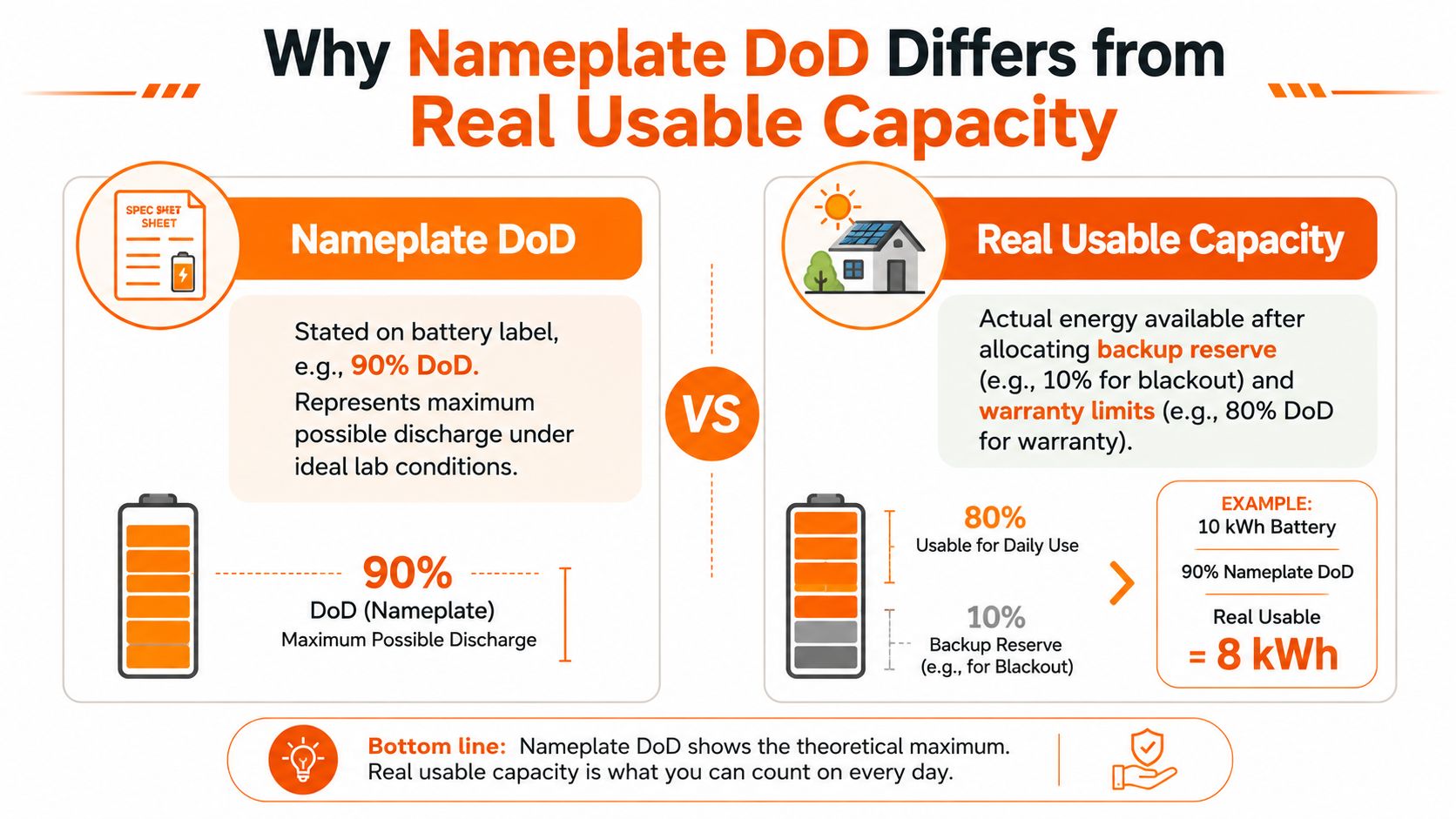
The published DoD can also overstate what your household receives. A backup reserve may keep part of the battery unavailable during normal operation. Warranty terms may limit how or frequently the system should cycle, while a virtual power plant can dispatch energy according to its program rather than your preferred household schedule.
A larger nameplate battery can therefore provide less practical storage than a smaller system with a higher permitted DoD and fewer operating restrictions.
Practical rule: Compare usable kWh with the reserve settings, warranty cycling conditions and VPP controls that determine how much energy you can access.
How to Calculate Usable Energy from Your Battery
The calculation is simple:
Usable energy = nominal capacity × maximum DoD
Write the DoD as a decimal rather than a whole percentage. For example, 95% becomes 0.95. Then multiply the battery's nameplate capacity by that figure.
A battery with a nominal capacity of 10.1 kWh and a maximum DoD of 95% provides approximately 9.6 kWh of usable energy, based on the calculation described by VoltX Energy's explanation of DoD and usable capacity.
Worked examples
- Start with the nameplate capacity. Find the nominal capacity in the product documentation or monitoring app.
- Confirm the permitted DoD. Use the manufacturer's technical specification and warranty, not a generic chemistry assumption.
- Convert the percentage. For example, 80% becomes 0.80.
- Multiply the two values. The result is the theoretical usable energy before any additional reserve settings.
The table below applies that formula to illustrative combinations of capacities and DoD levels. The 10 kWh at 80% example is the Clean Energy Council example. The 10.1 kWh at 95% example reflects the Australian-facing calculation described above.
| Nominal Capacity (kWh) | DoD (%) | Usable Energy (kWh) |
|---|---|---|
| 10 | 80 | 8 |
| 10.1 | 95 | 9.6 approximately |
| 10 | 50 | 5 |
| 10 | 90 | 9 |
The final two rows show the mechanics of the formula, not a recommendation for a particular battery chemistry. A lower DoD can be appropriate where the manufacturer sets a conservative cycling envelope or where the homeowner values longer service life over maximum daily discharge.
A kWh measures energy, not power. That distinction matters when assessing whether a battery can cover evening demand, overnight consumption or a short outage. This plain-language guide to kWh can help separate storage volume from the rate at which appliances draw electricity.
The Cycle Life Trade-Off at Different Discharge Depths
A battery cycle isn't necessarily one uninterrupted journey from full charge to empty. Partial discharges can accumulate into an equivalent full cycle. For example, repeated smaller withdrawals eventually represent the same total energy movement as a deeper discharge, although the battery's exact cycle accounting depends on the manufacturer and battery management system.
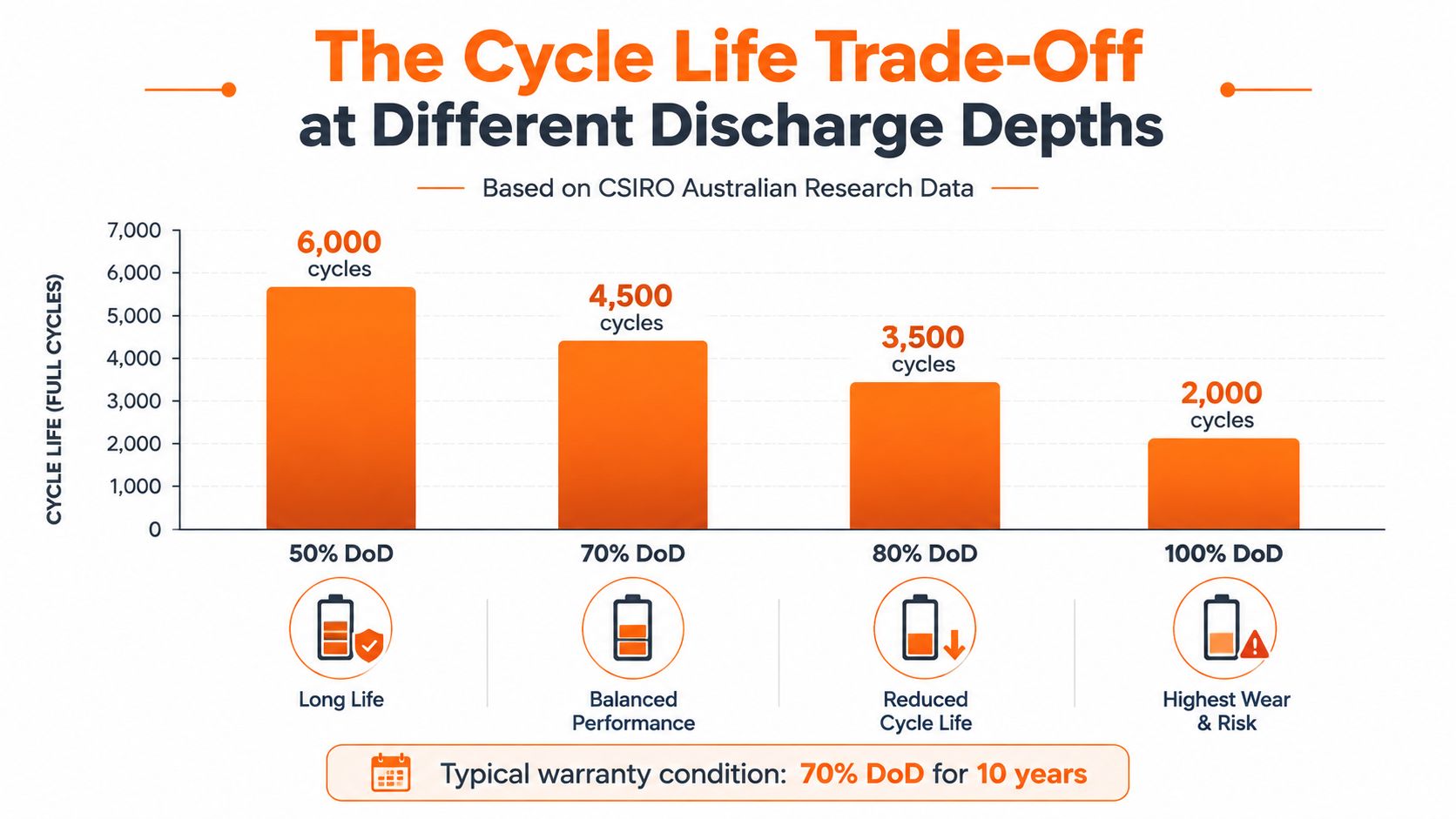
CSIRO's Australian home-battery guide demonstrates why DoD is also a lifetime management setting. Its figures show that a battery may reach approximately 180 full cycles at 100% DoD, 300 cycles at 80% DoD, 680 cycles at 70% DoD and 1,300 cycles at 50% DoD, before falling to 80% of its initial discharge capacity. These figures appear in CSIRO's Batteries for Homes guide.
Reading the trade-off correctly
The CSIRO figures don't mean every battery will achieve those exact results. They show the direction of the relationship. A fully discharged-and-recharged battery generally yields fewer cycles than a battery operated at a shallower DoD.
| Operating depth | Approximate cycles to 80% initial discharge capacity |
|---|---|
| 100% DoD | 180 |
| 80% DoD | 300 |
| 70% DoD | 680 |
| 50% DoD | 1,300 |
The difference between 50% and 100% DoD is roughly sevenfold in CSIRO's figures, with approximately 1,300 cycles compared with approximately 180 cycles. That makes deeper discharge a commercial decision, not just a convenience setting. More energy per cycle can support greater self-consumption or stronger participation in demand events, but the additional energy may come with faster capacity loss.
A VPP operator also has to consider dispatch frequency, household load, solar production and the battery's warranty. A system that cycles aggressively every day may create more short-term energy movement while consuming more of its long-term cycling allowance. Conversely, a battery that rarely discharges may preserve capacity but leave potential value unused.
The installation must also meet Australian safety requirements. CSIRO notes that home battery installation should comply with standards such as AS 5139. Technical performance and electrical compliance belong in the same decision, especially when a system will participate in coordinated grid services.
Why Nameplate DoD Differs from Real Usable Capacity
Why can a battery advertise a high maximum DoD while delivering less energy for everyday use? The gap usually comes from settings and operating rules that sit between the battery's label and the energy available to the home.
Three figures need separating:
- Nameplate capacity, the battery's total stated size.
- Technical usable capacity, the energy available within the permitted DoD.
- Operationally available capacity, what remains after the backup reserve, inverter controls and programme rules are applied.
Backup reserve changes the VPP equation
Australian lithium battery guidance often discusses DoD around 90% to 95%, while lead-acid systems generally use lower limits. The NSW Home Solar Battery Guide treats DoD as a central design parameter and explains that chemistry affects how far a system should be discharged.
For a homeowner, the useful question is how much energy can serve the household, and how much remains protected for an outage. A battery configured with a backup reserve may provide less energy during a VPP dispatch event, even though its nameplate DoD remains unchanged. That trade-off can suit a household that values resilience over additional grid participation. VPP schedules can also leave energy unavailable for the home because dispatch timing, reserve rules and household demand do not always align.
Warranty conditions create another boundary. One Australian warranty statement voids coverage if the battery is cycled beyond 185 cycles at 30% DoD, 150 cycles at 50% DoD or 80 cycles at 100% DoD. The CSB warranty statement shows why the manufacturer's cycling envelope should be checked before changing operating settings.
Australian conditions require a cautious approach
Chemistry, ambient temperature, charge rate and dispatch pattern interact. Hot Australian summers can increase the importance of thermal management, especially where a battery cycles frequently or sits in a poorly ventilated location. A marketing percentage therefore cannot serve as a universal operating instruction.
The battery model, installation conditions, reserve requirement and intended use all affect the suitable setting. For households in NSW and Queensland, the practical usable capacity may be well below the nameplate figure once outage protection, warranty limits and VPP dispatch rules are included. Product documentation and warranty terms should guide the final configuration.
Setting and Monitoring DoD in Your Battery App
Most modern battery systems expose the relevant controls through an inverter or manufacturer app, although the wording varies. Look for terms such as backup reserve, minimum state of charge, reserve level, emergency reserve or discharge limit.
A practical setup sequence
- Confirm the manufacturer's limits. Check the battery manual and warranty before changing any setting. The app may allow a value that isn't appropriate for the warranty or installation.
- Choose the household priority. A higher reserve protects more energy for an outage. A lower reserve leaves more capacity available for self-consumption or coordinated dispatch.
- Check the inverter settings. The inverter may impose a separate limit, so the battery's headline DoD won't always equal the energy dispatched to the home.
- Review the result over time. Compare state of charge, discharge events, solar generation and household demand rather than relying on one day's graph.
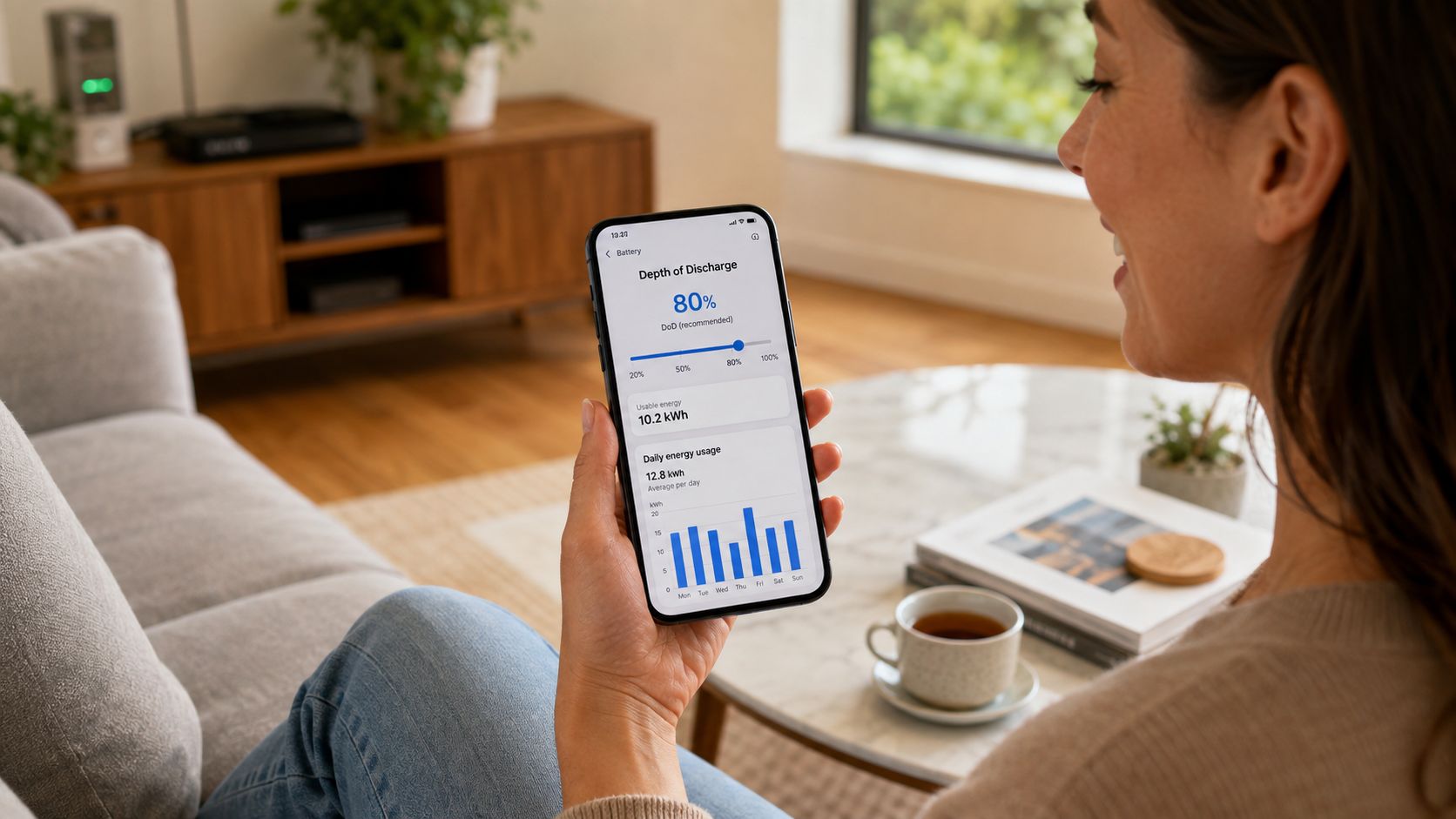
A monitoring app should help you see whether the battery is reaching its intended operating range. It should also show when grid charging, household demand or export restrictions prevent the battery from following the plan you expected. A home energy monitoring app can make those patterns easier to review.
VPP participation and household priority
A BYOB VPP coordinates compatible existing batteries to respond to grid conditions, wholesale price volatility and demand events. The operator may seek discharge when electricity value is higher, but a sound operating plan must account for household demand, reserve settings and the battery's cycling limits.
HighFlow Energy's VPP model uses spare battery capacity for grid services while prioritising the household's energy needs. Customers retain ownership and priority access to their stored energy. Participation doesn't remove the need to check warranty terms or decide how much reserve suits the home.
Optimising Battery Value Beyond Depth of Discharge
DoD is only one part of battery optimisation. A battery can be technically healthy yet financially underused if it discharges at the wrong time, exports when network constraints reduce value or charges from the grid without a sound tariff and market rationale.
Australian homes in Queensland and New South Wales operate within the National Electricity Market, where wholesale prices can vary and network conditions can restrict exports. A retailer-based VPP can combine several value streams, including household bill reduction, demand response and grid stabilisation services. The practical outcome depends on the tariff, system compatibility, dispatch rules and actual household usage.
Compare the operating choices
| Strategy | Main priority | Potential trade-off |
|---|---|---|
| Conservative reserve | Backup readiness and shallower cycling | Less energy available for daily optimisation |
| Self-consumption focus | Use stored solar in the home | May miss higher-value demand events |
| Time-of-use alignment | Shift battery energy towards expensive periods | Requires accurate load and tariff monitoring |
| VPP dispatch | Use spare capacity for coordinated grid support | Requires clear reserve and warranty controls |
Traditional feed-in tariffs pay for exported energy under the retailer's offer. A VPP may create additional value by coordinating battery discharge when the grid needs support, while the retailer manages the customer's electricity account. These are different revenue structures, so households should compare the full operating outcome rather than one export rate.
Most battery owners underuse the financial potential of their asset because they focus on installation and leave the battery on default settings. A properly structured VPP can materially improve value without requiring new hardware, but it shouldn't override household priorities or obscure the cycling implications.
Key takeaway: The best DoD setting is the one that balances usable energy, warranty protection, backup resilience and the value of each discharge event.
Common Questions About Battery Depth of Discharge
Can every lithium battery operate at 100% DoD?
No. Lithium-ion systems generally support high usable DoD, but the permitted daily setting depends on chemistry, manufacturer controls, warranty conditions and installation environment. Check the specific product documentation, especially for LFP and other lithium chemistries.
Does a higher DoD always produce better value?
No. Higher DoD provides more energy per cycle, but deeper cycling can reduce cycle life. The financially sensible operating window depends on the value created by that extra discharge compared with the long-term cost of capacity wear.
How can I tell whether my battery is degrading quickly?
Look for a sustained reduction in usable energy under similar operating conditions. Review the app's capacity, state-of-charge behaviour and discharge history, then ask the installer or manufacturer to assess the system against its warranty criteria.
Does DoD affect feed-in tariff earnings?
It can. Energy used inside the home or dispatched through a VPP isn't exported as ordinary solar energy, so changing reserve and discharge settings can alter export volumes. Compare the total household outcome rather than judging the battery by feed-in income alone.
What happens during a blackout while VPP services are active?
The backup reserve and inverter controls should determine how the battery responds. A VPP programme must respect the home's priority and configured reserve, but owners should confirm the exact outage behaviour for their battery and retailer arrangement.
Should I change my battery settings before joining a VPP?
Not without checking the warranty and programme rules. The operator should explain how dispatch interacts with reserve settings, household priority and cycling limits.
Homeowners weighing battery backup against other outage options may also benefit from this practical guide to comparing backup generator types.
HighFlow Energy is an Australian electricity retailer and BYOB VPP operator that uses spare capacity from compatible existing batteries for coordinated grid services while preserving household priority. Visit HighFlow Energy to check eligibility and assess whether your current battery settings are leaving value unused.