

Battery Storage System Guide for QLD and NSW Homeowners
You've got rooftop solar, a home battery and an electricity bill that still doesn't look as low as expected. During the day, solar may be powering the house while excess energy charges the battery. Later, the battery might sit at a conservative reserve or discharge without responding to the most valuable periods in the market. The hardware is working, but the household may not be getting the full value from it.
A battery storage system can do more than shift solar energy from daytime to evening. For homeowners in Queensland and New South Wales, it can support self-consumption, backup planning, demand response and, where technically and commercially suitable, participation in a Bring Your Own Battery Virtual Power Plant, or BYOB VPP. The right choice depends on your load profile, tariff, export conditions, battery limits and preference for household control.
Why battery storage matters for homeowners
Australia's home battery fleet is already substantial. 185,798 home battery units were installed by the end of 2024, with the market up 62% from 2023, according to the Clean Energy Council's rooftop solar and storage report. During the second half of that year, Queensland and New South Wales recorded 23,241 battery sales combined, creating a large and growing base of systems that could be optimised.
The important question isn't just whether a battery is installed. It's whether the system charges at useful times, preserves energy for the household, responds safely to price and network conditions, and reports its performance clearly. A battery that only follows a basic schedule may reduce some grid imports, but it can miss opportunities created by time-of-use tariffs, solar forecasts, export constraints or coordinated grid services.
The underused asset problem
Many households think of their battery as a tank that fills with excess solar and empties after sunset. That model is easy to understand, but it can be too rigid. A smarter control strategy may hold energy for evening demand, charge from the grid when conditions justify it, or retain headroom so the battery can respond in either direction during a grid event.
That doesn't mean active dispatch is always better. A household that relies on stored energy during evening cooking, cooling or home medical equipment may reasonably prioritise self-consumption and backup. The strategic decision is to compare the value of passive battery use with the value of controlled participation, rather than assuming one approach suits every home.
Practical rule: Your battery's value comes from how it's operated, not only from its nameplate capacity.
The installed base gives retailers and VPP operators a meaningful opportunity to improve performance without replacing existing solar panels or batteries. For an eligible household, optimisation can involve software, a compatible inverter, transparent operating rules and a commercial arrangement that explains what the operator can control and what the customer retains.
What a battery storage system is
A home battery storage system stores electrical energy so your household can use it later. A useful analogy is a water reservoir. Rooftop solar fills the reservoir when the sun is producing more electricity than the home needs. The battery releases that stored energy when household demand rises or solar production falls.
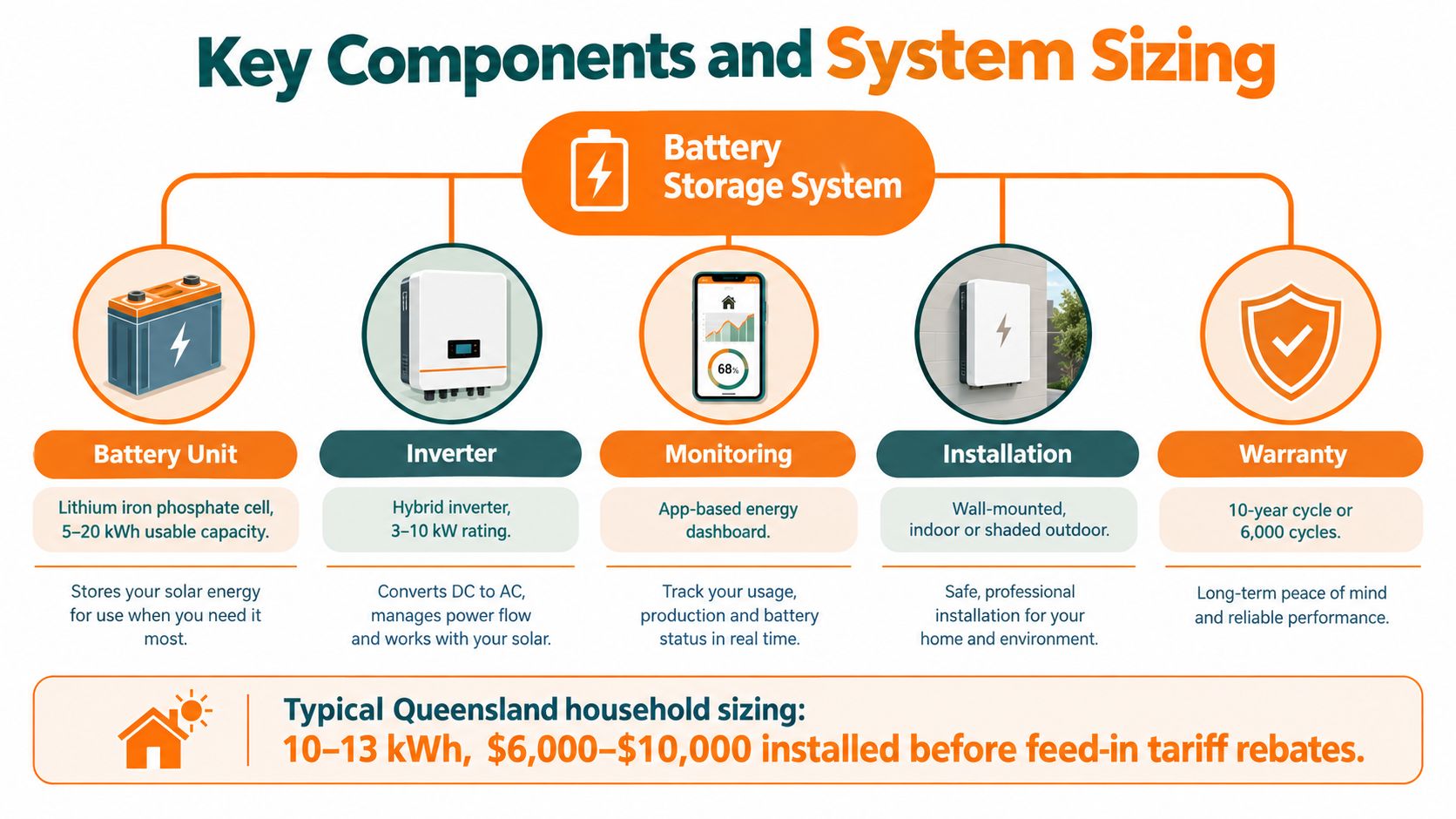
The system normally includes several connected parts:
- Battery modules: These store energy, commonly using lithium-based cells.
- Inverter: This converts electricity between direct current and alternating current, allowing solar, battery and household circuits to work together.
- Battery management system: This monitors voltage, temperature and operating limits to keep the battery within safe parameters.
- Metering and communications: These measure energy flows and allow an app, retailer or VPP platform to manage the system where authorised.
Nameplate capacity is not usable capacity
A battery's advertised capacity is its nameplate capacity. The energy available for normal operation is its usable capacity, which is affected by reserve settings, depth of discharge, inverter limits and warranty conditions. A system may keep part of its capacity protected rather than allowing the household or grid services to use every stored unit of energy.
Depth of discharge, or DoD, describes how much of the battery's total capacity is used during a cycle. CSIRO explains that battery life is commonly assessed to an end-of-life threshold of 80% of original capacity, and that faster charging or discharging and deeper cycling can accelerate degradation. Its battery guidance for homes is useful when comparing systems and warranty assumptions.
The inverter's power rating matters as well. Capacity describes how much energy the battery can store, while power describes how quickly it can deliver or absorb energy. A household may have sufficient stored energy but still be unable to run several high-demand appliances simultaneously if the inverter is the limiting component.
How a battery storage system works
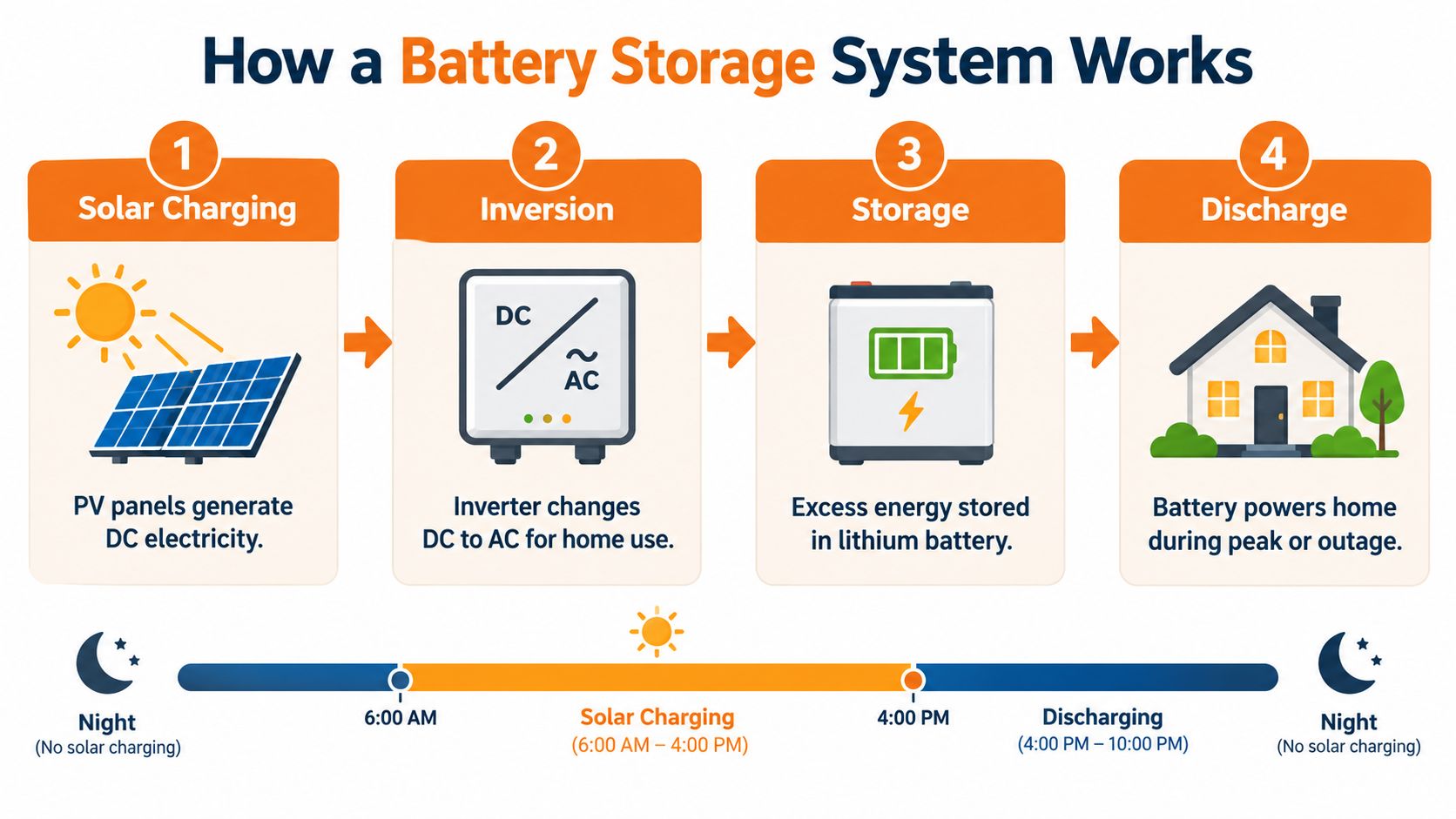
The daily cycle usually follows four operating stages. Each stage has a household purpose and a set of technical limits.
Charging from solar or the grid
During daylight, rooftop solar first supplies the home. If generation exceeds household demand, the battery can charge with the surplus, subject to inverter capacity, battery temperature and its maximum state of charge.
Some systems can also charge from the grid. A control platform may consider a time-of-use tariff, expected solar output, market conditions and the household's planned demand. Grid charging only makes financial sense when the total cost and future use value justify it, and the battery's warranty and network rules permit the operating pattern.
Holding energy safely
The battery doesn't sit disconnected from the rest of the system. Its management system tracks state of charge, temperature, voltage and current. The control software may maintain a reserve for backup or household use, leaving less energy available for export or grid services.
That reserve creates an important trade-off. A larger reserve improves access to stored energy after sunset or during an outage, but it reduces the amount that can be dispatched for a market or network event.
Discharging for the home or the grid
The battery can discharge when solar output falls and household demand rises. This can reduce imports during evening periods, subject to the battery's power rating and the retailer's tariff.
A VPP may also request charging or discharging when the battery has suitable headroom. Upward response requires stored energy that can be exported. Downward response requires available capacity so the system can absorb energy. A controller must therefore forecast household load and solar generation rather than emptying the battery whenever a price signal appears.
A safe, coordinated system should prioritise household requirements, enforce temperature and warranty limits, and provide a manual override. Homeowners working around electrical hazards should use appropriately trained professionals. For practical safety context, how to respond to live panel incidents explains why live electrical equipment requires disciplined procedures.
Key components and sizing for your system
A battery system works like a water tank with two limits. One limit is how much it can store. The other is how fast that stored energy can flow out when several appliances switch on at once. For Queensland and New South Wales homeowners, sizing starts with a practical choice. Do you want the battery mainly for self-consumption, or do you want spare capacity available for future VPP participation under local tariff and program conditions, including options discussed in the Queensland home battery scheme guide?
Battery capacity and power
Start with what happens after sunset. Review interval data, solar output and the appliances you want the battery to support. A home running air conditioning, a pool pump, electric cooking and EV charging in the evening will need a different setup from one with lighter overnight demand.
Capacity answers, “How much energy can the battery supply over time?” Power answers, “How much can it supply right now?” A system can have enough stored energy on paper but still struggle if the inverter cannot handle several high-load appliances at the same time. That is a common point of confusion.
Cycling and degradation
Battery life is shaped by how hard and how often it is used. CSIRO identifies two operating variables that matter here:
- C-rate: Faster charging and discharging can shorten achievable cycle life.
- Depth of discharge: Using a larger share of the battery repeatedly increases electrochemical stress.
For a homeowner comparing passive and active battery use, this matters. A battery used mostly for evening self-consumption may age differently from one that also responds to VPP dispatch events. Any payment or bill benefit should be weighed against the extra wear created by those additional cycles.
Safety and compliance
Safe performance depends on the full setup, not just the battery cells. Installation location, thermal conditions, inverter settings and battery protection all shape how the system behaves over time. Installers must account for Australian requirements, including AS 5139, and the proposed charging and dispatch pattern should still fit within warranty terms.
Communication hardware also matters. A VPP-ready system needs stable connectivity, compatible firmware, accurate metering and controls that can act on instructions without overriding household priorities.
Before accepting an offer, ask about reserve level, export conditions, dispatch limits, outage behaviour, warranty treatment and how performance will be reported. Those details give a clearer picture than a broad claim that the battery is “smart”.
Integrating solar and VPP readiness
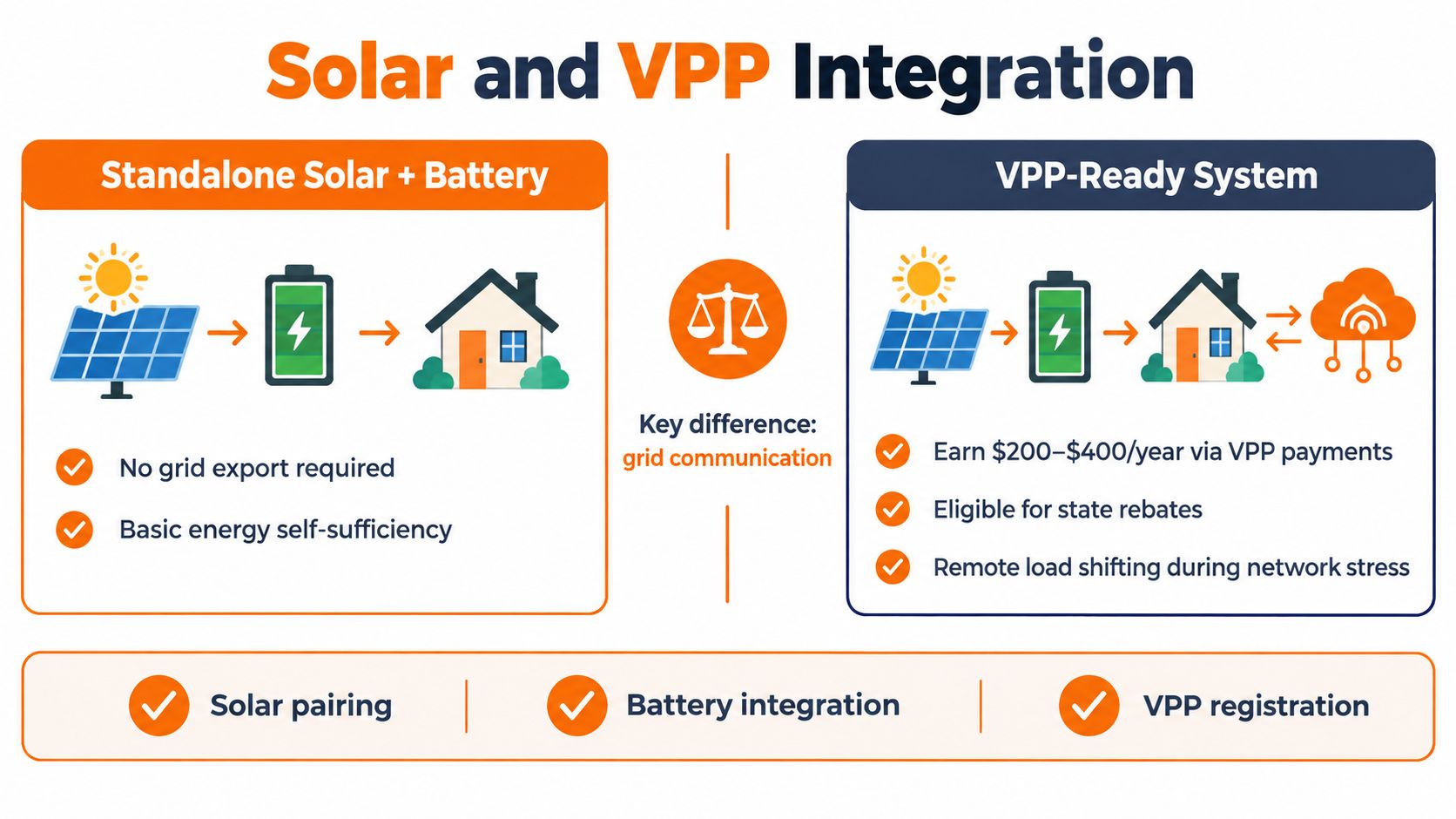
A standalone solar-and-battery setup gives the homeowner direct control over stored energy. The battery can prioritise solar self-consumption, evening use or backup. A BYOB VPP adds another layer, allowing an electricity retailer or operator to coordinate spare capacity across many homes.
The difference is not an app. A VPP needs technical visibility and operational discipline. AEMO's VPP demonstration requirements include information about state of charge, inverter capacity and five-minute data for services such as Frequency Control Ancillary Services and wholesale market responses. The AEMO VPP data specification sets out the type of operational information needed for coordinated participation.
Standalone versus coordinated operation
| Consideration | Standalone solar and battery | VPP-ready battery |
|---|---|---|
| Primary control | Household schedule or local app | Local household rules plus authorised remote coordination |
| Energy priority | Self-consumption and backup | Household needs first, with spare capacity available for services |
| Dispatch | Usually based on a fixed schedule or local forecast | Can respond to prices, frequency events or network needs |
| Communications | Useful for monitoring | Essential for measurement, forecasting and control |
| Main trade-off | May miss external value opportunities | May involve reserve settings, export limits and additional cycling |
A well-designed VPP must preserve headroom in both directions. If the battery is full, it can't absorb surplus energy. If it's empty, it can't export meaningfully. The platform should therefore forecast solar production, household demand and market signals while respecting power, temperature, reserve and warranty constraints.
Homeowners should check compatibility before enrolment. The system integration requirements can help identify the inverter, battery, communications and metering details an operator may need.
VPP participation also doesn't guarantee backup during a blackout. Some systems disconnect from the grid for safety, and only batteries with suitable backup hardware and configuration can continue supplying selected circuits. Confirm the outage response in writing.
Benefits and costs of your battery storage system
A battery can be worth a lot on one evening and much less on another. For QLD and NSW homeowners, that is the starting point. The value does not come from one simple saving figure, because a battery can do two different jobs. It can keep more of your own solar at home, or it can join a VPP and follow outside dispatch signals when that suits the contract.
That is why battery value should be separated into parts. A household may gain from avoided grid imports, higher solar self-consumption, export revenue, tariff timing, network-related charges or a VPP allowance. The mix depends on your retailer plan, local export rules, operating schedule and the limits of the battery itself.
Analysts at AEMO reported that battery discharge increased 305% year on year in the first quarter of 2026. They also noted that battery value still turns on tariff design, export limits and whether VPP revenue covers the cost of extra cycling. The AEMO Quarterly Energy Dynamics report gives useful market context.
A practical value framework
| Value or cost | What to examine |
|---|---|
| Avoided imports | Which household loads can the battery cover, and during which tariff periods? |
| Export income | What feed-in rate and export limit apply? |
| Time-of-use response | Can the system shift energy without leaving the home short later? |
| Supply and network charges | Which charges still apply, and which might be offset by an allowance? |
| VPP payments | Are payments fixed, variable, conditional or tied to dispatch? |
| Degradation | Does extra cycling reduce future usable capacity or affect warranty support? |
A simple way to read this table is to compare passive and active value. Passive value comes from using more of your own solar at the right time. Active value comes from letting the battery respond to a VPP program, market event or tariff window. A QLD home with strong solar output and modest evening demand may care more about export limits and state incentives, especially when reviewing options like the Queensland home battery scheme. A NSW home on a sharper time-of-use plan may care more about evening import avoidance or whether VPP participation adds enough to justify the trade-off.
So the right comparison is a range, not a single payback claim. Model a best case with favourable dispatch, a typical case based on your real interval data, and a weaker case with export restrictions, fewer events and extra cycling. This solar battery payback framework is a useful structure, but the inputs should come from your own bills, meter data and contract terms.
Traditional feed-in tariffs pay for exported energy under your retailer's offer. A VPP can add a separate income stream by coordinating the battery for grid services, but that usually comes with rules on dispatch, reserves, exits and outage treatment. Read those terms closely before deciding whether self-consumption or active participation is the better fit for your home.
Maintaining and optimising performance
A battery needs ongoing oversight, even when software handles daily decisions. Review the app regularly and look for unexpected imports, missed solar charging, unusual state-of-charge changes, fault alerts or communication gaps.
A practical maintenance routine includes:
- Review operating data: Compare solar generation, household consumption, battery charge and discharge, and grid imports.
- Check reserves: Make sure the backup or household reserve still matches your priorities.
- Install approved updates: Firmware can affect compatibility, safety and control performance.
- Inspect the environment: Keep vents clear and follow the installer's requirements for heat, moisture and access.
- Record warranty information: Keep installation documents, service records and dispatch terms together.
- Test household expectations: Confirm which circuits receive backup and how the system behaves during an outage.
Avoid forcing unnecessary full-depth cycles to respond to a weak price signal. Automated plans should be overridden when household circumstances change, such as a planned evening load, extreme weather or an expected outage.
A small connected device may also be important during an outage. If you want to understand the practical considerations for maintaining connectivity, this guide to backup power for your router explains why internet equipment can determine whether monitoring and communication remain available.
Choosing the right battery storage system for QLD and NSW homes
Queensland and New South Wales homeowners should choose between passive self-consumption and active VPP participation based on household priorities, not market enthusiasm.
Only about 24% of households with batteries in Queensland and New South Wales participated in a VPP in early 2026, while 64% of non-participants expressed interest, according to Nous Group's VPP analysis. That gap suggests that homeowners want the potential value but need clearer answers about reserves, export limits, remote dispatch and blackout behaviour.
Use this checklist:
- Review evening demand and backup requirements.
- Check the battery's usable capacity, inverter power and warranty.
- Confirm Queensland or New South Wales export and tariff conditions.
- Compare passive savings with VPP allowances and cycling implications.
- Require clear controls, live state-of-charge information and an override.
- Check whether the operator prioritises household use.
For eligible existing solar and battery owners, HighFlow Energy operates a BYOB VPP in Queensland and New South Wales, coordinating spare capacity while prioritising household needs. Its electricity retail model includes an app for monitoring and optimisation, but eligibility, operating terms and system compatibility should be assessed before enrolment.
Most battery owners focus on installation quality. Far fewer focus on ongoing performance and optimisation. HighFlow Energy helps eligible Queensland and New South Wales homeowners assess whether an existing solar and battery system is underutilised and whether coordinated VPP operation fits their household priorities. Visit HighFlow Energy to review your system's eligibility and understand the allowance and control terms before deciding.