

Connect Your Battery: VPP System Integration Requirements
You've probably seen the pattern already. A household installs solar, adds a battery, watches self-consumption improve, then expects the electricity bill to keep falling. Instead, the battery sits there doing a decent job, but not a great one. It charges, discharges, and keeps the lights on during an outage if that feature is enabled, yet the financial return still feels thinner than expected.
That gap usually isn't caused by the battery cells. It's caused by everything around them. The difference between a battery that only stores energy and a battery that earns its keep in a Virtual Power Plant comes down to system integration requirements. In practice, that means network approvals, communications, control software, firmware behaviour, metering, and compliance settings that let your system participate safely in a coordinated market service.
For homeowners in New South Wales and Queensland, this matters because the battery itself is only one component in a much bigger operating environment. The grid operator, your DNSP, the VPP platform, your inverter, your smart meter, and your internet connection all have to line up. If they don't, your battery may still work perfectly as hardware while underperforming as an energy asset.
The same integration bottlenecks show up at a broader market level. Australia's shortage of skilled integration professionals is estimated to shave 2.4 percentage points off forecast system integration market growth, which tells you something important about real-world delivery risk: connecting complex energy systems is hard, and it's getting harder, not easier, to do well, according to Mordor Intelligence's Australia system integration market analysis. If you've felt that the industry often glosses over these practical hurdles, that instinct is sound. A useful backgrounder on those broader issues is this overview of renewable energy integration challenges.
Is Your Battery Underperforming? The Integration Gap
A common homeowner story goes like this. The system was installed properly. The battery app looks healthy. Solar generation is strong on clear days. But the bill outcome still doesn't reflect the size of the investment.
That usually means the battery is operating as a standalone device, not as a grid-coordinated asset.
Where underperformance actually starts
Initial assessments often focus on the wrong layer. They compare battery capacity, brand reputation, or inverter specs. Those things matter, but they don't answer the more important operational question: can the battery exchange the right data, receive dispatch instructions, comply with export rules, and respond predictably enough to be useful in a VPP?
A battery can be technically excellent and commercially underused at the same time.
In the field, the weak points are rarely glamorous. An export approval hasn't been finalised. The smart meter isn't configured the way the VPP operator needs. The internet connection is unstable. Firmware is out of date. The inverter can't expose the control points the aggregator requires. None of that shows up in a glossy product brochure, but all of it affects value.
Why this feels confusing to homeowners
Battery owners are often told that participation starts with “compatibility”. That word is too vague. In practice, compatibility means a stack of system integration requirements that sit above the hardware and determine whether the battery can be observed, instructed, and verified in real time.
The result is a simple but important distinction:
| Battery outcome | What it means |
|---|---|
| Installed | The hardware is present and operating locally |
| Connected | The system can exchange data reliably |
| Approved | The network permits the export behaviour required |
| Coordinated | The VPP platform can optimise charge and discharge |
| Valuable | The battery can support both the home and grid services |
That's the integration gap. Most disappointment lives there.
The Foundational VPP Compatibility Checklist
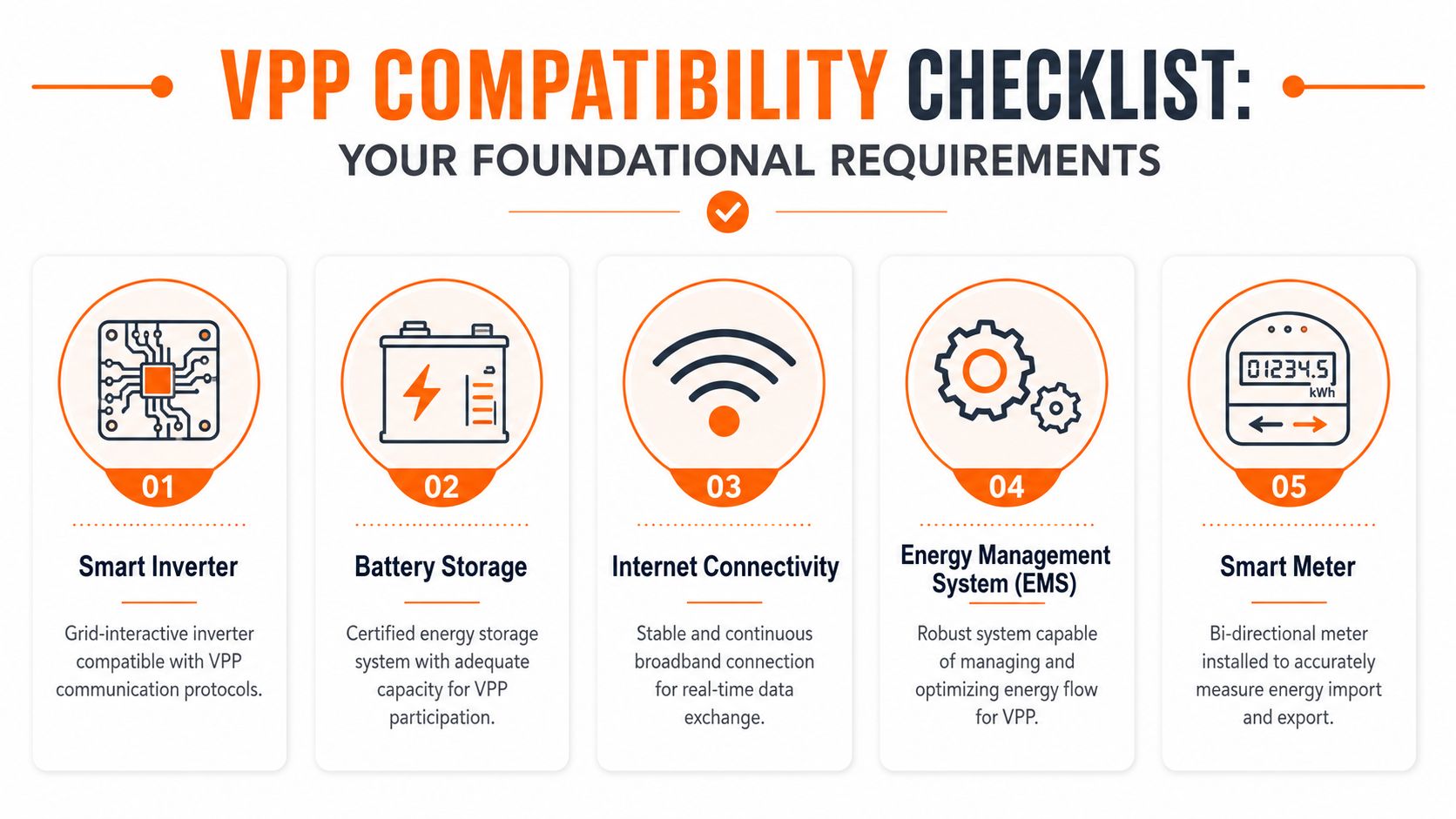
Before looking at communication protocols or compliance workflows, start with the basic pass-fail items. If these aren't in place, a VPP provider can't do much with your battery.
The first-pass eligibility check
For Australian homes, a battery needs at least 5 kWh of usable storage, a certified smart meter, stable internet, and explicit export approval from the local DNSP to integrate into a VPP, as outlined in Solar Choice's guide to joining a Virtual Power Plant with a home battery.
That single sentence contains most of the practical gatekeeping.
- Usable storage capacity matters: A VPP needs enough controllable energy to make a dispatch worthwhile. Capacity on paper isn't the same as usable capacity available to the platform.
- The smart meter matters for settlement and visibility: Without interval data and accurate import-export measurement, the operator can't confirm what happened.
- Stable internet matters because commands aren't magic: The VPP platform needs a reliable path to your site. If the battery drops offline at the wrong moment, the system becomes less dependable.
- DNSP export approval matters because network permission is not optional: If your local network hasn't approved export behaviour, the battery can't lawfully participate in the way a VPP expects.
The parts homeowners often miss
A battery also needs the surrounding equipment to behave properly.
- Inverter compatibility: The inverter has to be grid-interactive and expose the functions required for remote coordination. If you're unsure where the limits sit, this primer on solar inverter installation helps explain why inverter choice affects much more than basic conversion efficiency.
- Energy management capability: Some systems include a local controller or EMS that handles site logic, prioritises household demand, and passes instructions between the battery and cloud platform.
- Firmware readiness: Older firmware can block remote control features or create conflicts between local settings and VPP dispatch logic.
Practical rule: If your installer only discussed battery size and brand, you probably haven't had the full VPP compatibility conversation.
A quick homeowner checklist
Use this as a blunt screening tool:
- Battery capacity: Is there at least 5 kWh usable available?
- Metering: Do you have a certified smart meter installed and active?
- Connectivity: Is your home internet stable enough for continuous communication?
- Network permissions: Has your DNSP approved exports for the site?
- Control layer: Can your inverter and battery software accept coordinated operating instructions?
If any one of those is unresolved, the battery may still work well for self-consumption, but VPP participation becomes uncertain or impossible.
How Your Battery Talks to the Grid
People often imagine VPP control as a utility “taking over” the battery. That's not how a competent system should work. The better analogy is a secure digital handshake between your home energy system and a dispatch platform that coordinates many batteries at once.
The communication chain
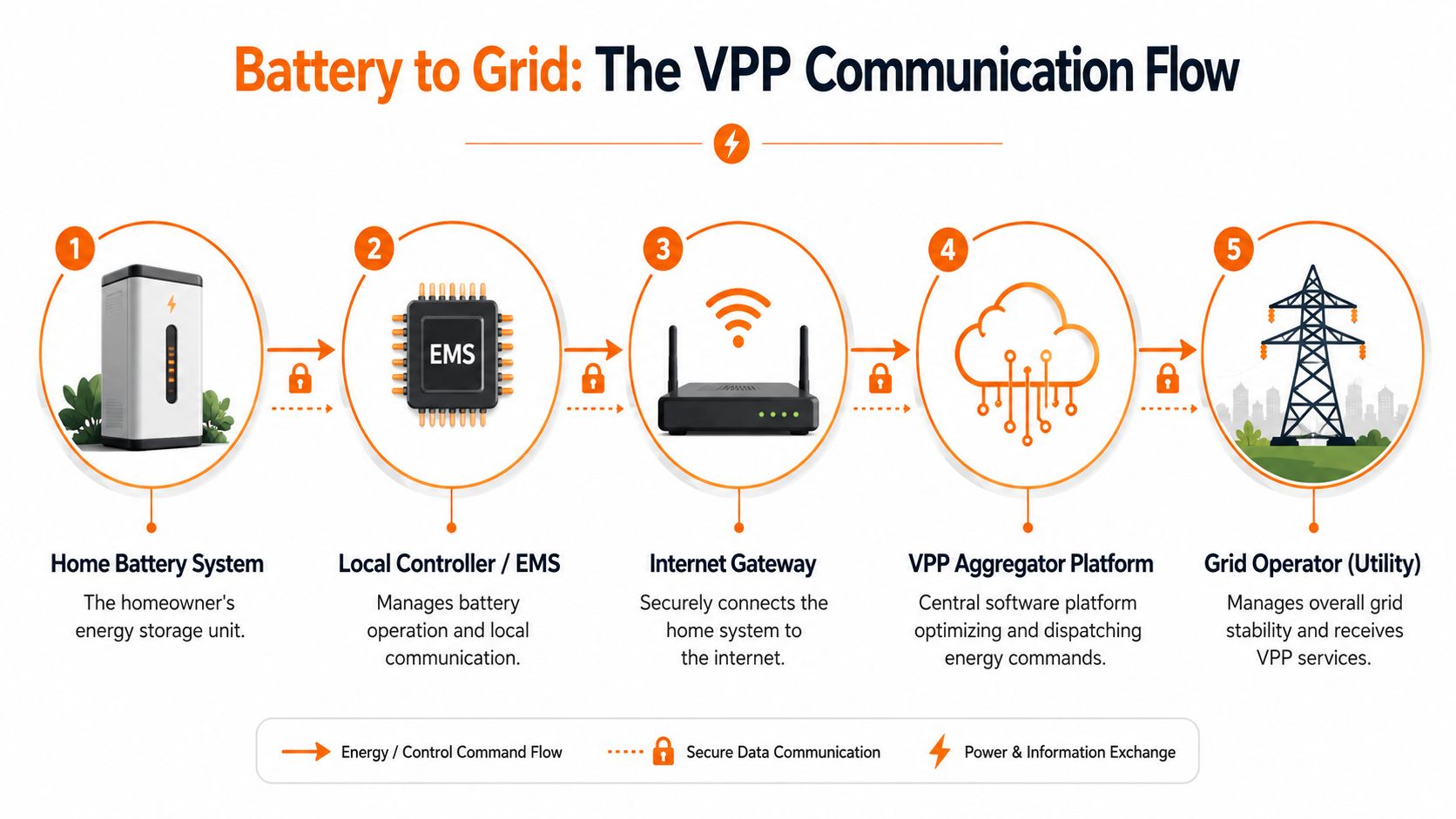
Your battery usually doesn't “talk” directly to the wider grid. There's a chain of control and telemetry:
| Layer | What it does |
|---|---|
| Battery and inverter | Execute charge and discharge physically |
| Local controller or EMS | Manages on-site operating rules |
| Internet gateway | Sends and receives data securely |
| VPP aggregator platform | Optimises and dispatches fleet behaviour |
| Grid-facing market interface | Aligns battery actions with grid needs |
Each layer has to agree on status, operating limits, and commands. If one layer reports stale data or misses an instruction, the whole chain becomes less useful.
Why protocols matter
A protocol is just a shared technical language. It defines how devices report state, accept commands, acknowledge actions, and handle faults. Homeowners don't need to memorise protocol names, but they do need to understand the consequence of poor protocol support: unreliable control, patchy visibility, and awkward integration workarounds.
A VPP operator needs to know things like:
- whether the battery is online
- how much energy is available
- whether the system is charging, idle, or discharging
- what export or import limits apply
- whether a command was received and executed
Without that visibility, optimisation becomes guesswork.
For a plain-English explanation of one part of that data chain, this guide on how smart meters work is useful because metering is often the least understood link in the stack.
Secure coordination, not blind control
The best systems don't just send commands. They confirm outcomes. That's what separates a workable VPP from a marketing concept.
A typical sequence looks like this:
- The platform reads site status
- It checks household priorities and operating constraints
- It decides whether spare capacity exists
- It sends a charge, hold, or discharge instruction
- The site controller verifies and executes
- The platform records what happened
This explainer is worth watching if you want a visual sense of coordinated battery operation:
When that chain works properly, your battery isn't being used recklessly. It's being orchestrated within known limits.
Navigating Australian Regulatory and Network Rules
The least discussed system integration requirements are often the ones that stop projects entirely. Hardware problems can sometimes be fixed with a settings change or firmware update. Regulatory and network approval problems usually can't.
DNSP approval is a hard gate
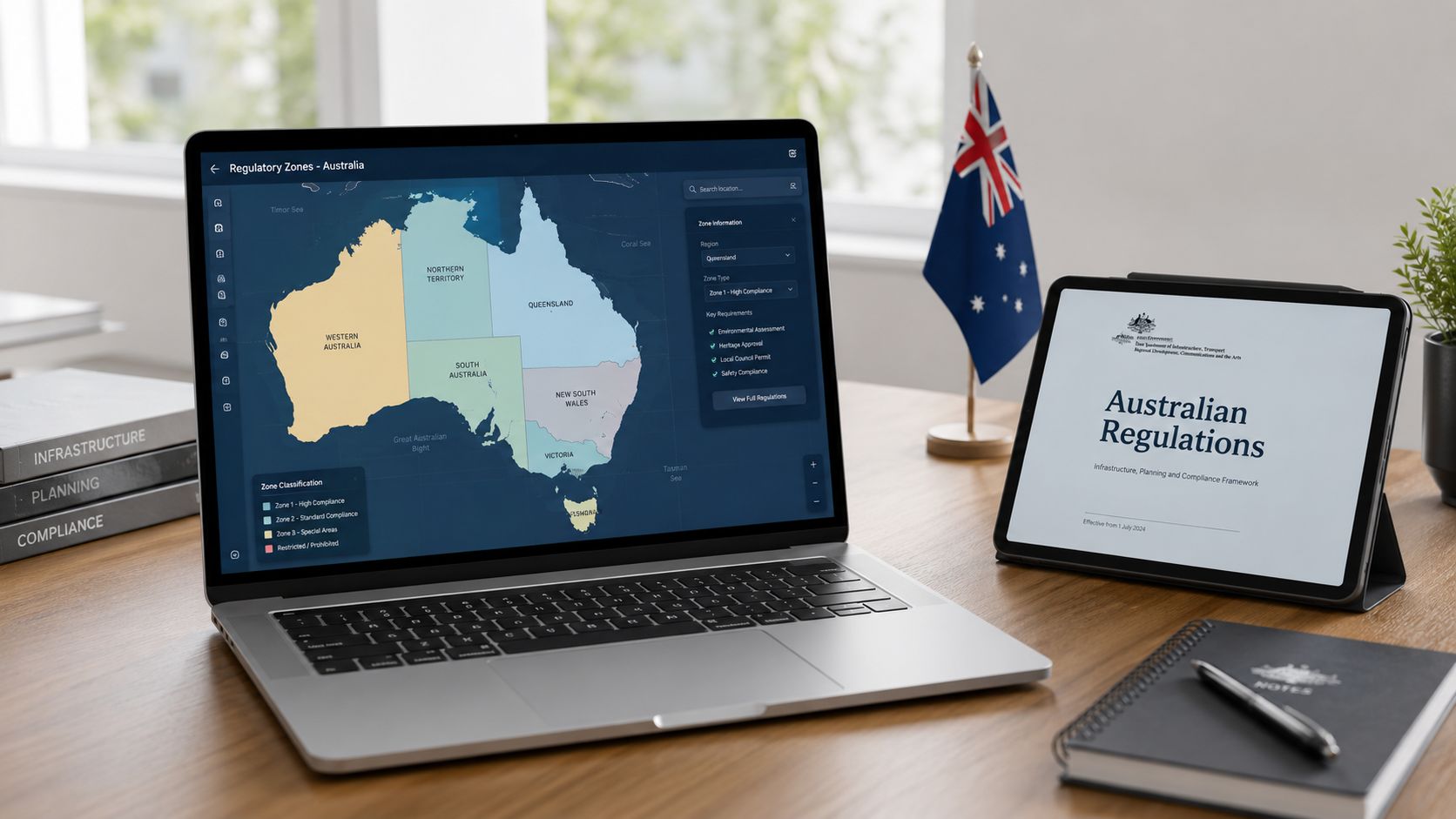
For a home battery to participate in a VPP, export behaviour has to align with the local network's rules. Your DNSP decides what can be exported, under what conditions, and from which premises. If explicit export approval isn't in place, the battery may be blocked from the very actions a VPP depends on.
That's why homeowners in NSW and QLD should treat network approval as part of the integration design, not post-install paperwork.
If the network won't allow the export behaviour, the VPP model doesn't matter. The battery can't perform the service.
State rules create different commercial pathways
NSW has a particularly relevant incentive setting for homeowners considering VPP participation. The NSW government's VPP incentive only applies to batteries 28 kWh or smaller, according to the NSW energy department's page on Virtual Power Plant incentives. Separately, the NSW Peak Demand Reduction Scheme provides a reward of $550 to $1,100 for eligible participants joining a VPP, as described in EcoFlow's overview of Australian Virtual Power Plant incentives.
Those aren't just marketing details. They shape eligibility, economics, and the types of systems that are easier to enrol.
Compliance is broader than one application form
A compliant VPP setup has to line up with electrical safety, metering accuracy, network operating limits, and software behaviour. Homeowners don't need to become regulatory specialists, but they should expect the provider and installer to manage a traceable process.
A useful way to think about it is the same way electrical professionals think about any controlled environment. The rules aren't there to slow things down for the sake of it. They exist because distributed energy resources can affect voltage, export flows, and network stability if they're poorly coordinated. If you want a non-Australian but still helpful reference on how formal rule sets shape electrical work, this overview of Irish electrical regulations gives a clear example of why documented compliance matters.
What to check before you enrol
- Network status: Has export approval been granted for your exact site and system configuration?
- Battery size and state scheme fit: In NSW, does your battery sit within the relevant VPP incentive eligibility settings?
- Installer records: Are the inverter, battery, and meter details documented cleanly?
- Control permissions: Has the provider explained what software access is required to coordinate the system?
That's the practical difference between “my battery can probably join” and “my battery is ready”.
The VPP Commissioning and Testing Process
Once eligibility and approvals are in place, the core work starts. Joining a VPP should involve a controlled commissioning process, not a loose promise that the battery will “sync up later”.
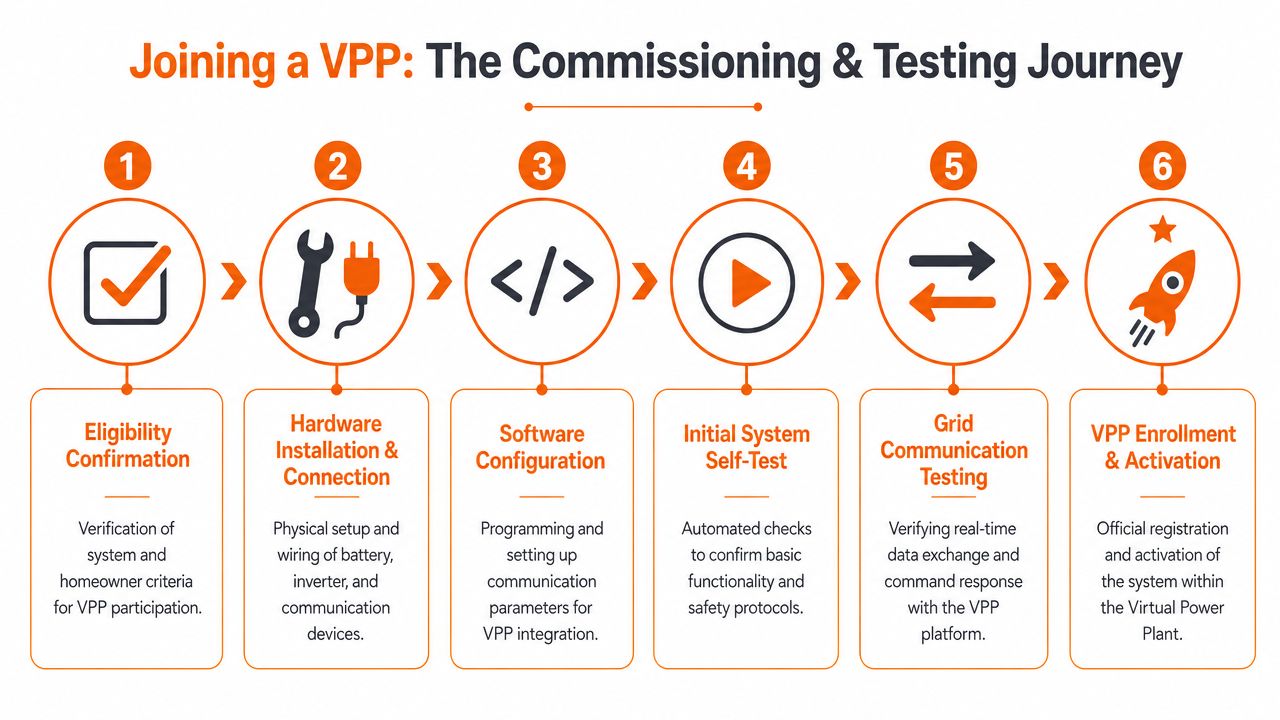
What a proper commissioning sequence looks like
A disciplined onboarding flow usually includes these steps:
Eligibility confirmation
The provider verifies that the battery, inverter, meter, and network approvals line up with the intended operating model.Firmware and software preparation
Solar Choice notes that firmware updates may need to be performed by the installer or provider to enable remote software coordination. That matters because dispatch logic depends on the battery being able to execute automated charge, hold, and export commands, as noted earlier in that source.Secure communication setup
The platform establishes telemetry and control links, then checks whether site data is arriving consistently.Initial self-tests
The system confirms local operating limits, fault handling, and basic response behaviour.Test dispatches
The platform sends trial commands to verify that the site responds correctly and that the resulting behaviour matches the instruction.
Why testing can't be skipped
Battery fleets are only useful when operators can trust them. South Australia's REPS specification shows how precise some VPP operating requirements can become. For an asset to achieve productivity factors, the aggregated battery system may need to source full capacity before relying on grid energy during peak periods such as 3 PM to 1 AM, and fully recharge during low-demand windows such as 1 AM to 6 AM, according to the REPS specification for VPP assets.
That kind of scheduling only works if every enrolled battery does what the software expects.
Testing is where a provider proves that “compatible” also means controllable, observable, and dependable.
The same document also requires post-activation performance reporting tied to energy delivered and response against commitment. That tells you something useful as a homeowner: serious VPP participation depends on verification, not assumptions.
Controls matter in software as much as in hardware
If you come from a technical, audit, or engineering background, it helps to think in terms of control evidence. You don't rely on a setting because someone says it exists. You validate that it operates when needed. AuditReady's explanation of a test of controls is a good general reference for that mindset.
A well-run commissioning process doesn't feel dramatic from the homeowner side. That's a good sign. Quiet, verified setup beats hurried activation every time.
Common Misconceptions About VPP Integration
The most persistent myths about VPPs usually come from treating integration as a black box. Once you unpack the operating rules, most of the fear becomes easier to assess properly.
I'll lose control of my battery
In a competent setup, the home still has priority settings. The VPP coordinates spare capacity within predefined limits. That's different from handing over unrestricted control.
The practical question isn't “does the provider ever send commands?” Of course they do. The better question is whether those commands respect household operating constraints, reserve settings, and agreed participation logic. If they don't, that's a provider design problem, not an unavoidable feature of VPPs.
VPP participation automatically ruins battery life
Battery wear is a real engineering consideration. So is underusing an expensive asset. Good operation sits between those extremes.
What matters is how dispatch is managed: cycle depth, reserve levels, timing windows, temperature management, firmware logic, and whether the system is dispatched blindly or with site awareness. Homeowners should ask how the operator handles those trade-offs, not assume that any grid participation is necessarily abusive.
My warranty will definitely be voided
This is often stated too broadly. Warranty outcomes depend on the battery manufacturer, approved operating modes, integration method, and whether the system is used within supported parameters. The right question is whether the VPP operating model aligns with the manufacturer's supported control framework.
If a provider can't explain that clearly, keep asking.
Switching later will be simple
This is the misconception that deserves more attention. Vendor lock-in is real. If a battery manufacturer or software provider exits the market, re-integrating the battery with another VPP can become prohibitively complex and costly, as discussed in Panorama Consulting's piece on the consequences of system integration issues.
That doesn't mean every VPP is a trap. It means homeowners should look for signs of flexibility before joining.
| Question to ask | Why it matters |
|---|---|
| Who controls the software interface? | Determines how portable the battery is between platforms |
| Are there contract lock-ins or exit barriers? | Affects your ability to move if the offering changes |
| What happens if the manufacturer changes support? | Exposes long-term integration risk |
| Can local operation continue independently? | Protects baseline battery usefulness |
Ask about exit pathways before you ask about enrolment speed.
That's not pessimism. It's good systems thinking.
Unlocking Your Battery's True Value
The overlooked part of VPP performance isn't usually the battery chemistry. It's the integration layer around the battery. That includes communications, approvals, metering, firmware readiness, control logic, and a commissioning process that proves the system can respond reliably.
Key takeaways
- System integration requirements determine whether a battery can participate effectively in a VPP
- Minimum hardware eligibility is only the starting point
- DNSP approval, smart metering, and stable internet are foundational
- Software coordination and verified testing are what turn a battery into a dispatchable asset
- Vendor lock-in risk deserves serious attention before enrolment
Most battery owners focus on installation quality. Far fewer focus on ongoing performance and optimisation. High Flow Energy is an electricity retailer built around optimizing the full value of your existing solar and battery system.
If you would like to understand whether your battery is underperforming financially, request an eligibility assessment today.
FAQ
What are system integration requirements for a home battery?
They're the technical and regulatory conditions that let your battery connect safely and usefully to a wider platform such as a VPP. That includes metering, communications, approvals, firmware behaviour, and control compatibility.
Can any battery join a VPP in Australia?
No. Eligibility depends on the battery, inverter, metering setup, internet reliability, and network approval. Some batteries are easier to integrate than others because their software interfaces are better supported.
Why does my internet connection matter?
A VPP depends on data and control signals moving between your home system and the operator's platform. If the connection is unreliable, the platform can't coordinate the battery consistently.
What does DNSP export approval actually do?
It gives network permission for your system to export under approved conditions. Without that approval, a VPP may not be able to use your battery for grid-support actions that involve export.
Do I need a smart meter for VPP participation?
In practice, yes. Accurate import and export measurement is central to visibility, verification, and settlement.
Will joining a VPP stop me using my battery for my own home?
A properly structured VPP should preserve household priority and operate within agreed limits. You should ask exactly how those priorities are configured.
What happens if my battery brand or software platform changes support?
That can create re-integration risk. Ask how portable your setup is, who controls the software pathway, and what happens if the original provider exits the market.
Is the joining process instant?
Usually not. For enterprise integration projects, pre-development planning alone often runs for 7 to 10 weeks across scoping, architectural design, and detailed planning in Australian system integration work, according to Osher's article on system integration steps. Residential VPP onboarding is different, but the broader lesson is the same: good integration work follows a structured process.
Why High Flow Energy
High Flow Energy is built for homeowners in NSW and QLD who already have solar and a compatible battery and want better performance from that existing asset. The model is retailer-based, focused on battery optimisation, transparent participation, and preserving customer priority use.
That matters because traditional retailers generally don't optimise battery value. A well-structured BYOB VPP can create stronger use of the asset you already own, while keeping compliance and operating visibility front and centre.
SEO and supporting elements
SEO title
VPP System Integration Requirements Australia
Meta description
Learn the system integration requirements for joining a VPP in Australia, from DNSP approvals to software, metering and testing.
Suggested URL slug
/vpp-system-integration-requirements-australia
Featured image concept
A modern Australian home with rooftop solar, battery storage, smart meter and cloud-based VPP control overlays showing data flow to the grid.
Image alt text
Home battery system connected to an Australian Virtual Power Plant through smart metering and software controls
Internal linking suggestions
- Renewable energy integration challenges
- Solar inverter installation
- How smart meters work
- BYOB VPP explainer
- NSW VPP eligibility guide
- QLD battery optimisation guide
External authority references
- Australian Energy Regulator
- AEMO
- NSW Government energy programs
- Relevant DNSP connection and export guidance
- South Australian VPP specification material
LinkedIn-ready excerpt
Most battery owners don't have a battery problem. They have an integration problem. This article breaks down the system integration requirements that determine whether a home battery can perform in a VPP, including DNSP approvals, metering, communications, software coordination, testing, and vendor lock-in risk for households in NSW and QLD.
AI summary snippet
A home battery doesn't join a VPP on hardware alone. It needs the right system integration requirements, including usable capacity, a smart meter, stable internet, DNSP export approval, compatible software controls, and tested communications. For Australian homeowners, the non-hardware layer often determines whether the battery only stores energy or creates additional value through coordinated grid participation.
If you already own solar and a compatible battery, HighFlow Energy can help you assess whether your system is underutilised and whether it's eligible for a Bring Your Own Battery VPP in NSW or QLD. The focus isn't on selling new hardware. It's on understanding current performance, checking eligibility, and determining whether your existing battery could deliver more value through better coordination and retail structure.