

Solar Battery Storage Residential: Costs, Sizing and VPPs
Close to 75,000 home battery units were sold in Australia in 2024, up from 46,127 in 2023, an increase of about 62.5%, according to the Clean Energy Council. If you're weighing solar battery storage residential choices in Queensland or New South Wales, that shift is the point. The battery is no longer a niche add-on. The question is how much of it you use in practice, and whether a retailer program can turn spare capacity into a lower bill.
How a Home Battery Stores and Releases Solar Power
Treat the battery as a water tank. Rooftop panels fill it through the day. The house draws from it after sunset. The tank doesn't make water. It only holds what the roof, or sometimes the grid, puts in.
A kilowatt-hour (kWh) is the energy unit. A 1 kW appliance running for one hour uses 1 kWh. Nominal capacity is the label on the box. Usable capacity is what you can draw after a reserve and conversion losses. State of charge is how full the tank is. Depth of discharge is how far you empty it. The inverter turns the battery's direct current into alternating current the house can use.
The AEMO distributed PV and batteries forecast uses a planning benchmark of about 90% round-trip efficiency, informed by data from multiple manufacturers. Charge 10 kWh and you recover about 9 kWh, before standby use and further inverter losses. That benchmark is a National Electricity Market planning figure, not a promise for your unit.
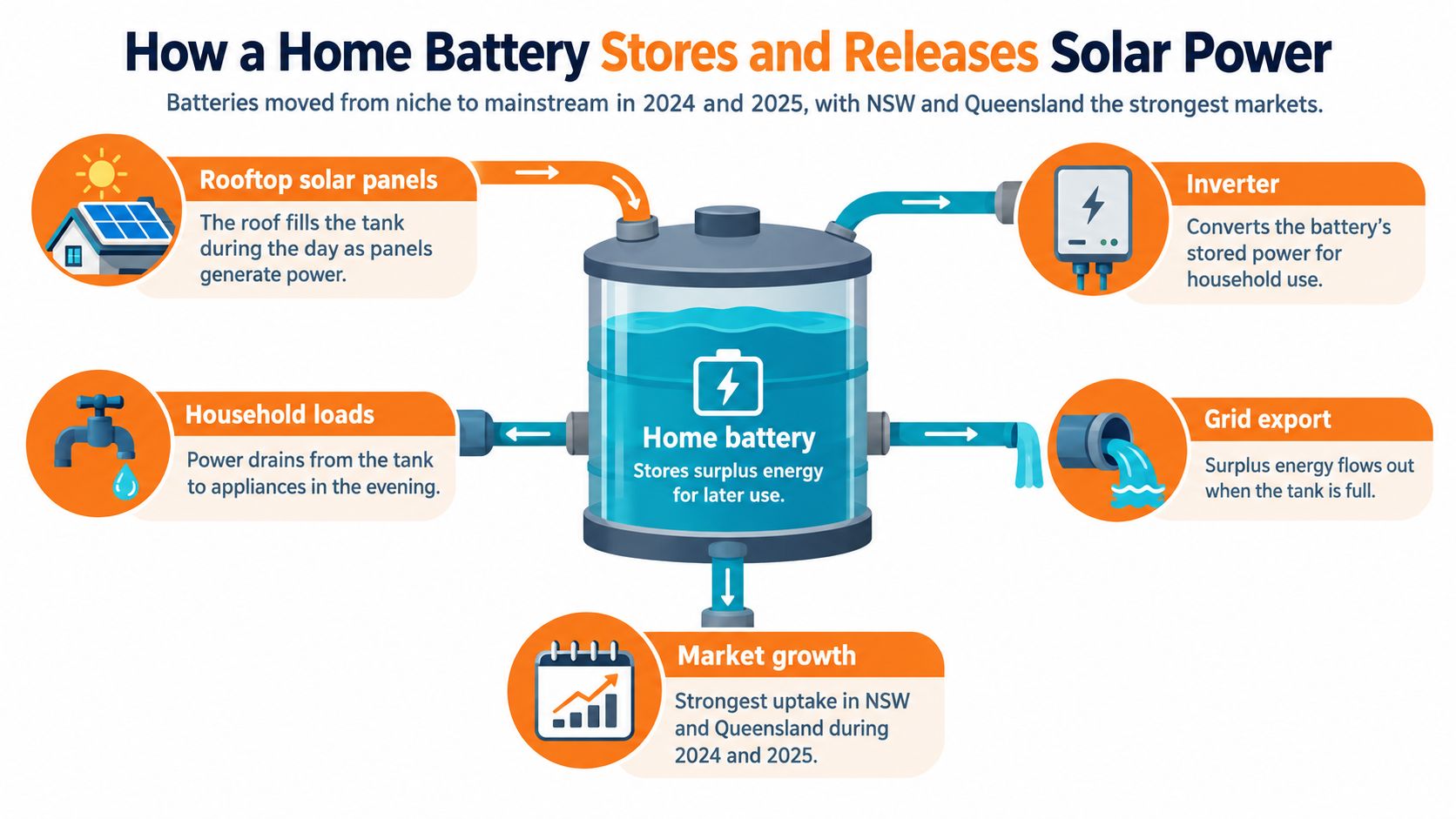
New South Wales recorded 14,686 battery sales in the second half of 2024 and Queensland 8,555. Together those states accounted for 23,241 sales in six months, roughly 31% of Australia's reported sales in that period, in the ACCC National Electricity Market inquiry report. By the end of 2024 about 185,798 home batteries were installed, and 28.4% of rooftop solar systems installed in the second half of the year included a small-scale battery.
A battery does three jobs. It lifts self-consumption of your own solar. It shifts energy into higher-priced periods. It can keep designated circuits alive in an outage, if the hardware is built for backup.
A battery creates no energy. It only moves solar or grid power through time, and a larger nameplate isn't automatically the better buy.
On its own it stores what it's given and releases that energy under the settings you, or a control program, apply.
System Types and Which One Fits Your Home
The split that matters is how the battery sits relative to the solar inverter. That choice sets conversion losses, outage behaviour and how hard a retrofit is. Start with the inverter you already own, then pick capacity.
| System type | Best fit | Behaviour in an outage | Solar charging path | Retrofit effort |
|---|---|---|---|---|
| AC-coupled battery | Existing solar with a compatible inverter, adding storage later | Only if a backup gateway and circuits are installed | Solar charges via the battery's own inverter, with extra conversion | Usually lower |
| DC-coupled hybrid | New solar and battery installed together | Often supports backup circuits | Direct solar-to-battery path with fewer conversions | Higher if replacing an existing inverter |
| Backup-capable hybrid with essential circuits | Households where outages matter most | Designated circuits stay on | Same as DC-coupled or AC-coupled, depending on design | Higher; separate circuit wiring |
| Battery-only, grid-charged | Limited cases, such as no solar or a specific tariff | Off in a blackout unless backup circuits are wired | No solar charging; relies on grid electricity | Moderate; exposed to tariff costs |
AC-coupled and DC-coupled
An AC-coupled battery sits behind the existing solar inverter. It suits a retrofit. Solar is converted to household power, then converted again to charge the battery, so you pay an extra efficiency step on every cycle. Say you already have a string inverter that still has years left. An AC-coupled unit avoids ripping that inverter out, provided the models can be paired and the switchboard has room.
A DC-coupled hybrid shares one inverter with the panels. Energy can move from the roof to the battery with fewer conversions, which usually means less loss on the solar-charging path. The trade-off shows up when the existing inverter has to come out. Labour, cabling and a switchboard tidy-up often cost more than the battery brochure suggests. A plain explanation of how the shared inverter is wired sits in our note on a hybrid solar system.
Backup circuits and grid-only batteries
Backup isn't automatic. A standard grid-tied battery can shut down when the grid fails, because it isn't allowed to energise a dead line. A backup gateway and a separated essential-circuits board keep the fridge, lights, internet and a few power points on. The rest of the house goes dark. Whole-home backup needs far more power and a larger usable reserve than most evening-load designs.
A battery-only system charges from the grid. There's no free solar to store, so every kilowatt-hour you later use has already been bought, plus round-trip loss. That path only makes sense on a tariff with a wide, reliable price gap, and warranties sometimes restrict grid charging.
Practical rule: If you already have solar, read the inverter model number before you talk about kilowatt-hours.
Sizing a Battery to Your Household Load
A 13.5 kWh battery in a home that uses 8 kWh after dark cycles at half its nameplate every night, and the surplus earns little. Useful size follows the energy you use after sunset, not the size of the array. A big roof on a small evening load fills a battery by lunch and leaves the rest with nowhere to go.
Pull 12 months of bills, or the smart-meter export from your retailer portal. Note average daily import, then estimate the evening share: cooking, cooling or heating, hot water, and anything that runs after the array drops off. That evening slice is the first sizing input. Daytime loads the roof already covers don't justify extra storage.
Usable value, not the label
Usable value is what's left after a backup reserve and conversion losses, then what's left again after years of cycling. Australian government guidance on warranties and insurance notes that warranties may be limited by years, charge cycles, total throughput or end-of-warranty capacity, and may restrict grid charging, daily cycling or operating conditions. A nameplate figure describes the box, not the kilowatt-hours you can bank on.
Work the sum in this order.
- Reserve first: Subtract the kilowatt-hours you refuse to spend, so backup or morning use stays available.
- Then losses: Apply round-trip loss to what's left. A full nameplate cycle doesn't land as a full usable cycle.
- Then the cap: Check cycle or throughput limits. Extra daily cycling can burn the warranty faster than the bill saving pays for.
- Then the network: A DNSP export limit can stop you emptying a large battery into the street on a mild evening.
New installations have trended larger, and many now arrive bigger than the evening load they're meant to serve. If export limits, low overnight demand or a throughput cap stop frequent productive cycling, the extra capacity can lower returns rather than raise them.
| Daily household use | Indicative usable capacity | Typical household profile | Sizing note |
|---|---|---|---|
| Under 10 kWh per day | 5-8 kWh | Small home, low evening load | Extra capacity often goes unused |
| 10-15 kWh per day | 10-13.5 kWh | Typical single-level family home | Check evening share before choosing 13.5 kWh |
| 15-20 kWh per day | 13.5-20 kWh | Larger home, air conditioning or electric hot water | Confirm export and warranty limits before upsizing |
| Over 20 kWh per day | 20 kWh and above | Large home or electric vehicle charging | Model daily cycling and warranty throughput |
These bands are planning guides, not a quote. Before you commit, check three things: the evening share of daily use, the distributor's export and tariff settings, and the warranty's cycle or throughput cap. If the battery would sit above 80% state of charge most nights, you don't need the next size up. For what stays on when the street goes dark, the home backup guidance from Amp'd Energy Solutions is a useful cross-check on circuit loads, separate from bill savings.
Installed Costs and What Drives Payback
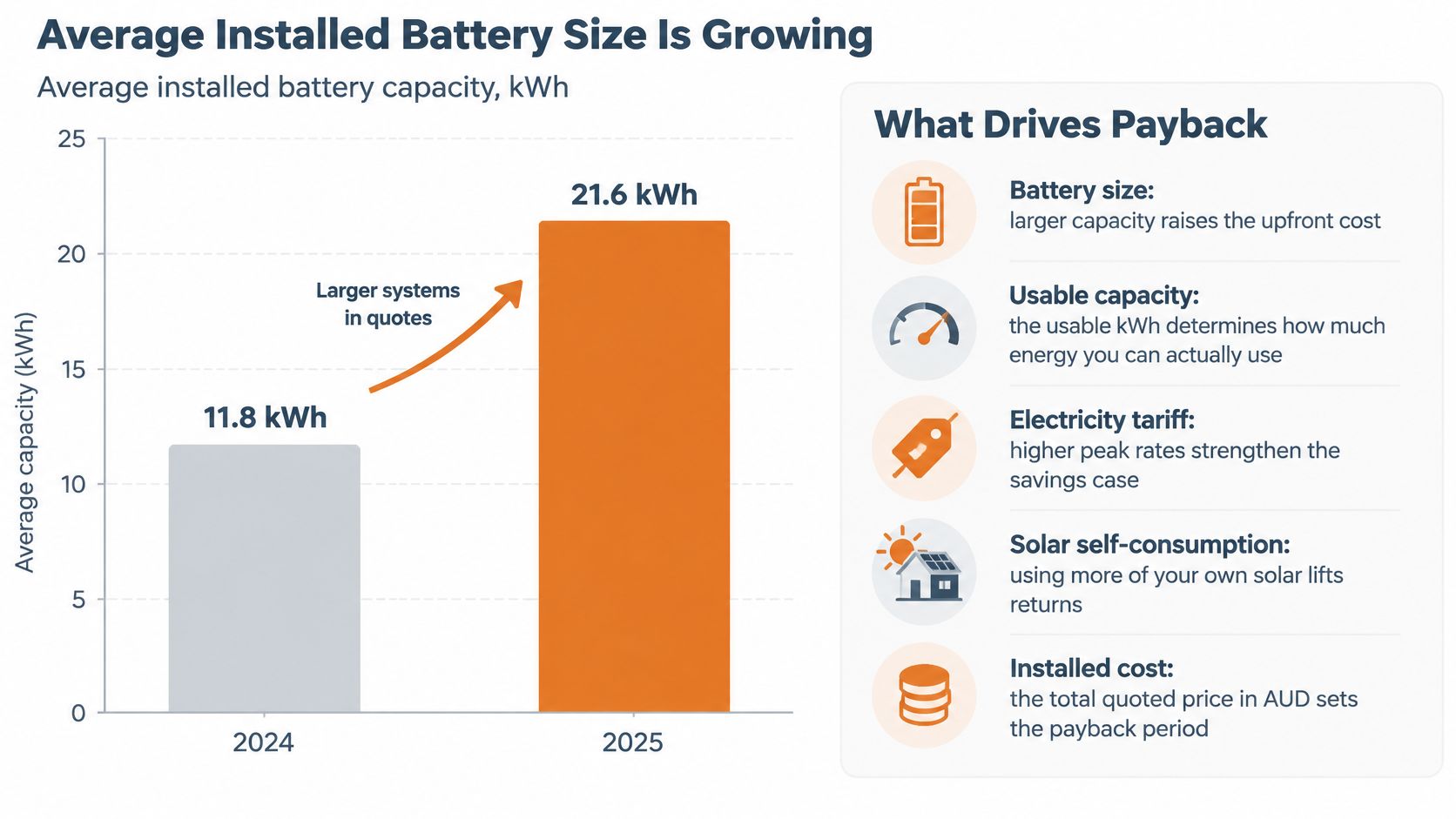
Quotes got bigger because the batteries did. SunWiz figures reported by Renew Economy put 221,000 residential systems installed in 2025, against 72,500 in 2024, adding about 4,790 megawatt-hours. By the end of 2025 batteries were in about 4.6% of Australian homes, and 13% of rooftop solar systems had an associated battery. Average size rose from 11.8 kWh in 2024 to 21.6 kWh in 2025.
What moves the quote
Installed price follows usable capacity, but not in a straight line. A hybrid inverter costs differently from an add-on AC inverter. Backup wiring, a switchboard upgrade, long cable runs and labour in a tight meter box all sit on top. The federal battery subsidy discounts eligible systems, and both eligibility and the discount depend on size and the rules on the day you buy. Treat any "after subsidy" number as provisional until the installer writes it down.
The bands below are indicative only, before subsidies, and they aren't taken from a price survey. Check each one against a current written installer quote.
| Usable capacity | Indicative installed cost (AUD) | Typical use case |
|---|---|---|
| 5 kWh | $4,000-$6,500 | Small home, limited evening load |
| 10 kWh | $7,000-$10,000 | Moderate evening load, partial backup |
| 13.5 kWh | $9,000-$13,000 | Typical family home, self-consumption focus |
| 20 kWh | $12,000-$18,000 | Large evening load or electric vehicle charging |
One payback sum you can audit
Payback is net cost divided by annual net saving. Annual saving depends on the tariff spread, the export rate, how fully you cycle, and degradation over time. Two quotes aren't comparable unless they use the same four inputs.
Say the net cost after any discount is $9,000, and a full daily cycle saves $900 a year at your tariff. Simple payback is 10 years. If real cycling is only half of that, because evenings are light or export is capped, the saving falls to $450 and payback stretches to 20 years. Same battery, same roof, different result. The nameplate capacity matters less than the kilowatt-hours you really cycle, and the warranty's throughput cap bounds how many of those cycles can earn a saving before degradation trims the later years. A payback quoted without those inputs isn't a number you can compare. Run the same four inputs against your own bill with a battery payback calculator before you treat any quoted figure as final.
How VPP Participation Changes Battery Economics
A Virtual Power Plant aggregates many home batteries under one control platform. It isn't a monitoring app. A fleet controller reserves part of each battery's charge or discharge headroom, groups thousands of small inverters, and sends fast commands.
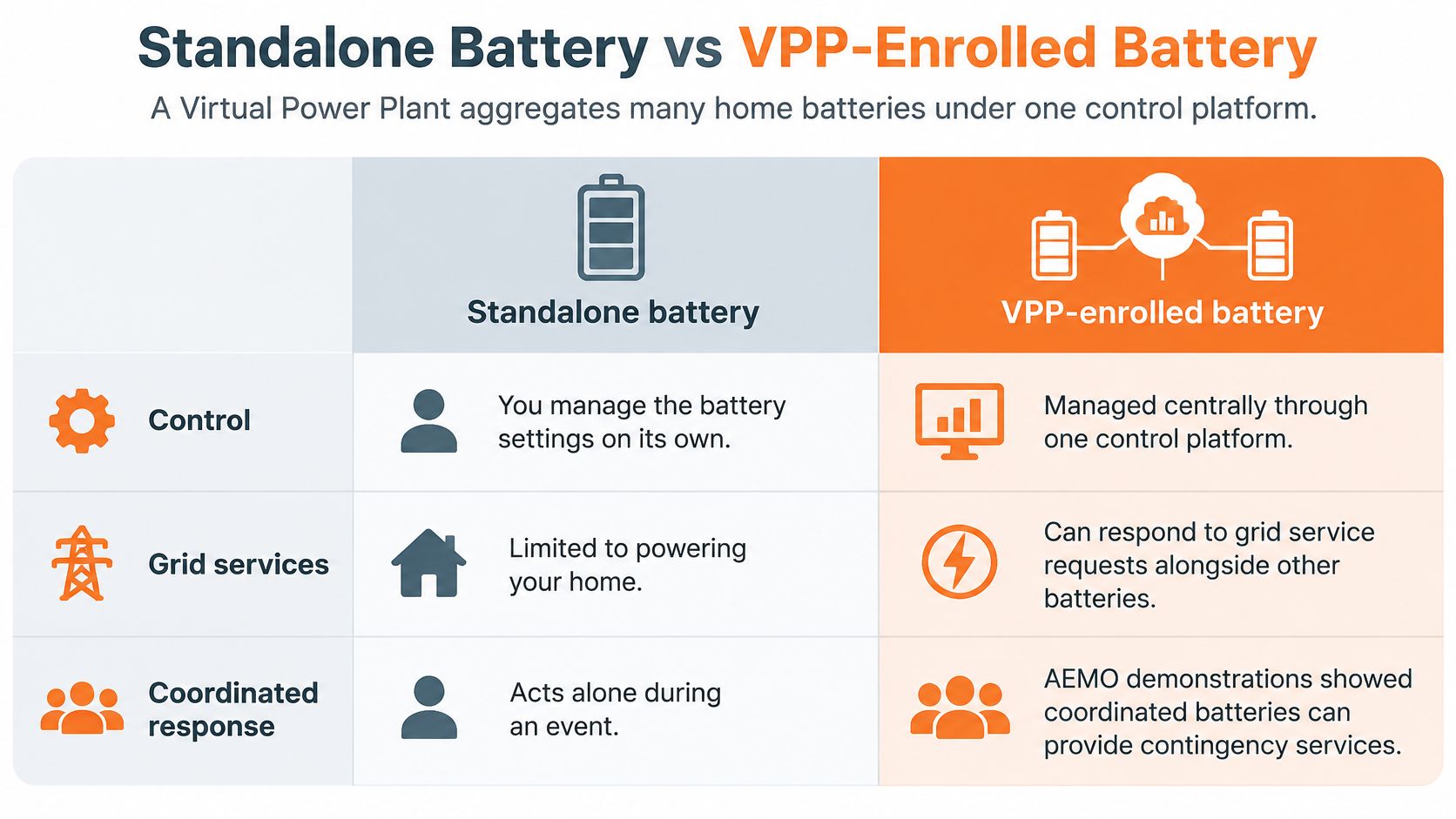
AEMO's VPP demonstrations knowledge sharing report found that coordinated household batteries can provide contingency Frequency Control Ancillary Services (FCAS), respond to wholesale prices in near real time, and sometimes deliver local network services at the same time. Participating VPPs reached 3% of contingency-FCAS market share in April 2021, up from 0.6% a year earlier. AEMO described household batteries as reliable and effective for that service.
Household use stays first
For a Queensland or NSW owner, value isn't the nameplate. It's the spare capacity left after your own forecast. A sound platform enforces state-of-charge floors, inverter power limits, communications fail-safes and a customer override before it offers anything to the grid. Telemetry quality, dispatch accuracy, market eligibility and response speed decide whether that spare slice earns anything.
A common fear is that a VPP drains the battery before dinner. It shouldn't. Your household energy use is always prioritised before supporting the grid. The VPP is limited to spare capacity. That still isn't a promise of backup. Participation doesn't guarantee a minimum charge level or backup power during an interruption, and remote charge or discharge for market participation can change the stored level at a given moment.
The retailer path is simple to audit. You bring your existing solar and battery. The battery joins the HighFlow Virtual Power Plant. HighFlow supports the grid using spare capacity only when the battery is available. Grid-support revenue funds a monthly bill-free electricity allowance. The allowance can cover supply and usage up to that cap. Usage above it is billed. "Bill-free" doesn't mean every charge on the account disappears.
A short walk-through of how fleets are dispatched is in this video.
| Value source | How value is earned | Who keeps the value | Main trade-off |
|---|---|---|---|
| Feed-in tariff only | Exporting surplus solar at the retailer's set rate | Household | Export rates are often low and export limits can apply |
| Self-consumption | Using stored solar in the evening instead of buying grid power | Household | Value depends on the size of the evening load |
| Time-of-use shifting | Charging in lower-price periods and discharging at peak | Household | Price spread must exceed round-trip losses and degradation |
| Retailer VPP allowance | Grid-support revenue funds a monthly bill allowance | Household through the allowance structure | Only spare capacity is used and reserves are not guaranteed |
| Direct market participation | Aggregated capacity earns wholesale or FCAS revenue | Shared between aggregator and household under contract terms | Requires telemetry, dispatch accuracy and higher cycling exposure |
A feed-in tariff pays only for exported surplus, often at a low rate, and a DNSP cap can cut it further. Self-consumption and time-of-use shifting keep the value in your bill, but only if the evening load or the price gap is real. A retailer BYOB VPP (bring your own battery) turns grid-support revenue into an allowance you can read on the bill. Direct market participation can pay more and cycle harder. More on how a retailer fleet is structured is on our solar battery virtual power plant page.
Cycling adds wear and can press a throughput warranty. Low-value price arbitrage can fail the test once round-trip loss and degradation are counted. Join only if the allowance, or the contract share, is likely to beat that extra wear and any change of tariff.
Installation Checks Before You Commit
Confirm the tariff and the approvals before you buy hardware. Then choose the battery. Enrol in a VPP last, once the system is actually compatible.
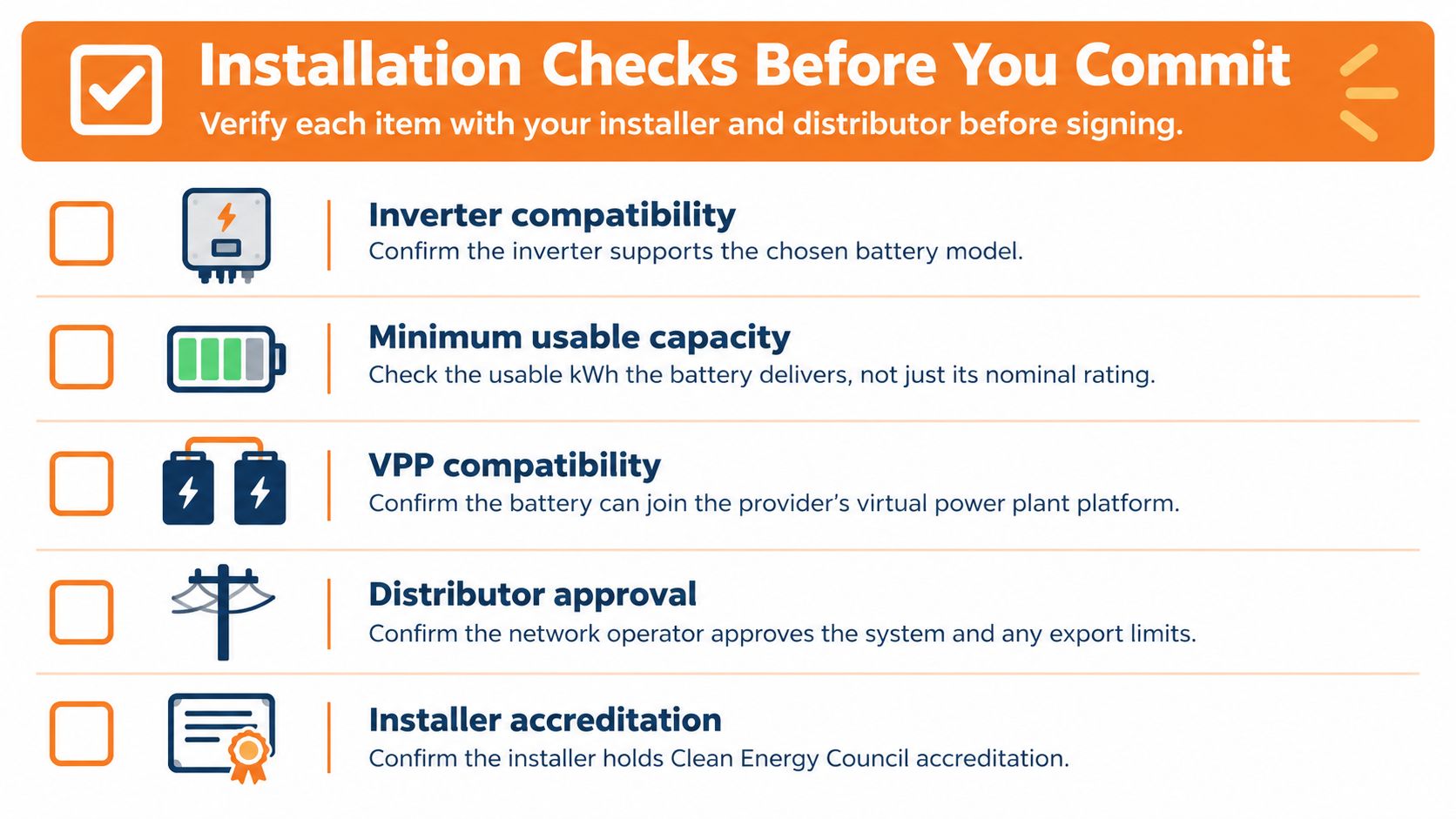
- Inverter and battery match: Confirm the inverter pairs with the battery, and that usable capacity, inverter type and VPP compatibility meet the program standard. Eligible batteries must meet minimum usable capacity, inverter requirements and VPP compatibility standards.
- Switchboard: Ask whether the board has spare capacity or needs an upgrade before the battery is connected.
- Distributor: Get approval and complete notification for a battery added to solar. Export limits are set here, not in the brochure.
- Location: Check ventilation, the allowed temperature range and clearance. A hot garage can void conditions the warranty relies on.
- Installer: Use a Clean Energy Council accredited installer, and keep the compliance paperwork.
- Warranty fine print: Read limits on grid charging, throughput and operating temperature before you agree to automated cycling.
- Internet: A VPP needs a live connection to the battery. To join, you need a compatible solar system, a compatible home battery and that connection. No new hardware is required if those three are already in place.
Queensland's 44 cent tariff
Queensland's legacy Solar Bonus Scheme pays eligible customers 44 cents per kilowatt-hour, and it is closed to new customers. To keep eligibility, annual consumption must stay below 100 megawatt-hours, and you must check with your distributor before adding panels, batteries or other generation. The Queensland Government Solar Bonus Scheme page states that alternative sources, including batteries, may only be used when the 44-cent system isn't operating, such as at night or during a blackout, or through a separate connection. Change the wiring first and you can lose a tariff that still dominates any VPP allowance. Confirm that impact in writing before anyone opens the switchboard.
Frequently Asked Questions About Home Batteries
How long does a home battery last?
Battery life comes down to how much usable capacity the cells lose as they age, and every charge and discharge cycle contributes to that loss. The warranty's years, cycle count and throughput cap, plus how hard you cycle, set the practical life more tightly than the brochure year count. A battery cycled gently on spare capacity will typically hold its usable capacity longer than one run hard every night.
Will my battery keep the lights on in a blackout?
Only if it's a backup-capable system with designated circuits through a backup gateway. A standard grid-tied battery may shut down when the grid fails, even if the tank still holds charge. VPP participation doesn't change that: joining one doesn't guarantee a minimum charge level or backup power during an interruption.
Does joining a VPP drain my battery?
No. Your household use always comes first, the program draws only on spare capacity, and you keep full ownership and control of the battery. A remote charge or discharge for market participation can still change the stored level you see in the app, so treat the dispatchable share as a revenue asset rather than a guaranteed reserve.
Can I add a battery to a Queensland Solar Bonus Scheme system?
Check with the distributor before you change anything. On the legacy 44-cent arrangement, batteries may only run when the tariff system isn't operating, such as at night or during a blackout, or on a separate connection. Eligibility also hinges on staying under the annual consumption cap, so a wiring change made in the wrong order can cost more than the battery earns.
Is a bigger battery always better?
No. Export limits, a small overnight load and a throughput cap can leave the extra kilowatt-hours idle. Idle capacity costs money up front and cycles less often, which is why usable throughput matters more than nameplate size when you compare options.
How does VPP value differ from a feed-in tariff?
A feed-in tariff pays only for exported surplus at the retailer's rate. VPP participation can fund a monthly bill-free electricity allowance from grid-support revenue, drawn only from capacity you aren't using yourself. The allowance has a ceiling: usage above it is billed at the applicable excess usage rate.
Confirm Whether Your Battery Is Underused
Key takeaways
- A home battery stores solar or grid energy. It doesn't create it.
- Usable capacity after reserves and losses matters more than nameplate kWh.
- Cost and payback are comparable only when tariff, export, cycling and net price are the same.
- VPP value depends on spare capacity, household priority and warranty limits, not on headlines.
- A legacy feed-in tariff needs a distributor check before any equipment change.
Do these four checks this week.
- Pull the last 12 months of bills and note average daily import and export.
- Record usable capacity and the warranty's cycle or throughput cap, not just the marketing kWh.
- Estimate the evening share of daily use and compare it with how often the battery cycles.
- Read the tariff and the distributor's export conditions before you change settings or hardware.
If the battery sits near full through the late afternoon, or exported energy is paid poorly, the asset is underused. That's an operating problem, not an installation problem.
HighFlow Energy is an electricity retailer for homeowners in Queensland or New South Wales who already have solar and a compatible battery, still receive a bill, and want more from equipment they own. You keep full ownership and control. The house stays first. There's no new hardware and no lock-in of the kind that forces a battery purchase through us, because this plan doesn't supply the battery.
Most battery owners focus on installation quality. Far fewer focus on ongoing performance and optimisation. HighFlow Energy is an electricity retailer built around releasing the full value of your existing solar and battery system. If you would like to understand whether your battery is underperforming financially, request an eligibility assessment today.
HighFlow Energy coordinates spare capacity from the solar and battery you already own, in Queensland and New South Wales, and applies the value to a monthly electricity allowance while your own use stays first. If your bills haven't fallen in line with the battery on the wall, an eligibility check shows whether that gap is spare capacity going unused. Visit HighFlow Energy and request an assessment against your current bill, tariff and battery.