

Solar Panel Life Cycle: Stages, Lifespan and Recycling
Australia's decommissioned solar-panel waste could approach 1 million tonnes by 2035, according to a UNSW Sydney report. That projection reframes the solar panel life cycle: a panel's environmental value isn't determined only by how much electricity it generates, but also by how long it stays useful and what happens when it leaves its first roof.
For homeowners in Queensland and New South Wales, the key question isn't merely whether a panel has reached a stated lifespan. It's whether it remains safe, productive and economically useful compared with the alternatives. The answer can affect maintenance, inverter and battery decisions, and whether an older panel should keep generating, be reused or be replaced.
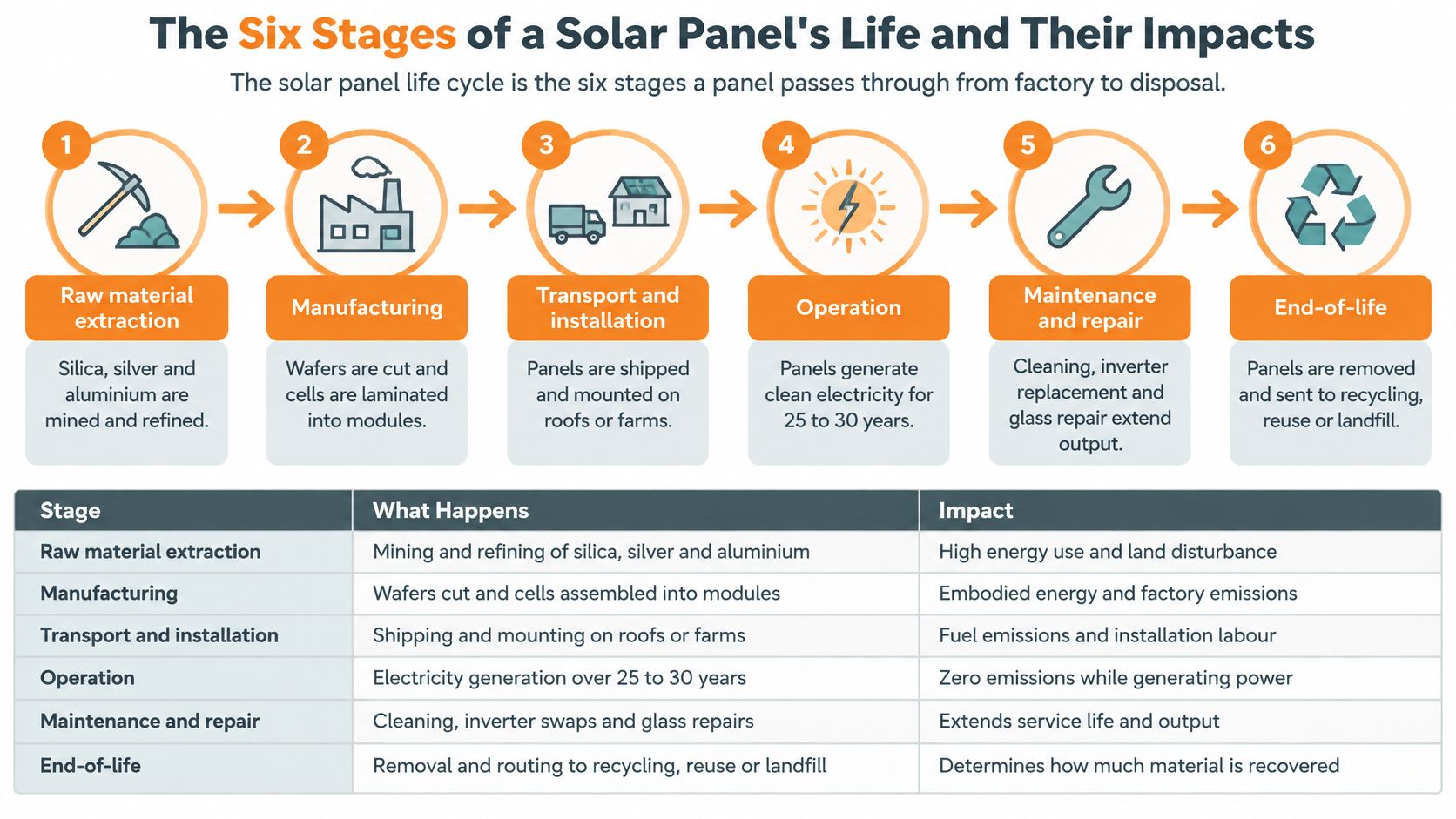
The Six Stages of a Solar Panel's Life and Their Impacts
The solar panel life cycle is the six stages a panel passes through from factory to disposal. Read economically, the useful question at each stage is whether keeping the panel in service produces cheaper, cleaner energy than the available alternative.
| Stage | What happens | Typical timing | Main impact |
|---|---|---|---|
| Manufacture | Silicon purification, wafer and cell production, glass and frame assembly | Before first generation | Largest share of embedded energy |
| Transport | Shipping from manufacturing hubs and freight to installers | Before installation | Freight emissions and packaging waste |
| Installation | Racking, wiring and inverter commissioning | Usually a few days per home | Labour, mounting materials and roof penetrations |
| Operation | Daytime electricity generation | Decades | No operating emissions; output declines gradually |
| Maintenance | Cleaning, inspection and inverter service | Ongoing | Protects output and limits premature failure |
| End-of-life | Removal, reuse, recycling or landfill | Often earlier than design life | Largest variation in outcome between pathways |
From raw materials to a working system
Manufacture begins before the module reaches a factory assembly line. Silicon is purified, cut into wafers and made into cells, which are assembled with glass and an aluminium frame. This stage carries much of the system's embedded energy, which generation must repay over time.
Transport moves panels from manufacturing hubs to installers in Queensland or New South Wales. Freight and packaging add impacts, although the major contribution to a panel's life-cycle burden is associated with making it.
Installation puts the equipment to work. Installers fit racking, wire the array and commission the inverter. The quality of roof penetrations and mounting matters: poor workmanship can compromise roof integrity and create repair needs unrelated to the panel itself.
Generation, upkeep and retirement
Operation is the long production phase. Panels generate electricity without operating emissions, and output generally declines as modules age. Australian Government energy information gives a practical panel service-life range of 20 to 30 years in its overview of solar system replacement and recycling. Treat that range as a planning boundary: capacity, safety, roof condition and system value decide whether a panel stays useful.
Maintenance includes checking for damage and keeping panels clean when it's worthwhile. The inverter also needs attention: it converts the panels' electricity into a form the home can use, and it may need replacing before the panels do. A small fault caught early can prevent wiring damage from ending a workable array.
End-of-life is a routing decision with uneven outcomes. A panel might continue generating on another site, be refurbished, enter a recycling stream or go to landfill. Reuse can beat recycling when the module still works safely, because it extends the energy-producing life already paid for; recycling becomes the better pathway when damage, incompatibility or poor output removes that option. Manufacturing choices influence how readily materials can be recovered, while homeowners have more direct influence over maintenance and removal. An Australian life-cycle assessment estimated an energy-payback period of 7.91 years once output decline was included. After that point, a panel generates net energy for the remainder of its operating life.
Keeping a rooftop system productive can also reduce its life-cycle burden. Homeowners can learn more about reducing a household's carbon footprint by making better use of existing energy assets and avoiding premature replacement.
How Long a Solar Panel Really Lasts
A solar panel's design life is commonly modelled at 25 to 30 years, but that isn't a guaranteed time it will remain on a particular roof. Australian parliamentary inquiry material reports that panels disposed of in Queensland are often only 7 to 10 years old, well below their expected service life. The Australian parliamentary inquiry links early replacement to falling panel prices, improving efficiency, storm damage, cracked glass, moisture ingress and household system upgrades.
It helps to distinguish three meanings of “lifespan”. Design life is the period used to model expected service. Service life is how long a panel remains in use, whether on its original roof or elsewhere. Economic life is the period it remains worthwhile to operate given its output, repair needs, roof work and system compatibility.
Modelled output over time
Australian photovoltaic life-cycle modelling uses an average output degradation assumption of 0.7 per cent per year. Applying that rate as a compound decline gives the following illustrative retained-output estimates.
| Year | Output retained | What happens at this point |
|---|---|---|
| 0 | 100% | Commissioning baseline |
| 10 | 93% | Early decline, usually not visible on a bill |
| 15 | 90% | Inverter commonly replaced around this point |
| 20 | 87% | Lower midday surplus for battery charging |
| 30 | About 81% | Design-life endpoint before any unplanned losses |
These are fleet-average model estimates, not promises about an individual system. Shading, dirt, temperature, faults and physical damage can reduce actual output further. Conversely, a panel's design-life endpoint doesn't mean it stops producing electricity that day.
A panel can still generate after it's removed from a roof. In many cases, “end of life” means the end of its first installation, not zero generation capacity. Australia's parliamentary inquiry estimated that about 60,000 tonnes of panels, approximately 3 million panels, reached end of life during 2025, and projected annual volumes above 90,000 tonnes by 2030. For an owner, a practical first test is to compare measured annual output with the system's original commissioning figure, allowing for differences in weather and operating conditions.
Keeping Output High Through Operation and Maintenance
Judge an ageing system by its current midday output and useful energy, not just its original nameplate rating. A yearly review can separate gradual ageing from a fault, new shade or damage that deserves attention.
- Compare annual yield with the commissioning baseline. Use monitoring records or inverter data, and account for weather differences before treating a change as a fault.
- Clean panels when visible soiling makes it worthwhile. Dust and debris can reduce light reaching the cells, especially where rainfall doesn't regularly wash the surface. For practical background on keeping solar panels clean, use guidance that reflects the panel manufacturer's cleaning recommendations.
- Check for new shade. Growing trees, extensions or nearby structures can change how much sunlight reaches the array.
- Look for signs of physical damage. Cracked glass, moisture ingress or loose mounting are reasons to arrange a qualified inspection rather than assume normal ageing.
- Check inverter operation and plan for replacement. Confirm it's operating within its specified range, and allow for at least one inverter replacement over a long rooftop-solar operating life.
- Keep records together. Retain module warranty terms, installer details, commissioning information and service records so you can compare performance over time.
Follow the manufacturer's maintenance guidance. HighFlow Energy recommends running high-energy appliances during daylight hours, avoiding unnecessary overnight grid usage, and maintaining the solar and battery system according to manufacturer guidelines. Using electricity while panels are producing can make more direct use of the generation available at that time.
A consistent record helps distinguish expected output decline from an abnormal loss that may be repairable. As midday surplus changes, battery charging and discharge plans may need review too. A battery strategy designed around an array's original output can become poorly matched to the system if its available solar energy falls.
End-of-Life Pathways and Repair, Reuse or Replacement Decisions
Recycling isn't automatically the greenest choice for every working panel. The best end-of-life outcome depends on whether equipment is landfilled, partly recycled, fully recovered or kept in useful service through reuse. That distinction matters because manufacturing has already used energy and materials; discarding an electrically safe module early can waste some of its remaining productive life.
The Australian Government's solar-panel guidance states that more than 95 per cent of a panel is technically recyclable, including glass, aluminium, copper, silver and silicon, while current recycling remains below 5 per cent. For Australian households, this gap makes the practical pathway important. Collection arrangements, transport distances and available processing determine what can be recovered in practice.
Comparing the measured pathways
A 2021 Australian life-cycle assessment compared landfill and two recycling pathways over a 30-year photovoltaic system lifespan. Its ReCiPe endpoint single score measures life-cycle impact, with lower scores indicating a lower impact in this comparison.
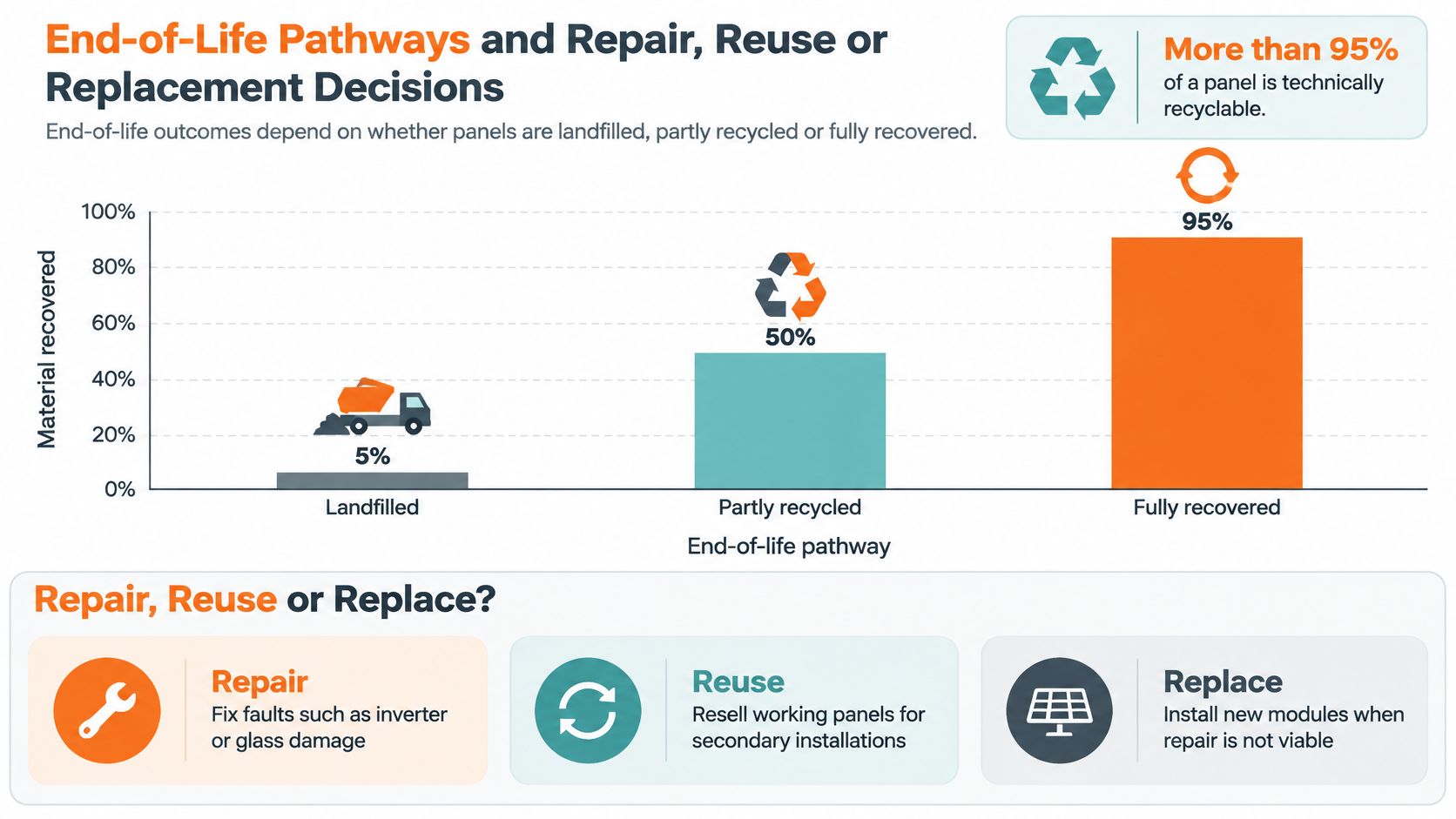
| End-of-life pathway | ReCiPe endpoint single score | Change compared with landfill |
|---|---|---|
| Landfill disposal | 0.00706 | Baseline |
| Laminated-glass recycling facility | 0.00657 | About 7% lower |
| Fuller end-of-life material recovery | 0.00523 | About 26% lower |
In this assessment, recycling lowered total life-cycle impact compared with landfill. The same assessment estimated that cumulative Australian photovoltaic waste could exceed 800,000 tonnes by 2047. More recent projections in the Australian Government's panel guidance put national waste at about 59,340 tonnes in 2025 and 91,165 tonnes in 2030, with cumulative waste approaching 1 million tonnes by 2035. Those projections underline why a homeowner should plan the destination before a contractor removes the equipment.
Use a second-life assessment
Before replacing panels that still operate, assess five things:
- Measured output: Compare annual generation with the commissioning baseline.
- Degradation trend: Look at changes over time rather than drawing conclusions from one reading.
- Repairability: Check whether the fault lies in the panel, inverter or another part of the system.
- Roof access and condition: Roof work can change the cost and practicality of retaining equipment.
- Replacement impacts: Consider the materials and transport involved in a replacement, as well as the generation the new modules could add.
A panel producing less electricity around midday may still be useful when paired with storage or household load shifting. The decision isn't “old panel versus new panel” alone. It's whether the existing system can safely provide useful energy, and whether repair, reuse or replacement creates the better practical outcome.
Continue operating panels when their output and safety are acceptable. If a component must be replaced, coordinate panel, inverter and battery decisions only after checking battery compatibility, minimum usable capacity, inverter requirements and VPP compatibility. Ask the removal contractor for written confirmation of the reuse, refurbishment or recycling route, and keep it with serial numbers and installer records.
Damaged panels need controlled handling because breakage can complicate separation and transport. A proposed coordinated replacement may reduce repeat labour, scaffolding and transport, but only if each component's condition and remaining useful life justify doing the work together.
For a battery-linked home, HighFlow Energy's Bring Your Own Battery VPP requires a compatible solar system, a compatible home battery and an internet connection for the battery. That makes compatibility and remaining service life relevant to the replacement decision, not just the panel's age.
Why Panel Life Matters for Battery Owners
A battery's usefulness depends partly on how much solar energy is available to charge it. If panel output declines, the midday surplus available for storage can shrink, changing when the battery can charge and how much energy it can later supply to the home.
In the National Electricity Market (NEM), wholesale prices can move over time. Stored energy may be more valuable at some points than energy exported earlier, especially during peak pricing periods or demand events. That doesn't make a particular outcome certain: the benefit depends on the household's tariff, export settings, battery operation and available surplus.
Network congestion and export limits also matter in Queensland and New South Wales. Where a system can't export freely, using surplus behind the meter, including by charging a battery, may be more useful than relying on exports alone. A battery can then serve household demand and, if enrolled in an eligible programme, provide support to the grid when available.
A Virtual Power Plant coordinates participating batteries to support the electricity system through activities such as demand response and grid support. Customers retain ownership of their battery and priority use of stored energy; participation is layered around household needs and available capacity. The battery's dispatch plan should be reviewed whenever measured midday surplus changes, rather than left calibrated to year-one panel output.
Panel output is only one input to battery decisions. The battery's age, usable capacity, inverter requirements and the household's consumption pattern also shape how it should operate. For more on the battery side of the asset lifecycle, see how long solar batteries last.
Common Questions About Solar Panel Life Cycles
Does a solar panel stop working at 25 years?
No. The design-life figure is a modelling baseline, not a switch-off date, and a panel may continue generating at reduced output. Check its measured performance and safety before deciding to replace it.
Is recycling always better than landfill?
Recycling generally lowers total life-cycle impact compared with landfill in the Australian pathway assessment. Reuse may be preferable for a safe, working panel if it can continue generating useful electricity.
Do I need to replace panels when I replace the inverter?
No. Assess panel output, safety and system compatibility first, then decide whether the panels still make sense to retain.
What's the difference between a panel's lifespan and an inverter's?
The panel generates electricity, while the inverter converts it for household use and connection to the system. Inverter replacement may be needed earlier than panel replacement, so assess each component on its own condition and service needs.
Will a battery shorten the life of my panels?
Battery operation doesn't directly degrade panels. Coordinating maintenance and reviewing how the system uses its solar surplus can help avoid unnecessary replacement.
What should I ask a removal contractor?
Ask for written confirmation of whether the panels will be reused, refurbished, recycled or landfilled, and where they'll go. Keep that confirmation with the equipment's serial numbers and installer records.
Check Your System Before You Replace Anything
Most battery owners focus on installation quality. Before replacing a panel or system component, check three things:
- Measured annual output against the commissioning baseline.
- The age and condition of the panels and inverter.
- Battery performance against its current dispatch plan.
These checks help identify whether the problem is declining panel output, a failed component, a change in household demand or a battery plan that no longer matches available solar generation. If you're considering inverter work, compare the system's existing requirements with the replacement options before proceeding. This guide to solar inverter installation provides a useful starting point for understanding that part of the decision.
HighFlow Energy is an electricity retailer for Queensland and New South Wales homeowners with existing solar and a compatible battery. Customers bring their system, connect the battery to the HighFlow Virtual Power Plant, and HighFlow uses spare battery capacity to support the grid only when the battery is available. Customers receive a monthly bill-free electricity allowance, with household needs prioritised; no new hardware is required, and the offer has no fixed contract term or exit fee while the customer remains eligible and with HighFlow Energy.
Most battery owners focus on installation quality. Far fewer focus on ongoing performance and optimisation. HighFlow Energy is an electricity retailer built around unlocking the full value of your existing solar and battery system.
Request an eligibility assessment to understand whether your existing solar and battery system may suit HighFlow Energy's VPP. Assessment outcomes depend on eligibility, and retail services are provided under authorised energy retail frameworks.
HighFlow Energy connects eligible existing solar and battery systems to a VPP, using spare battery capacity to support the grid while prioritising household needs. If you're in Queensland or New South Wales, visit HighFlow Energy to request an eligibility assessment and see whether your system could benefit from ongoing battery optimisation.