


Home Battery Scheme QLD: Complete Guide 2026
The most popular advice about the home battery scheme QLD is also the least complete: find the rebate, choose a large battery, and install before the next policy change. That approach treats storage as a one-off purchase discount. The more important question for Queensland and New South Wales homeowners is what the battery will earn, save, and deliver after installation, particularly when solar output, household demand, wholesale price volatility, network constraints, and VPP participation are considered together.
Queensland's state Battery Booster program closed to new conditional approvals on 8 May 2024. The market has therefore shifted from a state rebate conversation to a broader value assessment. Upfront support still matters, but a battery's long-term economics depend on how intelligently it charges and discharges, how much solar the household uses, what the retailer pays for exports, and whether the system can participate in coordinated grid services.
Why Rebates Are Only Part of the Battery Value Equation
A rebate lowers the purchase price. It doesn't automatically make the battery financially productive.
That distinction matters because a home battery can sit underused even when it was purchased with government support. A system may charge during the day, discharge in the evening, and still miss value during demand events, high wholesale price periods, or network conditions where coordinated export control is useful. The hardware remains the homeowner's asset, but the operating strategy determines much of its commercial performance.
Queensland households should therefore separate two calculations:
- Upfront economics, including purchase price, installation, financing, and any available incentive.
- Operating economics, including solar self-consumption, avoided grid purchases, export income, battery cycling, backup priorities, and VPP payments or allowances.
The second calculation continues for the life of the system. It's also where the difference between a conventional retailer and a performance-focused VPP operator becomes visible. A standard electricity plan may record imports and exports without actively coordinating the battery around market conditions. A VPP can use software and retailer market access to coordinate multiple systems, subject to customer settings, technical capability, network rules, and household requirements.
Practical rule: Treat a rebate as a reduction in entry cost, not as proof of payback.
The central commercial question is whether the battery can create value repeatedly without compromising backup needs or warranty conditions. Homeowners comparing the solar battery ROI should assess the expected operating model, not just the advertised discount.
Queensland Battery Incentive History and Current Status
Queensland's battery policy has developed through more than one support model. In November 2018, an earlier state plan offered grants of $3,000 plus interest-free loans of up to $10,000 for up to 1,000 combined solar-and-battery systems. It also offered $3,000 grants plus interest-free loans of up to $6,000 for 500 battery-only systems, with loans repayable over 10 years. Energy Matters records this as an early large-scale attempt to make household storage more accessible.
The later Battery Booster program used a simpler rebate structure. Queensland announced it as a $10 million scheme intended to support about 2,000 eligible households. Rebates reached up to $4,000 for lower-income households and up to $3,000 for other eligible households. The Queensland Government announcement confirms that applications for new conditional approvals closed on 8 May 2024.
What the Battery Booster required
The scheme was designed around solar-plus-battery installations rather than general stand-alone storage. Requirements included:
- Solar capacity: A new or existing rooftop solar PV system of at least 5 kW.
- Battery capacity: An approved battery system of at least 6 kWh.
- Installer: An approved installer and approved battery system.
- Income: The standard rebate applied to households with combined annual taxable income of $180,000 or less, while the higher rebate was available where the income earner made $66,667 or less in the most recently ended financial year. Queensland's retailer fact sheet sets out these thresholds.
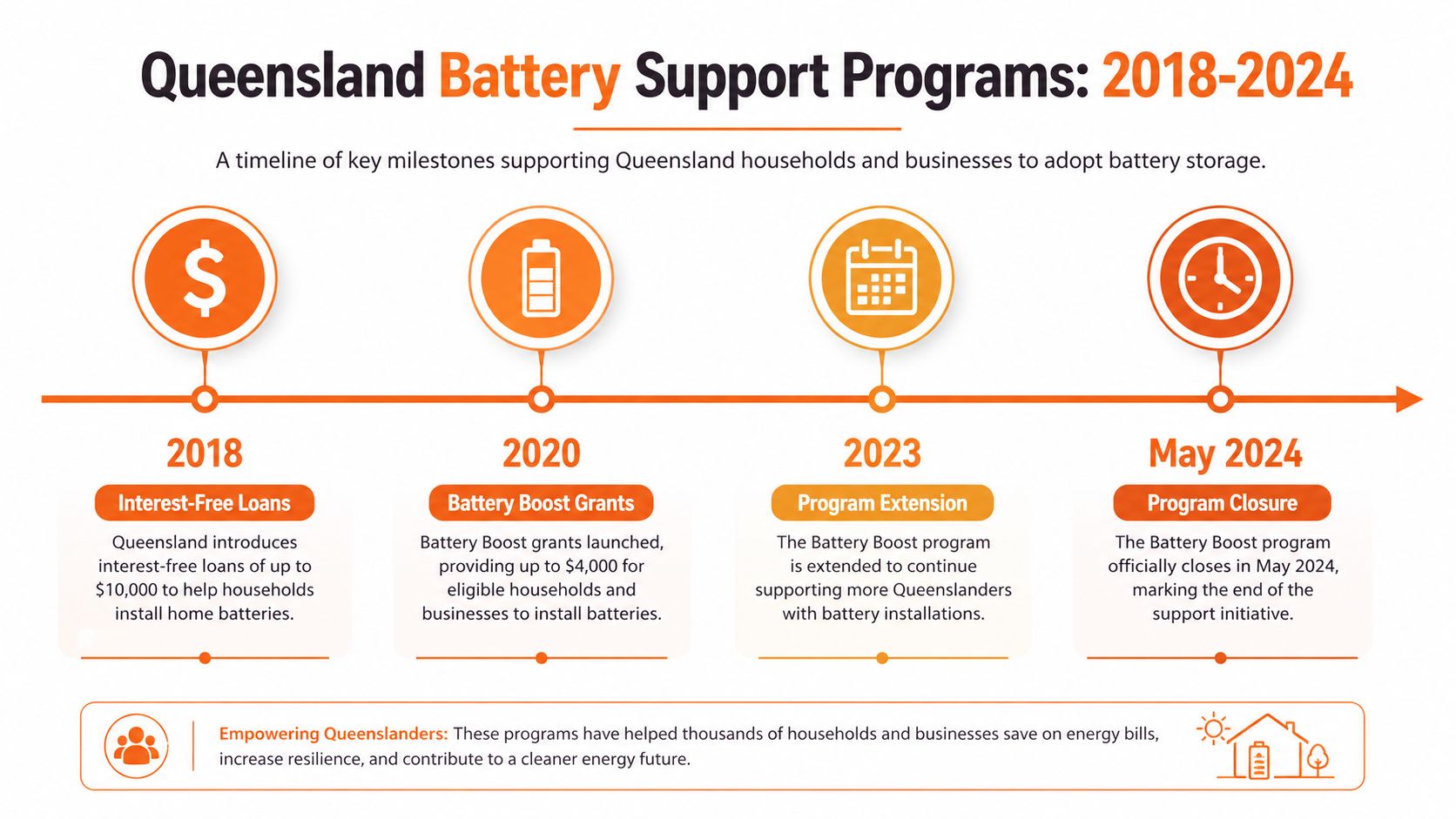
Queensland no longer has a dedicated state battery rebate for new applicants. Independent consumer guidance on the Queensland Battery Booster distinguishes the closed state program from federal support that may apply under separate rules. That distinction prevents a common purchasing error, relying on an old state rebate figure when assessing a current quote.
Federal Incentives vs State Schemes in 2026
The current incentive discussion for Queensland needs to distinguish the discontinued state Battery Booster from the federal Cheaper Home Batteries program. The federal program is not the same policy instrument as the former Queensland rebate, so homeowners should read the eligibility, installation, product, and timing conditions that apply to the federal arrangement rather than treating the old state thresholds as current.
A further change took effect on 1 May 2026. The federal structure became tiered, reducing the effective rebate for larger batteries over time. This makes system sizing more important. A larger battery may provide useful backup or greater energy shifting, but its additional capacity may receive less incentive support, so the homeowner must compare the installed cost with the household's actual load profile and likely operating benefit.
| Feature | QLD Battery Booster, closed | Federal Cheaper Home Batteries, active |
|---|---|---|
| Policy level | Queensland state scheme | Australian Government program |
| Current status | Closed to new conditional approvals on 8 May 2024 | Available under current federal rules, subject to eligibility and program conditions |
| Rebate design | Up to $3,000 for standard eligible households and up to $4,000 for lower-income households | Tiered support structure from 1 May 2026, with lower effective support for larger battery capacity over time |
| Solar requirement | New or existing rooftop solar PV system of at least 5 kW | Assess under current federal eligibility and installation requirements |
| Battery requirement | Approved battery of at least 6 kWh | Assess the proposed system against current federal rules and product requirements |
| Planning implication | Historical upfront assistance | Size and timing now need to be tested against installed cost and expected use |
The federal change doesn't mean the largest possible battery is automatically the most valuable. A system should be matched to solar production, evening demand, backup priorities, tariff structure, and export limits. It should also be assessed under the rebate level that applies when installation and certification occur, rather than under an earlier estimate.
Industry reporting cited in Queensland coverage says Australia has reached 400,000 home battery installations under the federal scheme, adding 11.2 GWh of storage since the scheme's announcement. Queensland Government guidance uses this adoption context to highlight the importance of checking current rebate conditions. The commercial lesson is straightforward. The incentive can accelerate installation, but correct sizing determines whether the installed asset remains financially rational after the incentive steps down.
Virtual Power Plant Participation and Real Bill Impact
A battery that only serves one home has one primary value stream, shifting energy across time for that household. A battery connected to a Virtual Power Plant, or VPP, can also support coordinated grid activity. The operator may aggregate many systems and manage charging or discharge in response to market signals, demand events, and network requirements, while preserving the household's stated priorities.
Independent coverage of the ACCC's July 2025 NEM inquiry reported that households with rooftop solar and a battery averaged $323 per quarter for energy bills. The same coverage reported that VPP participation could produce an additional $106 per quarter in savings, reducing average bills to $217 per quarter. Clean Energy Council coverage provides the cited bill comparison.
These figures don't guarantee the same outcome for every Queensland home. Results depend on battery compatibility, solar generation, consumption timing, retailer arrangements, network conditions, control settings, and the VPP's payment model. They do show why the ongoing operating model deserves as much scrutiny as the installation discount.
Where the value comes from
A retailer-based VPP can combine several mechanisms:
- Self-consumption: The battery stores surplus solar for later household use.
- Demand response: The operator changes battery behaviour during relevant system conditions.
- Grid support: Aggregated batteries can respond to signals that individual households can't access directly.
- Retail value: The retailer can structure credits, allowances, or other customer benefits around coordinated operation.
The trade-off is control. Customers need to understand when the VPP can operate the battery, what reserve is protected for the home, how cycling is managed, and how payments appear on the bill. Participation shouldn't be evaluated only by the headline allowance. It should be judged by the net value after household usage, battery wear considerations, and any limitations on dispatch.
For a plain-English explanation of how coordinated systems work, see High Flow Energy's guide to solar battery virtual power plants. Homeowners comparing technologies may also benefit from this expert solar comparison guide, particularly when considering how generation assets and storage fit into a broader energy plan.
The operational gap is becoming more important. Reporting in May 2026 described Australia's 400,000 home batteries as having “barely a VPP in sight”, highlighting the disconnect between installing storage and coordinating it as a grid asset. The hardware base can grow without households receiving the full value of flexible dispatch.
How to Assess Your Battery's Current Performance
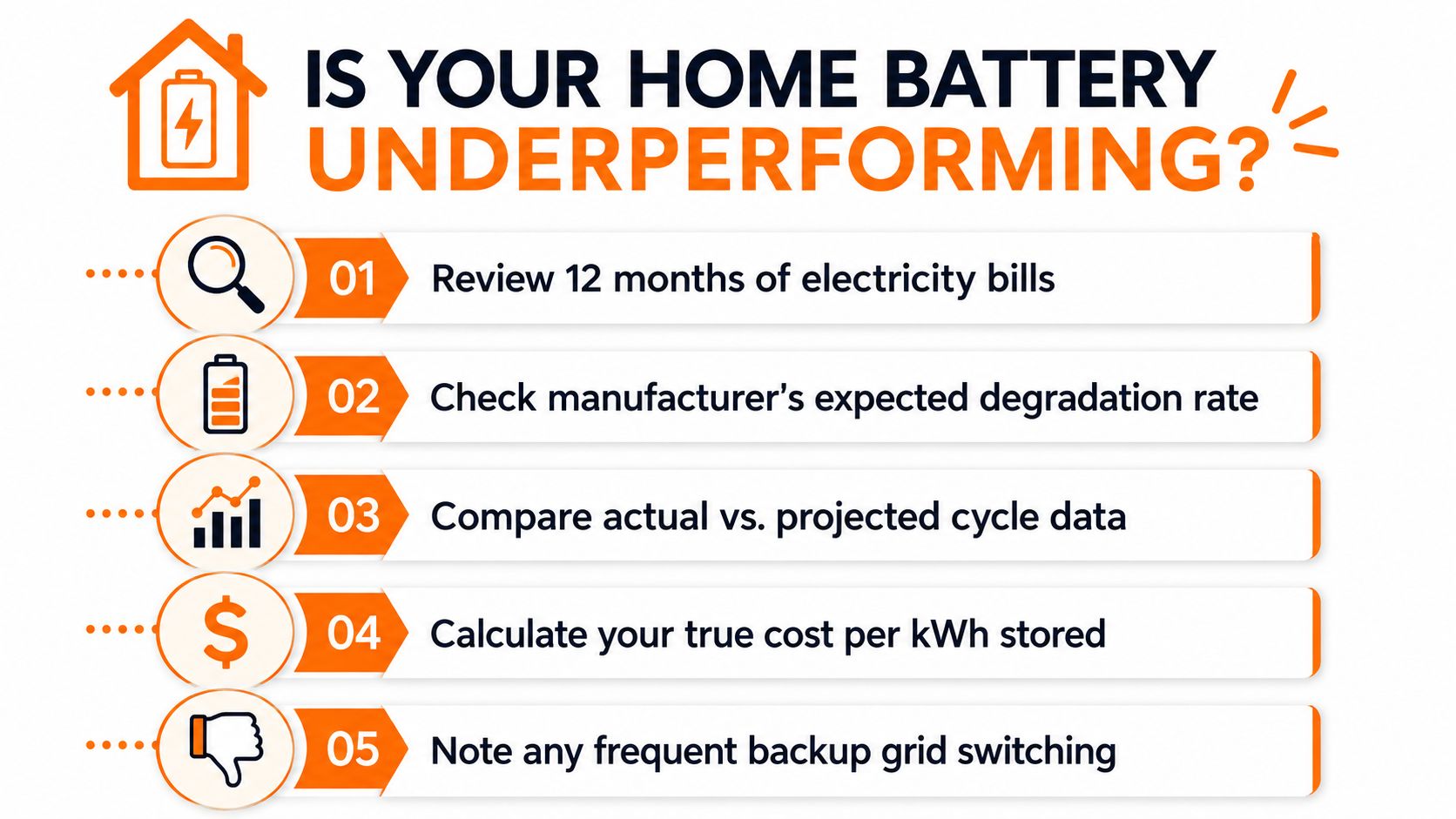
A battery's purchase price says little about its current economic value. Before changing retailers or joining a VPP, establish how the system performs under its existing settings, tariff, and household demand. The relevant comparison is the bill value created today against the value a different operating strategy could produce.
Use a full year of bills and battery data where available. Check for repeated imports after sunset, solar exports while the battery remains below its useful charge level, and grid purchases during periods when discharge should have been possible. These patterns may point to a control setting, tariff mismatch, limited capacity, or a load profile that does not suit the system.
A practical review sequence
Reconcile the bills. Record imports, exports, supply charges, usage charges, feed-in credits, and VPP-related credits. Feed-in revenue alone cannot show the battery's total contribution.
Review battery behaviour. Identify when charging begins, when discharge stops, and whether a backup reserve is maintained. A battery that stays idle during expensive periods may be following a setting that no longer matches household demand.
Compare solar and load timing. Heavy daytime exports followed by night-time imports may indicate useful self-consumption from storage. If the battery frequently remains full or empty at unsuitable times, its dispatch strategy requires examination.
Ask the current retailer precise questions. Can the battery join a VPP? Is a dynamic connection required? Who controls dispatch during demand events? How are credits calculated? What reserve remains available to the household during a grid event?
Check warranty and inverter terms. VPP operation must remain within manufacturer requirements. Obtain the operating limits in writing before authorising external control, particularly if coordinated dispatch increases cycling.
The real measure of a battery is bill value created per cycle, supported by reliable performance data.
A battery health check can help frame the review around operating performance rather than purchase price. For wider technical context, Forward Electrical explains how businesses can integrate renewables with battery storage. Queensland households still need to apply local tariff, network, warranty, and retailer conditions when assessing whether that operating model improves returns.
Retailer-Based VPP Models vs Traditional Feed-In Arrangements
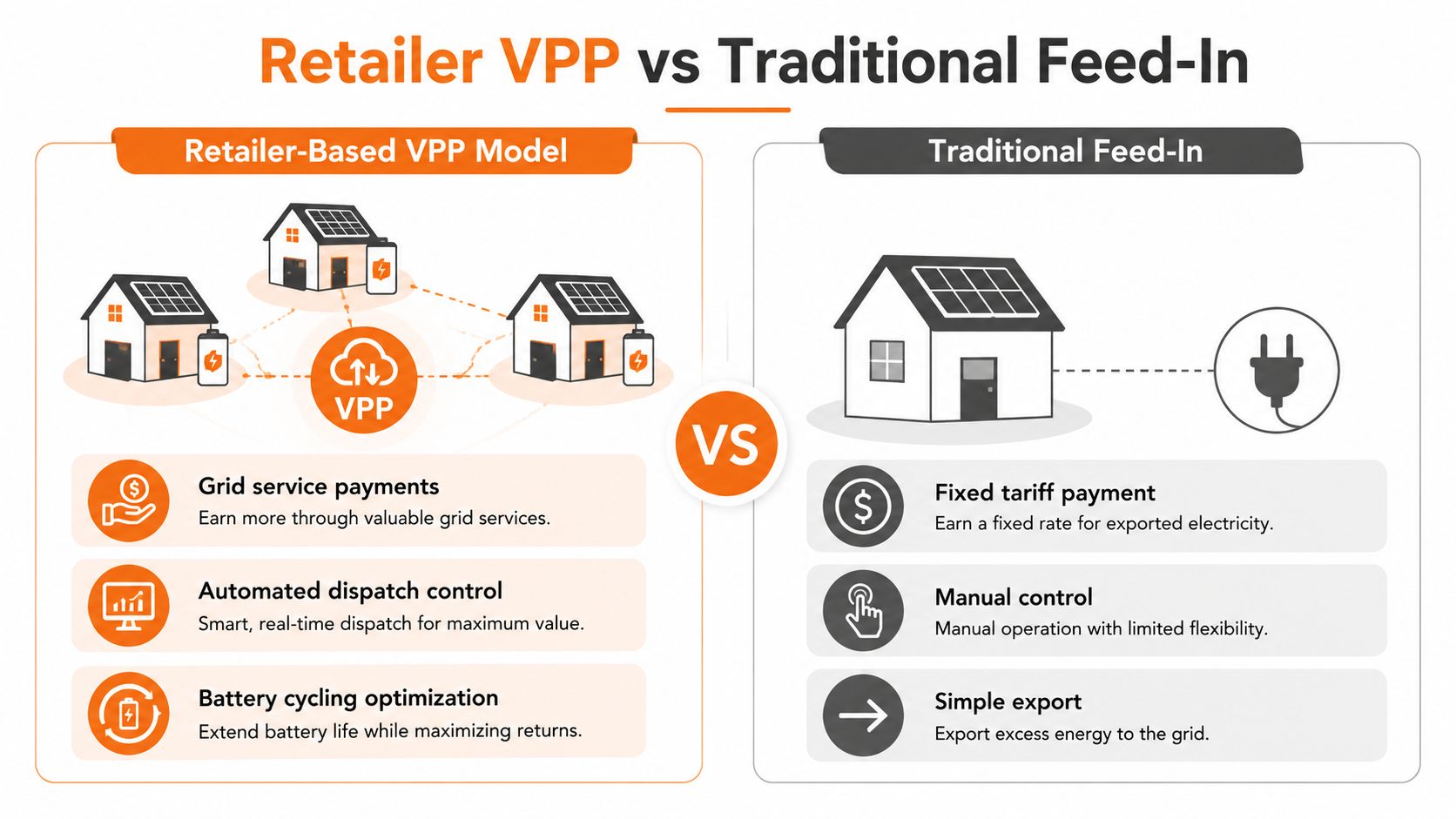
A traditional feed-in arrangement pays for exported electricity under a tariff. The payment is easy to understand, but it usually treats each export as a separate transaction. It doesn't necessarily optimise the battery around wholesale volatility, network congestion, or coordinated demand response.
A retailer-based VPP can connect the battery to a wider operating model. The retailer supplies electricity, manages customer billing, and may coordinate the battery fleet through an approved technical and commercial framework. That arrangement can create value from services beyond simple solar export, provided the agreement clearly explains dispatch authority, customer priority, payment rules, and exit conditions.
Queensland government guidance says a dynamic connection is available to customers with rooftop solar and home batteries. It also says a dynamic connection is needed to participate in a VPP. The Queensland battery buyer guidance explains the technical significance: dynamic connections support export control and flexible operating rules, allowing systems to respond to network constraints and grid signals rather than operating only as fixed behind-the-meter storage.
What customers should compare
| Question | Retailer-based VPP | Traditional feed-in arrangement |
|---|---|---|
| Primary value | Coordinated grid and retail value, subject to the agreement | Export payment under a feed-in tariff |
| Battery operation | Automated dispatch may respond to market or network signals | Usually household-led or inverter-led |
| Customer control | Must specify reserve, override, and priority-use rules | Generally simpler manual control |
| Payment visibility | Allowances or credits should be shown clearly on bills | Export credits appear against exported energy |
| Technical requirement | Dynamic connection and compatible equipment may be required | Depends on the connection and retailer rules |
The strongest VPP model isn't the one with the most complicated software. It's the one that makes customer value auditable. Ask whether the allowance is fixed or variable, whether network and distribution charges are included, how excess usage is billed, and whether there are lock-in or exit fees.
Battery owners should also separate energy economics from outage planning. A VPP may coordinate the battery for grid services, but backup settings remain a distinct design requirement. Guidance such as LuminAID's discussion of best backup power for outages can help homeowners think through essential-load priorities before agreeing to external dispatch.
Common Misconceptions About Battery Schemes and VPPs
A quote built around an old Queensland Battery Booster payment can misstate the economics before the system is installed. The state program closed to new conditional approvals on 8 May 2024. Current proposals therefore need to separate historical Queensland support from federal assistance and assess the battery's operating value independently of the former rebate.
A battery also cannot be assumed to eliminate every electricity bill. It can reduce imports, while supply charges, household consumption, solar production, tariff settings, and electricity-plan terms continue to affect the result. A VPP allowance may cover specified charges or usage, but consumption above that allowance can still be billed under the retailer's conditions.
Control and battery wear
VPP participation does not automatically remove household access to stored energy. The agreement should define priority use, minimum reserve levels, manual overrides, and the circumstances in which the operator may charge or discharge the battery. Without those details, the offer cannot be compared on price alone.
Battery cycling requires a commercial assessment. Extra dispatch can increase operating activity, yet excluding all grid participation may leave an income-producing asset underused. The relevant trade-off depends on the payment structure, operating limits, warranty terms, and the value assigned to retaining backup capacity.
What matters is whether each operating decision serves household needs, grid requirements, or both at a transparent net value.
A large rebate also provides no basis for selecting a large battery. The post-incentive assessment should test the home's load profile, solar surplus, backup requirement, and expected value from retailer or VPP operation. A smaller system may fit daily demand more closely. Additional capacity may be justified where backup or coordinated grid participation has measurable value, but that conclusion should come from the household's actual data rather than the incentive size.
Frequently Asked Questions About QLD Home Battery Schemes
Is the Queensland Battery Booster rebate available in 2026?
No. The Queensland Government says applications closed to new conditional approvals on 8 May 2024. The former scheme offered up to $3,000 for standard eligible households and up to $4,000 for eligible lower-income households, but those historical amounts shouldn't be used as a current Queensland state rebate.
What support can Queensland households assess now?
Queensland households need to assess the federal Cheaper Home Batteries program under its current rules, rather than relying on the closed state scheme. The federal structure changed on 1 May 2026 to a tiered approach that reduces effective support for larger batteries over time. Confirm eligibility, product requirements, installation conditions, and the applicable timing before signing a contract.
Did the old Battery Booster program require solar?
Yes. The Battery Booster rules required a new or existing rooftop solar PV system of at least 5 kW and an approved battery system of at least 6 kWh. The program was aimed at paired solar-and-battery systems rather than stand-alone storage.
Can an existing solar and battery owner join a VPP?
Potentially. Eligibility depends on the battery model, inverter, communications capability, connection arrangement, network requirements, retailer terms, and the VPP operator's technical criteria. Queensland guidance says a dynamic connection is needed to participate in a VPP, so a homeowner should check the connection type before assuming the system is ready.
Will VPP participation remove household control?
Not necessarily. The agreement should state how the operator manages dispatch, what reserve is protected, how customers override automated settings, and whether household demand receives priority. Customers should read these terms alongside the battery and inverter warranty conditions.
How should I compare a VPP allowance with a feed-in tariff?
Compare the total annual value, not one line on the bill. Review export credits, avoided imports, supply charges, VPP allowances, excess-usage rates, network charges, control restrictions, and any exit costs. A higher feed-in tariff may look attractive while a coordinated allowance creates more value through several operating channels, but the result depends on the household's actual usage and contract.
What should I ask before joining a battery VPP?
Ask for clear answers on compatibility, dynamic connection requirements, dispatch authority, backup reserve, override controls, battery cycling, warranty treatment, payment calculation, bill presentation, contract term, and exit conditions. Also ask whether the retailer operates under the relevant authorised energy retail framework and how complaints are handled.
Is a VPP suitable for both Queensland and New South Wales households?
VPP availability and value vary by network, retailer arrangement, customer location, battery compatibility, and market conditions. High Flow Energy operates its BYOB service across Queensland and New South Wales, but individual eligibility still needs to be assessed from the household's existing solar, battery, inverter, and connection details.
What is the main financial question after receiving a rebate?
Ask whether the battery can continue creating value after the incentive has stepped down or ended. Test the system against actual household demand, solar production, battery dispatch, tariff exposure, backup requirements, and potential VPP participation. That analysis is more useful than comparing headline discounts alone.
HighFlow Energy helps eligible Queensland and New South Wales homeowners with existing solar and compatible batteries assess participation in a Bring Your Own Battery VPP, including the potential bill allowance and operating conditions. Visit HighFlow Energy to review your eligibility and determine whether your battery is being underutilised financially.