

Home Battery Scheme NSW: Incentives and VPP Value
You've already done the hard part. You put money into rooftop solar and a battery, the system is installed, and now the battery often sits there as a backup box while your bill still lands every month.
That's the wrong way to think about the home battery scheme NSW homeowners are dealing with now. The original state installation discount has moved on, but the policy still has two real levers left for households that already own, or are buying, a battery. One lowers upfront cost, the other pays for grid participation and can keep producing value after installation.
Why the Home Battery Scheme NSW Matters to Battery Owners
A lot of NSW homeowners in Sydney, Newcastle, Wollongong, or a regional town have the same problem. They installed solar, added a battery, and then treated the battery like insurance. It works when the power goes out, but on an ordinary day it doesn't feel like a financial asset.
That's a bad outcome if you spent real money on the system. The better question is not whether the battery exists, but whether it is doing useful work. In NSW, that means understanding the difference between an installation incentive and an ongoing VPP payment.
The home battery scheme NSW used to be sold as a straightforward discount story. That story is outdated. The smart framing now is simple, what gets the upfront cost down, and what keeps generating value after the install is finished?
Practical rule: If your battery only sits there waiting for an outage, you're leaving most of its value on the table.
The policy still matters because NSW hasn't stopped supporting battery adoption. It has shifted the support model. Households and small businesses can still access the federal installation discount, and they can still earn value through NSW's VPP pathway when the battery is enrolled correctly. The homeowner who understands those two streams will make a better purchase decision than the one chasing a headline rebate.
What the NSW Battery Scheme Actually Covers
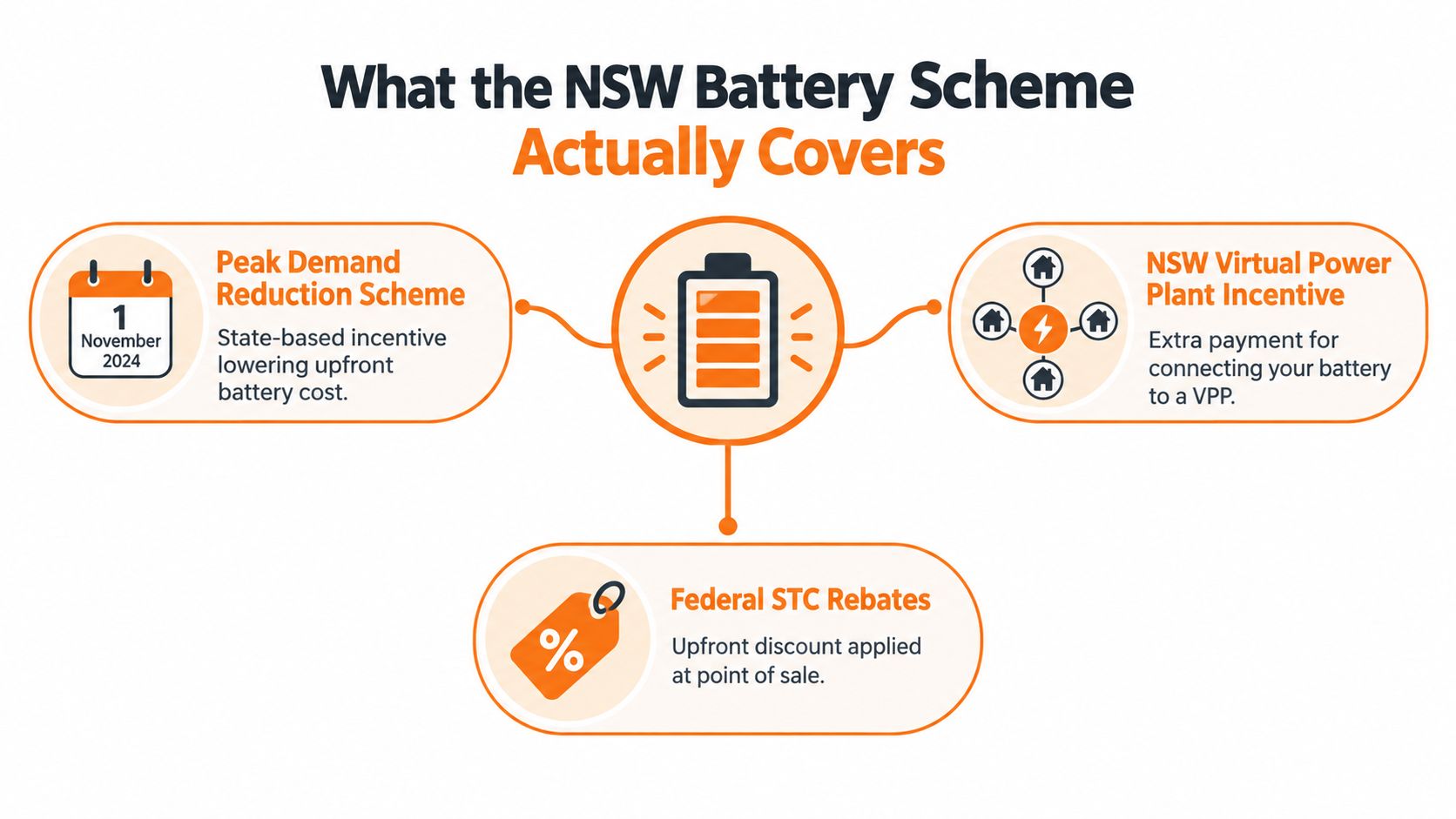
The cleanest way to think about the current setup is as three separate policy levers, not one lumped-together rebate. NSW opened the original household battery incentive under the Peak Demand Reduction Scheme on 1 November 2024, after the state's May 2024 commitment to expand the scheme to include household batteries NSW Government release. That program rewarded battery installation and VPP participation. The federal program is different. It reduces purchase cost. The VPP incentive is different again. It pays for grid support behaviour.
The state's old general installation discount is no longer the thing to chase for a new job. NSW says the former battery installation discount has been replaced from 1 July 2025, and NSW and Australian battery discounts cannot be claimed together as duplicate installation rebates NSW battery installation guidance. That matters because people still talk about “the NSW rebate” as if it were one ongoing cheque. It isn't.
The three moving parts
- Peak Demand Reduction Scheme: the NSW framework that originally backed household battery uptake and VPP participation.
- Cheaper Home Batteries Program: the federal installation discount that now carries the upfront economics for new battery jobs.
- NSW VPP incentive: the payment for linking a compatible battery to an approved virtual power plant.
A good installer or retailer will explain these separately. A bad one will blur them together and make the quote look better than it is. If the person selling the system can't separate installation savings from ongoing grid-service value, keep looking.
Current Incentives, Dollar Values, and What Has Changed
The numbers that matter are straightforward, and they should be handled carefully. NSW says the federal Cheaper Home Batteries Program supports eligible batteries from 5 kWh to 50 kWh, with an upfront discount of approximately 30% NSW battery guidance. NSW also increased its VPP incentive from 1 July 2025 to up to $1,500 for eligible households and small businesses that connect a compatible battery to a VPP NSW ministerial update.
A practical way to read those figures is this. The federal support lowers the installed capital cost. The NSW VPP incentive rewards the act of joining a grid-support program. They are not the same thing, and they should not be modelled as if they were.
| NSW Battery Incentive Snapshot in 2026 | Eligible Battery Size | Value | Key Constraint |
|---|---|---|---|
| Federal Cheaper Home Batteries Program | 5 kWh to 50 kWh | Approximately 30% upfront discount | Applies to installation cost, not VPP earnings NSW battery guidance |
| NSW VPP incentive | 2 kWh to 50 kWh | Up to $1,500 | Requires grid connection, a participating VPP provider, and a compatible retailer NSW VPP incentive |
| Earlier NSW installation discount | Former PDRS battery installation pathway | No longer available for new installations | Only applied to installations completed before 1 July 2025 NSW install battery guidance |
NSW's own illustrative examples make the policy shift clear. The government described an 11.5-kWh battery as receiving almost $5,000 in combined upfront support after the July 2025 changes, and a larger 27-kWh system costing just over $30,000 before assistance as receiving around $10,000 from the Commonwealth, plus almost $1,500 more from the NSW VPP payment if connected to a participating VPP NSW energy strategy.
Commercial rule: Treat the federal discount as capex relief, and treat the NSW VPP incentive as participation value. If you mix them together, you'll overstate your payback.
Who Qualifies and How to Apply
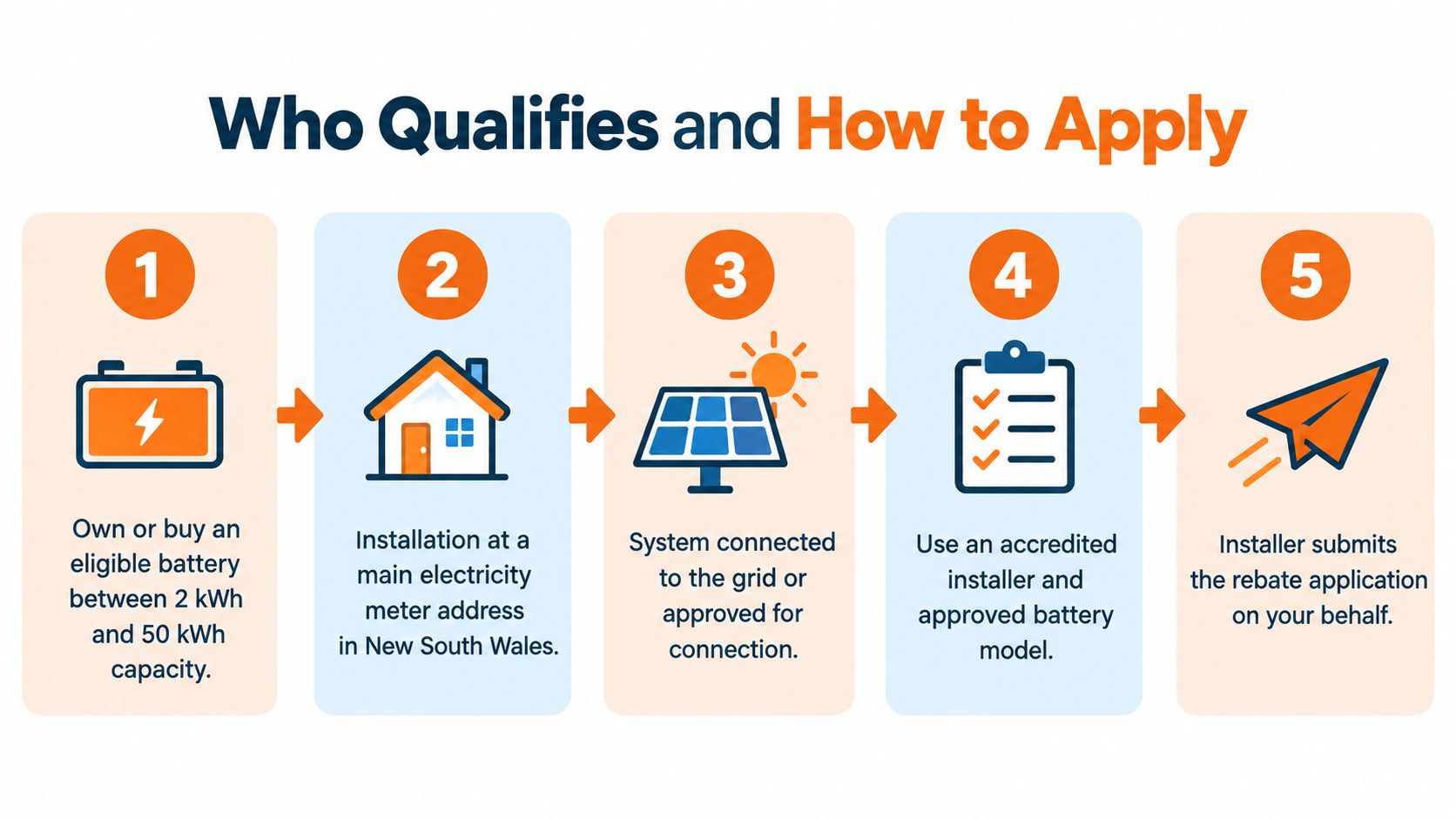
NSW's VPP incentive is open to households and small businesses with an eligible battery between 2 kWh and 50 kWh, but the battery has to be installed at the property, connected to the electricity grid, and linked to a participating VPP provider and compatible electricity retailer NSW VPP incentive. That's the first filter. If the battery isn't grid-connected, it can't participate. If the retailer doesn't support the arrangement, you may need to switch.
The second filter is technical quality. NSW guidance recommends a Solar Accreditation Australia-accredited installer and a battery that appears on the Clean Energy Council approved-products list NSW battery guidance. That's not paperwork for the sake of paperwork. Approved products and accredited installation support electrical compliance, safety, and the ability to participate in VPP dispatch properly.
A sensible application sequence
- Check the battery size. Make sure the usable capacity sits within the relevant program band, not just the marketing label.
- Confirm the installation address. The system needs to be at the NSW property that will host the battery.
- Verify grid connection. No grid link means no VPP participation.
- Use an accredited installer. Ask for the Solar Accreditation Australia credentials up front.
- Keep the paperwork. Store the quote, model number, commissioning documents, and VPP agreement.
The old rule about installation date still matters for anyone trying to prove they qualified under the earlier NSW pathway. NSW says the former incentive only applied to installations completed before 1 July 2025 that met Peak Demand Reduction Scheme requirements NSW install battery guidance. If you're relying on historical eligibility, the commissioning record matters.
A useful extra reference for homeowners sorting wiring and device integration is the DigiDevice guide to home automation. It's not about rebates, but it helps explain how smart devices coordinate in the home, which is useful context when you're looking at battery control and VPP enrolment.
For homeowners also dealing with meter changes, the practical sequencing often starts there. High Flow Energy's smart meter guide is worth checking if your connection setup still needs to be sorted before VPP enrolment can happen.
How Batteries, Rooftop Solar and VPP Services Create Value
The financial logic is simple once you strip out the marketing noise. Rooftop solar covers daytime usage and pushes excess energy into the battery. The battery then shifts that energy into the evening, when household demand is higher and grid power is usually less convenient to buy.
The VPP layer changes what happens next. Instead of the battery sitting idle at all times outside the home, the retailer or VPP operator can call on spare capacity during grid stress events. That is not a hardware sale. It is a demand-response arrangement, and the value comes from coordination.
A battery on its own saves money. A battery inside a well-run VPP can do more than that, because the owner is paid for controlled participation.
That doesn't mean the household gives up the battery. It means the battery is used with rules. Priority access stays with the home, and any VPP dispatch has to respect the operating terms. The point is not to empty the battery for the grid. The point is to use spare capacity intelligently and get paid for doing it.
Flat tariff versus VPP value
A flat feed-in tariff pays a set amount for exports. A VPP arrangement can create an additional stream because the battery is doing something more useful than passively exporting daytime surplus. The extra value doesn't come from more solar panels. It comes from a better commercial structure around the battery you already own.
For a household trying to understand daily bills, this is the practical difference. With no optimisation, the battery just reduces self-consumption from the grid. With VPP participation, the same asset can also support bill-free allowance structures and other bill credits depending on the retailer arrangement. High Flow Energy's model sits in that category. It coordinates spare battery capacity through a BYOB VPP and uses the resulting value to fund a monthly bill-free electricity allowance, while the household keeps priority access to its own stored energy.
Common Misconceptions About NSW Battery Incentives
The biggest mistake is assuming the old NSW installation discount is still available for new jobs. It isn't. NSW says the former battery installation discount was replaced from 1 July 2025 NSW install battery guidance. That cut-off is important, because a quote that mixes old and new rules is not a trustworthy quote.
The second mistake is assuming the federal and NSW incentives are just two rebates on the same installation. That's not how the current structure works. The federal program reduces upfront cost, while the NSW VPP incentive pays for participation in a grid-support arrangement. Those are separate value streams, and they should be assessed separately.
What people also get wrong
- Nameplate capacity is not usable capacity. The number on the brochure is not the same thing as the energy you can reliably draw on for the house.
- Annual savings aren't guaranteed. Tariff structure, export limits, weather, backup reserve, and battery degradation all affect the result.
- VPP value is conditional. It depends on grid connection, retailer support, and the dispatch terms of the specific offer.
The NSW Government's older illustrative figure of around $1,500 in annual savings came from a combined solar-and-battery scenario, not from a guaranteed outcome for an existing battery owner NSW ministerial release. That distinction matters. A battery owner should not use a combined installation example to forecast an ongoing VPP return without checking the actual operating conditions.
If a salesperson gives you a single annual saving number without explaining tariffs, reserve settings, and dispatch rules, they're overselling the system.
Practical Checklist Before You Enrol Your Battery
Start with the hardware, then move to the contract. If the battery and inverter can't communicate properly, nothing else matters. If the retailer can't support the VPP program, the numbers in the brochure won't translate into real bill value.
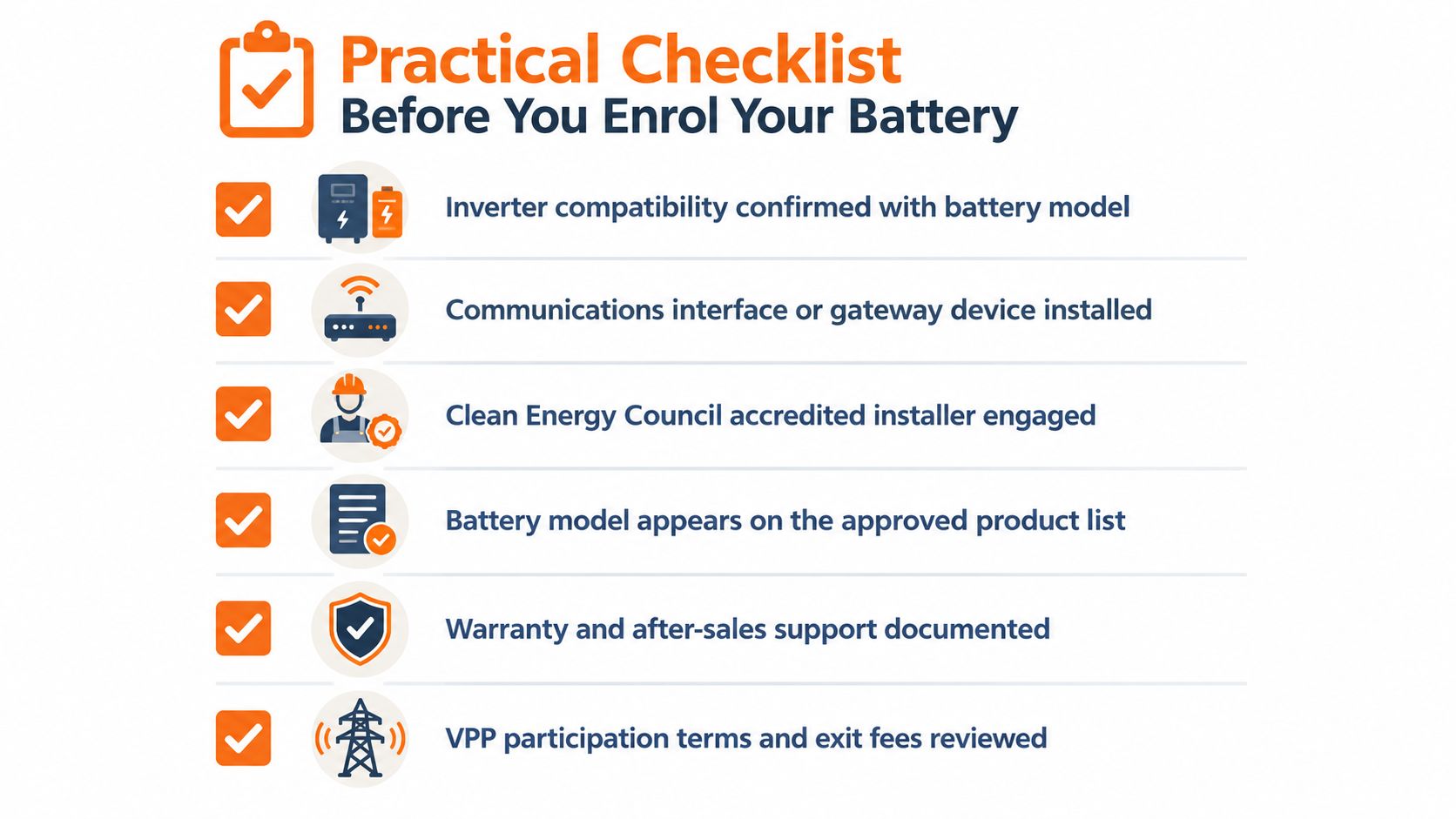
Run this checklist before you sign
- Inverter compatibility confirmed. Check that the inverter can speak properly to the battery model.
- Communications interface installed. The battery needs a working gateway or communications path for VPP control.
- Approved-product status verified. Confirm the battery appears on the Clean Energy Council list.
- Installer credentials checked. Use a Solar Accreditation Australia-accredited installer.
- Usable capacity understood. Don't rely on nameplate figures alone.
- Retailer support confirmed. Make sure your current retailer can handle VPP participation, or be ready to switch.
- Documents saved. Keep commissioning records, model details, and any evidence linked to the pre-July 2025 NSW cut-off if relevant.
For technical handover questions and system integration, High Flow Energy's system integration guide is a useful reference point if you're checking what the battery needs before it can participate properly.
A realistic commissioning process usually involves the installer finishing the physical work, the meter and network setup being confirmed, and then VPP enrolment once the technical requirements are signed off. Don't rush that step. A battery that's wired badly or documented poorly is a battery that will create administrative pain later.
Key Takeaways and How HighFlow Energy Fits In
The federal program now drives most of the installation discount. The NSW VPP incentive pays for ongoing grid support. Those are different value streams, and the best battery owners separate them cleanly.
The core issue is not whether you own a battery. It's whether that battery is coordinated well enough to produce ongoing value instead of sitting underused. High Flow Energy is a technology-enabled electricity retailer for NSW and Queensland households with existing solar and compatible batteries, built around a BYOB VPP model that keeps household priority use intact.
Most battery owners focus on installation quality. Far fewer focus on ongoing performance and optimisation. High Flow Energy is an electricity retailer built around revealing the full value of your existing solar and battery system. If you want to know whether your battery is underperforming financially, request an eligibility assessment and see the true worth of the current setup to you.
Most battery owners focus on installation quality. Far fewer focus on ongoing performance and optimisation. High Flow Energy is an electricity retailer built around realising the full value of your existing solar and battery system.
If you want to know whether your battery is underperforming financially, visit High Flow Energy and request an eligibility assessment today.