

Inverter Efficiency Loss for Solar and Battery Homes
A 1 percentage point improvement in inverter efficiency, from 97% to 98%, can add about 100 kWh a year in Brisbane, or roughly 1,000 kWh over a decade, for the same solar system, according to Australian solar efficiency guidance. The difference is small on paper, yet it changes the energy available for household use, battery charging and exports.
For Queensland and New South Wales households, that lost energy also affects a retailer-based Virtual Power Plant. Less usable energy can reduce the amount available for VPP dispatch, while tariffs and battery settings determine its value. A bill-free allowance may therefore shrink even when the panels generate as expected.
Inverter efficiency loss covers energy consumed or released as heat during conversion and system operation. Heat, low operating loads, battery architecture, cable voltage drop and dispatch decisions all influence the result. The loss cannot be eliminated, but careful system selection and control can limit its effect on solar yield and BYOB VPP returns.
What Inverter Efficiency Loss Means for Your Home
Solar panels produce direct current, or DC electricity. Most household appliances, the grid and standard switchboards use alternating current, or AC. The inverter converts DC into usable AC, and that conversion is the first point where household energy disappears.
Inverter efficiency loss is the share of incoming DC energy that doesn't emerge as usable AC energy. Residential solar inverters in Australia commonly operate at around 94% to 98% peak efficiency, meaning roughly 2% to 6% of DC energy is lost during conversion, as outlined in Australian solar system efficiency guidance.
A simple example helps. If the panels send DC electricity into an inverter operating at 97% efficiency, most of the energy reaches the AC side, but a small portion becomes heat or is consumed by the inverter's internal electronics. The panels may be producing normally, and the battery may still be holding charge, yet the home receives less energy than the panels generated.
Where the loss appears
The conversion loss happens before the energy reaches its final destination. It can reduce:
- Self-consumption, because less solar energy reaches household loads.
- Battery charging, because less surplus energy is available for storage.
- Feed-in exports, because the export meter sees the converted AC output.
- VPP dispatch, because the retailer can only coordinate energy that remains available.
- Bill-free allowance capacity, because every lost kilowatt-hour is one less unit that can offset consumption or support grid services.
Australian inverter efficiency figures are generally tested under standard laboratory conditions. A CEC-listed inverter's datasheet peak is useful for comparison, but it isn't a promise of the annual result at a hot Queensland home, a shaded garage in New South Wales, or a system that spends long periods producing very little power.
Practical rule: Treat the datasheet peak as a ceiling, not as the efficiency your home will achieve during every operating condition.
The commercial point is straightforward. A wasted watt can't be consumed, stored, exported or dispatched. In a conventional solar system, that may look like a modest reduction in generation. In a coordinated Virtual Power Plant Australia program, it also reduces the energy available for bill reduction and grid participation.
The Main Technical Causes of Conversion Loss
An inverter doesn't lose energy through one single fault. Several internal mechanisms operate at once, and their combined effect changes with voltage, current, temperature and output level. The most useful way to understand the process is to follow the energy through the power electronics.
Four internal loss mechanisms
Switching losses occur when semiconductor devices turn on and off at high frequency. The switching devices briefly carry voltage and current during each transition, producing heat. The exact contribution depends on the design and operating conditions, so it shouldn't be assigned a universal percentage without a model-specific efficiency curve.
Conduction losses arise from resistance in transistors, diodes, inductors, busbars and internal cabling. Current flowing through that resistance creates heat. Higher current generally increases this loss, which is why a system operating close to its maximum output can experience a different loss profile from one operating at a light load.
Transformer and core losses occur in magnetic components, including inductors and isolation transformers where fitted. Magnetic hysteresis and eddy currents consume energy even when the inverter is performing its intended conversion. These losses can remain relevant across a broad operating range.
Standby and auxiliary losses come from control boards, sensors, communications equipment, cooling fans, displays and other internal systems. They matter most when the inverter is awake but processing very little power. A small fixed electrical draw becomes a larger proportion of output when the useful output is also small.
| Loss mechanism | Typical contribution | Source of waste |
|---|---|---|
| Switching | Varies by design and load | Heat produced during semiconductor transitions |
| Conduction | Varies with current and resistance | Heat in switches, inductors and cabling |
| Transformer and core | Varies by magnetic design | Hysteresis and eddy-current losses |
| Standby and auxiliary | Most significant at low output | Controls, communications, fans and internal power use |
These losses are not a straightforward list that can be added to a headline figure. The inverter's efficiency curve reflects their combined effect. A popular residential unit may sit around 96.5% to 98% efficiency, while efficiency can fall sharply below 10% of rated load, according to Australian inverter performance guidance.
For a deeper explanation of how conversion losses affect stored energy, see High Flow Energy's guide to round-trip efficiency. The practical lesson is that a high peak rating doesn't tell you how the inverter behaves during every hour of the day.
Why the efficiency curve matters
An inverter running at a moderate or high load can spread its fixed internal consumption across more delivered energy. At low load, the same control electronics and auxiliary systems consume a larger share of the energy being processed. That's why early-morning production, cloudy-day output and battery trickle charging can be financially less useful than the headline specification suggests.
For homeowners, the right question isn't only, “What is the peak efficiency?” It's also, “How often does my system operate near that point, and how much energy passes through the inverter at low load?”
Temperature and Partial Load Behaviour in Australia
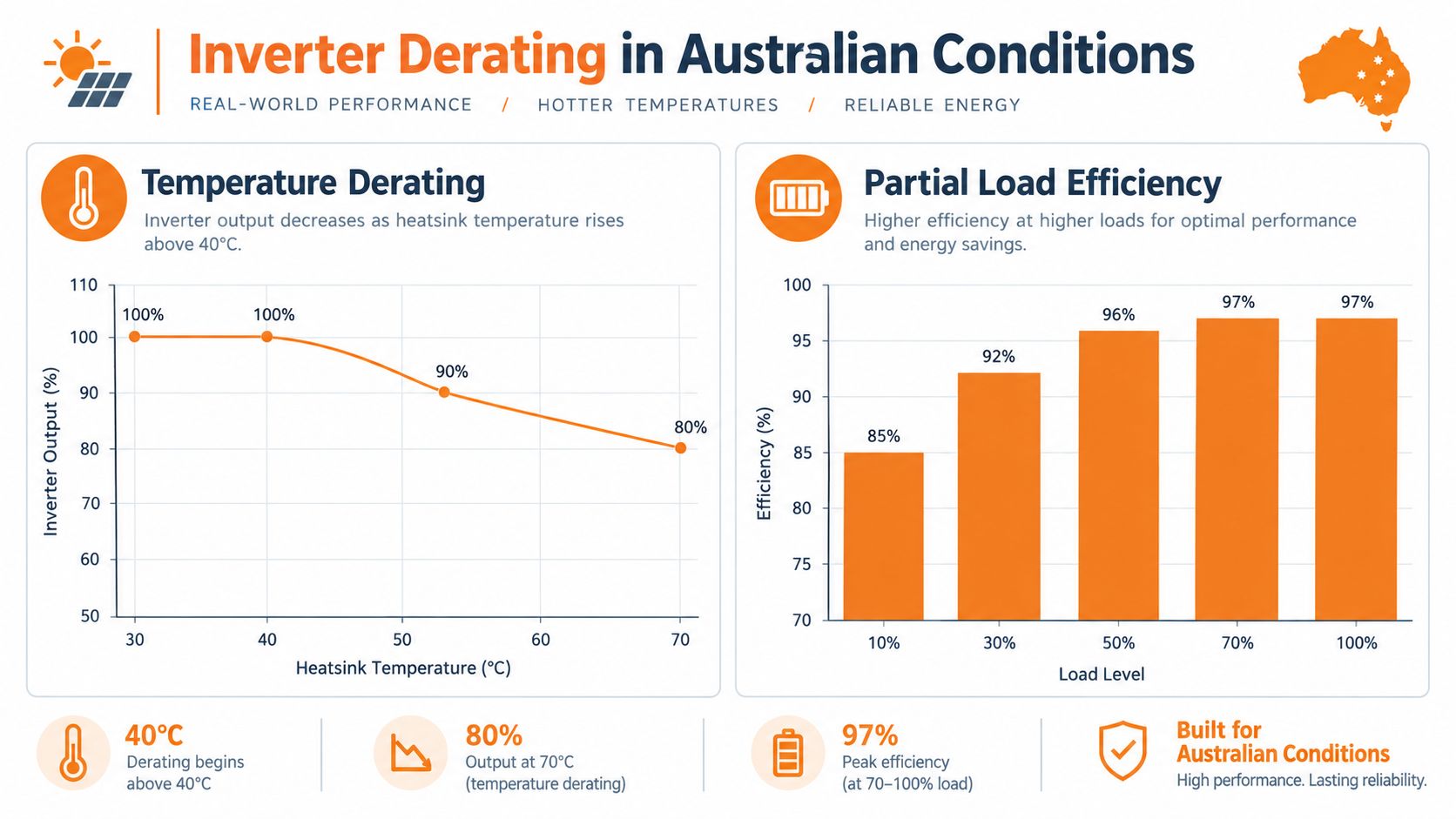
Australian heat and light demand can both move an inverter away from its efficient operating range. Temperature derating reduces available output as internal components heat up. Partial-load operation makes fixed control and cooling losses a larger share of the energy passing through the unit.
Some Australian inverter models may begin derating at around 40°C to 50°C ambient temperature, depending on the product, as explained in Australian guidance on temperature and inverter power. A poorly ventilated roof space, direct western sun or a hot external wall can raise operating temperature. The panels may still be able to produce energy, yet the inverter can restrict how much reaches the home or grid.
Low load is easy to overlook
Efficiency can also fall sharply below 10% of the inverter's rated load, particularly during early mornings, overcast weather and battery trickle charging, according to Australian battery and inverter efficiency information. The inverter still needs to run its controls and auxiliary systems, even though only a small flow is being converted.
A battery supplying low power to the home may therefore be operating correctly while delivering less useful energy for each unit processed. This matters economically when stored energy is reserved for a bill-free allowance or dispatched through a retailer-based VPP. Small conversion losses reduce the energy available for household use, export rewards or participation in a Queensland or New South Wales VPP schedule.
Brisbane systems can face high afternoon temperatures, while a home in western Sydney may combine heat with export limits and long low-load periods. Annual results depend on weather, array size, inverter rating, battery controls and household demand. The installation environment also matters. High Flow Energy's guidance on battery thermal management systems explains how heat management around storage equipment can support reliable operation.
A Real World Example for a Rooftop Solar and Battery System
Consider a hypothetical Brisbane or Sydney home with a 6.6 kW rooftop solar array and a 10 kWh home battery connected through a single hybrid inverter. This is a worked illustration, not a claim about any individual household. Actual results depend on solar output, household demand, battery controls, inverter curves and local conditions.
Assume the system achieves a weighted solar-to-AC efficiency of 94% and battery round-trip efficiency of 88%. The first figure represents energy lost while solar DC becomes household AC. The second represents the energy that isn't recovered after charging and discharging the battery.
Step one, solar conversion
If the array produces a hypothetical 10,000 kWh of DC energy in a year, a 94% conversion result would deliver about 9,400 kWh of AC energy. The difference is approximately 600 kWh, which is lost before the home can use it, export it or send it into a VPP schedule.
This annual solar production figure is used only to demonstrate the calculation. It isn't a general Australian production claim. The method is what matters. Take the DC energy recorded or estimated by the system, apply the measured conversion efficiency, then separate the energy that never reaches the AC side.
Step two, battery cycling
Suppose the battery processes 3,000 kWh of charging energy over a year. At 88% round-trip efficiency, approximately 360 kWh isn't available after the complete charge and discharge cycle. That loss includes the conversion path and associated system losses, not just the battery cells.
At a self-consumption value of 25 cents per kWh, the illustrative loss would have a value of about $240 for solar conversion and $144 for battery cycling, or $384 across the two channels in one year. Over a 10-year period, a simple unchanged-value calculation would total about $3,840.
Those figures are deliberately calculated from the stated assumptions. They shouldn't be presented as a typical household result or as a guaranteed financial outcome.
| Loss channel | kWh lost per year | Value at 25 c/kWh | 10-year value |
|---|---|---|---|
| Solar DC-to-AC conversion | 600 | $150 | $1,500 |
| Battery round-trip conversion | 360 | $90 | $900 |
| Combined illustration | 960 | $240 | $2,400 |
The table applies 25 cents per kilowatt-hour directly to each loss channel. It doesn't assume that every lost unit would otherwise have displaced a retail purchase. Export value, time-of-use pricing and VPP dispatch value can be lower or higher depending on the event and tariff.
The example shows why a battery owner's financial analysis must separate panel production from delivered AC energy. A VPP also needs to account for energy that is lost before dispatch. Surplus sent to the grid at a low feed-in rate carries an opportunity cost, because the same energy may have supported household consumption or a coordinated demand event under a different operating plan.
AC Versus DC Coupling and Round Trip Losses
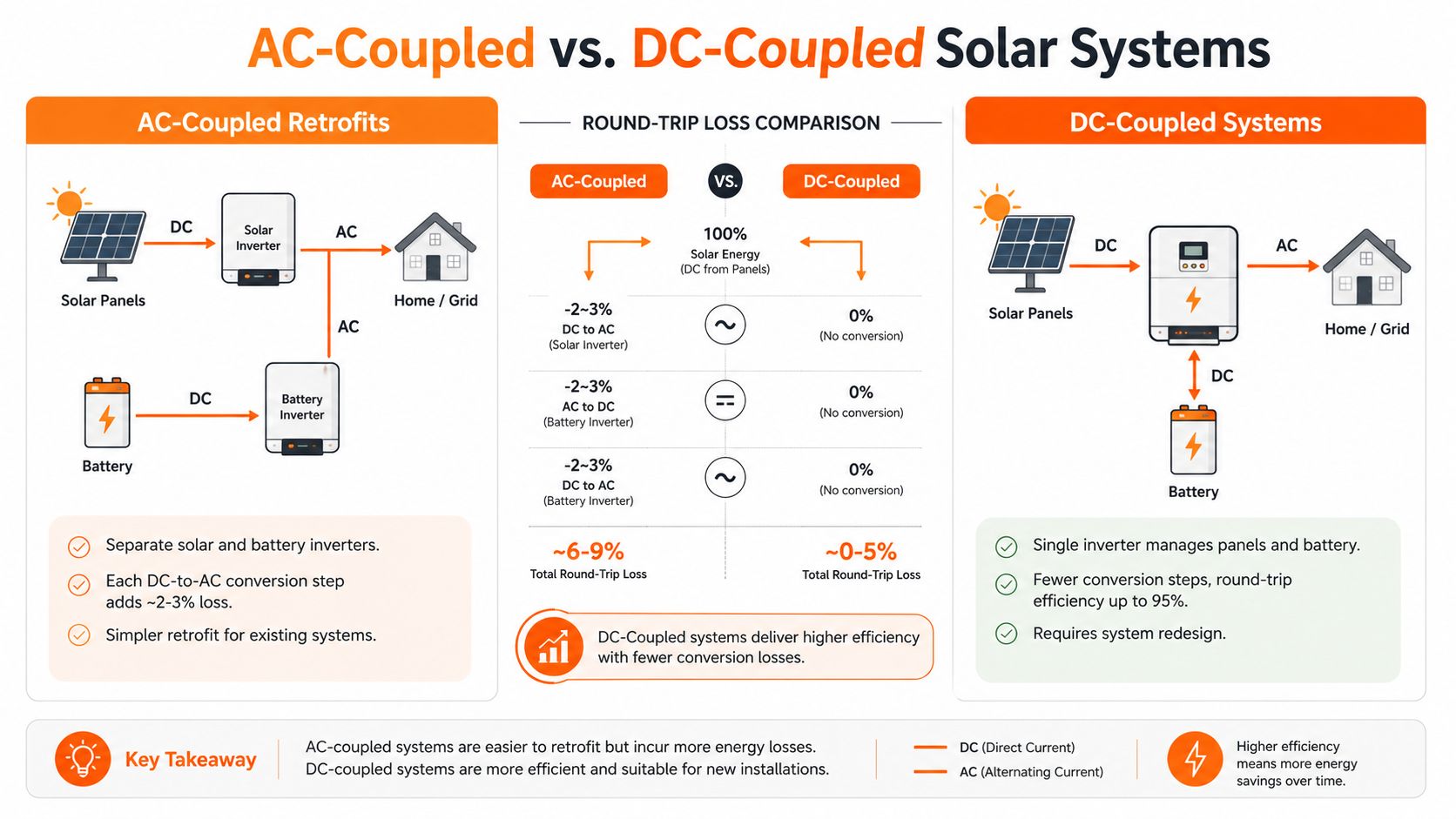
Battery architecture sets the number of times energy changes form before it reaches the home. In an AC-coupled retrofit, the solar inverter changes panel DC into AC. A separate battery inverter then changes that AC back into DC for charging, before converting the stored energy to AC again during discharge. Each conversion is like passing water through another pump: some energy is used by the equipment rather than delivered to the switchboard.
A DC-coupled system links the solar array and battery on the DC side through a hybrid inverter. Fewer conversion stages can reduce losses, particularly when solar energy goes directly into the battery. The arrangement may require different equipment and wiring, so it is not automatically suitable for a home adding a battery to an existing solar system. This comparison of DC-coupled and AC-coupled systems explains the main design trade-offs.
Australian guidance cites 5% to 15% conversion losses for AC-coupled battery charging and discharging, plus around 10% to 20% round-trip losses through inverters and chargers. Voltage drop between the panels, inverter and switchboard can add 1% to 2%, as outlined in Australian AC and DC coupling guidance. These ranges are operating references, not a promise that every home will experience the same result.
Round-trip efficiency is the useful measure
Round-trip efficiency asks how much energy comes back after charging and discharging the battery. It covers inverter conversion, charging equipment, cabling, controls, cooling and standby use, as well as the battery cells.
Australian product comparisons show whole-system results can vary. One cited battery-inverter system records 89%, while others record 96% to 97%, meaning 3% to 11% is lost across the storage and conversion cycle, as described in Australian battery system comparisons.
A published cycle-life efficiency figure may reflect controlled test conditions. A Queensland or New South Wales home may operate at partial loads, in hot weather, or under VPP dispatch, producing a different measured result. Check the test assumptions before using an efficiency figure to estimate bill-free allowance or VPP value. A small loss reduces the energy available for household use, export or a retailer-controlled event, which can change the return from each stored kilowatt-hour.
Practical Ways to Reduce Inverter Efficiency Loss
Homeowners cannot remove every conversion loss, but they can limit avoidable losses and protect the value of the energy that remains. Start with the installation, then check the settings that decide when the system charges, discharges or exports.
Improve the operating environment
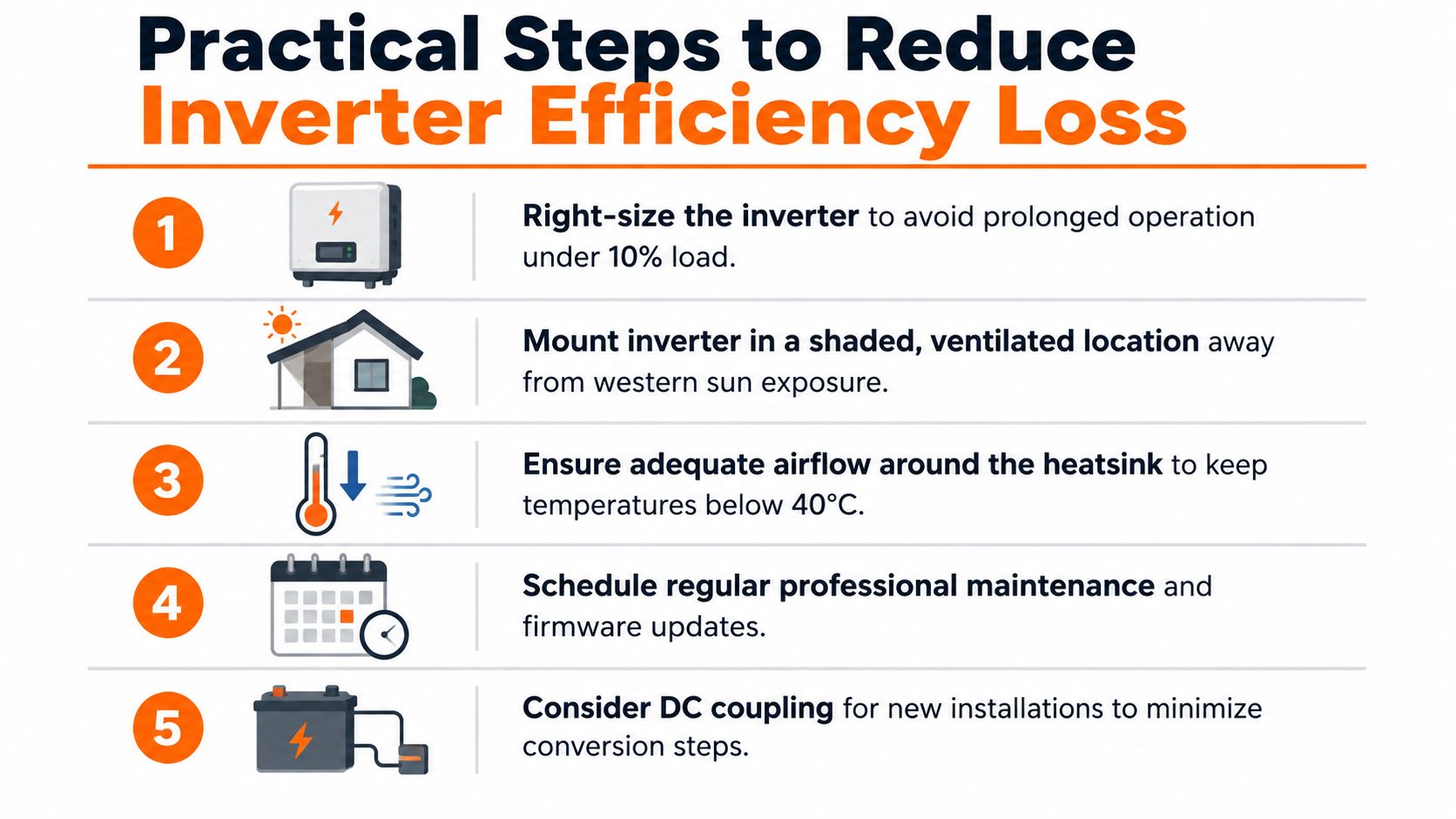
- Use an appropriately sized inverter: An inverter running below 10% load for long periods may operate inefficiently. Compare its rating with the home's actual solar production and battery demand profile.
- Choose shade and ventilation: Where practical, keep the inverter out of direct western sun. Leave its heatsink and airflow paths unobstructed.
- Control heat: Depending on the model, derating can begin around 40°C to 50°C. Avoid enclosed locations that trap hot air.
- Maintain the equipment: Check status lights, app messages, vents and communication connections. A qualified technician should investigate recurring faults instead of repeatedly resetting the system.
- Keep panels operating well: Dirt and shading reduce the DC energy reaching the inverter before conversion begins. For the wider maintenance economics, see this resource on cost savings from panel cleaning.
Firmware and grid-setting updates can also affect performance. Manufacturers may refine control behaviour, fault handling and network-compliance settings. Apply updates through the installer or an authorised process, and do not alter grid-protection settings without professional approval.
Tariff alignment determines what the converted energy is worth. A battery may provide greater household value by avoiding expensive consumption periods than by exporting during a weak feed-in period. The suitable schedule depends on the retail plan, household demand, network conditions and the battery's warranty requirements.
A coordinated VPP can add another control layer. It can select charge and discharge windows instead of letting the battery operate without a clear purpose. The operator should preserve household priority, respect export limits and allow for conversion losses before scheduling a grid event. That matters for bill-free allowances because a small loss reduces the energy available for either household use or a retailer-controlled dispatch.
Measure delivered AC energy, not only panel output. The gap between those readings identifies the first part of the financial investigation.
The following video provides a visual introduction to inverter operation and efficiency behaviour:
Why Inverter Losses Matter for Bill Free Allowance and VPP Value
A solar and battery system can lose a meaningful share of its energy before that energy becomes useful to the household or available to a VPP. A battery's value therefore depends on usable energy, not only the capacity printed on its specification sheet. Conversion losses reduce the energy entering the home or battery, while round-trip losses reduce what remains after storage. Heat, low output and partial-load operation can reduce the energy a VPP can dispatch during a demand event.
This connection matters in Queensland and New South Wales, where VPP operators participate in the National Electricity Market. Wholesale prices can change sharply, and network constraints can influence export and dispatch decisions. A retailer-only arrangement may value exported energy through a feed-in tariff. A VPP may instead create value by coordinating available battery capacity when the electricity system needs support.
A bill-free allowance depends on the energy and value a retailer can recognise. If inverter losses reduce the battery's deliverable output, the household may receive less useful energy from the same solar production. The result can be a smaller contribution towards the allowance, less energy available for a scheduled VPP event, or both.
The commercial comparison must use the specific offer rather than a general promise. A flat 7 cents per kWh feed-in baseline and a VPP accessing 15 to 25 cents per kWh of wholesale exposure represent different value streams. Those figures apply only where the relevant retailer's terms support them. Participation fees, allowance rules, battery reserve settings, cycling requirements, conversion losses and household priority all affect the final result.
The value of a lost kilowatt-hour also depends on timing. Energy lost during a low-value export period may have a smaller financial effect than energy lost before a high-value VPP dispatch. A system that repeatedly loses energy during the windows selected for retailer control may provide less value than its nominal battery capacity suggests.
Australian battery research involving 1,300 households found battery-coupled sites reduced curtailment to 0.2% on average, compared with 1.5% for PV-only sites, while some systems still lost up to 25% of generation, as reported in Australian AC and DC coupling research. The finding reinforces a practical point: control strategy and site conditions can matter more than one brochure efficiency figure.
| Scenario | kWh lost per year | Retailer-only value at 7 c | VPP wholesale value at 20 c | Annual value difference |
|---|---|---|---|---|
| Illustrative low-loss operation | Not specified | Cannot be calculated without measured throughput | Cannot be calculated without measured throughput | Requires site data |
| Illustrative measured-loss assessment | Use logged system data | Lost kWh × $0.07 | Lost kWh × $0.20 | Lost kWh × $0.13 |
The table deliberately avoids inventing annual throughput. A homeowner can populate it with inverter logs, battery records and the retailer's stated value rules. It shows why the same lost kilowatt-hour can carry a different opportunity cost under a retailer-only arrangement and a VPP. The calculation should use delivered AC energy, because that is the energy available for household use, export or retailer-controlled dispatch.
Before joining or switching a BYOB VPP, record current solar production, battery throughput, export energy and household imports. Compare these measurements with the inverter's rated curves, then check whether ventilation, firmware, tariff alignment or dispatch controls could recover useful value. A small efficiency improvement may matter when it occurs repeatedly across charging, discharging and VPP events.
Do not assume that more cycling automatically produces better returns. The battery must retain enough energy for household needs, remain within warranty conditions and respond to events where the value exceeds the cost of conversion. A retailer may offer attractive wholesale-linked value, but the household still needs a clear reserve and a dispatch schedule that suits its actual demand.
Key takeaway: Inverter efficiency loss reduces more than technical output. It reduces the energy available for self-consumption, bill-free allowance and wholesale-linked VPP value.
Key takeaways
- Peak efficiency isn't annual efficiency: Australian residential inverters commonly reach around 94% to 98% at peak, but load, temperature, voltage and control settings change the result.
- Low load matters: Efficiency can fall sharply below 10% of rated load, so small morning or evening outputs may deliver less useful energy than expected.
- Heat can trigger derating: Some models begin reducing output around 40°C to 50°C ambient temperature to protect their electronics.
- Storage has its own loss pathway: Australian sources commonly place whole battery-system round-trip losses around 10% to 20%, although products and operating conditions vary.
- Architecture affects conversion: AC-coupled retrofits and DC-coupled systems use different energy pathways, which changes where conversion losses occur.
- VPP value depends on usable energy: A retailer needs available, deliverable energy, not nominal panel or battery capacity.
- Measure before changing plans: Use household data to compare current retail value with the potential value of coordinated dispatch.
High Flow Energy is an Australian electricity retailer and BYOB VPP operator for eligible solar and battery owners in Queensland and New South Wales. Its service coordinates existing batteries for grid support while preserving household priority, and provides a bill-free electricity allowance under its retail structure. To assess whether inverter losses and underused battery capacity are limiting your system's value, visit HighFlow Energy and request an eligibility assessment.
Frequently asked questions
What is inverter efficiency loss?
Inverter efficiency loss is the share of DC electricity that does not become usable AC electricity during conversion. The lost energy is generally released as heat or consumed by internal components.
What efficiency should a residential inverter achieve?
Australian residential inverters commonly operate at around 94% to 98% peak efficiency, while popular models often sit between 96.5% and 98%, according to Australian solar efficiency guidance. Actual performance depends on load, temperature, voltage, installation and system controls.
Why is my inverter less efficient in the morning?
Early-morning production can leave the inverter operating at a low fraction of its rated output. Fixed internal consumption then represents a larger share of the energy being processed, and efficiency can fall sharply below 10% of rated load.
Does heat reduce solar inverter output?
It can. Depending on the model, temperature derating may begin around 40°C to 50°C ambient temperature, causing the inverter to reduce output to protect its electronics.
Is battery round-trip efficiency the same as inverter efficiency?
No. Inverter efficiency describes one conversion stage. Round-trip efficiency measures how much energy remains after charging and discharging the battery, including inverter, charger, cabling and related system losses.
Is DC coupling always more efficient than AC coupling?
DC coupling can reduce the number of conversion stages, but the suitable option depends on whether the system is new or being retrofitted, the equipment already installed, control compatibility and the home's operating pattern.
Can a VPP eliminate inverter losses?
No. A VPP cannot remove the physical losses inside an inverter. It can coordinate charge and discharge periods so the battery operates with a clear purpose, directing the remaining usable energy towards household, market or grid-support value.
How should I investigate poor battery performance?
Start with the inverter and battery apps, status indicators, production records, export data and communication status. A qualified installer or retailer can compare measured performance with the equipment's operating curves and the VPP's dispatch records.