

High Electricity Bill Problem? Diagnose and Fix It
You've checked the bill twice because the jump doesn't seem to match anything obvious. The household still has the same occupants, yet the quarterly total has climbed sharply. A pool pump may have been added, the tariff may have changed, and a small battery may not be operating as expected. That's the high electricity bill problem in practice: several modest changes combine into one expensive result.
Australian households are facing genuine price pressure. Electricity prices were 25.4% higher in the year to March 2026, while the Consumer Price Index rose 4.6% over the same period, according to Australian cost-of-living and electricity pricing data. A national survey also found that 11% of households spent more than 6% of household income on energy bills, and 19% were vulnerable to or already experiencing at least one energy hardship indicator (Energy Consumers Australia's national energy hardship report).
That doesn't mean you should accept every high bill as unavoidable. The correct response is diagnosis first, then targeted action. Separate price, tariff, fixed charges, household usage and battery performance before switching plans or buying equipment.
Start With a Structured Electricity Bill Diagnosis
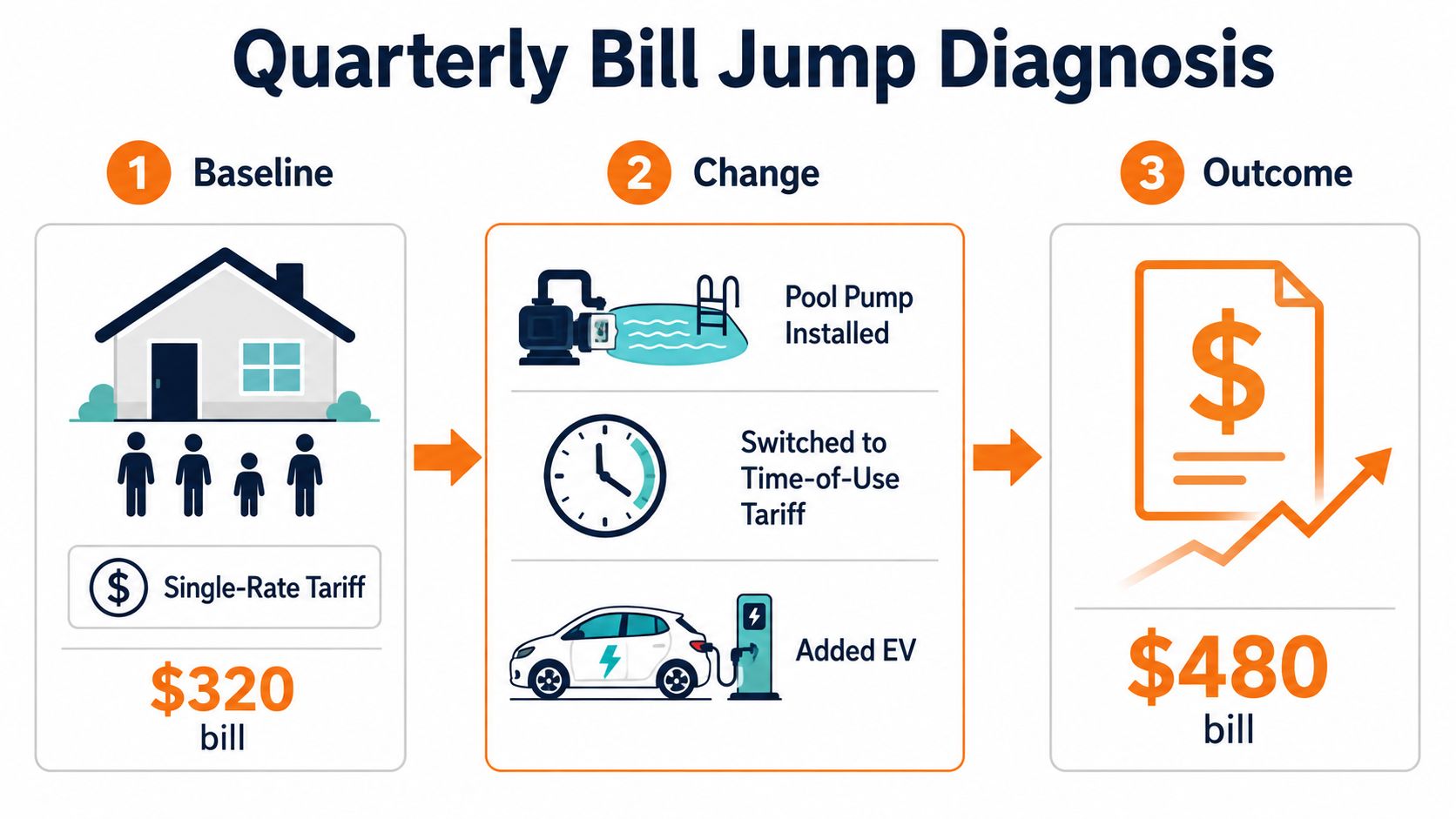
Consider a four-person home that previously received a $320 quarterly bill on a single-rate tariff. The household then installed a pool pump, moved to time-of-use pricing and added a small battery. The next bill reached $480. That outcome doesn't prove the battery failed or the pool pump caused the entire increase. It shows why a bill needs to be treated as a layered cost stack.
Start with the evidence already available.
Build a clean bill record
Collect the last four electricity bills and place them side by side. Record:
- Billing period: Note the start and end dates, because a longer billing period can make a normal daily cost look like a sudden increase.
- Meter reads: Identify whether the bill used actual or estimated reads.
- Meter type: Confirm whether the property has a smart meter, interval meter, controlled-load meter or another configuration.
- Total consumption: Write down the kilowatt-hours used during each period.
- Tariff details: Capture the plan name, single-rate or time-of-use structure, supply charge and any conditional discount.
- Household changes: List new appliances, changed routines, extra occupants, pool equipment, electric vehicles and heating or cooling changes.
A bill isn't just consumption multiplied by a single rate. It generally combines usage charges, daily supply charges, network and market components, discounts, credits and other plan-specific items. The utility bill components and data guide from Matil provides useful background for identifying those separate elements.
Next, compare the billing period length and total kWh before comparing dollar totals. If consumption is stable but the average cost per kWh rises, the tariff or plan deserves attention. If kWh rises while rates remain similar, investigate household loads. If both rise, you've got a combined problem.
Flag the largest line items
Don't begin by changing every appliance setting. Highlight the biggest charges first, including usage by time band, supply charges, controlled load, network-related items and the value of solar or battery credits. A small line item can be irritating without being financially important.
Use the High Flow Energy billing accuracy resource if the meter reads, dates or calculations appear inconsistent. Ask the retailer to explain any unexplained estimate, tariff change or adjustment before accepting the bill.
Practical rule: Don't optimise a battery until you know whether the largest problem is usage, pricing, fixed charges or an inaccurate bill.
The next step is to isolate those layers rather than guessing from the total.
Separate Prices, Tariffs and Fixed Charges
A high electricity bill usually contains several different problems hiding under one headline figure. Usage volume measures how many kilowatt-hours the home consumed. Usage rate determines what each kilowatt-hour cost, and that rate can change by time of day, tariff type and market plan.
A single-rate plan applies one usage price across the relevant billing period. A time-of-use plan applies different prices to peak, shoulder and off-peak periods. The same household can therefore pay a different weighted average rate without changing its total daily consumption. Moving pool pumping, hot-water heating or battery charging into a cheaper period can help, but only if the schedule fits the plan and the equipment.
The daily supply charge is separate. A charge of $1.10 per day works out to roughly $400 per year, whether the home uses 4 kWh or 12 kWh per day. That figure is an illustration of the calculation, not a universal Australian charge. The point is more important than the example: lower usage won't remove a fixed daily cost.
Map every cost layer
Use the bill to classify each amount before deciding what to change.
| Cost Layer | How It Is Calculated | Response to Lower Usage |
|---|---|---|
| Usage volume | Kilowatt-hours multiplied by the applicable rate | Usually falls when consumption falls |
| Usage rate | Single-rate, peak, shoulder, off-peak or controlled-load pricing | May change when load is shifted or the plan changes |
| Daily supply charge | Fixed amount applied for each billing day | Doesn't normally fall with lower usage |
| Network and market components | Charges passed through or embedded in the retail price structure | Can remain partly fixed and vary by plan or tariff |
| Discounts | Conditional or unconditional reduction applied under plan terms | Can disappear if conditions aren't met |
| Solar and battery credits | Exports multiplied by the applicable feed-in or VPP treatment | Depend on export volume, timing and contract rules |
| Green-power premium | Optional premium attached to a renewable energy product | Usually remains while the option is selected |
| Controlled load | Separate meter or circuit charged under its own rate | Depends on controlled-load consumption and tariff |
Network charges deserve particular attention. The Australian Energy Regulator's 2026 pricing work shows substantial variation in reference prices and network charges across NSW and Queensland distribution zones, with typical annual bills around $1,899 in Ausgrid NSW and between $1,815 and $1,988 in Queensland zones (Finder's 2026 Australian energy report). These figures aren't a prediction of your bill, but they show why location and distribution zone matter.
Solar exports appear as credits under a feed-in tariff, while a battery can alter both imports and exports. A controlled-load circuit may continue operating under a separate rate even when the rest of the home uses a battery. Total each layer, then rank the largest contributors. Don't let a visually prominent solar credit distract you from a large supply charge or expensive peak usage.
Check Your Meter, Tariff and Retail Plan
Before blaming household appliances, verify that the retailer is billing the property against the correct technical and contractual settings. A solar or battery installation can change meter configuration, export behaviour and the way interval data appears in an app.
Open the retailer portal and look for half-hourly or other interval usage data. Compare the highest-use periods with the tariff schedule. Check whether the meter records controlled load separately and whether solar generation, imports and exports are shown as distinct quantities.
Confirm the tariff schedule
Flat, time-of-use and demand tariffs behave differently. A flat tariff is straightforward, but it gives you less price incentive to move consumption. Time-of-use pricing rewards some off-peak behaviour and penalises usage during expensive peak windows. A demand tariff can add a charge based on the highest level of demand during a defined period, depending on the plan and customer class.
A worked example makes the issue clear. The same kilowatt-hour might cost 12 cents at night and 45 cents during a weekday peak under a particular tariff. Those rates aren't universal, so use the retailer's current fact sheet rather than relying on a generic comparison. Your battery should charge and discharge against the actual tariff, not an assumed schedule.
Ask the retailer or installer to confirm:
- Meter programming: Check whether the meter was re-programmed after solar or battery installation.
- Controlled-load separation: Confirm whether hot water or another circuit is billed independently.
- Export treatment: Verify how solar and battery exports are credited.
- Plan conditions: Check contract end dates, conditional discounts and any requirements attached to advertised rates.
- Feed-in changes: Review whether the feed-in tariff steps down, expires or depends on a specific product.
- Billing transitions: Ask whether switching plans mid-cycle creates pro-rata charges or overlapping adjustments.
A rebate or discount may look valuable until you check whether the household achieved the required conditions. ACCC analysis found that customers who stayed on the same electricity plan for more than three years paid, on average, $221 more per year than customers on newer plans, while 37% of customers, nearly 2.5 million, were paying at or above the default offer (ACCC electricity billing analysis). The source also highlights why rebates and conditional discounts need careful interpretation.
Save the usage-by-period breakdown from the app or portal. A captured copy gives you something concrete to compare when reviewing a new offer, especially if the plan changes supply charges, export credits or peak pricing.
Find Unusual Household Electricity Loads
The pool pump is an obvious suspect, but obvious doesn't mean dominant. A high electricity bill can result from several less visible changes, including longer air-conditioning cycles, a second refrigerator, altered work-from-home routines, electric vehicle charging, gaming equipment or ducted heating.
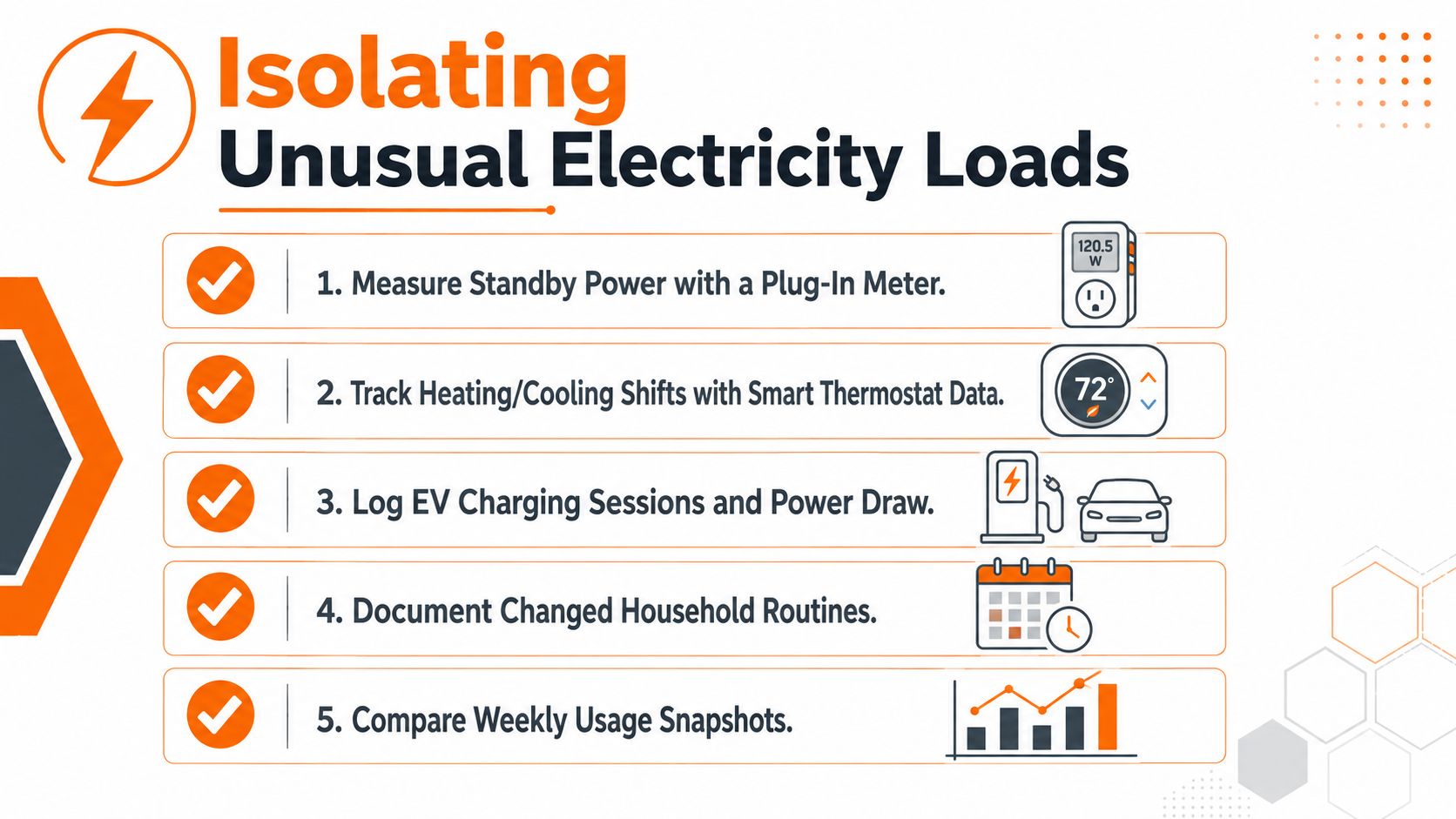
Use measurement rather than intuition. A plug-in energy meter can measure suitable plug-connected appliances. Smart plugs can show operating patterns for compatible devices. Whole-home interval data can reveal when usage spikes, although it may not identify the exact appliance without further testing.
Run a one-week load investigation
A practical detective process looks like this:
- Record a baseline: Note the meter reading or whole-home usage at a consistent time.
- Track routines: Log heating, cooling, pool operation, EV charging, cooking and occupancy.
- Test suspected plug loads: Measure spare fridges, freezers, entertainment systems and office equipment.
- Compare overnight patterns: Look for unusual consumption when the household is asleep.
- Change one variable: Turn off a safe, plug-connected load for a defined period and compare the next snapshot.
- Rank the results: Prioritise the load that combines high consumption with an easy, low-cost adjustment.
Don't open a switchboard or isolate mains circuits yourself. A licensed electrician should handle panel work, circuit testing and any suspected wiring fault. Heat-pump, air-conditioning and refrigeration faults also need qualified diagnosis, particularly if a compressor appears to run continuously or the system struggles to reach its set temperature.
Window performance can influence heating and cooling demand, although it won't explain every bill increase. For practical building-envelope considerations, review this window advice from Equity Building Materials, Inc., then ask a qualified building professional whether the issue is relevant to your property.
The High Flow Energy power usage monitor resource can help households think about monitoring at whole-home level rather than chasing one dramatic appliance.
Use the video below as a visual explanation of how household energy monitoring can identify patterns. It isn't a substitute for a licensed electrical assessment.
Phantom loads and changed habits often work together. A spare fridge might run inefficiently, while the family also uses more cooling and charges an EV during expensive periods. Treat the bill as a pattern to investigate, not a hunt for one villain.
Improve Solar and Battery Optimisation
A battery can be healthy and still deliver poor financial performance. The critical question isn't only whether it charges. It's whether it charges and discharges at the right times for your tariff, household demand, export limit and reserve settings.
Open the battery app's daily summary and inspect four values: solar generation, household consumption, grid imports and exports. Then look for charge-from-grid events, missed solar charging, export shortfall and a reserve level that leaves the household importing power unnecessarily.
Check the operating logic
Review these settings before asking an installer to replace hardware:
- Charge window: Does the battery charge during low-price periods or only from solar?
- Discharge window: Does it discharge during the tariff's expensive periods?
- Backup reserve: Is too much capacity held back for backup, forcing avoidable imports?
- Export limit: Is the inverter constrained by the network connection or a conservative setting?
- Cycling depth: Is the system using an appropriate portion of its capacity without conflicting with warranty conditions?
- Forecast data: Is the app using current weather and demand forecasts, or stale information?
- Smart mode: Has automated optimisation been disabled after an update or service visit?
- Firmware and logs: Do the inverter logs show faults, communications failures or repeated interruptions?
A battery shouldn't discharge because it can. Discharge timing must account for evening demand, forecast solar, household comfort, network constraints and the value of retaining stored energy. Exporting at a low feed-in rate may be less useful than preserving energy for a later high-cost period, while aggressive cycling can create its own warranty and asset-management questions.
| Setting | What It Controls | Symptom If Wrong | Question to Ask Installer |
|---|---|---|---|
| Charge schedule | When the battery takes energy from solar or the grid | Grid imports or missed solar charging | Is the schedule aligned with the current tariff? |
| Reserve level | Capacity held for backup or later use | Battery appears full but the home imports power | Is the reserve appropriate for our backup needs? |
| Export limit | Maximum energy sent to the grid | Solar or battery output is curtailed | What export limit applies at this property? |
| Discharge mode | How stored energy serves household loads | Peak imports despite available battery energy | Which tariff periods trigger discharge? |
| Forecast source | Inputs used for automated scheduling | Poor decisions on cloudy or high-demand days | Is the forecast current and reliable? |
| Firmware and communications | System control and data reporting | Missing data or irregular operation | What firmware version and fault history are recorded? |
The AER and ACIL Allen benchmark methodology is useful here because it combines household survey data with distributor meter reads, matches and weights the datasets, then applies econometric analysis to estimate benchmarks (AER and ACIL Allen electricity benchmark methodology). The practical lesson is simple: diagnose battery performance against billed usage and tariff data, not just an app's estimated savings screen.
Use a BYOB VPP to Improve Battery Value
A traditional feed-in tariff pays for eligible energy exported to the grid. A retailer-based BYOB VPP, or Bring Your Own Battery Virtual Power Plant, uses software to coordinate participating batteries and respond to system conditions. The distinction matters because a battery can create value through household bill management and through controlled grid support, subject to the customer's agreement and technical eligibility.
A VPP operator may signal charge and discharge windows around wholesale price volatility, demand events, network congestion and grid-stabilisation requirements. The customer still needs priority access to stored energy. A properly documented arrangement should state the reserve rules, dispatch authority, opt-out process, allowance or payment structure, export treatment and warranty responsibilities.
The Australian Energy Market Commission's rule change created a formal dispatch mode in the National Electricity Market and allows aggregated consumer energy resources, demand response and independent small generators or batteries to be scheduled and dispatchable (AEMC price-responsive resources determination). That market mechanic supports broader VPP participation, but it doesn't make every battery automatically eligible.
Compare the commercial structures
| Dimension | Feed-in Tariff | BYOB VPP |
|---|---|---|
| Revenue model | Payment or credit for eligible exports | Value from coordinated dispatch, allowance structures or other agreed retail treatment |
| Dispatch authority | Usually controlled by the household's inverter settings | Shared or delegated control under defined program rules |
| Battery autonomy | Household decides when to charge and discharge | Household retains priority use, while agreed grid-support events may affect operation |
| Opt-out rights | Governed by the retail plan and inverter settings | Must be checked in the VPP terms and customer agreement |
| Bill impact variability | Depends on export volume and feed-in rate | Depends on tariff, season, usage, dispatch events, battery performance and program terms |
A VPP won't fix an incorrectly programmed meter, an unsuitable tariff or a battery with a fault. It also won't remove the need to understand export limits. AEMO's VPP demonstrations report explains that batteries above 5 MW and generating systems above 30 MW must be scheduled in central dispatch, while aggregations of smaller resources above those thresholds have historically lacked equivalent dispatch provisions (AEMO Virtual Power Plant Demonstrations report). The technical requirements include telemetry and communications once relevant thresholds apply.
Eligibility normally depends on inverter compatibility, retailer alignment, battery condition, tariff pairing and the program's minimum capacity requirements. Read the control permissions carefully. “Automated” should mean the software follows documented rules, not that the household loses practical control.
High Flow Energy is one retailer-based option for eligible existing solar and battery owners. Its BYOB VPP coordinates spare battery capacity, uses app-based operating information and applies an allowance structure under its service terms. Review the Virtual Power Plant Australia service information before deciding whether the arrangement suits your tariff, battery and household priorities.
Apply the Findings and Assess Your Next Move
Once the bill is separated into price, tariff, fixed charge, usage and battery-performance causes, the next action becomes clearer. Don't replace equipment before checking whether the plan is wrong. Don't join a VPP before checking whether the battery is correctly configured.
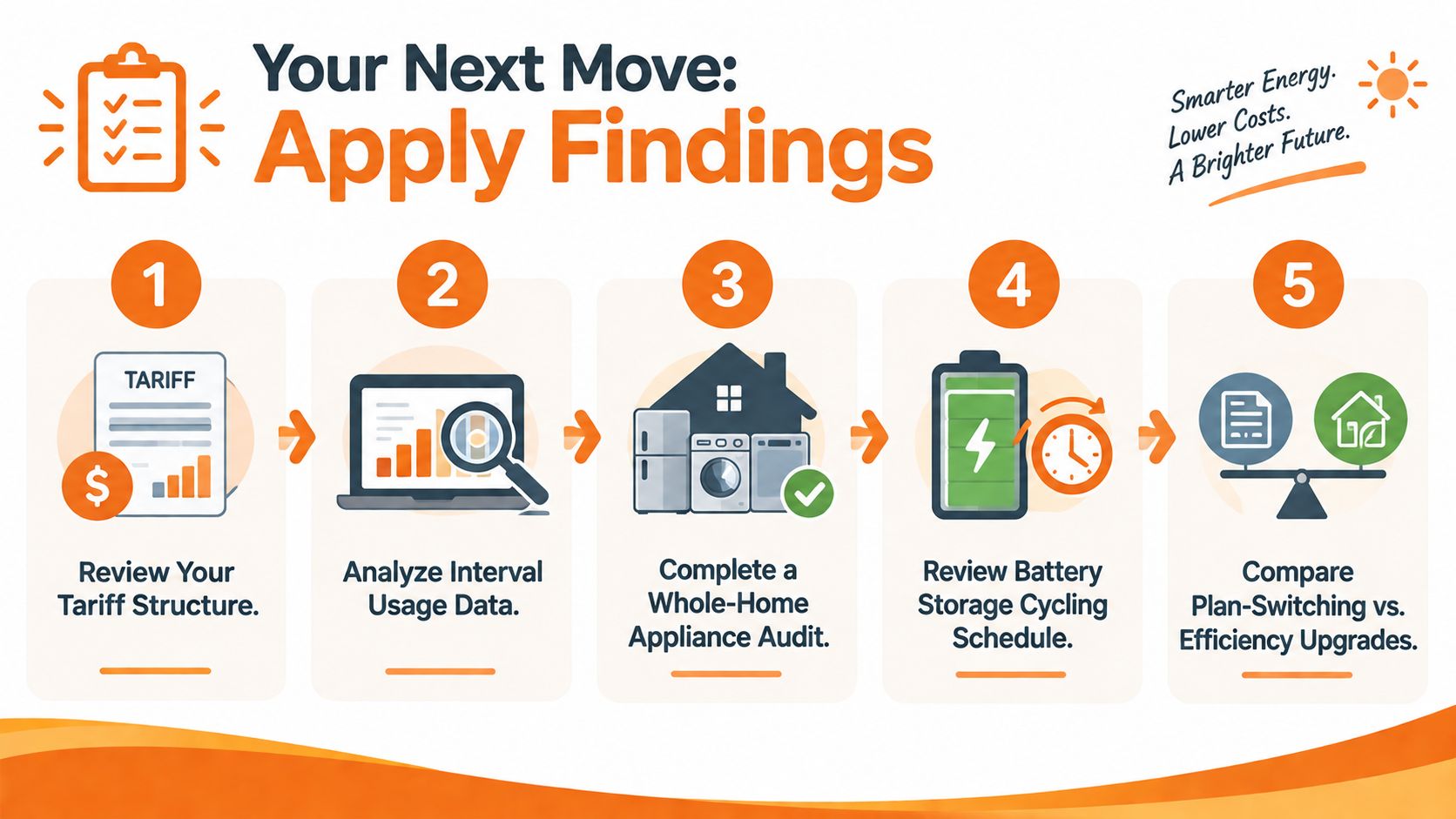
Use this order:
- Review the tariff: Compare peak, shoulder, off-peak, single-rate and demand exposure against actual interval usage.
- Check the meter data: Confirm reads, controlled-load treatment, export settings and billing-period dates.
- Audit household loads: Test pool equipment, heating and cooling, EV charging, fridges, entertainment systems and changed routines.
- Review battery cycling: Check reserve, charge and discharge windows, export limits, forecast inputs, firmware and faults.
- Compare options: Assess plan switching, load scheduling, battery optimisation and BYOB VPP participation on the same usage record.
Prioritise by cost-to-effort ratio. Asking a retailer to correct a tariff mismatch may be easier than changing a major appliance. Adjusting an unsuitable reserve level may be more relevant than chasing small standby loads. A battery owner should compare the financial value of better self-consumption with the potential value of coordinated grid participation.
The AER's final Default Market Offer for 2026–27 says residential flat-rate standing offer prices will fall by 3.4% to 5.0% in NSW and by 7.2% in South East Queensland, while time-of-use customers are expected to see savings in every DMO region, including a reduction of as much as 10.7% in South East Queensland (AER Default Market Offer 2026–27). Treat this as a reference-price change, not a guarantee that your individual bill will fall.
Avoid three common mistakes:
- Fixed-rate contract trap: A new offer may reduce the usage rate while worsening the feed-in tariff or increasing the daily supply charge.
- Discount confusion: A conditional discount may no longer apply if payment, billing or usage requirements change.
- Wrong VPP tier: Registering a compatible battery under an unsuitable product or control tier can undermine the intended value.
HighFlow Energy eligibility should be assessed against battery age, inverter compatibility, current retailer relationship, tariff structure and contract length. Those are practical filters, not promises of a particular bill outcome.
Key takeaways
- A high bill is usually a combination of usage, rates, fixed charges and system settings.
- Compare kWh and billing days before comparing dollar totals.
- Review interval data before changing appliances or tariffs.
- Check battery reserve, export limits and dispatch windows.
- A BYOB VPP can create another value stream from an existing battery, but control rights and eligibility must be clear.
- NSW and Queensland households should compare their specific distribution zone and retail plan, not rely on generic national advice.
Frequently asked questions
Why has my electricity bill increased when my usage looks similar?
The usage rate, tariff structure, daily supply charge, network component, discount conditions or billing period may have changed. Compare the last four bills and calculate the average daily usage and average cost per kWh separately.
Can a battery eliminate a high electricity bill?
A battery can reduce grid imports, but the result depends on capacity, household demand, tariff timing, reserve settings, export limits, system condition and retail terms. It won't automatically remove supply charges or correct an unsuitable plan.
Is a time-of-use tariff always cheaper?
No. It can suit households that can shift flexible loads into cheaper periods, but it can work against homes with heavy peak usage. Compare your interval data with the actual tariff schedule before switching.
What should I check if my solar battery isn't reducing imports?
Check whether the battery is charging from available solar, whether the reserve is set too high, whether discharge is enabled during expensive periods, whether export limits are binding and whether the inverter or communications system shows faults.
Is a BYOB VPP different from a feed-in tariff?
Yes. A feed-in tariff generally credits eligible exports, while a BYOB VPP coordinates participating batteries to provide agreed grid or market services. The customer should retain priority household access, but the exact dispatch and allowance rules depend on the contract.
Can a VPP control my battery without permission?
A VPP should operate under defined customer terms that explain control authority, dispatch windows, reserve requirements and opt-out rights. Read those terms before joining and confirm how household backup needs are prioritised.
Does switching retailers fix a high electricity bill?
It can help when the current plan has poor rates, outdated conditions or an unsuitable tariff. Switching won't solve higher household consumption, incorrect battery settings, network charges or an appliance fault on its own.
Should I replace my battery if my bill remains high?
Not immediately. First check the meter, tariff, interval usage, battery settings, export limit, firmware and warranty conditions. Replacement only makes sense after you understand whether the existing system is technically or financially unsuitable.
Most battery owners focus on installation quality. Far fewer focus on ongoing performance and optimisation. HighFlow Energy is an electricity retailer built around realising the full value of your existing solar and battery system through a retailer-based BYOB VPP. If you want to check whether your battery is underutilised, review your potential allowance and assess your current electricity performance, visit HighFlow Energy and request an eligibility assessment.