

3 Phase Voltage in Australia: What Homeowners Need to Know
When you search for 3 phase voltage in Australia, are you trying to understand the number on the standard, or what an electrician will measure at your switchboard? Those aren't always presented clearly. The modern nominal supply is 230 volts phase-to-neutral and 400 volts phase-to-phase, yet older equipment and consumer guides still refer to 240/415 V.
That distinction matters if you already own solar and a battery. Your phase configuration affects how large loads start, how an inverter manages voltage, how export limits apply, and whether a three-phase setup adds practical value for an electric vehicle, heat pump or future Virtual Power Plant participation. It doesn't automatically mean every battery household needs a supply upgrade.
What Three-Phase Voltage Actually Means
A Queensland homeowner might notice the issue on a hot afternoon. The ducted air conditioner starts, the battery inverter reduces its output or disconnects, and the household sees a nuisance trip or an unexpected change in solar performance. The immediate problem may not be the battery itself. It may be the way several high-demand devices share one electrical phase.
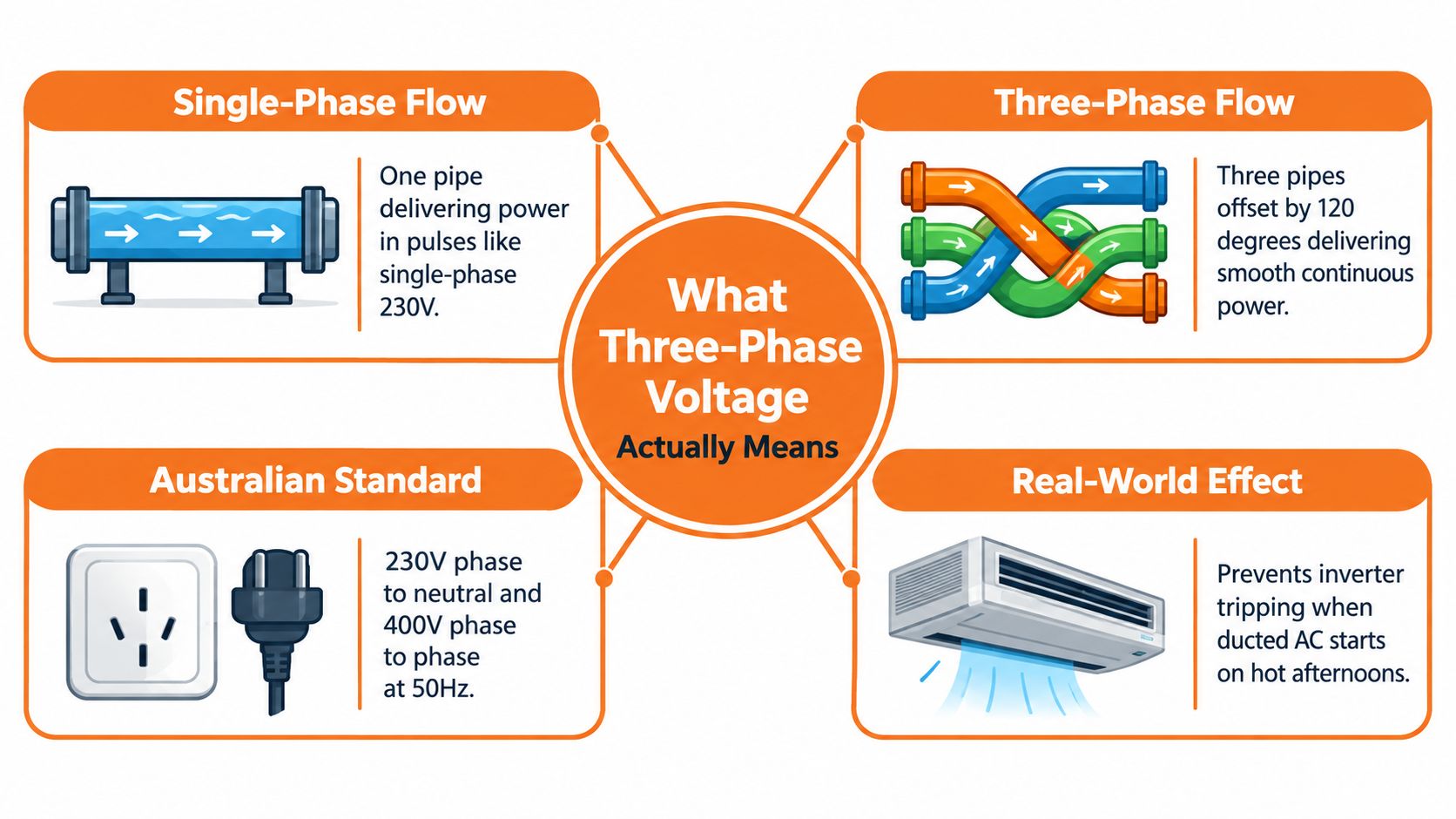
Single-phase supply uses one alternating voltage waveform. A simple water analogy helps. Think of one pipe delivering water in changing surges. The supply can run ordinary household loads, but the flow rises and falls with that single waveform.
Three-phase supply uses three alternating currents. Each phase reaches its cycle at a different point, separated by 120 degrees. Imagine three pipes pushing water in sequence. The combined flow is smoother because one phase is contributing while another is moving away from its peak.
What the phases connect to
Each active phase measures about 230 V to neutral. The voltage between any two active phases is nominally 400 V. That line-to-line value is why three-phase motors and larger equipment can receive power in a smoother, more useful pattern than a comparable single-phase arrangement. Australian reference material describes this practical distinction between approximately 230 V phase-to-neutral and approximately 400 V between phases in technical guidance on checking three-phase power.
A motor can use the rotating field produced by the phase sequence. That produces smoother torque than a single alternating supply, which can reduce vibration in appropriately designed equipment. The benefit isn't that every appliance receives 400 V. Ordinary lights, sockets and many household circuits still use one phase and neutral at about 230 V.
Practical rule: Three-phase doesn't mean every outlet is 400 V. It means the property has three active phases, with 230 V available from each phase to neutral and 400 V available between phases.
At the switchboard, the arrangement may include a three-pole main switch and circuits distributed across the phases. Solar and battery equipment then has to work with that arrangement. A three-phase inverter can exchange energy across the phases, while a single-phase inverter may be connected to only one of them. That design choice affects export, load balancing and the way the battery responds when one part of the home is drawing heavily.
The 230 and 400 Volt Standard Explained
Australia's harmonised low-voltage nominal standard is 230/400 V. Under the modern Australian Standard framework, AS 60038, second edition 2012, the stated values are 230 V phase-to-neutral and 400 V phase-to-phase. Earlier national rationalisation work dates back to 1983, with implementation around 2000, as described in Power and Water's service and installation rules.
The supply isn't expected to sit at exactly 230 V or exactly 400 V at every moment. The modern low-voltage standard allows a tolerance of +10% to -6%. For a nominal 230 V phase-to-neutral supply, that corresponds to roughly 216 V to 253 V. The equivalent three-phase range is based on the 230/400 V system and the applicable tolerance requirements. Queensland regulation connects low-voltage three-phase supply after 27 October 2018 to AS 60038, while AEMO identifies 230 V single-phase and 400 V three-phase as the nominal Australian LV values in its technical material on distributed energy resources. See the AS 60038 regulatory preview and supply requirements.
Why 415 V still appears
The older convention was 240 V single-phase and 415 V three-phase. It remains visible on legacy equipment, older switchboard labels and online explanations. That doesn't mean Australia has two competing nominal standards. It means older documentation has remained in circulation while the formal nominal reference moved to 230/400 V.
A 240 V-rated appliance may still be compatible with the modern supply when its design and certification support the applicable operating range. Compatibility must be checked from the manufacturer's instructions, particularly for motors, heating elements, inverters and equipment that connects between phases. Don't assume a label alone confirms suitability.
| Parameter | Legacy pre-2000 | Current AS 60038 | Tolerance range |
|---|---|---|---|
| Phase-to-neutral nominal voltage | 240 V | 230 V | Approximately 216 V to 253 V |
| Phase-to-phase nominal voltage | 415 V | 400 V | Based on the applicable 230/400 V tolerance |
| Frequency | 50 Hz | 50 Hz | Confirm equipment requirements |
| Common documentation | 240/415 V | 230/400 V | Older labels may remain in service |
The 400 V value also has a mathematical relationship with 230 V. In a balanced three-phase system, line-to-line voltage is approximately the phase-to-neutral voltage multiplied by the square root of three. That relationship is why 230 V produces a nominal line-to-line value near 400 V.
Switchboard work also requires correct isolation. If you're learning about the difference between isolating one conductor and isolating both active conductors in relevant equipment, this guide to when to use a double pole switch provides useful background. It doesn't replace advice from a licensed electrician.
Residential Single-Phase vs Commercial Three-Phase Supply
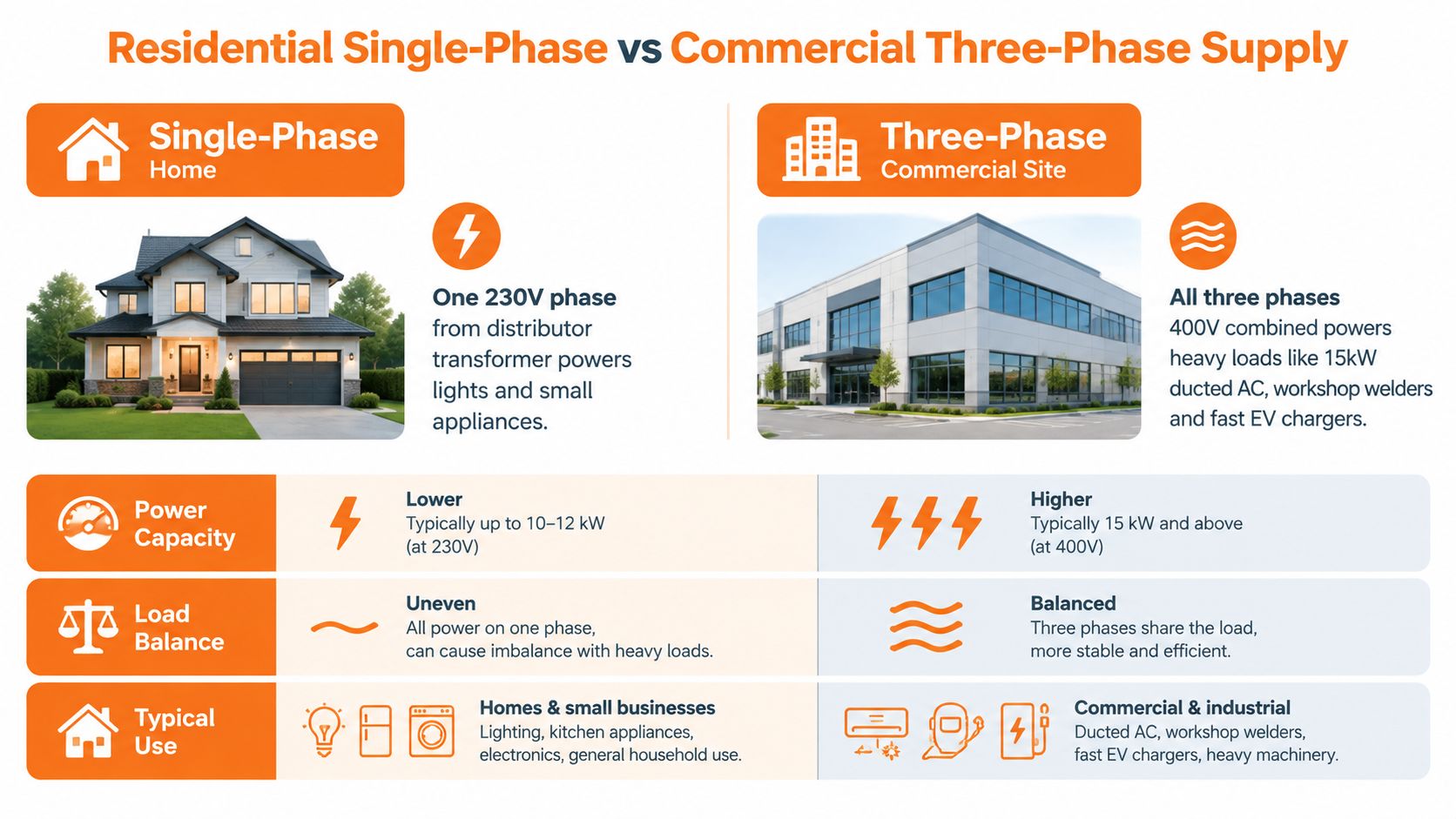
A typical suburban home may receive one 230 V phase from the local distributor transformer. That supply can run lighting, refrigeration, general power and many household appliances without difficulty. The constraint appears when several large loads demand current at the same time.
Consider a home with a 7 kW ducted air conditioner, a 32 A electric oven, a 7.4 kW single-phase EV charger and a battery charging from solar. Those devices don't always operate at their maximum simultaneously, but their combined demand can place considerable pressure on one phase. The result may be nuisance tripping, lights dimming during motor start or an inverter reducing output to stay within current and network limits.
A commercial site, workshop, rural property or larger home may use all three phases. Loads can be allocated across the supply, and three-phase equipment can draw power between phases. A 22 kW three-phase EV charger, for example, is designed around a three-phase connection, vehicle compatibility and the site's approved capacity. It is a distinct technology from a single-phase outlet.
The difference is capacity and distribution
| Consideration | Single-phase home | Three-phase site |
|---|---|---|
| Supply arrangement | One active phase and neutral | Three active phases and neutral |
| Ordinary outlet voltage | About 230 V | About 230 V from each phase to neutral |
| Larger equipment | Often limited to one phase | Can use phase-to-phase supply where designed |
| Load management | Demand concentrates on one phase | Loads can be distributed across phases |
| Common setting | Standard suburban dwelling | Commercial, workshop, rural or high-demand property |
There isn't a universal rule that every new detached home receives three-phase. Supply arrangements depend on the property, distributor network and requested design. Townhouse developments with shared EV infrastructure, commercial premises and rural properties with heavy machinery are more likely to require it because their loads are more substantial or less predictable.
A three-phase connection also doesn't solve poor circuit design. An electrician still needs to calculate maximum demand, select protective devices and distribute circuits sensibly. If you're assessing a home supply or planning an upgrade, review the service options described by High Flow Energy's residential electric service team.
The following video provides a visual introduction to the distinction between single-phase and three-phase arrangements.
Australian Wiring and Safety Basics for Three-Phase
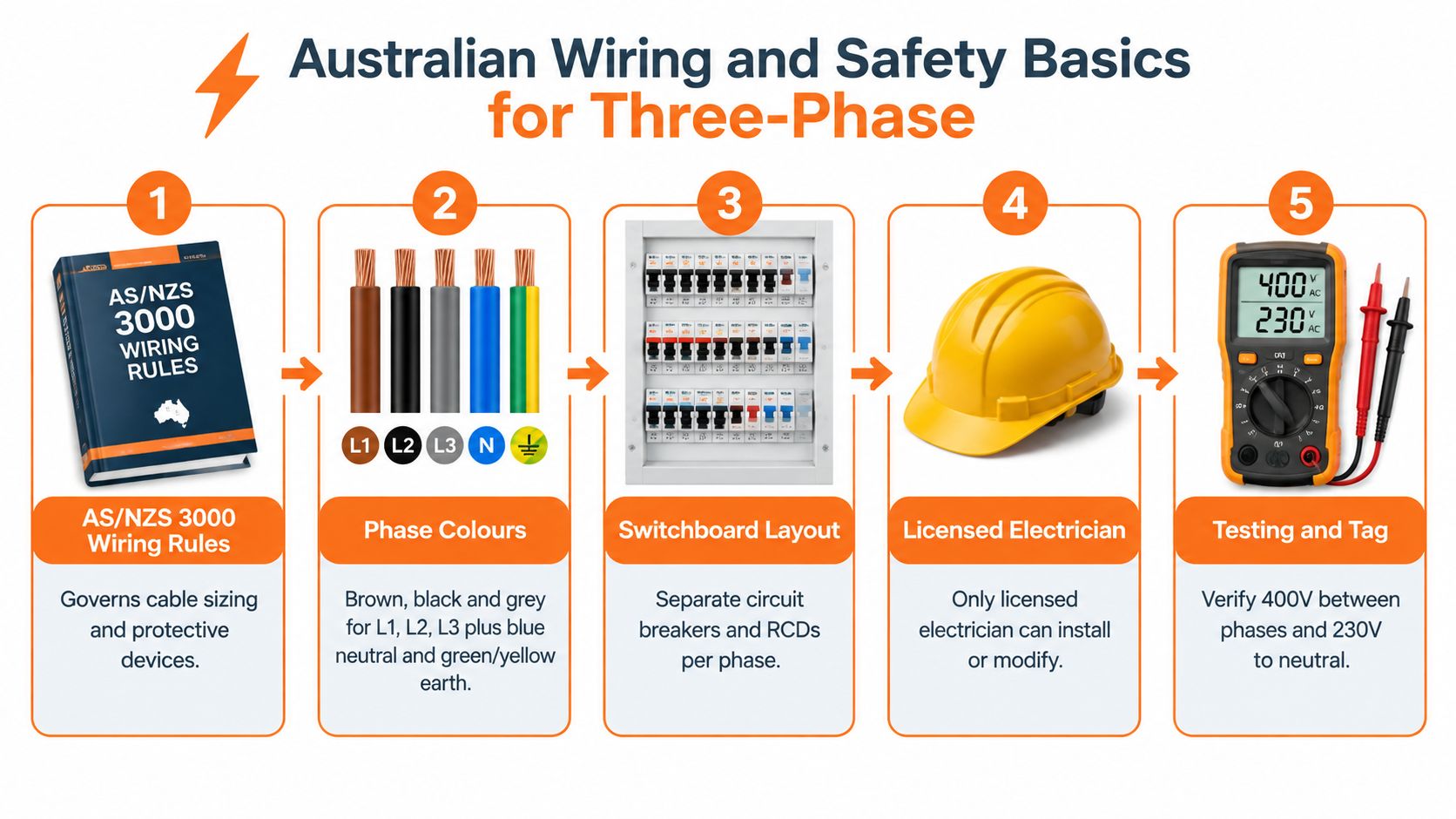
Three-phase installation work in Australia sits within AS/NZS 3000:2018, commonly called the Wiring Rules. The standard applies to electrical installations up to 1000 V AC and covers matters such as cable selection, protective devices, earthing, isolation and switchboard construction. A summary of the relationship between the Wiring Rules and the 230/400 V, 50 Hz supply is provided in Australian wiring standards guidance.
The phase conductors, neutral and protective earth need clear identification. In the arrangement commonly described for modern Australian installations, active conductors use brown, black and grey, neutral uses blue, and protective earth uses green with yellow. Existing installations can contain different or legacy arrangements, so colour alone isn't a safe test.
What the electrician verifies
A competent installer does more than connect three wires.
Phase sequence: The L1, L2 and L3 order must be checked where equipment depends on rotation. A motor connected with the wrong sequence can run in reverse, which can damage pumps, compressors or machinery.
Protection: The switchboard needs suitable main switching, circuit protection and residual-current protection. Individual circuits may use RCBOs, or an appropriate combination of RCDs and circuit breakers, subject to the installation design.
Labelling and separation: The board should identify phases, neutrals, earths and circuits clearly. A future electrician must be able to isolate the correct equipment without guessing.
Testing: Voltage, continuity, insulation, polarity, earthing and protective-device operation must be tested before the installation is placed into service. A meter reading between two phases should be interpreted by a qualified person, not treated as a DIY diagnostic.
Three-phase work must be carried out by a licensed electrician. Supply alterations can also involve the local distributor, inspection requirements and certificates of electrical safety. In Queensland and New South Wales, the exact process depends on the work and the network, so the installer should confirm the approval pathway before energisation.
Don't open an energised switchboard to count phases or test voltage. If your project involves an inverter, battery, EV charger or new supply, use a licensed electrician and review the installation pathway described in High Flow Energy's solar inverter installation information.
Three-Phase Voltage and Your Solar and Battery System
Three-phase voltage affects a solar and battery system through the inverter connection, phase loading and network export rules. The battery cells don't become more powerful because the property has three phases. The value comes from how the inverter converts stored DC energy into AC power and how that power is distributed through the home and grid connection.
Australian inverter requirements under AS/NZS 4777.2 apply across an LV operating range of 180 to 260 V phase-to-neutral, with equivalent three-phase voltages appropriate to 230/400 V networks. This means an inverter must tolerate substantial voltage variation without nuisance disconnection. AEMO's technical requirements for distributed energy resource connections discuss the operating expectations relevant to connected energy resources.
Three design questions for existing systems
First, what type of inverter is installed? A single-phase inverter may export through one phase even when the house has a three-phase supply. A three-phase inverter can exchange power across the phases, subject to its design, configuration and network approval.
Second, how does the system respond to voltage rise? Rooftop solar backfeed can increase local voltage. Export control, volt-var response and phase balancing can help the system remain connected and operate within required limits. These functions matter for reliable solar and battery operation, especially on constrained network sections in Queensland and New South Wales.
Third, what does the VPP need to control? A VPP operator may need to coordinate battery charging and discharge with household demand, wholesale price volatility, network constraints and demand events. A three-phase system can give the operator a different control structure from a single-phase system, but eligibility depends on the program, inverter, battery, metering and connection approval.
| Factor | Single-phase solar and battery | Three-phase solar and battery |
|---|---|---|
| Grid connection | Usually exchanges energy through one active phase | Can exchange energy across multiple phases when equipment supports it |
| Household loads | High demand may concentrate on one phase | Loads can be distributed across phases |
| Voltage management | Sensitive to conditions on the connected phase | Requires coordinated response across the phases |
| Export control | Often applied to the connected phase or approved system limit | May be coordinated across phases |
| VPP operation | Can be eligible under many program designs | May support broader phase-aware control, subject to program rules |
A three-phase battery system isn't automatically more financially valuable than a single-phase system. The outcome depends on your tariff, solar generation, battery capacity, household consumption, export approval and the VPP's operating rules. For a more focused discussion of system architecture, see High Flow Energy's three-phase solar battery guide.
Why phase balancing matters
Suppose the home imports energy on one phase while solar is exporting on another. A basic system may not offset those flows in the way the homeowner expects. Metering arrangements, inverter configuration and distributor rules determine how the energy is recorded and controlled.
A well-configured system can prioritise household consumption, charge the battery from available solar, limit exports when the network requires it and discharge during useful price or demand periods. That's the technical foundation for battery optimisation. It isn't a promise of a particular bill result.
Do You Actually Need Three-Phase at Home
Many battery owners assume three-phase supply is the natural next step. That assumption is too broad. A household with moderate demand, a suitable single-phase inverter and a properly sized battery may not gain enough from a supply upgrade to justify the work.
The decision should start with measured demand, not product marketing. Review when large appliances operate together, whether the main switch trips, what your inverter is allowed to export and whether your future plans include a large EV charger or major electrification.
Signals that deserve an assessment
- Existing strain: Frequent trips, dimming lights or inverter current-limiting during coincident loads justify a load assessment.
- Planned charging: A 22 kW three-phase EV charger requires compatible vehicle equipment, charger hardware and supply capacity.
- Large electrification: Heat-pump systems, ducted air conditioning, induction cooking and workshop equipment can change the demand profile.
- Network constraints: A supply upgrade won't automatically remove an export limit. The distributor still controls connection approval and network operating conditions.
- Battery participation: Many VPP programs can accept suitable single-phase battery systems. Eligibility depends on the program rather than on the label “three-phase” alone.
A distributor upgrade in Queensland or New South Wales may cost AUD 1,500 to AUD 5,000 plus electrician fees, according to the specified Australian homeowner guidance on three-phase supply upgrades. Treat that as an indicative range, not a quote. The final requirement depends on the street network, service arrangement, switchboard, property access and distributor approval.
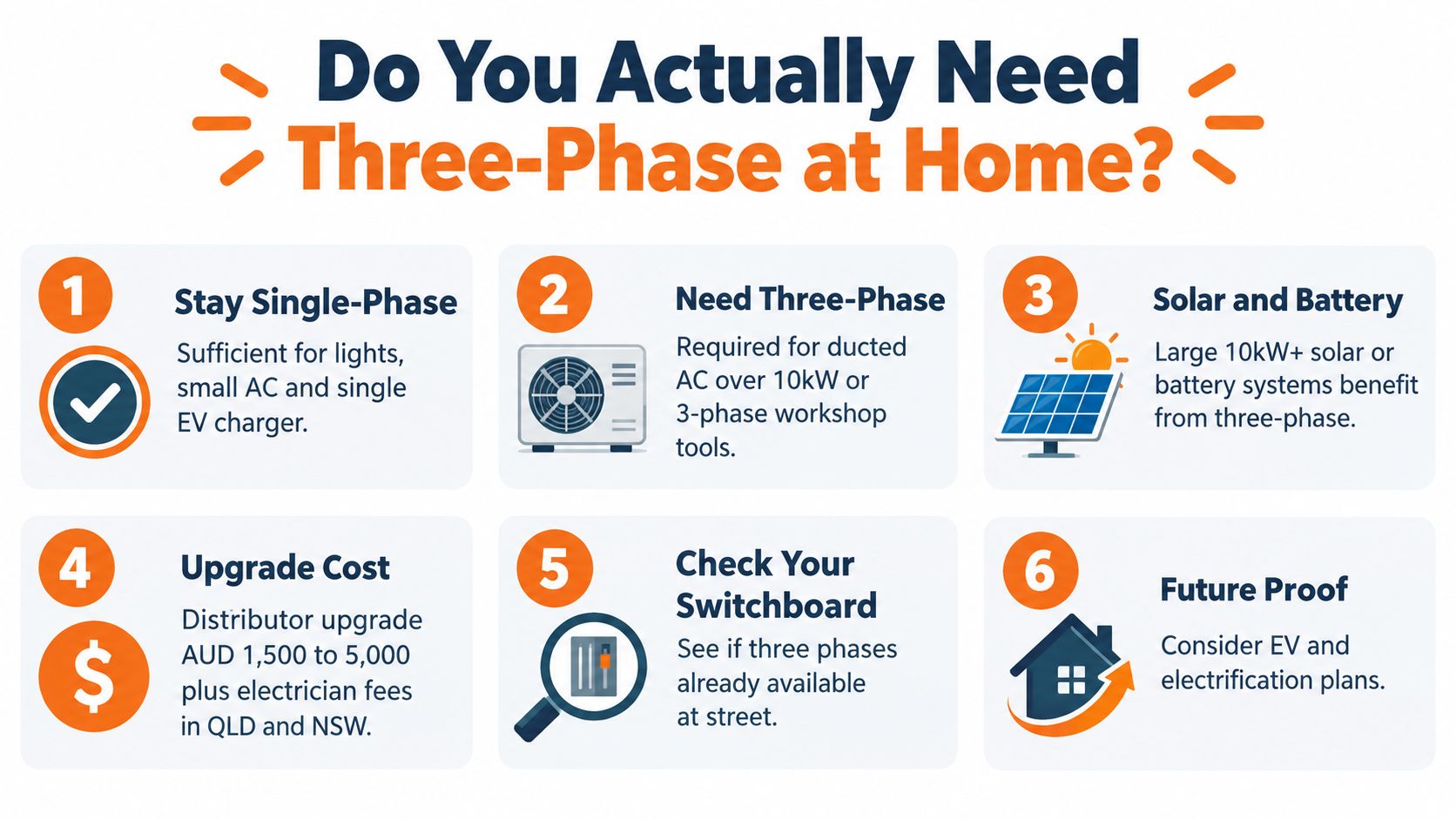
Decision test: If your current supply meets measured demand and your battery can participate in the VPP you want, keep the focus on optimisation. Upgrade when a defined load, connection requirement or future plan makes three-phase necessary.
Key Takeaways for Australian Battery Owners
For a homeowner in Queensland or New South Wales, three-phase voltage is both a technical standard and a practical design choice. The standard establishes 230 V phase-to-neutral and 400 V phase-to-phase. Your actual system performance then depends on the distributor connection, switchboard, inverter, metering and the appliances connected to each phase.
A supply upgrade is separate from a solar upgrade. Adding panels or replacing a battery doesn't automatically create three-phase capacity. Conversely, moving to three-phase doesn't guarantee higher solar exports or lower electricity bills. The distributor still assesses the connection, and the inverter must comply with the applicable operating and export requirements.
Use this checklist before requesting a quote:
- Check the switchboard: Ask a licensed electrician whether the property already has three active phases, a suitable main switch and enough room for new protection.
- Measure peak demand: Look at the periods when air conditioning, ovens, pool equipment, EV charging and battery operation overlap.
- Review export approval: Confirm the inverter's approved export arrangement with the distributor. More phases don't remove local network constraints.
- Match the inverter: A three-phase site can still have a single-phase inverter. Ask how the proposed equipment will import, export and respond to voltage on each phase.
- Consider VPP rules: Check whether your existing battery, inverter and meter qualify for the program. Participation may depend on control capability and connection settings.
- Price the complete change: Include distributor work, electrician labour, switchboard modifications, approvals and commissioning.
The 80 A single-phase limit, the solar export thresholds that may encourage a three-phase design, and any system-specific approval values must be confirmed from the relevant distributor and equipment documentation. They shouldn't be treated as universal figures for every Australian property.
The practical decision comes down to three questions: What configuration is already at the switchboard? What is the measured peak load? Which VPP and electrification plans matter to the household? Those answers are more useful than assuming three-phase is automatically superior.
Common Questions About Three-Phase Voltage in Australia
What voltage should I measure at the meter?
A compliant Australian low-voltage supply is nominally 230 V from phase to neutral and 400 V between two active phases. The applicable tolerance means a reading may vary with network conditions and load. Only a qualified person should perform or interpret live measurements.
Are older 415 V appliances still compatible?
Older Australian equipment may refer to 415 V three-phase because that was the legacy nominal convention. Compatibility depends on the appliance's rating, certification, operating range and installation instructions. Don't replace a protective device or connect equipment based only on the number printed on an old label.
How can I tell whether my home has three-phase supply?
Look for a three-pole main switch, a meter-panel label identifying three-phase supply or separate active-phase arrangements. Those signs aren't a substitute for testing. A licensed electrician can confirm the configuration safely without relying on the appearance of the switchboard.
Why might a Queensland home see voltage near 250 V?
The modern phase-to-neutral tolerance can extend to approximately 253 V at the upper end of the stated range. Local network conditions, solar export and changing demand can influence the measured value. If voltage is repeatedly high or equipment disconnects, record the conditions and contact your distributor or electrician.
Does a 5 kW single-phase inverter limit solar on a three-phase home?
It can, depending on the inverter approval, export settings and distributor requirements. A three-phase supply doesn't automatically allow a single-phase inverter to export more. Ask the installer to explain the approved connection arrangement and how the meter records imports and exports.
How do smart meters interact with three-phase tariffs?
A smart meter measures the property's approved supply arrangement and records energy according to the retailer and network tariff structure. Three-phase supply doesn't automatically create a cheaper tariff. Time-of-use pricing, demand components, export credits and VPP settings depend on the contract, retailer and network.
Who approves a three-phase upgrade?
The local distribution network service provider assesses the network connection. A licensed electrician or appropriately accredited service provider usually prepares and coordinates the technical work. In Queensland and New South Wales, the required process depends on the property and the proposed alteration.
What does a residential upgrade cost?
An indicative Queensland and New South Wales distributor upgrade range is AUD 1,500 to AUD 5,000 plus electrician fees, but the final price depends on the site and network. Obtain a written assessment that separates distributor charges, electrical work, switchboard changes and any inspection or approval costs.
High Flow Energy helps existing solar and compatible battery owners assess whether a retailer-based BYOB VPP could improve the value of their system while retaining household priority use. Visit HighFlow Energy to review eligibility, understand the allowance structure and assess whether your current battery is being underutilised.