

Battery Compatibility Chart for Australian Homes
Only about 24% of customers with installed batteries participated in a virtual power plant as of January 2026, even though VPP capability became an eligibility condition for batteries installed under the federal Cheaper Home Batteries Program, according to ACCC figures reported through the Clean Energy Regulator. A battery compatibility chart that stops at brand and kilowatt-hours will not explain that gap. In Queensland and New South Wales, a battery can sit on the wall, charge from the roof, and still fail a program because the inverter, the coupling, or the warranty record does not pass.
Most owners treat the battery as the asset. The chart that decides participation treats the inverter, the setup, and the program rules as equal fields. An approved product is not the same thing as an eligible one.
Battery Compatibility Chart Fields at a Glance
A useful Australian chart records far more than brand and capacity. The Clean Energy Council approved inverter and power-conversion list holds more than 3,800 models assessed against Australian and international standards plus extra consumer-safety checks. Inverter model and certification status are core fields, not footnotes.
Copy this template before you rely on any row. A question mark, or any cell you have not opened a source for, means the value is unverified. A blank is never a pass.
| Field | What to record | Why it matters | Where to verify |
|---|---|---|---|
| Battery model and firmware | Make, model and firmware version | Determines charge and discharge behaviour | Manufacturer datasheet |
| Usable and nominal capacity | Both values in kWh | Usable energy sets the real daily cycling range | Manufacturer datasheet |
| Inverter or power-conversion model | Exact model and certification suffix | Approval status attaches to the inverter | CEC approved inverter list |
| Coupling type | AC, DC or hybrid | Determines retrofit path and grid charging | Installer single-line diagram |
| Grid-charge capability | Yes, no or conditional | Affects automated charge scheduling | Inverter manual |
| Communications protocol | Protocol and any gateway requirement | Needed for remote dispatch | Inverter interoperability statement |
| Standards version | AS/NZS 4777.2 and AS/NZS 5139 editions applied | Confirms rules in force at installation | Installer certificate and CEC list |
| VPP status and warranty remaining | Eligible, pending or not eligible; years of warranty left | Sets VPP participation and incentive eligibility | Program eligibility check and warranty card |
| Checked on | Date of last verification | Approved lists change over time | Chart owner record |
Why each field earns its place
Battery model and firmware lock the charge curve the installer commissioned. Usable and nominal kWh stop you treating nameplate energy as daily cycling range. Inverter model and suffix are what an approval list matches. Coupling decides whether a retrofit keeps the existing solar inverter. Grid charging decides whether a program can fill the battery outside sunny hours. Communications decide whether a remote signal can land. Standards version records the rules on the installation date. VPP status and warranty years separate a working battery from one a program will accept. Checked on expires the row when lists move.
For a Queensland or New South Wales home, a battery counts as compatible only when the inverter, coupling and standards fields all verify against current sources. Capacity alone does not clear that bar.
Battery Brand and Model Lookup
One fully documented battery sets the standard every other row must meet. HighFlow Energy, the Australian importer for the Lithium Valley W16 manufactured by Dongguan Lithium Valley Energy Co Ltd, publishes the complete manufacturer set for that model: datasheet, installation and user manual, safety data sheet, warranty policy, and inverter compatibility statement. Those documents are what turn a chart cell from an assumption into a checked value.
| Brand and model | Usable kWh | Inverter pairing | Coupling | Grid charging | VPP status |
|---|---|---|---|---|---|
| Lithium Valley W16 | Usable and nominal figures stated on the W16 datasheet | Exact inverter model and suffix named in the W16 inverter compatibility statement | AC, DC or hybrid, set by the installation manual and the installer single-line diagram | Yes, no or conditional, per the paired inverter's manual | Pending until a program check returns eligible or not eligible |
How to read an open cell
A row copied from another site is not a checked row. Every cell needs a named document behind it, and anything less stays open rather than defaulting to yes. Capacity is the field most often misread: nominal kWh describes total stored energy, while usable kWh sets the cycling range a program can plan around, and only the datasheet separates the two.
Inverter pairing fails without warning. Two batteries can share a brand and still sit on different inverters, and an approval list matches the inverter's exact model and suffix, not the battery's marketing name. Coupling then decides whether the existing solar inverter stays in place, and grid charging decides whether a program can fill the battery outside solar hours.
For HighFlow's Bring Your Own Battery VPP, open to homeowners in Queensland and New South Wales, the program's own eligibility check is the final word on the status column, and HighFlow will help confirm whether a system qualifies. Each row also needs a fresh check date whenever approved lists change, because approvals move.
Key Terms Behind Battery Compatibility
Australia does not run battery matching off one universal battery-to-inverter standard. Approved-product and electrical-safety rules do the work.
A battery energy storage system (BESS) is the whole arrangement: battery, inverter or power-conversion equipment, controls, and the way it is installed. The battery module is only one part.
A battery inverter converts battery direct current into alternating current for household appliances. It also holds charging functions and a battery management system that controls when, and how quickly, the battery charges and discharges. That is why the inverter matters as much as the cells.
AC coupling puts a battery on its own inverter, joined through the home's AC wiring. An existing solar inverter can usually stay. DC coupling joins the battery through a converter, often to a hybrid inverter that already manages the solar array. The two paths are not swaps.
An approved product has been independently tested against electrical safety and quality standards. A virtual power plant (VPP) is a coordinated group of home batteries that supports the grid under a program, using spare capacity rather than the energy the house needs first.
Practical rule: A compatible battery connects correctly. An eligible battery is one a specific program will accept. The next checks exist because those two outcomes split.
AC, DC and Hybrid Setups Compared
The setup decides what the battery can do, not only whether the terminals meet.
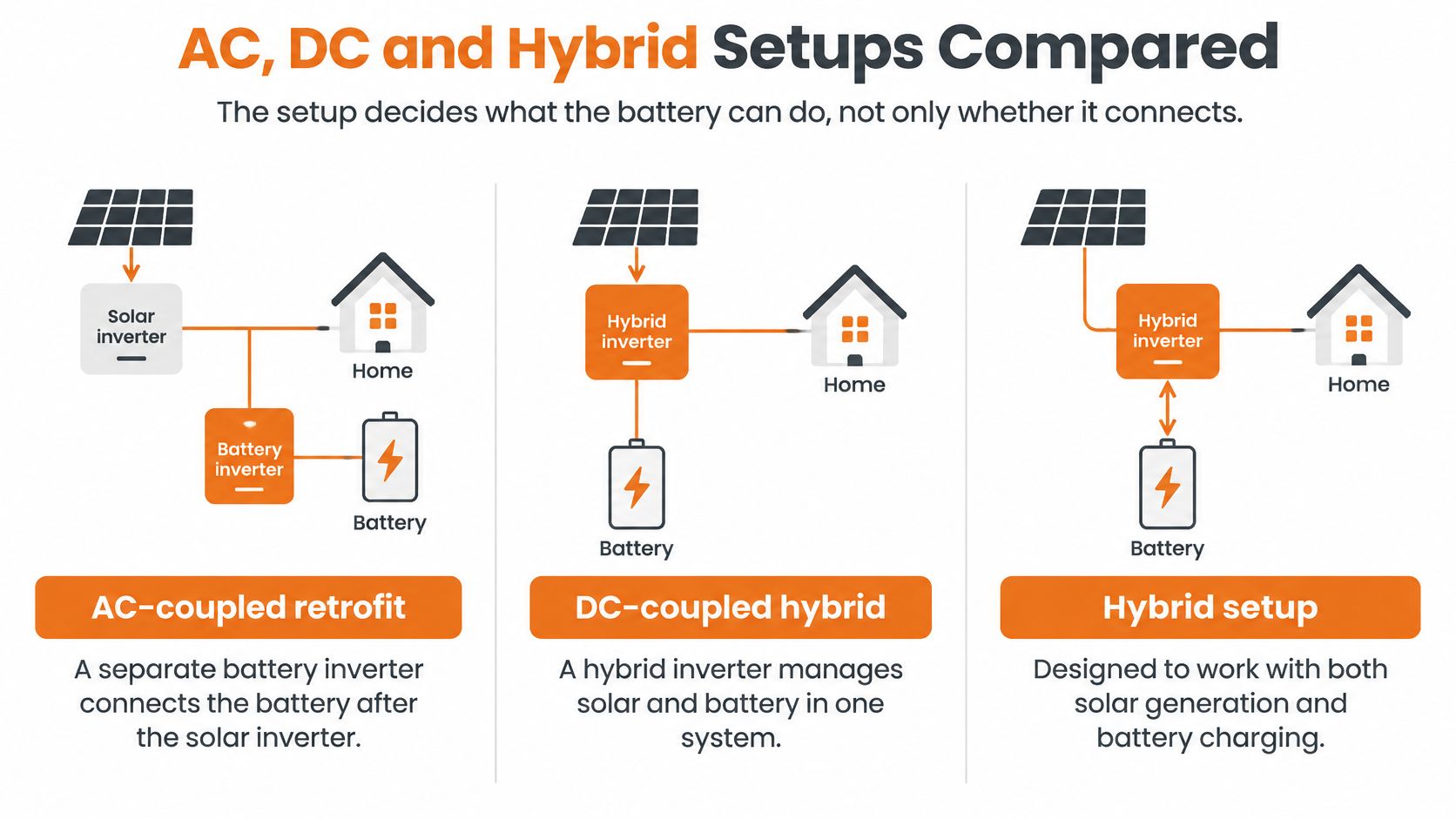
Queensland guidance treats three architectures as materially different: an AC-coupled battery with its own inverter, a hybrid inverter that joins PV and battery, and a DC-coupled arrangement that uses a dedicated DC-to-DC converter. They are not interchangeable. A deeper split of the two retrofit paths sits in our note on DC-coupled and AC-coupled batteries.
| Setup | How it connects | Grid charging | VPP implication |
|---|---|---|---|
| AC-coupled retrofit | Separate battery inverter on the home AC wiring; existing solar inverter can stay | Check inverter settings | Battery inverter must be VPP capable |
| Hybrid inverter | One inverter manages PV and battery | Check inverter settings | Inverter must stay on the approved list; replacement may be needed if delisted |
| DC-coupled | Battery connects through a DC-to-DC converter, often tied to a specific hybrid inverter | May be restricted to solar charging | Limits the charging windows a VPP can schedule |
A Brisbane retrofit
Say a Brisbane owner already has a non-hybrid solar inverter and wants a battery. The compatible route is AC coupling: the solar inverter stays, and a separate battery inverter joins the AC wiring. A DC-coupled model is not a drop-in. DC-coupled batteries are often specific to one hybrid inverter, and a gateway may be required before the devices will talk.
A DC-coupled retrofit may also restrict charging to solar rather than the grid. That cuts the windows a program can use for automated charging ahead of a high-price evening. The battery still stores roof energy. It just cannot be filled on command when the sky is dull.
Three questions for the installer
- Which coupling applies: AC retrofit, hybrid, or DC-coupled.
- Whether grid charging is enabled: yes, no, or conditional in the commissioned settings.
- Which gateway is required: the communications device, if the battery and inverter will not speak on their own.
Write the answers into the chart. A verbal "it'll work with your solar" is not a coupling type.
Standards and Approval Dates to Verify
Compatibility is governed by approved-product and electrical-safety requirements; there is no single pairing table that settles it. Record the rule that applied on the installation date. A system commissioned before a change can differ from one installed now, and an inverter approved under an older edition stays valid only under the conditions in force at the time.
From 23 August 2025, applications to the CEC approved-products program had to comply with AS/NZS 4777.2:2020 Amendment 2:2024, the grid-connected inverter standard, as set out in CEC application guidance. Battery products must be independently tested and certified by an IEC- or JAS-ANZ-accredited body. When a battery is added to existing solar, the battery system and inverter must meet the applicable requirements, and the inverter must appear on the CEC approved inverter list at installation.
| Standard or list | Scope | Applies from | Status |
|---|---|---|---|
| AS/NZS 4777.2:2020 Amendment 2:2024 | Grid-connected inverter requirements | 23 August 2025 for new CEC applications | In force |
| AS/NZS 5139:2019 | Battery energy storage system installation and clearances | Current edition | In force |
| CEC approved inverter list | Inverter and power-conversion models independently tested; more than 3,800 listed | Ongoing | Updated over time, so check the date |
| CSIP-AUS communications | Interoperability for new inverters | South Australia and Victoria now; NSW, ACT and WA expected 2026 | Confirm for your jurisdiction |
| CEC battery program specifications | Technical requirements for approved battery products | Phasing in | Confirm the version currently in force |
One check per row
Inverter standard: confirm the amendment that applied when the inverter was approved, not the marketing year on the box. Installation standard: battery work follows AS/NZS 5139:2019. Safety guidance includes keeping a BESS at least 600 mm from an exit, with specified non-combustible protection where fire-spread risk exists, as summarised by Energy Safe Victoria. List status: open the current CEC list and write the date.
Communications: national guidance on vehicle-to-home and vehicle-to-grid barriers notes CSIP-AUS support is required for new solar and hybrid solar-battery inverters in South Australia and Victoria, with the requirement expected to expand to New South Wales, the ACT and Western Australia in 2026. That expansion is a projection, so confirm it for your network before treating it as already mandatory.
Battery program specs: the CEC battery program is phasing in technical specifications for approved battery products. Confirm the version currently in force with the CEC before relying on it, then date the chart. Lists are monitored and they change.
VPP Eligibility, Warranty and Trade-offs
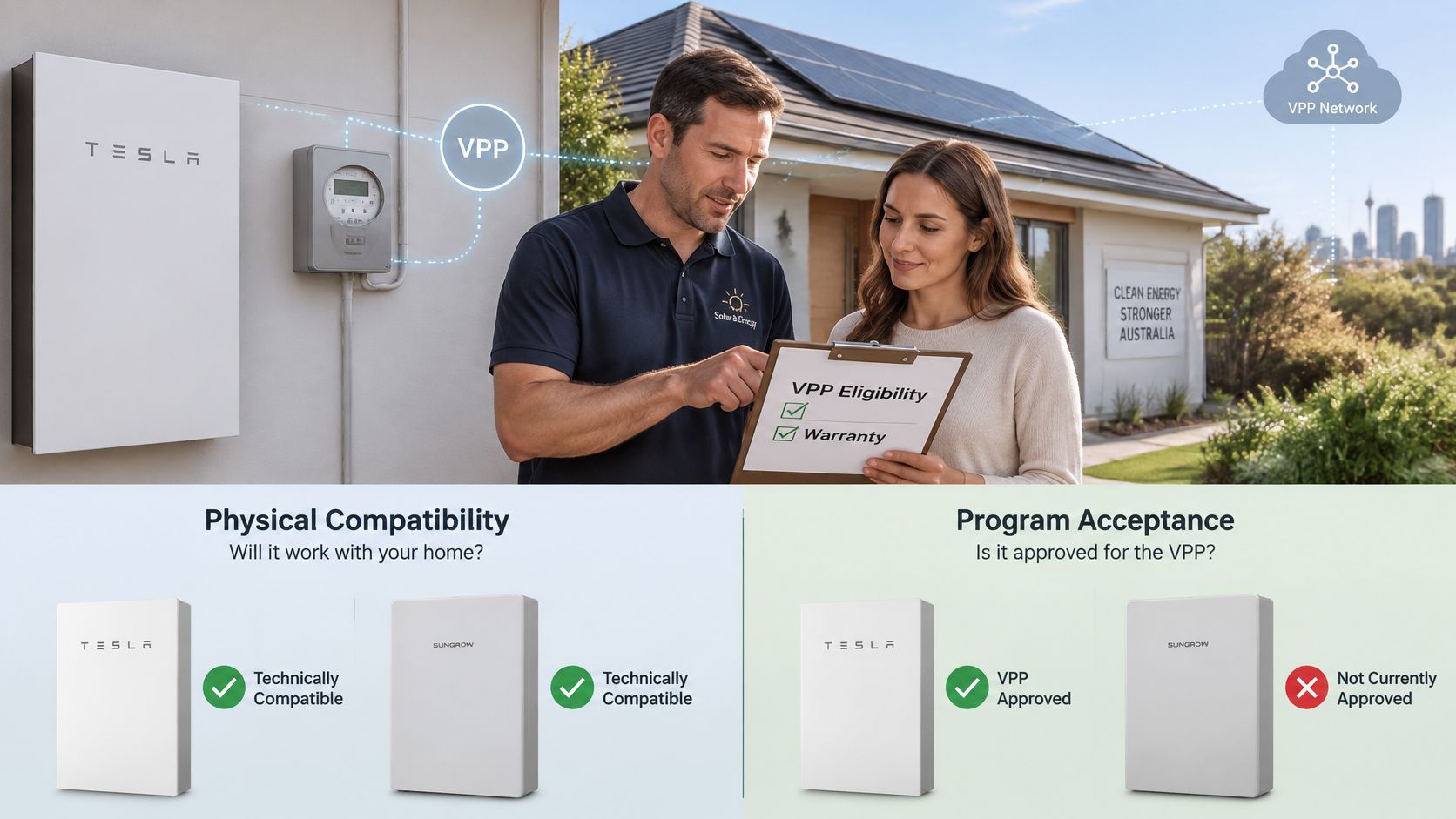
Physical connection and program acceptance are different tests. Australian Government guidance states that an on-grid battery system, including its inverter, must have the technical capability to participate in a virtual power plant where that participation is required. The inverter should connect to the grid and to external entities, directly or indirectly, and communicate with and respond to remote signals.
A battery that works at home and still fails
A Newcastle battery charges from the roof and covers the evening peak. Its inverter has no path for a remote dispatch signal. The battery passes the electrical test and fails the communications one. VPP programs layer their own product requirements on top of electrical fit, so a tick in the compatibility column does not settle the eligibility question. The inverter connected to the battery must be VPP-capable; an existing solar PV inverter does not necessarily need to be. If a hybrid inverter has left the approved list, it may need replacement unless it was listed when commissioned and has not been safety-delisted.
Three checks separate a confirmed yes from a guess: the battery inverter is VPP capable, remote communications are confirmed, and the program's product rules are confirmed in writing. Eligible batteries must also meet minimum usable capacity, inverter requirements, and VPP compatibility standards.
Some incentive programs weigh the remaining years on a battery warranty, so record the years left on the card before you apply. Joining HighFlow Energy's Bring Your Own Battery VPP does not affect the customer's battery warranty, and you keep full ownership and control of the battery. The trade-off sits in dispatch. HighFlow may remotely charge or discharge the battery for market participation, which changes how much stored energy is available at any given time. Confirm reserve and override settings before you join; the app allows a manual override at any point. If the battery stops working or is removed and eligibility requirements are no longer met, the allowance stops and standard retail pricing applies unless you leave.
A feed-in tariff pays a set rate for exports. VPP value tracks wholesale prices in the National Electricity Market and demand events, and it is not a promise of the same dollars every month.
Participation does not guarantee a minimum charge level or backup power during an interruption. The home's own use comes first, and the VPP only draws on spare capacity when the battery is available.
How to Check a Battery Against the Chart
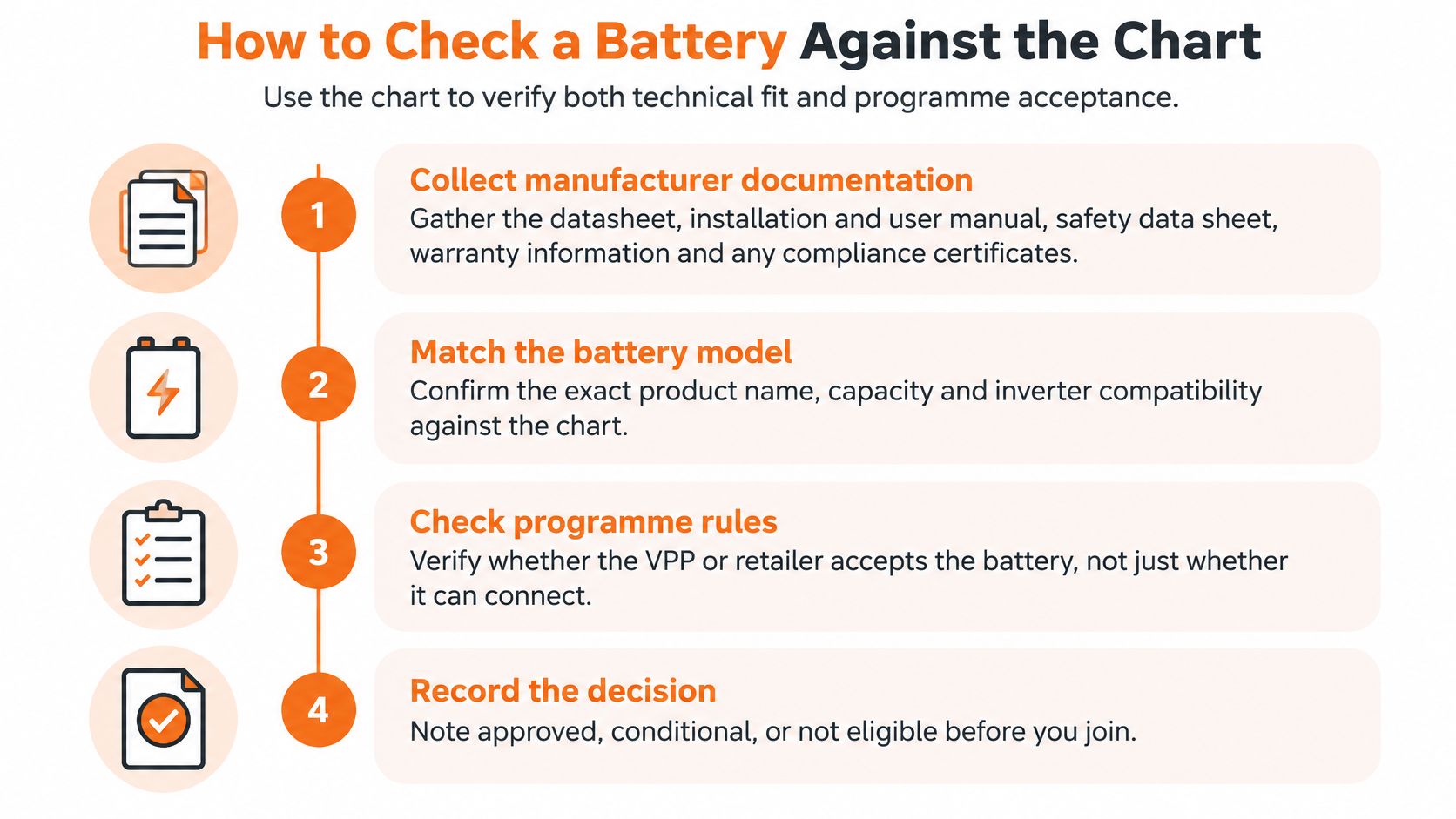
Run the checks in order. Each one closes a different failure.
- Collect the manufacturer set. For a home battery, this usually means a datasheet, installation and user manual, safety data sheet, warranty policy, and inverter compatibility statement. HighFlow Energy provides that set for the Lithium Valley W16. Without those pages, later ticks are guesses.
- Record model, firmware, and both kWh figures. Usable energy, not the nominal nameplate, sets the daily cycling range a program can schedule around.
- Identify the inverter and its certification suffix, then confirm that exact model on the CEC approved list. Government guidance recommends that check before purchase because listed inverters have been independently tested. Approval attaches to the model, not the logo. Our notes on matching a battery to an inverter walk through that pairing.
- Read coupling from the single-line diagram. AC, hybrid, and DC setups do not share grid-charging behaviour, so a brand match on the battery label is not enough.
- Write the standards edition that applied on the installation date. A later amendment does not rewrite a system that was approved under the earlier rule, and an old certificate does not approve a new application.
- Confirm the battery inverter is VPP capable and that remote communications are supported, including any gateway. A battery that only responds to a local app will not take an external dispatch.
- Record remaining warranty years and the checked-on date. Re-open the lists when they change. Do not recycle last year's printout.
A complete record has every field tied to a named source. No unverified cell is marked as a pass. If one field is still open, the row stays pending.
Frequently Asked Questions and Common Misconceptions
Is a battery on a compatibility list automatically VPP eligible? No. Remote-control capability on the battery inverter, and each program's own product rules, are assessed separately. Resolve it with the communications field and a written program check, not the battery brand line.
Does a hybrid inverter stay approved indefinitely? No. If it is no longer on the approved list, it may need replacement unless it was listed when commissioned and has not been safety-delisted. Resolve it by opening the current list and noting the commissioning date.
Does usable kWh decide compatibility? No. The inverter model and the coupling type decide most outcomes. Usable energy sets cycling range and some program minimums. It does not approve the hardware. Resolve it in the inverter and coupling fields.
Does VPP participation guarantee backup power? No. Participation does not guarantee backup or a minimum charge level, and the home's own use comes first. Resolve it by reading the reserve and override settings, not the sales brochure.
Does last year's chart still apply? Only if the checked-on date is recent. Approved lists change. Resolve it by writing a new date after you re-open the list.
Does an approved solar inverter approve the battery? No. The battery and its inverter are assessed as a system. The existing solar inverter often does not need to be VPP capable. The battery inverter does. Resolve it on the battery-inverter row, not the solar-inverter row.
Confirm Eligibility Before You Join a VPP
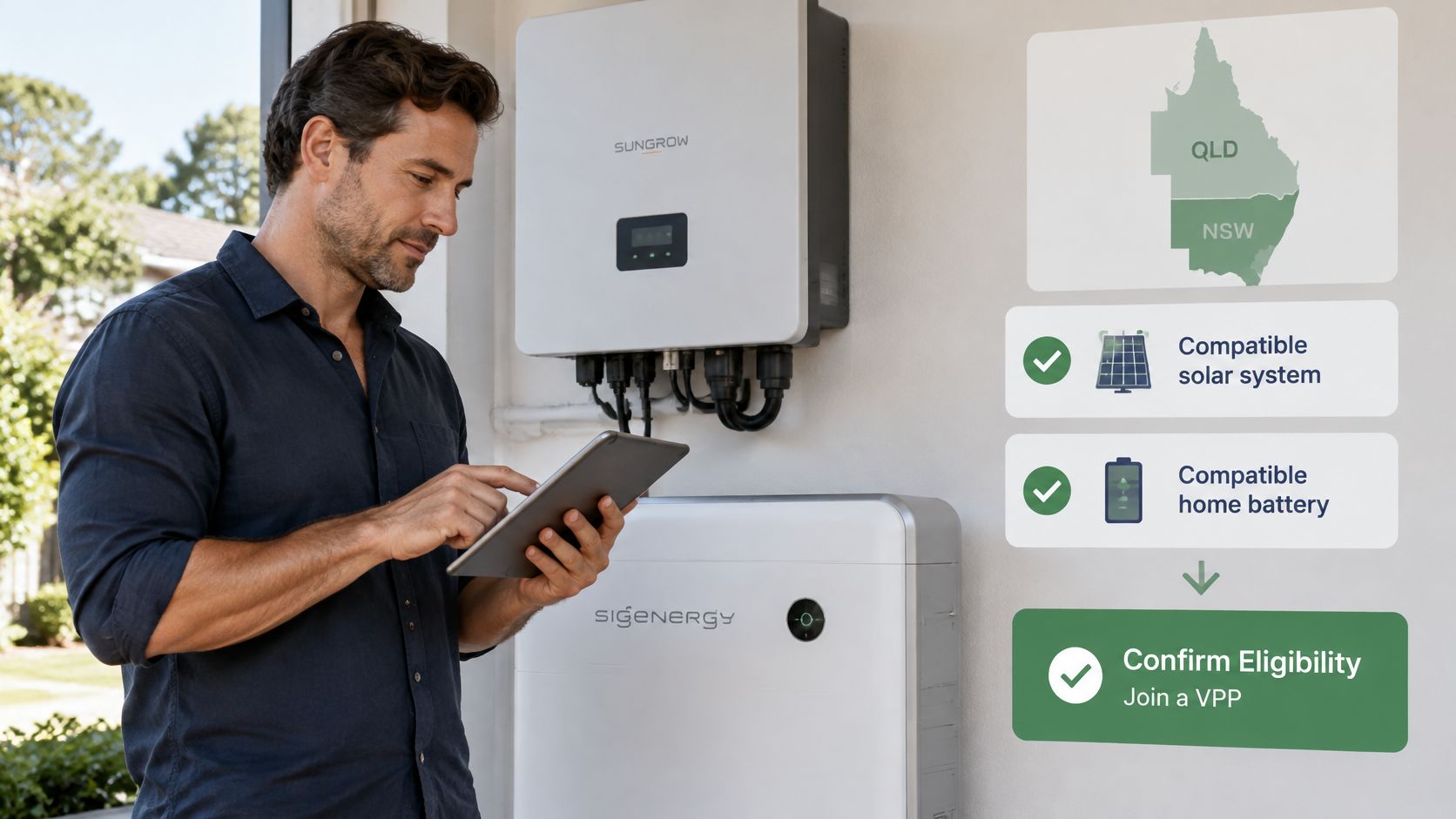
A Bring Your Own Battery VPP is open to homeowners in Queensland or New South Wales who have a compatible solar system, a compatible home battery, and an internet connection for the battery. HighFlow Energy will help you check whether your system qualifies.
Gather this before you ask:
- Battery model and datasheet, including firmware if you have it.
- Inverter model and certification suffix.
- Coupling type from the single-line diagram.
- Installation date, remaining warranty years, and the network area.
Those pages are what a chart is for. A brand-and-kWh match alone does not clear a battery. Eligible batteries must meet minimum usable capacity, inverter requirements, and VPP compatibility standards, so the paperwork above feeds every layer of the check at once. The same documents support a system integration check before any program decision.
If your system qualifies, no new hardware is required. You keep full ownership and control of your battery, stay connected to the grid, and the VPP draws on spare capacity only when the battery is available, with the home's own use coming first.
HighFlow Energy is an electricity retailer built around a Bring Your Own Battery virtual power plant for homes that already have solar and a battery. If your battery compatibility chart still has open cells, request a qualification check at HighFlow Energy.