


Virtual Power Plant Business Model in Australia Explained
Australia's VPP customer base reached 38,200 participating customers across New South Wales, Queensland, Victoria and South Australia by January 2025, while participation had been growing at an average 21.9% every six months over the preceding two-and-a-half years, according to the ACCC's National Electricity Market reporting. Those figures reframe the virtual power plant business model. A VPP isn't a battery discount or an enhanced feed-in tariff. It's a commercial system for turning thousands of small household energy assets into a coordinated grid resource, then deciding how the resulting value is shared between the operator and the homeowner.
The central question for Australian battery owners is practical: who controls the battery, who earns money from its flexibility, and how much of that value reaches the household bill? A credible VPP must answer all three clearly. It must also preserve reserve energy for the home, comply with market and network rules, and explain whether customer benefits arrive as bill credits, allowances, feed-in payments or another form of compensation.
What a Virtual Power Plant Actually Does in Australia
A virtual power plant coordinates household energy assets through software. Australian fleets commonly combine rooftop solar, home batteries and controllable electricity loads. The operator forecasts each system's available capacity, then coordinates charging, discharging and reserve settings so the portfolio can respond collectively. The model can support energy arbitrage, FCAS and network services.
A useful analogy is a wall made from individual bricks. One home battery is small, but a coordinated fleet can respond as a single resource. AGL's South Australian VPP project was designed around 1,000 residential and business battery systems and could operate as a 5 MW solar power plant, according to ARENA's project information. The commercial point is that a VPP expands by coordinating customer-owned assets instead of building a new central generator.
Three parties determine how money and control move through the model:
- The homeowner owns the solar and battery system. The household uses stored energy first, subject to the agreement's reserve settings and event rules.
- The VPP operator manages the portfolio. It forecasts demand, solar output, battery state of charge and market conditions, then issues automated instructions.
- AEMO and the National Electricity Market set the operating framework. The operator uses approved participation arrangements to offer available flexibility into energy and system-service markets.
During a VPP event, the operator may decide when a battery charges, discharges or holds capacity in reserve. Ownership remains with the homeowner. The agreement instead grants defined operational flexibility, allowing the operator to earn market value and return an agreed share through bill credits, payments or a bill-free allowance. In practical terms, the household's benefit depends on the value captured, the operator's costs and the proportion passed through.
A plain-English guide to what a virtual power plant is explains the household side of participation. The strongest virtual power plant business model is therefore an orchestration model, not a hardware-sales model. Its assets already sit behind the meter. The operator's job is to coordinate them while protecting household energy priorities.
How VPPs Generate Revenue in the National Electricity Market
A VPP earns revenue by assigning the same battery fleet to several services, subject to competing operational requirements. As noted in the AEMO VPP demonstration material, these services include energy arbitrage, FCAS and potential network support. The operator continually selects the best available use, because capacity committed to one service may be unavailable for another.
Wholesale arbitrage converts timing differences into value. The VPP charges batteries when solar or market electricity has lower value, then discharges during higher-value periods. The calculation must include household demand, reserve settings, export limits, battery efficiency and the possibility that a later event produces greater value. A high spot price alone does not determine the best dispatch decision.
FCAS pays for flexibility that supports system frequency. A battery may increase or reduce output, or retain headroom so it can respond when required. The economic value can therefore come from availability and response capability, not only from the amount of energy physically delivered to the grid.
Demand response and network services add further potential revenue. A coordinated fleet may reduce demand during system stress or provide local support where a distribution network faces voltage, export or congestion constraints. Availability depends on network design, connection settings and contractual or market arrangements. These services are not universal payments for every battery.
| Revenue stream | Typical trigger | Illustrative value mechanism |
|---|---|---|
| Wholesale arbitrage | Lower-value charging periods and higher-value discharge periods | Margin between charging and discharge value, after efficiency and operating constraints |
| FCAS | Frequency events or reserve requirements | Payment for availability and, where called, verified response |
| Demand response | System stress or retailer and market events | Payment linked to enrolled capacity and delivered reduction |
| Network services | Local voltage, export or congestion requirements | Contract-based payment for meeting a defined local operating need |
The table describes mechanisms rather than fixed household returns. Revenue changes with weather, wholesale volatility, customer behaviour, battery settings and network conditions. It also depends on whether the operator can stack services without compromising reserves or household use.
That is why a VPP usually combines several streams instead of relying on one. High Flow Energy's explanation of multiple revenue streams provides a useful framework for examining how these sources can operate together. Households should ask how each stream is measured, which costs are deducted and how the remaining value reaches them.
The money flow has three distinct stages: gross market revenue earned from dispatch or availability, operator revenue after trading and operating costs, and the customer benefit credited against bills or paid directly. Software, forecasting, compliance, customer support, market participation and performance risk all sit between market settlement and the household's final benefit. A VPP offer becomes economically clear only when it shows that pass-through rather than presenting stacked revenue as household savings.
Turning Market Value into a Bill-Free Allowance for Homeowners
Operators pass through around 50% of the value generated from consumer energy resources to customers on average, according to AEMC modelling cited in the ACCC's National Electricity Market report. That ratio is the clearest starting point for tracing money from FCAS, wholesale arbitrage and other VPP services to a household bill.
It is an average across the model, not a promise that each customer receives half of every transaction. The operator retains the remaining value for orchestration, trading, market participation, technology, operations and risk. A credible offer therefore needs to explain how the customer share becomes a usable benefit, rather than presenting gross market revenue as household savings.
Common structures include:
- A bill-free allowance, offsetting eligible usage and supply costs up to a defined amount.
- Periodic bill credits, applied after portfolio performance is calculated.
- An enhanced feed-in or export payment, providing a defined payment for energy dispatched under the agreement.
- A hybrid model, combining a fixed benefit with variable market-linked value.
The household should separate gross market revenue, operator revenue, and customer benefit. A battery can earn value through FCAS and arbitrage, but the homeowner receives only what the contract credits after its settlement method, billing cycle, exclusions and reserve requirements are applied.
Practical rule: Treat an allowance as a contractual product, not a forecast of wholesale earnings. Check how the operator handles weak market conditions, unavailable hardware and customer opt-outs.
A bill-free structure can reduce exposure to retail price changes because the benefit is applied against the bill instead of being paid only as market-linked cash. It does not necessarily remove every charge. Usage above the allowance, excluded items, network arrangements and tariff conditions can still leave the household with an amount to pay.
The commercial test is direct. Ask the operator to trace one dollar of value from dispatched energy or availability, through market settlement and retained costs, to the exact credit appearing on the bill. That calculation exposes whether the advertised allowance reflects genuine pass-through or a broader estimate of portfolio earnings.
BYOB VPP Compared with a Traditional Feed-in Tariff
A traditional feed-in tariff pays for exported solar energy under a defined retail arrangement. A Bring Your Own Battery VPP uses the battery as a flexible asset and may coordinate its charging, discharging and reserve capacity for several purposes. The difference isn't just the rate printed on the offer. It's the difference between selling surplus energy and participating in an optimisation programme.
| Dimension | Traditional feed-in tariff | BYOB VPP |
|---|---|---|
| Value basis | Usually a defined payment for exported energy | A combination of household energy management and services delivered by the aggregated fleet |
| Battery control | The household generally controls its battery settings, subject to the equipment and retailer arrangement | The operator may control dispatch during defined VPP events |
| Market upside | Usually limited to the contracted export payment | May include energy, FCAS and network-service value where the portfolio qualifies |
| Household outcome | Export payments are credited under the retail account | Benefits may appear as allowances, credits or other agreed payments |
| Reserve energy | Set by the homeowner or battery software | Set through the VPP agreement and operating controls |
| Contract risk | Primarily linked to tariff terms | Includes dispatch rules, eligibility, warranty conditions, exit terms and settlement methodology |
A feed-in tariff offers simplicity. The household knows the payment basis and accepts that it won't capture additional value when the battery could provide other services. A BYOB VPP offers a broader value stack, but it asks the owner to accept an operator's controls and terms.
The critical question is not whether one option always pays more. It's whether the VPP's additional market access produces a benefit that exceeds the value the household gives up through controlled dispatch, reserve requirements and contract restrictions.
Battery ownership remains with the homeowner in a BYOB arrangement. The operator receives permission to manage defined operating actions, not ownership of the physical asset. The agreement should state minimum state-of-charge settings, event limits, override rights, warranty responsibilities and what happens when the customer leaves.
A VPP also needs export capacity to monetise grid-facing services. A household with tight network limits may have less dispatchable capacity than its battery's nameplate rating suggests. That constraint can matter more than the advertised structure.
Australian Regulatory and Network Constraints That Shape the Model
A VPP business model only works when four layers align: market participation, dispatch obligations, distribution-network access and consumer contract compliance. The operator can't promise the same operating behaviour to every household because connection standards and export limits vary by state, DNSP and site.
First, the operator needs an approved pathway to participate in relevant markets. The AEMO VPP demonstrations report explains that batteries larger than 5 MW must participate in central dispatch as scheduled resources, while aggregations of smaller batteries have historically operated without an equivalent dispatch requirement. It also records that VPPs were exempt from the energy market dispatch process even when a portfolio exceeded 100 MW, illustrating why VPP regulation has historically differed from conventional generation.
Second, the operator must manage the dispatch and settlement consequences of its chosen market classification. That affects bidding, forecasting, performance obligations and liability. The exact pathway depends on the portfolio's structure and the services it provides, so households should be cautious about offers that describe market access as frictionless.
Third, the DNSP controls what the site can export. AEMO market-briefing material on VPP integration notes that distribution networks commonly apply static export limits at connection points. In South Australia, the cited example is a standard 5 kW per phase export limit for a small customer. Limits may change as VPP enrolment becomes widespread.
Western Australia provides another example of rules shaping the economics. The Western Australian Government's installer and retailer requirements state that inverter energy systems can reach an aggregate 30 kVA under standard connection arrangements, while systems installed from 1 May 2026 need remote disconnection and reconnection capability to participate in an export product such as DEBS.
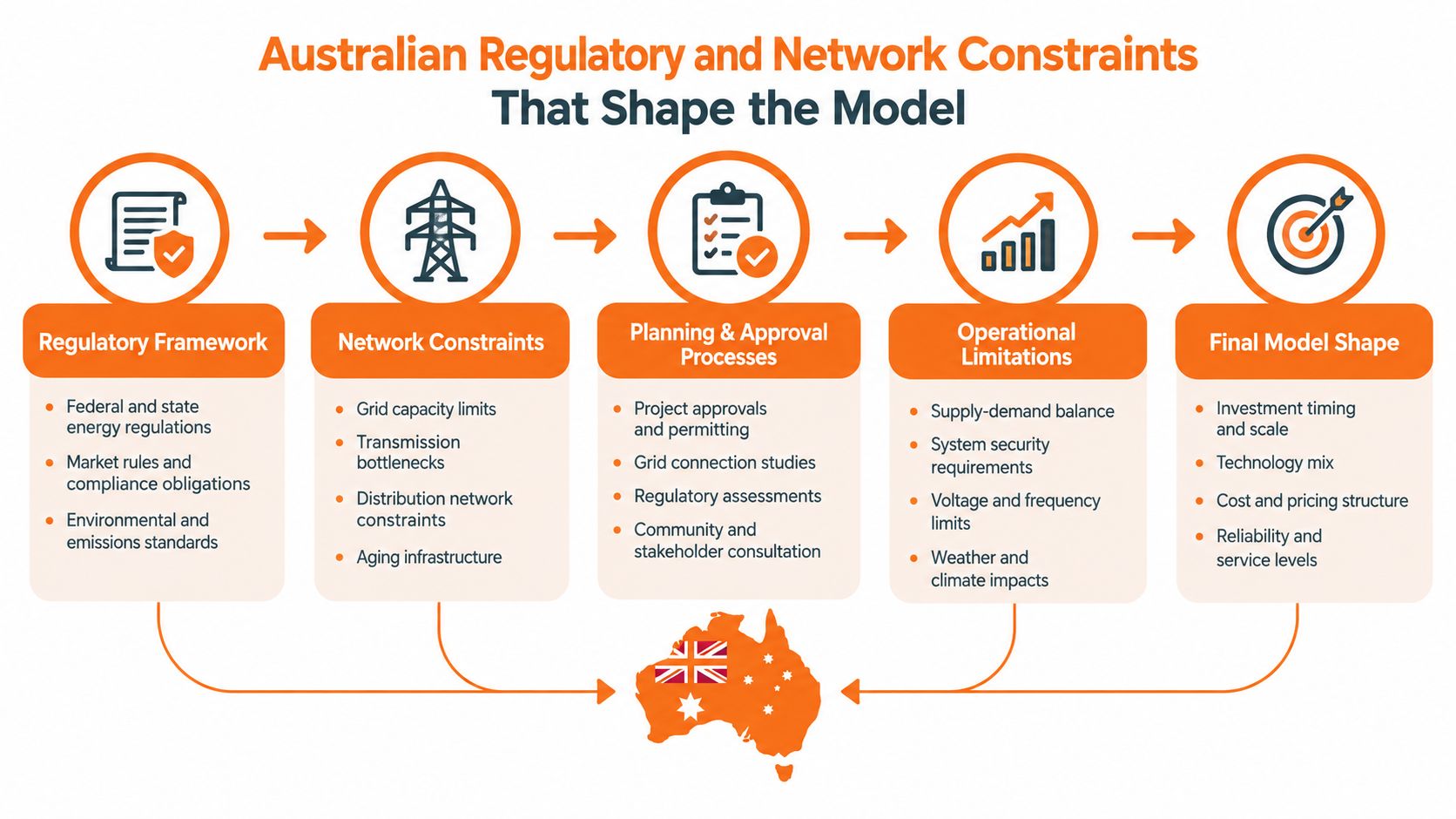
Finally, the customer contract must explain battery cycling, warranty treatment, exit conditions, override rights and the calculation of bill benefits. Households comparing electricity network charges should also ask whether the advertised allowance covers network-related components or only selected retail charges.
Why Most Battery Owners Are Still Missing Out on VPP Value
Most battery owners are still outside VPP programs. As noted above, participation remains small relative to the roughly 10.1 million residential and small business customers across the four mainland NEM states. That denominator changes the interpretation of market growth: a VPP can expand quickly within a narrow customer base while remaining marginal for households overall.
A separate survey found that 10% of Australian battery owners were in a VPP in October 2025, as summarised in the Energy Council's discussion of VPP competition and development. The gap is therefore not a lack of interest. It reflects uncertainty about how market revenue becomes a household benefit.
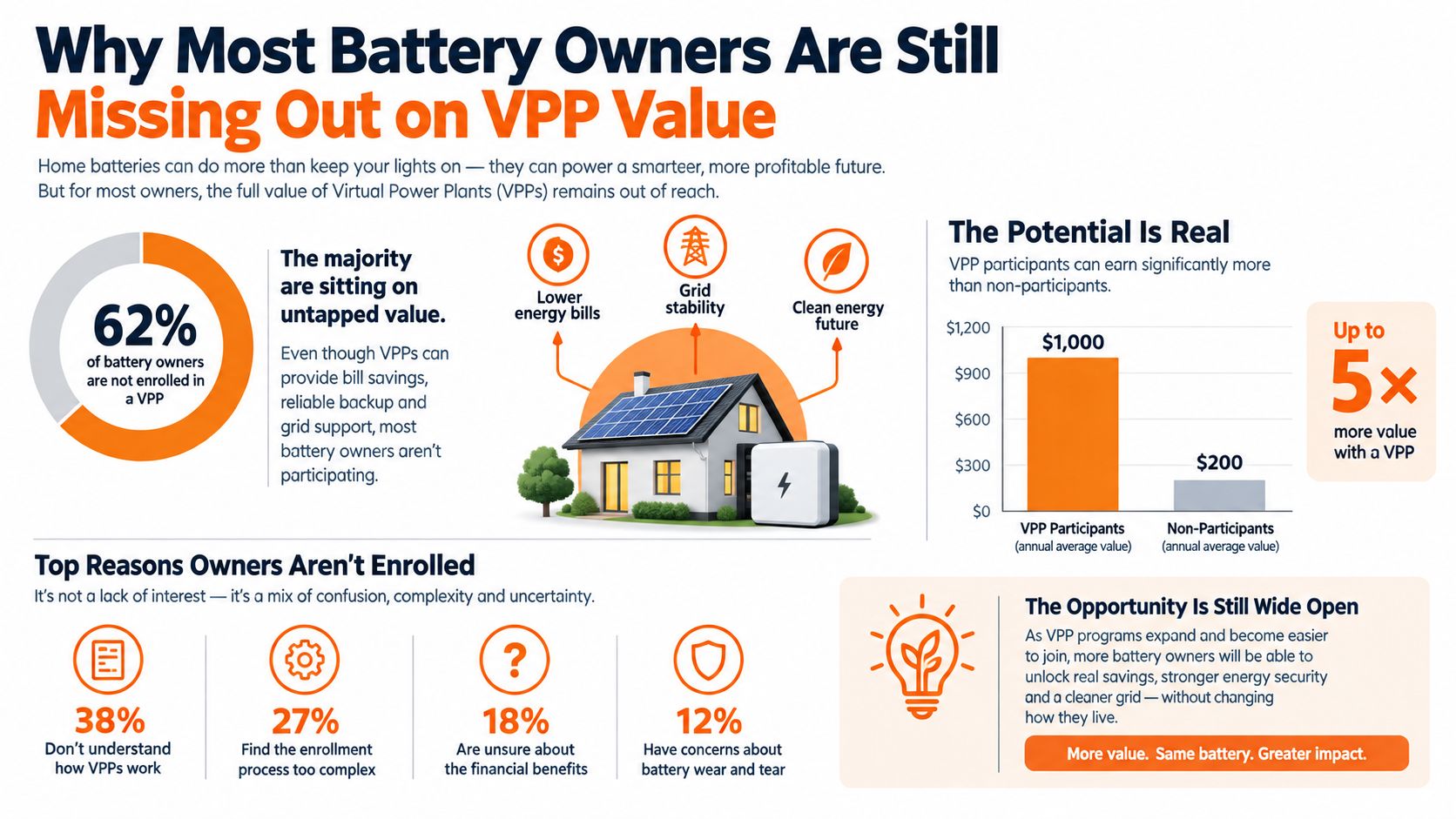
The money flow is often difficult to inspect. An operator may earn from wholesale arbitrage, frequency control ancillary services, or other grid services, then retain part of that value for software, trading, customer support, risk and battery management. The homeowner receives the remainder through a bill credit, fixed payment or bill-free allowance. Without a stated pass-through formula, a customer cannot tell whether the allowance reflects meaningful market value or only a small share of it.
Four practical barriers reinforce that opacity:
- Unclear economics: offers may describe rewards without showing the link between market revenue and household benefit.
- Hardware compatibility: manufacturer-specific platforms can limit a battery owner's choice of operator.
- Contract timing: households may purchase equipment before understanding dispatch settings, tariffs and export limits.
- Control and trust: customers need clear rules for reserve levels, operator access and overrides.
A credible VPP should publish its revenue-sharing method, state-of-charge bands, dispatch conditions and exit terms. It should also explain whether the allowance covers the full bill or selected charges. Clear terms do not remove cycling or compatibility constraints, but they let households judge the trade-off between battery control and compensation.
A Month in the Life of a QLD Household on a VPP Plan
Consider a representative south-east Queensland household with 6.6 kW of rooftop solar and a 10 kWh home battery. The following month is an operating illustration, not a savings forecast. Actual dispatch depends on solar production, household demand, network settings, market conditions, battery compatibility and the VPP agreement.
On a normal weekday, the battery charges from surplus midday solar. The operator then schedules discharge through the evening period, when household consumption is higher. The home uses part of that stored energy behind the meter, reducing the amount it needs to buy from the retailer. If the battery retains reserve capacity, the operator may use the remaining flexibility for an approved grid service.
On a low-demand Sunday, the operator may hold energy in reserve rather than discharge aggressively. That decision can look counterintuitive to a homeowner watching the battery percentage, but preserving capacity can be rational if a later market or system event has greater value. The household's priority remains the operating reserve and the energy settings defined in the agreement.
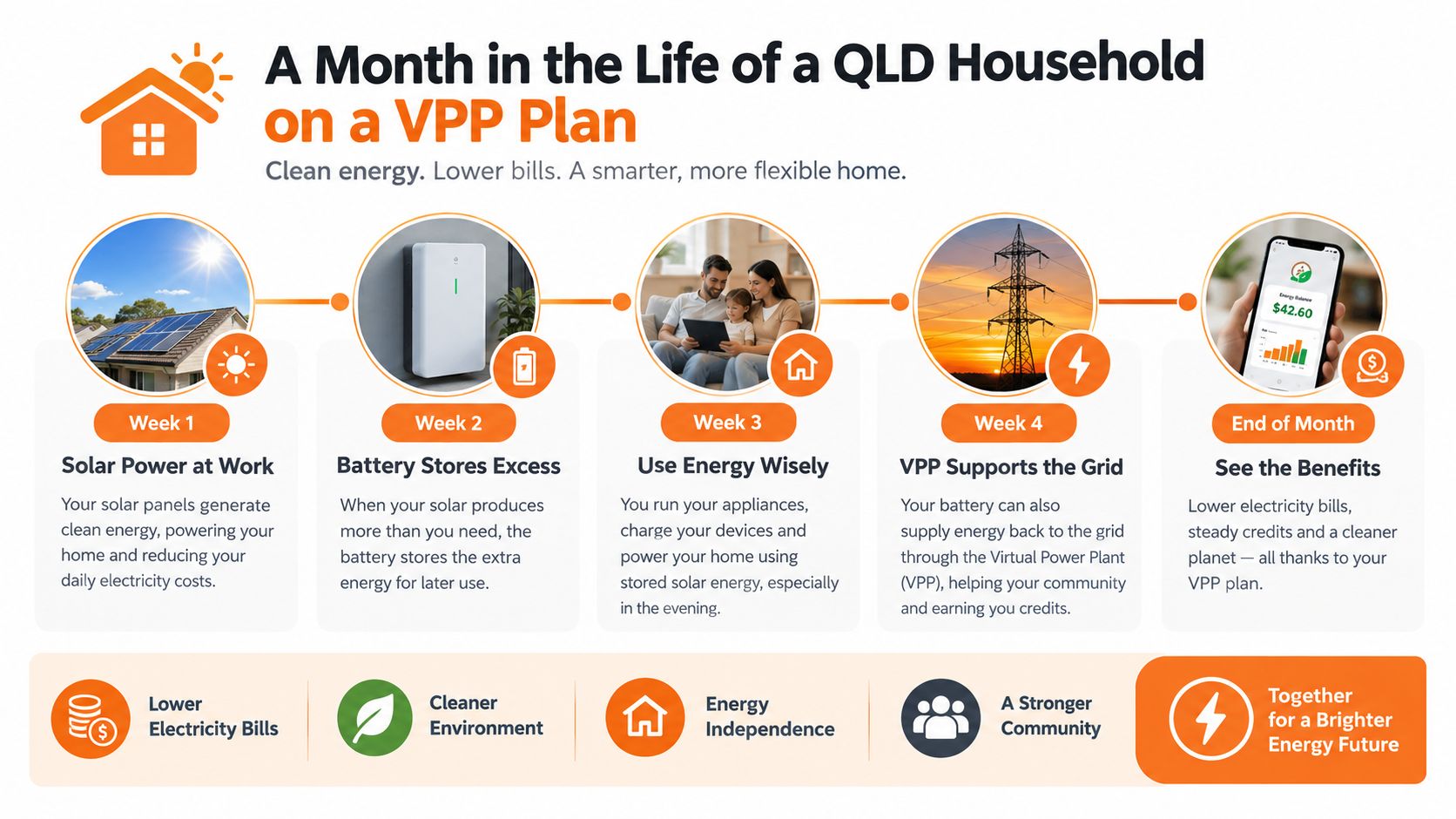
During a hot afternoon, an unexpected generator outage can tighten supply and create a high-value dispatch opportunity. If the VPP has available energy and the site's export arrangement allows it, the operator may direct the home to export part of its stored energy. The household's settlement then depends on the agreement's treatment of exported energy, market value and the customer share.
Overnight, the operator may offer battery headroom into a raise FCAS service. The battery doesn't need to empty itself to participate. It needs to retain the operating flexibility required by the service, while the software monitors the system instruction and the customer's reserve settings.
The monthly settlement should separate four items:
- Behind-the-meter discharge, which reduces retail purchases.
- Grid export, which may create market or retail value.
- FCAS participation, which is settled according to the service and performance.
- The customer credit or allowance, which appears on the retail bill under the agreed terms.
This separation lets the homeowner see whether the VPP is improving energy performance or merely shifting charges between line items.
Key Takeaways for Australian Households Considering a VPP
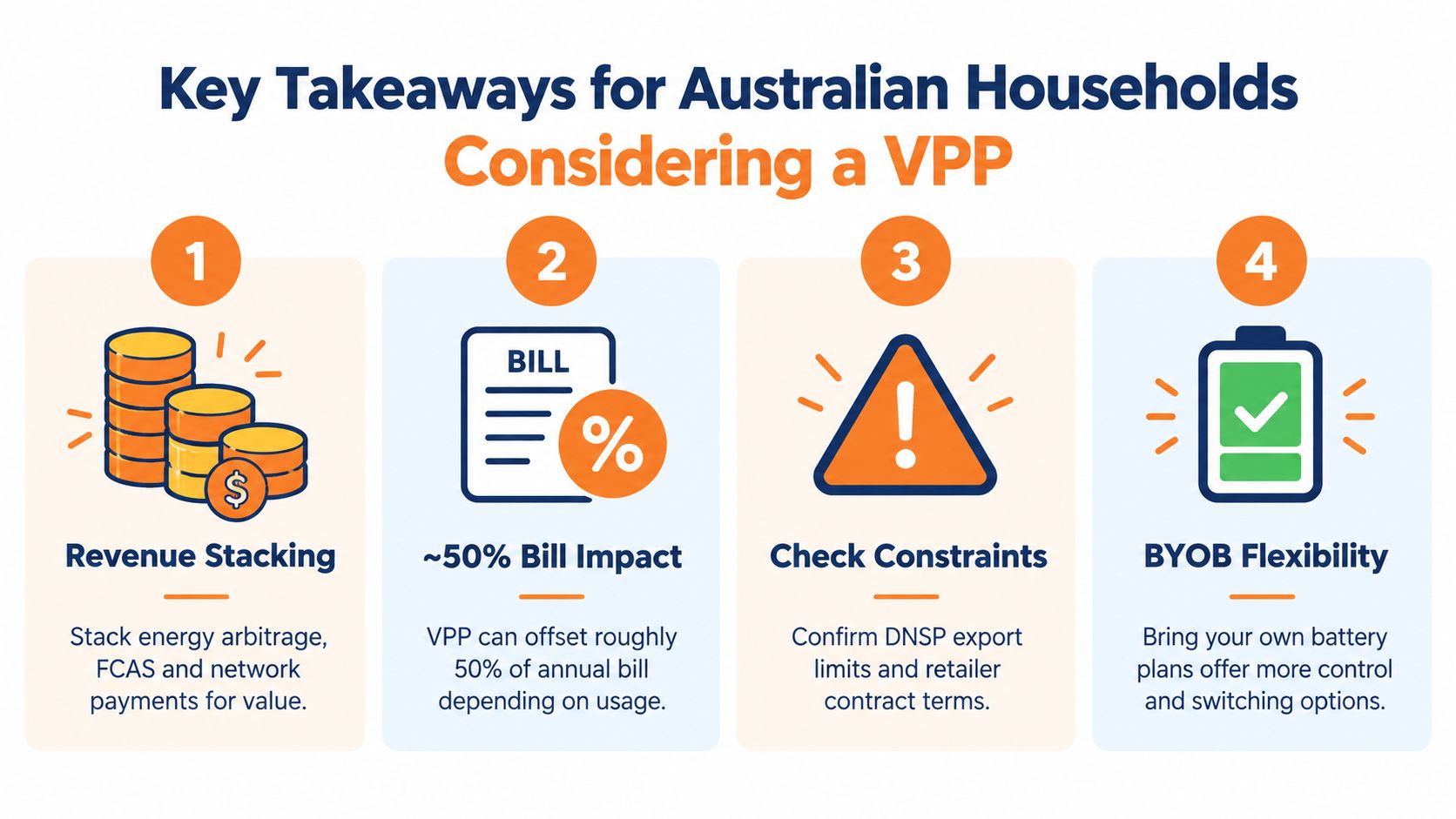
A household assessing a VPP should focus on the value chain, not the headline allowance. The operator earns value by combining available battery flexibility across several services. The customer benefit depends on how much of that value the operator passes through, how the contract calculates it and whether the battery can participate from the property's network connection.
The ACCC's cited AEMC modelling puts average customer pass-through at around 50%, but that doesn't predict an individual household's result. FCAS and wholesale outcomes vary, and quarterly benefits can move when market conditions, dispatch availability or portfolio performance change. A responsible retailer should explain that variability rather than imply that one allowance applies equally to every home.
Use this eligibility checklist before signing:
- Market pathway: Confirm that the aggregator has an authorised arrangement for the services it claims to provide.
- Hardware compatibility: Check that the inverter and battery can communicate with the operator's control platform.
- Network constraints: Ask the retailer to identify the site's export limit and explain how it affects dispatch.
- Customer value: Request a written statement showing what replaces ordinary retail credits, what is added as a VPP benefit and whether any amount is paid as cash.
- Battery protection: Read the warranty and cycling provisions. Confirm who bears responsibility if third-party dispatch affects the manufacturer's conditions.
Three questions deserve direct answers from any VPP retailer in New South Wales or Queensland:
- How is market revenue divided between the operator and the household?
- What are the opt-out, override and exit terms?
- How does VPP dispatch interact with the battery warranty and operating limits?
The forecast direction is clear. AEMO's 2026 Distributed PV and Batteries/Virtual Power Plant Forecast Report projects NEM VPP participation at 15% of consumer battery installations in 2026, 24% by 2035 and 40% by 2050 in its Step Change scenario. The same report projects Western Australian participation at 38% in 2026, 64% by 2035 and 59% by 2050, showing how incentives and local market design can alter the economics. Those are projections, not guarantees, but they indicate that coordination is becoming a more important part of Australia's distributed-energy system.
HighFlow Energy provides a Bring Your Own Battery VPP for eligible solar and battery owners in Queensland and New South Wales, using coordinated dispatch and app-based monitoring to help turn spare battery capacity into a defined electricity allowance. Visit HighFlow Energy to check eligibility, review how your current battery is performing and understand the potential value of participating.