


Do Dishwashers Use a Lot of Electricity? AU Guide
No, dishwashers are generally moderate electricity users, using about 0.54 to 1.61 kWh per load. A 6-star model may use about 0.3 kWh per cycle, compared with about 0.9 kWh for a 3-star model, costing roughly 15 cents versus 49 cents at an electricity rate of 48.69 cents per kWh.
So why do dishwashers sometimes feel like power-hungry appliances? The answer is that the label rating only tells part of the story. Cycle selection, heated drying, water heating, standby behaviour, appliance size and timing can shift electricity use considerably.
For households in Queensland and New South Wales, the most useful question isn't “How many stars does my dishwasher have?” It's, “How many annual kilowatt-hours does it use, which cycle do I select, and can I run it when solar or stored energy is available?”
This guide explains how Australian dishwasher electricity use is measured, what drives the difference between an efficient and inefficient wash, and how to reduce grid electricity without compromising cleaning performance. If you're planning a kitchen renovation, details such as whether an appliance can sit behind a matching cabinet front may also matter. A practical explanation of the design option is available in this guide to a panel ready dishwasher explained.
Introduction, Do Dishwashers Really Use a Lot of Power
Do dishwashers use a lot of electricity? Usually, no. A dishwasher is generally a moderate household load, rather than an appliance that heats or cools an entire room, dries clothes, or runs continuously.
The difference between models and programmes matters more than the appliance category alone. Australian guidance places a built-in 10 to 15 place-setting dishwasher between 0.54 and 1.61 kWh per load in typical usage guidance. Energy Networks Australia describes this broad per-load range. The Australian Energy Rating system also lets households compare annual electricity consumption between models.
Two homes running their dishwashers equally often can therefore have different electricity use. An efficient modern machine on an eco cycle may sit near the lower end of the range. An older appliance using intensive heating and heated drying may use considerably more.
The practical answer: dishwashers are moderate electricity users, but an inefficient model and high-heat settings can raise annual consumption and cost.
The star rating is only one part of the decision. Annual kWh shows the expected energy requirement over time, while the selected cycle determines how much electricity each wash uses. That makes annual consumption and real household settings more useful than judging the star label alone. For kitchen planning, whether the appliance can sit behind a matching cabinet front may also matter. This panel ready dishwasher explained guide covers that design option.
Timing changes the source of the electricity rather than the dishwasher's programme requirement. Running a cycle during rooftop solar generation can reduce grid imports. A battery can use stored solar later, and a suitably configured VPP may schedule battery charging or discharging around household demand, tariffs, and grid conditions.
That can turn a moderate appliance load into a near-zero grid-cost wash when surplus solar or stored energy covers it. The energy is still being used, but when and where the electricity comes from matters for Queensland and NSW households with solar, batteries, VPP participation, or time-of-use tariffs.
How Dishwasher Electricity Use Is Measured in Australia
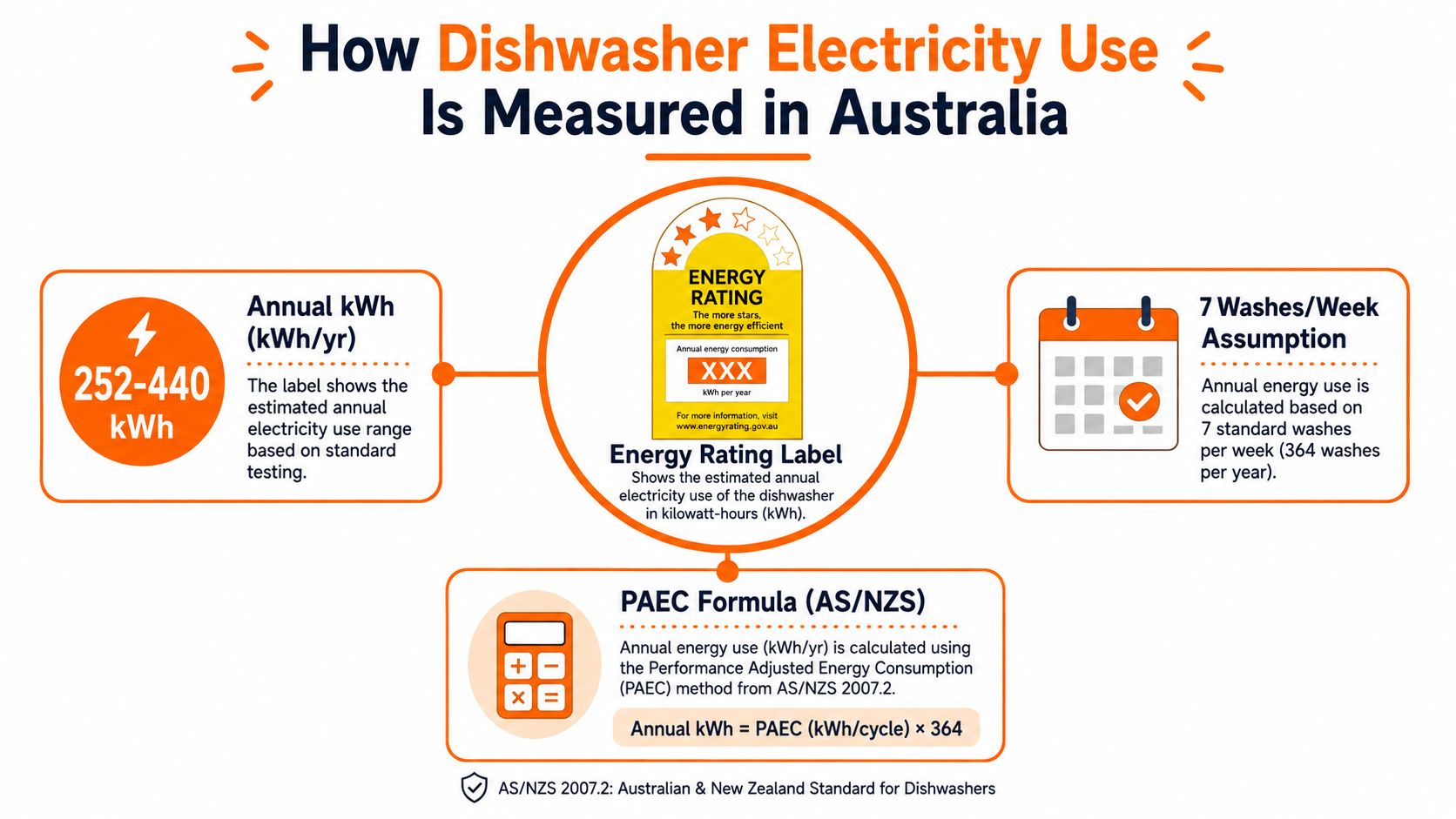
How can two dishwashers with similar star ratings have different running costs? The clearest comparison is annual electricity consumption in kilowatt-hours, shown as kWh per year on the Australian energy label. Stars provide an efficiency signal, while the annual kWh figure estimates how much electricity each model is expected to use.
The label uses a standard assumption of 7 washes per week, giving shoppers a consistent basis for comparison. It does not predict your exact bill. Your household may run more or fewer cycles, select different programmes, or use different drying settings. The label basis and standard usage assumption are explained in the Australian Government's energy rating guidance.
Kilowatt-hours are the appliance's fuel figure
A kWh measures energy used over time. It is more like a car's fuel-use figure than the size of its engine. A dishwasher can draw substantial power while heating, yet use less total energy if that demand lasts for only part of the cycle. This plain-English guide to what a kWh means explains the difference between power and energy.
Queensland household guidance gives an example of a 2-star dishwasher at 268 kWh per year, with input power of about 1350 W. The same material identifies water heating and drying as significant energy demands, rather than treating the motor as the whole load. See the Queensland Government energy-efficiency guidance for that annual-use and input-power example.
The annual label figure is calculated under the Australian standard AS/NZS 2007.2:2021. The regulatory formula includes a fixed 250 kWh per year component plus 48 kWh per year for each place setting, alongside test-cycle assumptions. Capacity therefore affects the projected annual figure. The formula appears in the Australian dishwasher energy-efficiency regulation.
Convert annual kWh into a household cost
Use this calculation:
Annual running cost = annual kWh on the label × your electricity rate
A model with a higher annual kWh figure generally costs more to run when both appliances face the same electricity rate. The Australian Government's guidance recommends using the annual kWh figure with your tariff to estimate running cost.
Star ratings still help, but they should sit beside the kWh figure, not replace it. Victorian government guidance gives the rule that each extra star can save about 30% on running costs, while Australian examples show that per-load use can vary by nearly threefold across built-in machines. Compare models with similar place-setting capacity, then favour the lower annual kWh figure.
That comparison describes expected energy use. Your actual grid cost can be lower if solar generation, a battery, or a suitably configured VPP supplies the cycle. In other words, annual kWh measures the dishwasher's energy requirement, while timing helps determine how much electricity you buy from the grid.
What Makes Your Dishwasher Use More or Less Electricity
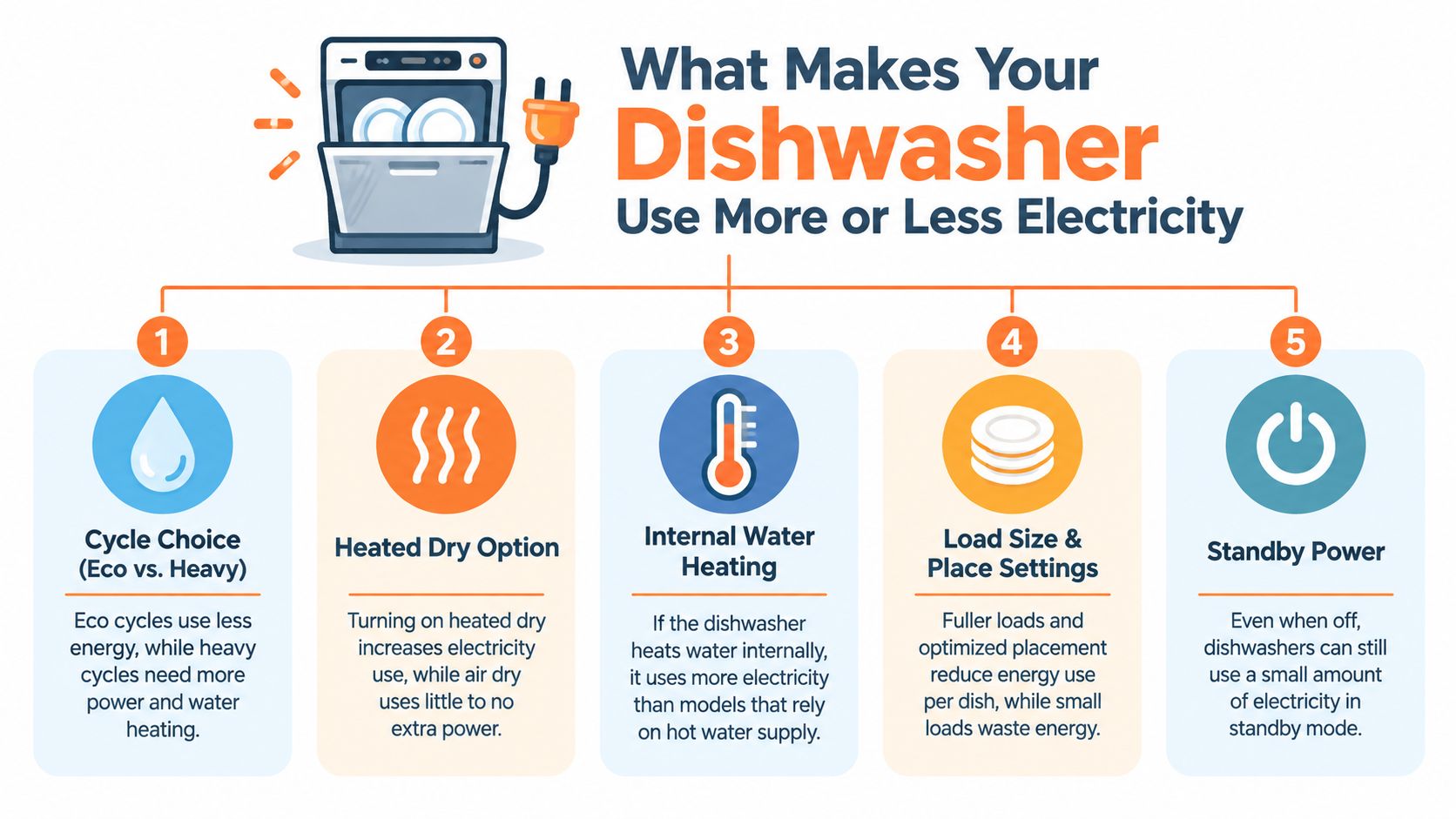
Which part of a dishwasher's cycle uses the most electricity? The motor moves water and rotates the spray arms, but heating water and drying dishes usually drive the larger electricity requirement. The programme therefore matters more than run time alone. Heating intensity, rinse stages and drying settings can shift energy use substantially.
Australian consumer guidance places quick or eco washes around 0.6 to 0.8 kWh, normal programmes around 1.0 to 1.4 kWh, and heavy or pots cycles around 1.5 to 1.8 kWh. These benchmarks appear in Australian consumer guidance from EnergyAustralia. Treat them like the size of a fuel tank used for one trip: the cycle determines how much energy the appliance draws, while your energy source determines how much grid electricity you buy.
Cycle choice changes the result
Eco cycles generally use less electricity because they heat water more carefully and manage water use efficiently. They often run longer. A longer display time does not automatically mean a higher bill, because low-intensity heating can use less energy overall.
Normal cycles provide a middle option. Heavy programmes use more heat and may add rinsing or drying, moving consumption towards the upper end of the guidance range. Reserve them for baked-on food and difficult loads instead of selecting them by default.
The label's annual kWh helps compare models, but the selected cycle determines what happens at home. A moderate annual figure can still become an expensive habit if every load uses intensive settings. The same cycle can also have a much lower grid cost when solar generation, a battery or a suitably configured VPP supplies it.
Drying and water heating matter
Heated dry can add roughly 0.5 to 1.0 kWh per cycle, according to EcoFlow Australia. That extra stage can be large beside an efficient wash, particularly in a frequently used appliance.
Air drying avoids that heating stage. Where the appliance and kitchen design permit it, opening the door after the cycle can help dishes dry without a heated element. Check the manufacturer's instructions before changing the setting.
Incoming water temperature also affects the workload. A dishwasher heating cooler water generally draws more electricity than one receiving warmer water. Do not alter plumbing solely for this reason without checking appliance requirements and installation advice. For broader hot-water context, Total Plumbing & Hot Water Systems covers household systems and installation considerations.
Capacity and standby add smaller effects
A larger tub can require more energy in the regulatory calculation because annual consumption scales with place settings. Running a half-empty machine also wastes the cycle's fixed energy overhead. Waiting until the load is reasonably full can spread that overhead across more dishes.
Standby is smaller than wash-cycle demand, but it is not always zero. Australian round-robin testing measured end-of-cycle power around 0.931 to 0.956 W and left-on mode around 0.742 to 0.765 W in the tested low-power states. The Australian dishwasher round-robin report distinguishes appliances returning to off mode within under 10 minutes from those remaining in a low-power state for 30 minutes.
If consumption seems high, check the programme, heated-dry setting, annual label kWh and post-cycle behaviour before blaming the motor.
Dishwasher Versus Handwashing and Other Household Appliances
Is handwashing always cheaper than using a dishwasher? The answer depends on the whole task, not just what happens at the sink. Handwashing can still use electricity indirectly when an electric system heats the water. Tap flow, water temperature, washing time and the number of dishes all change the result.
There is no single handwashing figure that suits every Australian kitchen. Compare the hot-water system and the total washing task, rather than treating tap water as free energy.
| Appliance or Method | Typical Electricity per Use | Key Context |
|---|---|---|
| Efficient dishwasher cycle | About 0.54 kWh per load | Lower end of Australian built-in dishwasher guidance |
| 3-star dishwasher cycle | About 0.9 kWh per cycle | Australian example for a 14-place-setting machine |
| Standard dishwasher cycle | About 1.0 to 1.4 kWh | More heating than quick or eco programmes |
| Heavy dishwasher cycle | About 1.5 to 1.8 kWh | Intensive heat and longer programmes |
| Handwashing | Varies by hot-water system and behaviour | Electricity may be used by the hot-water system rather than at the sink |
| Oven, clothes dryer or air conditioner | Varies substantially by appliance and duration | These can represent more significant household loads when heating, drying or cooling for extended periods |
A dishwasher usually sits in the moderate part of a household's electricity demand. Extended oven, clothes-dryer and air-conditioner use can matter more because heating, drying and cooling continue for longer. The comparison is like weighing one short trip against a longer journey. Both use energy, but duration changes the total.
The dishwasher still deserves attention when it runs regularly. A small difference between cycles becomes meaningful across repeated loads, while the annual label kWh gives a better replacement comparison than the star rating alone. Annual kWh shows the expected scale of use, and the selected cycle determines how much each load adds.
Timing also changes the cost paid to the grid. A dishwasher with a moderate load can use solar generation directly, or run from stored battery energy. A compatible home energy system or VPP schedule may place the cycle in a period of surplus supply, making the grid cost close to zero even though the dishwasher still consumes electricity.
Kitchen design can make efficient habits easier. A practical sink and dishwasher position helps households collect a full load and use the appliance consistently. See these Jennifer Gilmer Kitchen & Bath island tips for planning considerations.
For a fair appliance comparison, estimate each load using the same method. This guide to calculating household energy consumption explains how appliance power and operating time combine into total energy use.
Simple Ways to Cut Dishwasher Energy Costs at Home
Which dishwasher choices reduce energy use most? Start with the settings that control heating, then make each load count. A full load on a suitable programme usually gives a better result than running several small loads, while timing determines whether the electricity comes from the grid or your own solar system.
Choose the programme before pressing start
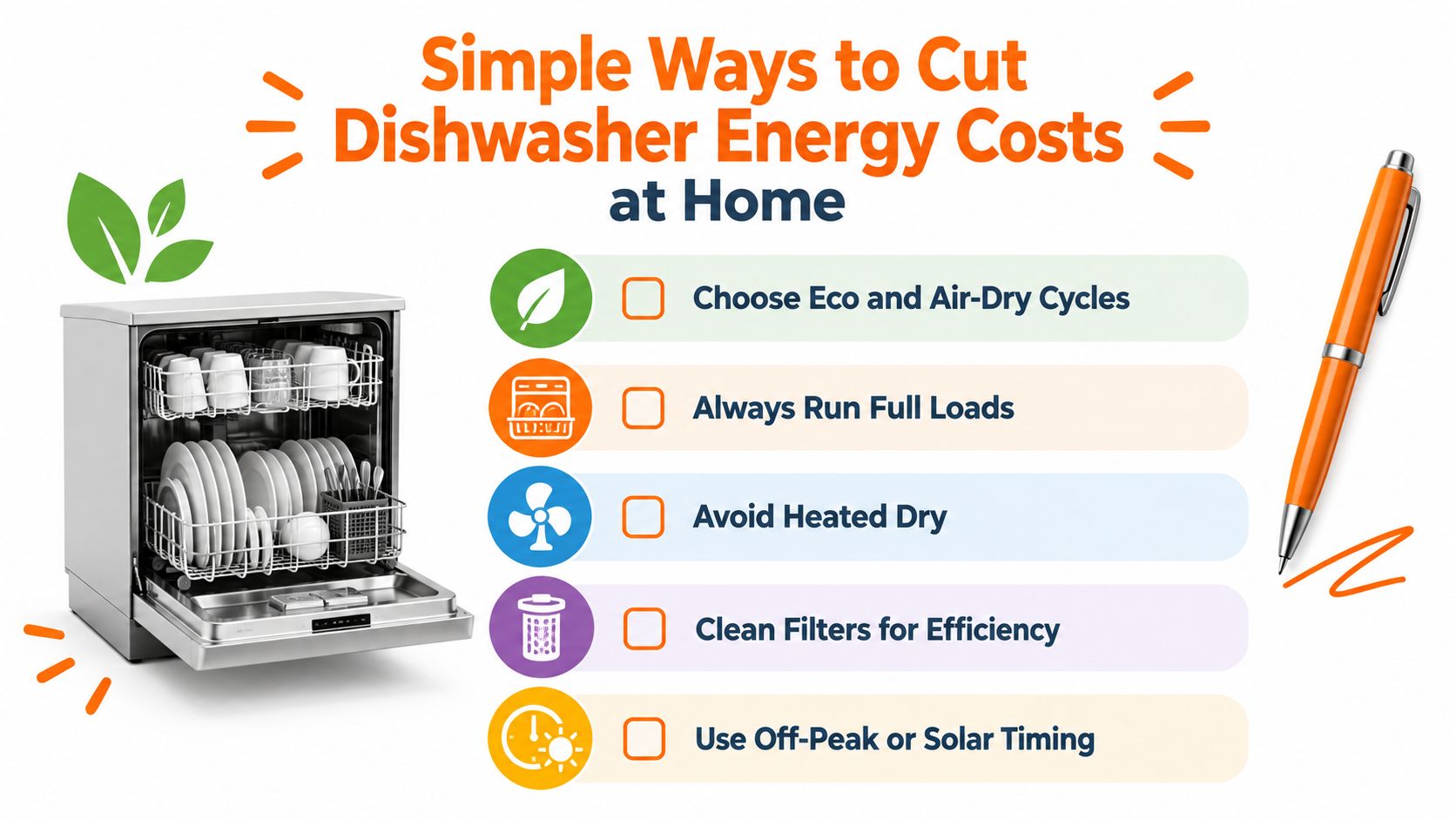
Use the eco cycle for normally soiled dishes when it provides the cleaning result you need. Australian guidance places eco or quick programmes at about 0.6 to 0.8 kWh, normal programmes at 1.0 to 1.4 kWh, and heavy programmes at 1.5 to 1.8 kWh. Those ranges show why cycle selection can matter more than the dishwasher's appearance.
Turn off heated dry when air drying is practical. Heated drying can add about 0.5 to 1.0 kWh per cycle, making it a significant part of the load. Leave the door slightly open after the wash, if the manufacturer allows it, so residual heat can help dry the dishes.
Load the machine properly
Run the dishwasher when it is full, without stacking plates so tightly that the spray arms cannot reach them. The cycle then spreads its energy across more dishes and reduces the need for multiple small runs.
Scrape ordinary food residue into the bin instead of rinsing plates under hot water. Pre-rinsing uses hot water before the dishwasher starts, and modern machines are designed to manage normal residue.
Clean the filter according to the manufacturer's instructions. A blocked filter can reduce water circulation and cleaning performance, which may lead to longer or repeated cycles.
Use timing as a cost-control tool
With rooftop solar, use delay start to run the dishwasher while the home is generating electricity. The appliance still consumes the same amount of energy, but its grid demand can fall when current solar output covers the load.
Without solar, an off-peak period on a time-of-use tariff may cost less. Check your retailer's tariff rather than assuming a particular clock time is always cheapest. With a battery, the same cycle may use stored solar later, and a suitable VPP schedule can coordinate battery operation around household demand. This can reduce the dishwasher's grid cost towards zero, even though its kWh use remains unchanged.
A star-rating upgrade can also affect running costs. Victorian guidance says an extra star can save about 30% on running costs, while Australian examples compare a 3-star dishwasher at about 0.9 kWh per cycle with a 6-star model at about 0.3 kWh per cycle. The Australian Government Energy Rating materials explain how to read the label.
A sensible replacement rule: compare annual kWh for dishwashers with similar capacities. A newer-looking appliance is not automatically efficient. The annual figure and cycle settings provide the clearer comparison.
Optimising Dishwasher Timing With Solar Batteries and VPP Schedules
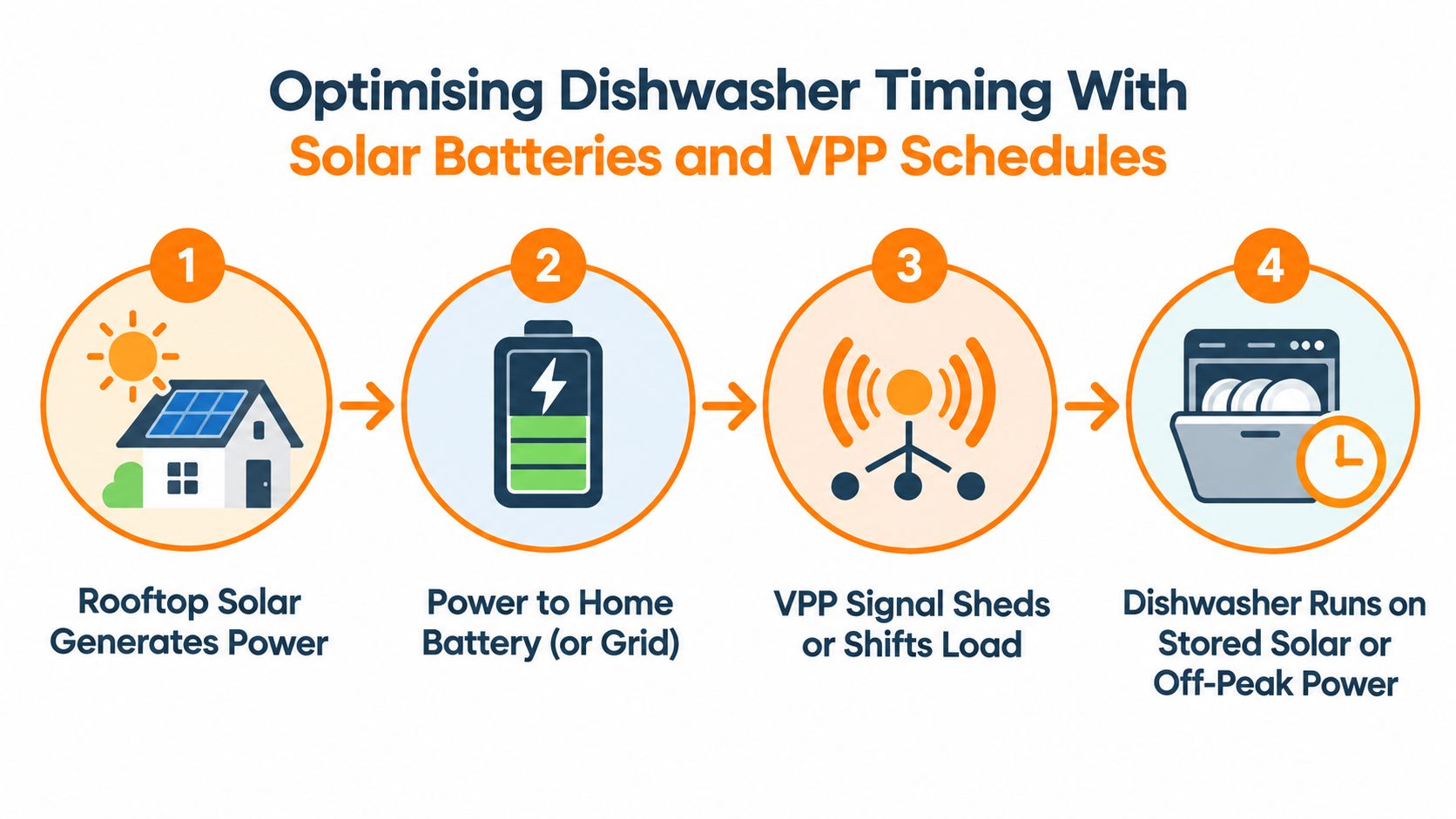
Does a battery make a dishwasher use less electricity? No. The cycle still needs the same energy. What changes is the source of that energy, whether it comes from current solar, stored energy or the grid, and when the appliance operates.
Run the dishwasher during strong rooftop generation when practical. Delay start can align the cycle with surplus solar, so the home imports less electricity even though the dishwasher's kWh consumption stays the same. A battery adds flexibility by storing surplus solar for a later wash.
Tariff settings also matter. With a time-of-use plan, grid electricity may cost different amounts during peak and off-peak periods. Check your retailer's actual tariff rather than assuming a particular time is always cheapest. The best choice may depend on whether the battery needs to retain energy for evening demand or whether more solar is expected later.
In Queensland and New South Wales, households are part of the National Electricity Market. Wholesale prices and network conditions can change, so a fixed “run everything at midday” rule may not suit every home. A useful schedule balances the dishwasher's modest load with battery state of charge, household demand, solar forecasts and any export limits.
What a VPP changes
A Bring Your Own Battery VPP coordinates compatible batteries in response to system needs, while households retain priority access to stored energy. The retailer or VPP operator may adjust battery behaviour around demand events, wholesale price movements and grid stabilisation requirements.
For dishwasher owners, the main benefit is scheduling choice. The appliance can run when solar or stored energy is available, while the wider battery strategy manages charging and discharging around other household loads.
A VPP cannot make every cycle free, and zero grid imports are not guaranteed. Weather, battery charge, export limits and simultaneous household demand can all change the result.
The commercial question is whether the battery is being actively optimised, rather than installed. Traditional retail arrangements may reward exported energy through a feed-in tariff. A VPP may provide further value through coordinated demand response and grid services. Before joining, compare the allowance structure, control settings, warranty treatment, retailer authorisation and priority-use rules.
HighFlow Energy offers eligible households a smart home energy app for viewing energy conditions and managing battery optimisation. The dishwasher is a moderate household load. Better timing helps solar and battery assets cover more of its running cost, potentially bringing its grid cost close to zero while its energy use remains unchanged.
Key Takeaways and Next Steps for Battery Owners
So, do dishwashers use a lot of electricity? Usually, no. Their demand sits in a moderate range, but the result depends on the machine's annual kWh figure, the selected programme and when the cycle runs. A star rating helps compare efficiency, while annual kWh shows the likely year-round requirement more clearly.
Keep the decision simple
Start with the number that reflects repeated use:
- Check annual kWh: Compare similar-capacity models using their projected yearly consumption.
- Choose the cycle carefully: Use eco for suitable loads, keep intensive programmes for stubborn food and avoid heated drying where practical.
- Run full loads: One well-loaded cycle uses the dishwasher's heating and operating energy more effectively than several partial cycles.
- Set the timing: Solar generation, suitable off-peak periods or stored energy can reduce electricity imported from the grid.
- Review the battery setup: If your home has solar and a compatible battery, check whether it supplies household loads effectively and whether spare capacity can join a compliant VPP.
For many households, cycle selection and heated drying offer the simplest savings. Replacing an older dishwasher makes more sense when its annual kWh is materially above efficient alternatives, it already needs replacement or the household uses it frequently.
A lower-kWh dishwasher reduces the amount of electricity required. Solar, a battery and VPP scheduling then affect where that energy comes from. The dishwasher still performs the same job, like filling a smaller bucket before carrying it. Using less is the efficiency gain, while choosing the energy source can reduce grid cost.
Battery ownership also requires attention after installation. Review how the system charges, discharges and serves household loads, rather than judging value from the installation alone. HighFlow Energy is an electricity retailer focused on helping households use existing solar and battery systems effectively.
Queensland and NSW battery owners can request an eligibility assessment through HighFlow Energy. Eligible households may access battery optimisation and VPP participation without installing new solar panels or batteries. A well-timed dishwasher cycle is a small load, but repeated scheduling can help keep its grid cost close to zero when suitable solar or stored energy is available.