

Pay Bill Electricity in Australia Made Simple
You've opened the electricity bill after a busy week, checked the amount twice and still aren't sure what you're paying for. The bill may show a daily supply charge, usage charges, solar credits, network costs, a due date and several payment options, all on the same page. For homeowners in New South Wales and Queensland, knowing how to pay bill electricity correctly starts with understanding which charges can change and which remain because the property stays connected.
This guide explains how to read the bill, choose a reliable payment method, respond early if cash flow becomes difficult, and assess whether an existing solar-and-battery system could offset more of the ongoing cost through a Virtual Power Plant.
Why Paying Your Electricity Bill Feels Harder Than It Should
A Queensland household receives a bill after a period of hot weather. The air conditioner has worked hard, evening cooking has increased demand, and the amount due is higher than expected. In New South Wales, another homeowner sees lower grid usage because the rooftop solar system produced well, yet the bill still includes a daily supply charge and network-related costs.
That experience creates the most common pay bill electricity search intent. People want to make the payment quickly, but they also want certainty that the amount is correct, the payment will arrive on time and no avoidable charge has been overlooked.
Australian electricity bills generally combine two main elements:
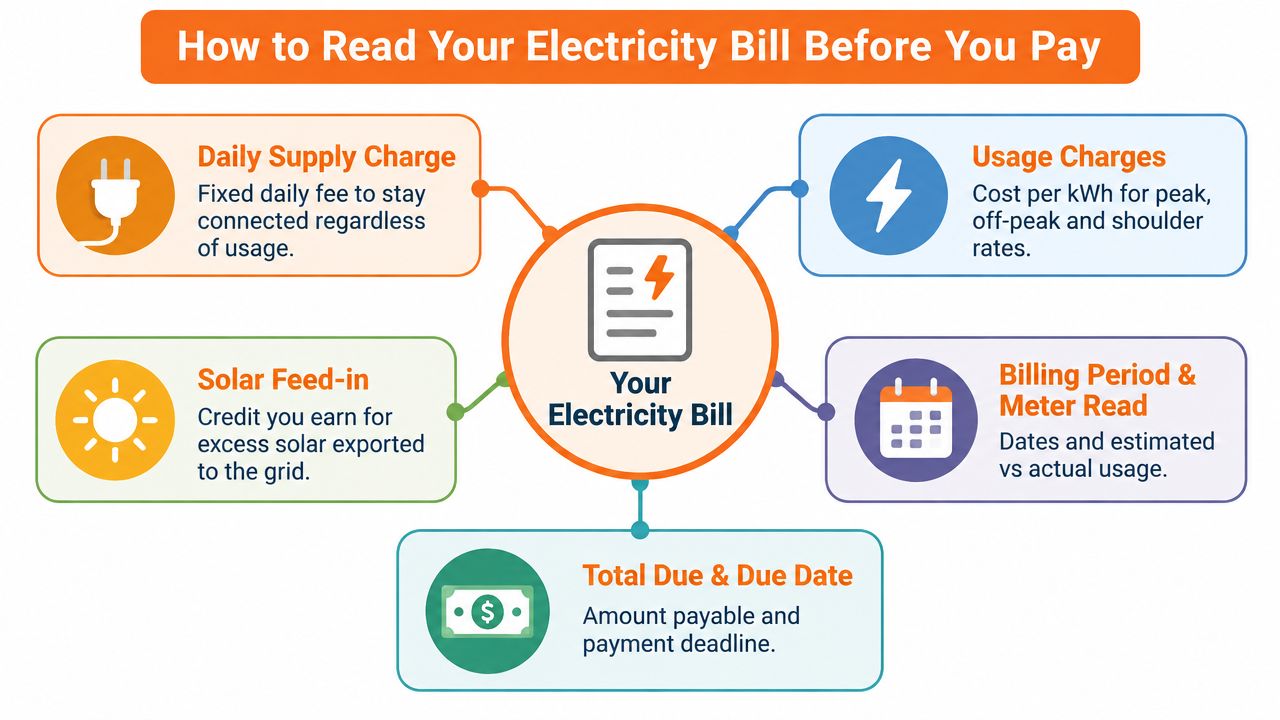
- Daily supply charge: A fixed amount for remaining connected to the electricity network, regardless of how much energy the home uses. The Australian Government's energy-bill guidance explains that this charge is paid each day for access to electricity and isn't based on consumption.
- Usage charge: The cost of electricity drawn from the grid, usually calculated according to the amount used and the applicable tariff.
Network costs make this distinction important. The Australian Energy Regulator reported that network charges represented about 40% to 50% of a residential customer's energy bill in 2021, according to the bill context summarised by CheckRate's Australian electricity bill guide. Cutting consumption can reduce usage charges, but it won't automatically remove fixed connection costs.
Practical rule: Before choosing a payment method, separate the amount you can influence through energy behaviour from the amount charged for staying connected.
This is also why solar households often look beyond simple energy conservation. A home might use less grid electricity while still paying supply and distribution charges. If you're investigating ways to direct surplus solar into useful household loads, a resource such as the Ring Hot Water solar controller can help explain how hot-water timing fits into a broader energy strategy. HighFlow Energy's deconstruction of electricity costs provides further context for the relationship between retail bills, network charges and energy supply.
How to Read Your Electricity Bill Before You Pay
Don't begin with the payment button. First, verify the bill period, account details and amount due. A quick review can identify an estimated meter read, a missed payment, an unusual usage pattern or a tariff detail that needs clarification.
Start with the fixed charge
The daily supply charge accumulates across the billing period whether the home draws electricity or not. It covers connection to the network, so a battery can reduce grid imports without automatically removing this line.
Usage charges are more responsive. They reflect electricity taken from the grid, and the rate may vary under a time-of-use arrangement. Energex notes that residential network tariffs can include a fixed daily charge and a consumption charge, while its residential time-of-use demand and energy tariff applies only where the customer has a smart meter. That means the meter type can affect which tariff structures are available.
Check the details that control the payment
Look for:
- Account and supply address. Confirm the bill belongs to the correct property.
- Billing period. Check the start and end dates against the previous bill.
- Meter read type. An actual read and an estimated read can produce different levels of certainty.
- Tariff information. Identify whether the bill uses a flat structure or separate peak, shoulder and off-peak rates.
- Solar credits. If the property exports solar energy, confirm that the feed-in credit appears.
- Total due and due date. These determine how much must be paid and when the retailer must receive it.
- Biller code and reference number. These are essential for BPAY and must be entered accurately.
Network charges vary by location. A 2026 comparison from GoSwitch's Queensland and New South Wales electricity rates guide lists regulated daily supply charges of 192.02 cents per day on Energex, 166.23 cents per day on Ausgrid, 185.13 cents per day on Endeavour Energy and 272.22 cents per day on Essential Energy. These figures show why a household's distribution area matters when assessing the fixed part of a bill.
| Bill component | What it means | Why it matters when you pay |
|---|---|---|
| Daily supply charge | Fixed cost for remaining connected | It can remain even when grid usage is low |
| Usage charges | Cost of electricity imported from the grid | The amount can change with consumption and tariff timing |
| Solar feed-in credit | Credit for eligible solar exported to the grid | It reduces the balance but may not offset all fixed charges |
| Billing period and meter read | Dates and the source of usage data | They help you identify estimated or unusual readings |
| Total due and due date | Amount payable and payment deadline | They determine the payment instruction you must follow |
For a visual example of the line items and layout, review HighFlow Energy's electricity bill example. Pay only after the account reference, balance and due date match your records.
Ways to Pay Your Electricity Bill in Australia
Most NSW and Queensland retailers support several electronic payment channels. The best option depends on whether you value immediate control, automatic processing or a payment trail that fits your household budget.
App and website payments
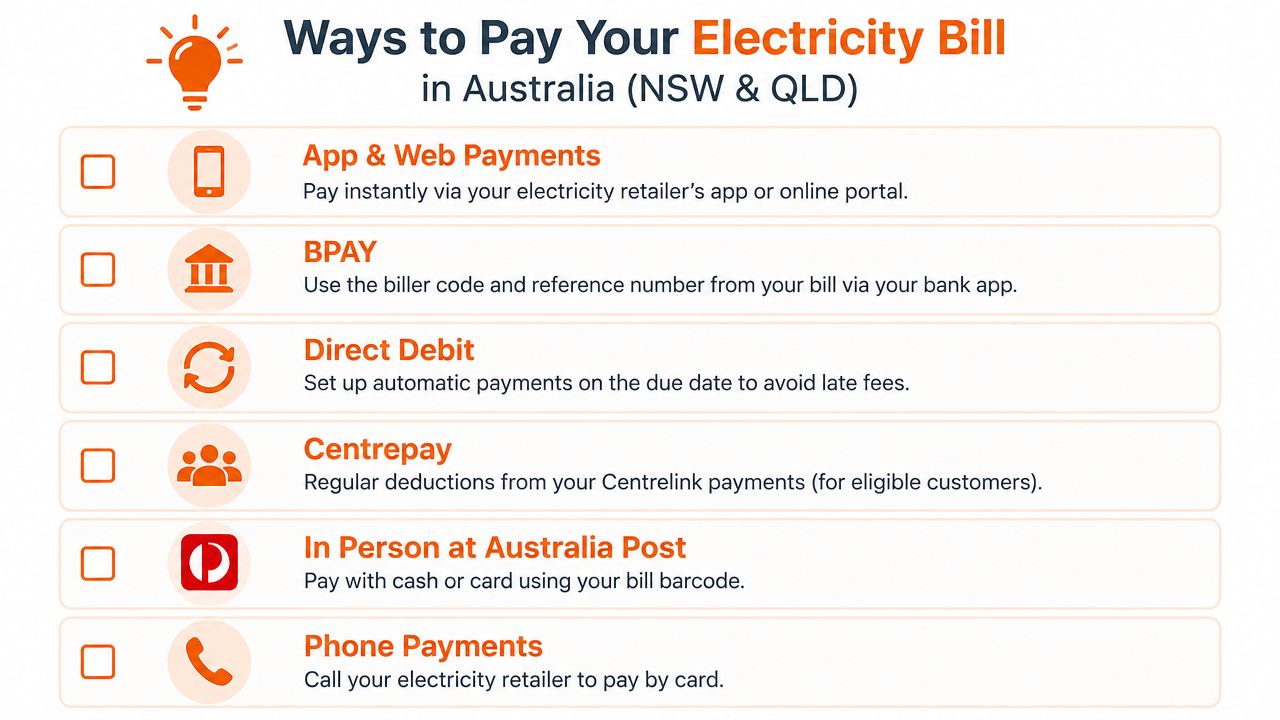
Log in to the retailer's app or online account, select the current bill, choose card or another available electronic method, confirm the amount and save the receipt. This works well when you want to inspect the bill before authorising payment.
Check that the payment confirmation relates to the correct account. A bank transaction alone may show that money left your account, but the retailer's receipt or account status provides stronger evidence that the payment was allocated correctly.
BPAY
BPAY is useful when you prefer to pay through your bank. Enter the biller code and bill reference number exactly as shown on the electricity bill, then confirm the amount and submit the transaction.
The main operational risk is reference accuracy. A single incorrect digit can delay allocation or require the retailer to trace the payment, so copy the details carefully and retain the confirmation screen.
Direct debit
Direct debit removes the need to initiate each payment. Set it up through the retailer, confirm which account will be debited and check whether the chosen bank-account arrangement carries a payment fee.
Automation needs oversight. ACMA research across essential services found that 43% of financially stressed respondents had experienced a direct debit failure, while 40% had made a late energy payment in the previous 12 months, as reported in the ACCC-published consumer outcomes material. Keep alerts switched on, maintain a balance buffer where possible and update the mandate if your bank account changes.
Digital wallets, phone and in-person payments
Some retailers support digital wallets or card payments by phone. These channels can suit customers who don't want to store card details in a retailer account, but you should still request a receipt and confirm settlement.
Australia Post and cheque payments remain available in some arrangements. They may be slower and can involve processing fees, so don't leave them until the due date.
A reliable workflow is simple:
- Identify the bill: Use the current bill, not an old saved reference.
- Select the channel: Choose app, web, BPAY, direct debit, wallet, phone or in-person payment.
- Confirm the amount: Include the full balance unless the retailer has approved an arrangement.
- Check the reference: Match the account number, biller code or payment identifier.
- Save proof: Keep the receipt, confirmation number or bank record.
- Verify allocation: Recheck the retailer account after settlement.
This video on electricity bill payment processes can complement the written steps, particularly if you're setting up an electronic payment for the first time.
What Happens If You Pay Late and How to Stay Ahead
A late payment doesn't always lead directly to disconnection, but ignoring the account can turn a manageable problem into arrears. Retailers may offer payment plans or hardship assistance, and early contact gives them more opportunity to match the arrangement to your cash flow.
The scale of the issue is visible in Australian energy market data. The Australian Energy Regulator reported that 129,498 residential energy customers were on a payment plan nationally as at 31 March 2025, compared with 140,190 a year earlier, according to its market reporting. Broader AER-regulated jurisdictions had 613,000 electricity and gas accounts in arrears at the end of 2025, with more than $700 million owed across accounts on hardship plans or with debt of at least 90 days, as reported in the ACMA arrears data.
Contact the retailer before the account deteriorates
Early warning signs include a failed direct debit, a missed due date, a balance that is growing across bills or a household budget that no longer covers the usual payment. Don't wait for a disconnection warning before explaining the situation.
The AER found that among customers unable to pay energy bills on time, 45% cut essential spending, 40% cut optional spending and 32% contacted their retailer for assistance, according to the same ACMA-hosted research source. Those figures underline a practical point. Calling the retailer can be more constructive than sacrificing essentials while the debt continues to build.
A payment plan may convert one large bill into smaller, more frequent debits. Ask how the arrangement affects the current balance, future bills, direct debit timing and any eligibility for hardship support. Confirm the agreement in writing.
From 1 July 2026, the minimum disconnection threshold rises to $500 in NSW, Queensland and other National Energy Customer Framework states, according to the AER's January to March 2026 retail performance update. This threshold shouldn't be treated as a safe amount of debt to carry. It's a regulatory protection, not a budgeting strategy.
Early action matters: A retailer can usually do more with a customer who contacts them after a missed payment than with an account left unattended until serious arrears accumulate.
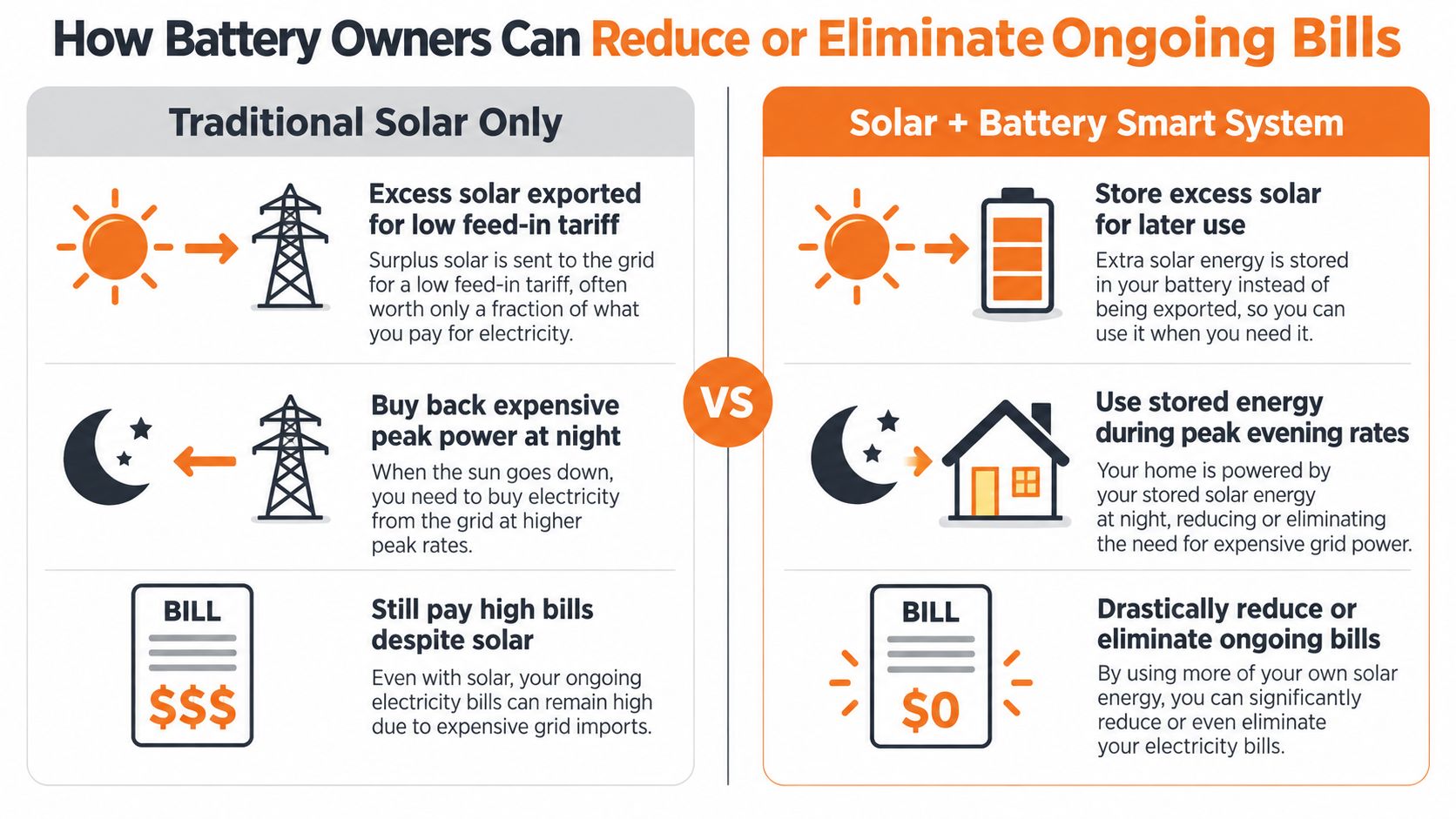
How Battery Owners Can Reduce or Eliminate Ongoing Bills
Paying a bill and reducing the need for that bill are different strategies. Rooftop solar lowers daytime grid imports, while a battery can shift stored energy into later periods. A VPP adds another pathway by allowing an eligible battery to support the grid during selected events while the household retains priority access to its stored energy.
Network charges remain important because they form a substantial part of retail electricity prices. The Energy Council of Australia says network costs accounted for 33% to 48% of draft Default Market Offer 7 prices, while wholesale costs represented 31% to 44%, as set out in its analysis of regulated electricity prices. A battery that only reduces kilowatt-hour consumption may therefore leave a meaningful fixed and network-related amount on the account.
Feed-in credits and VPP participation serve different purposes
Traditional solar-only operation exports surplus electricity when the home can't use it. The retailer applies a feed-in credit, and the household later buys electricity when solar production is unavailable. That arrangement can leave the battery owner exposed to evening imports, time-of-use pricing and fixed network costs.
A BYOB VPP changes the commercial structure. Instead of treating the battery only as a device for self-consumption, the VPP operator can coordinate spare capacity for grid support, including demand response during system stress or high-value periods. The resulting value may support a retailer allowance that covers eligible supply charges and usage up to the allowance, with the exact treatment governed by the customer's plan.
HighFlow Energy operates as an electricity retailer and BYOB VPP operator for eligible existing solar and compatible battery owners in Queensland and New South Wales. Its model uses grid-service value to fund a monthly bill-free electricity allowance, while household needs remain prioritised, with no new hardware, lock-in contracts or exit fees stated in the publisher's service information. Customers who use more than the allowance pay standard rates for the additional usage. Read more about reducing electricity bills with solar and batteries.
Check the trade-offs before joining
A VPP isn't a promise that every bill will be zero. Outcomes depend on the battery, tariff, household load, export conditions, network limitations, retailer terms and the amount of energy available for grid services. Battery cycling also deserves attention. More coordinated charging and discharge can affect the system's operating pattern, so review warranty conditions and the operator's controls before enrolling.
NSW introduced a VPP incentive from 1 July 2026 for batteries up to 50 kWh, according to the NSW Government VPP incentive information. Recent reporting cited in the verified market context says only 7% of Australian battery-owning households participate in VPPs, while battery and VPP participation can deliver savings of around 60% in the quoted coverage. These figures indicate an adoption gap, not a guaranteed outcome for an individual household.
Ask whether you retain ownership, priority use and manual override access. A transparent operator should explain the allowance, export limits, demand events, data use, warranty position and what happens when your household exceeds the allowance.
Your Next Steps to Pay Smarter and Get More From Your Energy
Use this sequence whenever a new electricity bill arrives:
- Check the account and billing period.
- Separate the daily supply charge from usage charges and solar credits.
- Confirm the meter read, tariff and total due.
- Choose a payment rail that matches your routine.
- Save the confirmation and verify that the retailer allocated the payment.
- Contact the retailer early if a debit fails or the balance becomes difficult to manage.
- If you own solar and a compatible battery, assess whether the system is underutilised financially.
The key distinction is simple. Payment methods help you settle the amount already charged. Battery optimisation and VPP participation may change how much electricity you need to buy and how much value your stored energy creates, but eligibility and plan terms must be checked carefully.
Most battery owners focus on installation quality. Far fewer focus on ongoing performance and optimisation. HighFlow Energy is an electricity retailer built around realising the full value of your existing solar and battery system. If you'd like to understand whether your battery is underperforming financially, request an eligibility assessment through HighFlow Energy and review the available allowance structure for your Queensland or New South Wales home.