

Utilities Bill Example Explained for AU Solar Owners (2026)
You've done the expensive part. You installed rooftop solar, added a battery, and expected the electricity bill to become a footnote. Then the statement lands in your inbox and it still looks like a standard retailer bill, full of line items that don't tell you whether your system is performing well.
That frustration is rational. A conventional utilities bill was built to invoice consumption, not to report on the financial performance of a home energy asset. If you live in Queensland or New South Wales, that matters because electricity is still a recurring household cost. As of April 2024, the average monthly electricity bill for a typical household in Australia was about $165 per month, with New South Wales at $152 per month and Queensland at $164 per month according to Australian household utility bill data.
For a solar and battery owner, the bill should answer better questions. How much of your imported energy happened at the wrong time? Are fixed charges swallowing the value of lower usage? Is your battery reducing costs, or just sitting there as an expensive backup device most of the month? A useful utilities bill example in 2026 isn't just about reading the invoice. It's about reading the economics behind it.
Introduction Why Your Bill is High With Solar and a Battery
A common pattern looks like this. A homeowner exports solar through the middle of the day, uses the battery in the evening, and still opens a bill that feels disconnected from what happened on the roof and in the battery cabinet. The household knows it produced energy. The bill still asks for money. That gap creates distrust.
The problem usually isn't one single charge. It's the way charges, credits, tariff structure, and timing interact. A bill can look ordinary even when the underlying household energy behaviour is very different from a home without solar and storage.
A solar and battery household shouldn't read its bill as a simple payment notice. It should read it as a monthly performance report.
That shift matters because most retailers still bill around traditional logic. They charge for connection, charge for imports, apply credits for exports, and leave the homeowner to work out whether the battery is delivering enough value. The document shows transactions. It rarely shows optimisation.
For financially motivated households, that creates a blind spot. You can own a battery and still underuse it. You can export solar and still buy power back at expensive times. You can lower annual imports and still feel the fixed cost of staying connected every day.
What your bill is really telling you
A utilities bill example becomes more useful when you stop asking, “Why do I owe this amount?” and start asking:
- Which costs were fixed: Charges that applied even if you barely imported power.
- Which costs were timing-related: Charges that rose because imports happened in the wrong window.
- Which credits were low-value: Exports that earned less than the cost of buying power later.
- Which battery value was missing: Spare capacity that wasn't monetised.
That last point is where the VPP era changes the analysis. Once a battery can participate in coordinated grid support, the bill stops being only a record of consumption and starts reflecting whether your energy asset is earning its keep.
Deconstructing a Standard Utilities Bill Example
A standard Australian electricity bill usually looks more complicated than it is. Strip away the formatting and most bills come back to two core charges: a fixed fee for staying connected and a variable fee for what you imported.
The fixed part of the bill
The first line to isolate is the daily supply charge. A typical residential bill includes a fixed daily supply charge of around $1.48 per day in NSW and $1.23 per day in QLD, plus a variable usage charge based on consumption. That means a household can still accrue more than $450 annually in fixed charges even with zero energy usage, as explained in High Flow Energy's guide to the daily supply charge on electricity bills.
That charge exists because you're paying for access to the grid, not just for the electrons you use. Meters, service lines, and network access still cost money even when your solar reduces imports.
If you want a cleaner mental model for line-item reading generally, this itemised receipt guide from Smart Receipts is useful because it shows how to separate fixed, variable, and credited components rather than reading the total first.
The variable part of the bill
The second major line is the usage charge. That's calculated by multiplying imported kilowatt-hours by the applicable cents-per-kilowatt-hour rate. On a flat tariff, that rate is consistent. On a time-of-use plan, the price changes by period.
Here's a simple way to read the structure:
| Bill component | What it means | Why it matters |
|---|---|---|
| Supply charge | Fixed daily fee to remain connected | You pay it regardless of low usage |
| Usage charge | Imported kWh multiplied by tariff rate | Timing and consumption drive this line |
| Solar feed-in credit | Credit for exported energy | This may be smaller than evening import cost |
| Concessions or rebates | Government or eligibility-based adjustments | These reduce the amount payable |
| GST | Tax applied to eligible bill components | It affects the final amount due |
Many retailers also bundle network and metering costs inside broader charges rather than showing them as separate, intuitive categories. That's one reason households struggle to understand what changed month to month.
For a broader view of how retail tariffs shape the bill, High Flow Energy's overview of the cost of electricity in Australia is a helpful companion because it frames the bill within the wider retail pricing model.
The practical reading order
Don't start with the total due. Read a utilities bill example in this order instead:
- Billing period. Check whether the dates match your expectation of seasonal use.
- Supply charge line. This tells you the unavoidable baseline.
- Import usage line or lines. Look for flat-rate versus peak and off-peak treatment.
- Solar export credit. This shows what daytime exports were worth to the retailer.
- Adjustments and taxes. These can distort month-to-month comparisons.
Practical rule: If a solar household only looks at the amount payable, it misses the more important question of whether imported power was expensive, poorly timed, or only weakly offset by exports.
The Financial Dilemma for Solar and Battery Owners
A common solar-battery scenario looks good on paper and weak on the bill. The home generates excess solar in the middle of the day, exports part of it at a modest feed-in rate, then buys power back after sunset at a much higher retail rate. The battery helps, but many standard plans still value the asset narrowly. They record imported and exported energy. They do not necessarily pay for the battery's ability to respond when grid demand and prices are highest.
That gap matters because battery ownership and bill optimisation are not the same thing. A battery can be technically well used and still produce an ordinary financial result if it only supports self-consumption. For households on variable or time-based tariffs, the key question is not just how much solar you used at home. It is whether the battery reduced the most expensive imports and participated in any higher-value dispatch opportunities available under the retailer model.
Why battery ownership doesn't automatically equal bill optimisation
Many households judge success by one metric: self-consumption. That is too narrow for the current retail market.
A financially useful battery strategy depends on three moving parts working together:
- Export value versus import cost. Daytime solar credits are often lower than the price of evening grid electricity, so exporting a kilowatt-hour and later buying one back can still leave the household worse off.
- Tariff structure. Flat rates, time-of-use pricing, and demand-sensitive charging windows change the value of each battery cycle.
- Dispatch rights. If the battery is only serving the home, the owner may miss revenue opportunities tied to grid support events.
For a homeowner focused on payback, the non-obvious conclusion is that a battery can reduce visible grid usage while still leaving too much value on the table. That is why plan design matters so much. High Flow Energy's guide to energy tariff comparisons is useful here because it shows how the tariff itself can shape the outcome before any VPP revenue is added.
The bill problem is really a market access problem
Traditional billing mostly rewards energy movement. The emerging VPP model rewards timing, flexibility, and controlled discharge into higher-value periods. That difference changes the economics for solar and battery owners.
Under a standard retail arrangement, the battery mainly helps the household avoid some imports. Under a VPP structure, the same battery may also earn bill credits or allowances by supporting the grid at moments when stored energy is worth more. For the homeowner, the key shift is simple: the battery stops being just a consumption-management tool and starts functioning as an income-producing energy asset.
Many households miss this because the statement still looks familiar. Supply charges remain. Usage charges remain. Export credits remain. Yet the primary driver of savings is no longer limited to self-consumption. It is whether the billing model gives the battery access to value beyond the home.
The admin problem behind the energy problem
The financial challenge is not only tariff math. It is also record-keeping. Once a home has solar generation, battery cycling, feed-in credits, and variable import pricing, monthly review becomes harder and errors become easier to miss.
For readers trying to organise recurring costs with more discipline, this resource on how to automate business financial management is useful because the same habit applies to household energy review. Track recurring charges, compare billing periods consistently, and investigate any month where imports, exports, or credits move in ways your usage pattern does not explain.
The core dilemma is straightforward. Many battery owners have an asset that can do more than a standard bill rewards. In the VPP era, the important question is no longer just whether your battery stores solar. It is whether your retailer structure turns that flexibility into measurable bill reduction.
The HighFlow Energy Bill A VPP Transformation
A standard solar bill can still feel disappointing. You generated power, you stored some of it, you exported the rest, and the balance due still looks stubbornly close to a normal month. Under a VPP-based structure, the bill changes because the battery is no longer valued only for what it saves inside the home. It can also produce revenue through coordinated grid support.
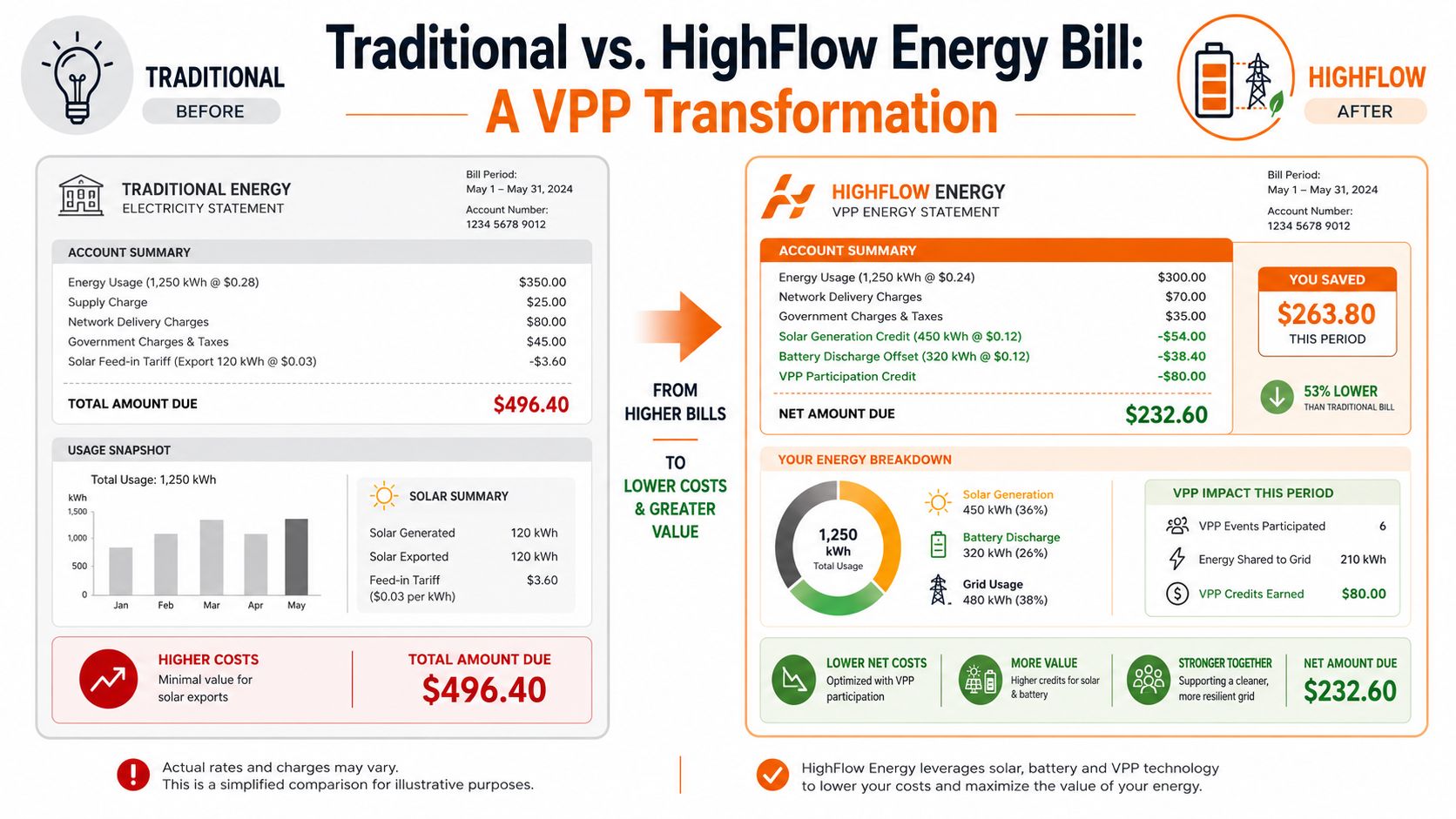
That difference shows up in bill design. A conventional retailer statement usually leaves the customer with three familiar lines: fixed supply charges, usage charges, and a relatively small export credit. A VPP-oriented statement adds another layer, a bill allowance funded by battery participation in grid services.
In practice, that means the statement is doing more than recording imports and exports. It is also allocating part of the value your battery created outside the home. For a financially motivated homeowner, the important shift is straightforward. Savings are no longer limited to avoided evening imports. Part of the outcome depends on whether the retailer can convert battery flexibility into bill credits.
What changes on the statement
The billing difference is economic, not cosmetic. A VPP allowance works as an account credit that offsets charges that would otherwise remain payable.
A simple before-and-after comparison looks like this:
| Traditional retailer bill | VPP-style bill structure |
|---|---|
| Daily supply charge remains payable | Allowance can offset supply charge up to its limit |
| Usage charged at retail tariff | Allowance can offset eligible usage up to its limit |
| Solar exports credited separately | Battery participation creates an additional value stream |
| Battery mostly used for household shifting | Battery can also support grid demand events when spare capacity exists |
A homeowner reading this kind of statement should ask a different question than they would on a standard solar plan. The issue is not only whether self-consumption improved. The issue is whether battery participation changed the funding of the bill itself.
A discount reduces the amount charged. A VPP allowance can offset charges using revenue created by the battery.
That distinction reframes the battery from a tool for reducing imports into an asset that can reduce imports and participate in coordinated market activity. For households with high fixed charges or modest feed-in tariffs, that can change which part of the bill is worth focusing on.
Why the retailer structure matters
Retail design determines how much of that value reaches the customer and how clearly it appears on the statement. Some plans add VPP participation on top of a standard retail structure, which can make the financial outcome hard to trace. Others build the plan around battery dispatch, bill allowance logic, and customer controls from the start.
One example in the market is HighFlow Energy, an Australian electricity retailer focused on Bring Your Own Battery VPP participation in NSW and QLD. Its model connects compatible existing batteries to a VPP and applies a monthly allowance funded by grid services, while allowing customers to retain priority use of stored energy and app-based override. If you want to cross-check how interval data on your meter supports that billing logic, this guide on how to read your electric meter data helps.
The commercial implication is easy to miss. Two households can own similar solar and battery hardware and still end up with very different annual outcomes because the retailer structure determines whether spare battery capacity is merely idle insurance or a revenue-producing resource.
For households that review home energy with the same discipline they apply to other household costs, the process is familiar. Document the inputs, check the treatment, and separate marketing language from bill mechanics. Readers who work from home may also find this guide to Australian home office tax claims useful because the same logic applies: the financial result depends on how accurately costs and credits are recorded, not on headline assumptions.
A short explainer on how VPP billing works in practice is worth watching here:
How to Verify Your Bill and VPP Performance
Once your bill includes solar, battery behaviour, and VPP-related credits or allowance logic, passive reading isn't enough. Verification becomes part of managing the asset.
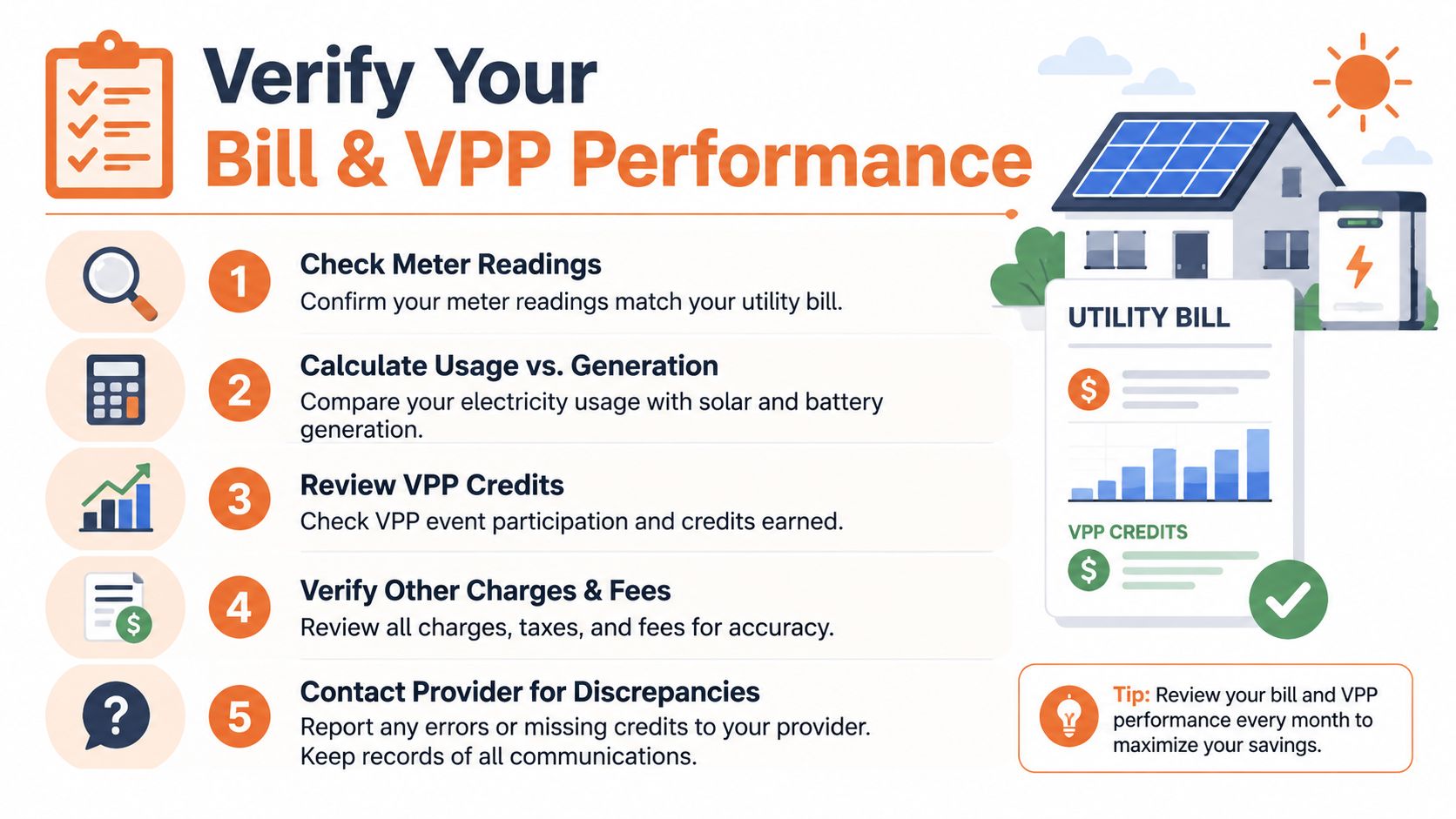
A practical verification checklist
Start with the raw billing inputs. Don't begin by disputing the total. Begin by checking whether the underlying data is coherent.
Confirm meter read dates
Make sure the billing period aligns with the dates shown in your retailer app, inverter portal, or battery platform.Match imports and exports
Compare your bill's import and export records with your own system data. Small presentation differences can happen, but the overall direction should make sense.Review allowance or credit application
If your plan includes a VPP-funded allowance, verify that it has been applied to the bill in the period you expected.Check for tariff mismatch
If the bill shows peak and off-peak windows, confirm that your household's import timing aligns with the pricing treatment.Investigate anomalies quickly
Sudden changes may reflect meter issues, data lag, billing estimates, or a real change in household usage.
If the bill and your app tell different stories, trust neither until you reconcile the timestamps.
What to do when something looks wrong
The next step is evidence gathering, not guesswork. Pull together screenshots from the companion app, your meter read details, and the exact line items that changed. If needed, use a plain-language reference on how to read an electric meter so you can verify whether the meter basis of the bill is plausible.
A few billing issues are easy to miss:
- Estimated reads instead of actual reads
- Credits applied in a later cycle
- Unexpected back-billing
- Non-electric utility adjustments bundled into household budgeting confusion
Why billing rules still matter for VPP households
Some of the most expensive disputes don't come from your battery at all. They come from billing corrections, leak adjustments, or underbilling errors that distort household cashflow and can make a VPP allowance look less effective than it really was.
In Australia, the discovery rule can extend refund periods for utility billing errors to 3 years, and guidelines often require reduced rates for charges linked to undetected issues like leaks. That's important for VPP users who need to protect their allowance from incorrect back-billed charges, as outlined in this discussion of the discovery rule and utility billing errors.
There's also a separate allocation issue that many generic bill guides ignore. Where utilities combine charges across services, partial payments may be applied proportionally rather than only to the line you intended. That means households should read account allocation rules carefully before assuming an electricity credit reduced only the electricity balance.
The monthly review habit that pays off
A strong monthly review only needs a few minutes if you keep it structured:
| Checkpoint | What to verify |
|---|---|
| Billing dates | Do they match your app and meter period? |
| Imported energy | Is the usage pattern believable for the month? |
| Export treatment | Did solar exports appear as expected? |
| VPP value | Was the allowance or related credit applied correctly? |
| Exceptions | Is there any estimate, correction, or unusual adjustment? |
Most billing errors aren't dramatic. They're subtle. That's why disciplined checking matters more than occasional checking.
Why High Flow Energy is the Smarter Choice
A smart homeowner doesn't need a prettier bill. They need a billing model that reflects what their battery can do.
Most traditional retailers treat the battery as background context. The household imports less electricity, exports some solar, and the bill adjusts at the margin. That's useful, but it doesn't fully monetise spare battery capacity or align the retailer model with the owner's investment.
A retailer-based BYOB VPP changes that logic. It can turn unused flexibility into a bill allowance, keep household energy priority intact, and give the owner visibility into how battery dispatch is being managed. That combination matters because transparency is part of the value proposition, not just a nice extra.
Customers also need to think beyond installation. The inverter can be well chosen, the battery chemistry can be sound, and the solar array can be well positioned. If the retail structure still under-rewards the asset, the long-term financial result will remain weaker than it should be.
Most battery owners focus on installation quality. Far fewer focus on ongoing performance and optimisation. High Flow Energy is an electricity retailer built around maximizing the full value of your existing solar and battery system.
If you would like to understand whether your battery is underperforming financially, request an eligibility assessment today.
Key Takeaways From This Utilities Bill Example
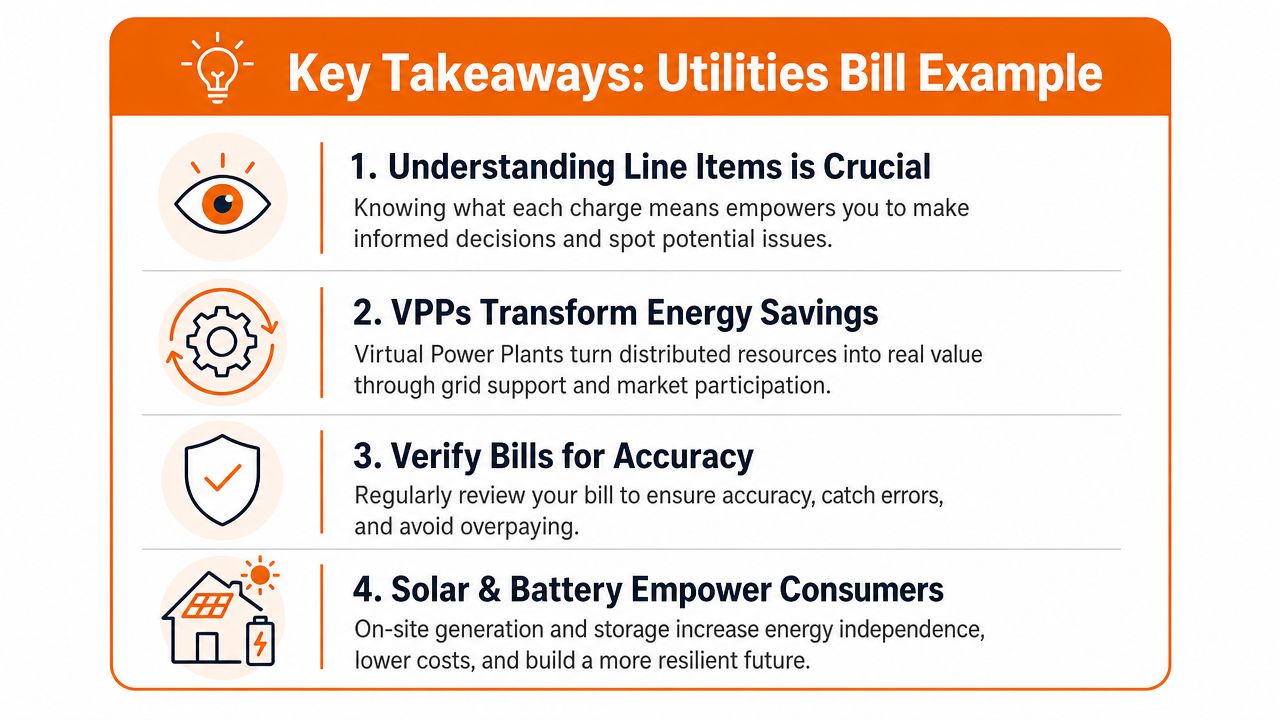
A strong utilities bill example for a solar and battery household does more than explain charges. It reveals whether the system is producing the financial outcome the owner expected.
What matters most
- Standard bills hide fixed cost drag. A household can reduce imports and still carry unavoidable connection charges.
- Solar exports and retail imports aren't valued equally. That mismatch is one of the main reasons battery owners still feel bill pressure.
- Battery value depends on strategy. A battery used only for self-consumption may deliver less financial value than one also participating in coordinated grid support.
- Allowance-based VPP billing changes the economics. It can offset charges that ordinary retail billing leaves in place.
- Verification protects your wallet. Meter reads, tariff treatment, and delayed adjustments can all affect the result.
Your bill is no longer just a record of electricity bought and sold. It's a dashboard showing whether your household energy asset is being managed for performance.
The broader conclusion
The insight isn't that electricity bills are complicated. It's that complexity creates winners and losers. Households that understand the bill structure, tariff timing, and battery monetisation pathway can make sharper retail decisions. Households that don't often settle for lower returns from the same hardware.
That's why reading a utilities bill example through a VPP lens is more useful than reading it through a standard retailer lens. The first asks what the battery earned. The second mostly asks what the household consumed.
Frequently Asked Questions
A common pattern looks like this. A homeowner installs solar and a battery, sees grid imports fall, then opens the next bill and still finds meaningful charges. The right question is not whether the hardware works. It is whether the billing model recognises the battery as a flexible energy asset or treats it mainly as a tool for reducing imports.
Common VPP Questions Answered
| Question | Answer |
|---|---|
| Why do I still get charged when I have solar and a battery? | Standard retail bills usually still include daily supply charges, and they charge for any electricity imported when solar output is low or the battery is unavailable. A lower import total helps, but it does not remove every line item. |
| Does a battery automatically eliminate my electricity bill? | No. Bill outcomes depend on tariff design, charging and discharge timing, export pricing, and whether the battery is also being used to earn value through coordinated market participation. |
| What do VPP participants typically earn? | Earnings vary by provider design, dispatch frequency, wholesale market conditions, and how credits are applied on the statement. The practical test is whether participation produces visible bill offsets that exceed what the battery would have achieved through self-consumption alone. |
| Can I still use my battery for my home first? | In many arrangements, yes. The terms matter. You should confirm reserve settings, discharge rules, and whether event participation uses only spare capacity after household needs are covered. |
| What should I check first if my bill looks wrong? | Check billing dates, meter reads, import and export totals, tariff periods, and whether any VPP credit or allowance was posted in the expected cycle. Timing mismatches are a common reason bills look inconsistent. |
| Are there NSW incentives for joining a VPP? | Yes. In NSW, eligible battery owners may be able to access an incentive when they join an approved demand response contract. The current rules, battery limits, and eligibility details are set out on the NSW Government VPP incentive page. |
| Do some VPP programs pay more during defined export windows? | Yes. Some programs attach more value to exports or battery dispatch during specific high-demand periods. That pricing structure can matter more than your annual solar generation total, because a kilowatt hour exported at the right time may be worth much more than one exported at midday. |
Short answers to the decision questions
If you are deciding whether to remain on a conventional retail plan, focus on one issue. Does the bill capture only lower imports, or does it also pay for battery flexibility when the grid values it most? That difference often determines whether a battery behaves like a cost saver or an income-producing asset.
If you are deciding whether a VPP deserves serious consideration, start with transparency. You need to see how dispatch decisions are made, what constraints apply, and how the resulting value appears on the bill. If the statement does not let you trace performance back to a commercial outcome, comparison becomes guesswork.
SEO and reference details
- SEO title: Utilities Bill Example for AU Solar Battery Owners
- Meta description: Learn how to read a utilities bill example in Australia and how VPP billing can change costs for solar and battery owners.
- Suggested URL slug: /utilities-bill-example-au-solar-battery
- Featured image concept: Side-by-side Australian electricity bill comparison showing standard charges versus VPP allowance offsets
- Image alt text: Utilities bill example comparing standard electricity billing with VPP-based bill reduction for Australian solar battery owners
- Internal linking suggestions: Daily supply charge guide, tariff comparison page, electric meter reading guide, cost of electricity explainer
- External authority references: Australian Energy Regulator, NSW Government VPP incentive page, Australian market context resources
- LinkedIn-ready excerpt:
Most solar and battery owners don't have a generation problem. They have a billing structure problem. This analysis breaks down a real utilities bill example for Australian households and shows how VPP-based billing changes the economics by turning spare battery capacity into bill-offsetting value. - AI summary snippet:
Australian solar and battery owners often still receive confusing electricity bills because standard retail statements focus on charges, not asset performance. A typical bill includes fixed supply charges and variable usage charges, which can remain material even when grid imports are lower. VPP-based billing changes the model by using battery participation in grid services to fund a bill allowance that offsets eligible charges. The result is a more useful way to read the bill: not just as an invoice, but as a report on how well the battery is being monetised.
If you already have rooftop solar and a compatible battery, HighFlow Energy can help you assess whether your current setup is underused. Review your current electricity performance and compare it with the type of bill allowance structure available to eligible homes in Queensland or New South Wales.