

What Is Daily Supply Charge: Your 2026 Energy Bill Explained
Your bill arrives, and the part that irritates you isn't the usage. It's the charge that stays there even when your solar does the heavy lifting and your battery covers the evening. If you've searched what is daily supply charge, you're probably trying to work out why a fixed cost still survives after investing in your own energy system.
The short answer is simple. The daily supply charge is the fixed fee you pay to stay connected to the electricity grid, whether you use any electricity from it or not. It's separate from the part of your bill that rises and falls with kilowatt-hours used. If you want a broader view of why bills stay stubbornly high, these tips to lower energy bills are a useful companion read. It also helps to understand the wider cost of electricity in Australia before you judge whether your battery is delivering its full value.
The Unavoidable Cost on Your Electricity Bill
Your battery finishes the evening with charge left. Your solar covered most of the day. You open the bill expecting the fixed costs to be tiny, then the same daily fee is still sitting there.
That fee exists because your home is still linked to the grid. The network has to stay available to your property, whether you import much electricity or almost none. Poles, wires, metering, fault response, and the systems behind billing and settlement do not disappear because your panels and battery handled most of the work. For broader context on how fixed and variable costs shape retail pricing, HighFlow Energy's guide to the cost of electricity in Australia is a useful reference.
Retailers usually show the charge as a cents-per-day amount. Some make it obvious on the bill. Others fold it into a supply or service total for the billing period. Either way, it is a fixed access cost, separate from the electricity you buy.
What the charge really means
The supply charge works like line rental on an old phone service. You could make very few calls and still pay to keep the line connected.
Electricity works the same way. Your household may import very little on a bright, mild day, but the grid still has to be ready the moment your solar output drops, your battery empties, or a cloudy week pushes you back into import mode.
That is why this charge survives efficiency upgrades. Lower usage helps with usage charges. A lower supply charge usually needs a different retail structure, a specific credit mechanism, or a decision to disconnect entirely.
Practical rule: If the charge remains when grid usage is close to zero, the issue sits in the tariff structure, not in your appliance habits.
Why battery owners still see it
Battery owners often expect self-generation to wipe out nearly the whole bill. In practice, it often wipes out much of the variable part first. The fixed part stays put.
For solar and battery households in Queensland and New South Wales, that makes the supply charge one of the last stubborn costs left after the system has already cut daytime imports and shifted evening demand. This distinction is what generic explainers usually miss. They define the fee, but they do not explain why it keeps appearing for homes with strong energy hardware.
That missing piece is the key opportunity. Once you understand that the remaining cost is tied to billing design rather than energy production alone, you can start looking for retailer offers that offset the fixed charge instead of assuming more panels or a bigger battery will solve it. If you are comparing bill-reduction strategies beyond hardware, these tips to lower energy bills add useful context.
Deconstructing Your Bill Supply vs Usage Charges
Open a bill after a month when your solar did most of the work and your battery covered the evening peak, and one charge still looks stubbornly familiar. That is usually the point where the bill starts to make more sense. You are looking at two different pricing engines on the same page.
The two core bill components
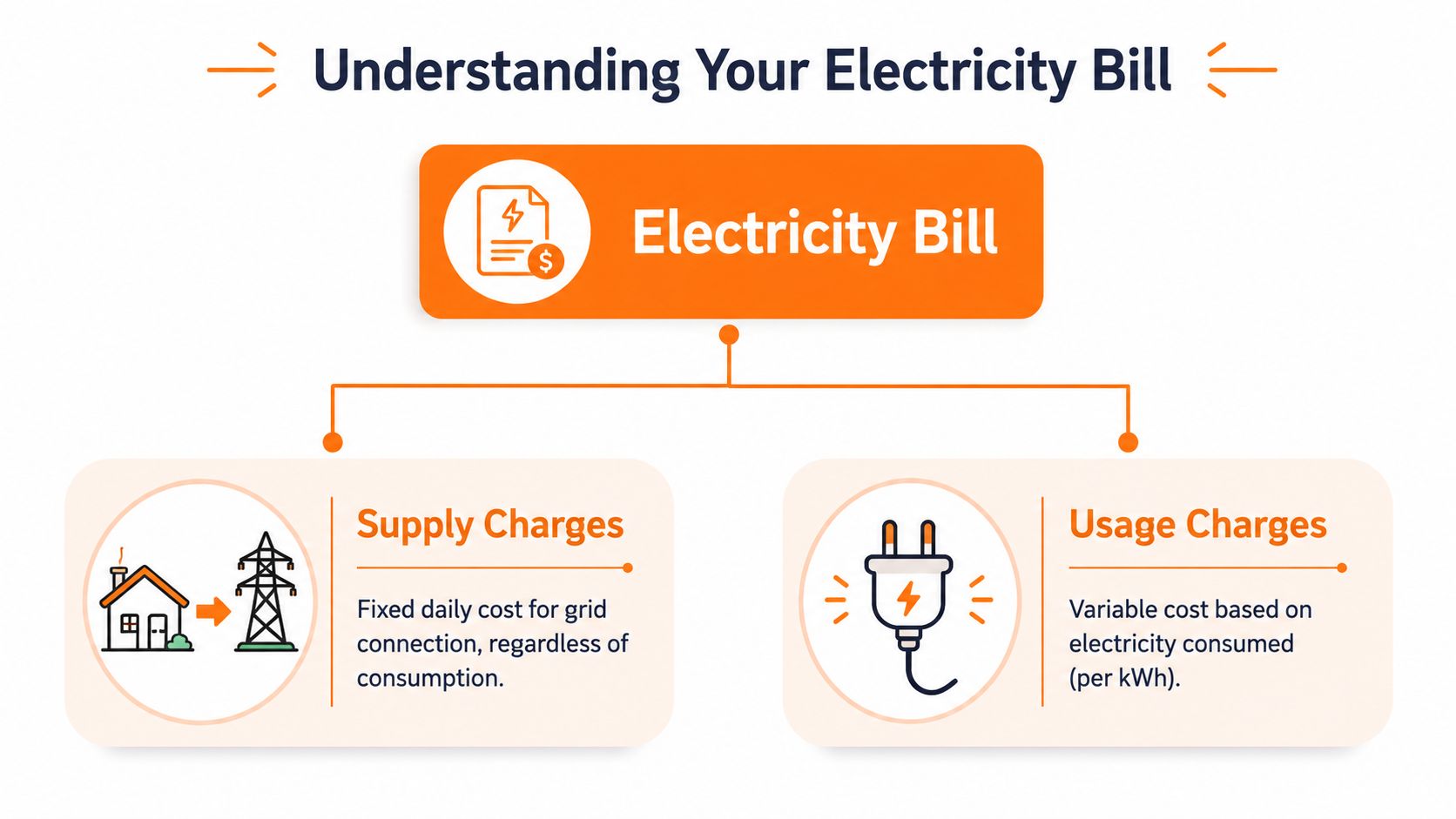
| Bill component | What it covers | Does it change with usage |
|---|---|---|
| Supply charge | Ongoing grid connection and network availability | No |
| Usage charge | Electricity consumed from the grid, usually charged per kWh | Yes |
Start with the clean distinction.
A usage charge rises and falls with the electricity you import from the grid. If you buy fewer kilowatt-hours, you usually pay less. If you want a quick refresher on that unit, this guide explains what a kWh means on your bill.
A supply charge is different. It is the daily cost attached to keeping your property connected and able to draw power from the network. Your meter, service line, and access to the grid remain in place whether you import 20 kWh, 2 kWh, or close to none.
That distinction is the commercial heart of the issue for solar and battery owners. Hardware cuts the variable part first. The fixed part stays until the retail arrangement changes or a credit offsets it.
What you're paying for
The supply charge exists because a grid connection has ongoing costs even on low-import homes. Your retailer and the network still have to maintain the connection, meter the site, and keep the system available when your home needs backup supply, extended cloudy-weather support, or extra capacity.
So the practical question is not, "Did I use much electricity?" It is, "Am I still connected under a tariff that includes a daily access cost?"
That is why two homes with very different import levels can still face a similar daily fixed charge. One household may rely heavily on grid electricity. Another may have strong solar production and a well-managed battery. If both remain grid-connected on standard retail terms, both usually keep paying for access.
Your solar and battery system can shrink imported energy sharply. They do not automatically remove the cost of staying connected.
Why the distinction is useful outside electricity
People often grasp fixed and variable costs faster in other household decisions. Cars are a good example. Registration and insurance sit there whether you drive often or not, while fuel changes with distance travelled. If you want another practical model, this guide helps compare electric vehicle costs by separating ownership costs from usage costs.
Apply the same logic to your electricity bill and a lot of confusion disappears. One line item reflects access to infrastructure. The other reflects energy activity.
For battery owners, that is more than a billing definition. It explains why adding more hardware does not always remove the last visible cost on the bill. It also sets up the more useful question, especially in QLD and NSW. Which retailer structures, credits, or VPP arrangements can offset that fixed charge rather than reducing imports further?
Why Your Solar and Battery System Is Not Enough
You install solar. You add a battery. Your imports drop close to zero for long stretches. Then the bill arrives and the daily supply charge is still there.
That result surprises battery owners because the battery solved the energy problem, not the connection problem. Your system can cover a large share of consumption. It does not automatically replace the commercial arrangement that keeps your home attached to the grid.
The simplest way to see it is to separate the physical asset from the billing structure. A battery stores and shifts electricity. The daily supply charge pays for ongoing access to poles, wires, metering, and the retailer account that lets your home draw power when your own system cannot cover demand.
The misconception
A common expectation among homeowners is that once the battery is large enough, grid costs should disappear as well. Bills do not work that way.
The Australian Energy Regulator has explained that daily supply charges are generally tied to connection and metering rather than the volume of electricity used. You can see that structure in the AER's consumer guidance on electricity bills and charges: Australian Energy Regulator electricity bill information.
This finding reframes the problem. If the remaining cost is fixed by your retail and network arrangement, adding more storage capacity may deliver only small extra bill savings. It is like owning a rainwater tank but still paying the fixed water service fee because the property remains connected.
Why feed-in credits don't fix it
Exports and feed-in tariffs can reduce the bill total, but they usually do not remove the charge itself. They work on the credit side of the bill. The supply charge remains a separate daily debit.
In practice, the roles are different:
- Solar cuts daytime purchases. It covers loads while the sun is producing.
- Battery cuts evening and overnight purchases. It shifts your own energy into higher-value hours.
- The supply charge still applies. It is attached to the live grid connection, even on days when imports are very low.
A battery is an energy asset. The daily supply charge is a retail and network charge. Those are related, but they are not the same thing.
Why this becomes more important for high-performing homes
The better your solar and battery perform, the more visible the fixed charge becomes. If usage charges fall sharply, the supply charge can move from a minor line item to one of the last stubborn costs left on the bill.
That is the key commercial insight for battery owners in QLD and NSW. Past a certain point, the next layer of savings does not come from squeezing out another kilowatt-hour of imports. It comes from choosing a retailer structure, tariff design, or VPP arrangement that can offset the fixed daily charge itself.
Daily Supply Charges in QLD and NSW A Closer Look
You open the bill after a strong solar month, see very low grid imports, and still find a few hundred dollars a year that refuse to disappear. For many battery owners in QLD and NSW, that stubborn cost is the daily supply charge.
What the maths looks like
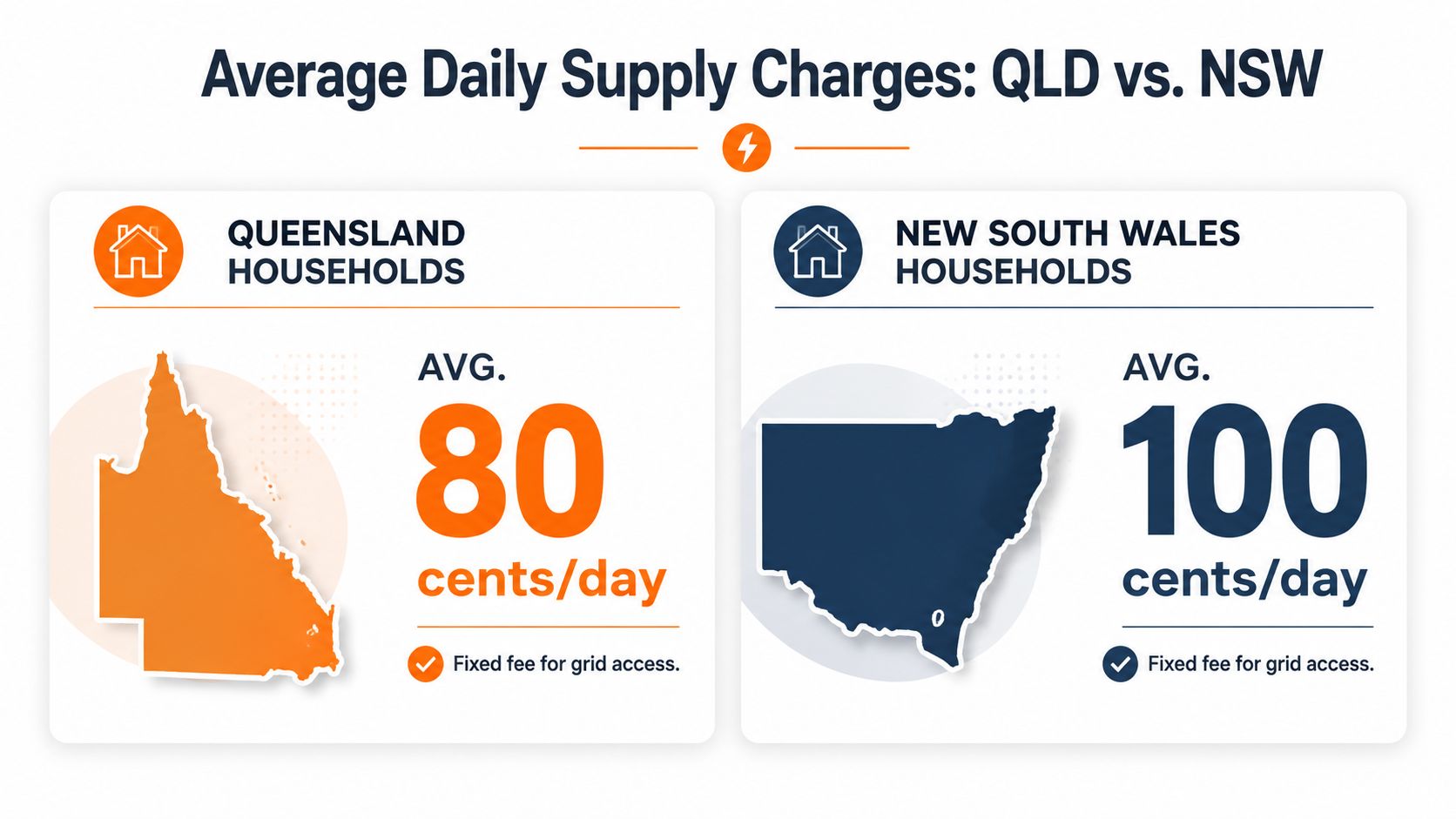
Recent retailer and community examples discussed earlier put typical supply charges at roughly $1.48 per day in NSW and $1.23 per day in QLD. Annualised, that is about $540.20 in NSW and $450.45 in QLD before usage charges are added.
| State | Typical daily supply charge | Approximate annual cost |
|---|---|---|
| NSW | $1.48 per day | $540.20 per year |
| QLD | $1.23 per day | $450.45 per year |
That gap matters.
If your solar and battery have already pushed variable energy costs down, a fixed charge of $450 to $540 a year stops looking like background noise and starts looking like one of the main remaining costs of staying grid-connected.
Why NSW and QLD are different
The daily supply charge is not one single national fee. It varies by retailer, network area, meter type, and tariff structure. A home in regional NSW can face a different fixed charge from a home in southeast Queensland, even if both households use similar amounts of electricity.
A simple way to view it is this. Usage charges pay for how much electricity you draw. Supply charges help cover the cost of keeping the connection available at your address. That includes parts of the network and account structure that still exist whether you import a lot, a little, or almost nothing.
This is why two high-performing solar homes can still get noticeably different results on paper. One may have lower imports, but the other may have the better retailer setup.
Why this section matters for battery owners
Most articles stop at the definition. The more useful question is why the charge still survives after you have already spent money on solar and storage.
The answer is commercial, not technical. Your battery reduces energy bought through the meter. The supply charge sits in the account structure behind that meter. Different tool. Different cost bucket.
That distinction is what makes retailer-based virtual power plant participation worth examining. In QLD and NSW especially, the actual opportunity is often not squeezing out one more small reduction in imports. It is finding a tariff or VPP arrangement that produces enough account value to neutralise this fixed daily cost.
The Solution How VPP Participation Offsets Fixed Charges
A battery can lower the electricity you buy. It does not automatically change how your retailer charges the account.
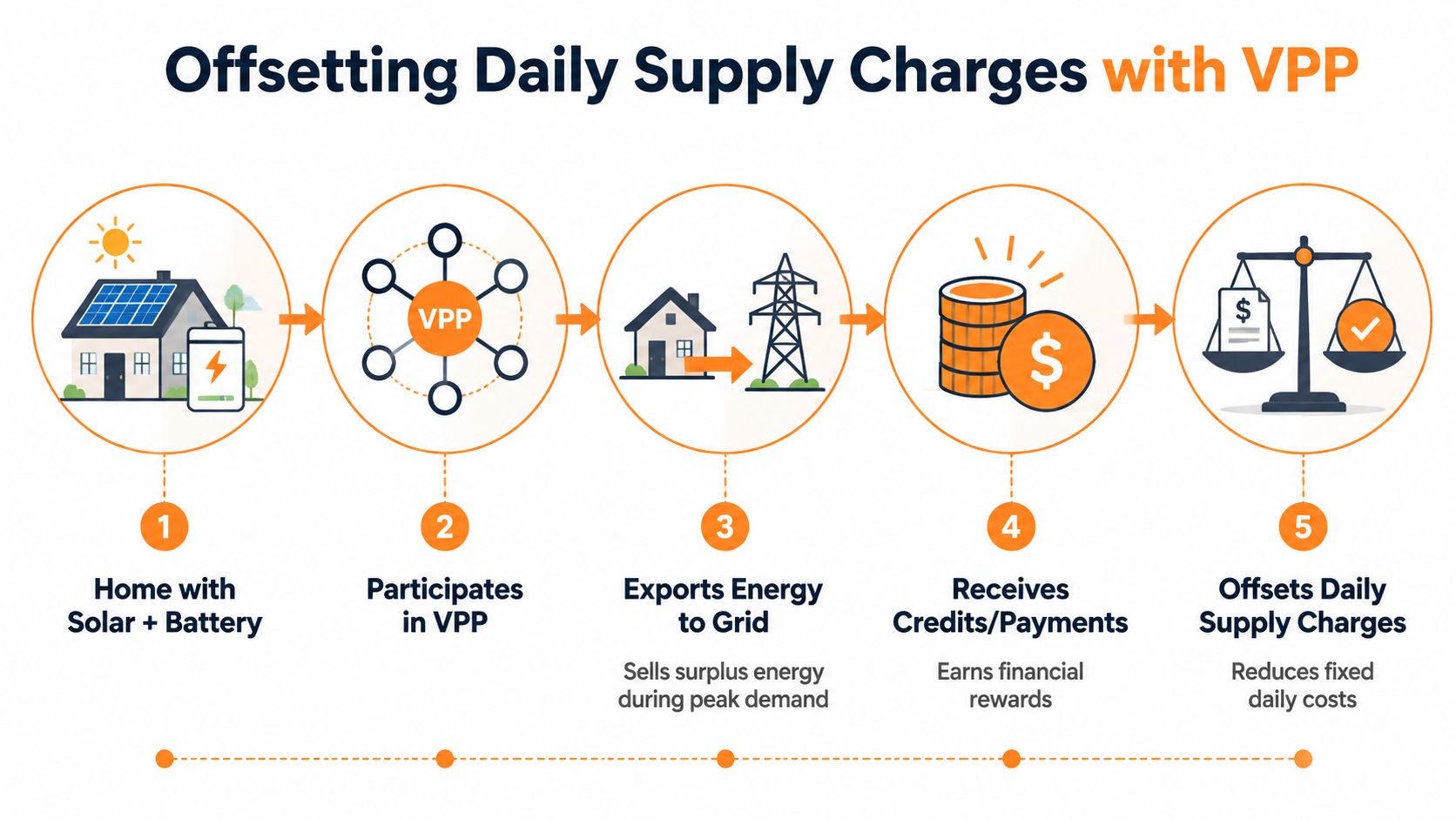
The practical solution is to make the battery earn value at the account level, not just the meter level. That is the role of a Bring Your Own Battery Virtual Power Plant. The retailer or VPP operator coordinates some spare battery capacity during high-value periods, then returns part of that value as bill credits or a monthly allowance.
Why this works better than simple export credits
Feed-in tariffs usually reward one narrow behaviour. Exporting excess solar.
A retailer-based VPP can reward something more commercially useful, including battery discharge at times when electricity is more valuable and participation in grid support events. That changes the maths in a way solar owners often miss.
It values timing, not just kilowatt-hours
One unit of electricity is not worth the same amount all day. A coordinated battery can respond when value is higher.It converts spare battery capacity into bill value
Your battery stops being only a tool for self-consumption. It also becomes a revenue-producing asset for the electricity account.It can offset fixed and variable charges
If the retailer applies a dollar allowance to the full account, that value can reduce the daily supply charge as well as usage charges.
A useful analogy is rent versus groceries. Solar and battery self-consumption help cut the grocery bill. A VPP-style allowance can help pay the rent too. For many battery owners, that is the missing piece.
The retailer-based VPP framework
One example is a retailer-based BYOB virtual power plant model. In that setup, the customer keeps the existing solar and battery system, the home still gets priority access to stored energy, and participation can produce a monthly electricity allowance.
The key detail is how the value is credited. A feed-in tariff usually rewards exports in a narrow line item. A monthly allowance is broader. It can be applied against the total bill, which means the daily supply charge is no longer protected from the value your battery creates.
That distinction matters more than many product brochures suggest. The primary question is not whether a VPP sounds smart or modern. The question is whether the retailer returns battery value in a form that can neutralise fixed charges.
What to check before joining any VPP
Not every VPP solves this problem. Some mainly improve export value. Others are structured to reduce the whole bill.
| Question | Why it matters |
|---|---|
| Does the value come back as bill credits or a usable allowance? | This decides whether fixed charges can be offset at all. |
| Is household energy priority protected? | Your battery still needs to cover your own evening and backup needs first. |
| Can you see performance clearly? | Clear reporting helps you judge whether the arrangement is producing real account value. |
| Are there lock-in or exit constraints? | Contract flexibility matters if your tariff, retailer, or household needs change. |
A well-designed VPP is not just a technical control layer. It is a retail structure that lets your battery work on both sides of the bill.
A Worked Example Eliminating the Supply Charge
A real bill scenario shows why battery owners often feel confused. Your solar can slash daytime imports. Your battery can cover a good share of evening demand. Yet the fixed daily charge keeps appearing because grid connection is still being billed in the background.
Take a household in New South Wales with rooftop solar and a compatible battery. Under a standard retail plan, the home uses its own solar first, then discharges the battery later in the day to avoid buying as much grid electricity. That improves the usage side of the bill. The daily supply charge, noted earlier at about $1.48 per day in NSW, still adds up across the year to roughly $540.

Traditional retailer outcome
Start with the two bill buckets.
- Usage charges: These fall when solar generation and battery discharge reduce grid imports.
- Supply charge: This keeps accruing each day the property remains connected.
That distinction is the whole problem. A battery changes how much electricity you buy. It does not change the retailer's billing structure by itself.
So even a well-performing system can leave you with a bill. In summer you might export plenty and buy very little. In winter or during cloudy periods, feed-in credits usually soften the bill rather than clearing it. The fixed charge remains one of the last costs standing.
Retailer-based VPP outcome
Now change one variable. The battery joins a VPP that returns value as a monthly bill allowance rather than only paying for exported energy.
That allowance works like a store credit on your electricity account. The retailer applies it against what you owe, starting with the charges already sitting on the bill. If the monthly allowance is greater than the month's supply charge and any remaining usage costs, the amount payable can fall to $0 up to the allowance limit.
Here is the commercial difference in plain terms. A feed-in tariff rewards a specific flow of electricity out to the grid. A bill allowance can reduce the whole account balance, including the fixed charge.
Why the example matters
This is how supply charges are eliminated in practice for some battery owners. The charge has not disappeared from the tariff. It is still there. The difference is that battery value is being returned in a form that can absorb it.
That matters even more in QLD and NSW, where the annual total from daily fixed charges is large enough to deserve its own line in your battery payback thinking. If you only optimise self-consumption, you are improving one side of the ledger. If you also choose a retailer and VPP structure that applies battery value to the full bill, you are improving the billing model as well.
That is the shift many owners miss. The hardware cuts energy purchases. The retail structure decides whether fixed charges still land in your pocket.
Frequently Asked Questions About Supply Charges
A useful way to frame these questions is to separate two different jobs on your bill. Your solar and battery can reduce the electricity you need to buy. Your retailer's billing structure determines how fixed charges are treated. Those are related, but they are not the same thing.
Can I remove the daily supply charge just by having a battery
No. A battery can cut imported energy sharply, especially overnight, but the daily supply charge is tied to grid connection rather than daily consumption. If your home stays connected, that fixed line item usually stays in place.
Do solar feed-in tariffs cancel out supply charges
Feed-in tariffs can create bill credits from exported energy, but that is different from removing the charge itself. The supply charge still appears on the account. What changes is whether your credits are large enough, and flexible enough, to offset it.
Is the daily supply charge the same as a usage tariff
No. They measure different things.
The supply charge is the fixed cost of keeping the property connected to the network and account services active. Usage tariffs are variable charges based on the electricity you import, usually measured in kilowatt-hours. One is closer to an access fee. The other rises and falls with consumption.
Why do so many battery owners misunderstand this
Because battery marketing often focuses on energy independence, while bills are built from both energy costs and fixed access costs.
That creates a simple mistake. An owner sees imports fall close to zero and expects the whole bill to follow. In practice, low imports can coexist with a persistent fixed charge. The hardware changes energy flows. The tariff and retail structure decide how that value appears on the bill.
Can a VPP offset fixed charges
Some can.
The key question is not whether the battery helps the grid. Many VPPs do that. The key question is how the retailer returns that value to you. If the benefit comes back as an account credit or monthly allowance that applies to the total bill, it can absorb fixed charges as well as usage charges. If it only comes back as an export payment, the result is narrower.
What happens if I use more than my allowance
You pay the retailer's normal rates on the amount above the allowance or credit. That is why the details matter. Check whether the value is capped monthly, whether unused amounts roll over, and whether the credit can be applied against the whole account balance or only specific charges.
Most battery owners focus on installation quality. Far fewer focus on ongoing financial performance. HighFlow Energy is an electricity retailer built around realizing the full value of your existing solar and battery system.
If you'd like to understand whether your battery is underperforming financially, request an eligibility assessment today.