

How Long Can a Solar Battery Power a House
A solar battery's runtime isn't a fixed number. A 10 kWh usable battery typically powers a moderate-use Australian home for roughly 12 to 16 hours when running essential loads only, depending on how much electricity the home is drawing.
That's why a homeowner in Brisbane or western Sydney can receive very different answers to “how long can a solar battery power a house?” The battery may be the same size, but the household load can change from a quiet evening with the fridge, lights and Wi-Fi running to a high-demand night with air conditioning, hot water, cooking and pool equipment.
The practical calculation is simple: usable battery capacity divided by average household load equals approximate runtime. Real performance also depends on the inverter, the battery's depth-of-discharge settings, whether solar can recharge the system during the day, and whether the battery backs up the whole home or only selected circuits.
What Actually Decides How Long a Solar Battery Can Power a House
During an evening outage in suburban Brisbane, the lights may stay on while the fridge hums, Wi-Fi runs and the family waits for power to return. The same battery in western Sydney could run down much sooner if air conditioning, cooking equipment or other high-demand appliances remain connected.
Four inputs determine the result:
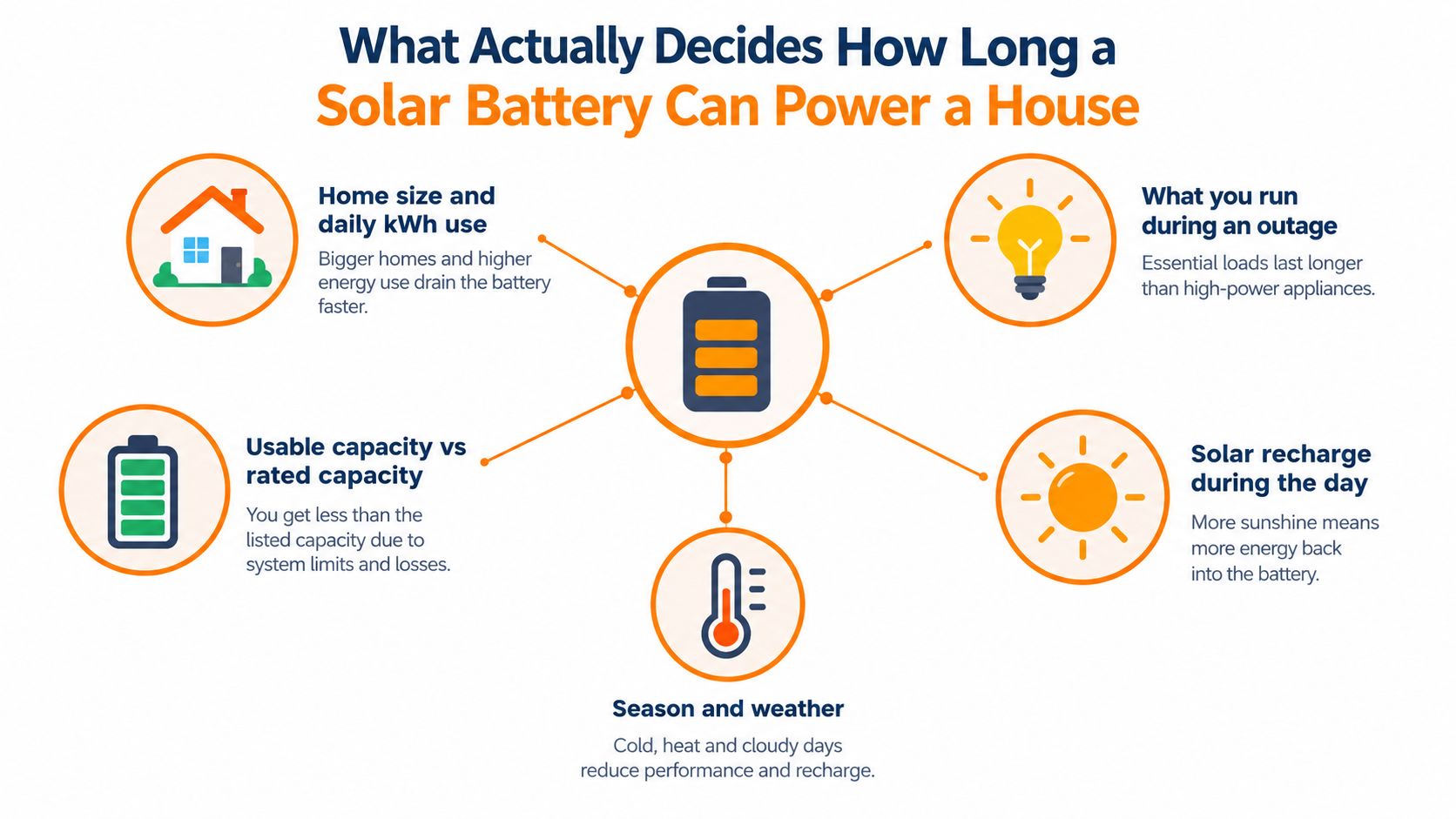
- Usable capacity: The energy available to the home is usually lower than the capacity printed on the battery.
- Average load: A home drawing 1 kW uses stored energy more slowly than one drawing 3 kW.
- Inverter performance: The inverter changes battery power into household electricity, with some energy lost during conversion.
- Depth of discharge: The battery management system may keep a reserve to reduce stress on the cells and support battery life.
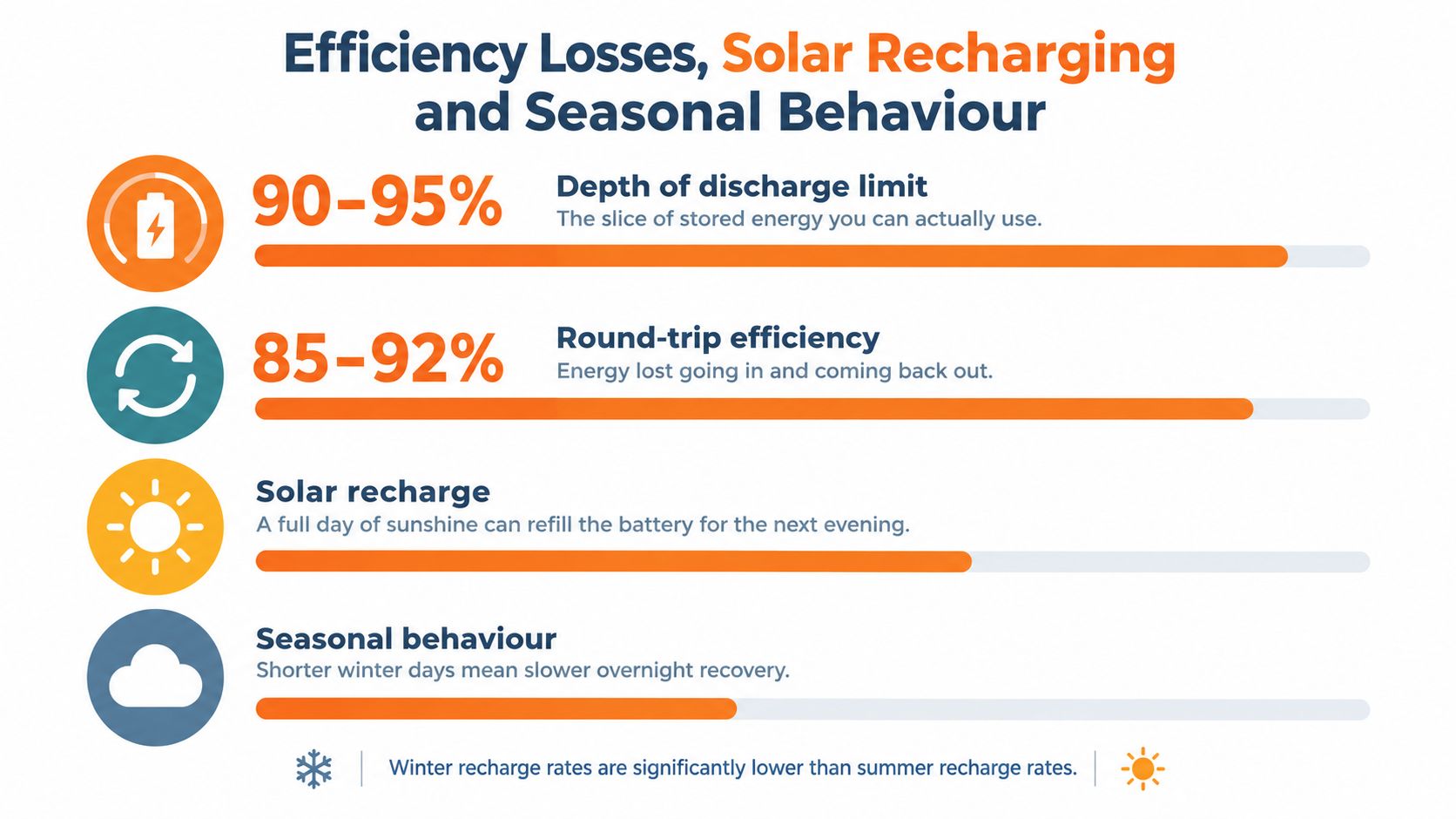
The Australian Government's YourHome battery guide explains the difference between nominal and usable capacity. Lithium batteries commonly allow a depth of discharge between 90% and 95%. A battery labelled at 10 kWh may therefore provide about 9 to 9.5 kWh of usable energy before inverter losses.
Backup circuits matter as much as battery size
A battery may supply priority circuits, selected appliances or the whole house. A priority-load setup might keep the refrigerator, communications equipment, lighting and selected power points operating. Whole-home backup also allows larger loads to run, so the same stored energy can disappear quickly.
A 13.5 kWh battery will generally run longer than a 10 kWh battery under comparable conditions, but the appliance mix still decides the outcome. The label alone cannot show whether a battery will last through the night. Usable capacity, inverter limits and the circuits connected to backup all matter.
Virtual power plant participation can change the backup equation. A VPP may control or draw on a battery during grid events, so homeowners need to check how participation affects stored energy availability and backup settings.
Practical rule: Treat the advertised battery size as a starting point. Use measured household demand and backed-up circuits to estimate the runtime you can actually expect.
Homeowners comparing battery backup with other resilience options can also review these whole-house generator buyer tips when deciding which appliances must remain available during a prolonged outage.
The Simple Runtime Calculation Every Australian Homeowner Should Know
A Gold Coast apartment may have a 10 kWh usable battery and a priority evening load averaging 0.8 kW. The basic runtime formula is:
Usable battery capacity in kWh ÷ average household load in kW = approximate runtime in hours
For this example:
10 kWh ÷ 0.8 kW = 12.5 hours
That estimate assumes the load stays steady. Household demand moves up and down instead. A fridge cycles, lights switch off when rooms are empty, and a kettle or television can create short periods of higher demand. The result is a planning estimate, not a guaranteed finish time.
A Penrith family home with the same 10 kWh usable battery may have an average backed-up load of 2 kW from the fridge, lighting, Wi-Fi and television:
10 kWh ÷ 2 kW = 5 hours
These loads are examples, not universal appliance ratings. Your inverter app, energy monitor or smart meter provides a better starting point than a generic calculator. A household energy audit can help you calculate household energy consumption across different times of day.
Work backwards from the runtime you want
The formula also works in reverse:
Required usable capacity = average load in kW × desired runtime in hours
If priority circuits draw 0.5 kW, a 5 kWh usable battery would provide about 10 hours under steady conditions. A 10 kWh usable battery would provide about 20 hours, while a 13.5 kWh usable battery would provide about 27 hours at the same low load.
These figures describe the energy available for the calculation. A VPP arrangement may reserve, control or draw on some stored energy during grid events, so use the capacity your system makes available for backup, not only the battery's advertised size.
Inverter overheads, start-up loads and temperature can reduce runtime. Focus on evening and overnight demand, when solar production normally falls away, and treat the result as a useful planning window.
Typical Battery Sizes vs Typical Australian Household Loads
Battery capacity becomes easier to understand when compared with household demand. CSIRO identified average daily usage of about 8 kWh for single-person households, 12 kWh for group households, 17 kWh for couples with children and 20 kWh for multiple-family households in Australia, as shown in its household energy use research.
Energy Consumers Australia reported that the median household drew about 15 kWh per day from the grid in 2025, while 20% of households used less than 9 kWh per day and 20% used more than 25 kWh per day. That spread explains why battery advice must start with the home's actual load rather than a standard household assumption.
The table below uses the battery classes and household profiles commonly discussed by Australian homeowners. Usable capacity can vary by model, configuration, reserve setting and installation design, so confirm the technical specification before comparing products.
| Battery Model | Usable Capacity | QLD Apartment, 8 to 12 kWh/day | Sydney Family Home, 18 to 22 kWh/day | Large QLD Home with Pool, 25 to 30 kWh/day |
|---|---|---|---|---|
| BYD Premium HVS, entry-level class | Confirm actual usable capacity | May cover a substantial portion of evening essentials | Usually covers only selected loads or part of overnight demand | Covers a limited share of total daily demand |
| Enphase IQ Battery 5P, mid-range system | Confirm actual usable capacity | Can support essential circuits for an extended evening | Better suited to essential loads than whole-home operation | Requires careful load shedding |
| Tesla Powerwall 3, larger system class | Confirm actual usable capacity | May provide broad coverage, subject to backup settings | Offers more flexibility for overnight loads | High-demand appliances can still shorten runtime sharply |
A typical Australian home uses about 15 to 20 kWh per day, according to CHOICE's solar and household energy guidance. That doesn't mean a 10 kWh battery will run the home for half a day in every situation. Daily consumption includes daytime activity, and the battery may only need to supply evening and overnight demand if solar covers part of the day.
For battery sizing decisions, Australian battery size guidance is more useful when paired with an hourly load profile. A smaller battery may suit a light-use apartment with modest evening demand. A larger home with electric hot water, ducted air conditioning, pool equipment and cooking loads may need a different design, or a clear essential-load strategy during outages.
Real Runtime Scenarios With Common Appliances in QLD and NSW Homes
A battery responds to the load running at each moment, not to the household's daily average. A fridge starting its compressor, a kettle heating water and an air conditioner cycling on can change the runtime calculation within minutes.
A fridge, Wi-Fi router, LED lighting and television create a relatively light priority-load group. If those circuits average about 500 W, runtime follows the same rule covered earlier: reducing the load gives the battery more operating time. The table below shows what changes when a single high-draw appliance joins that baseline.
| Appliance or group | Typical draw | Effect on a 10 kWh usable battery |
|---|---|---|
| Fridge, Wi-Fi, lights and television | Measure the combined load | Provides the longest practical runtime |
| Split-system air conditioning | Check the unit's rating and cycling load | Cuts runtime as compressor demand rises |
| Electric oven | Check the appliance rating | A cooking cycle can reduce available backup quickly |
| Kettle | Check the appliance rating | Short operation, but a sharp instantaneous demand |
| Pool pump | Check the pump rating and schedule | Usually suitable for load shedding during an outage |
| Priority circuits only | Measure at the switchboard or inverter | Shows the clearest estimate for planned backup |
The figures on a battery label describe stored energy. The inverter also has a power limit, which is a separate question. A battery may have energy remaining but still be unable to start a large motor or run several high-demand appliances together.
Comfort and continuity involve a trade-off
A Brisbane family might keep one bedroom cool during a summer outage instead of running ducted air conditioning across the house. A Newcastle household might keep the fridge, modem and selected lights operating while delaying cooking, laundry and water heating.
For an air-conditioning estimate, High Flow Energy's air conditioner electricity guide explains which appliance details to check. Use the unit's nameplate, operating mode and inverter-app data rather than relying on a broad appliance average. Starting demand and continuous demand can differ, particularly as compressors cycle.
A VPP can change the backup equation before an outage occurs. During normal grid operation, the program may control when the battery charges, exports or reserves energy. A homeowner should confirm the VPP's backup settings, because a battery committed to grid services may not hold the same reserve as a battery configured mainly for household backup.
A battery lasts longest when the household decides which services matter most before the outage begins.
A practical plan names the circuits that stay on, lists appliances that can wait and sets a clear expectation for hot weather. Runtime is therefore a household choice as much as an electrical calculation.
Efficiency Losses, Solar Recharging and Seasonal Behaviour
A battery's nameplate capacity is not the same as the energy appliances receive. After the depth-of-discharge reserve described earlier, inverter conversion and standby consumption reduce the energy delivered to the home. The battery system also needs some power to monitor, control and protect itself.
That difference matters in runtime planning. A calculation based only on the label can overstate how long a fridge, modem or air conditioner will operate. Use the system's usable capacity and measured inverter data where available, then compare that figure with the household load.
Solar can change the answer during a long outage
A battery-only calculation assumes that stored energy falls continuously. A solar-plus-battery system may recover some energy during the day if the solar inverter can operate during a blackout and the installation includes the required backup controls.
Solar usually supplies household demand first. Surplus generation can then recharge the battery for evening use. A cloudy Brisbane day, shaded panels or high daytime air-conditioning demand may leave little surplus, while a clear day can restore more of the battery's charge.
Recovery depends on weather, roof orientation, shading, export settings, backup configuration and daytime consumption. VPP controls may also affect when the battery charges or retains energy, so check whether the operating mode prioritises household backup during an outage.
The NSW Home Solar Battery Guide recommends comparing solar energy use with overnight consumption when sizing a battery. Annual solar generation alone cannot show whether enough energy will be available after sunset.
Weather and season change the operating pattern
Seasonal conditions alter both supply and demand. Shorter winter days in NSW can reduce the hours available for recharging. In summer, air conditioning may consume much of the solar energy before the battery reaches a useful evening reserve.
Australian household energy patterns show why daily totals need context. AEMC modelling reports 11.6 kWh of daily deferred self-consumption from batteries, 7.3 kWh of direct solar self-consumption and 3.3 kWh of daily grid import in Australia's Evolving Energy Consumer. Those figures describe normal grid-connected operation, not a guaranteed outage runtime.
During a blackout, solar and storage can reduce grid reliance, but neither creates an unlimited supply. The practical question is how much usable energy remains after conversion losses, how much solar can be recovered, and which appliances consume it first.
Practical Ways to Extend Runtime and Where a VPP Fits In
Runtime improves when the household reduces unnecessary demand before the battery has to supply it. The most effective actions are usually simple load-management choices rather than changes to the battery itself.
Start with the loads that can wait
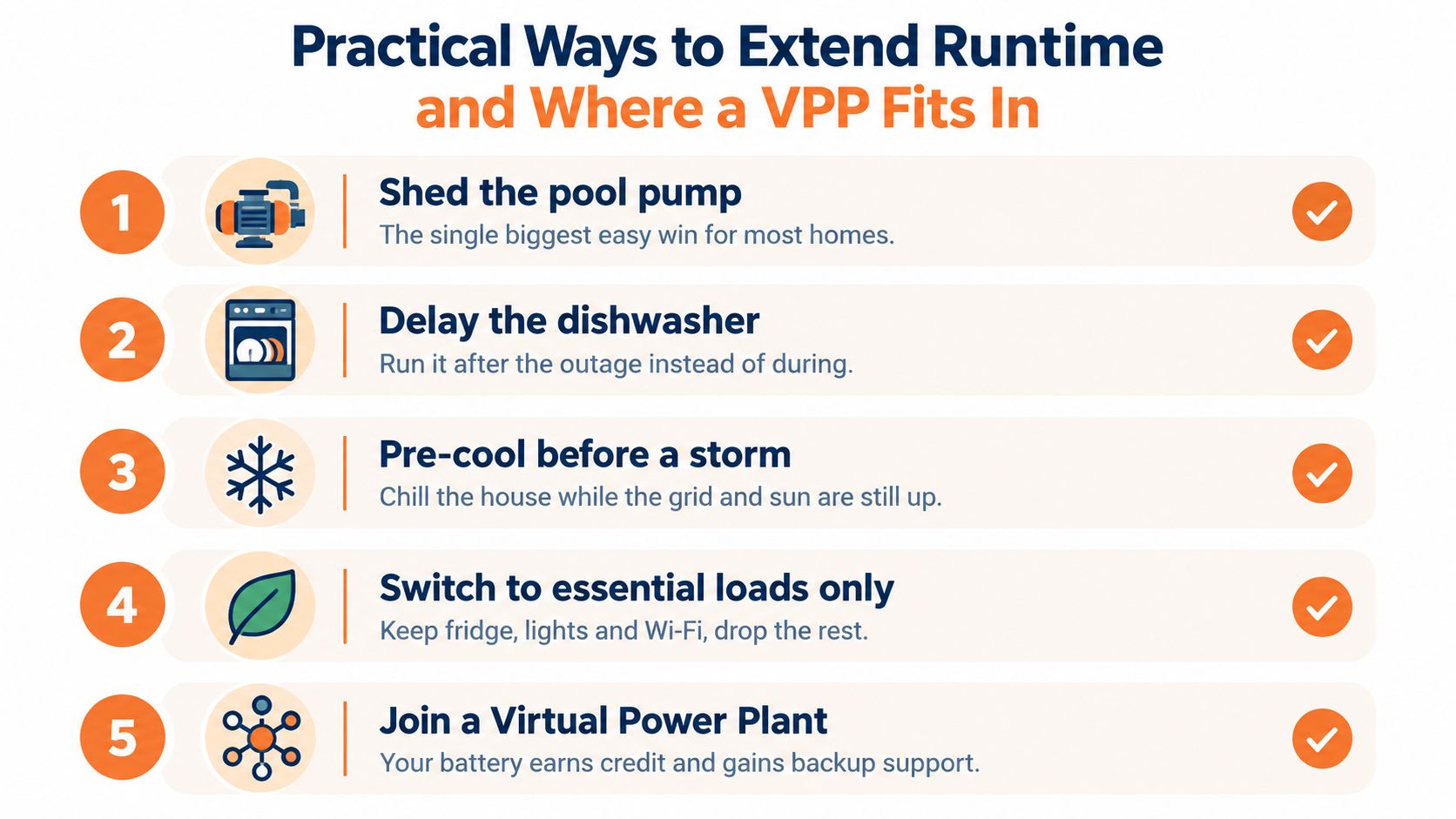
Before a forecast storm in south-east Queensland or a heat event in western Sydney, a homeowner can:
- Shed pool equipment: Pause the pool pump unless it has a specific operational or safety requirement.
- Delay dishwashers and washing machines: Run them after grid service returns or during a period of available solar.
- Pre-cool the home: Use the grid and daytime solar while they are available, then reduce air-conditioning demand during the outage.
- Choose essential circuits: Keep the fridge, communications equipment and selected lighting operating first.
- Remove standby loads: Switch off unnecessary entertainment equipment, chargers and other connected devices.
Heavy appliances are usually easier to manage before an outage than after one. Scheduling electric hot water, cooking and laundry during available solar can leave more stored energy for the evening.
Understand what a BYOB VPP changes
A Bring Your Own Battery VPP connects compatible customer-owned batteries through software so the operator can coordinate charging, discharging and grid support. In the National Electricity Market, demand response can help manage periods of wholesale price volatility, peak demand and network congestion.
That creates a different optimisation objective. The battery isn't used only as an emergency reserve. It can also be scheduled around household demand, solar production, electricity prices and grid-support events. Retailer-based VPP arrangements may provide bill allowances or other value structures, but customers should check how dispatch, reserve settings, warranty conditions and export limits work.
A VPP doesn't remove the runtime trade-off. If the system discharges stored energy to support the grid, the homeowner needs a defined backup reserve for the next outage. Customers should understand whether priority household use is protected, how much capacity is available for dispatch, and whether they can override an automated plan.
For a Queensland household concerned about cyclone-season outages, or a NSW household preparing for bushfire-risk conditions, the appropriate setting may be a higher reserve rather than maximum market participation. The right choice depends on the household's risk tolerance, load profile and contract terms.
Key Takeaways and How to Check If Your Battery Is Underperforming
The answer to how long can a solar battery power a house is always a moving estimate. Start with usable capacity and divide it by the average backed-up load. Then account for discharge limits, inverter losses, solar recharge, weather, appliance cycling and the circuits included in the backup system.
A 10 kWh usable battery can support a moderate essential load for much of an evening or overnight period. It may last far less when the household runs air conditioning, cooking equipment, pool pumps or other high-demand appliances. Solar production during the outage can extend support, but only when the system is designed to operate safely in island mode and sufficient sunlight is available.
A practical battery health check
Use the battery and inverter apps to review:
- State of charge: Check whether the battery reaches its expected upper level after a normal solar day.
- Discharge depth: Look for repeated deep cycles and confirm that reserve settings match your backup priorities.
- Actual throughput: Compare the energy entering and leaving the battery with the manufacturer's stated usable capacity.
- Outage loads: Record which appliances operated and identify the loads that consumed most of the stored energy.
- Inverter behaviour: Note unexpected shutdowns, output limits, faults or changes in charging and discharging behaviour.
- System balance: Ask an accredited technician to investigate unusual cell imbalance or a sudden reduction in runtime.
A sudden runtime reduction deserves attention, especially if household behaviour hasn't changed. Possible causes include additional appliances on the backed-up circuits, altered reserve settings, reduced solar production, inverter faults or battery performance outside the manufacturer's expected range.
Decide what action makes sense
If the battery empties too quickly, first reduce the backed-up load and change appliance schedules. If the home still needs more overnight coverage, review whether a larger system, additional storage or a different backup configuration is appropriate. A BYOB VPP may also help an existing battery earn value through coordinated discharge, but the household should confirm that market participation doesn't compromise its preferred backup reserve.
Key takeaways:
- Capacity isn't runtime: Usable kWh matters more than the nameplate figure.
- Load controls the clock: Every increase in household demand reduces runtime.
- Backup design matters: Essential circuits usually last longer than whole-home operation.
- Solar changes the equation: Daylight recharge can extend support during a continuing outage.
- VPP participation needs clear settings: Review reserve levels, dispatch rules, export limits and warranty terms.
- Measured data beats guesswork: Use the inverter app and appliance readings to assess actual performance.
Frequently asked questions
Can a 10 kWh battery run a house overnight?
It can support essential overnight loads in many homes, but there isn't a universal guarantee. A household drawing about 1 kW could use a 10 kWh battery for about a day in simple runtime terms, while a home drawing 3 kW could use the same capacity in about 3 to 4 hours, as described in Australian battery sizing guidance.
Does a solar battery work during a blackout?
Only if the system includes blackout protection and the relevant circuits are configured for backup. Some systems can switch to backup in under 3 seconds, according to Australian blackout protection guidance, but the exact behaviour depends on the inverter, switchboard and installation design.
Can solar panels recharge the battery during an outage?
They can when the solar and battery system is designed to operate during a blackout. The battery may recharge during daylight, but clouds, daytime household use, reserve settings and system controls affect how much energy is recovered.
Is whole-home backup better than essential-load backup?
Whole-home backup provides more convenience, but it can consume stored energy quickly. Essential-load backup normally gives the household more control over runtime by excluding high-demand circuits.
Does joining a VPP reduce backup protection?
It can affect the amount of energy reserved for an outage, depending on the VPP's dispatch rules. Before joining, check the minimum reserve, customer override options, household priority settings and how the arrangement treats battery warranties.
Should I buy a larger battery for occasional outages?
Not automatically. A larger battery may provide more resilience, but the decision should also consider daily consumption, solar production, evening demand, backup priorities, available space, export limits and the value of other battery uses.
Most battery owners focus on installation quality. Far fewer focus on ongoing performance and optimisation. High Flow Energy is an electricity retailer built around realizing the full value of your existing solar and battery system, with BYOB VPP participation available to eligible owners in Queensland and New South Wales. If you would like to understand whether your battery is underperforming financially, visit High Flow Energy to request an eligibility assessment.