

Home Battery Savings: Cut Your Power Bills in 2026
More than 300,000 Australian households had installed batteries by 2025, yet only about 8% of the roughly four million rooftop-solar homes were storing their surplus generation in a battery (Climate Council). That gap tells you a lot about home battery savings in Australia. Most households still leave value on the table because they only think about storage as backup, not as an operating asset.
The question is not whether batteries can save money, they can. The key question is where the savings come from, and whether your setup is using all of them or only one. In NSW and Queensland, battery value usually comes from four separate streams, self-consumption, avoided peak imports, bill-free allowances, and VPP credits. If you don't separate them, you'll never know what your battery is truly earning.
What Home Battery Savings Look Like in Australia
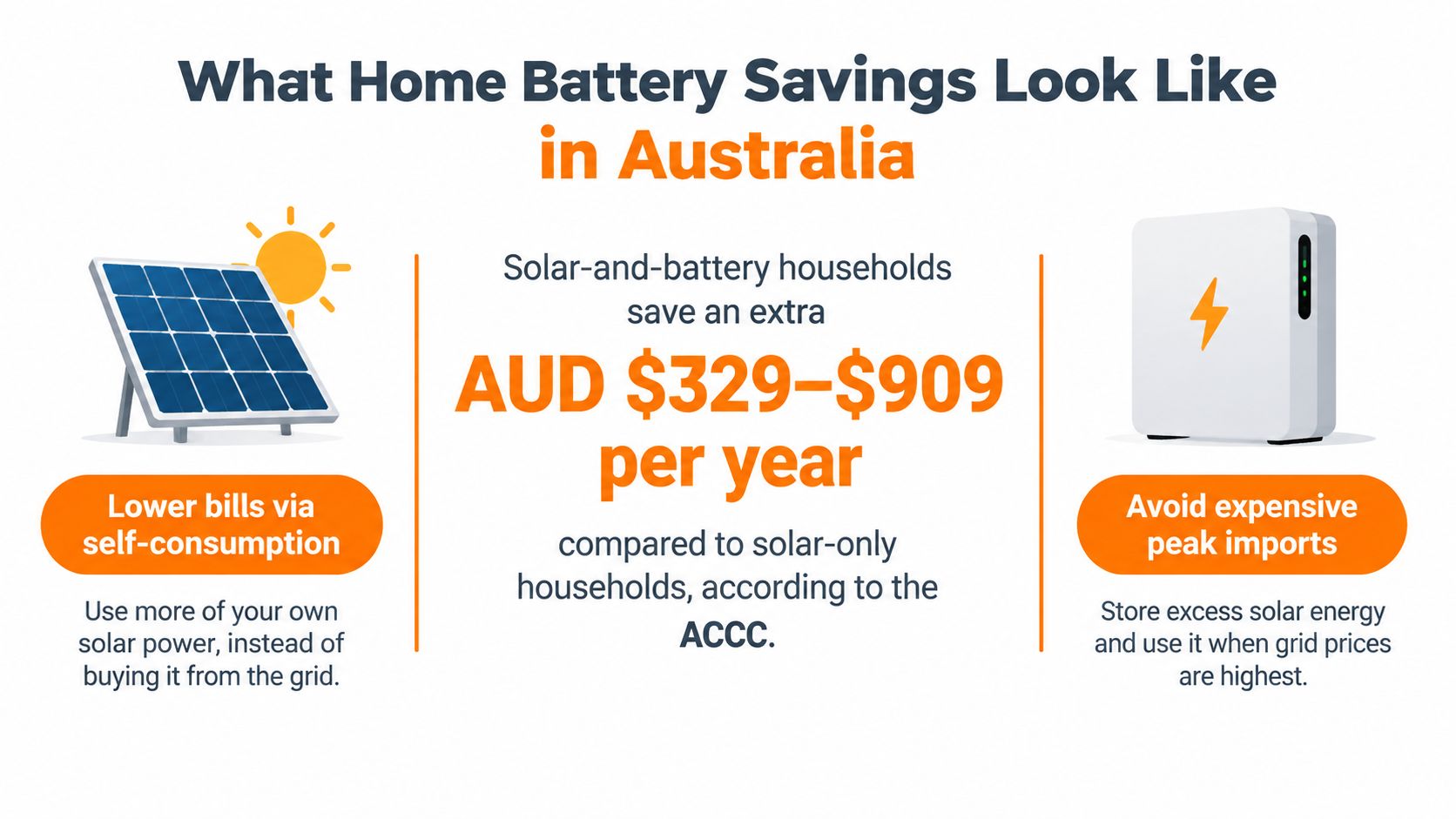
The clearest baseline comes from the ACCC. It reported that households with solar-and-battery systems paid about $329 to $909 less per year than households relying entirely on grid electricity, and that the 24% of solar-and-battery customers enrolled in VPPs generally received annual bill reductions of about $762 to $1,093, or 57% to 63%, compared with grid-only customers (ACCC). Those are real numbers, but they are not universal promises. They depend on tariff design, system size, battery dispatch and the household's evening demand.
Read the numbers the right way
A battery does not create savings by itself. It creates savings when stored solar or cheap grid energy replaces more expensive electricity later in the day. That is why the ACCC's ranges matter more than a single headline number, they show that home battery savings are measurable, but highly setup-dependent.
Independent Climate Council analysis also says pairing a battery with rooftop solar can nearly double solar-related bill savings, with potential annual electricity cost reductions of up to $2,300, depending on location, energy use, system size and retail plan (Climate Council). Treat that as an upper-range outcome, not a guarantee. The same analysis projected that two million additional household batteries by 2030 could produce more than $4 billion in combined annual bill savings nationally (Climate Council).
Practical rule: if someone gives you one annual saving figure without separating tariff value, export value and dispatch value, they're overselling the battery.
The right mental model is simple. Your battery earns money when it stops you buying expensive power and, in some cases, when it lets your battery participate in a grid programme. The rest of this article breaks those pieces apart so you can see which part of the saving is real in your home.
Self-Consumption and the Export Versus Import Price Gap
The foundation of battery value is self-consumption. That means using your own solar later in the day instead of exporting it cheaply at midday and buying it back at night at a much higher retail rate. In a CSIRO-reported Yarrabilba trial, a Queensland household said electricity costs fell by 60% after installing a battery, after previously exporting solar for about 6 cents per kWh and buying grid electricity back at about 32 cents per kWh (CSIRO).
Why the export gap does the heavy lifting
That example is the clearest way to understand the economics. If your retailer pays very little for exports and charges a lot for evening imports, storing energy is usually better than sending it away. The bigger the spread between export value and import value, the stronger the case for battery cycling.
A useful phrase here is self-consumption ratio. That is the share of your solar generation you use inside the home. A battery lifts that ratio by shifting power from midday into the evening, when households usually need it most. The more your home loads after sunset, the more value the battery can capture.
Rule of thumb: bigger evening demand usually matters more than a bigger panel array.
That's because the battery can only save what the household would otherwise have bought from the grid. If your nights are light, there's less to displace. If your household runs hard after dark, the battery has more room to work.

What to calculate on your own bill
Start with two numbers. First, your export rate. Second, your import rate during the hours you use power. The closer those two rates are, the less a battery helps. The further apart they are, the more home battery savings you can usually extract by shifting solar away from the grid and into your own home.
A battery does lose some energy in the charge and discharge process, so not every stored kilowatt-hour becomes a full kilowatt-hour of savings. That is exactly why the price gap matters so much. If the avoided import price is strong enough, the battery still wins.
For readers wanting the broader tariff context, see the explanation of net metering and solar billing mechanics. It helps you see why export value and self-consumption should never be treated as the same thing.
Time of Use Tariffs and Cycling Smarter
Time-of-use pricing changes the battery equation fast. The Queensland Government explicitly treats time-of-use tariffs as a way to shift discretionary demand, including battery charging, into cheaper periods and discharge during higher-priced periods (Queensland Government). In plain English, the battery should charge when power is cheap and discharge when it is expensive. That is where cycling adds value beyond basic self-consumption.
The AER's 2025 to 26 regulated reference prices show why timing matters. Annual residential DMO prices without controlled load were listed at about $1,965 for Ausgrid, $2,411 for Endeavour Energy, $2,741 for Essential Energy and $2,143 for Energex (Queensland Government). Those benchmark figures are a reminder that the fixed and usage components of a bill are real, and that savings have to overcome more than one cost bucket.
The free midday window changes the strategy
The AER's Solar Sharer Offer gives eligible residential customers with smart meters in NSW and South-East Queensland a three-hour zero-cost electricity period from 11 am to 2 pm, fixed in local time (AER). That matters because a battery can soak up cheap or free electricity midday, preserve rooftop solar for later, and reduce expensive evening imports. The value is in the sequence, not just the battery size.
For readers comparing charging logic, dynamic pricing strategies that boost revenue is a useful primer on how price signals change behaviour across markets. The same principle applies here, if the price moves, the battery should move with it.
If you want a clean explanation of timing windows, read when off-peak electricity actually starts. The practical point is simple, a battery that ignores tariff timing leaves money behind.
What smart cycling looks like
- Charge when the rate is low, or when solar would otherwise be exported for little value.
- Discharge during the expensive hours, especially in the evening.
- Hold some reserve, so you are not empty when the home needs power.
- Don't chase every cycle, because extra cycling can wear the battery faster.
A battery should not be cycling blindly. It should be responding to the tariff, the solar forecast and the household's own demand pattern. If the control logic cannot explain why it is charging or discharging, it probably isn't optimising much at all.
Adding VPP Credits on Top of Cycling Savings
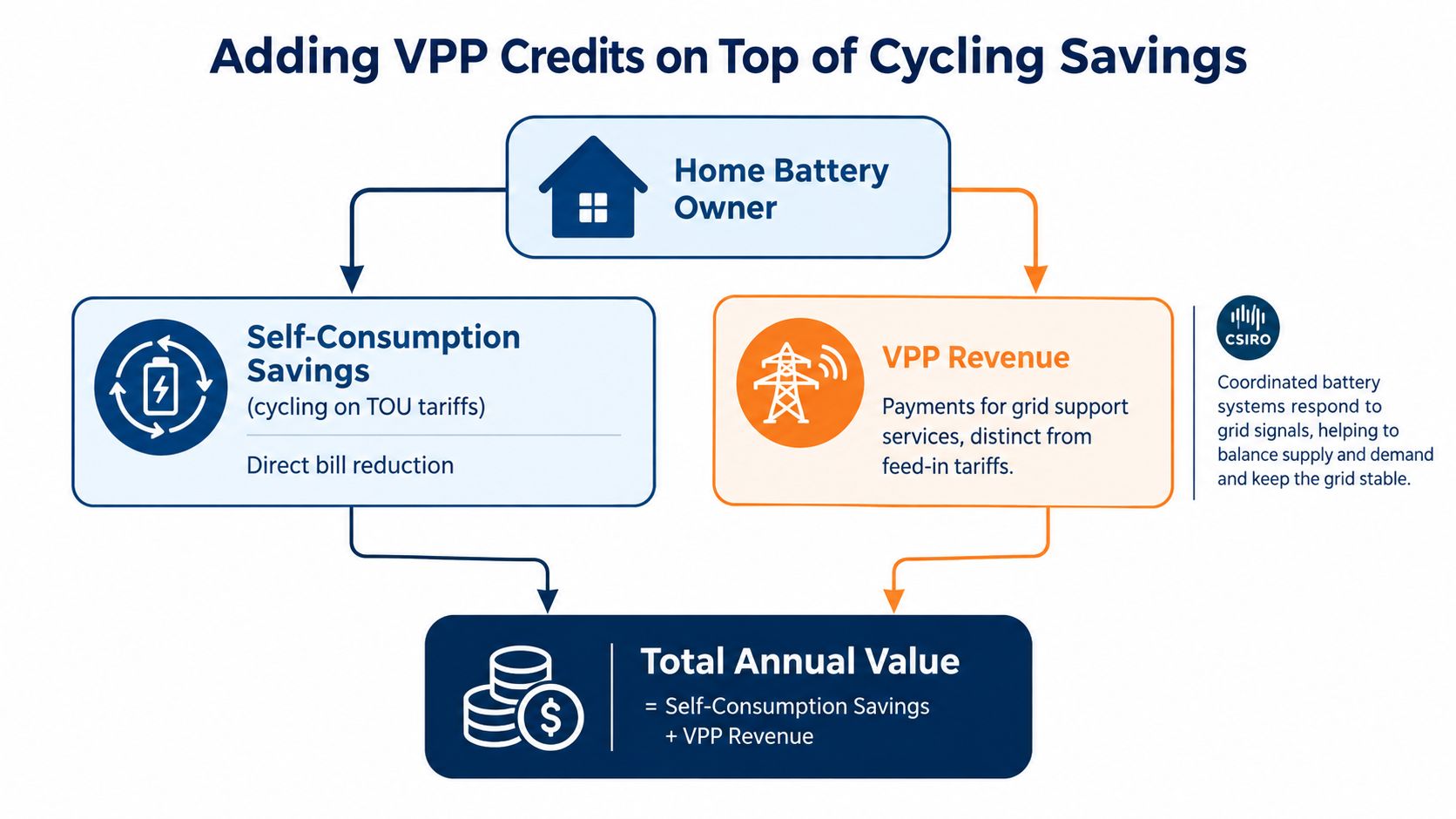
A Virtual Power Plant is coordinated battery control. CSIRO describes VPPs as coordinated battery systems that can respond to system needs, and it points to an earlier South Australian plan for a 50,000-home VPP with 250 MW of capacity and 650 MWh of storage (CSIRO). That scale is the point. A small household battery becomes part of a much larger resource when software coordinates hundreds or thousands of homes together.
What changes when the battery joins a VPP
Passive exporting and VPP dispatch are different. A normal feed-in arrangement pays a flat export value. A VPP can direct the battery to support the grid during higher-value events and pass some of that value back to the customer. That is a separate revenue stream, not a dressed-up feed-in tariff.
If you want the practical mechanics, how virtual power plants coordinate spare battery capacity explains the operating model clearly. The hard part is not the concept, it is the control trade-off. You are handing part of the battery's dispatch to an external program, so the savings depend on tariff, dispatch rules, reserve settings and how often the battery is called on.
The AEMC analysis referenced in the source material says NSW VPP participants could nearly double their benefits under modelled conditions, with an average 10-year net present value above $4,000 and a payback period just under four years. Those figures are useful only if you read the assumptions behind them. Battery size, tariff, dispatch rules, incentives and reserve settings all shape the result (CER).
Ask this first: how much control do I keep over my battery when the grid wants access to it?
That question matters more in NSW and Queensland than many sales pages admit. Extreme weather, outages and daily household routines all make reserve settings important. If the battery is dispatched too aggressively, the household loses resilience. If it is held too conservatively, the VPP leaves value on the table.
What to check before joining
- Priority household use, because the home should come first.
- Override rights, so you can stop dispatch when needed.
- Minimum state of charge, so the battery is not emptied below your comfort level.
- Dispatch transparency, so you can see when and why the battery is being used.
- Net benefit after wear, because extra cycling can reduce battery life.
The point of a VPP is not just extra revenue. It is better use of spare capacity that your battery already has. When it is set up properly, VPP credits sit on top of your self-consumption and tariff cycling savings.
Bill-Free Allowances and the Federal Battery Rebate
A battery can trim usage charges, but it will not wipe out every supply and network charge on a bill. A bill-free allowance is different. It adds a credit layer on top of battery optimisation, rather than expecting the battery alone to cover charges it cannot fully remove.
The federal battery rebate is scheduled to start at $354 per kWh of usable storage for 2025 to 26, then decline each year before ending on 31 December 2030 (The Energy). That timing matters. Delay can mean a smaller incentive later, but rushing in without checking your tariff can still leave you with a poor setup.
What the rebate example tells you
The Clean Energy Regulator's example says a 10 kWh battery installed for about $8,500 after the rebate, paired with solar larger than 7 kW, could save around $1,000 annually in Sydney, with an illustrative payback of about eight years before the rebate was introduced, down from roughly 12 years (The Energy). Treat that as a worked example, not a promise. Location, tariff, battery cost, model and night-time demand all shift the result.
The NSW Government says battery owners can save from $600 to more than $2,500 per year, with eligibility and incentive amounts varying. That range backs the same conclusion, batteries do not have one payback story.
| Federal Battery Rebate Trajectory | ||
|---|---|---|
| Year | Rebate per kWh usable | Status |
| 2025 to 26 | $354 | Available |
| 2026 to 27 | Lower than 2025 to 26 | Declining |
| 2027 to 28 | Lower than 2026 to 27 | Declining |
| 2028 to 29 | Lower than 2027 to 28 | Declining |
| 2029 to 30 | Lower than 2028 to 29 | Declining |
| 2030 ending 31 December | Ends | Final year |
Reduced bill versus bill-free
A reduced bill means you are still paying some mix of fixed and usage charges to the retailer. A bill-free structure aims to cover daily supply charges and usage up to an allowance, with grid value from the battery funding that credit. That is a different proposition. It is the only approach in this discussion that directly targets both recurring charges and consumption.
If you want full-bill coverage, do not stop at cycling savings. Ask how much of the offer comes from usage savings, how much from incentives, and how much from a dedicated allowance or credit structure. The difference is a cheaper bill versus a bill-free one.
Automated Optimisation Versus Manual Control
Manual control means the homeowner sets charge and discharge schedules, then tries to keep up with tariff changes themselves. Automated optimisation means software adjusts dispatch around live prices, forecasts and the household's own usage pattern. In practice, the choice is not about intelligence versus ignorance. It is about whether the battery is being steered by a person with a spreadsheet or by a control system that can react faster.
Only about 8% of the roughly four million Australian households with rooftop solar were storing surplus generation in a battery by 2025, despite analysis that pairing a battery with rooftop solar can nearly double solar-related bill savings (Climate Council). That low uptake tells you plenty of households still have not moved from basic ownership to active optimisation.
The real trade-off
Manual control gives you visibility. You know what the battery is doing because you told it to do it. Automated control gives you better timing, at least when the forecast and pricing data are good. A modern retailer-based service should offer both a clear app view and the ability to override.
Good service design keeps control visible. If the app can't show prices, forecasts and dispatch logic, the automation is too opaque.
The useful standard for Australian homes is straightforward. The system should charge from solar or cheap grid periods, discharge when the avoided import price is high enough, and leave room for household use during outages or weather events. If it cannot explain those choices, it is not optimising, it is merely cycling.
What to expect from a good service
- Live visibility, so you can see what the battery is doing.
- Automatic dispatch, so you're not managing every decision yourself.
- Optional override, because there will be times when the household matters more than the programme.
- Clear reserve settings, especially before storm season or heat waves.
High Flow Energy is one retailer option in this category, using a Bring Your Own Battery VPP model that coordinates spare battery capacity while prioritising household needs. The point is not that automation is magic, it's that most owners won't beat a well-designed dispatch system by hand for long.
Common Misconceptions About Battery Payback
The biggest mistake is treating battery payback like a fixed number. It isn't. A battery has multiple value streams, and each one behaves differently. If you only look at a single annual figure, you miss the difference between self-consumption value, VPP revenue, allowance value and the wear cost of extra cycling.
Another mistake is assuming a Sydney-style example applies everywhere. The Clean Energy Regulator illustration of a 10 kWh battery for about $8,500 after the rebate and around $1,000 a year in Sydney is useful, but it does not generalise neatly to every Brisbane, regional or high-load household (The Energy). Location, tariff and night-time demand change the economics fast.
The three assumptions that need to go
- One annual figure is enough. It isn't. Break the value into separate streams.
- More cycling is always better. It isn't. Extra cycles can wear the battery faster.
- A battery's job is only bill reduction. It isn't. It can also provide grid services and, in some programmes, a bill-free allowance.
Good payback analysis always includes degradation. If a battery is cycled harder for grid services, you need to account for the cost of that extra wear.
The practical result is a sharper lens. You should ask what part of the saving comes from the home itself, what part comes from the tariff, what part comes from grid participation and what part comes from a structured allowance. Once you split those pieces apart, it becomes obvious why some batteries look good on paper and underperform in real homes.
Key Takeaways and Your Next Step
Home battery savings in Australia come from four distinct value streams. Self-consumption cuts the export-versus-import gap. Time-of-use cycling improves the spread further. VPP credits add grid-service revenue. A bill-free allowance is the only layer that can directly tackle daily supply and network charges.
Before you judge your own battery, check four things. Your export rate versus your import rate. Your time-of-use tariff. Your evening demand profile. And how much of any offer comes from usage savings, incentive value or grid-service revenue. That's the only way to know whether your battery is earning its keep.
Most battery owners focus on installation quality. Far fewer focus on ongoing performance and optimisation. High Flow Energy is an electricity retailer built around drawing out the value of existing solar and battery systems, so the next sensible move is an eligibility assessment that shows where your savings are really coming from.
Most battery owners focus on installation quality. Far fewer focus on ongoing performance and optimisation. High Flow Energy is an electricity retailer built around drawing full value from your existing solar and battery system. If you want to understand whether your battery is underperforming financially, visit High Flow Energy and request an eligibility assessment.