

Energy Independence Home: What It Really Means
If your rooftop solar exports plenty of power at midday but your home still buys expensive electricity after dark, are you energy independent? That gap sits at the centre of most energy independence home decisions in Australia. Generating a lot over a year isn't the same as having power available when your family cooks, cools the house, or charges a car. Once you understand that timing problem, the role of a battery, a Virtual Power Plant, and your retailer becomes much clearer and far easier to judge.
What Home Energy Independence Really Means
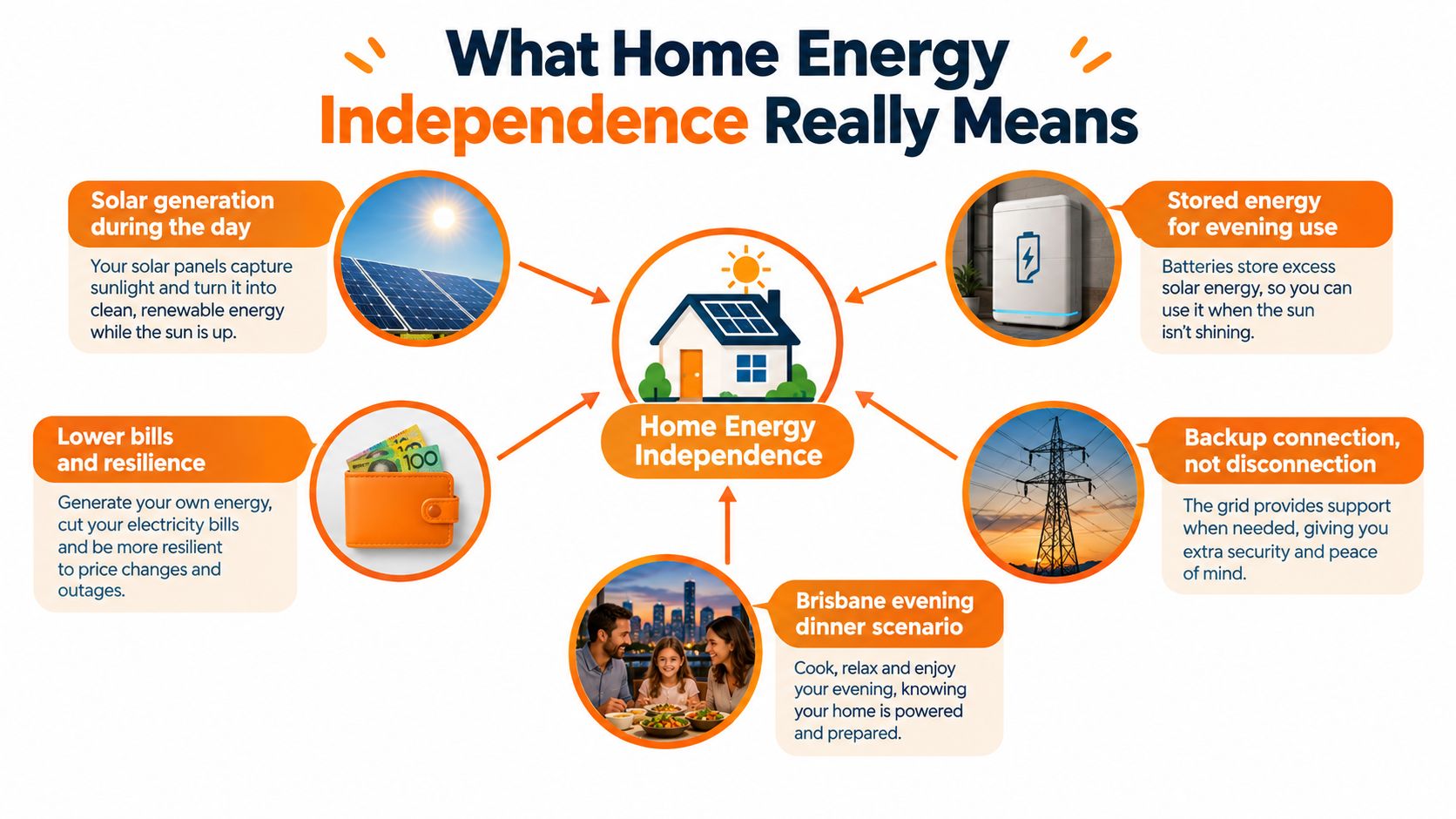
A Brisbane family is cooking dinner at 6.30 pm. The air conditioner is still running, the oven is on, and the sun has largely left the roof. Their battery, charged from surplus solar earlier, supplies the house instead of the grid.
That ordinary evening captures home energy independence better than any slogan. It doesn't mean cutting the cable to the street. It means reducing reliance on grid purchases by generating, storing, and using your own electricity in a smarter order.
The visual below maps how those pieces fit together for a connected home.
A Spectrum, Not a Switch
Think of independence as a dimmer, not an on or off switch. At one end, a solar only home uses some power directly and exports the rest. Further along, a battery shifts that surplus into the evening, and a well run Bring Your Own Battery arrangement can share spare capacity with the grid without leaving the household short.
Even highly self sufficient homes usually stay connected. The grid still provides backup on cloudy stretches, a path for exports, and reliability when household demand exceeds what panels and a battery can supply at that moment.
Energy available at the moment you need it matters more than a large annual generation total.
Good design reinforces that idea beyond the switchboard. If you're thinking about the building itself, Hutter Architects' self-sustaining home advice is a useful starting point for how layout and efficiency reduce demand before you try to supply it.
- Generate in daylight: Rooftop panels supply the home first while the sun is up.
- Store the surplus: A battery saves what you'd otherwise export for little value.
- Stay connected: The grid remains your safety net, not your default supplier.
Independence, in this practical sense, is control over timing. You decide, through your settings and your contract, whose needs come first when stored energy is limited.
The Scale of Solar and Battery Adoption in Australia
Australia isn't experimenting with rooftop solar any more. It's operating it at national scale, and Queensland and New South Wales sit at the centre of that shift.
By June 2024, the country had 3,853,965 small-scale generation units representing 23,650 megawatts of cumulative rooftop-solar capacity, according to figures compiled in the Australian Energy Council Solar Report for Q2 2024. In the second half of 2024, rooftop solar generated 12.4% of the country's electricity, compared with 11.2% in 2023 and 6.5% in 2020, based on data in the Clean Energy Council rooftop solar and storage report for July to December 2024.
Two States, Two Milestones
Queensland passed one million rooftop photovoltaic installations in 2023, the first Australian state to reach that milestone, as reported in the Australian Energy Council solar report material. New South Wales followed after adding 454 megawatts in the first half of 2024, a figure also covered in that report series.
Solar and Battery Adoption by State
| Metric | Queensland | New South Wales |
|---|---|---|
| Rooftop installations or capacity by end of 2024 | About 1.1 million installations | Approximately 7.1 gigawatts capacity |
| Battery sales, second half of 2024 | 8,555 units | 14,686 units |
| Battery equipped small generation installations, first half of 2024 | 1,855 | 3,043 |
Those state figures come from the Clean Energy Council report linked above, which also counted the first half battery equipped installations. Read together, they show solar as the mature base and batteries as the faster growing second stage.
Batteries Are Growing From a Smaller Base
Nationally, nearly 75,000 home-battery units were sold in 2024, compared with 46,127 in 2023, bringing the estimated installed total to 185,798 units, according to the Clean Energy Council report linked above. In the second half of 2024 alone, more than 45,000 batteries were sold, and 28.4% of new rooftop-solar installations included a small-scale battery, from the same report.
That matters because a battery changes what solar is worth to you. Without storage, surplus midday power leaves the house during low value periods. With storage, you keep part of it for the evening peak, when your demand and grid prices are typically higher.
How Rooftop Solar and Batteries Work Together
Solar panels and a home battery solve different halves of the same problem. Panels make electricity, but they can't move it in time. A battery can.
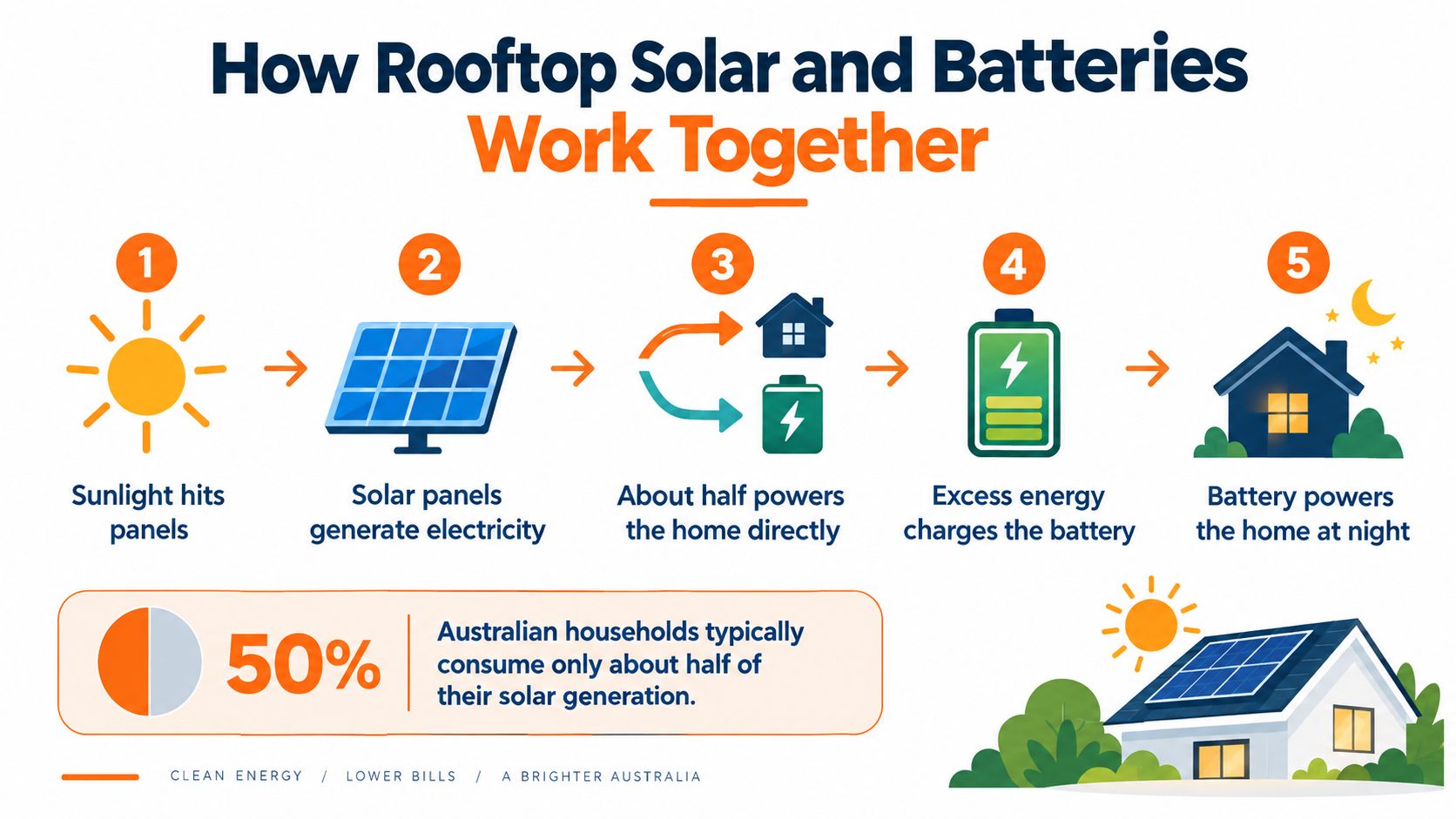
The process diagram below shows that handover from generation to evening use.
The Midday Mismatch
Australian households typically consume only about 50% of the electricity generated by their rooftop solar systems, with the remainder exported to the grid, as set out in the AEMC report on Australia's evolving energy consumer. Solar output peaks around midday, while household demand commonly rises in the early morning and evening.
A battery narrows that gap step by step.
- Panels supply the home first: Fridges, daytime air conditioning, and appliances use solar directly.
- Surplus charges the battery: Power you don't need at noon is stored instead of exported.
- The battery discharges later: Stored energy covers cooking, lighting, and entertainment after sunset.
- The grid fills any shortfall: You import only what the first three steps can't cover.
In the AEMC representative profile in that report, a household directly consumed 7.3 kWh of solar per day and used a further 11.6 kWh per day from battery-deferred solar, while daily grid imports fell to 3.3 kWh. That's the clearest plain English definition of battery optimisation, using the same solar twice as effectively by changing when it's consumed.
Practical roof decisions affect how well this works, from panel placement to future access for maintenance. Homeowners researching adding solar panels to your roof can use that guide to understand the roofing side before they focus on storage settings.
Shift Flexible Loads Into Daylight
You can also help the battery by moving flexible demand into solar hours.
- Pool pumps and hot water: Run them late morning so they don't drain the battery at night.
- Dishwashers and laundry: Timers let midday solar do this work for free.
- EV charging: A daytime top up preserves stored energy for the house.
If you're weighing system configurations, this overview of how a hybrid solar system works explains how panels, battery, and grid connection interact.
The short video below walks through the same daily cycle visually.
The core control rule stays simple. Cover household load first, then consider exports or grid services with what's spare.
Battery Operating Modes and the VPP Trade-Off
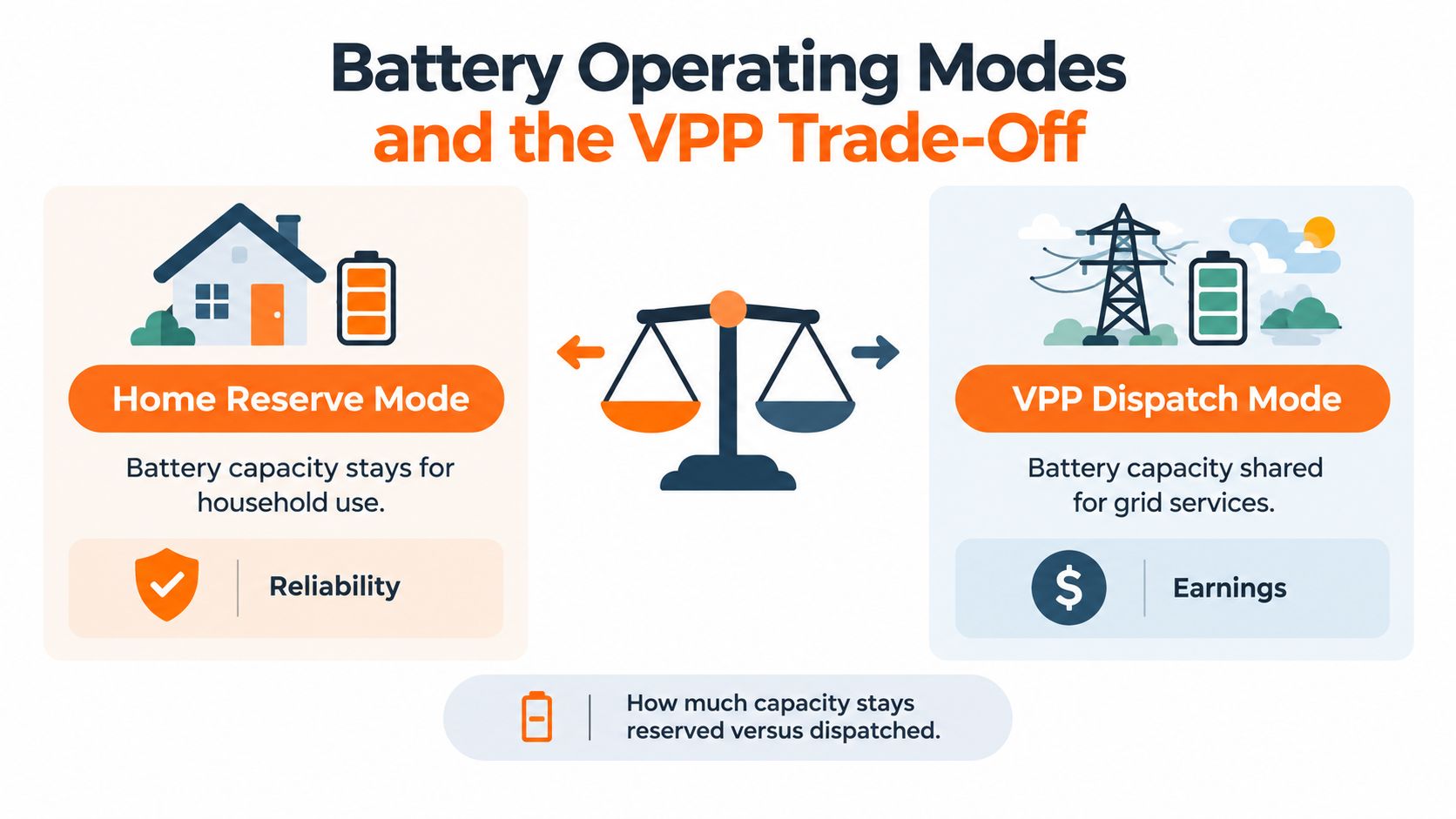
Here's the question most marketing skips. How much of your battery should stay reserved for your home, and how much can someone else dispatch to support the grid?
The comparison below frames that balance between reliability at home and earnings from shared capacity.
Three Modes, Three Priorities
Australian government guidance defines a Virtual Power Plant (VPP) as a coordinated network of behind-the-meter solar and battery systems that operates like a single power source, as explained on the Australian Government page on batteries. Smart software links the individual systems, so the fleet can store energy when supply is plentiful and discharge when the grid needs support.
Your battery can be set up to favour different goals on different days.
Battery Operating Modes Compared
| Mode | Primary Goal | Trade-Off |
|---|---|---|
| Bill minimisation | Use stored solar to avoid buying grid power in expensive periods | Less energy held back if an outage or cloudy evening follows |
| Backup reserve | Keep a protected minimum state of charge for the home | Less capacity available to cut bills or earn from dispatch |
| VPP participation | Share spare capacity for coordinated grid support | An event before your evening peak can leave you buying power later |
None of these modes is automatically right. A household with medical equipment or frequent outages will value reserve differently from a household focused on electricity bill reduction under a time-of-use tariff.
Practical rule: Dispatch only the capacity above your household reserve, never the reserve itself.
That hierarchy is the contrarian point homeowners need to grasp. Exporting or discharging more energy doesn't automatically make you more independent. If a VPP event empties your battery at 5 pm and you import grid power all evening, your annual throughput looks impressive while your actual independence falls.
Questions That Reveal the Real Offer
Before joining any BYOB VPP, ask the operator to answer these points in writing.
- Reserve protection: What's the minimum state of charge, and can you change it?
- Override rights: Can you opt out of an event on a cloudy day or before guests arrive?
- Dispatch limits: How often, at what depth, and at what times can your battery be used?
- Reporting: Will you see what was dispatched, what you earned, and what you later imported?
For a plain English explanation of how coordinated dispatch is structured, see this guide to a solar battery virtual power plant. Judge any offer by its control settings first and its headline rewards second.
Costs, Payback, and the Financial Case for Batteries
A battery earns its keep mainly by stopping purchases, not by selling power. That distinction helps you read savings claims with a cooler head.
The Australian Competition and Consumer Commission reported a median annual residential bill of $1,565 for regular users in 2023-24, compared with approximately $1,279 for households with rooftop solar and $936 for households with both solar and a battery, in its media release on growing home battery uptake. The solar and battery figure is about 40% lower than the regular-user median, based on that same ACCC release.
The summary visual below places those bill differences in context.
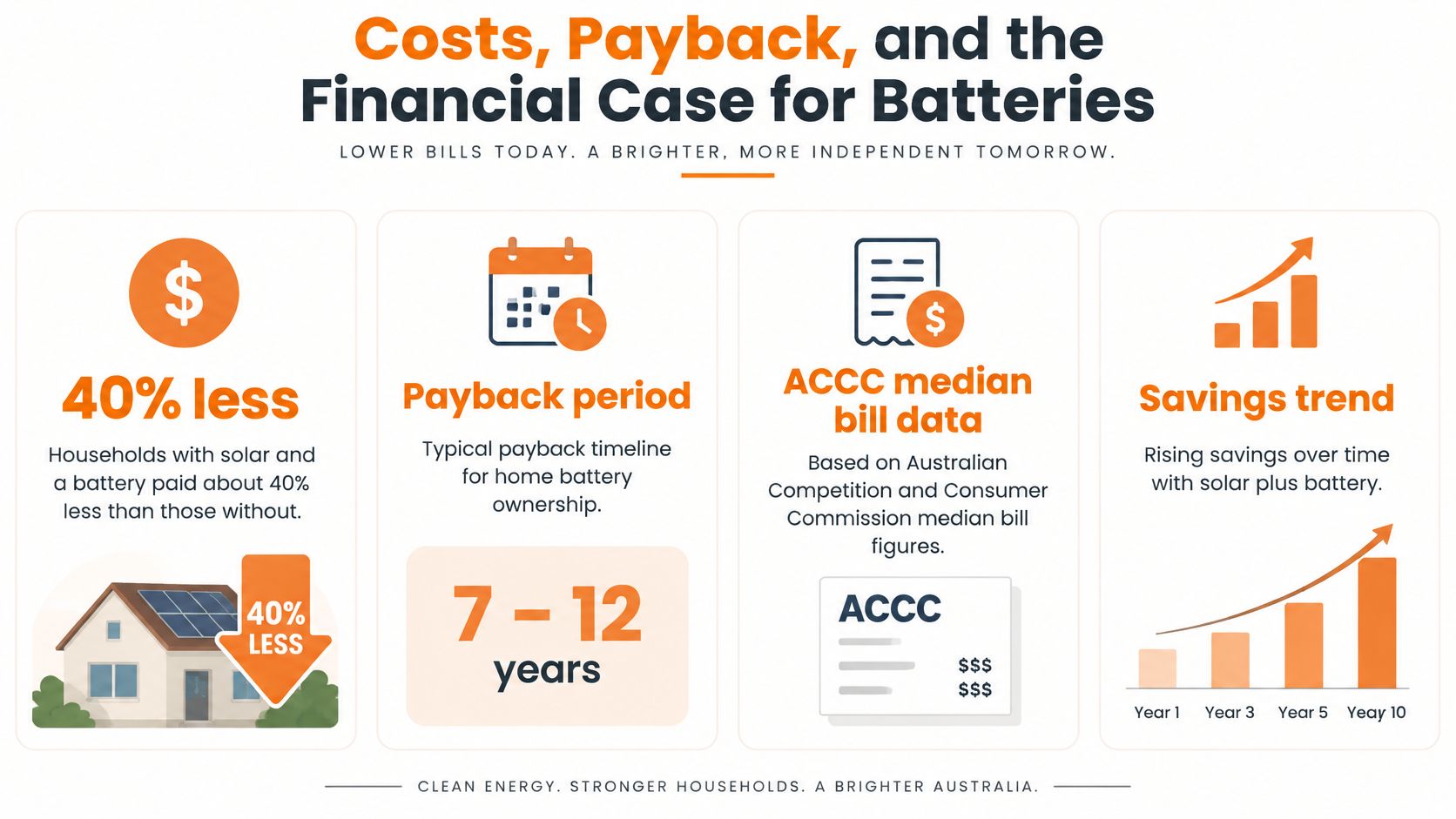
Median Annual Residential Electricity Bills
| Household Type | Median Annual Bill |
|---|---|
| Regular grid dependent user | $1,565 |
| Rooftop solar only | Approximately $1,279 |
| Solar and battery | $936 |
| VPP participant | Approximately $580 |
Households participating in a VPP recorded a median bill of approximately $580, or about 63% below the regular-user median, according to the ACCC release linked above. Treat those as market wide medians, not a promise for your address. Your result depends on consumption patterns, tariff structure, system size, export limits, and how intelligently the battery is scheduled.
Where the Savings Actually Come From
Independent consumer research described in the AEMO forecast material identifies avoided grid-consumption charges, not VPP income, as the dominant driver of bill savings for both VPP and non-VPP households, as summarised in the AEMO distributed PV and batteries VPP forecast report. In other words, using your own stored solar at 7 pm usually matters more than any event payment.
Running your own numbers helps, even with a simple tool. An Arizona energy efficiency calculator from a heating and cooling provider shows the basic method of comparing consumption before and after an efficiency change, which you can adapt using your Australian bill data.
For the local maths, this breakdown of solar battery payback works through how usage and tariffs change the result. Payback improves when the battery cycles purposefully against your expensive hours, not because it's installed.
QLD and NSW Policy and VPP Eligibility Requirements
Policy settings now assume your battery can talk to the grid, even if you never join a program. Understanding that requirement protects you from buying hardware that can't participate later.
What VPP Capability Actually Means
The Clean Energy Regulator states that a grid-connected battery must be technically capable of participating in a VPP for the relevant eligibility pathway, and where a battery connects to an existing solar system, the inverter must also be capable, as set out on the Clean Energy Regulator page for solar batteries. The regulator describes a VPP as small, distributed resources linked and controlled by smart software so they behave like a single power plant.
Capability is therefore a technical test, not a brochure label. Your battery and inverter need the communications and control functions that allow coordinated dispatch, within your network connection agreement and export limits.
The Cheaper Home Batteries Program specifies eligible batteries in the 5 to 100 kWh nominal-capacity range and requires compliance with AS/NZS 5139:2019 and applicable state electrical-safety laws, based on program details summarised in the Australian Energy Council report material cited earlier. From 1 July 2025, eligible on-grid systems under that program must have VPP capability, as noted in Australian Government guidance on how solar and batteries reduce bills.
State Guidance in Plain English
Queensland and New South Wales guidance describes the same household trade-off. The operator may discharge stored energy when demand or prices are high, while you receive a payment, bill credit, or a different energy deal, as summarised in state government guidance on home batteries.
Before you sign anything, work through this checklist.
- Hardware check: Confirm your exact battery model and inverter configuration support remote control.
- Connection check: Verify your export limit and network approval with your distributor.
- Contract check: Identify reserve settings, dispatch windows, compensation method, and exit conditions.
- Compliance check: Confirm the installation meets the standard and state safety laws named above.
An off-grid system must generally be within 1 kilometre of the grid for the relevant eligibility pathway, according to the Clean Energy Regulator page linked above. Most suburban homes in Brisbane, the Gold Coast, Sydney, or Newcastle won't face that issue, but rural owners should confirm it early.
Common Misconceptions About Energy Independence
Several popular beliefs sound logical and lead homeowners astray. Testing them against how batteries behave saves money and frustration.
Exporting More Means I'm More Independent
It doesn't. Exports measure what left your house, not what was available when you needed it. A home can export heavily at noon, import heavily at night, and remain highly exposed to evening prices and supply charges.
Independence is better measured at your hardest hours. Ask how much of your evening and early morning demand your system covers across cloudy weeks, not just on a perfect summer day.
Joining a VPP Means Surrendering Control
A well structured Virtual Power Plant Australia program keeps household priority at the top of the control stack. The contract should define your reserve, your override rights, and the share of capacity the operator may use. If those protections aren't clear, the problem is that specific offer, not the VPP concept itself.
Reluctance is understandable. AEMO projects VPP participation at only 15% of consumer battery installations in 2026, rising as a projection to 24% by 2035 under its Step Change scenario, according to the AEMO forecast report cited earlier. Limited market data at this early stage makes it hard for owners to verify promised value.
Transparency after each event builds more trust than a large reward promised before it.
A Bigger Battery Automatically Fixes Everything
Oversized storage that rarely cycles can be poor value, while a modest battery scheduled against your peak tariff can perform strongly. Size matters, but control logic matters more. Forecasts for solar generation, weather, evening demand, and battery temperature all shape whether stored energy is there when it counts.
Key Takeaways and Your Next Steps
Home energy independence isn't disconnection, and it isn't an annual export total. It's having stored energy available at the hours your household needs it, with the grid as backup rather than default.
Key Takeaways
- Timing beats volume: Shifting midday solar into the evening is where most household value sits.
- Reserve comes first: Bill savings and VPP dispatch should use only capacity above your protected minimum.
- Avoided purchases lead: Not buying grid power usually contributes more than grid service payments.
- Contracts decide control: Reserve settings, overrides, reporting, and exit terms matter as much as hardware.
A Simple Self Assessment
Start with your last few bills and your inverter app. Look at how much you import after sunset, how often your battery sits partly full overnight, and whether flexible loads still run in the evening. Those three checks quickly reveal whether your asset is underutilised.
Next, compare your current retailer arrangement with a retailer-based VPP that prioritises household use. One option available to existing solar and battery owners in Queensland and New South Wales connects a compatible battery to a coordinated program while the household retains priority access and can review performance through an app. Assess it the same way you'd assess any offer, against reserve, transparency, and exit conditions.
Most battery owners focus on installation quality. Far fewer focus on ongoing performance and optimisation. If you'd like to understand whether your battery is underperforming financially, request an eligibility assessment and review your current settings before another summer peak arrives.
If you already own solar and a compatible battery in Queensland or New South Wales, HighFlow Energy can assess whether your spare capacity could support the grid while your household reserve stays protected. Its Bring Your Own Battery program is built around transparent monitoring and household priority, so you can judge performance on evidence rather than promises. Visit the site to check your eligibility and see whether your existing system could be working harder for you.