

VPP Battery Requirements in Australia: What Qualifies
The advice to buy a VPP-ready battery and sort out enrolment later misses the most important part. Battery requirements aren't satisfied by storage capacity alone. Your hardware, electricity connection and retailer arrangement must each support the intended operation, and passing one check doesn't automatically clear the others.
For Queensland and New South Wales homeowners with solar and storage already installed, the practical question is whether the complete system can participate safely, preserve household priorities and deliver value under transparent electricity terms.
Why Battery Requirements Are About More Than Storage
Owning a VPP-ready battery doesn't mean you're participating in a Virtual Power Plant, or VPP. A VPP coordinates connected batteries so that available stored energy can respond to household needs and grid-service instructions.
The scale of the opportunity shouldn't be confused with universal readiness. Australia had about four million rooftop-solar households in 2024, but only around 4.5% had an accompanying battery, according to Clean Energy Council reporting on rooftop solar and storage.
The separate checks that matter
- Hardware capability establishes whether the battery and inverter can communicate with an external operator and respond to instructions.
- Network eligibility establishes whether the connection permits the proposed operation, including applicable export controls.
- Active participation requires compatible retail terms, enrolment and permission to operate the battery within agreed limits.
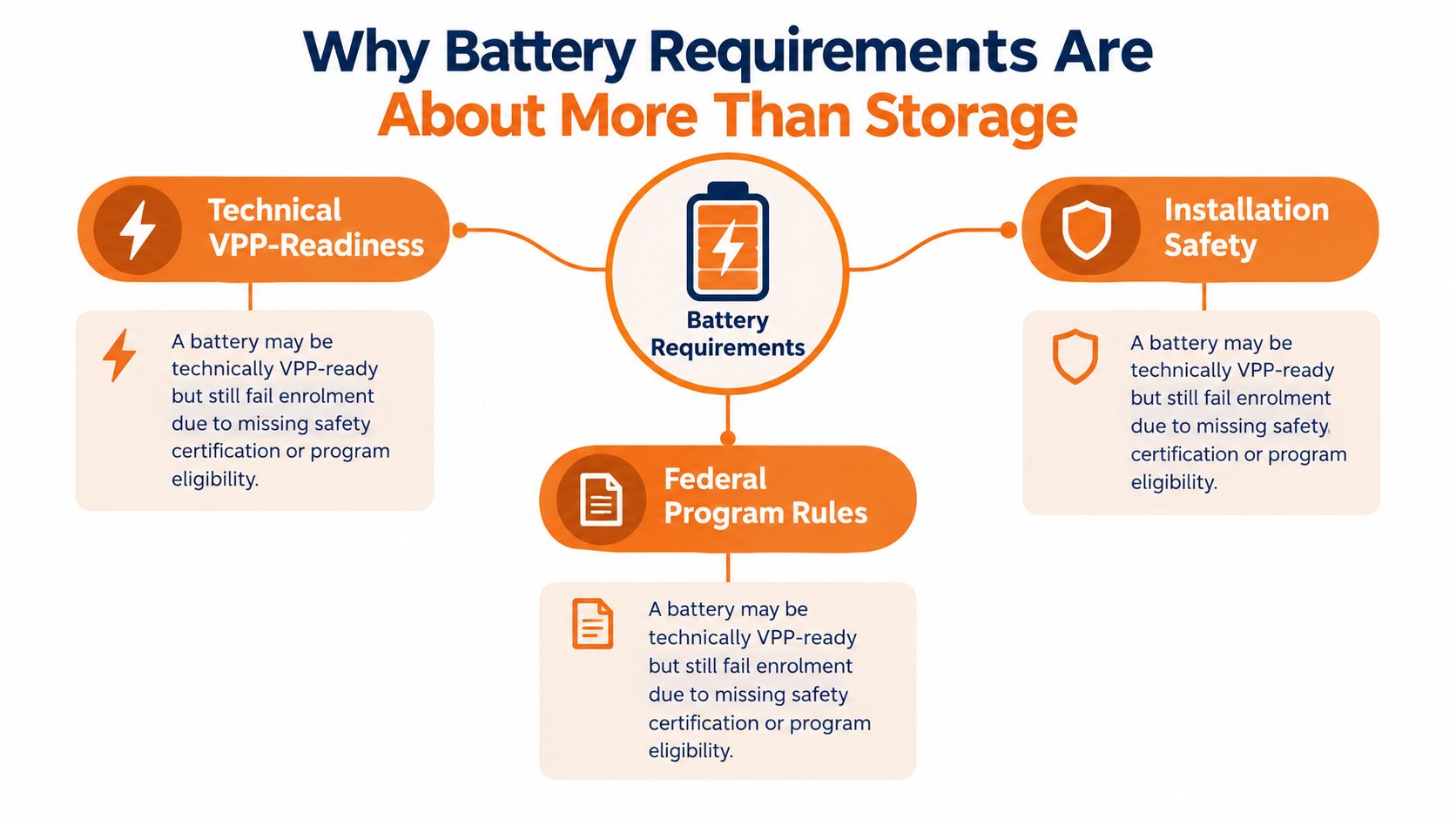
Installation safety underpins all of them. The following diagram shows how technical readiness, safe installation and federal program rules interact.
A Bring Your Own Battery, or BYOB VPP, starts with an existing asset rather than a new equipment purchase. The assessment should therefore examine what your system can do now, not what its original brochure promised.
Practical rule: Ask for separate confirmation of hardware compatibility, distributor permission and retailer acceptance. A single “VPP-ready” label isn't an enrolment decision.
Financial assessment also needs a broader lens than battery size. For readers comparing household and commercial evaluation methods, E & I Sales' storage ROI analysis for facilities provides a separate storage-investment resource. Australian residential eligibility must still be checked against the federal, state and retailer requirements that apply to the premises.
Installation and Safety Standards Under AS/NZS 5139
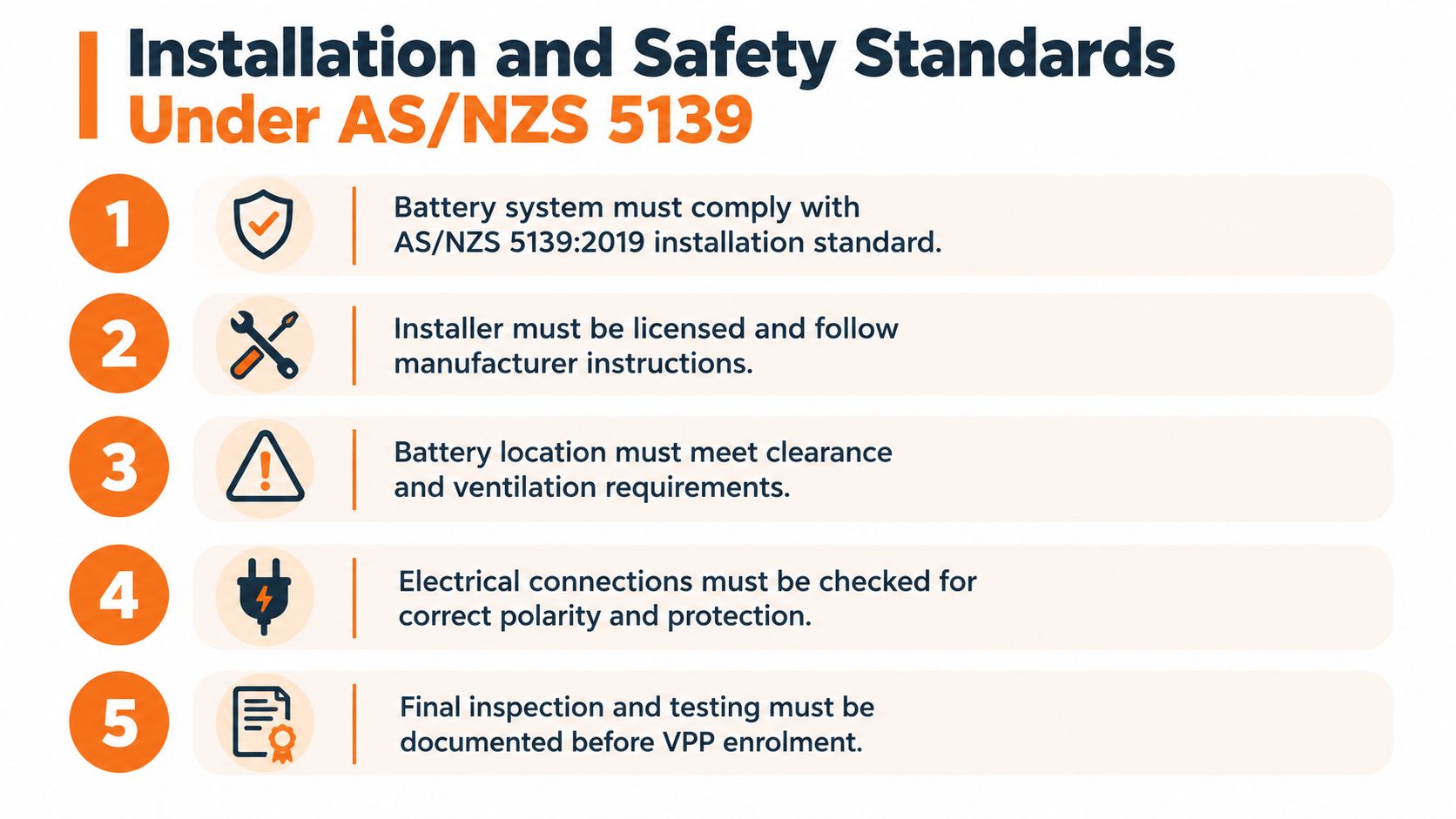
Remote operation shouldn't begin with a software compatibility test. It should begin with evidence that the existing installation is safe and compliant.
The essential checks cover the whole installed system, not just the battery enclosure.
Check the location and electrical installation
AS/NZS 5139:2019 is the core reference for battery systems connected to power-conversion equipment, covering nominal voltages from 12 V DC to 1,500 V DC. Common siting checks include 600 mm horizontal clearance from exits, windows, habitable-room ventilation openings and unrelated appliances, plus 900 mm clearance below those features; a suitably non-combustible barrier may be needed where a battery is mounted on or within 300 mm of a wall adjoining a habitable room, as explained in YourHome's battery installation guidance.
That guidance also identifies licensed electrical work and Solar Accreditation Australia accreditation as important installation and maintenance requirements. Treat the published clearances as screening checks, not permission to assess or relocate equipment yourself.
Ask the installer to verify:
- Electrical protection and isolation, including the inverter, earthing and emergency shutdown arrangements.
- Access and enclosure condition, so inspection and maintenance remain practical.
- Compliance documentation, including any changes made since initial commissioning.
For a homeowner-focused explanation, review solar battery safety considerations alongside the installer's site-specific advice.
The accompanying video offers additional viewing material for the safety review.
A battery that worked under its original settings still needs review if the system has been modified. Missing documentation or inaccessible equipment can complicate commissioning, insurance enquiries and service availability.
Don't open enclosures or alter wiring to prepare for enrolment. Refer physical defects and electrical questions to an appropriately licensed and accredited professional, and confirm the applicable requirements whenever the installation changes.
Federal Program Rules for VPP Capability
Federal program eligibility establishes a technical baseline. It doesn't establish a household's commercial return.
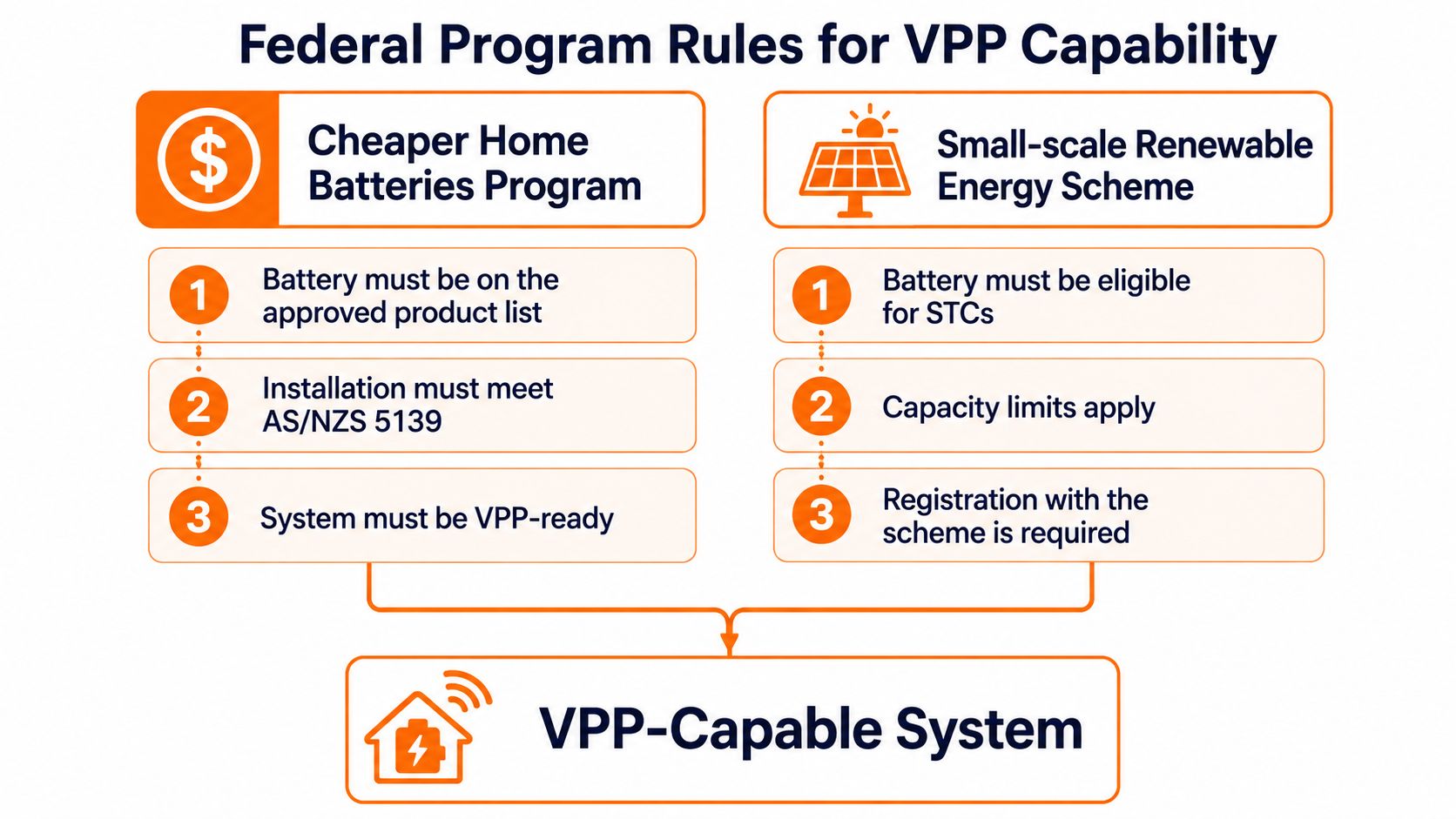
The Cheaper Home Batteries Program and the Small-scale Renewable Energy Scheme, or SRES, should be read together rather than treated as unrelated offers.
Product approval and communications capability
Eligible federal battery systems generally fall between 5 kWh and 100 kWh nominal capacity. The battery and inverter must appear on the relevant Clean Energy Council approved product lists at installation, and an eligible on-grid inverter must connect to external entities and receive and respond to remote signals through an appropriate communications protocol, under the Cheaper Home Batteries Program eligibility requirements.
A communications protocol is the agreed method devices use to exchange instructions. Approval of a product doesn't establish compatibility with every operator's control platform.
Installation must also be performed by, or under the on-site supervision of, a Solar Accreditation Australia-accredited battery installer. Product approval and installer accreditation are separate checks.
Capability isn't compulsory participation
For on-grid battery Small-scale Technology Certificate, or STC, eligibility, the battery and inverter must be VPP-capable when installed. Actual participation remains optional, ongoing internet is required for participation, and off-grid systems more than 1 kilometre from the grid are exempt from the capability requirement, according to the Clean Energy Regulator's VPP guidance.
A subsidy can support eligible hardware without committing its owner to a VPP contract.
Some installations may need additional hardware, software or site-controller access before a particular operator can communicate with them. Existing owners should obtain an operator-specific compatibility decision rather than rely on federal product approval alone.
Use the Australian solar battery rebate guide to orient the rebate enquiry, then verify the current official rules. Rebate eligibility, technical compatibility and ongoing operating value remain different decisions.
Queensland Dynamic Connection Requirements
Queensland homeowners need to establish their connection arrangement before assuming a compatible battery can export under VPP instructions.
The Queensland Government identifies a dynamic electricity connection as a requirement for VPP participation. This arrangement allows operating limits or export behaviour to change in response to network conditions, as described in the Queensland battery buyer's guide.
Prepare the distributor enquiry
A dynamic connection concerns what the network permits, not whether the battery has internet access. Prepare the following information for the distributor and prospective operator:
- Premises details, including distributor and National Metering Identifier, or NMI.
- Inverter identity, including model, firmware version and approval information.
- Battery specifications, including model, usable energy capacity and maximum continuous charging and discharging power.
- Connection configuration, including phase arrangement, existing export limit and supported control mode.
- Installation evidence, including electrical compliance records and communications availability.
Firmware is the software running inside the inverter. Record its version because the operator needs to assess the installed configuration, not just the product family.
The distinction between energy and power matters here. Usable capacity describes how much energy is available; continuous charge and discharge power describes how quickly the system can move it. A storage-capacity label alone can't answer both questions.
Obtain written confirmation before switching
Ask whether your existing connection supports the proposed operation and whether any approval or configuration change is needed. The solar inverter installation guide can help frame equipment questions, but the distributor must confirm the connection requirements.
Don't substitute a retailer's compatibility answer for network approval. Equally, distributor acceptance doesn't establish that an operator supports your inverter.
NSW households need their own distributor review. They shouldn't assume Queensland's dynamic-connection process applies unchanged across the border.
NSW VPP Incentive Eligibility Rules
The NSW incentive is a separate eligibility enquiry, not a substitute for network permission or a suitable retail contract.
Under the published rules, batteries from 2 kWh to 50 kWh may qualify, with the incentive calculation capped at 28 kWh of capacity made available to the grid. Participation requires a grid-connected battery, an approved VPP provider and a supporting electricity retailer, and the incentive can be claimed once per NMI, according to the NSW Government's VPP incentive eligibility information.
Separate the capacity measures
| Capacity measure | What it tells you |
|---|---|
| Nominal capacity | The battery's stated storage size |
| Usable capacity | Energy available within its permitted operating range |
| Capacity offered to the VPP | The portion available under the participation arrangement after relevant household protections |
These measures aren't interchangeable. Ask the provider to identify which capacity it uses for eligibility and which it uses for the incentive calculation.
A household reserve can reduce the energy available for dispatch. That isn't necessarily poor performance: retaining stored energy for evening consumption or backup may be more important to the owner than maximising grid-service availability.
Confirm the premises and provider
The NMI identifies the electricity-metering point for the premises. Check the incentive claim history and provider approval before assuming an existing battery qualifies for another payment.
A battery disconnected from the grid can't join a VPP under these rules. For a connected installation, retailer support remains necessary even when the capacity requirement is satisfied.
Queensland's connection requirement and the NSW incentive answer different questions. One addresses permitted network operation; the other governs a state incentive. Neither replaces federal checks where relevant, and neither guarantees bill savings.
Comparing the Three Eligibility Gates Side by Side
Three Eligibility Gates for a BYOB VPP in Australia
| Criteria | VPP-capable hardware | Dynamic-connection eligibility | Active VPP participation |
|---|---|---|---|
| Main question | Can the equipment respond? | Does the connection permit operation? | Has the household agreed to compatible operation? |
| Governing reference | Federal program and product rules | Distributor requirements, including Queensland's process | Operator eligibility and retailer terms |
| Capacity assessment | Relevant program limits | Energy and power characteristics for connection review | Spare usable capacity and household reserve |
| Inverter assessment | Approved products and communications | Approved connection configuration | Operator-supported model and firmware |
| Internet role | Assess communications readiness | Confirm required control communications | Maintain the required operational connection |
| Retailer role | Doesn't establish universal compatibility | Can't replace distributor approval | Defines tariffs, payments and operating terms |
| Outcome | Technical readiness | Permission within network limits | Coordinated operation under contract |
Compare financial structures separately
A traditional feed-in tariff enquiry focuses on export credits. A retailer-based VPP comparison must also examine how battery operation, import charges, grid-service value and any allowance interact.
Don't treat advertised wholesale opportunities as household revenue. Ask how the contract handles National Electricity Market price volatility, demand events and network congestion, and whether the customer bears any wholesale exposure. An operator's ability to respond to a price signal doesn't establish what appears on your bill.
Commercial test: Compare the complete electricity arrangement, not an isolated export rate or VPP payment.
Request an explanation of time-of-use charging, discharge priorities and settlement during peak pricing periods. Check whether grid-service payments replace or accompany export credits.
The useful comparison is between your present electricity costs and the proposed arrangement after fees, reserves, cycling and operating restrictions. A conventional retail offer without coordinated battery optimisation shouldn't be assumed to deliver the same service as a retailer-based VPP.
Pre-Enrolment Checklist for a BYOB VPP
Collect evidence before authorising control. This checklist turns an eligibility conversation into a documented assessment.
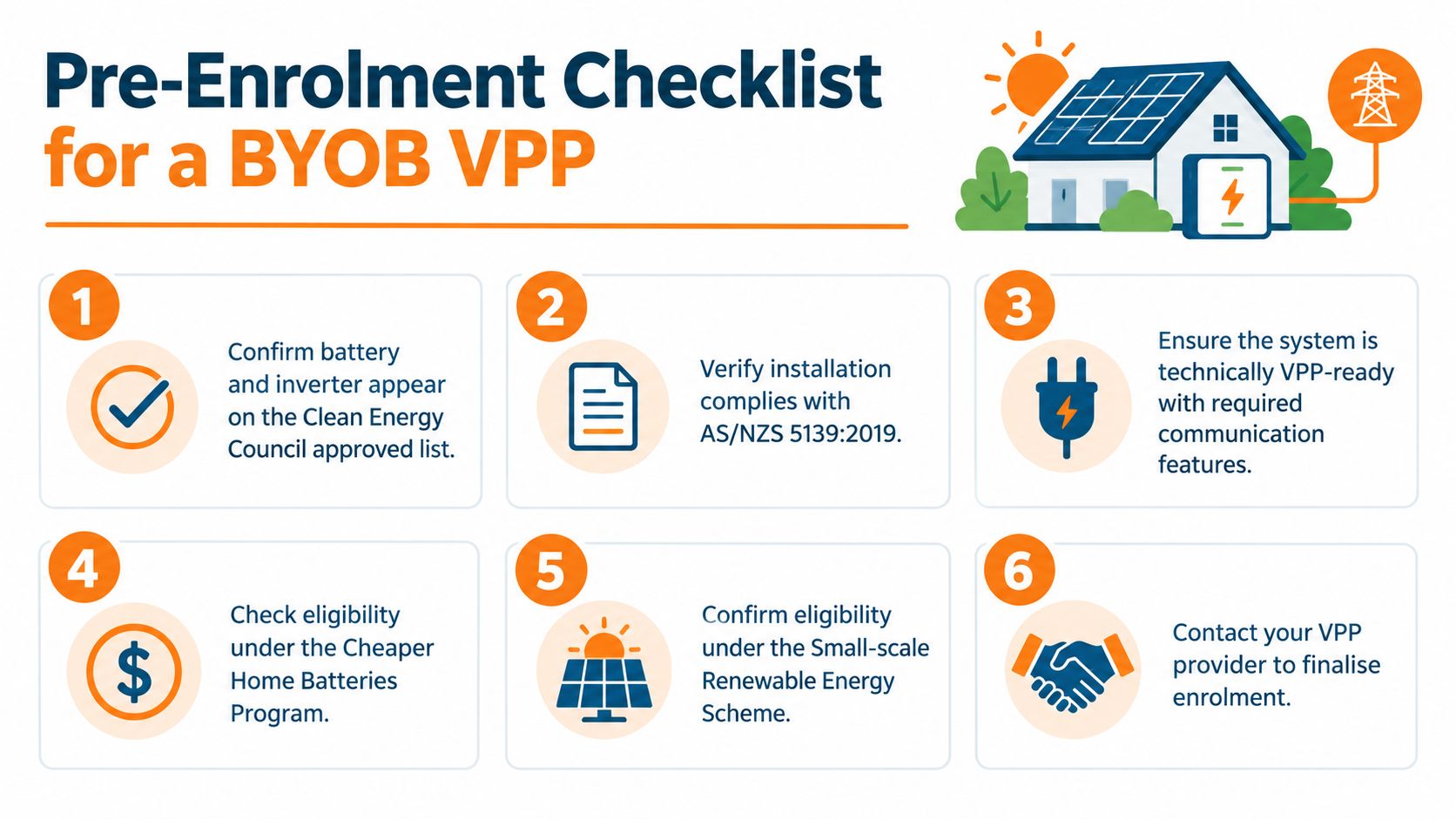
- Record approved products and installation evidence. Identify the exact battery and inverter, not just the brand. Verification authority: relevant approved product lists and installer documentation.
- Check communication support. Confirm external signalling, protocol compatibility and internet reliability against the federal government's home battery guidance. Verification authority: federal requirements and operator compatibility assessment.
- Confirm connection permissions. Obtain the export limit, NMI, meter configuration and any required dynamic-control approval. Verification authority: distributor.
- Assess household protection. Compare reserve settings with evening interval demand, solar generation and tariff timing. Verification authority: system settings and proposed retailer terms.
- Document the installed configuration. Save firmware versions, usable capacity and continuous power ratings. Verification authority: manufacturer documentation and operator assessment.
- Get commercial controls in writing. Ask about priority use, override rights, outage behaviour, allowance conditions, lock-in arrangements, exit fees and warranty implications. Verification authority: retailer contract and battery warranty.
Key Takeaways
- Approval isn't enrolment. Keep product, network and contract decisions separate.
- Reserve energy has a purpose. Don't expose it to dispatch without understanding the household trade-off.
- Written terms matter. Verbal compatibility assurances aren't enough to assess financial value.
A Worked Example for a QLD or NSW Household
Consider an illustrative household with solar and a battery already installed. This is a process example, not a customer case study or savings forecast.
Existing owners form a substantial assessment pool: SunWiz reported approximately 72,500 home-battery installations in 2024, up 27%, adding about 852 MWh, with NSW accounting for about 28,900 installations, as reported in RenewEconomy's coverage of SunWiz battery uptake data.
Follow the evidence trail
The owner first retrieves installer credentials and compliance paperwork. Next, they record the approved product identities and current inverter firmware for the operator's assessment.
| Location | Next enquiry |
|---|---|
| Queensland | Confirm dynamic-connection status with the distributor |
| NSW | Check distributor permissions, incentive eligibility and NMI claim history |
The owner then tests communications and reviews the current retail tariff and exit conditions before considering a switch.
A failed communications test, unsupported firmware configuration or incompatible retailer arrangement pauses enrolment. Firmware compatibility belongs in the operator's assessment; it shouldn't be confused with the approved product list.
Common Misconceptions That Block Enrolment
The most expensive misunderstanding is treating technical readiness as evidence of financial performance. A battery can pass compatibility checks while remaining poorly matched to the household's tariff and priorities.
Claims to challenge
- Any battery qualifies. Ask for assessment of the complete installed configuration.
- VPP enrolment guarantees savings. Request a tariff-specific assessment rather than an unconditional outcome.
- Feed-in credits always stack with VPP payments. Check settlement terms before counting both.
- Participation transfers ownership. Ownership and permission to control charging are different matters; understand the permissions you grant.
- The data-sheet capacity is all available for dispatch. Reserve settings, operating limits, losses, temperature and degradation affect availability.
Preserve the energy your household needs before assessing what spare capacity is worth to an operator.
Battery optimisation also involves a cycling trade-off. Ask how automated operation fits the manufacturer's warranty and expected performance, rather than assuming every additional dispatch is financially beneficial.
Household priority and override rights should be explicit contractual features. Don't assume every VPP offers identical controls.
Verification Steps After Enrolment
An accepted application isn't proof that dispatch and billing match the agreement. Verify the operational settings and commercial treatment together.
Check operation against the agreed plan
Use the available monitoring app or portal to inspect charging, discharging and reserve behaviour. Where the service provides live prices, forecasts and dispatch records, compare those records with the agreed operating plan.
- Test controls safely. Confirm the manual override works without altering electrical equipment.
- Review billing. Where an allowance applies, check covered supply and usage charges separately from consumption above it.
- Document outages. Obtain written confirmation of what happens when internet communication fails.
- Preserve evidence. Keep the NMI, firmware versions, screenshots and dispatch logs.
Send problems to the right party
Refer billing and control-permission disputes to the retailer. Refer electrical defects to a licensed, appropriately accredited installer; technical platform faults may require the operator and manufacturer to coordinate.
Don't infer backup performance from successful VPP dispatch. Confirm the installation's backup configuration and any limitations separately.
Frequently Asked Questions About VPP Battery Requirements
Must I join a VPP to qualify for federal support?
No. Technical capability and voluntary participation are separate under the federal rules outlined above.
How much energy remains available for dispatch?
It depends on usable capacity, household reserve and operating limits. Ask for an assessment against actual demand rather than nameplate capacity.
What happens during an internet outage?
Participation requires ongoing internet. Obtain the operator's specific loss-of-communications behaviour in writing; don't assume remote control continues.
Can I receive feed-in credits and VPP value together?
Only as permitted by the retail and VPP terms. Check how each exported unit and payment is settled.
Can I override automated discharge?
Confirm the available controls and contractual permissions before joining. Ownership alone doesn't explain how an operator handles overrides.
What should a battery performance explanation include?
Appropriate sizing, current and expected needs, warranty-period performance, feed-in tariffs, export limits and VPP infrastructure are covered by ACCC guidance on solar systems and home batteries.
HighFlow Energy is an Australian electricity retailer offering a Bring Your Own Battery VPP for eligible existing solar-and-battery households in Queensland and New South Wales, with household-priority operation and a monthly electricity allowance subject to its terms. Visit HighFlow Energy to request an eligibility assessment, review your system's compatibility and understand how its potential allowance compares with your current electricity performance.