


Live Wholesale Electricity Prices in Australia Explained
Most homeowners look at a battery app at the wrong moment, usually after dinner, when the house is already drawing more power and the screen shows a live number that seems to explain everything. In Queensland and New South Wales, that number can change every five minutes, which is exactly why live wholesale electricity prices are useful and easy to misread at the same time. The price on the screen is real, but it is only one part of the decision about whether to charge, discharge, or hold energy back for later.
What Live Wholesale Electricity Prices Actually Mean
A Brisbane household can watch the afternoon sun fade, rooftop solar output taper off, and the battery app show a very different price. That shift reflects the market signal moving inside the National Electricity Market, not a retail tariff change. AEMO's data dashboard shows current dispatch prices, historical five-minute spot prices, and 30-minute pre-dispatch forecasts for each region, so the feed feels live rather than fixed for the day. It also lets you compare the previous 48 hours, three months, and a full year, which helps you judge whether today's number is ordinary or unusually sharp. If you want a retail-side comparison, the full cost of electricity is explained here, alongside the factors that sit outside the wholesale signal.
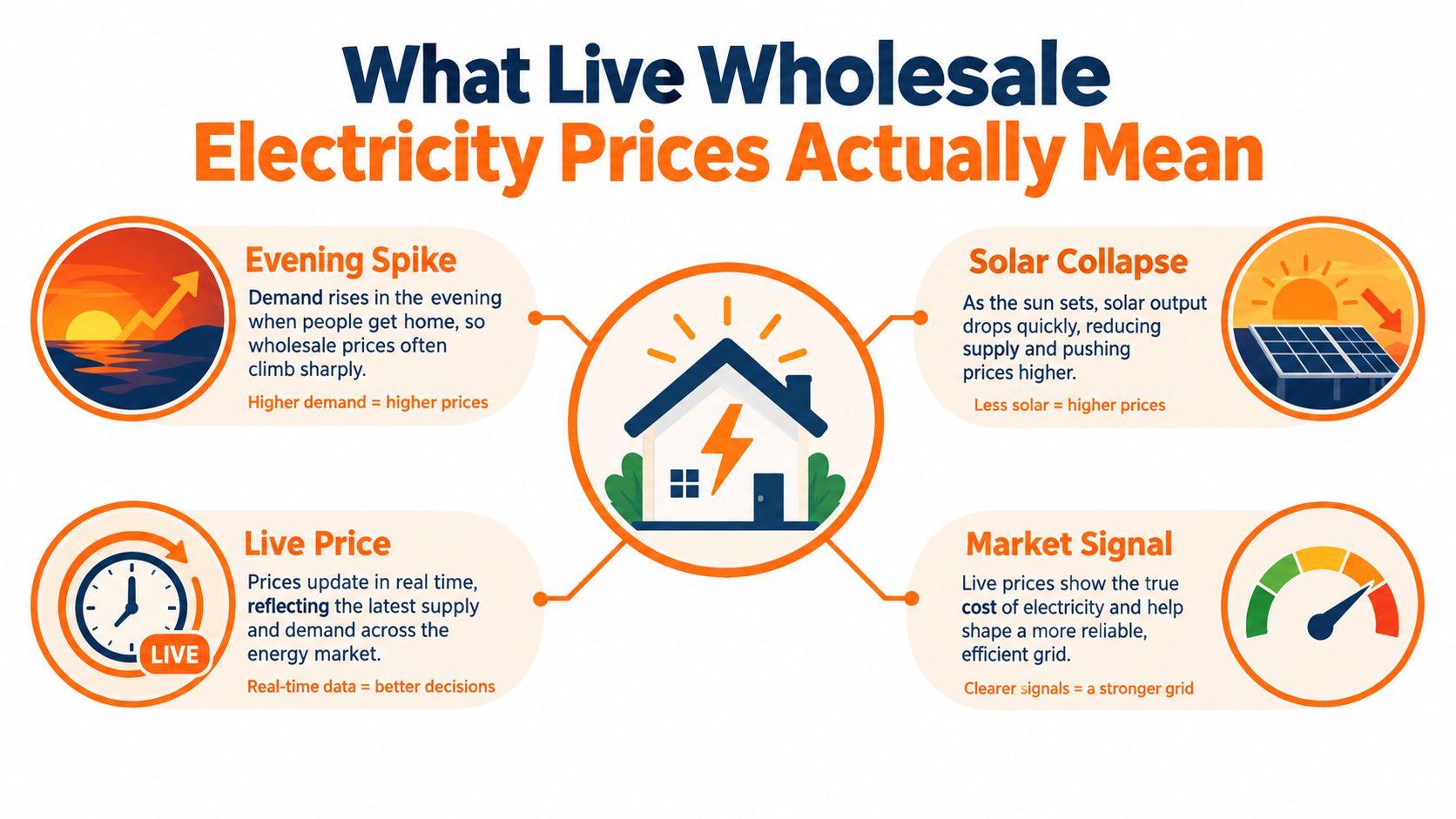
Wholesale price is not the same as your bill
The live wholesale price is the marginal spot price for that dispatch interval. It reflects the next increment of supply needed to balance the region, after network constraints, losses, and security conditions are considered AEMO market overview. A retail bill is built differently, with supply charges, usage charges, network costs, retailer margins, and other terms that do not reset every five minutes.
Practical rule: A live wholesale price shows what the market is doing now, while your final bill depends on the retailer and your household arrangement.
That difference matters because a low or negative wholesale interval can tempt a battery owner to export immediately, even when the better household choice is to hold energy for later. The right decision depends on evening demand, the battery's limits, and the retailer or VPP arrangement. For a home battery, the live price is one input in a household-priority decision framework, useful when it aligns with your needs and easy to ignore when it does not.
How Wholesale Prices Are Set Every Five Minutes
A Brisbane household can watch the afternoon sun fade while the battery app shows a very different price signal. That number comes from the market clearing process, where generators submit bids in price bands, AEMO clears the market every five minutes, and the highest-priced accepted offer needed to match supply with demand sets the spot price in that region AEMO market overview. A single interval can move sharply even when the home itself is behaving normally.
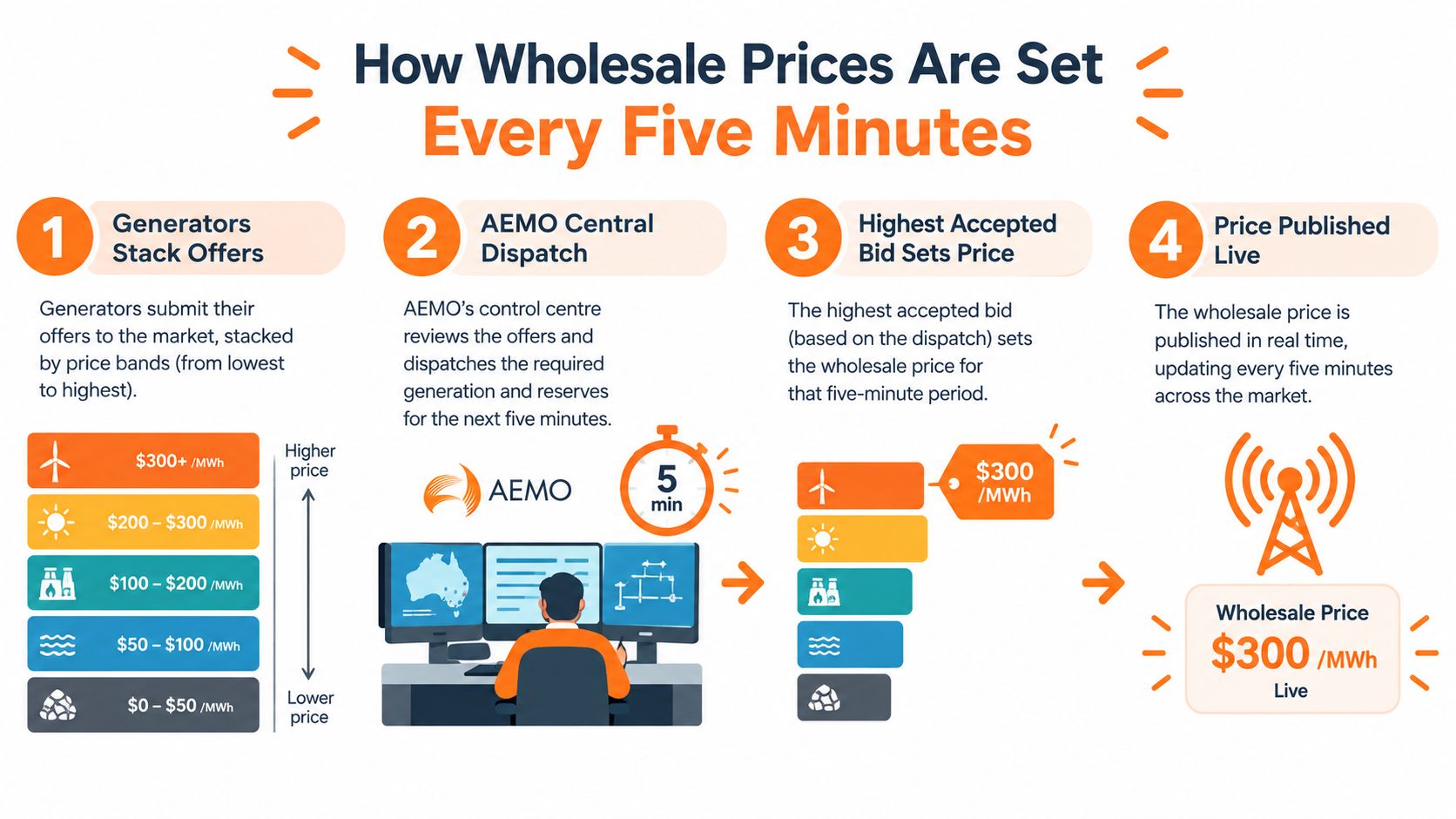
The five-minute price and the thirty-minute settlement are not the same thing
Two clocks matter here. The five-minute dispatch interval is the live price most feeds display. The 30-minute trading interval used for settlement means the commercial result can differ if charging or exporting happens in a different slice of time.
That matters for batteries. A home can charge in one interval and discharge in another, so a glance at the screen without the interval in mind can make a sensible move look poor, or hide a poor one. The two numbers can sit close together, but one is the market being cleared now and the other is the accounting window used around it.
Why neighbouring regions can diverge
Queensland and New South Wales share the same market design, yet they do not always see the same price at the same moment. Transmission limits, interconnector constraints, local demand, and system security requirements can separate the regions even when weather patterns look similar AER on high wholesale prices. That is why a live feed is regional, not national.
A useful way to read the process is in order.
- Offers first, because generators stack supply in bands.
- Dispatch second, because AEMO clears the region every five minutes.
- Price third, because the last accepted unit sets the market price.
- Settlement later, because the financial outcome follows the interval rules.
Once the sequence is clear, the live price stops looking mysterious. It becomes a record of the market balancing supply and demand in real time, which is exactly why it can matter for a battery sometimes and be background noise at other times.
What Recent Live Prices Look Like in Queensland and NSW
Queensland and New South Wales can look similar on paper, yet their live prices often move in different directions. In Q3 2025, Queensland recorded the lowest quarterly average spot price in the NEM at $72/MWh, down 28% from Q3 2024, while New South Wales averaged $90/MWh, a 25% year-on-year reduction of $31/MWh AEMO Q3 2025 report. Queensland also recorded a record 25.9% of dispatch intervals at negative or zero prices in that quarter, which shows how often the market can settle at very low values AEMO Q3 2025 report.
Quarterly averages hide sharp intraday movement
A full-year average smooths out the spikes that matter to a battery. The Australian Energy Regulator reported that for the full 2024 calendar year, Queensland averaged $101/MWh, 36% below 2023, while New South Wales averaged $114/MWh, 27% below 2023 and the highest regional average that year AER high wholesale prices. Those averages are useful for context, but they do not show the five-minute swings a household battery sees in real time.
| Period | Queensland ($/MWh) | New South Wales ($/MWh) | QLD YoY Change | NSW YoY Change |
|---|---|---|---|---|
| Q3 2025 | 72 | 90 | -28% | -25% |
| 2024 calendar year | 101 | 114 | -36% vs 2023 | -27% vs 2023 |
Same weather, different price outcome
Extreme price events show why the regions can split. The Australian Energy Regulator reported wholesale prices above $5,000/MWh during January, February and March 2023 in Queensland, New South Wales and South Australia, and noted that Queensland events on 31 January and 1 March were partly worsened by Queensland, New South Wales interconnector constraints AER high wholesale prices. Local network conditions can matter as much as weather.
For a battery owner in Brisbane, a low or negative price can signal a good charging window. For a household in Newcastle, the live price may be positive at the same moment. That difference is the point of regional wholesale pricing.
Where to Find a Live Wholesale Price Feed You Can Trust
A battery owner checking live prices needs a feed that shows the market, not just a polished chart. AEMO's NEM data dashboard is the clearest starting point because it brings together the current dispatch price, historical five-minute spot prices, and the 30-minute pre-dispatch forecast for each region. If you are using the number to guide battery behaviour, the source matters more than the appearance of the page.
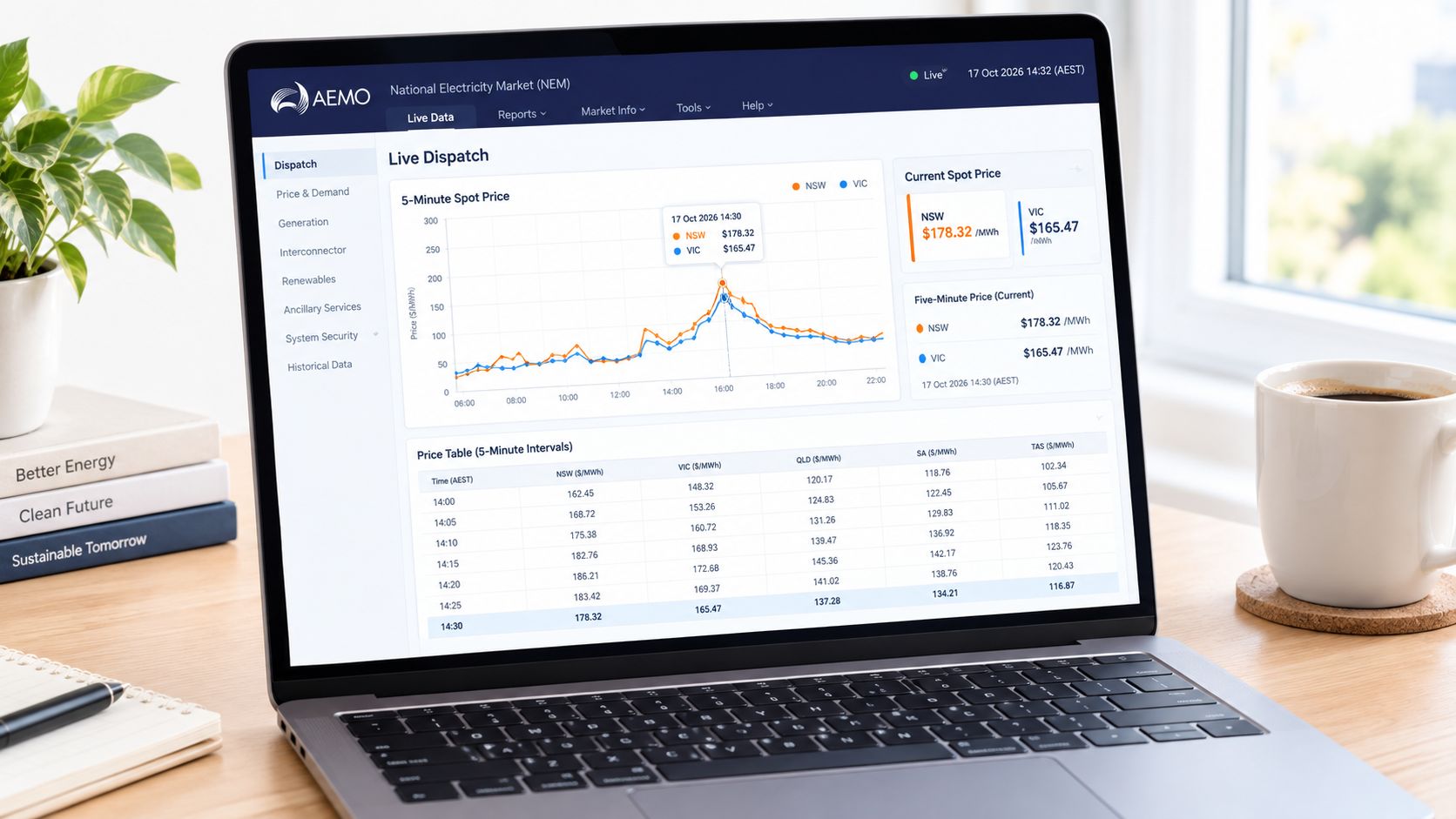
Read dispatch and forecast as separate signals
A pre-dispatch forecast points ahead. A dispatch price is the price the market is clearing in the interval being settled. They can move together, but they do not mean the same thing. For a home deciding whether to charge now or save room for later, the forecast is a guide, while the dispatch price is the market condition in force.
Third-party dashboards can still be useful if they republish AEMO data in a clearer format. The question to ask is simple, does the page show actual dispatch, forecast values, or a delayed version of the same underlying feed.
A trustworthy feed tells you what the market price is, what region it belongs to, and whether you are seeing a forecast or the settled outcome.
For households, the checks that still matter are straightforward:
- Check the region, because Queensland and New South Wales can differ materially.
- Check the source, because AEMO is the primary market reference.
- Check the purpose, because a market feed is not automatically a bill forecast.
For market notices and operational context, AEMO market notices can help explain why a price moved suddenly.
A live dashboard is most useful when you know what kind of number you are reading. For a battery, that distinction matters because the live price is only one input inside a household-priority decision framework. It may be worth acting on now, or it may be noise beside comfort, backup reserve, and the rest of the home's needs.
Why Cheaper Wholesale Prices Can Still Be Good News for Batteries
Lower average prices can look like bad news for a battery owner, but that view is too narrow. In Q4 2025, average wholesale prices fell to $58/MWh in Queensland and $75/MWh in New South Wales, down 55% and 48% respectively from Q4 2024 AEMO Q4 2025 report. At the same time, the Australian Energy Regulator linked lower wholesale pressure to rapid battery expansion, with installed battery capacity increasing from 2.2 GW to 6.1 GW during 2025 AER battery growth release.
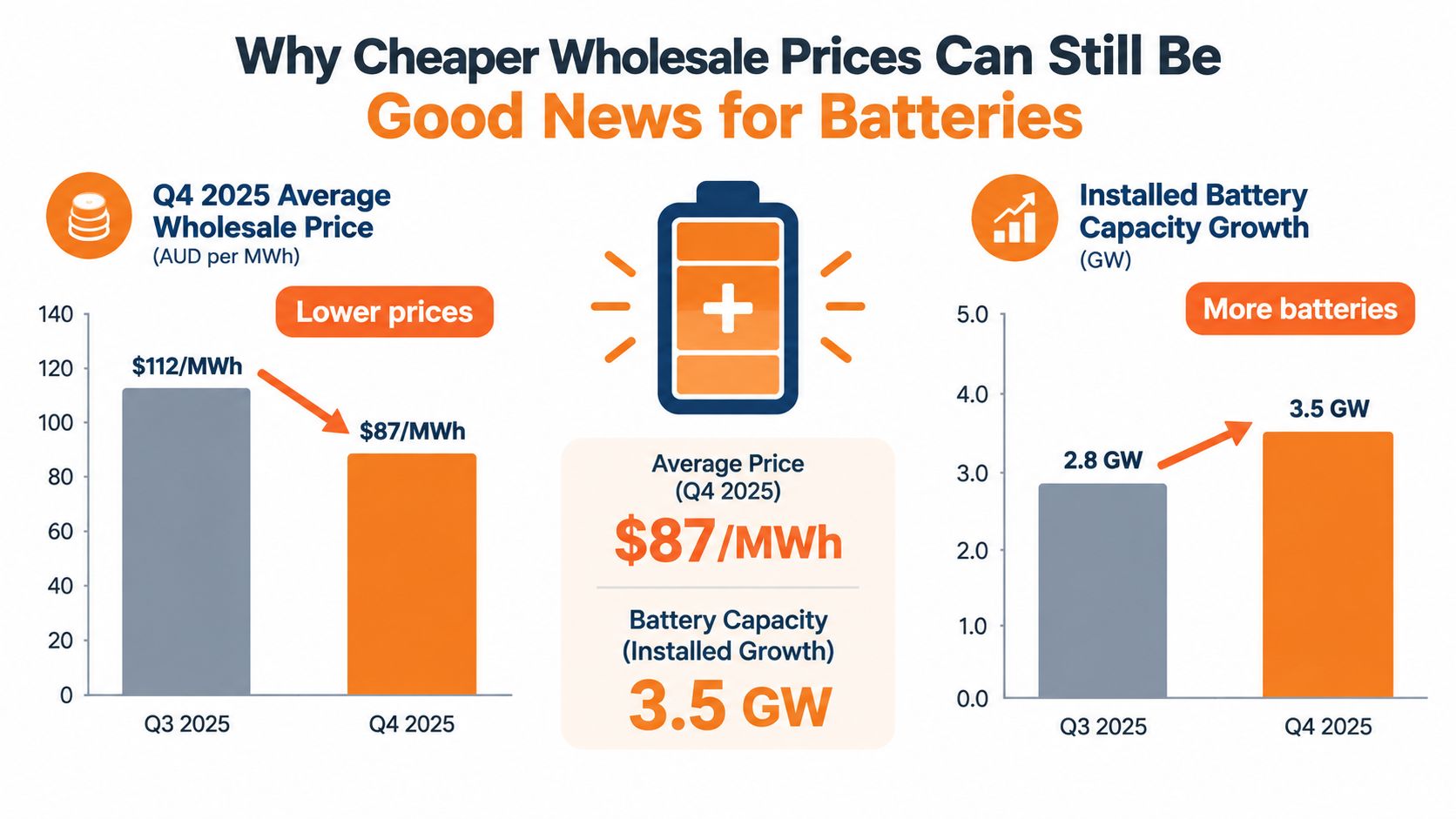
The value is shifting, not disappearing
Cheaper average wholesale prices weaken simple buy-low-sell-high arbitrage. They do not remove the usefulness of a battery. The value shifts toward flexibility, short-duration response, and soaking up energy when the market has very little value for it.
A battery can still create value by:
- Absorbing surplus solar when midday market value is weak.
- Supporting evening demand when household load usually rises.
- Holding back capacity for short-lived price spikes.
- Backing up the home, which matters even when exports are not attractive.
For homeowners who want to understand how stored energy can support essential loads, home battery backup power is a useful reference point on the backup side of the equation.
Queensland's record share of negative or zero-price intervals, noted earlier, shows why a battery can still matter in a lower-price market.
Lower wholesale averages often mean the market has more flexibility available, not that batteries have become irrelevant.
That is the key trade-off. The daily spread may be smaller, but a smart battery strategy still focuses on timing, reserve, and household priority rather than chasing every visible price movement.
A Household Decision Framework Around Live Prices
A live price should sit inside a household rule, not replace it. Start with the home's expected evening consumption, because that demand is the first claim on stored energy. If the battery is nearly full but the evening forecast is heavy, preserving capacity may be more valuable than exporting aggressively at a middling price.
Use the live price as one input
The price signal only matters if it covers the things that sit around it. A household still needs to account for round-trip losses, retailer or program fees, export limits, inverter constraints, and battery degradation. A positive live price can still be too low to justify discharge if the battery should be held for later household use.
The practical decision order is simple:
- Reserve energy for the home first.
- Compare the live spread against your losses and fees.
- Check whether the battery can still cover the evening peak.
- Use spare capacity for export or grid services only if the household remains protected.
Decision rule: If discharging now leaves the home exposed later, the live price is not high enough for that battery cycle to make sense.
What the live price does not tell you is just as important as what it does tell you. It does not show network charges, retailer margins, export limits, warranty constraints, or the household's full consumption forecast. It also does not know whether someone is cooking, running air conditioning, or planning to charge an EV later.
A live wholesale price is powerful because it is immediate. It is incomplete because it is only the market side of the decision, not the household side.
How HighFlow Uses Live Prices to Optimise a Home Battery
HighFlow Energy uses live NEM prices and forecasts as part of a BYOB Virtual Power Plant model, then layers household demand and battery state of charge on top so the home stays prioritised electricity price forecasting. The useful part is not the market signal by itself, but how that signal gets filtered through the household's needs before any dispatch action is taken.
The battery stays household-first
In practice, that means the control logic looks at three things at once. It checks the current price, the forecast path, and the state of charge. It then decides whether to hold energy for the home, charge from the grid, or make spare capacity available for coordinated dispatch.
The homeowner keeps override control through the companion app, which matters because priorities change. A battery that would normally support grid activity can be held back if the household expects higher evening use or wants more backup reserve.
HighFlow's retail model uses the value created by coordinated battery operation to fund a monthly bill-free electricity allowance, while the household still keeps priority use of stored energy. That is a very different proposition from a retailer that only shows a market feed and leaves the rest to the customer. The live price is still the signal, but the operating rule is household first.
Key Takeaways for Battery Owners Watching Live Prices
A live wholesale electricity price is a signal, not a household bill on its own. For a battery owner, the question is whether that signal should change what the home does next. A battery charged at 4 pm may be valuable, or it may be better kept in reserve if the evening load is still ahead.
Four checks help make that call. Does the home need this energy later? Does the live spread still justify cycling after losses and fees? Is the battery serving the household first? Is the retailer or VPP coordinating around the price in a sensible way?
A simple example makes the trade-off clearer. A Brisbane battery sitting at 80% charge during a high-price period should not automatically export if a heavy evening demand is likely. In that case, holding energy can be the better decision, because the battery is there to support the home first and the market second.