

Battery Backup for Solar Power Systems Explained
You probably didn't buy a home battery just to admire a clean-looking box on the wall. You bought it because you wanted more value from the solar already on your roof, a better buffer against outages, and less exposure to expensive grid power when evening demand kicks in. In Australia, that's no longer a fringe idea, with about 185,798 installed home battery units by the end of 2024 and 28.4% of rooftop solar systems installed in the second half of that year including a small-scale battery Clean Energy Council report.
The problem is that many households still treat battery backup for solar power systems as a single feature, when it's really three separate jobs. One job is storing surplus solar for later use. Another is keeping selected circuits alive when the grid fails. The third is participating in coordinated dispatch, where a retailer or aggregator uses your spare capacity in a way that can create financial value.
If you're in Queensland or New South Wales, that distinction matters even more. A battery can be a backup device, a self-consumption tool, or a dispatchable asset in a Virtual Power Plant, and the settings decide which of those roles it performs.
What Battery Backup Means for Solar Homes
A lot of homeowners reach the same point. The solar bill is lower than it used to be, the battery charges on sunny afternoons, but the system still feels underused. That's because battery backup for solar power systems is often discussed as hardware, when the actual issue is control. A battery is only as useful as the rules that tell it when to hold energy, when to release it, and what it must protect first.
Think of the battery as a tank, not a promise. It can store solar that would otherwise be exported, and it can later supply your home when the panels aren't producing enough. It can also be configured to hold back a reserve so that some energy is still available during an outage. But those are different operating modes, and most systems only deliver one or two of them unless they've been set up carefully.
That matters because the Australian market is already large enough to show the pattern clearly. The household battery fleet is no longer niche, but adoption doesn't automatically mean optimisation. A system can look impressive on paper and still fail to capture evening savings, reserve enough backup energy, or participate in a coordinated program that improves financial return.
Practical rule: treat battery backup as a control problem first, a hardware problem second.
If you want a plain-language refresher on one part of the topic, the guide on exit light code requirements explained is a useful reminder that backup power is always about configuration, not just having storage.
How Solar, Battery and Backup Actually Work Together
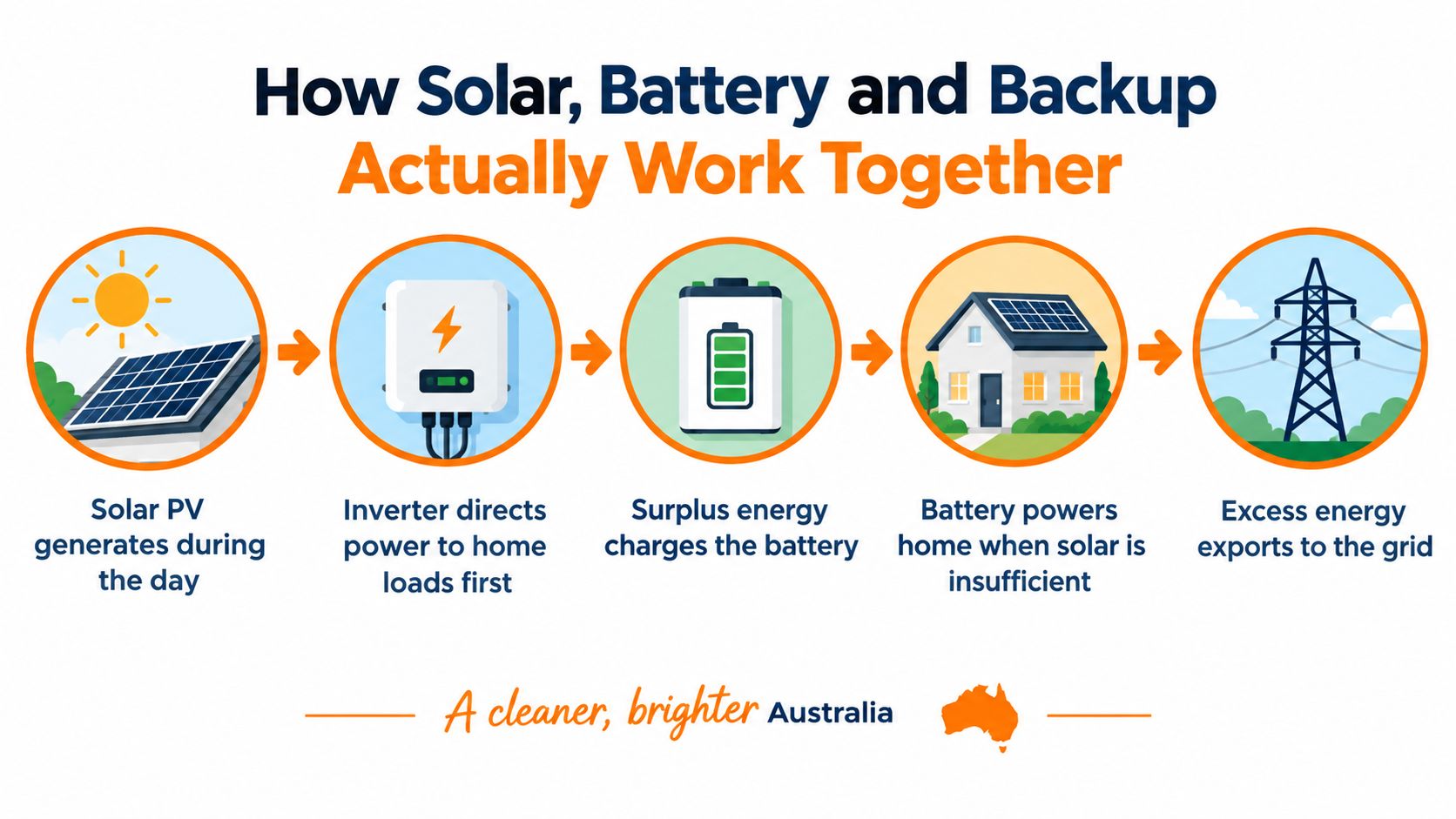
On a normal day, the energy path is simple. Solar panels produce electricity during daylight, the inverter sends that electricity to your home loads first, then any surplus charges the battery, and only after that does excess flow to the grid. That's the basic sequence most installers and homeowners expect from a modern rooftop solar system. The Australian Government's battery overview is clear that a battery stores surplus generation for later use, but outage supply only exists where the system is configured for backup power.
The inverter is the decision-maker
The inverter is not just a converter. It's the control point that decides whether electricity is used immediately, stored, exported or imported. In household terms, it acts a bit like a traffic controller, sending power to where it is most useful at that moment.
When the grid is healthy, the inverter can be programmed to favour self-consumption, preserve reserve energy, or respond to price signals. When the grid fails, the system has to change behaviour fast. It must disconnect safely from the network, isolate the home, and supply only the circuits that are wired for backup.
That's why two homes can own similar batteries and still have very different outcomes. One may use the battery mainly to reduce evening imports. Another may reserve part of the battery for outages. A third may allow a Virtual Power Plant to dispatch some capacity, while still protecting the homeowner's minimum reserve.
If you want a deeper technical explainer of storage behaviour, the article on how solar batteries store power is a useful companion read.
The outage changeover is where most confusion starts
A blackout changes the rules. The inverter has to island the home, a backup gateway or changeover arrangement has to isolate the selected circuits, and the battery has to have enough energy left to do the job. Without those pieces working together, the system can still be useful for bill reduction, but it won't necessarily keep the house energised.
A battery without backup wiring is still valuable, but it isn't automatic outage protection.
That gives you three distinct operating modes: self-consumption only, time-of-use shifting, and full backup mode. The same hardware can move between them through software and wiring choices, which is why the installation and settings matter as much as the battery label.
The Australian Battery Market in Real Numbers
The market is large enough now that it's easy to mistake adoption for maturity. In 2024, residential battery storage in Australia added an estimated 852 MWh of behind-the-meter capacity, with about 72,500 home batteries installed and cumulative residential storage reaching roughly 3.6 GWh by year end RenewEconomy. That is a serious amount of distributed storage sitting behind household meters.
Retrofit demand matters
One of the most important details is that 58% of 2024 battery installations were retrofits added to existing solar systems without changing the PV array RenewEconomy. That tells you the addressable market isn't limited to new solar buyers. A large share of owners already have panels and are now trying to make the battery earn its keep through better control, better reserve management, or better participation in coordinated programs.
The average residential system installed in 2024 had about 11.75 kWh of storage capacity, up from 11.3 kWh in 2023 RenewEconomy. That's large enough to shift meaningful daytime solar into evening use, but it's not infinite. The question is no longer whether battery storage exists, it's whether the battery is being used in a way that matches the household's real load shape and risk tolerance.
NSW and Queensland are the key markets
New South Wales led the annual market with 28,900 installations, followed by Queensland with 9,278 RenewEconomy. Those are the two states where the commercial case for battery optimisation is especially relevant, because there are enough installed systems to support both household savings and grid coordination.
The practical takeaway is simple. If so many homes already have batteries, the differentiator isn't ownership. It's whether the owner has a control policy that protects backup value, improves self-consumption, and leaves room for coordinated dispatch without sacrificing household priority.
Why a Battery Does Not Automatically Mean Blackout Protection
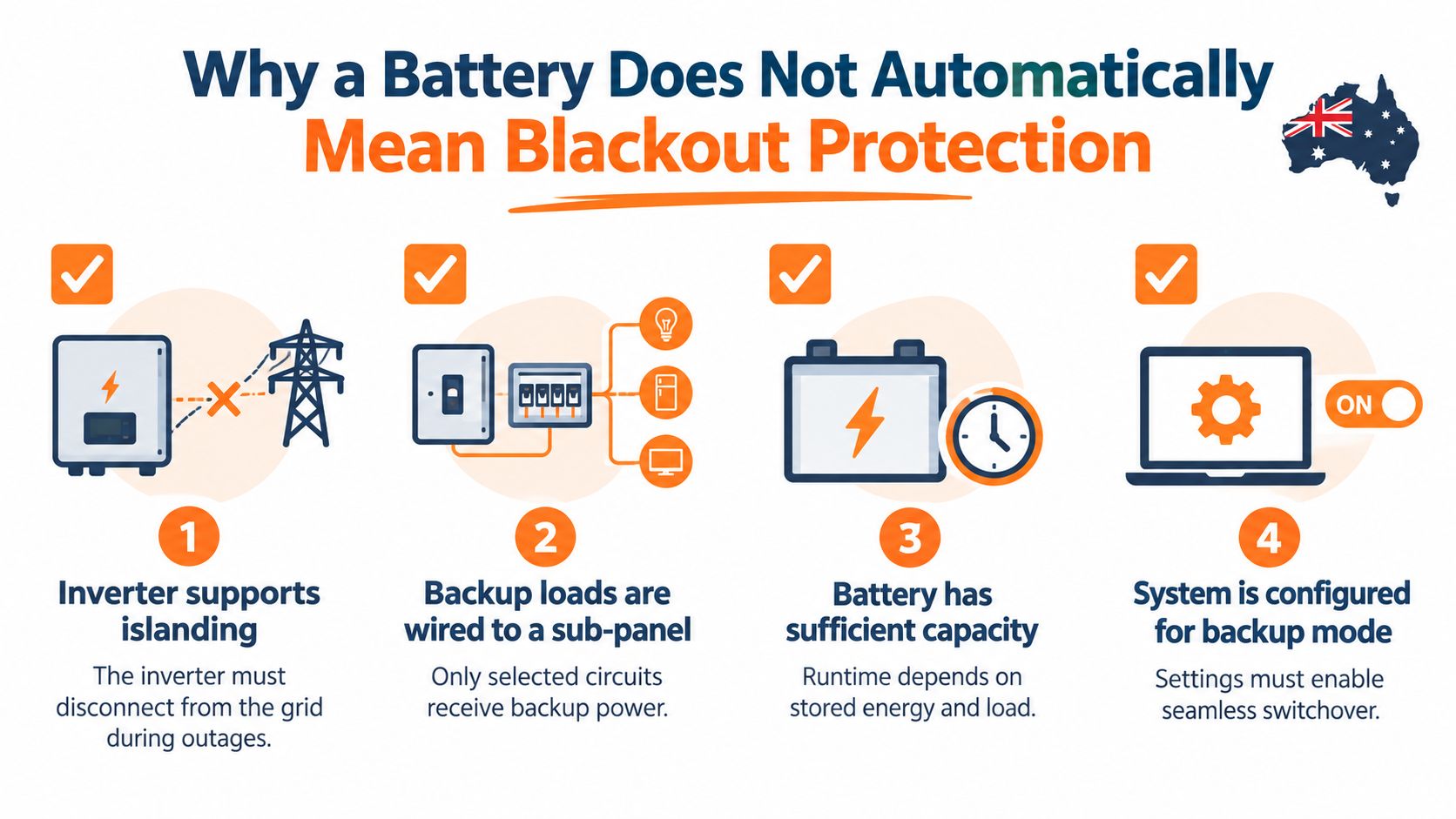
The biggest misconception in consumer battery content is the easiest one to repeat. People see the battery, assume the house is protected, and only discover the limits during a real outage. In practice, blackout resilience depends on whether the inverter supports islanding, whether the system has backup wiring, and whether the battery has enough reserve at the moment the grid drops. The CSIRO notes that behind-the-meter batteries can absorb rooftop PV, ride through outages and join VPPs, but those functions depend on compatible hardware and control settings rather than capacity alone CSIRO.
What actually has to be in place
The inverter must disconnect from the grid safely. Only selected circuits can be wired to the backup side. The battery must still have usable energy when the outage begins. The system must also be configured to switch cleanly into backup mode instead of shutting down.
That's where homeowners get caught out. A fridge might look like a modest load, but pumps, compressors and some air conditioners can draw high starting current that exceeds inverter surge limits. A battery with enough kWh on paper can still fail to support a particular appliance if the inverter can't deliver the needed power at the same moment.
A good test for any existing system
Ask three questions of your installer or retailer:
- Is the inverter approved for islanding? If not, the system may shut down with the grid.
- Which circuits are backed up? Whole-home backup and essential-circuit backup are very different.
- Is there a reserve policy? If the battery is routinely drained for trading or self-consumption, there may be little left when the outage arrives.
If those answers are vague, the system may still be financially useful, but it isn't delivering true backup resilience. For a more detailed local explanation, the internal guide on solar battery blackout protection is worth reading before you assume your current setup is outage-ready.
How a Virtual Power Plant Actually Coordinates Your Battery
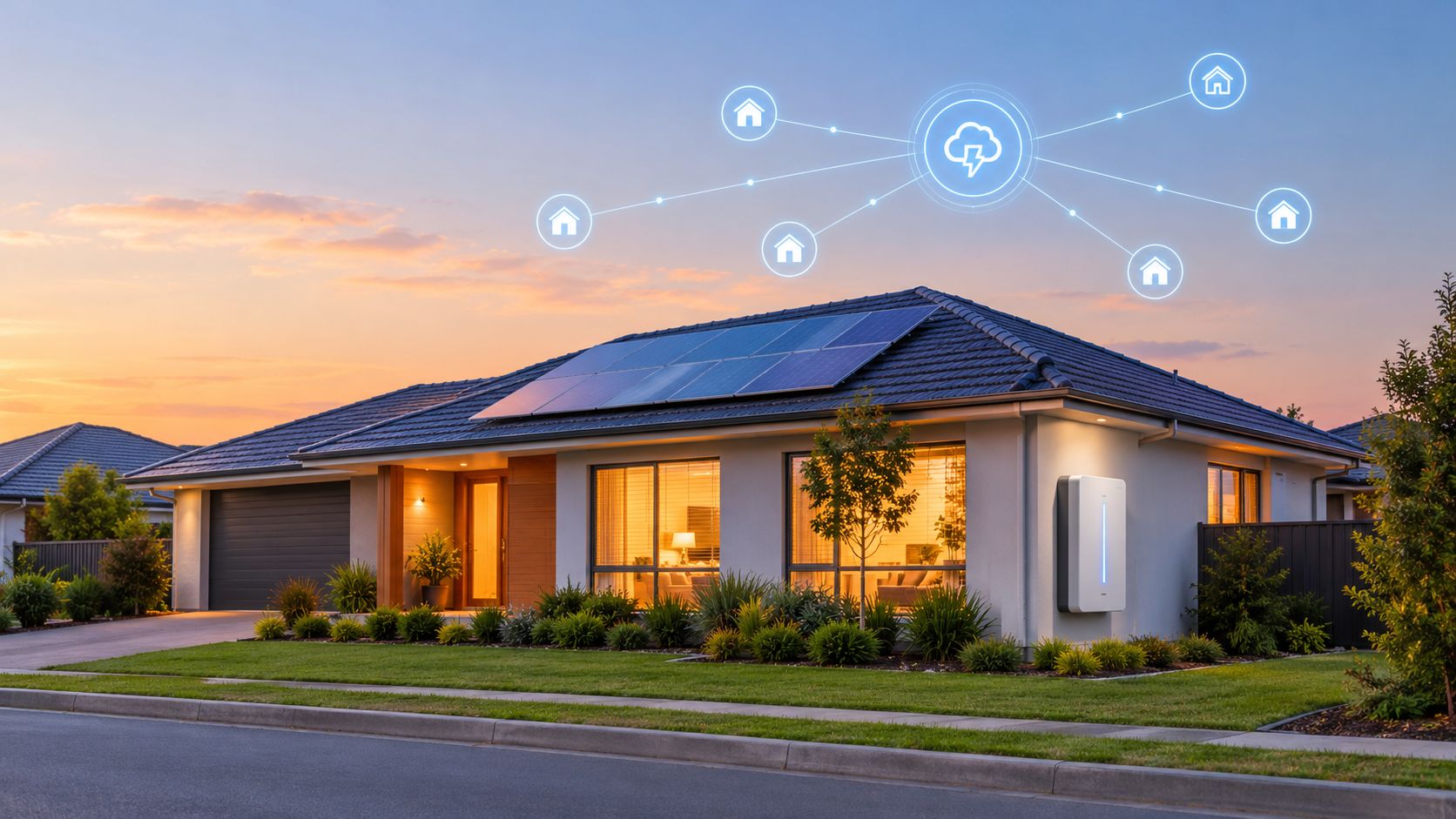
A Virtual Power Plant, or VPP, is a way of coordinating many separate batteries through one platform. Instead of treating each battery as isolated storage, the platform issues charge and discharge instructions across the fleet so the combined response can be used for grid services. The result is that spare household capacity becomes a dispatchable resource.
ARENA's South Australian VPP project is the clearest public example. It aggregated approximately 1,000 behind-the-meter battery systems into a combined 5 MW resource with more than 9 MWh of dispatchable stored energy ARENA. That proves small batteries can become a material grid asset when they're coordinated properly.
What a dispatch event looks like
A homeowner doesn't usually see wholesale market mechanics in real time. They see a platform decision. The battery is checked against its state of charge, reserve setting, communications status and site limits. If it has spare flexibility, the system may discharge a calculated amount. The outcome then appears on the bill or statement, depending on the retailer or VPP structure.
The important limit is that the platform can't use energy that isn't safely available. Inverter power, reserve settings, local network constraints and communications availability all shape how much of the battery's capacity can be offered. That's why a VPP is not a license to empty the battery. It's a managed trade-off between household priority and grid value.
Household priority has to stay intact
A sound VPP policy starts with a minimum reserve. It should also respect essential-load backup, allow override rights when an outage is imminent, and avoid commands that ignore the site's approved connection settings. If those protections aren't explicit, the household is carrying too much of the operational risk.
For readers who want to see how a retailer-side VPP can be structured in practice, the internal overview on solar battery virtual power plant is a useful reference point. The core principle is straightforward. If the battery has spare capacity after the home is protected, coordinated dispatch can turn that spare capacity into something measurable.
Where the Money Actually Comes From
Battery value comes from four separate channels, and they shouldn't be confused with one another. The first is self-consumption, which means using stored solar in the evening instead of buying more grid electricity. The second is export value, which comes from sending surplus energy to the grid. The third is tariff arbitrage, where the battery charges when prices are lower and discharges when prices are higher. The fourth is grid-service revenue, which can appear when a VPP coordinates the battery for system support.
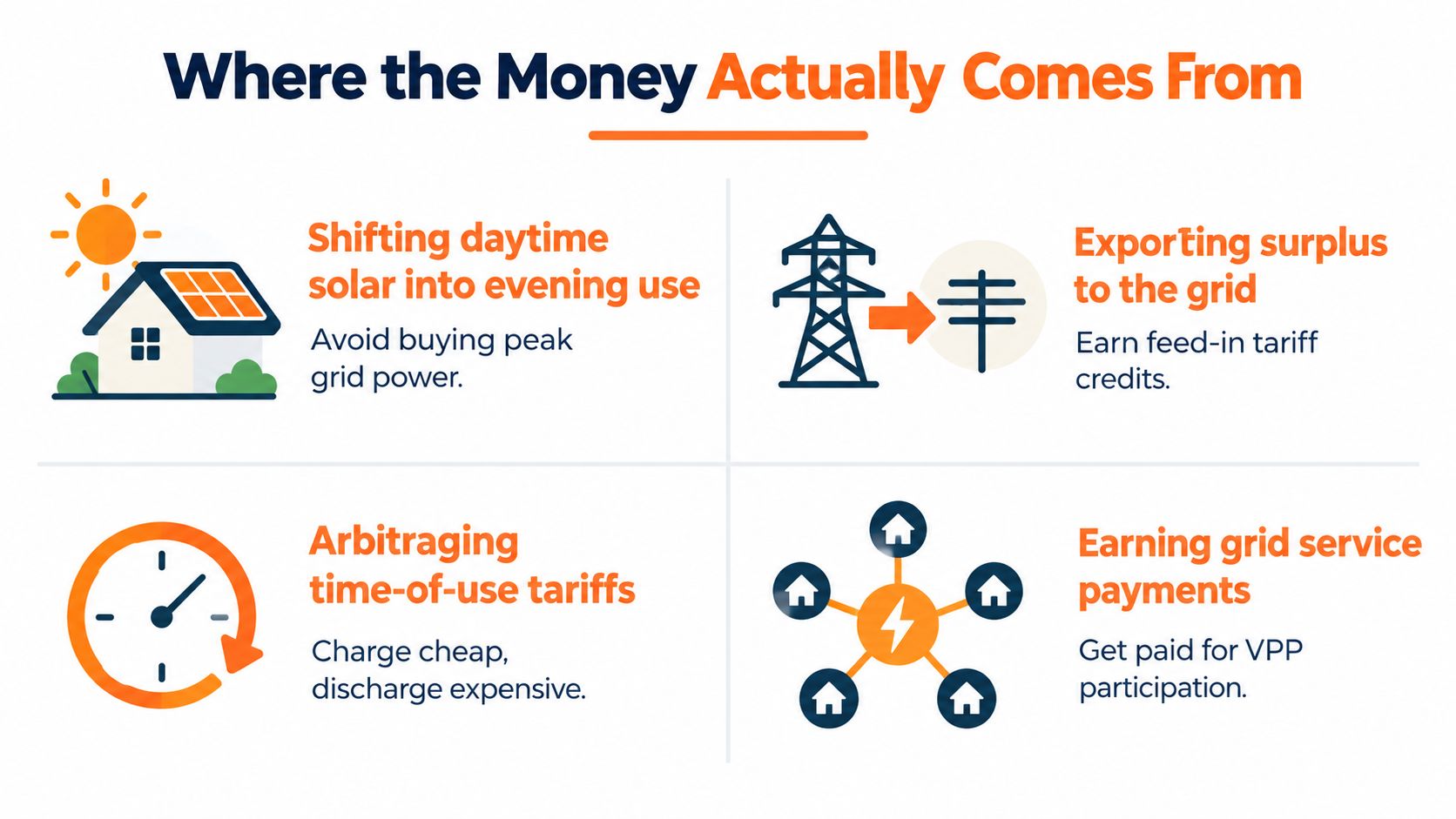
The split between reliable and variable value
Self-consumption and tariff arbitrage are the most understandable benefits because they follow household behaviour and published tariffs. Grid-service income is different. It depends on market conditions, dispatch frequency, reserve rules and the offer structure you've signed up to.
That distinction matters when people compare offers. A headline number may combine ordinary bill reduction, export credits and event-based dispatch income into one annual figure. A careful homeowner should ask how much of that figure is repeatable, and how much depends on market volatility or occasional grid events.
What the ACCC data shows
The ACCC found that VPP households recorded annual bill reductions of $762 to $1,093, or 57% to 63%, compared with grid-only customers, while only about 24% of solar-and-battery customers were participating in a VPP ACCC. That gap is the opportunity. Plenty of batteries exist, but far fewer are being coordinated well enough to realise their full financial value.
The right question is not “what's the biggest saving?” The right question is “which part of the saving comes from self-consumption, which part comes from dispatch, and what happens when wholesale prices are low?” If that answer is opaque, the offer is opaque.
Designing a Backup Contract You Can Actually Trust
A good battery agreement should read like a protection plan, not a marketing brochure. The first item is the minimum reserve percentage that must stay in the battery at all times. The second is the exact list of circuits that remain backed up. The third is the expected runtime for refrigeration, medical equipment and internet under measured load. The fourth is what happens if solar output is weak during a longer outage. The fifth is whether the homeowner can override a dispatch command when an event is imminent.
What to ask before you sign
- Reserve setting: How much charge is always kept back for the household?
- Essential loads: Which circuits are protected, and which ones are not?
- Runtime expectation: How long will the backed-up circuits run under normal use?
- Solar recovery: Can the battery recharge from rooftop PV during an outage?
- Override rights: Can the homeowner pause dispatch if a storm or outage is likely?
An Australian 2025 study using real-world outage data found that including backup value could reduce battery payback time by more than 31%, while rooftop PV contributed more than 39% of total backup performance in some scenarios SolarQuotes. That reinforces an important point. Backup isn't just a comfort feature. It has a measurable economic role, and it should be written into the offer clearly.
If the contract doesn't spell out reserve, circuits and override rights, the battery's backup value is being assumed, not delivered.
A one-page checklist is often enough to separate a serious offer from a loose one. Print the five questions above and ask for direct answers. If the retailer or installer won't commit to them in writing, the system may still be useful, but you won't know how it behaves under stress.
Common Misconceptions Battery Owners Should Retire
The first misconception is that a battery automatically guarantees blackout protection. It doesn't, and assuming otherwise can leave critical loads unprotected when the grid drops. The better question is whether islanding, backup wiring and reserve settings are all in place.
The second misconception is that all VPPs work the same way. They don't. Some prioritise household security and transparent statements. Others rely more heavily on dispatch and market participation, which changes the risk profile and the shape of the bill.
The third misconception is that a headline annual saving means the bill disappears every month. Savings may be real without being uniform. The ACCC also reported a 107% increase in consumer reports concerning household batteries and new energy services over the previous 12 months, which says something simple, customer understanding is lagging adoption ACCC.
The fourth misconception is that joining a VPP means losing control of your system. A well-designed program should keep household priority intact and make reserve, dispatch and override rules visible. Ask what happens when wholesale prices fall, what happens to your reserve, and how the statement shows each value stream.
Most battery owners focus on installation quality. Far fewer focus on ongoing performance and optimisation. High Flow Energy is an electricity retailer built around getting the full value of your existing solar and battery system.
If you would like to understand whether your battery is underperforming financially, request an eligibility assessment today at High Flow Energy.