

Solar and Battery Packages Brisbane
Queensland now has approximately 1.1 million rooftop solar systems in the first half of 2025, and Brisbane households sit inside that scale, not outside it. That matters because the conversation has moved on from adding panels or buying a bigger battery, it's now about optimising existing solar and battery assets inside a network that limits what homes can export and when. For Brisbane owners searching for solar and battery packages Brisbane, the key question is no longer "what should I buy?", it's "how do I turn the asset I already have into a better-performing energy position?" Clean Energy Council rooftop solar and storage report, January to June 2025
| Feature | Traditional Solar & Battery Package | BYOB VPP Retailer Model |
|---|---|---|
| Starting point | New hardware purchase | Existing compatible battery |
| Main value driver | Self-consumption and backup | Coordinated dispatch and retailer-managed value |
| Grid role | Passive export and household use | Active participation when spare capacity is available |
| Network fit | Must work within export limits | Designed around export limits and control settings |
| Customer focus | Upfront equipment choice | Ongoing performance and allowance structure |
The Shift From Hardware to Optimisation
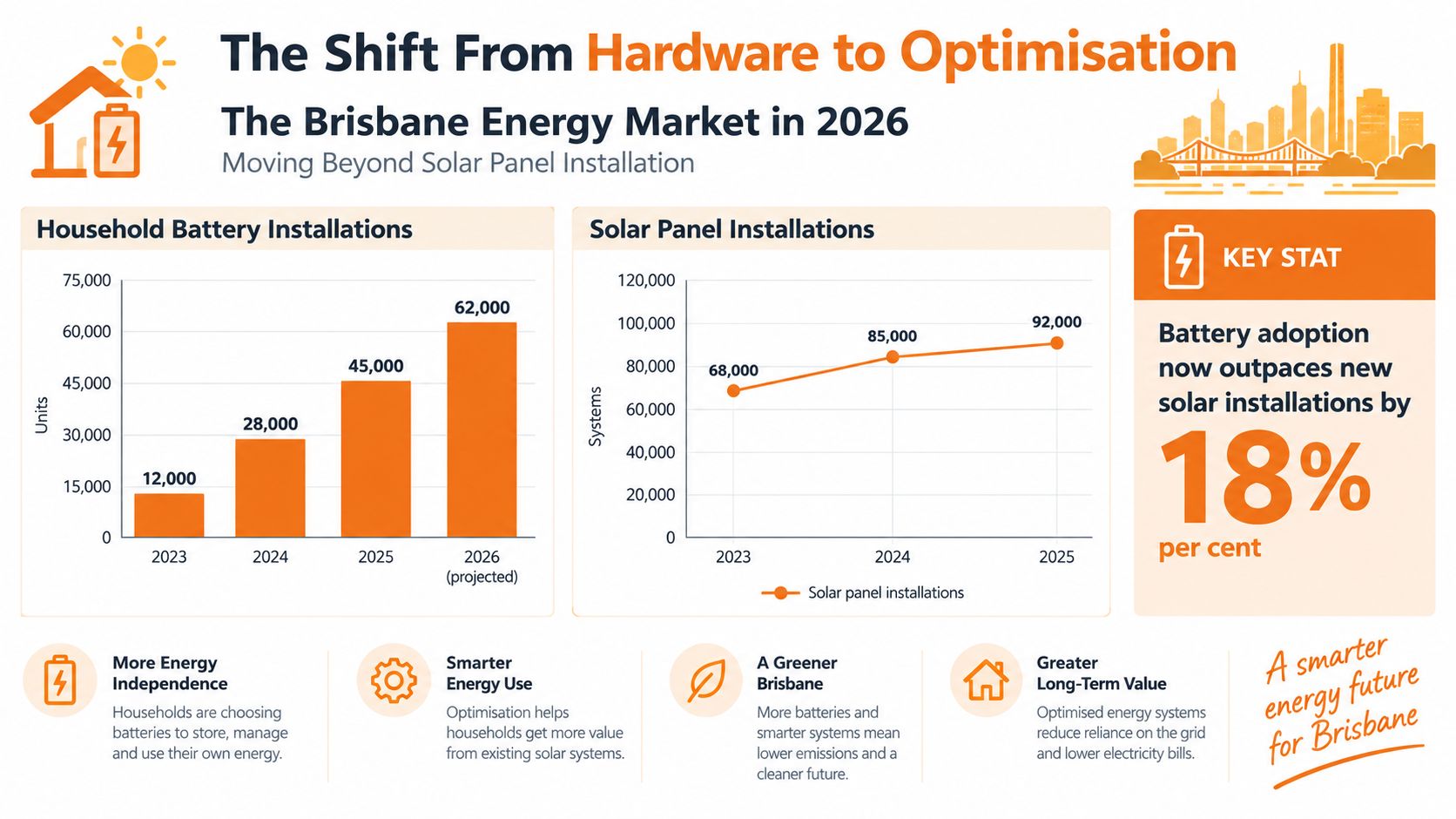
Brisbane's battery market is no longer marginal. Australian households bought 268,675 home batteries in 2025, compared with 74,582 in 2024, and cumulative household battery installations reached about 454,753 by the end of 2025 Clean Energy Council battery surge report. That scale shifts the value question. A battery that sits idle, or one managed under a generic retail plan, leaves money on the table.
Hardware is only the starting point
In a market this dense, the physical battery matters less than its control settings. Queensland's rooftop solar fleet is already measured in the millions of small generators, so system value now depends on timing, export limits, and dispatch logic, not only nameplate capacity. Learn how optimisation changes the value of a solar plus battery system without buying new hardware. A Brisbane battery can absorb surplus midday energy, but if the retailer or control platform does not coordinate that storage well, the household still buys grid power at the wrong times.
Practical rule: a battery earns its keep when it is managed like an energy asset, not treated like a backup box that only matters during an outage.
Why optimisation now beats simple ownership
The older model was straightforward, self-consume more solar, export the rest, and reduce the bill. That still helps, but it is no longer enough in a mature rooftop-solar market. A household with solar and storage now needs to consider when the battery charges, when it holds reserve, and whether spare capacity can be coordinated into a VPP.
BYOB, Bring Your Own Battery, becomes relevant at that point. Instead of buying new hardware to chase a better outcome, some Brisbane homes can improve performance through software, retail design, and participation in a managed fleet. The asset stays the same. The way it earns value changes.
Navigating Brisbane Network Export Constraints
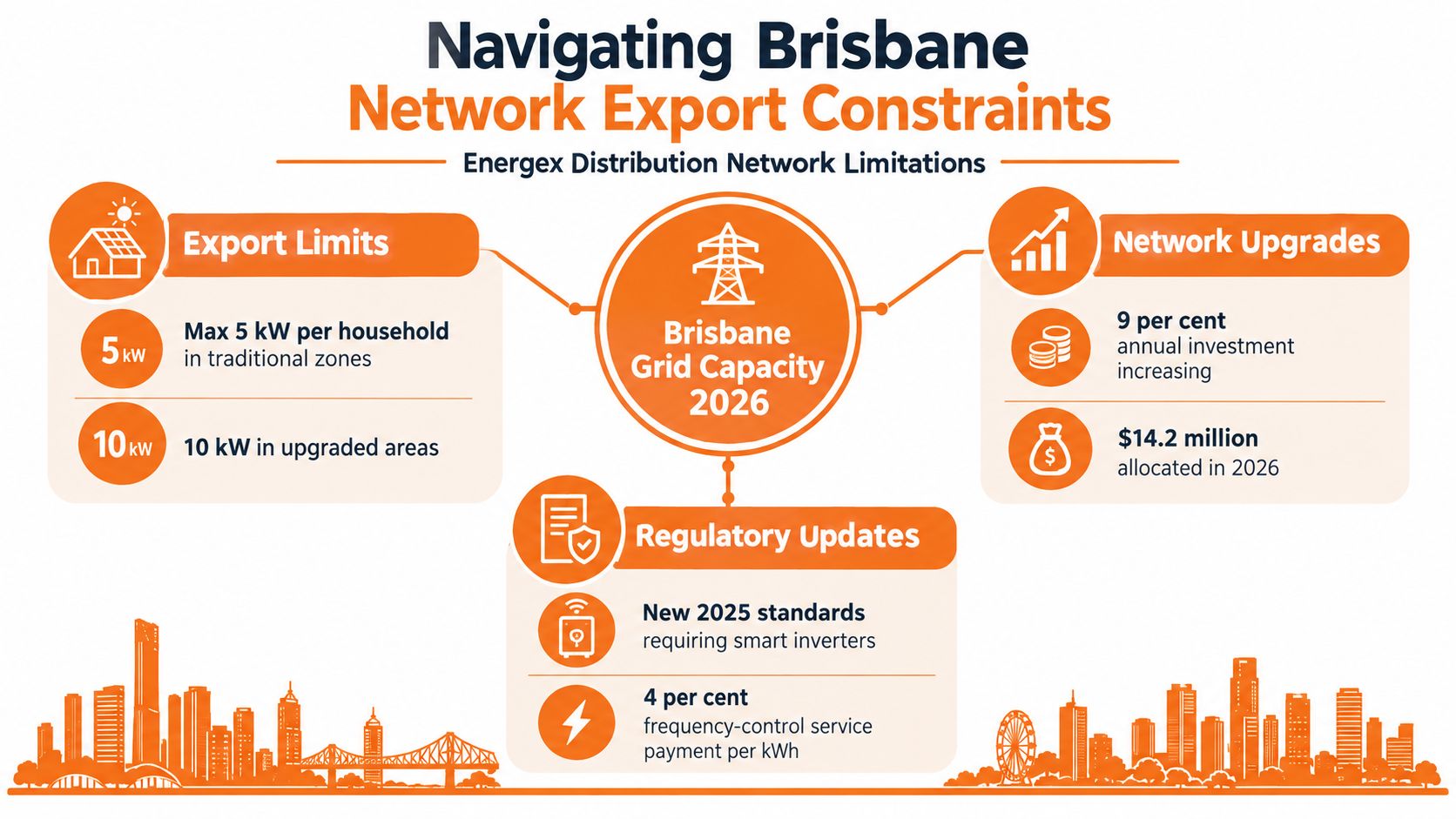
Brisbane homeowners often assume the grid will take whatever the roof can produce. It won't. For Energex customers in south-east Queensland, the standard single-phase export capability is generally 5 kW at any instant, although dynamic connection arrangements can permit higher export subject to network approval Gridly export limits overview. That's a hard design constraint, not a marketing detail.
What the export cap means in practice
If your panels produce more than the network allows you to export, the excess has to go somewhere. It can be used in the home, stored in a battery, or curtailed. That makes battery sizing and inverter settings more important than many buyers expect. A large array can look impressive on paper while still being throttled by the connection agreement.
A battery's technical job in Brisbane is often to capture energy the grid will not accept at that moment. That doesn't just improve self-consumption, it protects the value of the solar array itself. Without storage or smart control, midday production can be wasted even when the roof is working exactly as intended.
How dynamic connections change the picture
Dynamic connections are useful when a home wants more flexibility than the standard limit allows, but they're not a free pass. AEMO's material says most Queensland connections are standard connections with exports limited to 5 kilowatts per phase, while dynamic connections can allow exports to be dynamically limited up to 10 kilowatts per phase, though uptake has been limited AEMO consultation material. That makes the connection class just as important as the battery brand.
For homeowners comparing system options, a good external reference on broader planning impacts is this overview of local solar water impacts. The grid lesson is the same, local infrastructure constraints shape what an energy asset can do.
A battery that fits your export ceiling is more useful than a bigger battery that spends its best hours waiting for permission to move power.
Read more on electricity network charges
Comparing Traditional Packages and VPP Models
The difference between a bundled solar and battery package and a BYOB VPP model is not cosmetic. One is built around hardware ownership, the other is built around asset performance and grid coordination. A Brisbane household with a capable battery can often choose between adding more equipment or extracting more value from what's already installed.
| Feature | Traditional Solar & Battery Package | BYOB VPP Retailer Model |
|---|---|---|
| Upfront outlay | Higher, because new hardware is purchased | Lower, because the home uses existing compatible equipment |
| Main objective | Self-consumption, backup, basic bill reduction | Coordinated battery value, tariff efficiency, grid participation |
| Value source | Solar generation and household storage | Retailer-managed dispatch and customer allowance structure |
| Control style | Mostly local, homeowner-led | Shared operating rules, with household priorities retained |
| Grid interaction | Limited to exports and home backup | Designed for controlled participation in grid services |
| Suitability | Best when hardware is missing or outdated | Best when the battery already exists and is compatible |
Why retailer-led models are different
A traditional package usually stops at installation quality, warranty terms, and how much solar the home can self-consume. That's useful, but narrow. A BYOB model treats the battery as a flexible resource that can support the grid when spare capacity is available, while still prioritising household use.
That distinction matters because a battery is not just a storage tank. It's a controllable device with rules around reserve, export, and response. If the retailer doesn't actively optimise those settings, the customer may be paying for capability they're not fully using.
What Brisbane owners should compare
Don't compare battery options on capacity alone. Compare usable capacity, continuous charge and discharge power, reserve settings, export controls, and whether the operating model fits the household's tariff exposure. A well-designed VPP arrangement can create value from spare capacity, while a poorly matched hardware package can only move the same bill around.
HighFlow Energy is one example of a retailer model in this space, it operates as a Bring Your Own Battery VPP for compatible systems rather than a solar or battery seller. That distinction is important because the value proposition comes from coordination, not equipment markup.
The Legacy Solar Bonus Scheme Trap
Queensland's Solar Bonus Scheme still pays eligible legacy customers 44 c/kWh for exported electricity, and it is currently scheduled to end on 1 July 2028, subject to Queensland Government confirmation Queensland Government Solar Bonus Scheme information. For some Brisbane households, that legacy tariff is more valuable than a generic battery self-consumption calculation. A new battery can help, but it can also change the operating pattern that keeps the entitlement intact.
Why battery settings matter more than battery size
The issue is not whether a battery exists. It is how it discharges.
Queensland Government guidance says customers can lose eligibility if the battery can discharge while the solar PV system is generating or export energy to the grid. That means a system set up for aggressive optimisation may undermine the tariff that made the home financially strong in the first place.
The highest-value setup is not always the one with the most moving parts. For legacy SBS homes, it is the one that protects the tariff before chasing extra flexibility.
How to think about the trade-off
A homeowner on the legacy tariff should compare three paths. Keep the existing operating mode and preserve the feed-in entitlement. Reconfigure the battery to discharge only at night if that remains compliant. Or move to a different value model where the legacy tariff is no longer the main asset.
The right answer depends on the full household profile, not on the battery brochure. If a home still benefits materially from 44 c/kWh exports, a standard self-consumption package can destroy value. If the tariff is already secondary to usage patterns and future flexibility, a VPP-aligned operating model may make more sense.
Queensland has more than 1.1 million rooftop-solar installations and more than 40% of households had rooftop PV as of July 2025, which is why this issue matters beyond a few edge cases. The market is large enough that tariff preservation is a strategic issue, not a minor compliance note.
Technical Requirements for Grid Participation
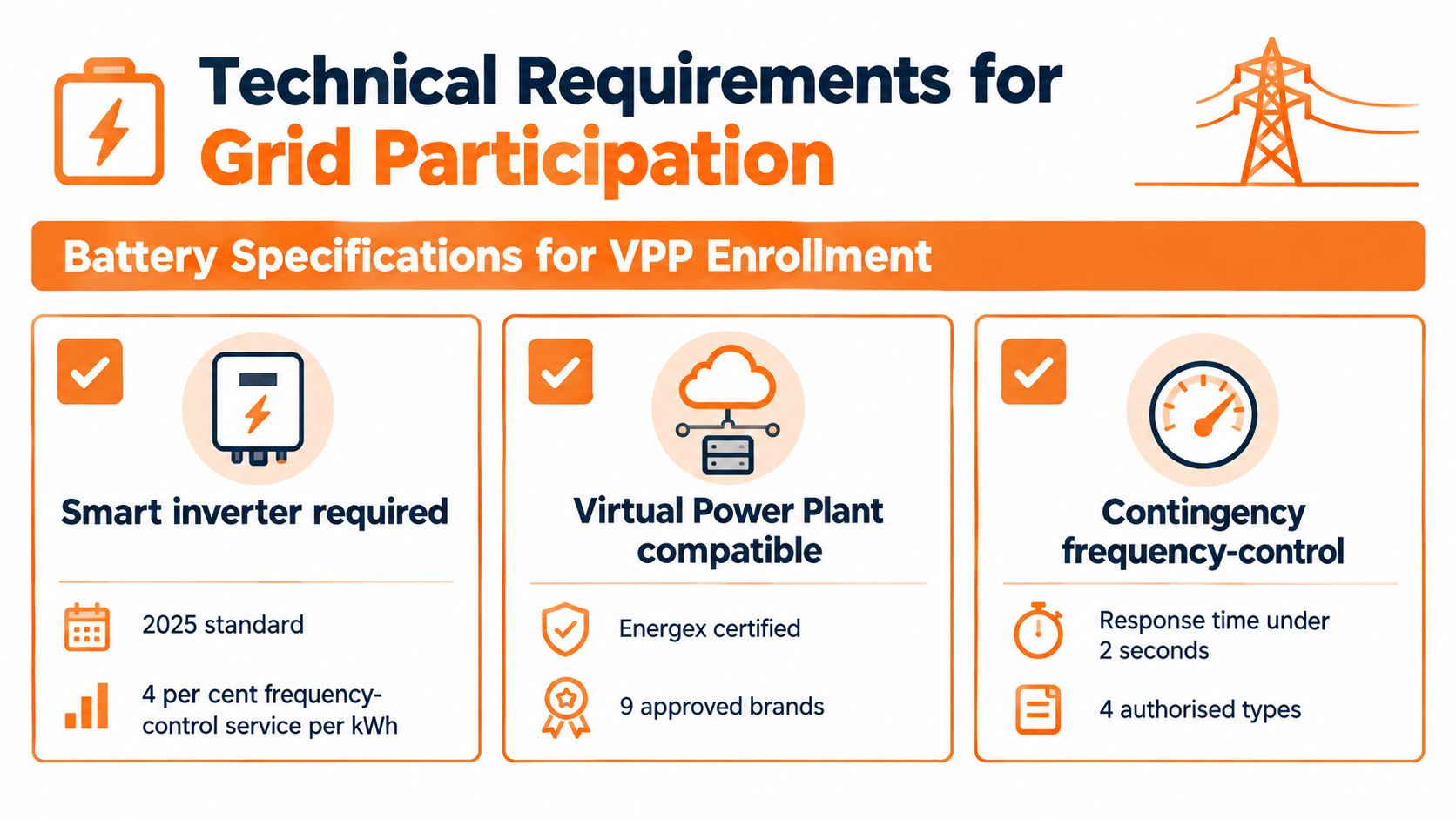
A battery described as “VPP-ready” still needs the right control stack before it can contribute to grid services. AEMO VPP demonstrations show that aggregated small batteries can provide contingency frequency-control ancillary services, respond to wholesale price signals, and sometimes supply local network services at the same time AEMO VPP demonstrations. That only works when the inverter, gateway, communications link, and control logic are aligned.
What the system has to do
A VPP participant has to monitor frequency and active power at the relevant control point, with net response behind the connection point recorded as PV output or household load changes the measured result. In practical terms, the battery has to measure, react, and report that reaction with enough accuracy for the market role it is performing.
The demonstration materials also describe a 0.7% droop setting used by several battery VPPs, which allows a proportional response to frequency deviations. That detail separates genuine grid participation from broad marketing claims.
What to audit before joining
- Export control behaviour: confirm the battery can stay within the site's connection limits while charging and discharging.
- Reserve logic: check the minimum state of charge and whether household backup stays protected.
- Control latency: make sure the platform can respond quickly enough for dispatch and frequency events.
- Dispatch separation: verify the battery can distinguish between household priority use and VPP instructions.
- Measured response: ask how performance is logged behind the connection point, not just what the brochure promises.
Review system integration requirements
AEMO also found that simultaneous value stacking is technically possible, but responses to high and negative price events can be less predictable than modelled. That makes transparent reserve settings and customer override controls technically important, not optional.
Choosing the Right Path for Your Home
The right choice depends on what you already own, not on the latest bundle ad. A Brisbane homeowner with legacy SBS entitlement faces a very different decision from a family with an underused battery or a first-time buyer trying to avoid overcapitalising on hardware.
If you hold a legacy SBS entitlement
Protect the tariff first. If your battery can alter the discharge pattern in a way that affects eligibility, the financial downside can be immediate and permanent. For these homes, the priority is compliance and operating mode, not maximising dispatch at all costs.
If you already have a battery that isn't earning its keep
The smarter move may be software and retail reconfiguration, not new panels or a larger battery. If the battery is compatible and the home still has spare capacity under the export limit, a BYOB VPP model can improve utilisation without another round of capital expenditure. The question is whether the system is underperforming because of hardware limits or because it's managed too passively.
If you're still deciding whether to buy new gear
Start with the household load shape, the connection limits, and the future use case. Backup needs, EV charging, and evening demand all change the answer. A new hardware package only makes sense when the existing asset base can't do the job.
The cheapest system on day one is not always the most efficient asset over five years. In Brisbane, network rules and operating control can matter more than the sticker price.
Common Misconceptions About Battery Control
The most common fear is loss of control. In a well-structured VPP, the household's needs come first, and the battery should keep reserve for backup and expected use. That's a different proposition from handing your asset to a retailer with no transparency.
Another misconception is that grid cycling automatically ruins the battery. That's too simplistic. What matters is how often the battery cycles, how deep those cycles are, and whether the operating rules respect household priorities. Smart control can preserve utility while still allowing coordinated participation.
The final myth is that a battery must be isolated from the market to be safe. Brisbane homeowners don't need isolation, they need rules. The best models are the ones that make those rules visible, so customers know when the battery is being used for the home and when it's being offered into the grid.
Most battery owners focus on installation quality. Far fewer focus on ongoing performance and optimisation. HighFlow Energy is an electricity retailer built around getting the full value from your existing solar and battery system. If you want to check whether your setup is underutilised, visit HighFlow Energy to review eligibility and see whether a BYOB VPP model fits your home.