

Solar Battery Storage Technology Explained for 2026
By September 2025, the Clean Energy Regulator figures reported by the Minister for Climate Change and Energy counted 43,517 solar batteries installed under the federal scheme since 1 July 2025, with 825 MWh of nominal capacity and an average size of 19.0 kWh. That reframes solar battery storage technology in Australia. You're no longer assessing a small backup box. You're assessing a dispatchable household asset that's large enough to shift evening demand, respond to National Electricity Market price signals, and wear out faster if it's cycled without a clear return.
Solar Battery Storage Technology Options Compared
Lithium iron phosphate, or LFP, is the most common chemistry in new Australian home batteries because it pairs long cycle life with strong thermal stability and round-trip efficiency in the low 90s. That's the direct answer for most homes cycling daily. Other chemistries still matter, but each trades life, efficiency, size, or safety for cost or a niche use.
Cycle life is how many full charge and discharge cycles a battery delivers before usable capacity falls materially. Round-trip efficiency is the share of stored energy that comes back out for use.
Battery Chemistries Compared for Residential Use
| Chemistry | Typical residential use | Cycle life (approx.) | Round-trip efficiency (approx.) | Main trade-off |
|---|---|---|---|---|
| LFP lithium iron phosphate | Most new home batteries | 4,000 to 6,000 cycles | 90 to 95% | Heavier and bulkier per kWh than some NMC designs |
| NMC lithium-ion | Older or compact home systems | 2,000 to 4,000 cycles | 90 to 95% | Higher thermal runaway risk than LFP |
| Lead-acid (AGM or lead-carbon) | Backup or low-cost older systems | 500 to 1,200 cycles | 75 to 85% | Shorter life when deeply cycled and more space needed |
| Vanadium flow | Large commercial or grid-scale projects, rarely homes | 10,000 or more cycles | 70 to 80% | High upfront cost and large footprint |
| Sodium-ion | Emerging residential option | 2,000 to 4,000 cycles | 85 to 90% | Limited Australian field data |
| Thermal (heat) storage | Hot water load shifting | Not applicable | Not applicable | Stores heat, not electricity for appliances |
Residential sodium-ion data is limited, so don't treat early cycle claims as proven across hot Queensland summers and cooler New South Wales winters. Vanadium flow suits long-duration, frequent cycling where footprint doesn't matter, which rarely describes a suburban garage. Lead-acid can still make sense for shallow backup, but daily deep cycling to chase evening tariffs shortens its life quickly.
Why Existing Solar Changes the Decision
Most storage decisions in Queensland and New South Wales start from solar you already own. In November 2024, the Australian Government figures reported by the Clean Energy Council showed Australia had surpassed 4 million rooftop-solar installations, with approximately 1 in 3 Australian homes using rooftop solar. The same reporting put rooftop PV installed since January 2019 at approximately 6,692 MW in New South Wales and 5,713 MW in Queensland.
That scale matters because your panels produce most power in daylight while cooking, cooling, and entertainment loads often run into the evening. A battery shifts surplus generation instead of exporting it immediately at a low feed-in tariff. Whether a retrofit uses DC-coupled or AC-coupled battery wiring then affects conversion steps, inverter choice, and how easily you can add storage to an existing array.
Practical rule: Choose chemistry by daily cycling, available installation space, and thermal safety, not by the lowest headline price per nameplate kWh.
If you'll cycle almost every day for bill reduction and possible Virtual Power Plant participation, LFP's cycle life usually outweighs its extra bulk. If the battery will sit mostly full for rare outages, cycle life matters less and standby behaviour, warranty terms, and backup circuitry matter more. Thermal storage is different again. Diverting surplus solar to a hot water system can be cheap and effective, but it won't run lights, wi-fi, or a fridge after sunset.
How the Battery Management System and Inverter Work Together
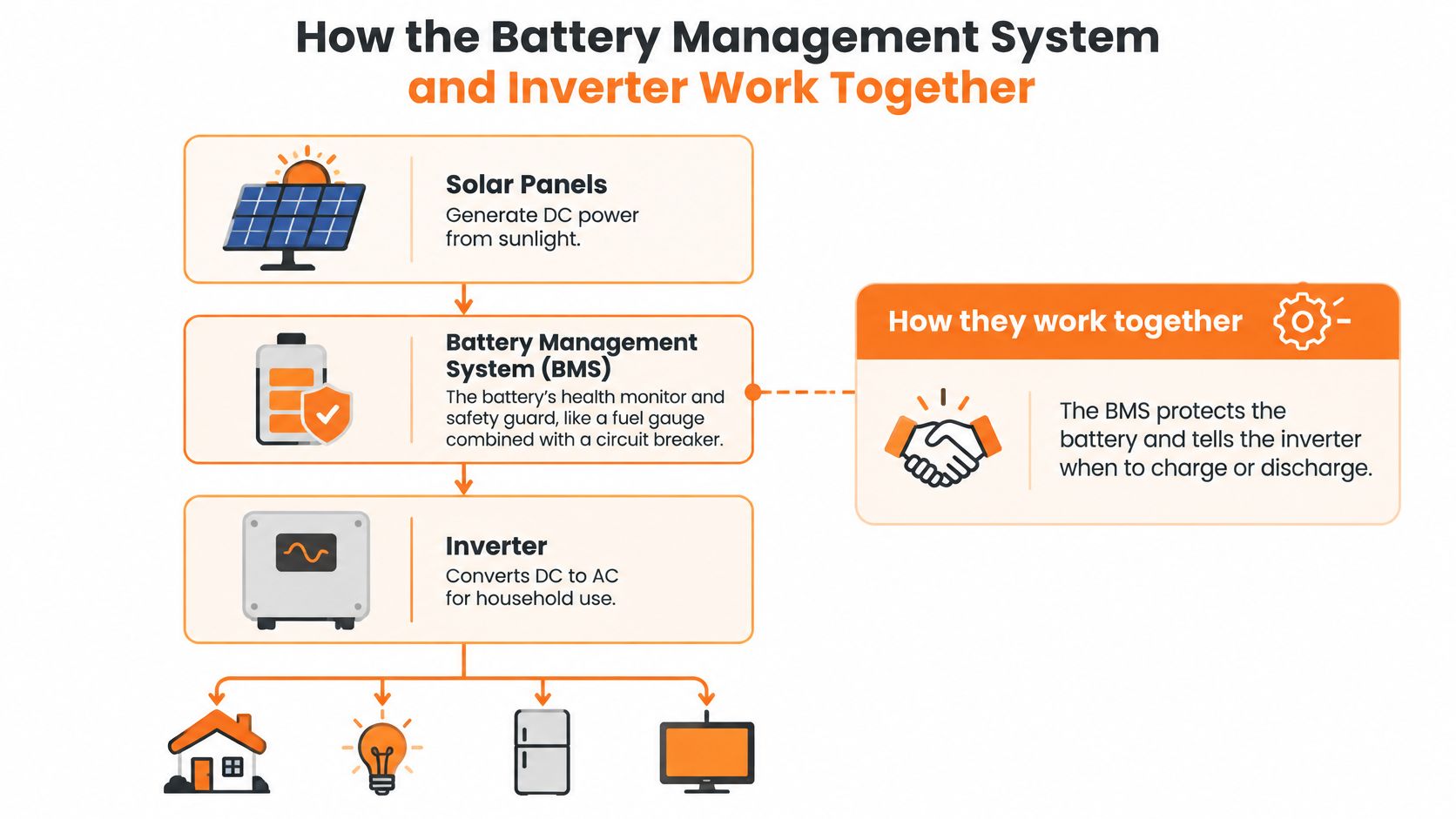
Think of the battery management system, or BMS, as a fuel gauge combined with a circuit breaker. It's the battery's health monitor and safety guard. Think of the inverter as the throttle. It sets how fast energy flows in and out, and it converts battery direct current to household alternating current.
The diagram below shows that control hierarchy, from generation through protection to conversion.
What Each Device Controls
The BMS measures cell voltage, temperature, current, state of charge, and state of health. It balances cells so one weak cell doesn't limit the whole pack, and it enforces limits for over-charge, over-discharge, and high temperature. When the BMS says stop, charging or discharging stops, even if an app or retailer platform requested more.
The inverter does a different job:
- Converts power: It turns DC from the panels or battery into AC for household circuits and the grid.
- Sets power limits: It applies maximum charge and discharge rates, which can be lower than what the battery cells could handle.
- Applies export limits: It follows network rules at your connection point and any dynamic export instruction.
- Prioritises flows in hybrid systems: It decides whether solar serves the home, charges the battery, or exports.
A Typical Day in Sequence
Say a Brisbane home has midday surplus and a hot evening forecast. The sequence usually runs like this:
- Solar serves household load first.
- Surplus solar charges the battery until it reaches the target state of charge.
- The battery supplies evening load, reducing grid imports during the peak tariff window.
- The controller exports only within network and inverter limits.
That sequence looks simple in an app, but each step is constrained. Cloud reduces charging. A high reserve setting leaves less energy for evening use. A small inverter can't discharge fast enough to cover an oven, air conditioner, and pool pump starting together.
For Virtual Power Plant participation, this distinction is decisive. A controller can only dispatch what the BMS allows and what the inverter can deliver. Reserve settings, temperature limits, and inverter capacity define real available capacity, not the number printed on the carton.
Before you join any program, verify four items on the datasheet and contract:
- Inverter model: Confirm exact model and continuous power rating, not just battery brand.
- Firmware update policy: Ask who pushes updates and whether you can defer them.
- Reserve setting: Record the minimum state of charge in normal and backup modes.
- Remote control logging: Confirm whether charge and discharge commands are logged and visible to you.
Round-Trip Losses and Power Limits That Set Usable Value
A 10 kWh battery doesn't give you 10 kWh of evening electricity. The Australian Energy Market Operator residential battery projections report assumes 95% efficiency for both charging and discharging, producing a 90.25% round-trip efficiency. On that basis, 10 kWh stored returns approximately 9.03 kWh, before standby consumption, some inverter losses, and household wiring losses.
That's the starting gap between nameplate and usable value. You then subtract reserve settings, apply depth-of-discharge limits, and allow for capacity lost to ageing. A battery held at a 20% reserve for backup has only 80% of its remaining capacity available for daily cycling, even before conversion losses.
Energy Returned and Continuous Power by Battery Size
AEMO also models residential batteries with a 2.5-hour storage duration, implying maximum continuous power of roughly 40% of rated energy capacity. Applying the 90.25% round trip and that 40% ratio gives the following comparison. You can check the round-trip efficiency calculation method against your own datasheet figures.
| Battery size (kWh) | Energy returned after 90.25% round trip (kWh) | Approximate continuous power (kW) |
|---|---|---|
| 5 | 4.51 | 2.0 |
| 10 | 9.03 | 4.0 |
| 13.5 | 12.18 | 5.4 |
| 19 | 17.15 | 7.6 |
The power column explains a common disappointment. A 10 kWh battery modelled as a 4 kW device may hold enough total energy for an evening, yet still import from the grid when simultaneous loads exceed 4 kW. Energy capacity determines how long it can run. Power determines how much it can run at once.
Four Steps to Check Your Real Capacity
- Read usable capacity: Find usable kWh on the datasheet, not just nominal or nameplate kWh.
- Subtract the reserve: Remove any backup reserve or minimum state of charge you won't cycle daily.
- Apply the round trip: Multiply stored energy by 0.9025 to estimate returned energy under AEMO's assumption.
- Compare the power ceiling: Check continuous discharge kW against your evening peak from smart meter or inverter data.
A short, sharp evening peak is limited by power. A long, steady evening load is limited by energy.
That distinction should drive sizing and VPP expectations. If your air conditioner runs for five hours, extra kWh help. If your problem is a 30-minute spike when cooking and cooling overlap, extra kW help more. Delegated control, where a retailer or other business optimises charging and discharging, doesn't remove either limit. It can only schedule within them, preserve charge for household demand, and avoid dispatch that leaves you importing at peak prices later.
How Virtual Power Plants Earn Value From Your Battery
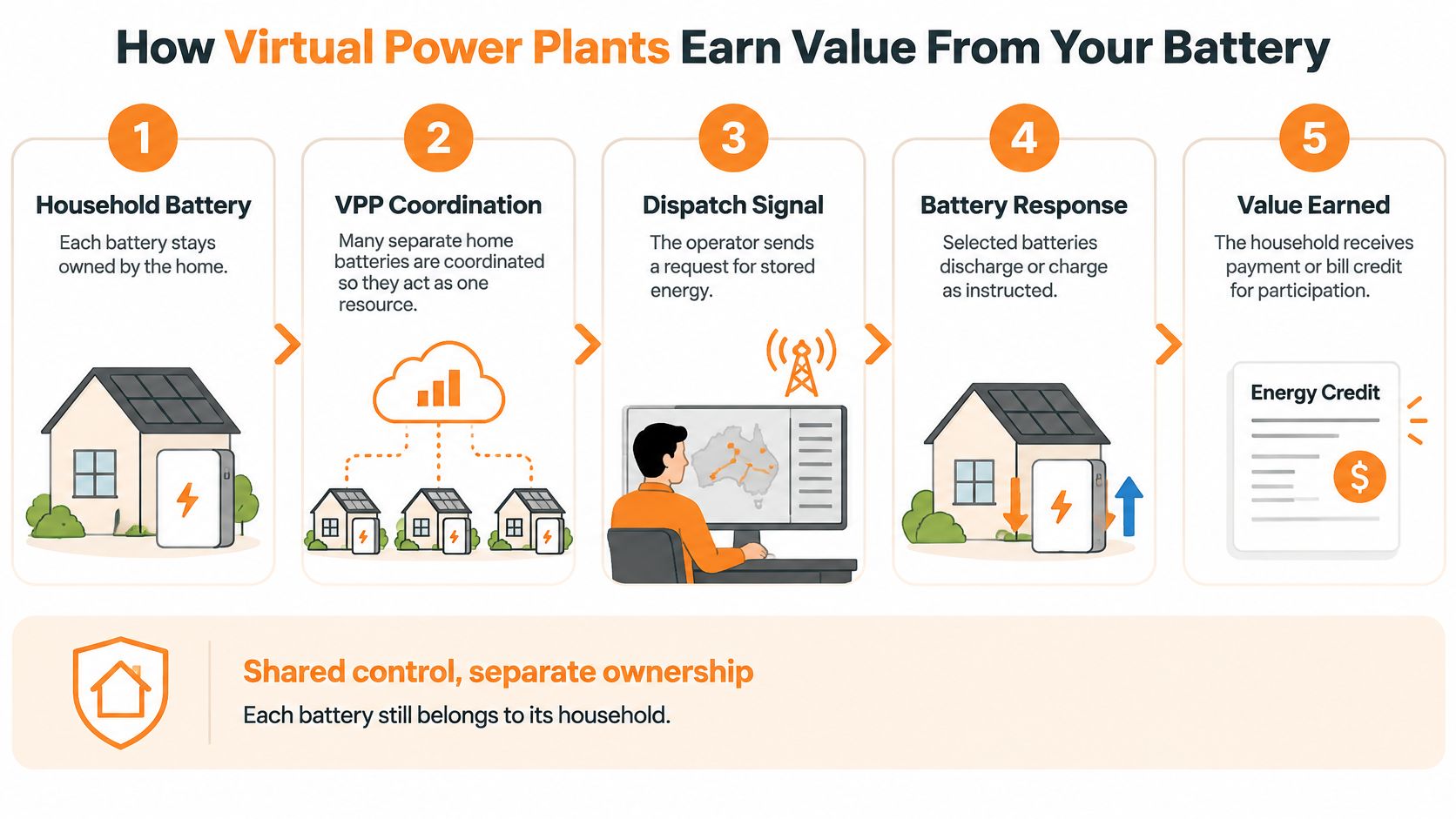
A Virtual Power Plant, or VPP, coordinates many separate home batteries so they act as one electricity resource. Each battery still belongs to its household, sits behind that home's meter, and serves that home first. The value comes from timing small, coordinated changes across thousands of systems, which is the logic behind a solar battery Virtual Power Plant.
The five-step sequence below shows how individual ownership and aggregated dispatch fit together.
The Dispatch Cycle
- Read the fleet: The operator reads state of charge, household load, and price, weather, and solar forecasts.
- Respond to a signal: Wholesale price spikes, network congestion, or demand events trigger a request.
- Shift energy: Batteries charge from surplus solar or discharge small amounts, within household settings.
- Verify the response: The aggregate response is measured at the connection point and checked against the instruction.
- Share the value: The value funds a retailer allowance, credit, or other payment under the contract.
Scale turns modest household actions into grid capacity. An ARENA-supported Simply Energy VPP project report recorded 1,363 residential battery systems delivering between 3 MW and 4 MW of flexible capacity to the South Australian grid at completion in March 2022. The range matters. Available capacity varies with state of charge, household demand, and customer settings.
Fast Frequency Response Is Stricter
Some VPP revenue comes from frequency control ancillary services, known as FCAS. The AEMO VPP demonstrations FCAS specification requires fast-response verification using measurements at intervals of 50 milliseconds or less, covering at least 5 seconds before and 60 seconds after a frequency disturbance. It permits a minimum droop setting of 0.7% for batteries, linking active-power response proportionally to local frequency deviation.
That means a VPP must hold upward and downward headroom. It may need room to charge harder when frequency rises and room to discharge when frequency falls. A battery that's already full, empty, or at its inverter limit can't provide both directions.
Compare feed-in tariffs carefully. A fixed feed-in tariff pays a set rate for each exported kWh. A VPP pays for dispatched capacity or energy at valuable times and leaves stored energy available for household use first, so compare both on the same kWh and timing basis.
Retail exposure means the retailer carries tariff risk under a retail offer. Wholesale exposure means the price you receive or pay moves with NEM spot prices. Returns depend on which exposure applies, so don't compare a fixed allowance with a volatile wholesale pass-through as if they're the same product.
Our VPP only uses spare battery capacity and operates automatically in the background, with the home's energy use always coming first. Participation doesn't guarantee that a battery will retain a minimum charge level or provide backup power during an interruption. If backup is essential, you need suitable backup hardware and a reserve setting, and you should expect less capacity available for daily optimisation.
Battery Degradation and Warranty Trade-Offs in VPP Use
The image below frames the central trade-off, payments today against usable capacity retained over time.
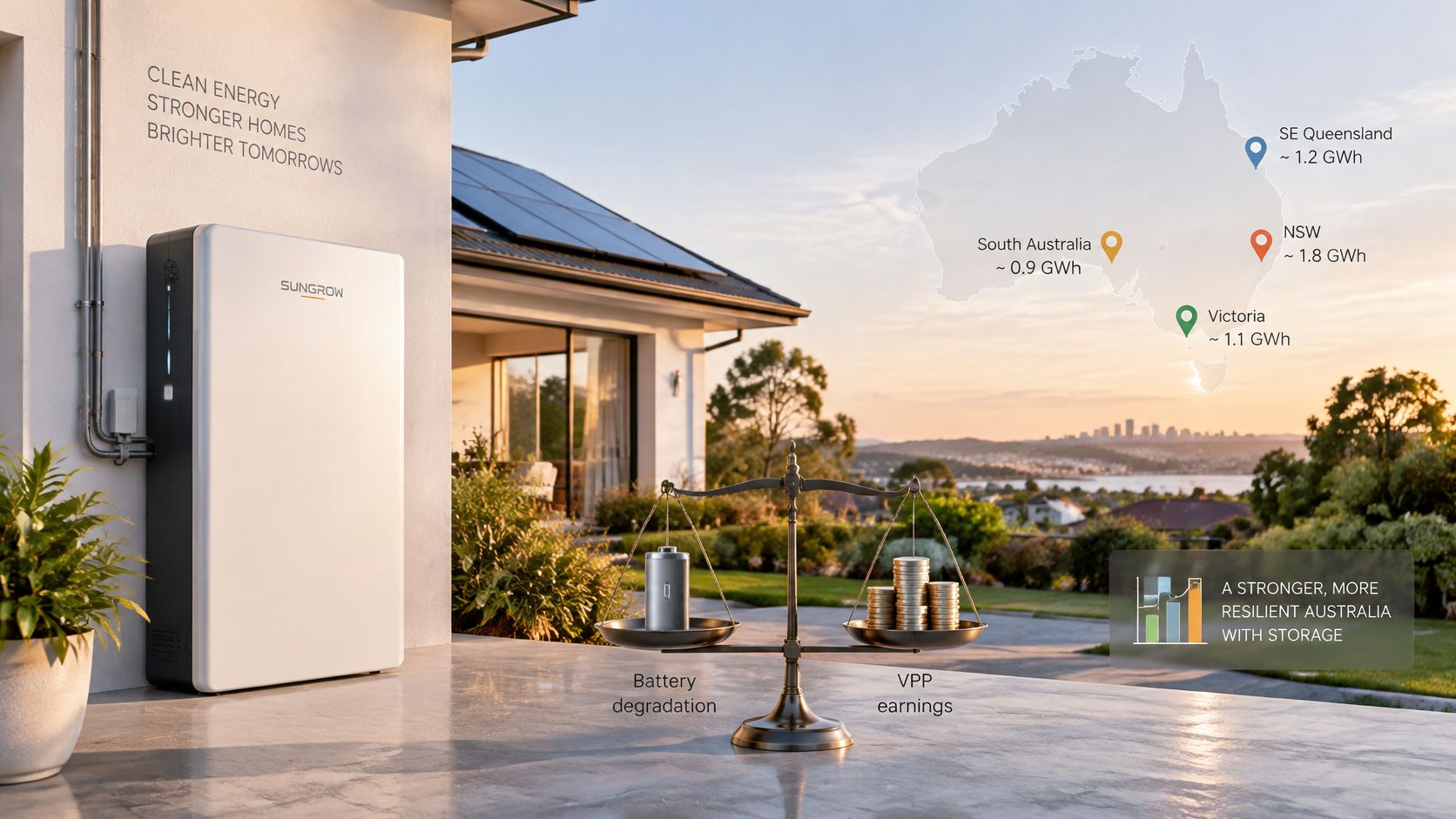
This isn't a marginal issue. The ACCC National Electricity Market inquiry report from July 2025 reported storage capacity across NSW, South Australia, Victoria, and South-East Queensland exceeding 1,014 MWh by Q4 2024. It also cautions that VPP agreements permitting heavy battery use may increase cycling and accelerate degradation compared with household-only operation.
Spend From One Cycle Budget
Every dispatch uses throughput. Warranty limits are usually expressed in cycles, years, retained capacity, or total MWh throughput, so extra VPP dispatch draws on the same budget as your own evening use. More cycling isn't automatically bad value. It's bad value only if compensation is lower than the cost of capacity and flexibility you give up.
CSIRO and AEMO projections cited in that report use approximately 90% round-trip efficiency and model degradation at about 1.8% per year, while noting temperature, depth of discharge, battery design, and cycling conditions materially affect outcomes. As a worked example, a 10 kWh battery losing 1.8% a year holds about 8.3 kWh after 10 years before any extra VPP cycling. Hot garages, deep discharges, and frequent high-power dispatch can worsen that path.
The short video below is a useful prompt to inspect your own cycling and reserve settings before you value any offer.
Run the Lifetime Test
- Estimate annual VPP payment: Use contracted credits or allowances, not best-case market events.
- Estimate extra cycles: Ask for expected additional annual throughput in kWh or MWh.
- Value lost capacity: Price the expected capacity loss at the grid tariff you'd otherwise avoid.
- Compare the results: Join only if payment and bill savings exceed degradation cost under conservative assumptions.
Joining our Bring Your Own Battery VPP does not affect your battery warranty. For any operator, confirm the position in writing with both manufacturer and VPP provider, including whether the operator covers accelerated degradation. Put reserve settings, depth-of-discharge limits, extreme-temperature handling, annual throughput caps, and who pays if degradation reduces usable capacity into the written terms.
Safety, Cybersecurity and End-of-Life Responsibilities
Homeowners don't experience safety, cyber risk, insurance, and disposal as separate topics. A failure can involve all four at once, so map responsibility before something goes wrong.
The Queensland household battery collection pilot final report found strong participant concerns about safety risks, unclear regulatory obligations, and the high cost of transport and disposal. Research summarised in that report also identified limited technical understanding, safety and privacy fears, and distrust of VPPs, with unresolved questions about insurance and liability if third-party control or frequent cycling contributes to damage. It also recorded about 109,000 validated batteries and 2.9 GWh of added capacity in Q4 2025, so these gaps now affect a large installed base.
Who Answers for What
- Installer: Wiring, mounting, clearances, labelling, commissioning, and compliance at installation.
- Manufacturer: Cell or product defects, BMS faults within warranty, and safety recalls.
- VPP operator: Remote commands it issues, dispatch records, platform security, and staying within agreed limits.
- Insurer: Covered loss under your policy, subject to disclosure and any conditions about modifications or third-party control.
- Household: Keeping access clear, reporting alarms or damage, maintaining internet connection where required, and following isolation instructions.
Chemistry belongs in this map. LFP has lower thermal runaway risk than NMC, so choosing LFP reduces one part of fire risk, but it doesn't remove the need for correct installation, ventilation clearances, and emergency information. Connected control adds another layer. Remote access should use authenticated accounts, encrypted communications, least-privilege permissions, and auditable command logs.
Questions to Resolve in Writing
- Emergency isolation: Where's the isolation procedure, and who can perform it safely?
- Failure escalation: Who's the first contact, and what's the response time for alarms or swelling, heat, or odour?
- Command logging: Are remote charge and discharge commands logged, timestamped, and available to you?
- Data permissions: What usage, solar, and battery data is collected, who can access it, and can you revoke access?
- End of life: Who arranges removal, transport, and recycling, and who pays each cost?
Tell your insurer you've installed a battery and joined a VPP, and keep the reply. You keep full ownership and control of your battery when you join HighFlow Energy, but ownership also means you shouldn't assume disposal or uninsured loss automatically transfers to an operator. The contract needs to say so explicitly.
Check Whether Your Battery Is Ready for a VPP
Start with eligibility, not projected savings. A compatible battery in the wrong state, or a large battery with an unsupported inverter, won't produce the value in a brochure.
Eligibility Steps
- Confirm location: You must live in Queensland or New South Wales to join our Bring Your Own Battery VPP.
- Confirm your assets: You need rooftop solar and a home battery you already own.
- Check technical fit: Eligible batteries must meet minimum usable capacity, inverter requirements, and VPP compatibility standards.
- Confirm connectivity: You need a compatible solar system, a compatible home battery, and an internet connection for the battery.
- Review actual use: Check the last 12 months of bills and battery data to see whether capacity sits unused or empties before the peak ends.
Next, gather the battery datasheet, inverter details, warranty statement, and remote control terms. Ask whether the program has lock-in or exit terms and get the answer in writing. Don't rely on verbal assurances about reserve levels or degradation.
Then request an eligibility assessment and ask for three figures before joining: usable capacity, reserve setting, and degradation or throughput terms. Ask how household priority is enforced in software, what happens during a communications outage, and how you override or pause participation. Good internal reference points before that conversation are VPP basics and battery sizing guidance, because they help you compare offers on usable kWh and kW rather than brand names.
Most battery owners focus on installation quality. Far fewer focus on ongoing performance and optimisation. Test whether a retailer built around getting more value from your existing solar and battery system improves on a standard feed-in tariff and unmanaged self-consumption, using your own interval data as the baseline.
Frequently Asked Questions and Key Takeaways
Frequently Asked Questions
Which chemistry suits a home with solar? LFP usually suits daily cycling because it combines long cycle life, strong thermal stability, and efficiency in the low 90s.
How do I read cycle life and efficiency? Cycle life estimates full cycles before capacity falls materially. Round-trip efficiency states how much stored energy returns for use.
Does a VPP shorten battery life? Extra dispatch adds throughput and can accelerate degradation. Value depends on payment, dispatch limits, temperature, depth of discharge, and warranty throughput.
Who's responsible if a battery fails? Installers cover installation faults, manufacturers cover product defects, operators answer for their remote commands, and insurers cover loss only within policy terms.
Does joining change ownership or priority access? No. You retain ownership, and household use should have priority over spare-capacity dispatch under the program settings.
How does usable capacity differ from nameplate capacity? Usable capacity excludes reserve and operating limits. Returned energy is lower again after round-trip losses.
Key Takeaways
- LFP is the default choice for most new Australian home batteries cycled daily.
- Nameplate kWh overstates value unless you subtract reserves, ageing, and conversion losses.
- Power in kW can limit savings even when total stored energy looks sufficient.
- VPP income must exceed degradation cost after valuing extra throughput conservatively.
- Responsibility must be written down for faults, remote control, insurance, data, removal, and recycling.
Most battery owners focus on installation quality, but ongoing optimisation decides whether spare capacity earns value or sits idle. HighFlow Energy is an electricity retailer built around getting the full value from your existing solar and battery system through its Bring Your Own Battery VPP. If you'd like to understand whether your battery is underperforming financially, request an eligibility assessment today.