


Long Term Electricity Price Forecast Australia 2026
Queensland wholesale electricity prices fell from $127.73/MWh in 2024 to $95.00/MWh in 2025, according to the Australian Energy Regulator. That's a substantial change in the cost of electricity before network charges and retail costs, but it doesn't tell a battery owner whether their next bill will fall.
A useful long term electricity price forecast for Australia must answer separate questions: where average prices are heading, when expensive intervals occur, and how your electricity plan converts battery performance into household value. For homeowners in Queensland and New South Wales, the difference between those questions matters more than a single headline forecast.
The Long-Term Outlook in Numbers
The AEMC's 2024 Residential Electricity Price Trends base case projects national residential electricity prices to fall by about 13%, or approximately 5 cents per kilowatt-hour, over a decade. That is an average modelled pathway, not a promise that every household's bill will fall by the same amount. The report attributes the initial decline mainly to new renewable generation.
Long-term outlook by period
AEMO's forecasting assumptions set out the timing of possible changes below. These are projections, not commitments about future tariffs.
| Period | Expected direction | Main driver | Planning implication |
|---|---|---|---|
| Next decade, AEMC base case | National residential prices decline | New renewable generation identified in the ISP | Average pathway, not a guaranteed bill cut |
| Early 2030s, projected | Wholesale prices decline | Renewable build-out lowers energy costs | Average costs ease, but timing still matters |
| Mid-2030s, projected | Greater volatility | Thermal retirements and replacement renewables, storage and firming | Test exposure to scarcity intervals |
| 2040s, projected | Modest wholesale increase; network charges rise gradually | Flexible gas generation and transmission investment | Long-run costs may rise after the initial decline |
The AEMC base case also expects network prices to fall. The report separates that outlook from wholesale costs, which decline initially before rising towards the end of the projection period.
This distinction matters for household bills. Wholesale forecasts cover the energy component; residential prices also include network, retail and policy costs. A lower average price therefore does not translate directly into an equal reduction in every customer's bill.
For battery owners, lower average prices may reduce returns from exporting electricity indiscriminately, while preserving value from avoiding costly imports. The key question is when stored electricity is used, not only how much is stored.
Planning rule: Model cheap and expensive periods separately for Queensland and NSW. An annual average alone cannot show when a battery may reduce household costs.
What Recent Prices Reveal About Volatility
Queensland and NSW wholesale prices
The observations and modelling below cover different periods and purposes. They shouldn't be joined into a continuous forecast.
| Measure | Queensland | New South Wales |
|---|---|---|
| 2024 average wholesale price and change from 2023, AER market assessment | Approximately $101/MWh, down 36% | Approximately $114/MWh, down 27% |
| Q2 2026 reported average, AEMO quarterly material | $67/MWh, down 44% year-on-year | $75/MWh, down 53% year-on-year |
| Q3 2026 figures reported in that quarterly material | $61/MWh | $74/MWh |
| 2026–27 modelled average, AER wholesale-cost modelling | About $145/MWh | About $145/MWh |
The quarterly material attributes Queensland's decline partly to increased renewable output and more battery discharge during peak periods. Its reported NEM-wide quarterly result also indicates lower average prices, but quarterly observations aren't interchangeable with annual wholesale-cost modelling.
There's also a comparability warning: the AER Queensland annual series used in the opening has a different reported basis from the annual figures in this table. Without reconciling the definitions, it would be misleading to calculate a trend between them.
Why lower averages don't settle the battery question
NSW remained the highest-priced NEM region in the annual assessment despite its falling average. Outages, generator rebidding and transmission constraints contributed to pressure during the autumn period.
The same AER assessment records administered pricing from 8 to 15 May 2024, with wholesale prices capped at $600/MWh, and cites an assessment containing 2,898 NSW trading intervals above $500/MWh and 303 above $2,500/MWh. These aren't prices every household paid. They describe wholesale conditions that retailers and market participants had to manage.
A household on a conventional fixed-rate retail plan doesn't automatically face the spot price during those events. Its exposure depends on its contract, whereas a VPP operator may use the event to dispatch available battery capacity.
Falling annual averages don't remove the value of avoiding expensive intervals. They make accurate dispatch, and the contract that shares its value, more important.
There's a counterweight: when many batteries discharge together, they can reduce peak prices. Forecasting battery returns by assuming yesterday's largest spreads will persist indefinitely is therefore too optimistic.
The Drivers That Will Shape Future Prices
Think of a produce stall with abundant stock around lunchtime and limited stock near dinner. Prices can differ sharply even when the daily average looks unremarkable. Electricity has an added constraint: operators must balance supply and demand continuously.
AEMO's Integrated System Plan fact sheet identifies renewables connected through transmission and distribution, firmed by storage and supported by gas, as the lowest-cost NEM pathway. That describes a system configuration, not a household tariff promise.
The main interactions are illustrated below.
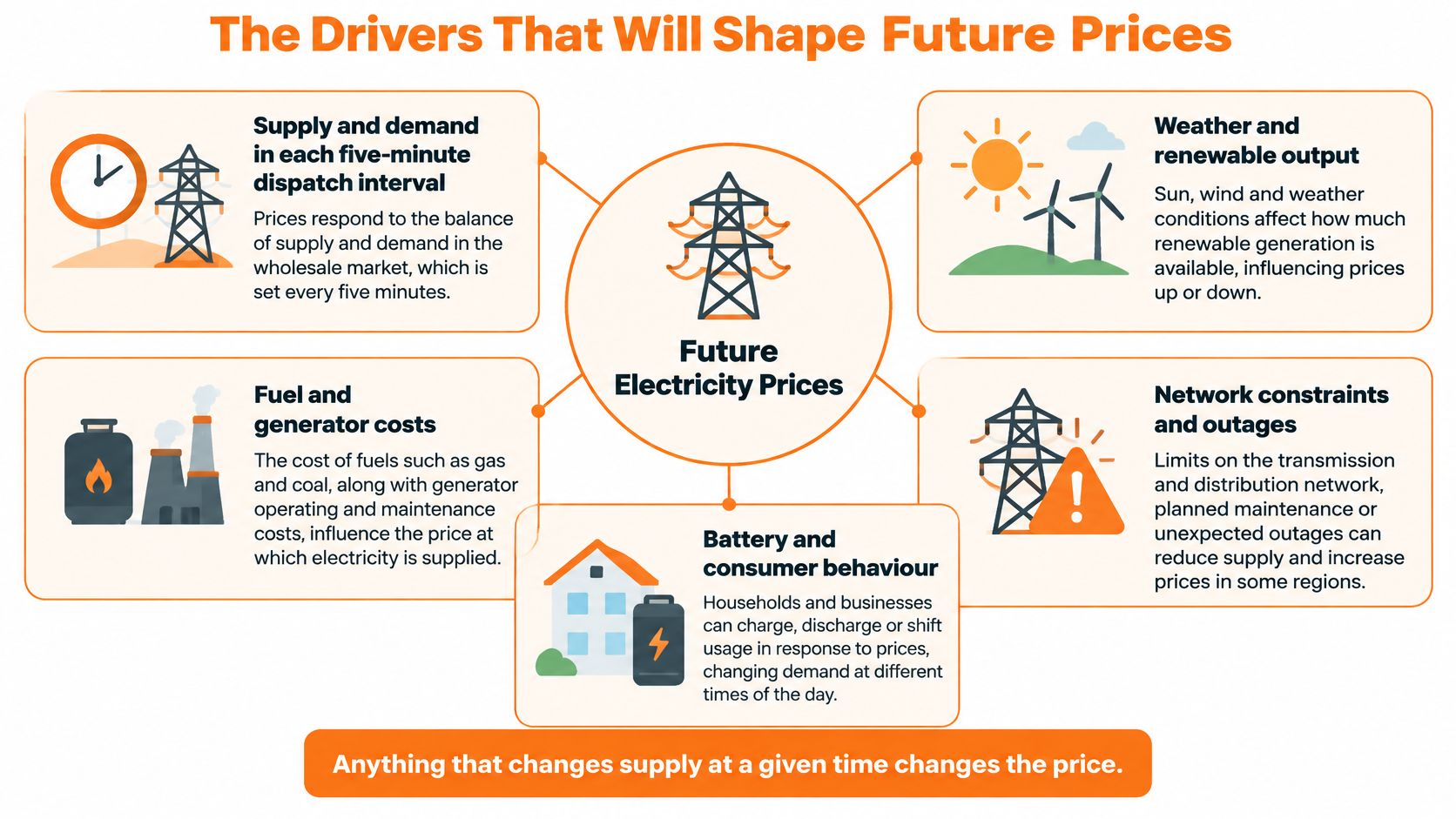
Wholesale energy
Solar and wind can reduce the need for higher-cost generation when output is strong. Coal retirements, low renewable availability and evening demand can tighten supply, while flexible gas generation provides firming at a fuel-dependent cost.
Storage shifts electricity between periods. Aggregated household batteries add flexible supply and demand, but they can't create unlimited energy or ignore household requirements.
Generator availability matters too. Forge Reliability's explanation of power plant condition monitoring provides operational context for understanding equipment condition and outage risk. It's a resource on plant reliability, not an electricity-price forecast.
Network, policy and retail costs
Separate the remaining drivers into distinct bill layers:
- Network costs: Transmission development, local congestion and distribution requirements affect how electricity reaches your home.
- Policy costs and support: Environmental schemes and government assistance influence bills independently of spot-market movements.
- Retail costs and margins: Your retailer's purchasing strategy, operating costs and contract determine how wholesale conditions translate into charges.
Our explanation of the cost of electricity helps distinguish these components when comparing offers.
A useful test for any electricity-price headline is straightforward: which bill layer changes, and does it affect the hours when your battery can act? A change in daily supply charges calls for a different response from a change in evening energy prices.
How Battery Value Stacks Up Across Revenue Streams
Battery value can come from several services, but each competes for limited stored energy and power. Some services can operate at the same time; others require the battery to reserve capacity for a different opportunity.
Battery revenue streams compared
| Revenue stream | What triggers it | Household effect | Main limit |
|---|---|---|---|
| Energy arbitrage | A price gap between cheaper and more expensive intervals | Avoided peak imports or export value | Spreads can narrow as storage participation grows |
| Contingency FCAS | Grid frequency events | Potential payment for rapid response | Requires response capability and available capacity |
| Local network support | A local network requirement | Value tied to a specific constraint | Opportunities depend on location and dispatch |
| Demand response | Demand events and peak conditions | Reduced grid demand during tight periods | Household requirements take priority |
Frequency Control Ancillary Services, or FCAS, help maintain electricity-system frequency following disturbances. Demand response changes consumption or grid imports when the system needs flexibility.
Aggregated batteries can provide more than one service, including responding to wholesale prices, supplying contingency FCAS and supporting local networks. The illustration shows these potential sources of battery value.
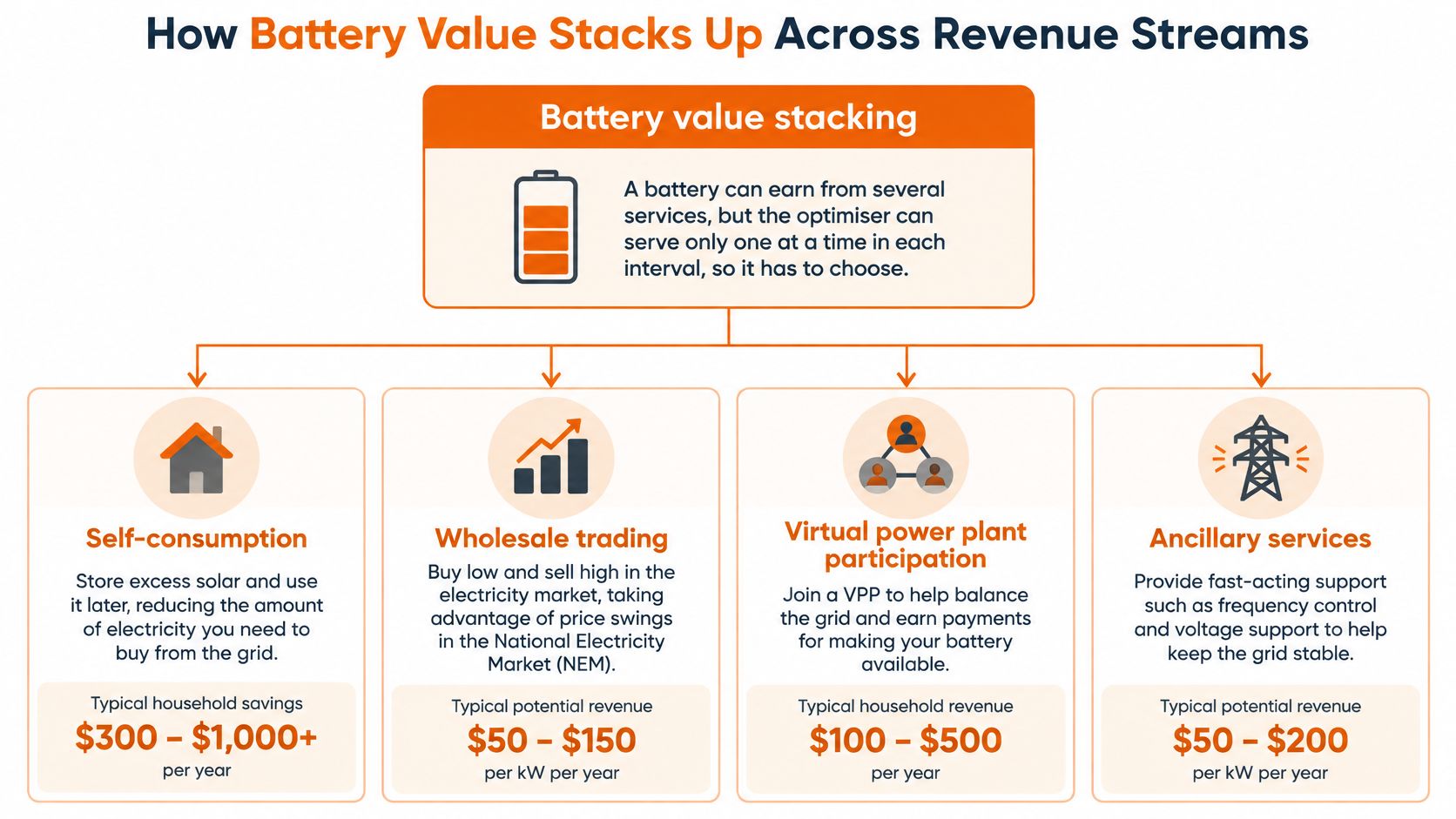
Household priority and opportunity cost
Keeping energy in reserve for a possible grid event means forgoing another use. This foregone opportunity has a shadow value: an optimiser should discharge only when the expected benefit is greater than the value of retaining that energy.
For HighFlow Energy's BYOB VPP, household energy use is prioritised before grid support. The battery's spare capacity supports the grid, and the value earned funds the customer's monthly bill-free electricity allowance.
The payment mechanisms differ:
- Fixed feed-in tariff: Pays an agreed credit for exported electricity, regardless of the export time.
- VPP participation: May capture value from services that depend on timing; the customer's benefit depends on the programme's payment or allowance terms.
- Self-consumption: Avoids purchases under the retail tariff rather than earning a separate market payment.
The guide to multiple battery revenue streams explains how these mechanisms differ. Before estimating additional battery value, identify which services it already provides and how much capacity remains available.
Modelling Price Scenarios for Battery Households
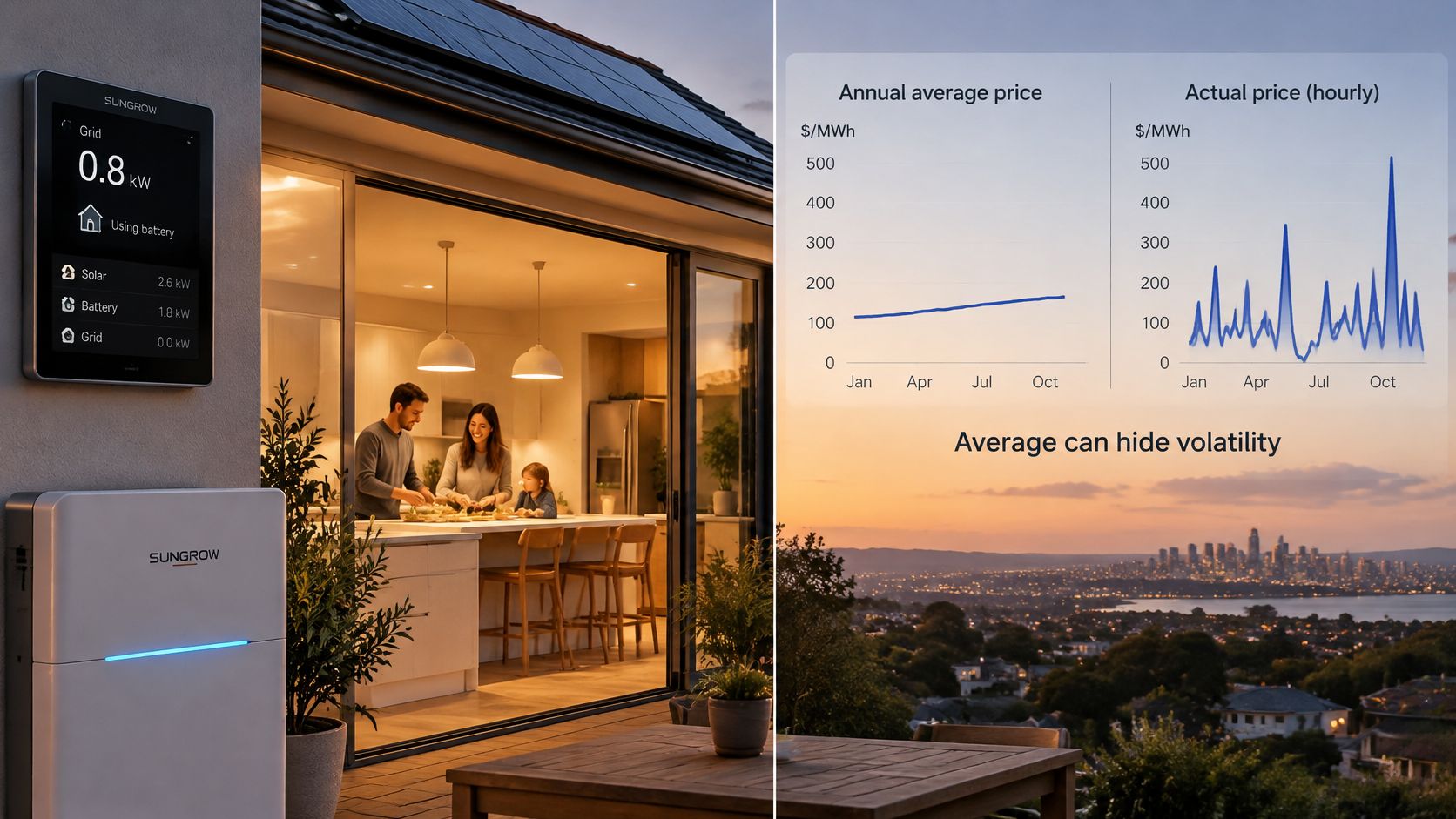
The annual modelling figure in the price comparison is a starting point, not a dispatch strategy. The AER's wholesale-cost modelling estimates approximately $145/MWh for Queensland and NSW in 2026–27, while the associated reliability discussion includes modelled intervals at $300–$500/MWh and higher bands reaching $7,500/MWh. Those are modelling inputs and outcomes, not promised trading opportunities.
The practical problem is matching available storage to that changing price profile.
Battery value under four forecast scenarios
These are illustrative planning assumptions, not separate AEMO or AER forecast outputs.
| Scenario | Wholesale assumption | Battery behaviour that pays | What to model |
|---|---|---|---|
| Central, gradual renewable build | Average costs ease before greater volatility | Evening discharge with reserve for peaks | Annual bills under low, central and high usage |
| Low price, heavy solar and battery uptake | Lower averages and narrower spreads | Self-consumption and allowance utilisation | Reduced arbitrage value and export credits |
| High volatility, slower storage build | Scarcity spikes and negative midday prices | Preserve capacity for valuable events | Event frequency and genuinely available capacity |
| Late-decade rise | Prices increase towards the outlook's end | Charge from solar surplus before costly imports | Energy costs, network charges and supply charges |
A low-price scenario shouldn't automatically assume poor battery economics. Avoided retail imports can still matter, but an optimiser must compare them with export opportunities after losses, cycling and reserve requirements.
Conversely, a high-volatility scenario shouldn't assume every spike is monetised. Your battery could be empty, serving your home, offline or constrained by its export limit.
Build the household model
- Set hourly price assumptions. Preserve the difference between daytime, evening and scarcity conditions instead of spreading an annual average uniformly.
- Apply physical limits. Include usable capacity, charge and discharge power, efficiency, export permission, battery state of charge and the household reserve.
- Run usage sensitivities. Test lower, expected and higher consumption, including supply charges, time-of-use tariffs and export credits.
- Separate the benefits. Calculate self-consumption, tariff arbitrage and grid-service value without counting the same stored energy twice.
For our Bill-Free Electricity offer, current allowance tiers range from 300 kWh to 1,000 kWh per billing month, depending on solar and battery system size. Model your confirmed allowance rather than assuming the largest tier applies.
The accompanying video provides additional context for the household energy discussion.
Stress-test first: If the projected benefit disappears when wholesale spreads narrow, treat it as price-sensitive upside rather than dependable household savings.
What the Forecast Means for Your Electricity Bill
The Default Market Offer isn't a cap on actual bills. The Australian Energy Regulator's DMO guidance makes that distinction explicit and gives 2026–27 NSW annual benchmarks ranging from $1,899 for an Ausgrid flat-rate customer using 3,900 kWh to $2,604 for an Essential Energy customer using 4,600 kWh.
Those benchmarks use different consumption assumptions. They aren't a like-for-like ranking of network affordability, and neither is a forecast of a solar-and-battery household's net bill.
Translate the forecast into your contract
Use the bill layers to identify what your plan charges:
- Wholesale energy: Influences retail purchasing costs, but doesn't necessarily flow straight through to your tariff.
- Network charges: Can remain payable even when your household imports little energy.
- Environmental and government components: Can change independently of your battery's operation.
- Retail margins: Form part of the commercial offer you accept.
- Daily supply charges: Require separate treatment from usage charges.
Our electricity tariff structure guide provides a framework for reading these charges. In an energy retailer comparison, calculate the total net bill rather than choosing the largest export credit.
Two assumptions to avoid
A falling forecast doesn't mean a battery loses all value. It changes the relative importance of avoided imports, export timing and service payments.
Solar and storage don't automatically remove every charge. A low-import household can still pay fixed charges, while exported energy may receive less than the price paid for imports.
For an allowance-based plan, put the mechanics into explicit questions before estimating savings:
- Coverage: While you remain eligible, does the confirmed monthly allowance provide a $0 daily supply charge and $0 usage within that allowance?
- Network treatment: Does VPP-funded coverage include network and distribution charges on the allowance?
- Excess usage: Is electricity above the confirmed allowance charged at the applicable excess usage rate, without a penalty for exceeding it?
- Other charges: Which additional fees can apply in particular circumstances?
These questions distinguish conditional bill coverage from an unconditional promise of bill elimination. A household forecast must retain the cost of excess consumption and any applicable charges rather than treating the allowance as unlimited electricity.
Check Whether Your Battery Is Earning Its Keep
- Download bills and interval data. Use a full annual consumption cycle where available, including seasonal solar production and evening imports.
- Confirm your distributor. Identify the actual network on your bill, such as Ausgrid, Endeavour, Energex, Essential or Ergon, before selecting a benchmark.
- Test usage scenarios. Compare lower, expected and higher consumption against your tariff and any confirmed allowance.
- Inspect battery behaviour. Record evening imports, unused export opportunities and whether you receive grid-service value.
- Check warranty and compatibility. Review cycling conditions, reserve settings and export approval before changing plans or operating settings.
A battery that fills early but empties before evening demand deserves investigation. That pattern isn't proof of underperformance: household load, battery size and backup preferences may explain it.
Use actual bills alongside battery records.

Why HighFlow Energy
Our Bring Your Own Battery offer is designed for homeowners in Queensland and NSW who have solar, a compatible battery and continuing electricity bills. It's available only in participating service areas and works the same way for Energex and Ergon customers.
We manage eligibility, customer communications and the allowance programme. ERC Energy Pty Ltd, an authorised Australian electricity retailer, provides regulated retail, billing, compliance and market services under our brand.
Billing and general enquiries are handled from 8:30am to 4:30pm AEST, Monday to Friday.
Key takeaways
- Forecast scope: National averages aren't individual bill predictions.
- Dispatch quality: Available capacity matters more than nameplate capacity.
- Contract value: Market revenue and household benefits aren't identical.
- Risk control: Test narrower spreads and higher household usage.
- Performance review: Assess ongoing operation, not installation quality alone.
Frequently Asked Questions
Does the AEMC forecast mean my bill will fall?
No. It describes a modelled national pathway, not a guaranteed household result. Your consumption, distributor, tariff and export arrangements determine how much of any reduction reaches your bill.
Is the Default Market Offer a cap on my bill?
No. It's a regulated benchmark based on specified usage assumptions. Your actual consumption and electricity plan can produce a different annual bill.
Why can a battery remain useful when average prices fall?
A battery operates at particular times, not at an annual average. Its value depends on the difference between charging opportunities, avoided imports and available service payments, after operating constraints.
Can a battery earn from more than one service at once?
Sometimes. Compatible services can overlap, but the operator must respect power limits, stored energy and service obligations. It can't allocate the same unavailable capacity to competing commitments.
Does a battery remove every charge on my bill?
No. Fixed charges, excess usage and other applicable fees can remain. Any allowance must be assessed against its eligibility conditions and confirmed plan terms before assuming a zero-dollar bill.
HighFlow Energy offers a Bring Your Own Battery VPP that uses spare battery capacity to support the grid and fund a conditional monthly electricity allowance. To understand how changing electricity prices could affect your existing system's financial performance, visit HighFlow Energy and request an eligibility assessment.