


Compare Energy Plans for Solar and Battery Homes
Choosing the highest solar feed-in tariff isn't a reliable way to compare energy plans when you own a battery. You need to price what your household imports and exports, at the times those transactions happen, after the battery has operated.
For homeowners in Queensland and New South Wales, the right comparison starts with a modelled annual net bill. Then test that result against your network's regulated reference price and the control, backup and compensation conditions attached to any Virtual Power Plant offer.
Annual Benchmarks to Compare Plans Against
The regulated benchmark is a reference point, not a forecast of your household's bill. The 2025–26 DMO determination sets these annual residential benchmarks for NSW distribution areas and south-east Queensland.
Annual DMO benchmarks by distribution area (2025–26)
| Distribution area | Annual benchmark without controlled load | Annual benchmark with controlled load |
|---|---|---|
| Ausgrid | $1,965 | $2,717 |
| Endeavour Energy | $2,411 | $3,072 |
| Essential Energy | $2,741 | $3,211 |
| Energex (south-east Queensland) | $2,120 | $2,818 |
The Australian Energy Regulator's DMO guidance explains that the DMO caps standing-offer prices and provides a reference for market offers in NSW and south-east Queensland. The annual benchmark assumes defined consumption, so actual charges vary with household use and plan terms.
A controlled load is a separately metered circuit, such as eligible electric storage hot water or pool equipment. Check the wiring and metering arrangement before assuming a battery can supply it.
Compare like with like
The benchmark helps test a plan, but a battery changes the household's pattern of imports and exports. The Clean Energy Council's rooftop solar and storage report reports that NSW installed 6,692 MW and Queensland 5,713 MW of rooftop solar capacity since January 2019. For households with solar and storage, a consumption-only comparison can therefore miss how the battery affects the annual bill.
Use the DMO as a check on the modelled result:
- Check the advertised comparison: Confirm the retailer uses your distribution area and meter configuration.
- Model your household: Calculate the offer using your own imports, exports and battery settings.
- Investigate an above-benchmark result: Check whether consumption, controlled load, backup preferences or tariff conditions account for the difference.
A modelled bill below the DMO does not establish that a plan is the cheapest available. A result above the benchmark calls for an explanation, not automatic rejection. Compare plans using the same household usage and battery behaviour, then rank them by modelled annual bill rather than treating the difference from the DMO as a retailer discount.
Tariff Structures That Change the Winning Plan
The daily supply charge is the fixed cost of maintaining the electricity connection. The usage rate prices imported electricity, while the feed-in tariff credits electricity exported to the grid. These components need separate treatment.
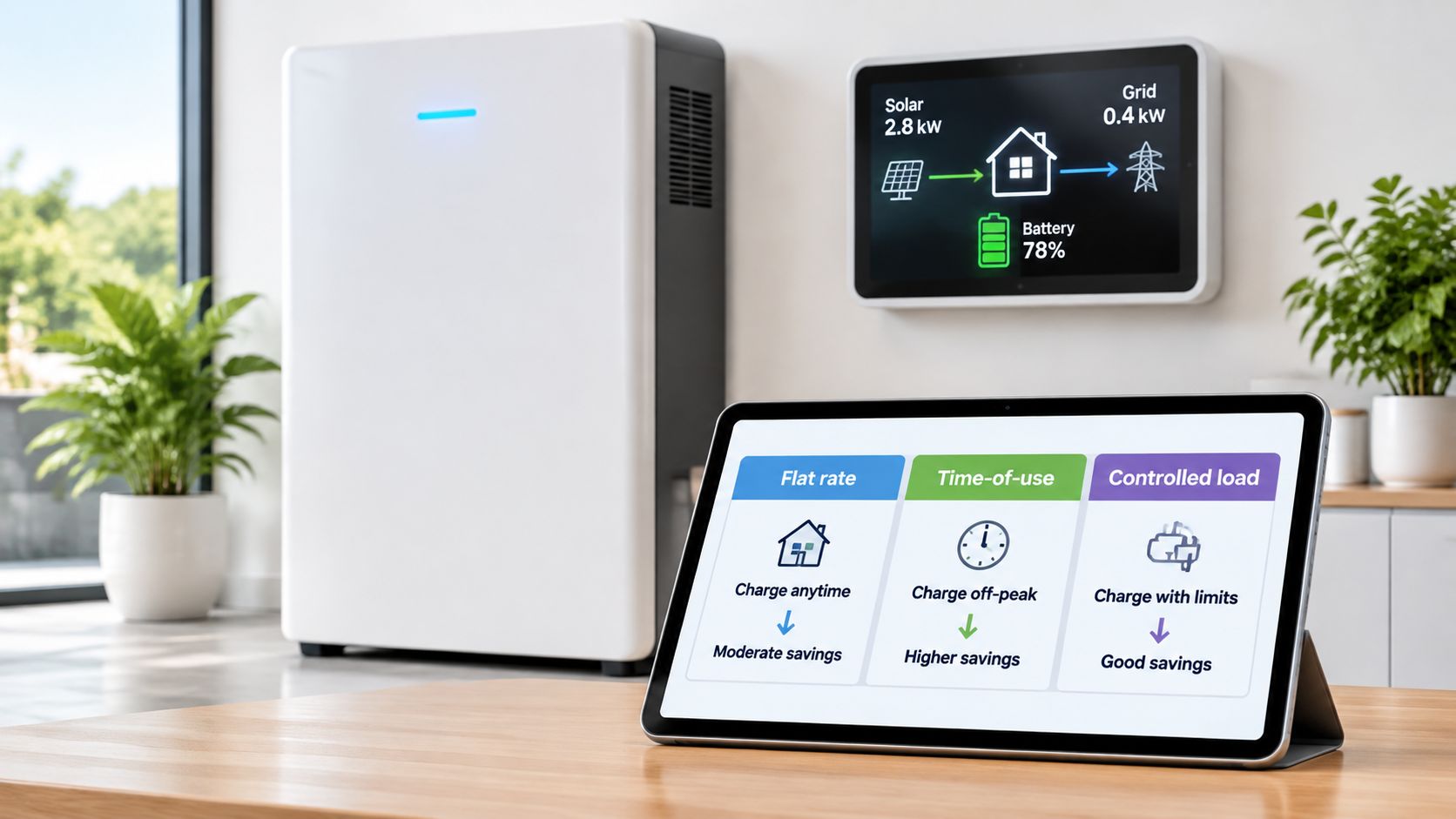
Tariff structures and their effect on a battery
| Tariff structure | How the rate is set | Effect on a battery owner |
|---|---|---|
| Flat rate | One usage rate at all hours | Timing alone creates no import-rate advantage; supply and usage charges remain important |
| Time-of-use | Peak, shoulder and off-peak rates | Charging off-peak and discharging at peak can change the plan ranking |
| Controlled load | Separate rate for a separately metered circuit such as hot water | Check the meter arrangement and applicable controlled-load benchmark |
| Time-based feed-in | Export credit changes by time window | Evening exports may earn more than midday exports under the offer's terms |
The AER's electricity pricing fact sheet%20-%20Fact%20Sheet%20-%20July%202026.pdf) describes how tariff timing affects electricity costs. For a battery owner, the practical question is whether cheaper charging and avoided peak imports outweigh charging losses and any forgone export credit.
Timing gains aren't the same as energy savings
Consider a hypothetical household importing 12 kWh during the evening peak window each day. If its battery has sufficient usable energy and discharge power to cover that window, it can replace those peak imports. But the electricity used to charge the battery still has a cost, whether that's an off-peak purchase or a forgone solar export.
On a flat-rate plan, shifting grid purchases between hours doesn't change the import price. Storing solar can still have value, but that's a different calculation from off-peak arbitrage.
A battery also can't physically remove the connection's daily charge. A retailer may offset that charge through an allowance or credit, but the model must account for the offer's conditions.
Before comparing feed-in rates, record:
- Fixed costs: Daily supply charges and recurring fees.
- Import windows: Peak, shoulder and off-peak prices and their exact hours.
- Export conditions: Time windows, thresholds and eligibility restrictions.
Use our electricity tariff structure guide to interpret the tariff components before entering them into a comparison.
How to Model Your Annual Bill Step by Step
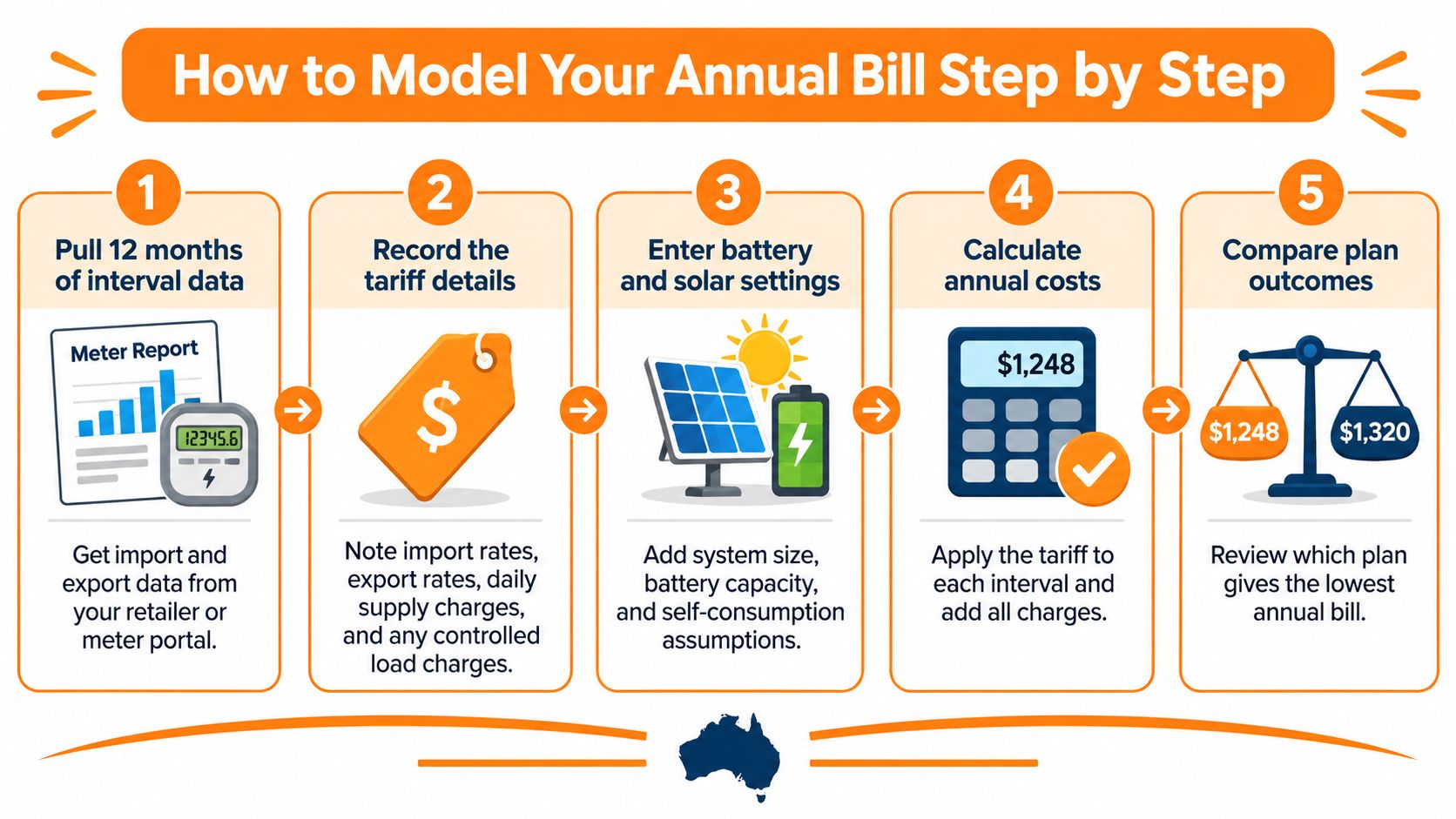
The annual bill, not the headline rate, determines which plan suits a battery household. Use interval data, meaning meter readings recorded across individual time periods, to price imports and exports under each offer. Compare the result with the applicable regulated DMO benchmark, while accounting for the battery's actual operating pattern.
Build and validate the calculation
Gather a full year of interval data. Request import and export records from your retailer or meter portal, ideally covering twelve months. Add solar generation and battery monitoring records where available. Meter data alone does not show electricity generated and consumed behind the meter.
Calculate fixed costs. For a standard non-leap-year model, multiply the daily supply charge by 365, then add applicable recurring fees. This keeps connection costs visible even when grid imports are low.
Price each import interval. Apply the offer's peak, shoulder or off-peak rate to each timestamp. Check weekends, seasonal windows and daylight-saving treatment rather than assuming every evening has the same price.
Credit each export interval. Apply the relevant feed-in rate, including time windows, daily thresholds and eligibility conditions. Only qualifying exports should receive an advertised premium rate.
Model battery operation under each offer. Enter usable capacity, charge and discharge power, losses, minimum reserve and grid-charging permissions. If a new tariff would change battery behaviour, model that operation rather than repricing historical imports.
Add separately billed components. Include controlled-load circuits, demand charges where applicable and other relevant charges. Keep these costs visible so you can identify what changes the result.
Calculate annual net cost. Add fixed, import and other charges, then subtract export credits and qualifying benefits. Compare each total with competing offers and the applicable DMO benchmark. The benchmark is a reference point, not a personalised savings guarantee.
Stress-test the result. Model normal battery operation, low-solar winter conditions and high-export summer conditions. Change the reserve setting too. A plan that wins only when the battery uses energy you want to keep for backup may not suit your priorities.
An Australian energy cost comparison guide can help organise the inputs. Keep assumptions visible wherever an estimate substitutes for missing interval data.
Separate tariff changes from household changes
Model planned efficiency upgrades separately from a tariff change, then combine them only if you want to assess both together. For example, a guide to cut cooling costs with spray foam can inform building-envelope considerations, but its savings assumptions should not be applied to a particular home without a property-specific assessment.
Validation check: Your current-plan model should reconcile reasonably closely with actual bills before you rely on its ranking of other offers.
Check billing periods, concessions, credits, taxes and missing readings if the totals differ. Actual charges depend on consumption and the terms of the Energy Plan, so a particular usage pattern does not guarantee a particular bill outcome.
Why a Lower Feed-in Tariff Can Win
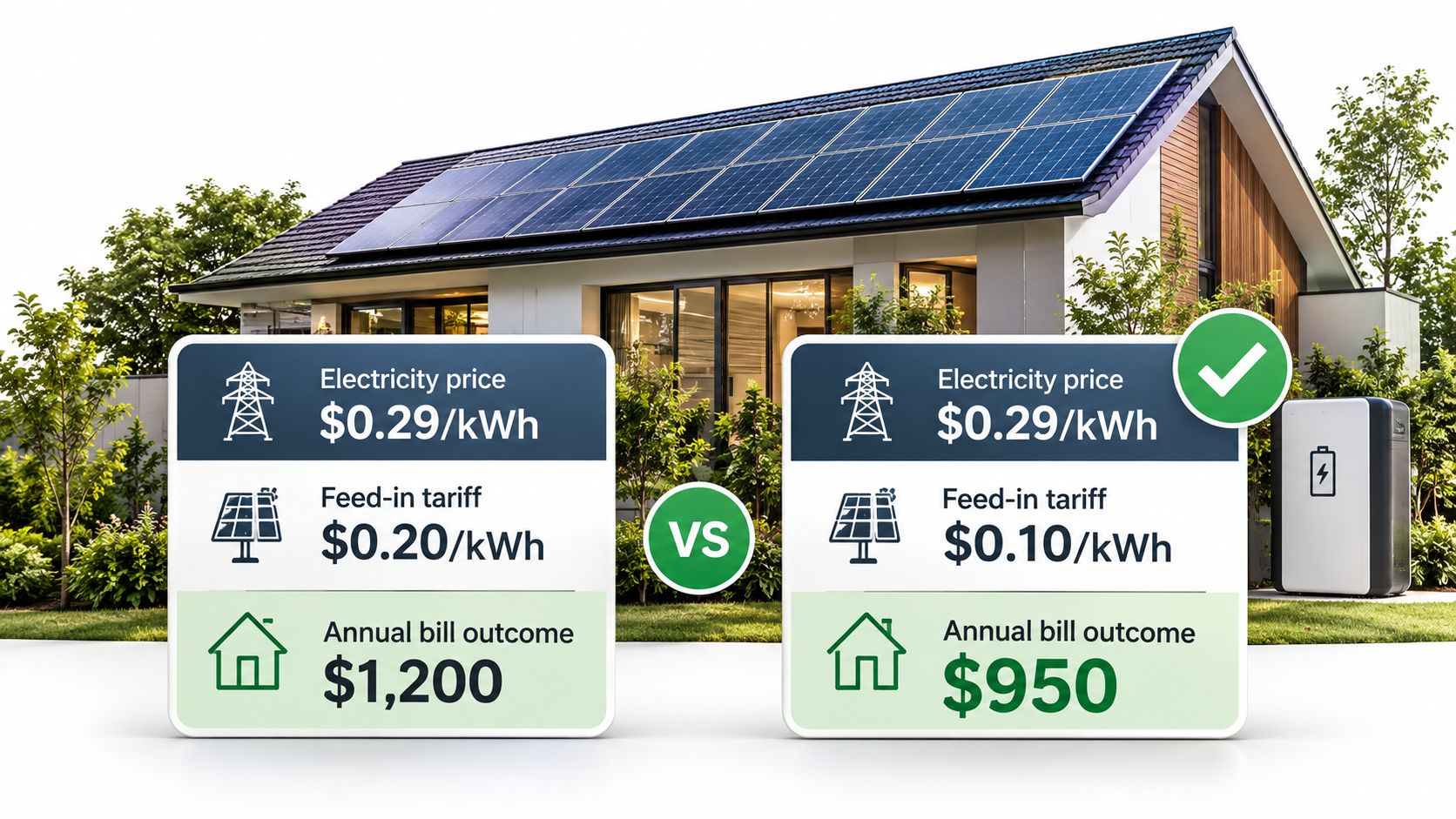
A lower feed-in tariff can accompany the better electricity offer. The Australian Bureau of Statistics reports that in 2024–25, the average Australian electricity price was $0.29 per kWh, while the average feed-in tariff was $0.06 per kWh.
These are national averages, not prices to insert into your own forecast. Their relevance is the distinction between earning an export credit and avoiding an import charge.
Compare the energy you actually trade
Suppose Plan A offers a higher feed-in rate but charges more for evening imports. Plan B pays less for exports but has cheaper evening electricity.
If the battery stores most surplus solar and supplies much of the evening load, the household may have relatively little export volume earning Plan A's premium. Plan B can win if its savings on remaining imports exceed the export revenue sacrificed, after allowing for supply charges and other conditions.
However, complete evening coverage changes that reasoning. If neither plan produces evening imports, Plan B's cheaper evening rate contributes no saving for those intervals. The outcome must then come from other imports, fixed charges, export credits or benefits.
Conversely, a household with strong daytime exports and little evening demand may favour Plan A. That result is more plausible when the premium applies to the household's actual export windows and isn't undermined by thresholds.
The feed-in rate tells you what a kilowatt-hour earns when it leaves the home; the annual bill tells you what the battery saves when it stays home.
Don't maximise self-consumption automatically, either. Where an export payment is sufficiently attractive, exporting and buying electricity later may produce the better financial result, subject to losses and plan rules.
Start with the same battery constraints for both offers so the comparison is fair. Then, if each plan permits different optimisation, run a second comparison using the best permitted operating schedule under each.
VPP Terms to Check Before You Join
A Virtual Power Plant, or VPP, coordinates participating batteries to provide services beyond the individual home. A Bring Your Own Battery, or BYOB VPP, uses a compatible battery the household already owns.
VPP scorecard: terms to confirm in writing
| VPP term | What to confirm | Why it matters |
|---|---|---|
| Minimum state-of-charge reserve | Lowest energy level retained for household use | Influences energy available for backup |
| Homeowner override | Whether you can stop grid activity at any time | Preserves operational control |
| Outage behaviour | What happens when the grid fails | Establishes whether supported backup is protected |
| Compensation method | Payment per kWh, event or allowance | Explains how participation value reaches you |
| Network charge treatment | Which charges an allowance covers | Determines the net financial benefit |
| Warranty implications | Whether permitted cycling meets warranty conditions | Helps protect the existing asset |
| Exit conditions | Fixed term, exit fee and cancellation fee | Establishes your ability to leave |
AEMO's Electricity Statement of Opportunities identifies coordinated batteries' ability to reduce peak operational demand and absorb excess generation. That system benefit doesn't, by itself, establish the homeowner's compensation or backup availability.
Translate grid value into household value
Within the National Electricity Market, coordinated charging and discharge can support demand response, meaning a change in electricity consumption or supply when the system needs it. Network congestion and connection export limits can still restrict what a battery may deliver.
A retailer-based VPP combines electricity billing with battery coordination. Distinguish the retailer's wholesale or grid-service revenue from the benefit contractually credited to you. Wholesale price volatility doesn't automatically mean your retail bill changes, so establish which risks the provider retains and which reach the customer.
The Australian Government's tariff guidance recommends comparing the complete electricity outcome, including import prices, export payments, supply charges and timing. Apply that same discipline to VPP allowances.
Protect control and backup
A reserve is an operating setting, not a guarantee that every appliance will run through an outage. Confirm backup-capable circuits, inverter behaviour and manufacturer warranty conditions alongside the contractual reserve.
Our solar battery Virtual Power Plant guide provides further context. With us, household energy use takes priority, manual override is available, and there's no fixed-term contract, exit fee or cancellation fee.
A cheap-looking offer can still be unsuitable if its dispatch permissions conflict with your backup priorities.
Which Plan Fits Your Battery Household
| Household profile | Main comparison priority | Constraint to preserve |
|---|---|---|
| Evening-heavy, little daytime demand | Peak and shoulder import costs | Sufficient stored energy for evening use |
| Large daytime exporter in a mild climate | Eligible feed-in payments and export windows | Connection export limits |
| Winter, low-solar household | Fixed costs and grid-charging economics | Reserve and cycling settings |
| Backup-priority household | Reliability of retained energy | Outage behaviour and override |
| Controlled-load hot water or pool owner | Separately metered rates and relevant benchmark | Actual circuit and meter configuration |
The right plan matches when your household trades electricity, not merely how much it uses annually. Households with identical annual consumption can rank the same offers in opposite order because their imports and exports occur at different times.
Account for competing uses of stored energy
An electric vehicle adds another decision: use surplus solar for transport, retain it for the evening, or export it. Facility Management Insights' discussion of coordinating EV charging and demand response offers useful scheduling context, but a home comparison must use the vehicle's actual charging routine and the applicable residential tariff.
Treat household priorities as constraints, not inconveniences to optimise away:
- Backup comes first: If you require a higher reserve, exclude models that achieve savings by breaching it.
- Export capacity is finite: Don't assign revenue to discharge your network connection won't permit.
- Convenience has value: Don't assume daily manual intervention if you won't maintain it.
The decision rule is straightforward: select the lowest credible annual net cost among offers that satisfy your operating requirements. A cheaper model that relies on unavailable capacity or unacceptable backup risk isn't the winning plan.
Frequently Asked Questions About Comparing Energy Plans
Is the DMO a cap on my final bill?
No. It caps standing-offer prices within its scope, not the amount every household pays. Your consumption, tariff structure and applicable charges determine the bill.
Where can I compare energy plans independently?
Energy Made Easy is the Australian Government's recommended starting point for NSW and south-east Queensland households. Use your own consumption information and check battery-specific conditions in the retailer's documents.
Does a battery remove the daily supply charge?
No. Storage changes energy flows, not the connection charge itself. An allowance or credit may cover that cost under an offer's conditions, which is different from eliminating the charge through battery operation.
Is a higher feed-in tariff always better?
No. Its value rests on qualifying export volume and timing, weighed against all other charges. A household retaining most surplus solar may receive little benefit from an export premium.
Will joining a VPP reduce my backup power?
It can affect available stored energy, depending on dispatch permissions and reserve settings. Confirm outage behaviour and backup hardware capabilities rather than treating battery ownership alone as backup protection.
Does controlled-load hot water change the benchmark?
Yes. Use the relevant controlled-load benchmark and include that circuit's actual charges. Don't assume hot water consumption appears in the main household tariff or can be supplied by the battery.
How often should I recheck my plan?
Review it when reference prices or retailer rates change, and after changes to household demand, battery settings or export conditions. An electric vehicle, changed work routine or higher backup reserve can alter the ranking without any tariff changing.
Key Takeaways and Next Step
A plan's headline rate does not determine its value for a battery household. Compare the modelled annual bill using your household's actual battery behaviour, then test the result against the applicable regulated DMO benchmark.
- Rank plans by annual cost: Include imports, exports, supply charges and any allowance limits.
- Account for fixed costs: Lower grid imports do not, by themselves, remove daily supply charges.
- Value exports in context: A higher feed-in tariff matters only for the electricity that qualifies.
- Check VPP terms: Review reserve settings, override options, outage behaviour, warranty conditions and exit terms.
Why HighFlow Energy belongs in the comparison
HighFlow Energy is an Australian energy service built around improving the value of existing solar and battery systems through a Bring Your Own Battery Virtual Power Plant. Compare its offer with your modelled annual bill; participation does not guarantee a particular saving.
HighFlow Energy provides Basic Plan Information Documents for residential market offers, setting out key pricing, eligibility requirements and conditions. Its eligibility criteria are published, allowance tiers are explained, and pricing outside the allowance is shown upfront.
The team can help identify your network and which plan applies. HighFlow Energy manages eligibility, customer communications and the allowance program, while ERC Energy provides regulated retail services under Australian energy laws.
Bill outcomes depend on electricity use and the Energy Plan's terms. For HighFlow's offer, compare the monthly allowance with your expected usage and account for standard rates on electricity imported above the allowance.
HighFlow Energy uses spare home battery capacity to support the grid through its VPP, with the value generated funding an eligible household's electricity allowance. Visit HighFlow Energy to request an eligibility assessment, understand your potential allowance and compare the proposed outcome with your household's modelled annual bill.