


Best Electricity Plans in QLD & NSW for 2026
The cheapest headline rate stops being the point the day a battery sits on the wall. Comparison sites still sort the best electricity plans by usage cents and sign-up discounts. That ranking was built for homes that only buy power. A rooftop system plus storage adds exports, a daily supply charge that does not disappear at noon, and the question of who controls the battery after dark.
This roundup looks at seven plans in Queensland and New South Wales the way a battery owner should. Feed-in tariffs, time-of-use windows, wholesale exposure, and Virtual Power Plant participation each get a plain verdict: what the plan rewards, and where it falls short.
Nothing here is a promised saving. Network tariffs, export limits, and your own load still decide the annual bill. Solar alone supplied about 18% of national generation in 2023–24, and small-scale rooftop solar represented 13.3% of generation in New South Wales and 12.2% in Queensland in 2024–25, according to the Australian Energy Update 2025. A single advertised rate cannot describe that household.
1. HighFlow Energy
HighFlow Energy is built for people who already own the hardware. You bring a compatible rooftop system and a home battery; HighFlow does not supply the battery under this plan. The battery joins a Virtual Power Plant, and spare capacity supports the grid. That grid-service value funds a monthly bill-free electricity allowance.
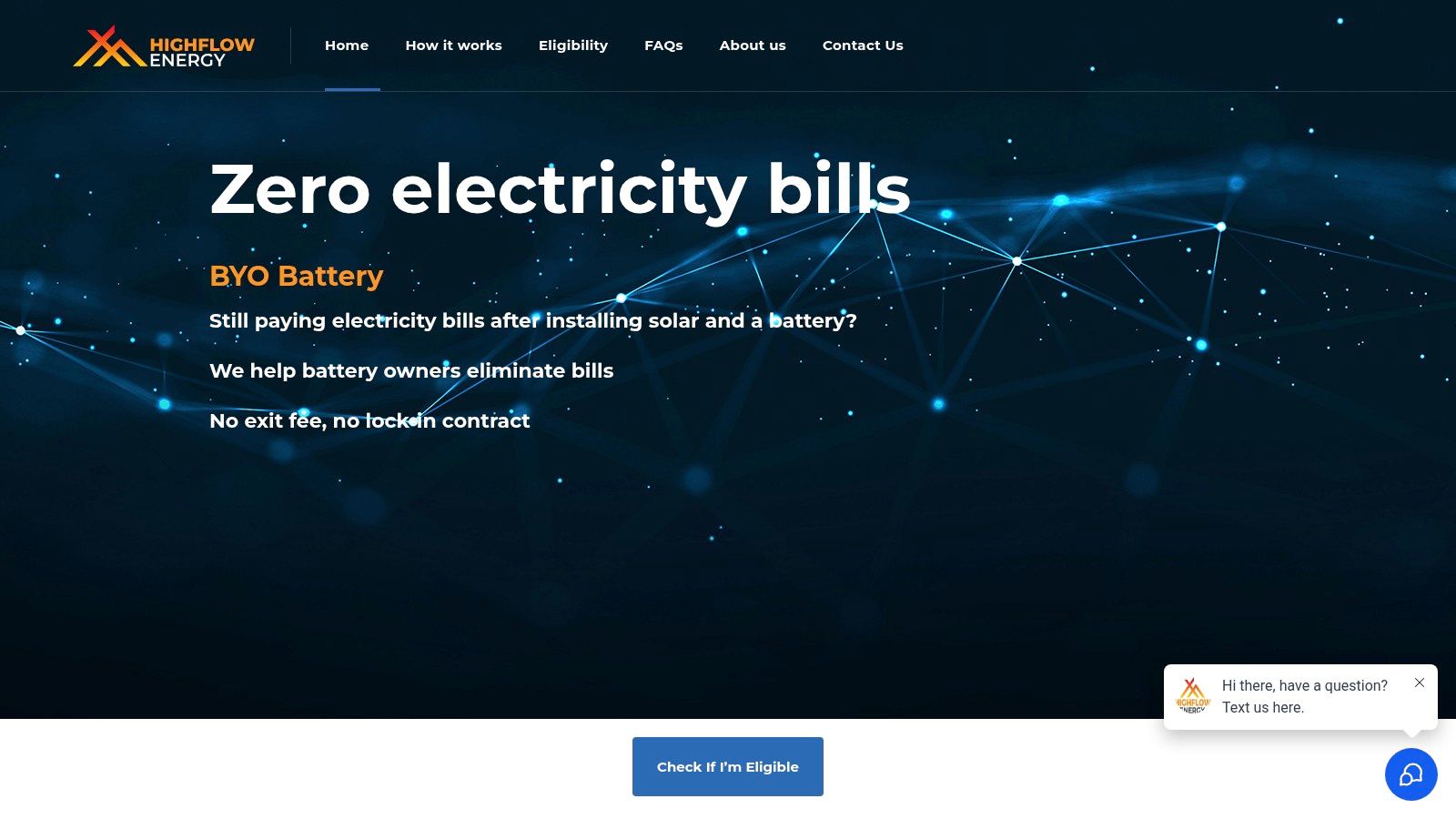
While you stay eligible, the allowance is a $0 daily supply charge and $0 usage inside a confirmed monthly cap, including $0 network and distribution charges on that covered portion. Current tiers run from 300 kWh up to 1,000 kWh per billing month, depending on solar and battery system size. Household use comes first. You stay connected to the grid, keep ownership, and stay in control of the battery, with no new hardware, no fixed term, and no exit fee.
The app shows live prices and home energy, and builds a charge and discharge plan from price, weather, solar and usage forecasts. You can override it at any time, and day to day you do not need to monitor anything or change how you use power.
VPP earnings move with grid conditions, so treat any bill estimate as a range rather than a promise. Model your own interval data against the allowance tier you would be offered. That is the honest way to test whether this structure beats a high feed-in tariff for your household.
What still shows up on the bill
The allowance resets each month. Usage above it is charged at the applicable excess rate, with no penalty for going over. A monthly bill still issues, and it can be $0 if you stay inside the cap. The offer runs only in NSW and Queensland service areas, and it works the same way for Energex and Ergon customers. Regulated retail services sit with ERC Energy under Australian energy laws. HighFlow does not guarantee that any usage pattern produces a set bill, and additional fees can apply to the account in certain circumstances.
Practical rule: Treat a bill-free allowance as a capped credit funded by grid support, then check whether your evening imports fit inside it before you ignore the excess rate.
- Worth it when: You want supply charges and ordinary usage covered without managing wholesale prices yourself.
- Weak spot: Eligibility depends on location and compatible equipment. Confirm the tier for your system size in the Basic Plan Information Document before you compare offers.
- Control: You do not hand the battery over full-time. Household needs stay prioritised, and manual override stays available.
Details sit on the HighFlow Energy site. Read the Residential Electricity Agreement, Price Schedule and VPP Market Services Agreement. The public FAQ is only a summary.
2. Amber Electric with SmartShift
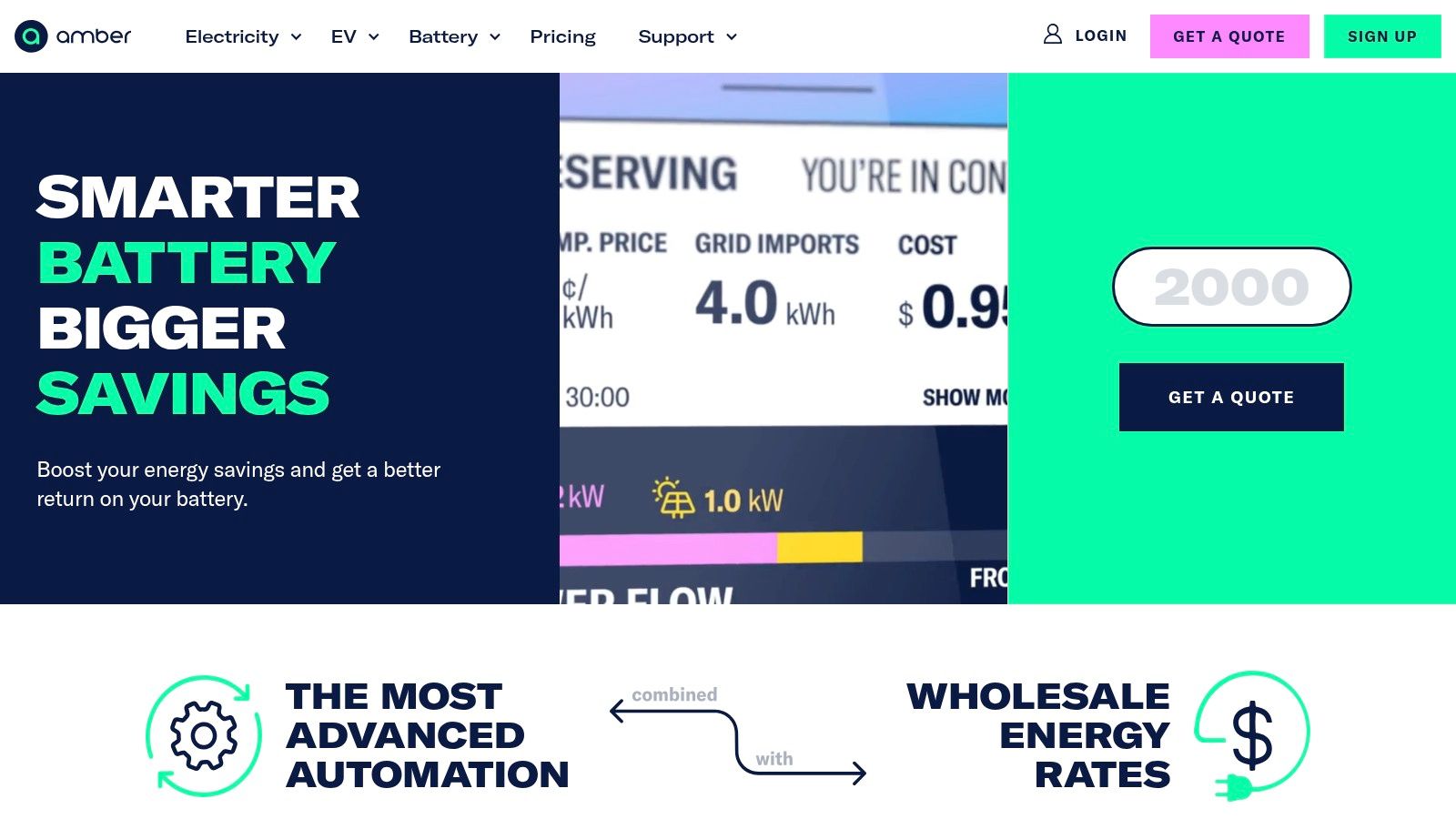
Amber prices imports and exports off the wholesale market, then lets SmartShift plan the battery around forecasts of demand, solar output, and price. If you already watch the National Electricity Market and you can shift a hot-water boost or a pool pump, this is the plan that uses that habit.
Official figures put solar generation at 47.8 TWh in 2023–24 and 53.4 TWh in 2024–25, and on-grid solar nearly doubled from 27.2 TWh in 2020–21 to 52.4 TWh in 2024–25, in the Australian electricity generation statistics. That flood of daytime solar is why a wholesale-linked battery can charge when prices sag and export when they spike. It is also why a high daytime feed-in rate is a weak scorecard. A lower export credit can still win if supply charges fall or the battery avoids the expensive hours.
SmartShift is available in NSW and South East Queensland on compatible batteries and inverters. The app shows forecasts and the planned actions, and you can step in manually. Some remote commands can lag. Wholesale prices move, sometimes sharply, so earnings are not guaranteed. I would not put a household that wants a fixed evening rate on this product.
See Amber for Batteries for the current equipment list.
3. AGL Battery Rewards Plan
AGL pays a published premium for battery exports in a short evening window, and it leaves the volume decision with you. The advertised rate on AGL's Battery Rewards plan is 28¢/kWh from 5pm to 9pm, then 3¢/kWh outside that window. You choose whether to export and how much, and you keep battery control unless you separately join AGL's VPP. You need an eligible battery and a digital meter. AGL states there is no lock-in contract and no exit fee.
The structure suits a household that already runs its battery on a schedule. Hold charge through the afternoon, discharge from 5pm, and every exported kWh inside the window earns the premium. Australian Government guidance on pricing plans notes that time-varying feed-in tariffs may pay more for evening exports, while time-of-use tariffs let batteries charge in cheaper periods and discharge at the peak. AGL's offer is that idea in fixed form: a known rate, a known window, and no exposure to the spot market.
Predictability is the trade-off. The premium exists only inside those four hours, so a battery that cannot hold charge until 5pm collects the flat rate instead, and usage and supply charges still depend on the address. If you are weighing AGL's separate VPP against a retailer allowance model, the AGL VPP review sets out the control questions in one place.
4. Origin Battery Charge
Origin sells a defined midday block rather than a market price. On Origin's battery plans, the advertised offer is up to 28 kWh of free electricity from 11am to 3pm, plus 11¢/kWh for battery exports from 6pm to 9pm, capped at 10 kWh, subject to plan limits. You schedule charging and exports in the Origin app or the battery app. Other Origin battery-plan structures exist if this window does not fit.
Daily supply charges and controlled-load charges still apply during the free-use period. The benefit collapses if you cannot store or use enough energy between 11 and 3, or if the export cap is already reached by early evening. Availability, rates and caps change by location.
A free midday block only pays if the battery has empty capacity when the window opens. A battery that is already full from the morning's solar collects little.
This structure rewards discipline more than battery size. A household that empties the battery before 11am and shifts heavy loads into the window collects real value; a household that exports little is paying for flexibility it never uses. For a smaller battery I would weigh it against a guaranteed feed-in rate, because the window and cap decide the return rather than a per-kWh price. If you are comparing Origin's solar add-ons with a VPP allowance, the Origin Solar Boost plan notes lay out how the pieces fit.
5. ENGIE VPP
A Virtual Power Plant pools rooftop solar and home batteries into one resource the operator can dispatch. Government battery guidance says joining a VPP can reduce electricity prices, lift feed-in tariffs, or deliver other financial benefits, in exchange for giving the operator control of the battery for some or all of the time. That trade is the product.
ENGIE pays in bill credits: an upfront credit once the battery is enrolled, then monthly VPP credits on the bill, on ENGIE's current description. Credits are easy to value, which makes this simpler to compare than a wholesale plan. The cost is the battery-operation conditions you accept up front. This suits a household that would rather not manage exports itself. It suits them less if backup reserve and unrestricted control matter more than the credit.
Participation across the VPP market remains limited, and reported bill outcomes vary with plan design, battery size, weather, and eligibility rather than any single enrolment decision. Regulator reporting such as the AER 2026–27 consolidated stakeholder report tracks the sector, but published averages are context, not an offer.
Confirm compatible equipment and the current credit before you enrol via ENGIE's VPP page. For a wider look at how dispatch, reserve, and exit terms should be read, see this solar battery virtual power plant guide.
6. GloBird Energy ZEROHERO
ZEROHERO is a plain time-of-use plan, not a wholesale product and not a VPP. For specified new sign-ups from 1 July 2026, GloBird's published schedule lists off-peak from 12pm to 3pm and peak from 4pm to 11pm. Times and rates still move with the network and the plan version. That label is a future sign-up schedule, so check the version that applies at your address.
Predictable off-peak hours make scheduled charging simpler than a wholesale feed. The cost is a long peak that covers late afternoon and the whole evening, which is exactly when many batteries are asked to cover the house. A high peak rate or a heavy supply charge can wipe out the cheap midday imports.
Smart-meter rules sit underneath any of these windows. The AER's smart-meter consumer rights page states that retailers must make a flat-rate tariff available to smart-meter customers in Queensland, and that customers in both Queensland and New South Wales are protected against unilateral tariff-structure changes for two years after a retailer-installed smart meter unless they consent. If a time-of-use switch does not suit the battery, ask for the flat option before you accept it.
Tariff sheets by network are on GloBird Energy.
7. Red Energy Living Energy Solar Saver
Living Energy Solar Saver is a conventional retail plan with a solar feed-in tariff, not battery automation. Red Energy's Queensland plan page lists 5¢/kWh. NSW feed-in tariffs vary by distributor and tariff type. There is no contract term and no exit fee, on Red Energy's account, and optional GreenPower is listed.
That simplicity is the product. You do not enrol the battery in a third-party dispatch scheme. You also do not get paid for shifting energy into the evening beyond whatever flat export rate applies at the address. Usage charges and the daily supply charge still dominate many annual totals, so the feed-in figure alone is a poor sort key.
Home batteries are arriving fast enough that a static export rate is a smaller slice of the decision. The AER reports that home battery installations in Australia increased by 62% in 2024 compared with 2023, in its energy yearbook release. Separately, the CER recorded 43,517 solar batteries installed with new or existing rooftop systems after batteries became eligible for the Small-scale Renewable Energy Scheme on 1 July 2025, with 825 MWh of combined nominal capacity, in its September 2025 installation update. A 5 cent export credit does not use that capacity.
Check the address-specific rate on Red Energy's Queensland plans.
How the top solar and battery electricity plans compare
| Plan | Battery value mechanism | Predictability | Best for |
|---|---|---|---|
| HighFlow Energy | Monthly bill-free electricity allowance for eligible batteries supporting the grid through a VPP | Allowance is capped; amount and excess usage rate are not specified | Eligible solar-and-battery households seeking bill credits while retaining battery control |
| Amber Electric, Amber for Batteries with SmartShift | SmartShift optimises battery charging and exports against wholesale prices | Wholesale prices and potential savings vary | Compatible battery owners comfortable with market-linked prices and automated control |
| AGL, Battery Rewards Plan | Pays 28¢/kWh for exports from 5pm to 9pm and 3¢/kWh outside that window | Set export rates and hours; usage and supply charges vary by address | Battery owners able to choose evening exports |
| Origin Energy, Origin Battery Charge | Up to 28 kWh of free electricity daily from 11am to 3pm; 11¢/kWh for exports from 6pm to 9pm, up to 10 kWh | Defined time windows and caps; terms and availability vary | Households able to charge batteries or shift usage to midday |
| ENGIE, ENGIE VPP | Upfront and monthly bill credits for VPP participation | Credit value depends on current offers and contract terms | Eligible battery owners comfortable with VPP operating conditions |
| GloBird Energy, ZEROHERO | Time-of-use pricing supports savings from off-peak battery charging | Set time windows; rates and timings vary by network and plan | Households able to charge or use energy off-peak and limit peak imports |
| Red Energy, Living Energy Solar Saver | Solar feed-in tariff, with no described VPP battery control | Feed-in tariff varies by state, distributor and tariff | Customers seeking a conventional solar plan without battery VPP participation |
Choosing Between Bill Credits, Export Rates and a Bill-Free Allowance
Pick the mechanism that matches how you want the battery to behave, not the logo.
Hands-off grid support. A VPP plan trades some automated dispatch for credits or an allowance. Ask who sets the reserve, whether you can override, and what happens to backup if the operator discharges before a storm.
Price exposure. Wholesale-linked control can earn more when you can tolerate bad weeks. It is the wrong default if a stable evening rate is the reason you bought the battery.
A published window. Evening export bonuses and free midday blocks are easy to audit. They pay only inside the clock times, and supply charges usually remain.
A flat feed-in tariff. Fine if you refuse outside control. Weak if the battery's value is mostly the imports it avoids after 6pm.
Key takeaways
- Rank plans on stored-energy treatment, not the headline usage rate.
- Model a full year: imports, exports, supply charges, and any credit or allowance.
- VPP medians are not your bill. Dispatch rules and exit terms are.
- Free hours and premium export windows expire outside the published clock.
- A low feed-in tariff can still be rational if you will not share control.
For eligible Queensland and New South Wales battery owners, HighFlow Energy's bill-free allowance is the option to test against those windows. Eligible customers receive $0 daily supply and usage charges inside a confirmed monthly allowance funded by VPP participation. Current tiers run from 300 kWh up to 1,000 kWh per billing month, scaling with solar and battery size, and they reset monthly. Electricity above the allowance is charged at standard rates with no penalty for exceeding it. There is no fixed contract term and no exit fee while you remain eligible. That is a structure to check against your interval data, not a guaranteed outcome.
Most battery owners focus on installation quality. Far fewer focus on ongoing performance and optimisation. If you want to see whether the battery is underperforming financially, request an eligibility assessment and read the plan documents before you switch.
HighFlow Energy connects an existing rooftop system and compatible home battery to a Virtual Power Plant, then uses spare capacity to fund a monthly allowance that can cover supply and usage charges. If your current plan only pays a flat export rate, or only pays inside a short evening window, an eligibility check shows whether that allowance fits the household better. Visit HighFlow Energy to review your system and the current terms.