

How Wholesale Electricity Prices Shape Your Battery Bill
In 2024, New South Wales recorded a volume-weighted annual wholesale price of AUD 150/MWh, rising 43% year on year, while Queensland averaged AUD 128/MWh, a 26% increase from 2023, according to the Australian Energy Regulator State of the Energy Market 2025 Chapter 2. Those wholesale electricity prices stayed well above pre-2022 levels, yet below the record reached during the 2022 energy crisis. For a solar and battery owner, the annual average is the least useful number in that sentence. Your battery doesn't earn or save at the average. It earns or saves in specific five-minute intervals, often when prices are far above or below it.
What Wholesale Electricity Prices Are and Who Sets Them
A wholesale electricity price is what generators are paid for each megawatt-hour (MWh) they sell into the market. It isn't the price printed on your bill. Your retailer buys energy shaped by that wholesale market, adds network, environmental, metering and retail costs, then sells you a retail plan with its own rates and charges.
Think of a daily produce auction. Sellers offer stock at set prices. The operator stacks the cheapest offers first until buyers' demand is met, and the last offer accepted sets the price for that interval. Electricity works on the same stacking logic, except the auction repeats constantly and the product can't be stored easily at grid scale without batteries.
Who Runs the Market
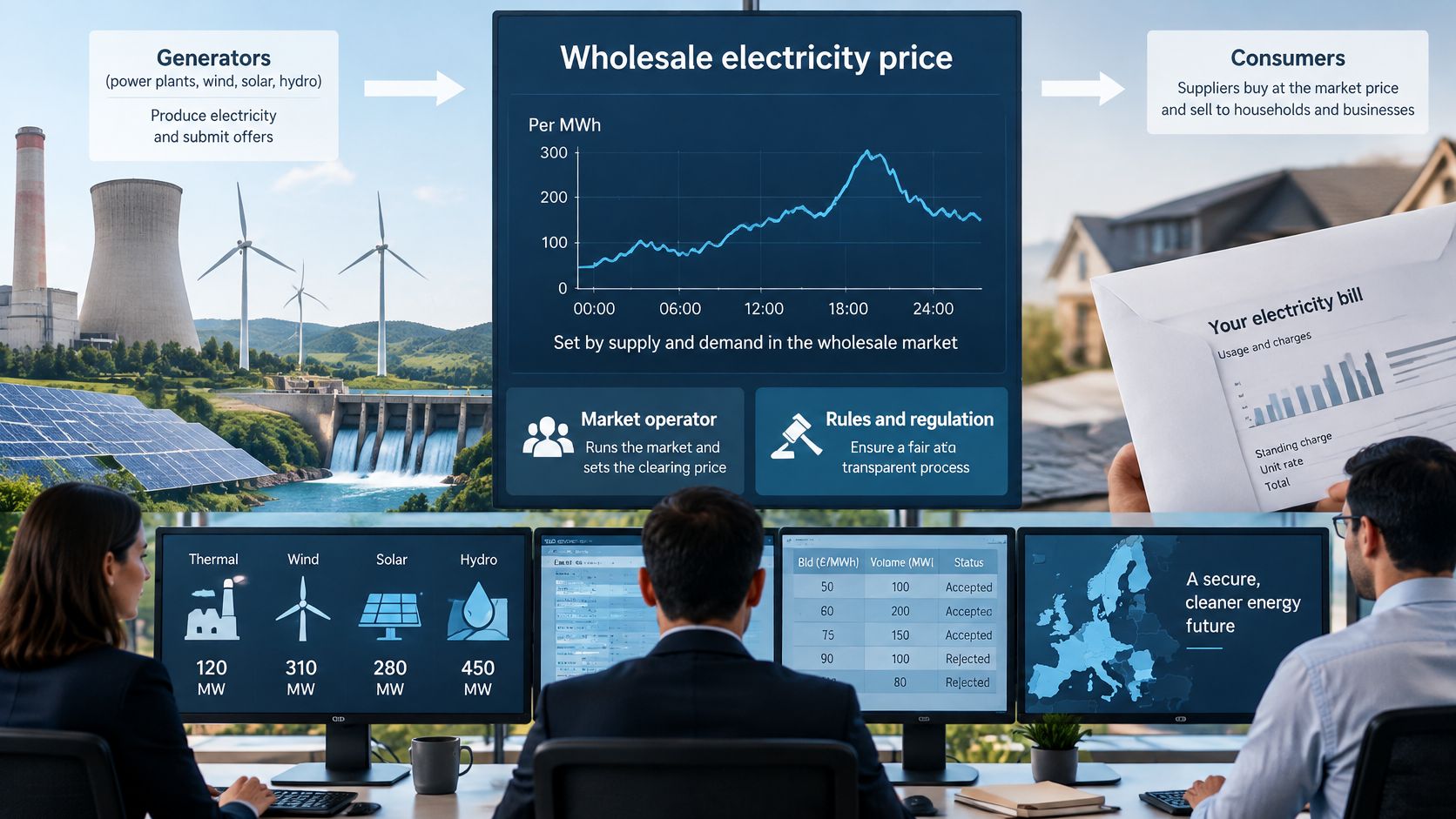
Australia's wholesale electricity markets are operated by the Australian Energy Market Operator (AEMO), which matches buyers and sellers, schedules generation at the lowest wholesale cost, settles trades and manages market data, as AEMO explains in its overview of what it does. The National Electricity Market (NEM) covers Queensland, New South Wales, Victoria, South Australia, Tasmania and the Australian Capital Territory. Prices form through competitive dispatch, so no individual retailer sets them directly.
That distinction matters when you compare retailers. A retailer can design how it exposes you to wholesale movement, hedges it, or shares value from responding to it. It can't control the dispatch price itself. AEMO also identifies rooftop solar and batteries as distributed energy resources that can participate in Virtual Power Plants, which is how a household asset connects to a market built for large generators.
Converting the Units
The arithmetic is simple and worth memorising. 1 MWh equals 1,000 kWh. A wholesale price of $100/MWh therefore equals 10 cents per kWh before network, environmental or retail costs are added. A price of $300/MWh equals 30 cents per kWh on the same basis.
Practical rule: Divide any $/MWh figure by ten to get cents per kWh, then remember that figure excludes every other bill component.
Your first step is to check your current plan. Does it fix your usage rate, vary it by time of use, or pass wholesale movement through in some form? That answer determines whether a wholesale spike is your problem, your retailer's problem, or, with a battery responding at the right moment, your opportunity.
How Supply and Demand Move Prices Every Five Minutes
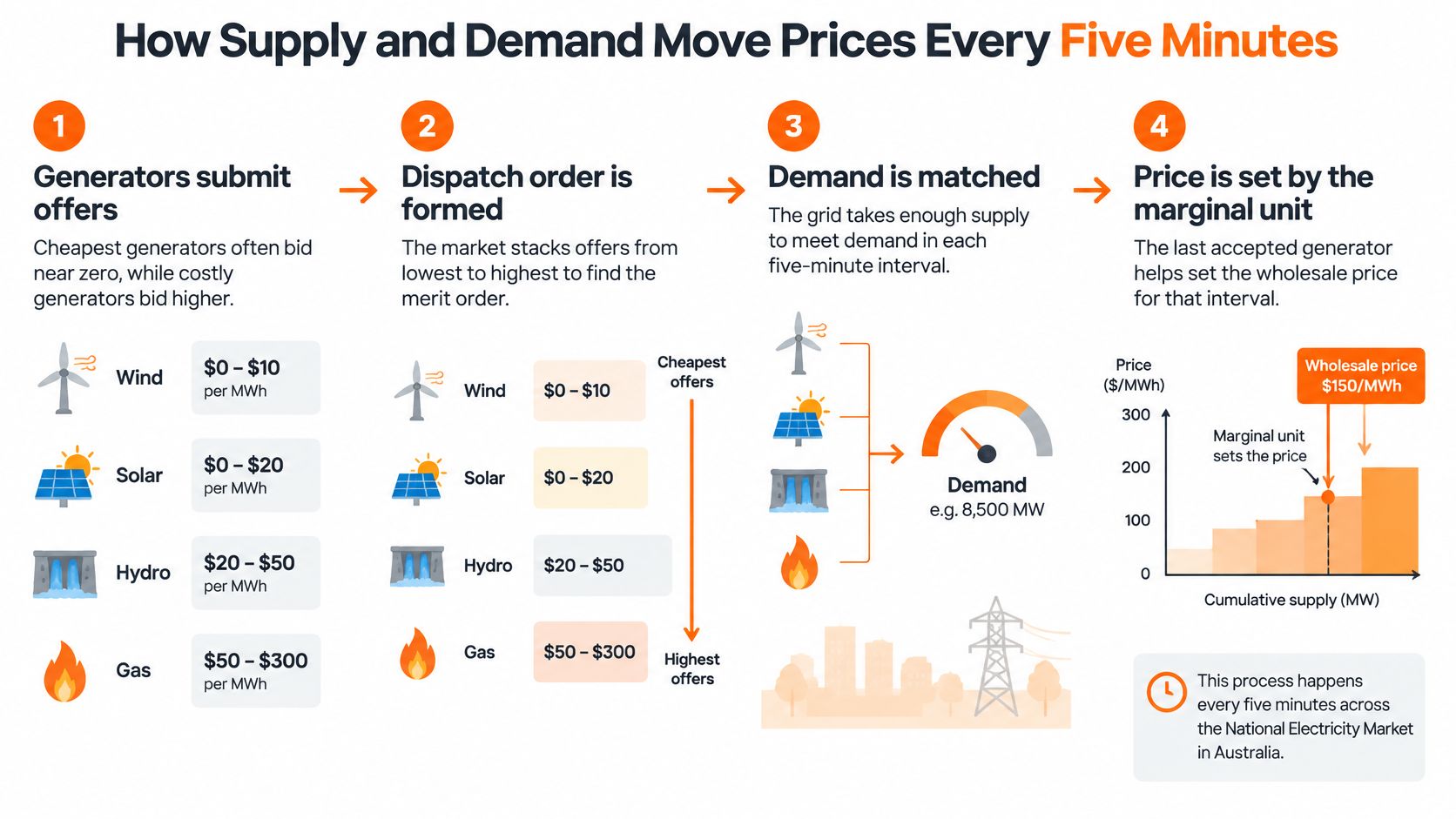
A hot afternoon and a mild midday can sit inside the same day and still clear at completely different prices. The NEM rebuilds the regional price in each five-minute interval. Generators submit offers stating how much energy they will supply at specified prices, and AEMO accepts those offers in cost order until forecast demand for that interval is covered.
The Merit Order in Five Steps
- Generators submit offers. Wind, solar and hydro often bid at or near zero because they have no fuel cost for the next unit of energy. Coal sits higher. Gas peaking plants and other high-cost units usually sit near the top of the stack.
- AEMO stacks offers from cheapest to dearest. This stack is the merit order. Dispatch moves up it until forecast demand for the interval is covered, because scheduling the cheapest available generation first keeps total system cost down.
- The last unit needed sets the regional price. Every dispatched generator in that region receives that interval price, not its own offer price. A small volume of expensive generation can therefore lift the price paid for all energy in the interval.
- High demand pushes dispatch up the stack. Hot afternoons raise air-conditioning load. Cold evenings raise heating load. Either condition can force AEMO to call gas-fired and other higher-cost units, and the interval price rises sharply.
- Surplus solar pushes dispatch down the stack. Strong midday rooftop and utility solar can displace higher-cost generation. When supply exceeds what the system needs at a positive price, the interval price can fall to zero or below.
An outage or a binding constraint often shows up in the price before it appears in any longer report. AEMO market notices and what they signal for households are the practical way to watch those conditions as they form.
What Shifts the Stack Beyond Demand
Demand is only one driver. Planned and unplanned generator outages remove cheap or mid-priced offers, so dispatch reaches expensive units sooner. Transmission constraints can trap cheap power inside one region. A neighbouring region then relies on costlier local generation even though surplus energy exists elsewhere in the NEM.
Gas costs matter because gas plant frequently sits at the margin in tight intervals. When gas is expensive, the price-setting offer rises with it. Rebidding matters too: participants can move capacity between price bands as conditions change, which can reprice an interval quickly when supply tightens.
These drivers rarely act alone. Demand, outages, constraints, gas costs and rebidding can line up in the same hours and produce a cluster of high-price intervals, then fall away once the stack loosens. The quarterly average folds those intervals into one number and hides how bunched they were.
The practical point is concentration. Spikes are short, and they sit around specific conditions. Two days with the same average price can contain completely different intervals. Only one of those days may have given a battery a discharge window worth taking.
Recent Wholesale Prices and Why Quarterly Averages Mislead
In Q1 2026 the NEM-wide spot price averaged $73/MWh, and $51/MWh of that figure was cap return from prices above $300/MWh, including $38/MWh from South Australia, according to AEMO's Quarterly Energy Dynamics Q1 2026. Most of the quarterly average came from a thin set of high-price intervals, not from the price that held for most of the quarter.
Read the table as a record of averages. Each cell compresses thousands of five-minute intervals into one number. None of these figures is a price a battery was paid.
| Period | Region | Average (AUD/MWh) | Year-on-year change |
|---|---|---|---|
| 2024 annual | Queensland | 128 | +26% |
| 2024 annual | New South Wales | 150 | +43% |
| Q3 2025 | Queensland | 72 | -28% |
| Q3 2025 | New South Wales | 90 | -25% |
| Q4 2025 | NEM-wide | 50 | -44% |
| Q4 2025 | Queensland | 58 | -55% |
| Q4 2025 | New South Wales | 75 | -48% |
| Q1 2026 | NEM-wide | 73 | |
| Q3 2026 | NEM-wide | 63 |
Reading the Table Row by Row
Start with 2024. Queensland averaged 128 AUD/MWh and New South Wales 150 AUD/MWh, up 26% and 43%. Both sat well above pre-2022 levels and below the 2022 crisis peaks. New South Wales was the dearer region, and its annual rise was larger. A battery in Sydney and a battery in Brisbane faced different wholesale conditions inside the same market.
By Q3 2025, Queensland recorded the NEM's lowest quarterly average at A$72/MWh, down 28% year on year, while New South Wales averaged A$90/MWh, down 25%, in AEMO's Quarterly Energy Dynamics Q3 2025. AEMO attributed the broader decline to higher renewable output and lower price volatility offsetting increased operational demand. For battery control that combination cuts both ways. Charging is cheaper on average, and exported energy is worth less on average, so each interval still has to be weighed against household load.
The fall steepened in Q4 2025. The NEM-wide average was AUD 50/MWh, 44% lower than Q4 2024. Queensland averaged AUD 58/MWh, down 55%, and New South Wales averaged AUD 75/MWh, down 48%, according to AEMO's Quarterly Energy Dynamics Q4 2025. Queensland's energy component averaged AUD 57/MWh in that quarter, a 41% year-on-year reduction, and its cap-return component was close to zero because price volatility was minimal. A quiet quarter like that pays ordinary self-consumption more than speculative export.
Q1 2026 and Q3 2026 sit in the table without a published year-on-year comparison in these rows. The level still matters less than the split inside it.
Why the Average Hides the Value
AEMO splits the NEM average spot price into an energy component, using spot prices up to $300/MWh, and a cap-return component for prices above $300/MWh. In Q1 2026 that split put $51 of a $73 average into cap return. A relatively small number of intervals set most of the quarterly result.
That is the wrong number for a battery decision. Value comes from those high-price intervals and from whether the battery still held charge when they arrived. Empty, reserved for the house, or already discharged, the battery captured none of the value the average appears to promise. A low-average quarter can still contain a handful of intervals worth discharging into.
An average states what the market paid across a quarter. It does not state whether the battery held charge at the intervals that set that average.
The same gap appears on the retail bill. A standard usage rate does not reprice each five-minute spike. The household sees the quarterly wholesale average only if the retail plan passes spot exposure through. On a plan that does not, the spike changes what the battery could have earned in the wholesale market and leaves the usage rate where the plan set it. Timing still decides the wholesale opportunity. The plan decides whether that opportunity reaches the bill.
Apply three checks to any price report. Read the components separately, because the split at $300/MWh shows whether ordinary energy costs or volatility drove the result. Use the regional figure, because Queensland and New South Wales routinely diverge by tens of dollars per megawatt-hour. Count high-price intervals, because frequency and clock time decide what a battery can capture. Quarterly moves of 40% or more appear repeatedly in the table, so one quarter is not a trend.
How Wholesale Prices Reach Your Retail Bill
Wholesale energy is one component of your bill, not the whole bill. Spot prices move within the day. Most retail tariffs don't, which is why a household can watch wholesale prices spike on a news report and see no change on its next bill.
| Bill component | Who sets it | How it responds to wholesale prices |
|---|---|---|
| Energy usage charge | Retailer, under the customer's energy plan | Indirectly, through the retailer's contract and hedging costs |
| Daily supply charge | Retailer, under the customer's energy plan | No, fixed per day |
| Network and distribution charges | Network businesses, on regulated revenue determinations | No, set on a regulated basis rather than spot prices |
| Environmental and scheme costs | Government schemes | No, set by scheme rules |
| Retail margin and other costs | Retailer | Partly, through the retailer's cost base |
Who Carries the Intraday Risk
On a fixed or time-of-use plan, your retailer carries most intraday wholesale risk. It buys contracts and hedges to cover expected customer load, then sets retail rates it believes will recover those costs. A short spike raises the retailer's cost of supplying you in that interval, but your usage rate stays where your plan put it. Sustained high wholesale prices are different, because they lift contract and hedging costs across a whole pricing period and eventually feed into retail offers.
Network and distribution charges sit outside this entirely. Network businesses recover revenue on a regulated basis for building and maintaining poles, wires and substations. A spot price spike doesn't change that determination, and a negative spot price doesn't reduce it. Understanding that split helps you read an electricity tariff structure without mistaking every line item for an energy cost, and a periodic household budget review using a guide to spot overlooked costs in your budget can separate fixed supply charges from usage you can influence.
Feed-in Tariffs Versus Timed Value
A traditional feed-in tariff in most cases pays a fixed rate per kWh exported, regardless of when the power leaves your home. Export at midday when wholesale prices are near zero and you receive the same rate as exporting during an evening peak. That simplicity is also its weakness, because it pays for volume rather than timing. VPP value works in the opposite direction, since it depends on when the battery discharges and which market or grid signals it responds to.
Under our Bill-Free Allowance structure, electricity imported from the grid above the Annual Usage Allowance is charged at the rates set out in the customer's Energy Plan. Billing occurs monthly or quarterly, depending on the customer's meter and distributor arrangements. Before comparing any offers, read the Energy Plan and the Basic Plan Information Document for your distribution area. Those documents state the actual rates, eligibility conditions and charges that a headline allowance figure can't convey on its own.
Battery Decisions When Prices Swing Within a Day
Negative prices are becoming a routine feature of Queensland and New South Wales middays, but the detail matters. Negative-price impacts reached new first-quarter highs in Queensland and New South Wales in Q1 2025, while across the NEM only 20% of negative-price intervals settled below −A$40/MWh, compared with more than 50% in Q1 2024, according to AEMO's Quarterly Energy Dynamics Q1 2025. Negative pricing became more frequent and economically relevant without necessarily becoming uniformly deeper.
That distinction shapes battery control. A mildly negative price is still a useful charging signal if you expect evening prices to be high and the event lasts long enough to fill available capacity. It isn't automatically a reason to cycle the battery. The optimal schedule depends on event duration, round-trip efficiency, your state-of-charge reserve and the opportunity cost of discharging later.
The Arithmetic That Governs Every Cycle
Work through the example AEMO's framing implies. If charging consumes 1 MWh and round-trip efficiency is 90%, approximately 0.9 MWh is recoverable. The later discharge price must therefore exceed the effective charging cost plus degradation cost before the cycle produces positive arbitrage value. Charging from your own surplus solar changes the input cost, since the alternative was exporting at your feed-in rate, but the efficiency loss and wear still apply.
Three constraints govern each decision:
- Round-trip efficiency: Energy lost in conversion raises the discharge price needed to break even, so a small price spread between charge and discharge intervals often isn't worth taking.
- State-of-charge reserve: Capacity set aside for evening use and backup is a hard constraint, not spare capacity. Market participation should use only what's left after forecast evening consumption and resilience reserves are protected.
- Opportunity cost: Discharging into a moderate price at 5 pm can leave you empty for a sharper peak at 7 pm. Holding charge has value when a better interval is likely.
Households adding new loads need the same discipline. If you're planning vehicle charging around solar hours, data on electric vehicle trends can help you think about how common home charging patterns are shifting demand, but your own interval data should set the schedule.
| Interval condition | Battery action | Constraint to check |
|---|---|---|
| Midday surplus, low or negative price | Charge from solar or grid if the later discharge value exceeds the effective charging cost | Free capacity and cycle budget |
| Mild price, forecast evening demand high | Hold charge for home use | Opportunity cost of discharging later |
| Evening peak, high price | Discharge to home load or export | State-of-charge reserve for backup |
| Grid support event, reserve available | Participate if the household reserve is protected | Household priority applies first |
Each full cycle adds wear, so cycling should be counted rather than assumed to be free. A controller that chases every small spread can consume battery life earning very little. A well-designed controller optimises against interval prices, forecast load and reserve settings together. It doesn't maximise exports, because exports in the wrong interval can be worth less than the stored energy you gave up.
How a Retailer-Based VPP Turns Battery Capacity into Value
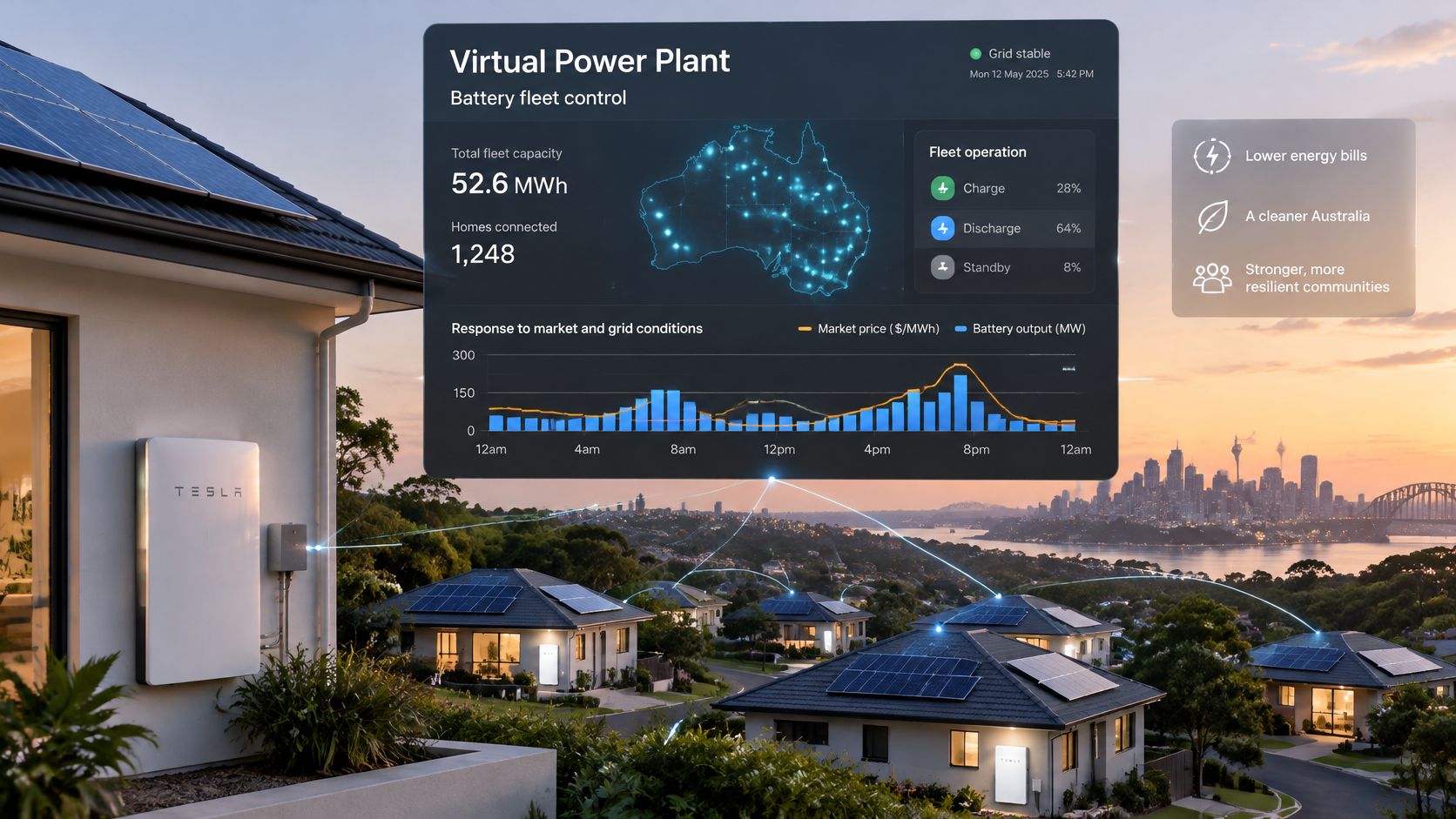
A household battery can serve two roles: storing energy for the home and, when spare capacity is available, supporting the grid through a coordinated fleet. A Virtual Power Plant (VPP) connects multiple batteries so they can respond together. The value depends on when the fleet is called and what services it provides, not on the total amount of stored energy.
The interface below shows connected homes presented as a coordinated fleet to an operator.
What Aggregated Batteries Do to Prices
When batteries discharge during high-demand intervals, they can reduce the need for more expensive generation. Their effect on wholesale prices depends on the number of batteries available, the timing of dispatch and conditions across the region. Fleet participation may moderate some price peaks, but it does not mean every battery captures the same value or that peak prices disappear.
The short video below shows how coordination can work from the household side, including control settings and overrides.
The Retailer-Based Model and Its Limits
In a retailer-based VPP, the retailer coordinates batteries and connects grid services with a retail electricity offer. HighFlow Energy uses a customer's existing home battery to support the grid when it has spare capacity, with the value generated funding a monthly bill-free electricity allowance. Household energy use is prioritised before grid support. The arrangement is Bring Your Own Battery, built around equipment the customer already owns.
HighFlow's Bill-Free Electricity offer is available to eligible residential customers in Queensland and New South Wales. Allowance tiers range from 300 kWh to 1,000 kWh per billing month, depending on solar and battery system size. The allowance includes a $0 daily supply charge, $0 usage charges within the allowance, and $0 network and distribution charges on that portion. Electricity used above the confirmed monthly allowance is charged at the applicable excess usage rate, with no penalty for exceeding it. Learn how multiple revenue streams can fund a retailer-based VPP.
The allowance resets each month, while the value available to fund it depends on grid services and market conditions. Before enrolling, check the offer's eligibility and terms, and review your battery manufacturer's warranty and cycling limits. Additional battery throughput needs to fit within those limits. HighFlow says household energy use takes priority, but the allowance is not a fixed payment for exported electricity: the amount of electricity covered is determined by the confirmed allowance, and excess use is charged at the applicable rate.
Key Takeaways, Common Misconceptions and FAQs
Key Takeaways
- Dispatch sets the price: The wholesale price is formed through competitive dispatch in five-minute intervals, not set by retailers.
- Units convert cleanly: $100/MWh equals 10 cents per kWh before network, environmental and retail costs.
- Averages hide spikes: A small number of intervals above $300/MWh can dominate a quarterly average.
- Regions diverge: Queensland and New South Wales prices differ materially, so use your own region's figure.
- Timing beats volume: Battery value depends on discharging in the right intervals, not on maximising exports.
Common Misconceptions
The quarterly average shows what my battery earns. It doesn't. Value sits in a few high-price intervals, and an empty or reserved battery captures none of them. Your result depends on state of charge at specific moments.
Wholesale prices flow straight to my bill. They don't on most plans. Fixed and time-of-use tariffs shield you from intraday spikes, your retailer carries that risk through hedging, and network charges are regulated rather than spot-based.
A feed-in tariff and VPP value are the same thing. They aren't. A feed-in tariff pays per kWh exported regardless of timing. VPP value depends on when discharge occurs and which signals the fleet responds to.
FAQs
What is the difference between the wholesale price and my bill? The wholesale price pays generators per MWh in each dispatch interval. Your bill adds network, environmental, metering and retail costs, then applies your plan's rates and daily supply charge.
Why do prices go negative? When renewable and other low-cost supply exceeds demand in an interval, generators that can't or won't switch off bid below zero to stay dispatched. Strong midday solar with constrained daytime demand makes this increasingly common in Queensland and New South Wales.
Does a battery always earn money by charging at midday? No. The later discharge value must exceed your effective charging cost, round-trip efficiency losses and degradation. If evening prices stay mild, the cycle may not pay.
Can a VPP guarantee a lower bill? No. Outcomes depend on participation, timing, usage, system size and eligibility. Treat any allowance as a structure to assess against your own usage, not a promise.
Which source publishes current interval prices? AEMO publishes market and dispatch data for the NEM, and the Australian Energy Regulator publishes wholesale market reporting and analysis. Use those two bodies as your primary references.
Check Whether Your Battery Is Earning Its Keep
A battery can post a tidy quarterly kWh total and still miss the few high-price intervals that decide whether it earns its keep. What shows up on the retail bill is timing, imports above any allowance, and whether spare capacity is offered when prices are high. Averages hide that.
Work through this checklist with a year of bills and the battery app open. Treat it as a review of settings, usage and eligibility. No retailer score will quantify the gap for you.
- Pull 12 months of bills. Note plan type, total usage, export volumes, and any charges above allowance or controlled-load arrangements. A single quarterly figure will not show whether imports pile up in expensive evenings.
- Confirm compatibility and warranty. Check that the solar and battery system can connect to a VPP, and that the battery warranty allows the expected cycling and throughput.
- Confirm your service area. The Bill-Free Electricity offer is available only in NSW and QLD, and it works the same way for Energex and Ergon customers.
- Compare usage with allowance tiers. Current allowance tiers range from 300 kWh up to 1,000 kWh per billing month, depending on solar and battery system size. Match typical monthly imports to the tier the system qualifies for. Usage inside that allowance is the portion a bill-free structure is built to cover. Imports above it are charged at the applicable excess usage rate, with no penalty for going over.
- Set the backup reserve first. Decide the state of charge the household needs for evening use and outages before any market participation uses the battery. Household energy use is prioritised before supporting the grid.
- Read the binding documents. The Residential Electricity Agreement and Price Schedule hold the full legally binding terms. An FAQ is a summary only. The Price Schedule sets out the terms that apply to any allowance.
- Review exit terms. Prices and terms may change where energy laws allow. Customers are notified and may leave at any time with no penalty. Standard non-energy fees can still apply, including disconnection or reconnection fees, special meter reads, and dishonour or late payment fees, as listed in the Price Schedule.
HighFlow Energy is a customer-facing electricity brand. Electricity retail, billing, compliance and market services are provided by ERC Energy Pty Ltd, an authorised Australian electricity retailer, trading under the HighFlow Energy brand. A retailer-based VPP belongs inside that authorised retail framework.
A battery's financial performance depends on its settings, usage and eligibility. One that stays full through the afternoon and empty by early evening on default settings is cycling without regard to price. The Price Schedule sets out the terms that apply to any allowance.
HighFlow Energy connects an existing solar and battery system to a coordinated Virtual Power Plant, prioritises household energy use, and applies the value from spare capacity as a monthly bill-free electricity allowance. You still receive an electricity bill each month. It just may be $0. Plan details for Queensland and New South Wales homes are on HighFlow Energy.