

Home Electrification Guide for Australian Homes
More than 72,000 home batteries were installed in Australia in the year to December 2024, yet the national total still represented only around one battery for every 30 households, according to the Australian Government's Consumer Energy Resources implementation update%20Roadmap%20Implementation%20Plan%20Update%20August%202025.docx). Home electrification is advancing, but owning the equipment isn't the same as coordinating it well.
For homeowners in Queensland and New South Wales, the practical question is what happens after the appliances switch to electricity. The bill depends on when those appliances run, how much solar they use directly, and whether battery energy remains available when the household needs it. A Virtual Power Plant only adds value when sharing stored energy doesn't undermine those priorities.
What Home Electrification Changes in an Australian Home
Australian residential buildings consume around 25% of Australia's electricity and produce about 10% of national emissions; in 2022–23, gas still supplied approximately 30% of residential energy, across more than five million gas-connected households using about 13 million gas appliances, according to the Senate inquiry into residential electrification.
Home electrification means replacing fuel-burning household equipment with electric alternatives. That includes space heating, hot water and cooking. For households replacing a petrol or diesel vehicle, it can also include home electric vehicle charging.
The important distinction is between electricity consumption and total energy consumption. The inquiry notes that heat pumps can be several times more efficient than comparable gas technologies. They move heat rather than producing it through combustion, so purchased electricity can rise while total purchased energy falls.
Household services in an all-electric home
| Household service | Common fuel now | Electric alternative | How flexible |
|---|---|---|---|
| Space heating | Gas ducted or room heater | Reverse-cycle heat pump | Low in cold evenings; some pre-heating possible |
| Space cooling | Electric air conditioning already | Efficient reverse-cycle | Low on hot afternoons and evenings |
| Hot water | Gas storage or instantaneous | Heat-pump water heater | High; tank stores heat for later |
| Cooking | Gas cooktop and oven | Induction cooktop and electric oven | Low; meals cluster at dinner |
| Clothes drying | Gas or resistive dryer | Heat-pump dryer | Medium; can wait for solar hours |
| Vehicle charging | Petrol or diesel | Home EV charger | Medium to high if departure time allows |
Space conditioning follows comfort needs. You can pre-heat a well-insulated home before sunset, but you shouldn't assume every cold-evening heating load can move into daylight.
Hot water offers more freedom. A tank heated during solar production can supply showers later, making it useful thermal storage. Cooking is less movable because dinner happens when people are home, not necessarily when solar output is strongest.
Drying can often wait until daylight. EV charging should follow the energy needed for the next journey and the departure deadline, rather than starting automatically when everyone arrives home.
Practical distinction: An efficient appliance reduces the energy needed for a service. Good scheduling changes where that energy comes from.
Lower usage doesn't automatically remove the electricity bill's fixed daily supply charge. A useful bill review separates that charge from import usage, export credits and any other applicable charges. Understanding those components matters more than comparing appliance labels alone.
The operational task is to coordinate the larger electrical load with available solar, storage and tariff windows.
How Rooftop Solar Grew Across Queensland and NSW
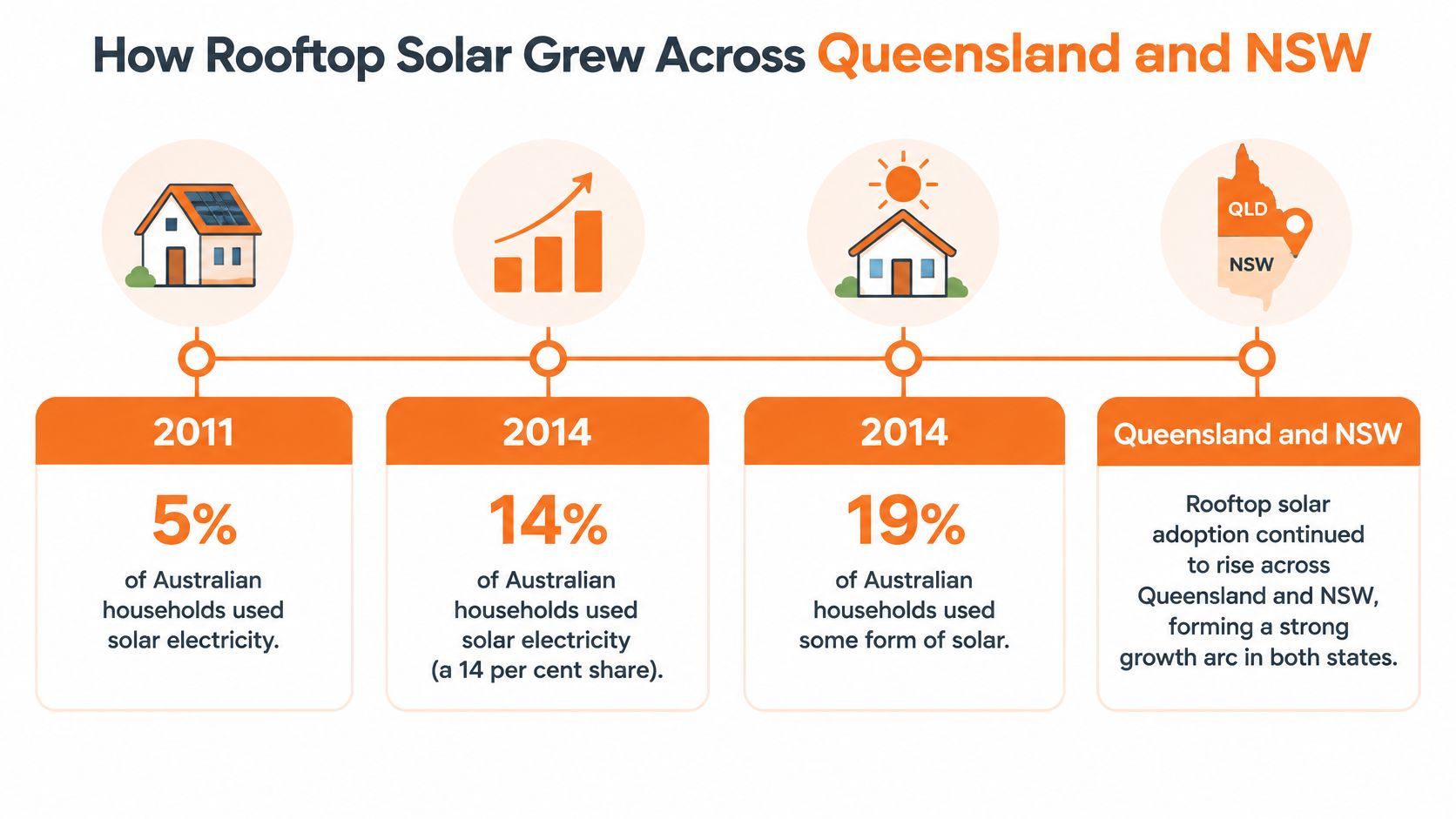
Australia's solar transition started well before today's battery discussion. The Australian Bureau of Statistics household energy series records solar electricity use rising from about 5% of households in 2011 to 14% in 2014, with 19% using some form of solar when solar hot water was included; Queensland's solar electricity adoption was 20%, compared with 10% in New South Wales.
The timeline illustrates that early expansion.
From customer to generator
A solar roof turns a household into a small power station. It can produce electricity, use it on site, store it or export it.
But solar generation and household demand don't automatically line up. A home can export surplus while its occupants are away, then buy electricity for dinner and heating after sunset. Storage and scheduling address that mismatch.
The fuel transition is also measurable: residential electricity consumption increased 6.2%, while residential natural-gas consumption declined 2.3%, during 2024–25, according to the Australian Energy Statistics 2026 update.
For an existing solar owner, electrification is therefore a planning question: which new loads can use generation that would otherwise leave the property?
Why the Shape of Demand Matters After You Switch
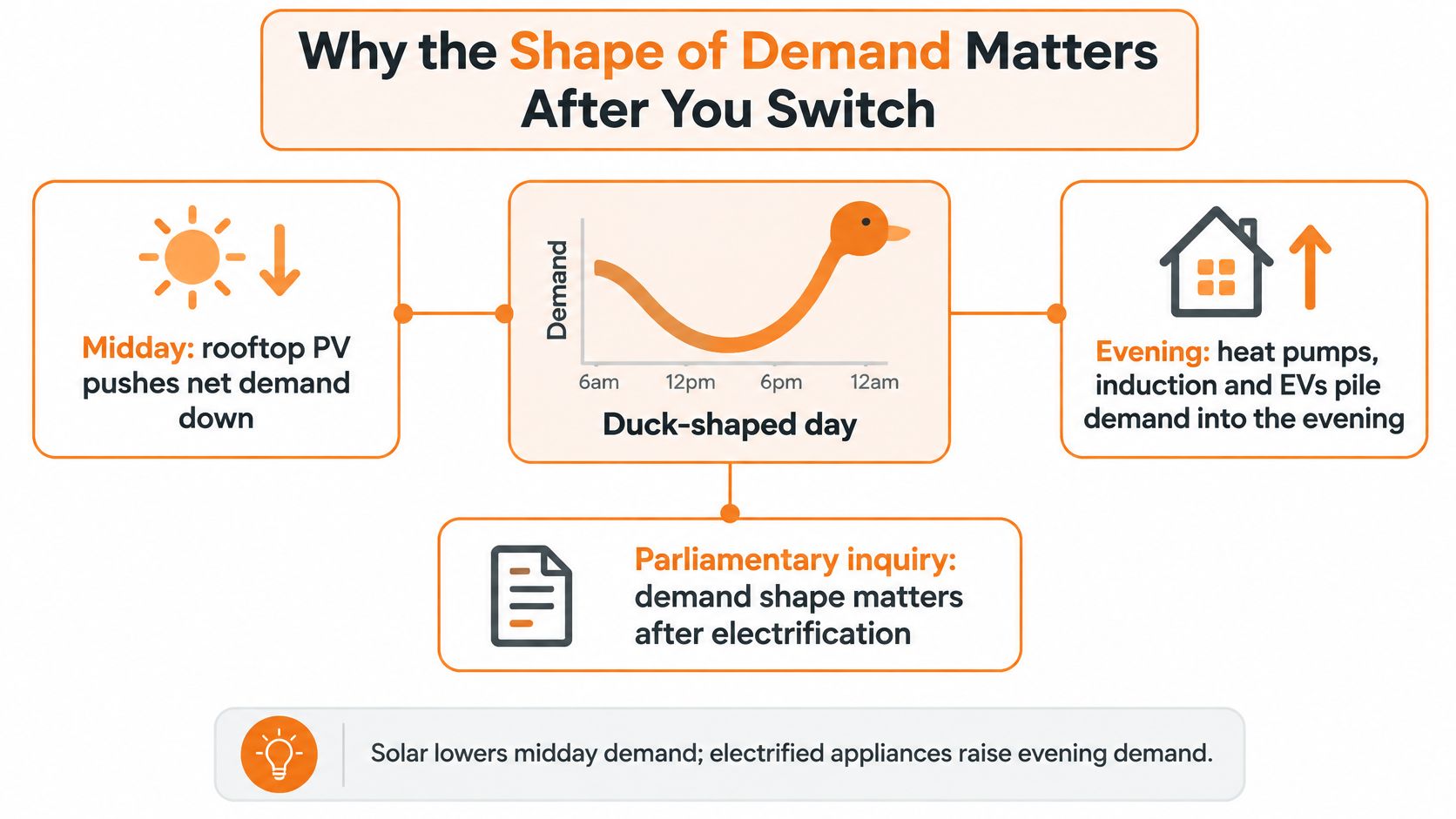
At midday, rooftop solar reduces the electricity homes need from the grid. After sunset, solar output disappears while cooking, heating, cooling and vehicle charging can overlap. Grid operators must manage that change, not just the day's total consumption.
The parliamentary inquiry's grid assessment identifies residential electrification as a driver of changing minimum and peak demand. Participants identified batteries as a way to absorb excess daytime solar and reduce peak grid demand.
The diagram shows the resulting demand shape.
Which appliances can move?
The appliance pathway modelled by the Parliamentary Budget Office projects increases of 125% in hot-water heat-pump units, 37% in ducted air-conditioning units, 80% in non-ducted air-conditioning units and 90% in induction cooktops.
| Appliance | Modelled growth | Flexibility on the clock |
|---|---|---|
| Hot-water heat pump | As projected above | Flexible; stored heat can move into solar hours |
| Ducted air conditioning | As projected above | Low; load follows hot afternoons and evenings |
| Non-ducted air conditioning | As projected above | Low; load follows hot afternoons and evenings |
| Induction cooktop | As projected above | Low; load clusters at dinner |
These are projections, not a claim that every home will adopt the same equipment. Their significance is that some growing loads can be scheduled, while others follow everyday life.
For Queensland and New South Wales distributors, concentrated solar exports can create local voltage and congestion problems. Across the National Electricity Market, a steep evening increase in demand can coincide with tight supply and volatile wholesale prices. Network export limits remain binding even when exporting would be financially attractive.
Market prices aren't necessarily your retail prices
A time-of-use tariff charges different retail rates across defined periods, usually with a dearer peak window. Wholesale prices move separately, and a wholesale price spike doesn't automatically become your household import rate.
Demand response means changing consumption or discharge in response to a system need, sometimes in exchange for payment. AEMO operates the market and power system, while the Australian Energy Regulator oversees relevant compliance and network economic regulation.
A useful control rule is to preserve enough battery charge for household reliability, then schedule remaining capacity against forecast solar, prices and network conditions. For vehicles, smart EV charging starts with the departure deadline rather than the moment the cable is connected.
Sequencing the Electrification Steps
Start with the electrical supply, not the appliance catalogue. Ask a licensed electrician to inspect the switchboard rating, service capacity, protective devices and circuit layout. They should establish whether proposed loads require electrical upgrades or a network application.
Put measurement before replacement
Collect interval electricity usage, gas consumption and solar production records. Note when people shower, cook, heat rooms and charge vehicles, because daily totals conceal simultaneous loads.
A practical replacement order is:
- Replace ageing gas hot water. A heat-pump water heater gives you a controllable load with stored heat available later. Confirm tank size and scheduling against actual household use.
- Prepare the cooking circuit. Before fitting induction, establish whether the cooktop and oven can operate together within the circuit and supply limits.
- Size heating for the building. A qualified installer should assess heat loss, insulation, room layout and duct performance. The principles behind energy-efficient ducted air conditioning matter more than choosing equipment by its headline capacity.
- Integrate the EV charger. Set charging around departure needs, expected solar and the remaining supply capacity.
- Review the tariff after each change. An additional evening load can alter which retail structure suits the home.
Check incentives without letting them dictate design
Size any additional solar or storage after understanding the changed load profile. Existing battery owners should first test whether scheduling improvements address the problem.
The government's Cheaper Home Batteries Program update describes an approximately 30% discount from 1 July 2025 for eligible small-scale batteries connected to new or existing rooftop solar. Eligibility must be checked when purchasing; it isn't a general discount on electrification equipment.
Retail obligations and network responsibilities are separate. A retailer manages the retail relationship, not repairs to the poles, wires or local network.
How Solar Batteries and a VPP Fit Together
A coordinated home energy system has distinct layers. Each has a different job, and none should be judged solely by how much electricity it exports.
The visual shows how household equipment connects to coordinated grid support.

Start behind the meter
Rooftop solar supplies active household loads first. Direct consumption avoids the need to store that energy and retrieve it later.
A home battery holds energy for a different time. For a clear explanation of charging, inverters and household supply, the solar battery advice from DLG Electrical is useful background.
An energy-management plan then assigns priorities. It accounts for essential evening consumption, hot-water scheduling, expected generation and the reserve the owner wants protected.
A Virtual Power Plant, or VPP, coordinates batteries, customer loads or electric vehicles so they can operate collectively as a flexible resource. Under AEMO's Step Change scenario, the National Consumer Energy Resources Roadmap projects coordinated storage growing from approximately 0.2 GW at the roadmap's baseline to 3.7 GW in 2029–30 and 37 GW in 2049–50, representing about 66% of NEM storage nameplate capacity by that final year.
Those are scenario projections, not guaranteed outcomes. They explain why coordinating existing equipment matters to system planning.
Compare the value streams
| Value stream | What it avoids or earns | Strongest when | Constraint |
|---|---|---|---|
| Self-consumption | Avoids buying grid electricity | Evening peak and high-cost import periods | Limited by household load and battery size |
| Feed-in tariff export | Pays for exported surplus | Midday, when the battery is already full | A low export rate can limit value; export limits apply |
| VPP grid support | Can pay for availability and dispatch | Network or wholesale-price events | Spare capacity only under a household-priority arrangement |
A feed-in tariff pays for exported energy. VPP value may also involve availability, dispatch or grid services, depending on the arrangement. Comparing the export rate alone misses those differences.
A retailer-based Bring Your Own Battery, or BYOB VPP, connects retail billing with battery coordination. A conventional retail contract may price imports and exports without scheduling the battery at all.
We coordinate spare battery capacity automatically and securely across participating homes, charging at optimal times and discharging small amounts to support the grid. Customers retain ownership, remain grid-connected and stay in control.
More battery discharge isn't automatically better battery optimisation. Useful dispatch must justify the stored energy it consumes.
The following video provides additional context for coordinated solar and battery operation.
When to Keep Stored Energy and When to Share It
The highest-value use of a battery isn't always the next market event. Retaining charge can be more useful than exporting it, particularly when the household will otherwise buy expensive electricity later.
RenewEconomy's examination of electrification barriers reports that fewer than 10% of Australian battery owners have joined a VPP. Participation alone, however, says nothing about whether an individual household would benefit.
Choose the job before dispatching the energy
| Primary use | Favoured when | Trade-off |
|---|---|---|
| Solar self-consumption | Evening imports would be costly and tomorrow's solar can refill | Less energy left for grid services |
| Evening peak cover | Cooking, heat pump or EV overlap the peak window | Battery may be empty before a later price spike |
| Backup reserve | Household wants charge held for an outage | That portion cannot earn grid value |
| VPP spare capacity | Minimum charge is set and surplus remains | Small discharges only; household use comes first |
| Export within the limit | Battery is full and the export limit still has room | Feed-in value may be lower than avoiding an import |
The table is a decision aid, not a ranking. An owner with important backup needs may reasonably accept less grid-service income in exchange for a larger reserve.
State of charge means how full the battery is. A minimum state-of-charge setting protects stored energy from routine discharge, but actual outage supply also requires suitable backup equipment and configuration.
Check the conditions that change the answer
Before sharing energy, review:
- Load profile: Identify the household's evening and overnight requirements, not just average daily consumption.
- Battery capacity: Use available capacity and discharge capability rather than assuming the label describes everything usable.
- Network: Identify Ausgrid, Endeavour Energy, Essential Energy, Energex or Ergon Energy and the applicable connection conditions.
- Tariff: Compare avoided imports, export credits and VPP compensation within the full retail offer.
- Reserve: Set a minimum charge consistent with household priorities and credible solar forecasts.
Low-solar weeks reduce refill opportunities. Heatwaves can extend cooling demand beyond sunset, while export constraints can prevent a planned dispatch. A payment is less attractive if the dispatch causes a larger replacement import later.
Three misconceptions deserve direct correction:
A battery doesn't remove the daily supply charge by itself. A higher feed-in tariff isn't the same as greater VPP value. Maximum export isn't automatically the best outcome.
Our operating priority is unambiguous: household energy use comes before grid support.
One Electrified Day in Brisbane and Sydney
Consider two hypothetical homes. Neither example assumes a particular saving or guarantees that the battery can cover every load.
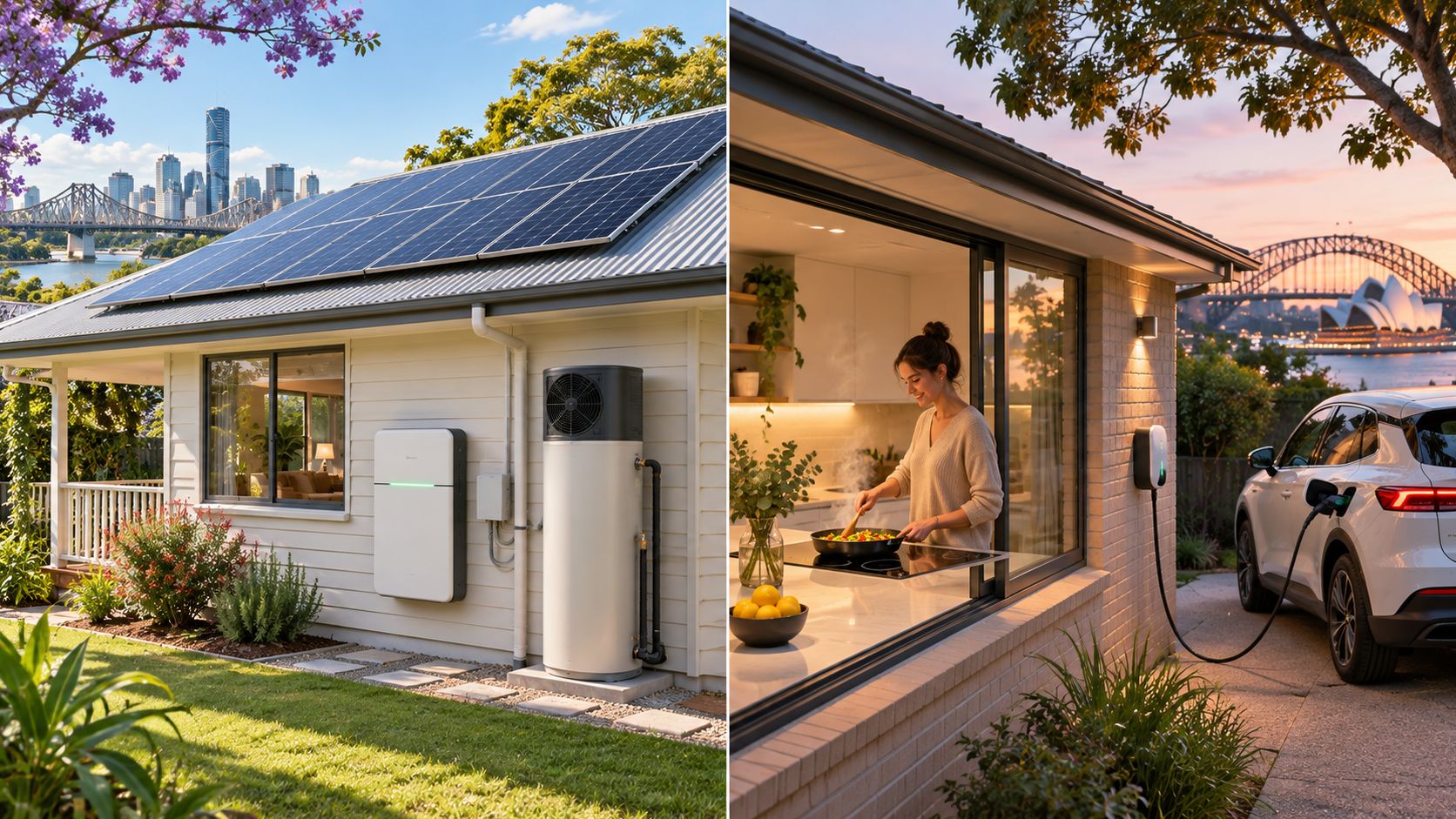
Brisbane with an Energex connection
During late morning, rooftop solar supplies the house, heats the water tank and charges the battery. The pool pump runs during the remaining solar window rather than after dinner.
By late afternoon, cooking and cooling draw on stored energy. A controller makes only the capacity above the protected household requirement available for grid support.
This illustrates the equipment working as a coordinated household system.
Sydney with an Ausgrid connection
On a winter morning, heating starts before solar production becomes useful. Preserving charge overnight helps cover that early demand.
At noon, surplus generation replenishes storage. Under a tariff with costly evening imports and modest export credits, keeping that surplus can be more useful than exporting it immediately.
Neither household should start the dryer, oven and EV together after sunset without considering supply and battery limits. We recommend daylight operation for high-energy appliances, avoiding unnecessary overnight grid use, and maintenance according to manufacturer guidelines. Additional cycling should remain within warranty conditions and the owner's reserve settings because battery cycle life is finite.
Does electrification always cut the bill?
No, efficient equipment doesn't guarantee lower retail charges. Appliance sizing, usage timing, tariffs and fixed charges all affect the result.
Who handles an outage?
The local electricity distributor handles network faults and outages. We direct customers to their distributor rather than managing network repairs.
Does the customer still own the battery?
Yes, joining our coordination program doesn't transfer battery ownership. Customers remain in control of their equipment.
What if winter solar is poor?
Allow for reduced charging opportunities and protect energy needed before the next likely refill. Grid charging may be appropriate where the retail tariff and operating arrangement support it.
Are NSW and Queensland treated the same on grid connections?
No, connection conditions are set by the relevant network and the approved installation. Retail participation doesn't override local export limits or technical requirements.
Check If Your Existing Battery Is Underused
Key takeaways
- Electrify the service: Replace gas equipment with efficient electric alternatives.
- Watch the clock: New evening demand can matter more than the appliance label.
- Protect household energy: Storage needs an operating plan, not just available capacity.
- Use genuine surplus: Spare battery capacity can provide grid support without a new installation.
This assessment suits homeowners in Queensland or New South Wales who already have solar and a compatible battery, still receive electricity bills and want better performance from their existing asset. Start by calculating household energy consumption and comparing it with battery charging and discharge records.
Why HighFlow Energy
HighFlow Energy's retailer-based BYOB VPP is designed around existing equipment and a transparent allowance structure. The process is straightforward:
- Bring your existing solar and battery. No new hardware is required for a compatible system.
- Confirm eligibility and join. We check system compatibility, network eligibility and the battery's internet connection.
- Make spare capacity available. Grid support occurs only when the battery is available, with household priority protected.
- Receive a monthly bill-free electricity allowance. Value generated by participation funds the allowance, including daily supply charges and usage within it; consumption above it attracts the applicable excess usage rate.
There's no guarantee of bill elimination. Customers retain control, and the relevant allowance and excess-usage terms determine the billing outcome.
HighFlow Energy manages customer communications, eligibility and the Bill-Free Allowance program. ERC Energy provides regulated retail services in accordance with Australian energy laws. That separation matters when comparing responsibilities, not just headline benefits.
Many owners concentrate on installation quality without reviewing ongoing operation. An eligibility assessment can establish whether unused capacity is available and whether coordination suits the household's actual needs.
HighFlow Energy helps eligible Queensland and New South Wales homeowners coordinate their existing solar and battery, using spare capacity to support the grid while prioritising household energy. Visit HighFlow Energy to request an eligibility assessment and understand whether your battery is underperforming financially.