


Smart EV Charging Guide for Homeowners
You plug in the car after work, glance at the app, and assume the charging will sort itself out overnight. Then the bill lands, and the timing of that session sits right inside the expensive part of the day. That's the frustration smart EV charging is meant to solve, especially for Australian households trying to line up EV charging with rooftop solar, battery storage, and time-of-use rates.
For many homeowners, the primary issue isn't the EV itself. It's that unmanaged charging can collide with peak pricing, local network limits, and the moment when the household is already using the most power. If you're also comparing finance options for a vehicle purchase, a practical starting point is a guide like New Zealand EV finance from Nomu Finance Limited, because the charging strategy only matters once the car is in the driveway.
The good news is that smart charging isn't a single gadget or app trick. It's a set of control methods that can make charging more flexible, safer for your switchboard, and better aligned with the electricity you're already generating. For households with existing solar and batteries, that can also become part of a wider plan to reduce reliance on standard grid imports and support a retailer-based Virtual Power Plant Australia model.
Understanding Smart EV Charging
A home charger can look ordinary from the outside and still behave very differently once it is set up for smart EV charging. Instead of starting at full power the moment you plug in, it uses timed control, software, and sometimes live price or grid signals to decide when to charge and how fast to charge, while still making sure the vehicle is ready when you need it. The California Energy Commission describes smart charging as the intelligent control of EV charging so it can be shifted according to grid conditions while still meeting the owner's needs, which makes it more than simple off-peak timing (California Energy Commission).
For Australian homes, that difference matters because the car is usually charged where it spends the most time. Evidence submitted to the AER shows 70–85% of Australian EV owners charge at home, while only 10–20% use public charging and 6–10% charge at work, so the home charger is where smart control has the most practical impact (AER submission material).
Why home charging changes the equation
A basic timer helps with one part of the job, the clock. A smart system can also respond to solar output, household demand, and charger limits, which matters when the car, the dishwasher, and the air conditioner all want power at once.
Practical rule: if the car is mostly charging at home, the biggest gains usually come from scheduling and load control, not from public charging features.
For readers comparing charger types, Compare EV charging levels is useful background because it shows why Level 1, Level 2, and DC fast charging behave so differently in the home context. The point is not to choose the fastest option available, it is to choose the one that fits your wiring, your usage pattern, and your tariff.
A smart charger also matters before you start thinking about bigger energy plans. A house with weak wiring, an overloaded switchboard, or no clear charging schedule can waste the value of rooftop solar and make later automation harder to use. That is why the first step is understanding how the charger decides, then checking whether the home can support that decision safely and consistently.
Key Technical Approaches
Smart charging sounds simple until you break it down into the methods behind it. The main difference between a basic charger and a smart one is control. One just delivers power. The other makes decisions.
Timed charging and load shifting
Timed charging is the most familiar version. You set the charger to run during a specific window, often overnight or when solar output is strongest. Load shifting goes a step further, because it moves charging away from periods when the home or the local grid is under pressure.
That matters in Australia because common home AC chargers are typically 7 kW to 22 kW, while fast chargers run at 50 kW to 350 kW, so load management is needed to keep charging within site capacity and avoid overloading switchboards (U.S. Department of Transportation charging speeds reference). In a suburban house, that might mean shifting a full evening charge into a midday solar window instead of starting as soon as the driver arrives home.
Dynamic price response and managed flexibility
The more advanced systems respond to price signals. If electricity is cheaper at one time and more expensive at another, the charger can wait or slow down without the driver having to babysit the process. That's the basic logic behind price-response charging.
This is also where planning starts to matter for households with solar and batteries. If your vehicle is charging when your home battery is already covering the house load, you can end up importing more power than necessary. If the charger waits for surplus solar, it can reduce that conflict and improve self-consumption.
V1G and V2G in plain English
V1G means one-way controlled charging. The charger still only sends power into the car, but software coordinates the timing. V2G, or Vehicle-to-Grid, goes further and allows the EV battery to send power back to the grid, though that remains an early-stage capability in Australia rather than everyday household practice.
Charging strategy is not only about cost. It's also about keeping the site within its electrical headroom and preserving the option to use the car as a flexible load later.
The useful way to think about it is this. Timed charging saves money by avoiding expensive periods. Load shifting protects the site. Price response optimises the session. V1G gives you the control layer most homes can use now.
Integrating and Preparing Your Home
A smart charger only delivers its full value when the home can support it. Many charging problems come from the wiring, the switchboard, or the assumption that a charger can be added without checking the site first.
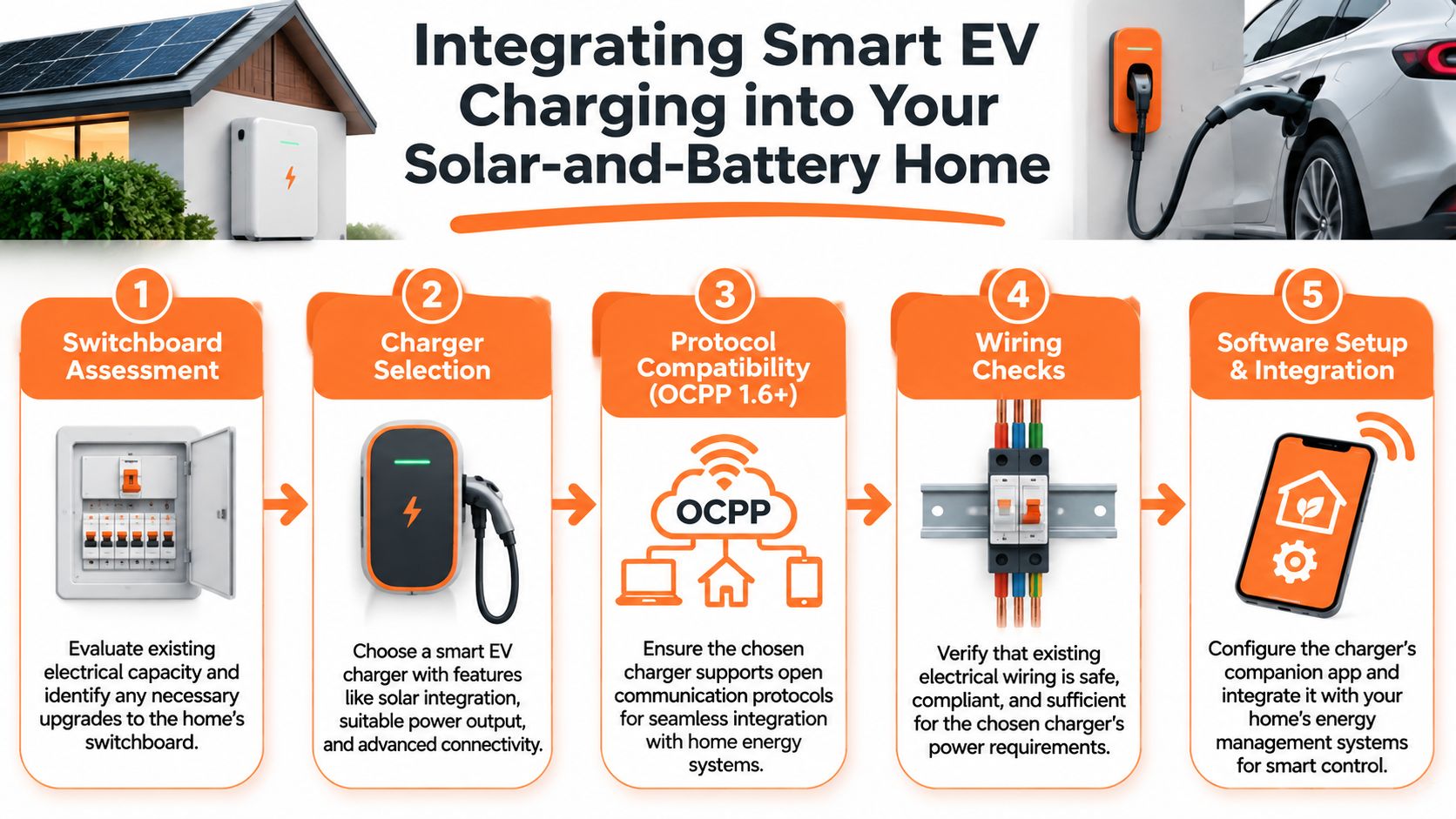
Start with the electrical limit, not the app
The first question is whether the site has enough electrical headroom. That means checking the switchboard, the main supply, existing appliances, and the likely charging profile. A charger may be rated for high output, but the actual limit is often the connection and switchboard, not the vehicle.
Protocol compatibility also matters in this context. Many smart charging programs require interoperable control protocols such as OCPP 1.6+ and charger efficiency above 90% for remote control (EECA technical specification requirements). If the charger cannot speak the right language, it may not integrate cleanly with your energy management system, your retailer tools, or future grid coordination.
Choose the charger for the site, not just the brochure
A smart charger should match the property, not just the EV model. That means checking whether it supports solar diversion, scheduled charging, remote control, and the right communication standard. It also means deciding whether single-phase or three-phase charging suits the home's electrical setup.
If you are already comparing solar and EV infrastructure, a practical starting point is High Flow Energy's solar EV chargers, because charger selection is only one part of the wider home-energy picture. The better question is whether the charger can cooperate with the rest of the household system.
Work through the workflow in order
- Switchboard assessment. An electrician checks capacity, protections, and any upgrade needs.
- Charger selection. Pick a unit with the right power level and software features.
- Protocol check. Confirm OCPP or another compatible control layer.
- Wiring review. Make sure the circuit and cabling suit the intended load.
- Software commissioning. Link the charger to the app, solar system, and any optimisation rules.
That sequence sounds basic, but it prevents the most common mistake, installing hardware before the house is ready for it. In practical terms, it also sets the home up for later coordination with solar, batteries, and retailer programs that can shape charging around lower-cost or higher-value periods.
Financial and Environmental Benefits
Smart charging is usually sold as a bill-saving feature, but the better framing is efficiency. You're using the same kWh, just at a better time and often in a better way. A literature review reports up to 30% lower charging costs, 10% lower grid operational costs and 40% lower renewable curtailment when smart charging is used (review of EV smart charging literature).
What that means in a household setting
A conventional charging habit is straightforward. The driver plugs in when they get home, and the car starts drawing power immediately. A smart setup changes the timing so charging can happen when solar is available, when rates are lower, or when the home needs less power.
That matters for families with rooftop solar and batteries because the cheapest kilowatt-hour is often the one you already produced. It also matters for grid planning. IRENA says smart charging can reduce peak load and avoid grid reinforcements, and it notes that avoided reinforcement costs can be about 10% of the total cost of reinforcing the grid (IRENA smart charging brief).
The household and the grid both benefit
If the car charges in the middle of the day, solar self-consumption improves. If it charges away from evening peak periods, local demand is easier to manage. If the charger can follow the home's own energy pattern, the network doesn't need to absorb a sharp new load spike every time someone gets home from work.
For homeowners designing around the EV as part of a wider energy plan, high-end sustainable house design is a useful reference point because it treats electrification, load management, and site planning as connected decisions rather than separate purchases. The same logic applies here.
Smart charging is not guaranteed to be cheaper for every household. The savings only hold when the charging window, tariff structure, and local network conditions line up.
If you're pricing out a site-level solution, the cost for electric car charging stations is a sensible internal resource because the hardware cost is only one part of the economics. Installation quality, control capability, and site readiness all matter too.
Practical Optimisation with AI Plans
A good app can improve charging behaviour, but the app only works if the settings match real household patterns. The best results usually come from small adjustments, not one big automation decision. The charger should understand when the car needs to be ready, how much solar is available, and whether the household wants to prioritise cost, convenience, or both.
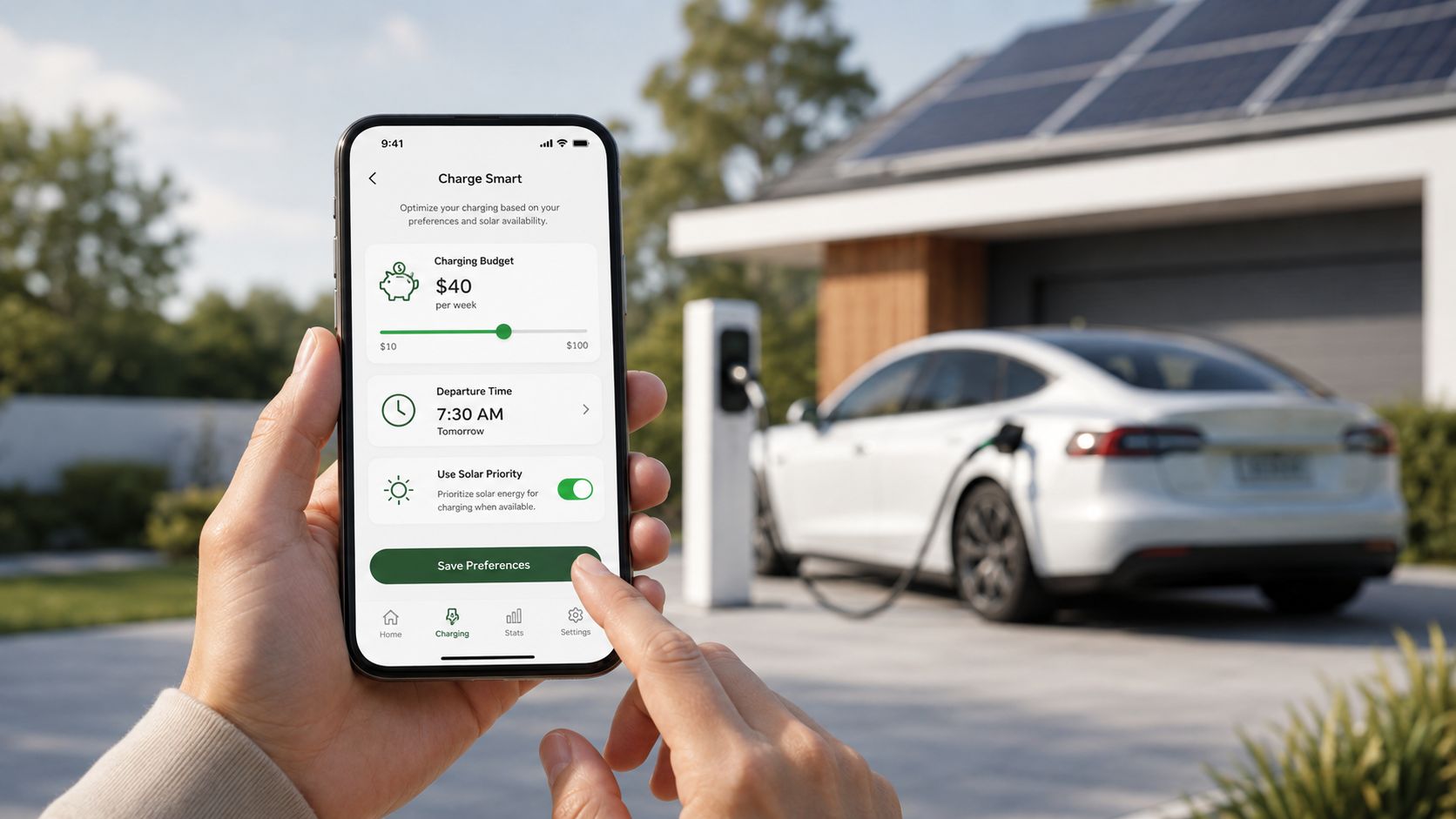
Set boundaries before you let the app automate
Start with a departure time and a minimum state of charge target. Then define a charging budget or cap if the app supports it. That gives the software clear limits, so it can decide whether to charge now, wait for solar, or slow the session later in the day.
If the system allows manual overrides, keep them turned on. A weekend trip, a rainy week, or an unexpected school run can change the charging pattern quickly. Smart control should reduce effort, not remove control.
Tune the plan to the season and the roof
Solar output changes across the year, and so does household behaviour. In summer, midday charging may be easy to align with solar surplus. In winter, the same schedule may need more grid support, or a different price-response window.
A useful practice is to review charging logs after the first few weeks and then again when seasons change. If the charger repeatedly starts too early or finishes too late, the schedule usually needs a simple adjustment. For a retailer-led energy plan that already thinks about household flexibility, High Flow Energy's EV power plan is the relevant internal reference point.
Watch the automation without micromanaging it
Here's the point many readers miss. AI charging works best when it has room to optimise, but it still needs clear household priorities. If the vehicle must be ready by 7 am, the charger should never gamble on a solar forecast alone.
Once the rules are set, the app can do the unglamorous work. It can shift loads, avoid bad timing, and keep the session inside the household's preferred settings without constant manual checks.
Leveraging Virtual Power Plants for Bill Elimination
Smart charging becomes more valuable when it sits inside a broader energy system. That's where a retailer-based Virtual Power Plant can matter, because the battery and the charger are no longer separate assets acting alone. They become flexible resources that can be coordinated when the household has spare capacity.
High Flow Energy operates as a BYOB VPP model for existing solar and battery owners in Queensland and New South Wales. The household keeps priority use of the battery, while spare flexibility can be coordinated as part of the program, and the value created through that coordination funds a monthly electricity allowance rather than relying only on a standard retail bill structure. In practice, that means smart charging and battery control can work together instead of competing for the same stored energy.
The important distinction is transparency. A well-structured VPP should not ask the customer to surrender the battery to the grid at random times. It should coordinate around household needs first, then use any available flexibility to create value from grid support and demand response.
Why the combination matters
A charger that only follows price signals can still leave money on the table if the battery is not part of the plan. A battery that only serves the home can also be underused if the system never coordinates charging, discharge, and flexible export together. The value comes from orchestration.
For homeowners comparing traditional retailers to energy-service models, the question is not just whether the charger can charge cheaply. It's whether the whole home energy stack can be coordinated so the battery, charger, and tariff all pull in the same direction. That's how a household starts moving from simple cost reduction to broader electricity bill reduction and, for eligible customers, a path toward eliminating the usual bill line items up to the allowance.
The right question is not “Can this EV charge?” It's “Can this EV charge without wasting the flexibility already sitting in the battery?”
That's where the publisher's role fits naturally. High Flow Energy is a retailer built around using existing battery flexibility to support the grid, and the charging load can be part of that wider optimisation if the site is eligible.
Key Takeaways and FAQs
A practical smart charging setup starts with a simple question. Can the charger, the battery, and the home's electrical setup talk to each other in a way that suits daily life? The answer is usually clearer when the household treats charging as part of the whole energy system, not as a separate device on the wall.
That matters because flexibility is the core value. A smart charger can shift load into cheaper periods, ease pressure on the network, and make better use of solar and stored energy when the home is prepared for it. It also creates the conditions for retailer-based VPP participation, where the battery is used as an active part of a broader home energy plan instead of remaining idle.
For many households, the right sequence is straightforward. Check the home's readiness first, then match the charger to the site, then decide whether the battery and EV should be coordinated together. That order helps avoid buying equipment that works in theory but cannot be controlled properly in practice.
FAQs
Will any charger work with smart charging?
No. A charger needs the right control features, and in many programs it also needs interoperable communication support, such as OCPP 1.6+.
Can apartment residents use smart charging?
Yes, but parking access is usually the main limit. Shared or curbside charging infrastructure matters more than app features on their own.
Does smart charging always reduce bills?
No. Savings depend on tariff timing, household load, solar availability, and how often the vehicle can be moved into a better charging window.
Can smart charging work with an older battery system?
Sometimes. Compatibility depends on the inverter, the control platform, and whether the site can support coordinated charging logic.
What should I check first with High Flow Energy?
Eligibility, battery compatibility, and whether the home has enough flexible capacity to join a BYOB VPP without interrupting normal use.
Most battery owners focus on installation quality. Fewer look at ongoing performance and whether the system is earning its keep over time. High Flow Energy is an electricity retailer built around using existing solar and battery systems more effectively.
If you want to understand whether your battery is underperforming financially, request an eligibility assessment today at High Flow Energy.