


No Exit Meaning in Australian Energy: What It Covers
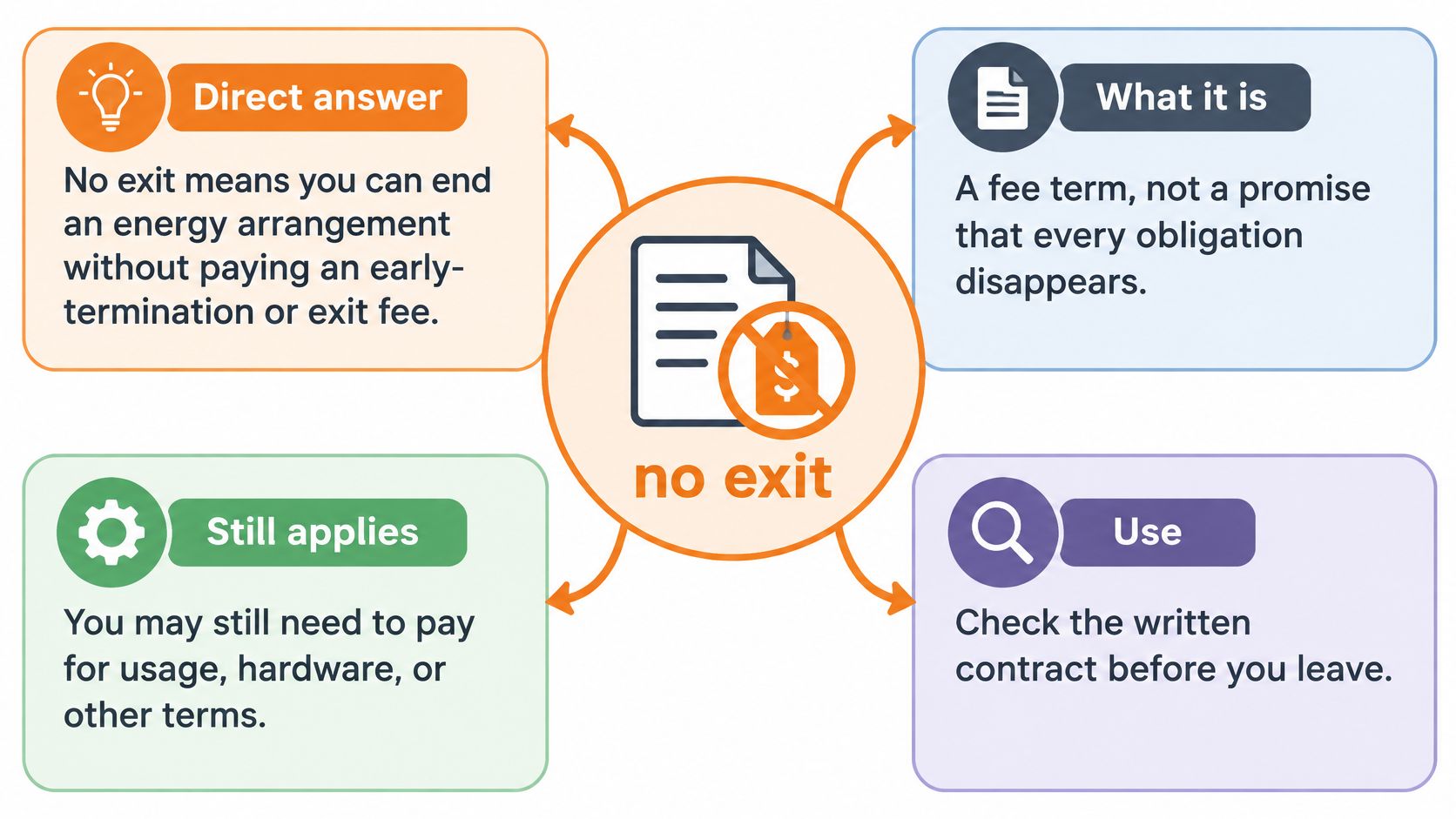
"No exit" means a customer can end an energy contract without paying an early-termination or exit fee, but it does not cancel charges already incurred for energy used. Treating those two words as a blanket guarantee that nothing else is payable is where Australian households routinely get tripped up.
The most popular advice during an energy retailer comparison is simple: look for a "no exit" badge and assume you can walk away cleanly at any moment. That shortcut overlooks the contract mechanics that matter most for solar and battery owners across the National Electricity Market (NEM), including hardware finance clauses, incentive clawbacks, minimum participation windows, and remote battery dispatch settings. Pinning down the no exit meaning takes a more disciplined approach: instead of accepting a headline slogan, you break the claim into five distinct contract terms and test each one in writing.
No Exit Meaning and What Still Applies
In Australian electricity contracting, no exit is a narrow fee term meaning you can end your retail or battery arrangement without paying an early-termination or exit fee, not a promise that every obligation disappears. That distinction grew out of consumer protections designed to reduce switching friction across New South Wales and Queensland. As detailed in a Parliament of Australia energy policy paper, New South Wales prohibited retailers from charging paper-bill fees and, subject to limited exceptions, electricity exit fees from 1 January 2018, while both New South Wales and Queensland moved to abolish exit fees when prices or contract terms changed mid-contract.
To see where a zero-exit-fee promise starts and stops, it helps to separate the switching penalty from ordinary account settlement.
The table below separates five common contract items into what a no-exit clause removes and what still needs settling when you leave.
| Term | Covered by no exit | Still needs settling |
|---|---|---|
| Exit or early-termination fee | Not charged for ending a standard retail contract | Any early-switching fee allowed under a fixed-term market arrangement |
| Fee for leaving before a time-based end date | Not charged where the contract has no exit fee | Early-ending charge set out in a time-based contract |
| Lock-in or minimum-term clause | Not a penalty where no exit applies | Any notice period stated in the written terms |
| Energy already used | Not waived | Final bill for usage up to your last day |
| Equipment or installation charges | Not part of an exit fee | Hardware finance, installation recovery, or return costs stated in the contract |
What remains payable after you cancel
Removing a cancellation penalty leaves legitimate charges already incurred untouched. When you switch electricity retailers or exit a battery service, you still owe a final bill covering daily supply and electricity usage up to your closing meter read, along with any consumption above an agreed monthly allowance billed at the contract's stated rates. Any separate fees disclosed before signing, or repayment obligations attached to supplied hardware, sit outside the exit-fee line item.
That separation is central to understanding how a no lock-in energy contract operates in practice. At HighFlow Energy, for example, if you decide to leave, your bill-free allowance stops and your account is finalised normally rather than attracting a termination charge. You pay only for legitimate amounts accrued up to your final day, with no switching penalty layered on top.
Cooling-off windows and time-based contracts
Contract timing also shapes whether a leaving fee can legally be applied. Householders in Queensland and New South Wales are generally covered by the National Energy Customer Framework, and the Australian Government's energy customer rights guide notes that customers receive a 10-business-day cooling-off period after entering an energy contract. Once that window closes, retailers may still apply an early-termination fee if you signed a time-based contract and leave before the agreed end date, depending on the written terms.
Two-part contract test: Before signing any retail or battery agreement, ask for written answers to two questions: can I leave without a cancellation charge, and which charges for energy used, excess usage, or equipment still apply on my final day?
How NSW and Queensland Rules Differ
State energy regulations set the baseline for exit fees, yet retail exceptions still catch battery owners off guard. Comparing New South Wales and Queensland side by side shows why your postcode and contract structure matter as much as the retailer's headline claim.
| State | Standard retail contract | Exceptions or caps |
|---|---|---|
| NSW | Exit fees generally prohibited on most new and existing contracts | Exemptions where solar PV, a battery, a digital meter, or associated equipment was installed under the contract, or a fixed tariff applies for the term |
| QLD | No exit fee on standard retail contracts | Fixed-term market contracts may carry an early-switching fee, capped at $20 |
New South Wales protections and hardware exemptions
According to the NSW Government switching providers guide, electricity retailers generally can't charge exit fees on most new and existing residential contracts. Two technical exemptions break that general rule: contracts where a solar PV system, home battery, digital meter, or associated equipment was installed as part of the agreement, and agreements carrying a fixed tariff or fixed charge for the full term. Because energy contracts are legally binding, those exemptions give retailers room to recover hardware or fixed-price commitments even when householders expect fee-free switching.
Queensland contract types and the cap on early switching
Queensland draws a clear line between contract categories. As set out in the Queensland Government electricity contract types guide, standard retail contracts can be ended without an exit fee, whereas fixed-term market contracts may include an early-switching fee capped at $20. Retailers must also disclose all applicable prices, charges, early-termination payments, and penalties in writing so householders can inspect them before committing.
Before relying on any no-exit promise, verify three variables: your state, whether the offer is a standard or fixed-term market contract, and whether any hardware is tied to the retail agreement. Say a homeowner in New South Wales finances a new battery through a retailer under a bundled plan. Even if the offer promotes zero retail exit fees, the installed-equipment exemption can leave a substantial payout owed if the household switches early.
History shows how costly system-linked termination clauses can become. In its National Electricity Market inquiry report, the Australian Competition and Consumer Commission reported that exit fees can range from the remaining value of a discount up to several thousand dollars where system costs are involved, including one reported case of approximately $8,000. A Bring Your Own Battery (BYOB) service that connects your existing, customer-owned battery avoids that installed-equipment trigger altogether, though reading the full contract remains essential.
Five Checks That Test a No Exit Claim
Many solar-and-battery households are looking beyond flat retail feed-in tariffs because most residential batteries sit underutilised under traditional plans. According to an Australian Competition and Consumer Commission media release, electricity bills for solar-and-battery customers participating in Virtual Power Plants were typically $762 to $1,093 lower than those of other customers between Q3 2023 and Q3 2025, equivalent to savings of 57% to 63%. Those figures highlight the financial upside of grid participation, yet the same consumer watchdog stressed that clear consumer protections are essential.
With the NSW Government Virtual Power Plant incentive guide noting updated onboarding rules and eligibility scheduled to expand for batteries up to 50 kWh from July 2026, "no exit" now gets used loosely across retail and battery offers. One provider might mean zero exit fee, another might mean no minimum term, and a third might let you pause automated discharge. Run every offer through the five checks below before signing.
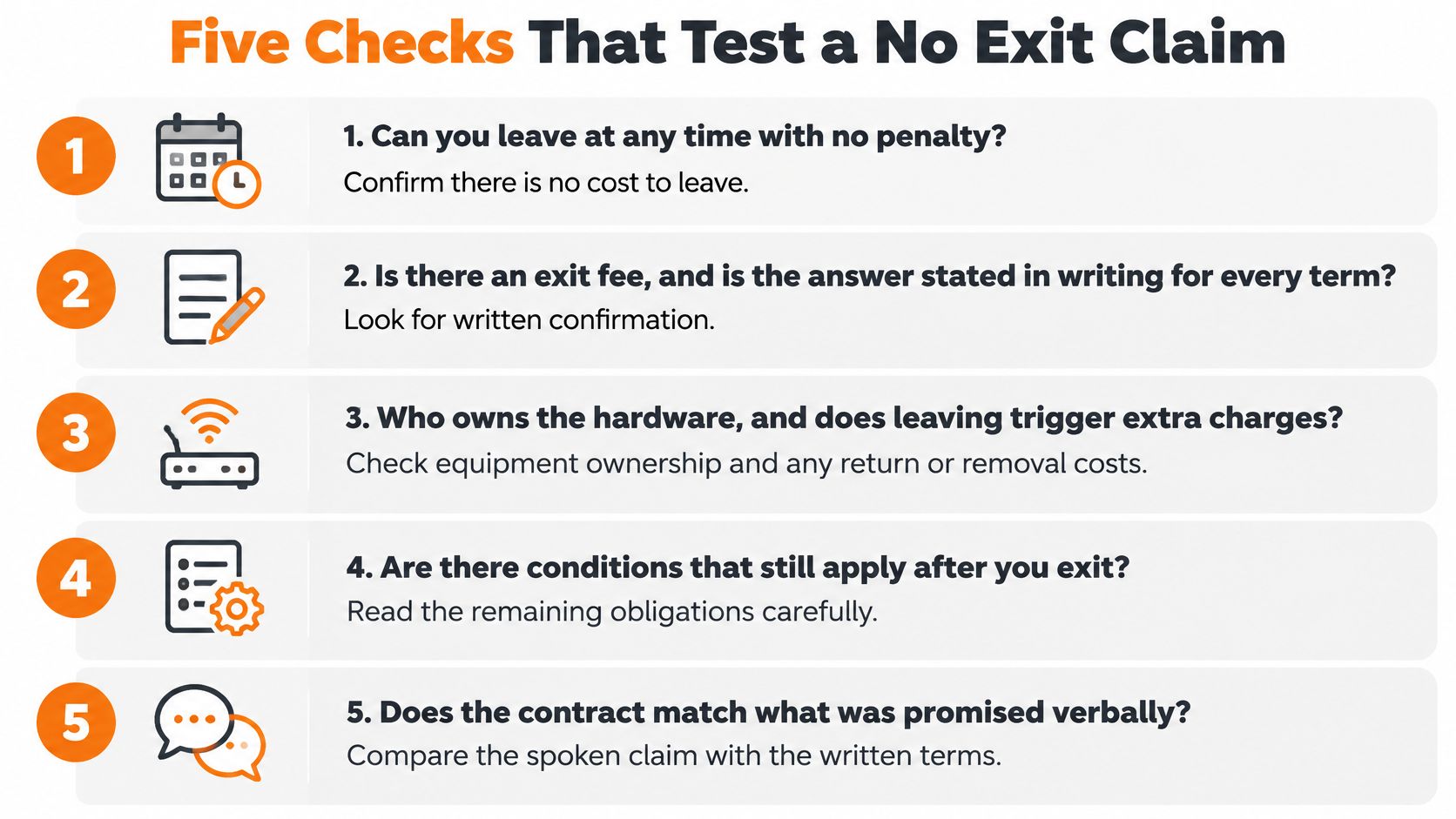
- Can you leave at any time with no penalty? A zero-dollar exit fee doesn't guarantee instant switching if the fine print imposes a lengthy notice period or clunky administrative steps. Because New South Wales guidance states that customers wanting to change VPP contract conditions or cancel must contact their provider directly, verify the exact cancellation channel and notice timeframe upfront.
- Is there an exit fee, and is the answer stated in writing for every term? Verbal assurances over the phone carry little weight next to a signed contract schedule. Check both the electricity retail agreement and any separate VPP schedule so a disconnection charge can't hide in a secondary document.
- Who owns the hardware, and does leaving require returning it? If you already own your rooftop solar and battery outright, joining a BYOB VPP shouldn't create hardware return or removal fees on exit. If a provider supplies a monitoring dongle, control gateway, or subsidised battery, confirm ownership and return costs in writing before installation.
- Are incentives or credits repaid if you leave, and is there a minimum participation period? Incentive clawbacks and minimum participation windows are the most common hidden conditions in Australian battery contracts because they don't appear as "exit fees" on a fee table. A customer might pay zero cancellation fee yet still be billed for a pro-rata share of an upfront sign-up bonus or state incentive if they withdraw early.
- Does leaving change how your battery runs day to day, including notice periods, data access, and network charges? As explained in the Australian Government battery technology guide, an on-grid battery and its inverter must connect to external entities, respond to remote signals, and often maintain an internet connection for VPP participation or monitoring. Confirm when remote access stops after cancellation, whether your time-of-use tariff or network charges change, and how your inverter returns to local self-consumption mode.
Cancellation versus lapsed eligibility
Householders often overlook a second path to losing VPP benefits: falling out of eligibility while staying on the retail account. If an inverter stays offline, hardware is modified into an incompatible setup, or technical conditions aren't maintained, the retail benefit can end without a formal cancellation request. Under HighFlow Energy's rules, if eligibility requirements are no longer met, the allowance stops and standard retail pricing applies unless the customer leaves. Testing a no-exit claim therefore means checking both voluntary cancellation and what happens if eligibility lapses.
Write down the provider's answer to each of the five checks, and treat any missing, verbal-only, or vague response as an unresolved contract term.
Staying in Control of Your Battery Under a VPP
In plain English, the Australian Government's solar and battery guide defines a Virtual Power Plant (VPP) as a coordinated network of distributed energy resources, including household solar and battery systems, operated by software as a single electricity source that can buy and sell power. During NEM demand events and periods of wholesale price volatility, the operator dispatches stored energy from participating batteries to support grid stabilisation and capture peak value.
That operational model is reaching mainstream Australian households quickly: the Clean Energy Council rooftop solar and storage report recorded 183,245 home batteries sold nationally in the second half of 2025. As battery uptake grows, understanding how a solar battery Virtual Power Plant coordinates dispatch becomes just as important as reading the fee schedule. True contract freedom isn't only about cancelling without a fee; it also means knowing how your battery behaves in three distinct operating states.
| State | Battery operation | Bill effect | Contract position |
|---|---|---|---|
| Normal optimisation | Battery charges and discharges under the agreed plan | Follows the active plan tariff and allowance terms | Ongoing service under the contract |
| Temporary override | Household sets a reserve or pauses dispatch | Follows the contract's tariff and eligibility rules | Ongoing service; the contract stays active |
| Permanent withdrawal | Battery returns to household-only use | VPP benefits end with the service; final bill is settled | Ends on the date set out in the contract |
Moving between optimisation, override, and withdrawal
Before authorising remote dispatch, check three practical control settings: the minimum backup reserve held exclusively for your household, whether an override takes effect immediately through your app, and whether dispatch limits and battery cycling rules align with your manufacturer's warranty and local grid export constraints. Clear boundaries keep your home powered through evening time-of-use peaks while letting spare capacity earn value during grid events.
Consider how a Queensland family might move across these states during summer storm season. When severe weather forecasts roll in, the homeowner raises the backup reserve or activates a temporary override so the battery stays near full charge in case of a network outage. Once the storm clears, they switch back to normal battery optimisation without touching their retail agreement. That temporary override never cancels the contract, whereas permanent withdrawal ends VPP participation completely and triggers final account settlement.
Usable capacity versus nameplate size
When comparing VPP offers and state incentives, check which battery measurement the provider uses. Under the Australian Government guide to the NSW Virtual Power Plant incentive, the incentive available to a resident depends on three stated factors: the battery's usable storage capacity in kilowatt-hours, the VPP provider selected, and the contract agreed with that provider. Confirming usable capacity rather than headline nameplate size ensures you compare solar battery value on an accurate like-for-like basis before committing.
Frequently Asked Questions About No Exit
Does a temporary override end my VPP contract
No. Activating a temporary override or raising your household backup reserve keeps your existing retail and VPP contract in place. Only a permanent withdrawal terminates the agreement and initiates a final closing bill.
How do I cancel a VPP arrangement
You must contact your VPP retailer directly to modify contract conditions or lodge a cancellation request. Ask for the cancellation procedure, any applicable notice period, and the disconnection confirmation date in writing so every milestone is documented.
What happens to incentives and exported energy when I withdraw
Check your written terms for incentive repayment clauses and minimum participation periods, as those obligations typically sit outside standard exit-fee clauses. Any solar or battery energy exported up to your final day should be reconciled on your closing account under the agreed retail rates.
Does my backup reserve change when I leave a VPP
When permanent withdrawal completes, automated external dispatch stops and your battery reverts to household-only operation. Confirm with your provider which reserve setting remains active on your inverter and the exact date remote control ends.
Does expanded NSW battery eligibility change my exit rights
No. Expanded state eligibility lets larger household batteries qualify for government incentive programs, but it doesn't alter a retailer's exit clauses, notice periods, or repayment rules. Always verify the written contract terms independently of state incentive eligibility.
Can a fixed-term energy offer ever be fee-free to leave
Yes, provided the signed contract explicitly specifies zero exit fee for the full term and no installed-equipment exemption applies. If battery finance, a discounted hardware package, or a fixed-price penalty is bundled into the agreement, leaving before the end date can still incur a charge.
Check Your Terms Before You Commit
A reliable switching decision comes down to verifying the mechanics in order rather than trusting a promotional tag. Work through these four steps before you sign any electricity or VPP contract:
- Confirm your state and contract type: Identify whether your property sits in New South Wales or Queensland and whether the plan is a standard retail contract or a fixed-term market contract.
- Verify hardware independence: Confirm that no solar panels, battery finance, or installation recovery clauses are bundled into the retail agreement where an installed-equipment exemption could apply.
- Complete the five-point checklist: Record written answers on cancellation penalties, written fee confirmation, hardware ownership, incentive clawbacks, and day-to-day battery control.
- Test override and withdrawal rules: Confirm how backup reserves, temporary pauses, and permanent disconnection work before granting remote inverter access.
How HighFlow Energy structures contract flexibility
Under our contract cancellation policy, HighFlow Energy operates with no fixed contract term and no exit fee, and customers may leave at any time with no penalty. Because retail electricity services operate under Australian energy laws and ongoing system eligibility requirements, the offer isn't guaranteed forever, and exact rights and obligations are always governed by your signed agreement. Existing solar and battery owners in Queensland and New South Wales should confirm every contract point in writing before signing and can request an eligibility assessment to see whether their current electricity setup suits a BYOB VPP retailer.
Key Takeaways
- Narrow scope of no exit: "No exit" eliminates an early-termination charge, yet you remain responsible for electricity used and other disclosed amounts up to your final day.
- State and hardware nuances: Statutory exit-fee protections differ across NSW and Queensland, and bundled hardware or fixed tariffs can trigger legal exemptions.
- Beyond the fee schedule: Notice periods, minimum participation windows, and incentive repayment clauses create switching friction even when the stated exit fee is zero.
- Control alongside cancellation: A transparent VPP clearly separates normal optimisation, temporary household overrides, and permanent contract withdrawal.
Most battery owners focus on installation quality. Far fewer focus on ongoing performance and optimisation. HighFlow Energy is an electricity retailer built around unlocking the full value of your existing solar and battery system. If you would like to understand whether your battery is underperforming financially, request an eligibility assessment today.
HighFlow Energy connects existing rooftop solar and compatible home batteries across Queensland and New South Wales to a transparent Bring Your Own Battery Virtual Power Plant with no new hardware, no lock-in contract, and no exit fees. If you're reviewing your current electricity performance and want clear, written contract terms alongside app-based battery control you can override at any time, check your system's eligibility at HighFlow Energy.