


Exit Cost Explained for Australian Energy Customers
An exit cost is the total charge, or value lost, when a household leaves an energy contract or service before the arrangement ends, and in Queensland the direct fee on a fixed-term electricity contract is capped at AUD 20. That capped fee is one line on a much longer bill.
Ask a household what it costs to leave its electricity retailer and most will name the cancellation fee in the contract. Fewer will mention the discount they lose. Almost nobody will mention the equipment repayment clause in their battery agreement, the feed-in rate that changes with the retailer, or the special meter read that lands on the final account. Every one of those is an exit cost, and they arrive from four different places: the retailer, the network, the VPP provider and whoever owns the hardware.
Queensland and New South Wales households feel that gap sharply. The retailer's termination fee is tightly regulated and, in Queensland, capped at a small figure. A battery or VPP agreement sitting beside the same household can carry a recovery charge many times larger. Treating exit cost as one number is how people end up surprised by a final invoice.
What an Exit Cost Covers
An exit cost is the total charge, or value lost, when you leave an energy contract or a service built on it before the arrangement ends.
A gym makes the difference easy to see. Joining costs a sign-up fee. Leaving costs a cancellation charge, the value of sessions you paid for in advance, and the price of finding another gym. Nobody would call the joining fee the cost of leaving. Energy contracts run on the same logic, except the clauses sit in three or four separate documents.
Australian Government guidance requires a price fact sheet to disclose all prices and charges, including early-termination payments and penalties, together with the contract's date and duration, as set out in the energy.gov.au advice on finding the best energy deal. That is the document to request, not the marketing page.
Six different charges, one confusing label
| Cost type | Where it comes from | When it applies | Where to check |
|---|---|---|---|
| Early termination fee | Fixed-term retail contract | Leaving before the term ends | Price fact sheet and contract terms |
| Fixed-term exit fee cap | Queensland rules | Fixed-term electricity contract in Queensland | Queensland guidance and the AER, AUD 20 cap |
| Equipment or installation recovery | Financed or provider-owned solar or battery | Ending a VPP contract early | VPP agreement |
| Repayment of upfront discount | VPP or plan incentive | Leaving before the agreed period | Discount repayment formula in the contract |
| Final account balance | Energy already used | Closing the account | Final bill |
| Non-energy fees | Retailer price schedule | Disconnection, reconnection, special reads or late payment | Price schedule |
Three rows belong to the retailer. One belongs to the network or the retailer's schedule of service charges. Two belong to whoever funded the equipment or the incentive, and those are the rows that produce the largest figures.
Run each row against the paperwork you hold. If a row has no matching line in any document, either it doesn't apply or you were never given the document. Clearing that up before you accept a new offer is cheaper than discovering it at the final bill.
When Retailers Are Allowed to Charge an Exit Fee
Not every energy contract carries a fee, and the ones that do carry it under narrow conditions. A retailer may charge an early termination fee when you leave a fixed-term contract before the term ends, particularly where the contract cannot be transferred to a new address, as the AER's explanation of energy services sets out. Sign a new energy contract and change your mind, and a 10-business-day cooling-off period lets you cancel without fees.
The protection is easier to see once it's drawn out.
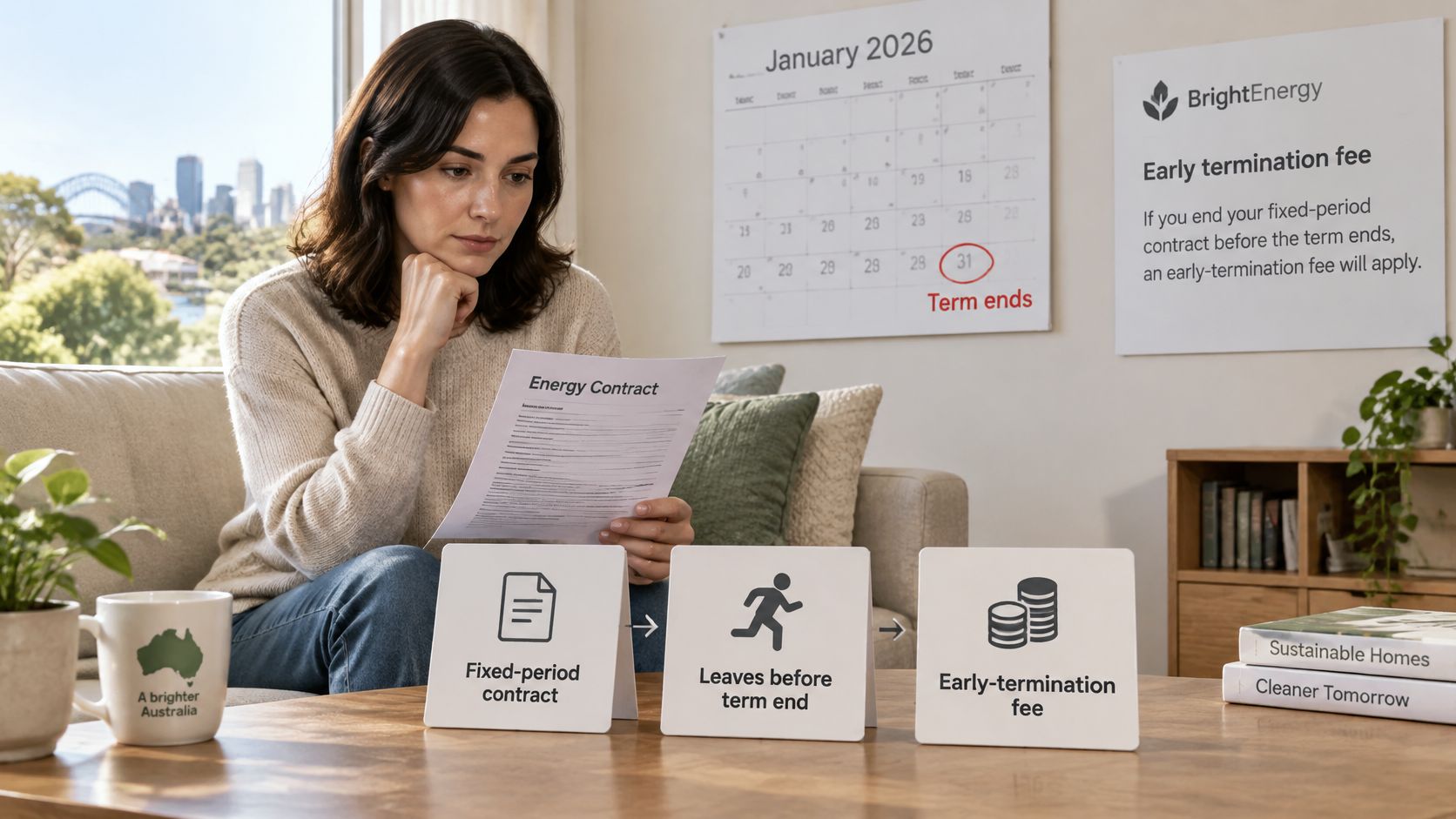
Three conditions decide whether a fee applies
- Fixed term or ongoing. A fixed-period market contract can carry an early termination fee if you leave before the term ends. An ongoing contract has no term to break, so there's nothing to terminate.
- Transferable or not. If the contract can move with you to a new address, moving house doesn't end it. If it can't, the contract ends and the fee question becomes live.
- Inside or outside cooling-off. Cancel within 10 business days of signing a new energy contract and no fee applies.
Say a household signs a 12-month fixed contract in March and moves in August. Two questions decide the outcome, and neither has a national answer: does the contract transfer, and does the move end the term? Get both in writing rather than assuming last time's rules still apply.
A VPP agreement sits outside the retailer framework and sets its own cancellation conditions. A battery household can therefore face a real leaving charge on an agreement with no fixed electricity term at all.
Fees also suppress switching in a market where mobility is already modest. The AER's 2024–25 annual retail market report puts electricity switching at generally between 3.3% and 5% of customers across jurisdictions as at 30 June 2025, and earlier AER reporting noted that customers who found a preferable offer could still face an early exit fee.
Before leaving, ask three things: the term end date, the transfer rule if you move, and whether you're still inside the cooling-off window. Our contract cancellation policy shows what that looks like when there's no term to break and you can leave at any time with no penalty.
Queensland and New South Wales Rules Compared
Two states sitting on the same national law treat the exit fee in opposite ways. Under the National Energy Retail Law, an early termination fee on a fixed-term market contract must be a reasonable estimate of the retailer's resulting costs, so the national rule limits the size of a fee rather than banning it. Queensland caps the fee outright. New South Wales leaves the amount standing and decides who should have to pay it.
| Jurisdiction | Rule | Scope | What it means for households |
|---|---|---|---|
| National (NERL) | Early termination fee must reflect the retailer's resulting costs | Fixed-term market contracts | Amount set per contract, within the reasonable-cost limit |
| Queensland | Fixed-term electricity exit fee capped at AUD 20 | Fixed-term electricity contracts | Small direct cost; non-price costs remain |
| Queensland | Retailers must offer at least one market contract without an early-termination fee | Retailer offers | A no-fee option exists in principle |
| New South Wales | Exit fees waived for hardship customers and certain eligible consumers | Hardship and eligible consumers | Eligibility depends on personal circumstances |
| New South Wales | Cooling-off period for VPP contracts set by the contract | VPP participants | Terms depend on the signed agreement |
Queensland is the outlier on price. Its rules cap an electricity exit fee on a fixed-term contract at AUD 20 and require each retailer to offer at least one market contract with no early-termination fee at all. The Queensland Treasury sunset review of the national energy retail law records the cap as a state-specific derogation from the national scheme and recommended retaining it because it reduced the potential barrier to switching. Since the cap sits outside the national scheme, confirm it still applies before relying on it.
New South Wales chose relief over a cap. The state requires retailers to waive exit fees for customers experiencing financial difficulty and certain other eligible consumers, as the AER's annual report on retail market performance records. The fee itself is untouched; what changes is who has to pay it. Eligibility turns on circumstances the household has to evidence, so a waiver is never automatic the way the Queensland ceiling is.
That split matters when you add up what leaving costs. Both the Queensland cap and the New South Wales waiver apply to the retailer's termination charge only. A capped or waived fee says nothing about credits that end at the final bill, charges from the distributor, or the repayment and exit conditions attached to equipment or a VPP agreement. An eligible New South Wales household can walk away from the fee and still face every other cost of switching.
Calculating the Full Cost of Switching
What would switching really cost once every moving part is added up? The quoted retailer fee is only one piece. A household also has to account for credits that stop, network charges that may still apply, and any battery or VPP arrangement tied to the account. Treat the calculation like packing for a move. The removal truck is the obvious cost, but the deposit, cleaning and replacement items still affect the total.
Start with the paper trail. A single “switching fee” quoted over the phone does not tell you much.
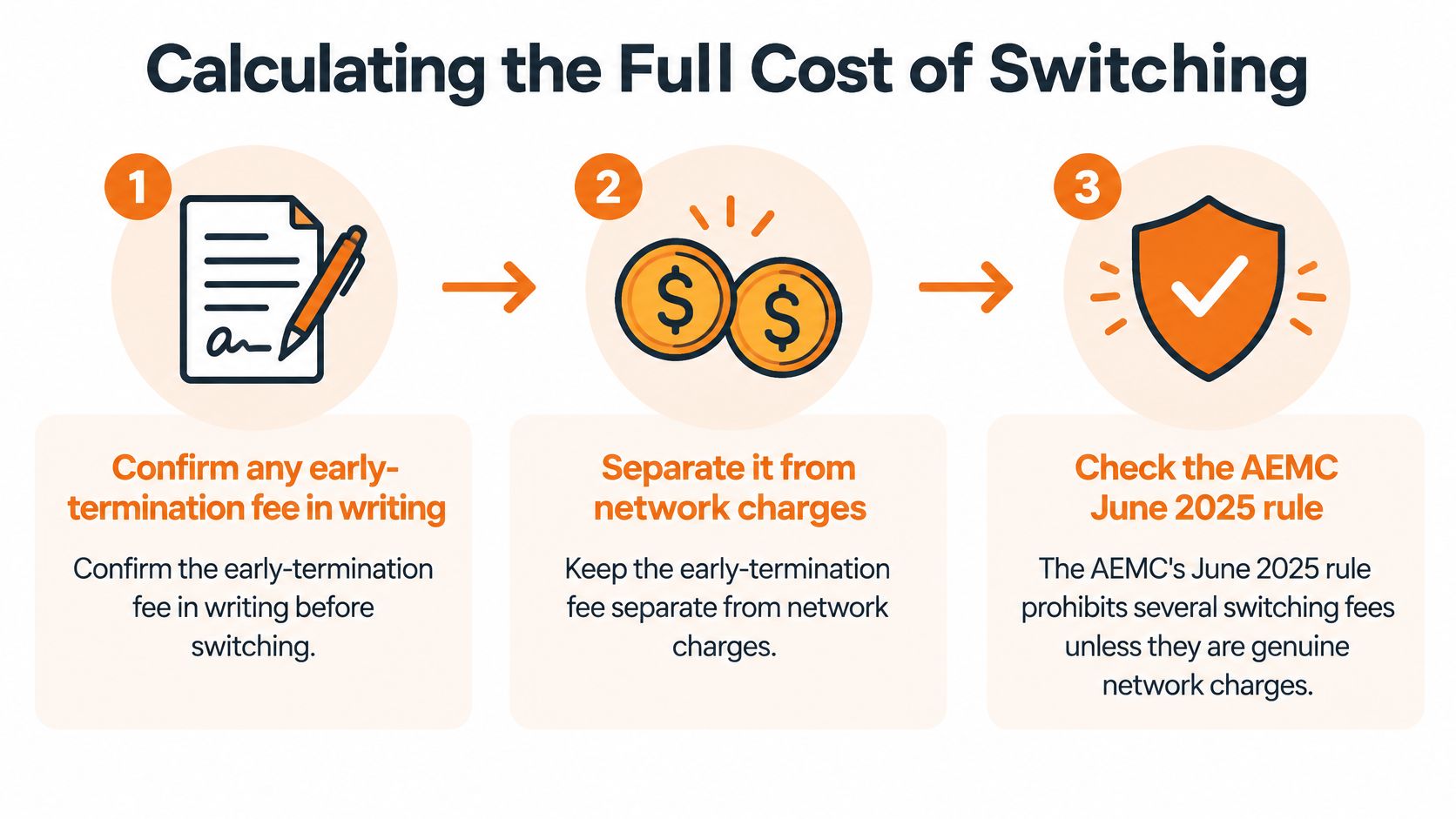
Confirm the early-termination fee in writing, then separate it from network charges. The Australian Energy Market Commission's June 2025 rule determination identified account establishment, meter reading, de-energisation and re-energisation charges as potential barriers to switching and prohibited several of them unless they are genuine network charges, per the AEMC final determination. Ask for each charge to be itemised. If it cannot be explained as a real network charge, query it before you switch.
List the discounts and credits that end at the final bill. Retention credits, prompt-payment discounts and sign-up bonuses usually stop when the account closes. Add them to the cost of leaving, not to the old plan's value. This is a common point of confusion because a credit can feel like stored savings, while the account may treat it as a conditional benefit.
Compare annual totals, not headline rates. Take the proposed daily supply charge and usage rates, multiply by your actual usage over 12 months, and set the result against your current annual total. A lower cents-per-kWh rate paired with a higher daily charge can lose money over a year. Work from bills, not estimates, where possible.
Check the solar and battery terms that travel with the account. A VPP is a contractual arrangement rather than a rebate, and leaving can end an incentive, a higher feed-in tariff or another benefit attached to participation, as YourHome's battery guidance explains. Feed-in rates and battery control permissions can change even when the advertised import rate looks better.
Add metering and connection costs if the move triggers them. A special meter read, de-energisation or re-energisation fee is a one-off cash cost. These charges belong in the same bucket as the retailer fee, even though they may appear under different line items. HighFlow Energy may also charge standard non-energy fees listed in the Price Schedule, such as disconnection or reconnection fees, special meter reads, and dishonour or late payment fees. Customers considering a car subscription rather than ownership can compare fixed weekly costs at reliable transport for self-employed tradies, but that comparison should stay separate from the energy calculation.
Total the one-off costs from steps one, two and five, then divide by the annual net saving. That gives the number of years to break even, which converts to months.
The formula: payback in months = one-off exit costs ÷ estimated annual net saving × 12.
Take a hypothetical household that gives up a AUD 150 credit and expects to save AUD 300 a year on the new plan. 150 ÷ 300 × 12 gives a payback of six months. If nine months remain on the old contract, switching pays for itself before the term would have ended anyway. If four months remain, waiting is the cheaper decision.
No standard offer shows a single figure for the total cost of leaving and starting again, so the arithmetic has to be done by hand or the comparison stays incomplete.
Equipment Recovery and VPP Contract Exit Risks
The largest exit cost a battery household can meet is rarely the retailer's fee. It usually sits in the agreement that put the hardware on the roof.

The ACCC's July 2025 National Electricity Market report found that VPP products involving financed solar or batteries, or provider-owned equipment installed at a customer's premises, can impose lengthy contract terms and significant exit fees, per the ACCC National Electricity Market report. Fees tend to run higher when a contract ends soon after installation, because the provider is recovering equipment and installation costs, and the report warns those charges can worsen financial hardship.
One detail matters more than the rest. Switching retailers can terminate some VPP contracts, which means an exit fee can appear even when the household only wanted a cheaper electricity rate.
A contract audit before you sign
Work through six items in order, because each one changes the size of the others.
- Who owns the equipment. Provider-owned or financed hardware creates a recovery obligation. Customer-owned hardware generally doesn't, unless the agreement ties a benefit to it.
- The remaining term. Long terms plus early exit is the combination that produces the biggest figures.
- The discount repayment formula. Look for a pro-rata or sliding-scale clause stating exactly what is repaid and when the obligation falls to zero.
- Minimum export or availability obligations. A clause requiring your battery to be available for a set number of events per year is a performance condition, not a fee, and breaching it can trigger one.
- Warranty implications. Check whether leaving the program affects the battery warranty and who honours it afterwards.
- What happens on a house sale or a retailer failure. Both end agreements unexpectedly, and both are usually covered somewhere in the fine print.
The battery itself doesn't move. It remains physically in the home while control rights transfer under the agreement, which is why the exit cost attaches to permissions and payments rather than to hardware disappearing.
For New South Wales households, the NSW Government battery and VPP consumer fact sheet says participants must sign a contract with the provider and that the provider must give a cooling-off period during which a household can change or cancel the offer. It also directs consumers to read the terms carefully and notes that households with registered life-support equipment cannot participate under the stated conditions. After that initial window, your ability to cancel, any notice requirement and any financial consequence depend entirely on the agreement you signed.
How No-Exit-Fee Services Differ From Standard Contracts
A published no-exit-fee term is a real difference, though a narrower one than the phrase suggests. The comparison below shows where the two arrangements part ways and where they stay the same.
| Feature | Fixed-term retail contract | HighFlow Energy (as published) |
|---|---|---|
| Early termination fee | Possible; cost-reflective under the NERL | None under published terms |
| Fixed term | Set by the contract | No fixed-term contract |
| Usage above any allowance | All usage charged at contracted rates | Excess charged at Energy Plan rates, with no penalty |
| Bill-free allowance after leaving | Not applicable | Stops; standard retail pricing applies |
| Outstanding energy charges | Payable on exit | Final account settled normally |
| Non-energy fees | Per price schedule | May apply, such as disconnection or late payment |
The promise underneath is short: no fixed contract term, no exit fee, no cancellation fee, and the freedom to leave at any time without penalty. That right also applies if prices or terms change where energy laws permit, since any change comes with notice and the same option to walk away. Three costs still sit directly beneath the promise, and each is worth pricing before you switch.
Energy already used stays payable. Leaving ends the arrangement, not the final bill, and the account is finalised in the normal way; if a credit balance remains when the account closes, it is refunded automatically.
The bill-free allowance stops on the day you leave. That allowance is what covers the daily supply charge plus network and distribution charges on in-allowance usage, so losing it costs more than the usage line alone. Standard retail pricing applies from that point.
Standard non-energy fees can still apply on the way out, including disconnection or reconnection fees, special meter reads, and dishonour or late payment fees, as listed in the Price Schedule. Direct debit may also be required where excess usage or other standard fees apply.
A zero on the termination line is not a zero-cost exit. A household that leaves mid-cycle loses the VPP-funded allowance for the rest of the period, and losing automated optimisation means scheduling battery charge and discharge manually. Read the published terms and the Price Schedule together, and confirm in writing anything they do not state plainly, including what happens to battery control on the day you leave and how the arrangement sits alongside a no lock-in contract.
Check Your Exit Cost Before You Switch
Five actions settle the question, and none of them takes long.
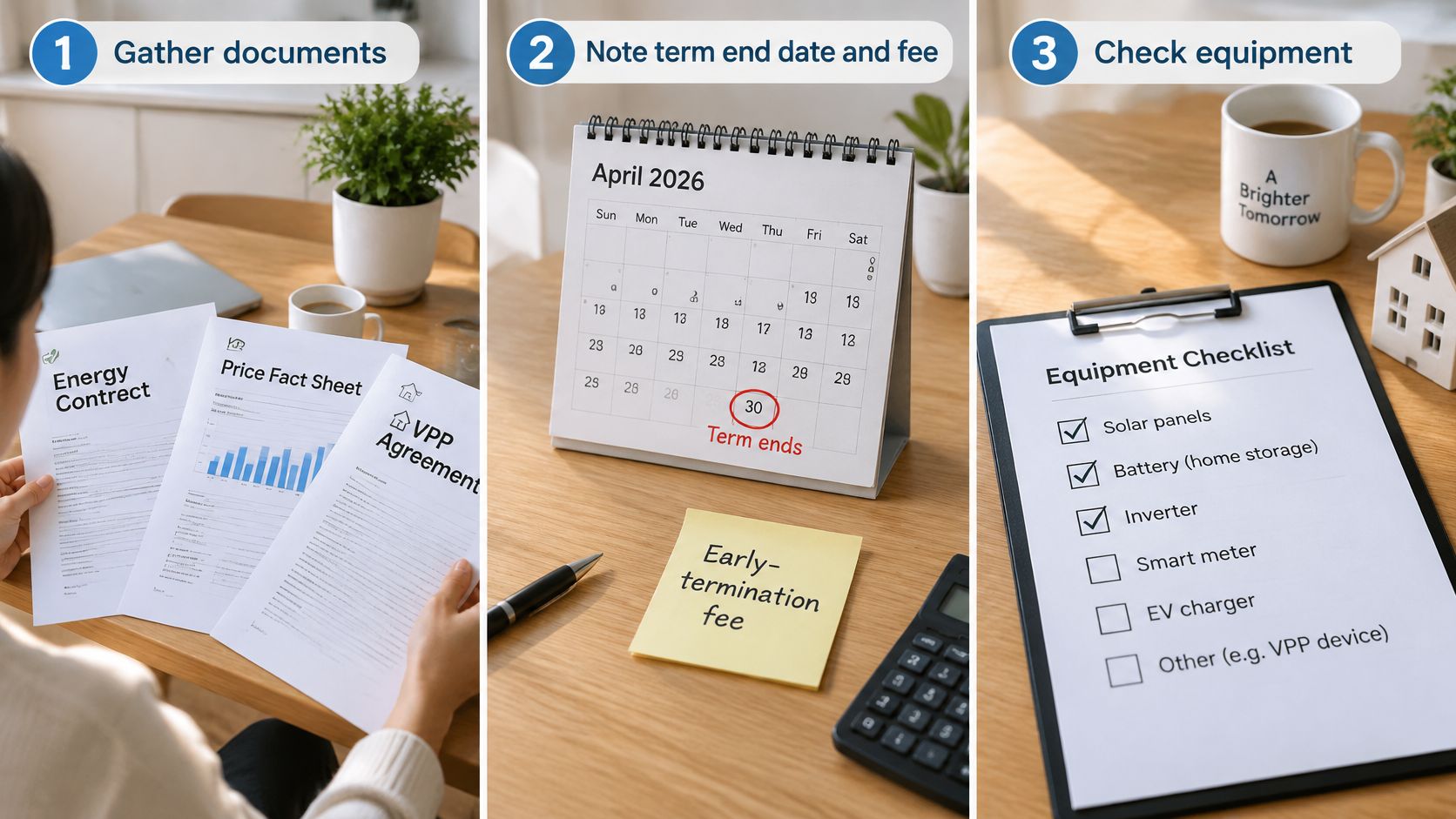
- Gather the documents. The energy contract, the current price fact sheet and any VPP or battery agreement, in one folder.
- Note the term end date and any early-termination fee. Write the amount down rather than relying on memory of a phone call.
- Confirm equipment ownership and any discount repayment clause. This is the item most households skip and the one that produces the biggest number.
- Run the payback calculation. One-off costs divided by the annual net saving, converted to months, compared against the remaining term.
- Ask what changes on the day you leave. Feed-in rate, battery control, allowance and final billing all need a written answer.
The transfer itself, from the final read to the first bill under the new retailer, is set out step by step in our guide to changing electricity provider.
HighFlow Energy's electricity retail, billing, compliance and market services are provided by ERC Energy Pty Ltd, an authorised Australian electricity retailer, trading under the HighFlow Energy brand. If eligibility requirements are no longer met, the allowance stops and standard retail pricing applies unless you leave, which is why the leaving question and the eligibility question belong in the same conversation.
Most battery owners focus on installation quality. Far fewer focus on ongoing performance and optimisation. HighFlow Energy is an electricity retailer built around unlocking the full value of your existing solar and battery system.
If you would like to understand whether your battery is underperforming financially, request an eligibility assessment today.
Whether switching reduces your costs depends on your own system, your usage pattern and the terms of any agreement you already hold. No arrangement removes every bill, and none of this guarantees bill elimination.
HighFlow Energy works with households that already own solar and a battery, coordinating that hardware through a Virtual Power Plant and using the value it creates to fund a bill-free electricity allowance. There's no fixed term and no exit fee, so testing a coordinated approach doesn't commit you to a cancellation clause, and the battery stays yours to use first. Visit HighFlow Energy to check your eligibility and see how much of your current bill your system could be covering.