

Alpha ESS Battery vs Tesla Powerwall in Australia (2026)
You've already done the expensive part. You installed solar. You added a battery, or you're close to choosing one. Now you're trying to work out whether Alpha ESS or Tesla will deliver better long-term value in Australia, not just the better logo on the wall.
That's the right question.
For homeowners in Queensland and New South Wales, the gap in an Alpha ESS battery vs Tesla comparison isn't solely hardware. It's how each system performs once it's connected to the grid, exposed to export limits, and used inside a Virtual Power Plant. A battery is no longer just backup. It's an energy asset, and the return depends on both technical capability and how that capability is monetised.
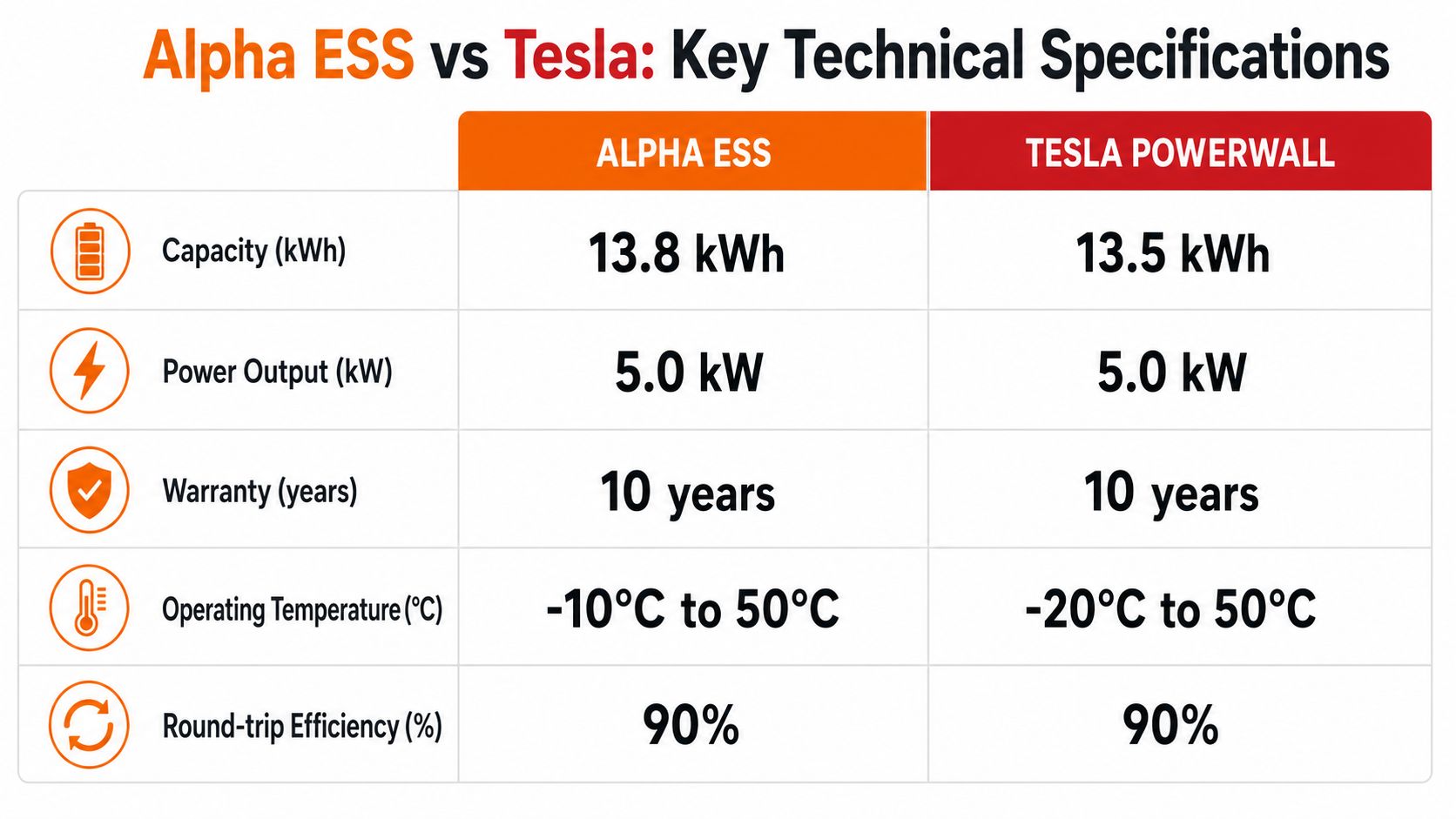
Alpha ESS vs Tesla Key Technical Specifications
A NSW or Queensland homeowner comparing these two batteries is usually trying to answer a practical question. Which system will produce more value once it is installed, enrolled with a retailer, and exposed to real tariff rules, export limits, and VPP dispatch events?
That makes a short spec sheet less useful than it first appears. The better comparison is the one that separates hardware traits that affect household self-consumption from those that affect future VPP earnings.
| Specification | Alpha ESS | Tesla Powerwall |
|---|---|---|
| Capacity approach | Modular, expandable | Fixed 13.5 kWh unit |
| Warranty | 10 years, with VPP participation described as unaffected in earlier cited market material | 10-year product warranty standard in market positioning |
| Inverter efficiency | 97.3% for SMILE-G3-B5 | 97.5% solar-to-home/grid efficiency for Powerwall 3 |
| VPP support | Explicit VPP integration, including fast FCAS positioning on SMILE-G3-B5 product material | VPP capable, with broad retailer compatibility in Australia |
The specification gap that matters most
The core technical difference is system architecture. Alpha ESS lets households expand storage over time. Tesla Powerwall is simpler to buy and size because each unit comes as a standard fixed-capacity block.
That choice affects economics. A modular battery suits households expecting a change in load profile, such as EV charging, a pool pump, electrified hot water, or higher evening usage. A fixed-capacity system suits households that already know their likely storage requirement and prefer a cleaner one-step purchase decision.
For buyers still working through sizing, a more careful solar panels and battery cost guide is often more useful than headline battery pricing alone, because oversizing and undersizing both reduce long-run value.
Efficiency is close. Dispatch capability is less interchangeable.
The inverter efficiency difference between these products is marginal. The Alpha ESS SMILE-G3-B5 delivers a maximum inverter efficiency of 97.3%, while the Tesla Powerwall 3 reaches 97.5% solar-to-home/grid efficiency, according to Aussie Solar Tech's Alpha ESS vs Tesla comparison. For a homeowner, that spread is too small to drive the investment case on its own.
The more commercially relevant question is how the battery behaves when a retailer uses it as a grid asset. In NSW and Queensland, VPP revenue depends less on tiny conversion-efficiency differences and more on whether the battery, software stack, and retailer can respond quickly enough to participate in higher-value grid services such as FCAS. That is where published marketing comparisons often stop too early.
Why modularity and VPP readiness can change returns
Alpha ESS has tended to present its VPP integration and FCAS positioning more directly in Australian sales material. That matters because a battery that is easier for a retailer to aggregate, control, and cycle under warranty can generate value beyond simple solar shifting.
Tesla remains a strong option for homeowners who prioritise a tightly integrated ecosystem and broad market recognition. But from an analyst's perspective, the hardware comparison points to a different conclusion. If two batteries are close on core conversion performance, the one that fits household load growth more precisely and aligns more clearly with retailer-led grid services can produce the better long-term return.
That hidden value usually does not appear in the spec table itself. It appears later in VPP credits, dispatch frequency, and the ability of your retailer to monetise the battery well.
Cost Analysis and Return on Investment
A NSW or Queensland homeowner comparing these systems is rarely choosing between a "cheap battery" and an "expensive battery." Instead, the choice is between two different return profiles. One tends to lower capital at entry and gives more flexibility on sizing. The other asks for a higher initial outlay and relies more heavily on software, integration, and retailer execution to justify that premium over time.
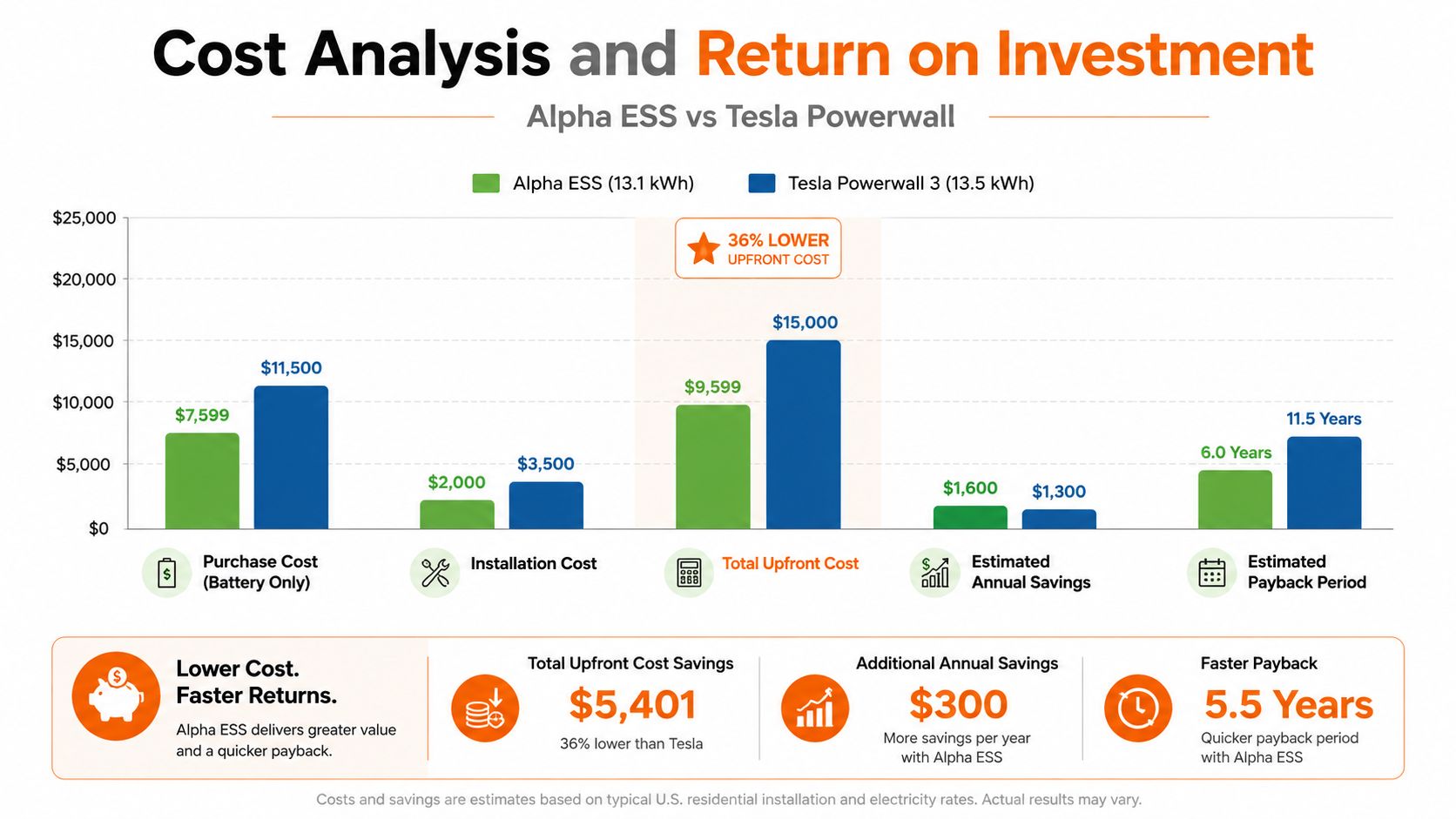
Earlier pricing references show that Alpha ESS usually enters the conversation with a lower upfront cost than Tesla in the Australian market. That matters, but only to a point. A battery earns its keep through three channels: solar self-consumption, bill reduction during peak periods, and any retailer payments available through orchestration programs such as a VPP. If the first two channels look similar across households, the difference in return often comes from how much capital was committed on day one and whether the battery can produce additional revenue later.
Upfront pricing and value per kilowatt-hour
For households that want capacity matched closely to current usage, Alpha ESS generally has a structural advantage because modular configurations can reduce oversizing risk. Oversizing is a quiet destroyer of battery economics. If part of the battery sits underused for much of the year, the effective cost per useful kilowatt-hour rises even if the headline purchase price looked competitive.
Tesla's case is different. The premium can still make sense for households that place a high value on its app experience, integrated backup behaviour, or brand confidence. From a pure return-on-invested-capital perspective, though, the higher entry cost means the battery usually needs stronger lifetime utilisation to close the gap. In practical terms, that often means sharper tariff arbitrage, more consistent cycling, or access to retailer programs that can monetise fast response into grid services.
That is why simple payback tables can mislead. They often treat the battery as a passive storage box rather than an actively dispatched asset.
For a broader look at the variables that shape household battery economics, including sizing, installation complexity, and tariff structure, this guide to solar panels and battery cost in Australia is useful context.
A short market explainer helps visualise how buyers are weighing the two systems in practice:
What ROI really means for homeowners
Return on investment should be assessed over the full operating life, not only by asking how quickly the system "pays for itself." A shorter payback reduces capital risk. It also leaves more years in which the battery can generate net savings after breakeven. For households uncertain about future electricity usage, EV adoption, or changes in feed-in tariffs, that lower-risk profile has real value.
The less obvious point is that NSW and Queensland owners should not treat ROI as a hardware-only calculation. If a retailer can use the battery for higher-value grid services, response capability and control software start to matter financially, not just technically. A battery that is easier to aggregate into a retailer-based VPP may produce a better long-term result even if its raw storage economics look only modestly better at installation.
The better investment is the battery that fits the home's load profile, recovers capital in a reasonable timeframe, and remains commercially useful once basic solar shifting has been exhausted.
Viewed through that lens, Alpha ESS often presents the stronger base-case economics before VPP income is added, particularly for households that want tighter sizing discipline and lower upfront exposure. Tesla can still deliver a sound outcome, but more of its value case depends on the quality of retailer integration and the household's willingness to pay for a premium ecosystem rather than the battery economics alone.
Maximising Value with a Virtual Power Plant
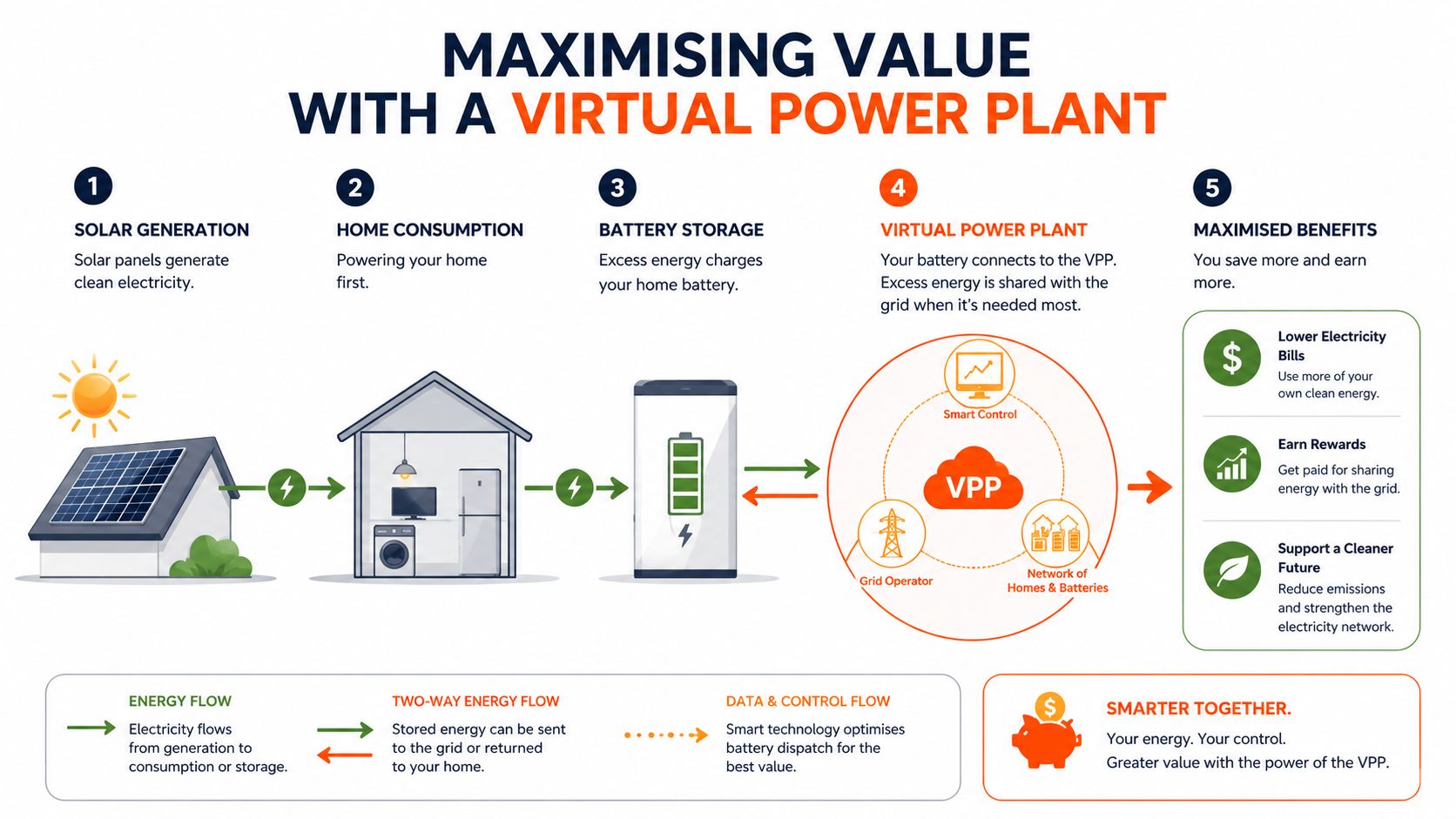
A Sydney or Brisbane homeowner can install a battery, cut evening imports, and still leave part of the asset underused. The larger value question starts after installation. Can the battery join a retailer-run program that pays for grid support, and can its control system respond fast enough to earn meaningful revenue when those events occur?
A Virtual Power Plant coordinates many home batteries so a retailer or aggregator can dispatch them as a single flexible resource. That matters because long-term battery returns in NSW and Queensland are shaped by more than self-consumption. They are also shaped by whether the battery can be used for short, high-value grid services without undermining household backup or bill savings.
Why FCAS matters in a battery comparison
For homeowners in Queensland and New South Wales, the significant gap in an Alpha ESS battery vs Tesla comparison is not only storage capacity, warranty terms, or app quality. It is also whether the battery can be aggregated effectively into FCAS, or Frequency Control Ancillary Services, which are used to help stabilise the grid.
That technical detail has a direct commercial effect. A battery that responds quickly and integrates cleanly with a retailer or aggregator has more opportunities to earn beyond simple solar shifting. In practical terms, this is the hidden value layer in a battery comparison. Two systems can look similar on everyday household cycling, yet produce different long-run returns once VPP participation is added.
As noted earlier, some market comparisons argue that Alpha ESS can be better positioned for FCAS-oriented participation in certain programs. The broader point is more important than any single brand claim. Response speed, aggregation compatibility, and software control are revenue variables, not just engineering features.
Retailer structure determines how much of that value you keep
Battery compatibility alone does not create VPP income. The retailer's operating model determines how often the battery is called, which services it can access, how reserve capacity is managed for the household, and how payments are shared.
Three commercial questions deserve more attention than they usually get:
- How fast can the battery respond? Faster-response capability can improve suitability for grid support programs where timing matters.
- Who controls dispatch? A tightly managed ecosystem may work well in one retailer program and less well in another, depending on integration rules.
- How much energy is reserved for the home? VPP earnings look less attractive if participation leaves too little stored energy during peak pricing periods or outage risk.
Homeowners comparing program design can review how a Virtual Power Plant in Australia typically operates before judging the battery on hardware alone.
A battery that only performs daily solar shifting captures one value stream. A battery that also participates in grid services may capture several.
This is why Tesla and Alpha ESS should be judged as part of a wider system that includes the retailer, the software layer, and the local grid context. In NSW and Queensland, where VPP value can rise during network stress and wholesale volatility, FCAS readiness can materially change lifetime returns even when the batteries appear broadly similar on paper.
State-Specific Incentives for NSW and QLD
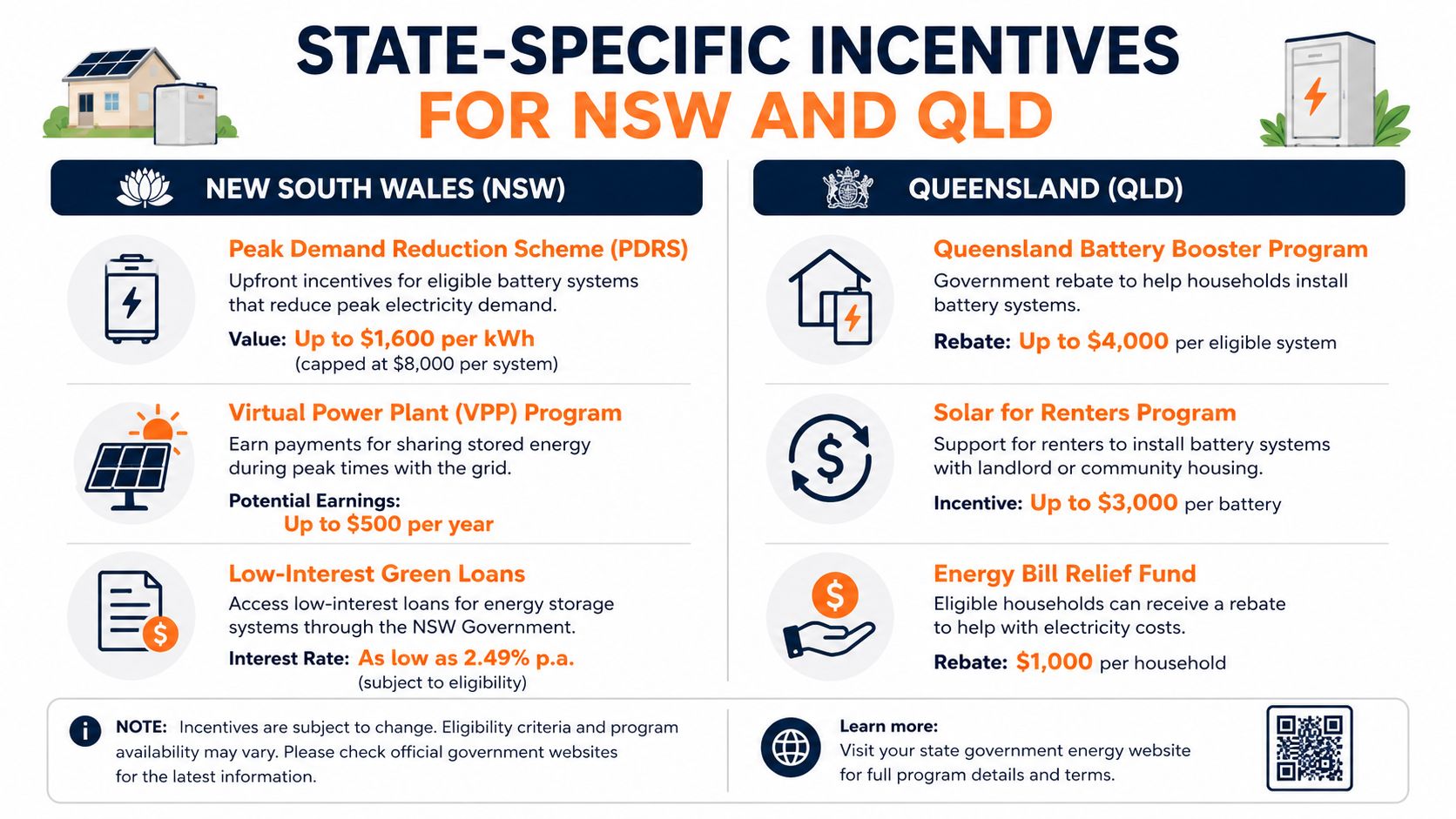
A Sydney or Brisbane homeowner can install two batteries with similar usable storage and end up with very different financial outcomes. The gap often comes from policy design, export rules, and whether the battery can participate in a retailer-run VPP quickly enough to capture grid service revenue.
New South Wales incentives
NSW has the clearest policy link between battery ownership and VPP participation. According to EcoFlow's summary of VPP incentives in Australia, households in New South Wales may be able to access the Peak Demand Reduction Scheme, with a cited battery incentive of $550 to $1,100 on top of federal support.
That matters because the incentive does not reward storage capacity alone. It favours a battery that can be enrolled, dispatched, and managed within a VPP structure that suits local network needs. For an Alpha ESS vs Tesla comparison, the commercial question is therefore broader than purchase price. It includes how easily each system fits the retailer program that monetises the battery after installation.
Homeowners who want current program details can check this guide to the NSW battery rebate eligibility and incentive settings.
Queensland and export-driven value
Queensland relies less on a direct state battery incentive in the source set used here, but tariff design and export timing can still have a large effect on returns. A household with the right inverter configuration, network approval, and retailer tariff can earn materially more from controlled exports than from simple overnight backup value.
The practical implication is easy to miss. In Queensland, a battery with stronger VPP compatibility or faster response capability may create more value through retailer dispatch and export optimisation than through self-consumption alone. That shifts the Alpha ESS vs Tesla decision toward software integration and retailer access, especially for households in Energex areas with good solar production and flexible evening demand.
The federal rule that changes both states
Federal settings now reinforce that same logic in both NSW and Queensland. As noted earlier, the Cheaper Home Batteries Program ties rebate access to VPP readiness. That makes communication standards, control architecture, and retailer compatibility part of the financial case, not just a technical footnote.
For homeowners comparing Alpha ESS and Tesla, the hidden value is straightforward. A battery that qualifies for incentives but only performs basic solar shifting captures one layer of benefit. A battery that also supports retailer-based VPP participation, including fast-response grid services where available, can add a second layer of value over its life.
In NSW, that can strengthen the case where state incentives and VPP participation overlap. In Queensland, it can improve returns where export timing and retailer dispatch matter more than direct rebates.
Which Battery Is Right for Your Household
There isn't one correct answer for every home. The right choice depends on whether you care most about entry cost, expandability, premium ecosystem design, or VPP optimisation.
If budget discipline matters most
Alpha ESS is the stronger fit for households that want to control upfront spend and recover cost sooner. Its modular architecture also reduces the pressure to get the battery size perfect on day one. That matters if your future demand is uncertain.
This profile usually includes households that already think in payback terms. They're less interested in premium branding and more interested in getting from installation to positive financial performance with fewer years of waiting.
If simplicity and brand ecosystem matter more
Tesla Powerwall makes sense for buyers who place a premium on an established ecosystem, polished software, and a straightforward fixed-capacity decision. Some homeowners value that simplicity enough to accept a higher cost base and a slower financial return.
That choice can still be rational. It's just a different priority stack.
If you want to optimise VPP participation
For households in NSW and Queensland that want to extract as much operational value as possible from battery participation, Alpha ESS has the more interesting edge because of the documented fast FCAS capability and the cited revenue advantage in VPP settings.
A quick decision guide helps:
- Choose Alpha ESS if your focus is modularity, lower capital outlay, and stronger VPP-oriented economics.
- Choose Tesla if you value ecosystem familiarity and are comfortable paying more for a premium integrated experience.
- Pause the decision if you still haven't mapped your tariff, export conditions, and likely battery usage pattern. Hardware alone won't answer the ROI question.
The mistake many buyers make is choosing a battery as if the purchase ends the decision. It doesn't. The purchase starts a longer commercial relationship between your hardware, your retailer, and the grid.
Why Your Energy Retailer Is More Important Than Your Battery
A well-chosen battery can still underperform financially if it sits on the wrong electricity plan or inside a weak VPP structure. That's the part many households miss.
The battery is the asset. The retailer and operating model determine how often that asset is used well.
Traditional retailers usually treat home batteries as passive load-management tools. They may acknowledge the battery, but they don't actively structure retail participation around extracting the full value of it. For homeowners in the National Electricity Market, that leaves money on the table during demand events, export windows, and grid-support periods.
The better framing is this:
- Battery quality matters
- Retail structure matters more over time
- Transparency matters most when revenue depends on orchestration
Buying a capable battery without a strong optimisation pathway is like buying a commercial-grade machine and using it at half capacity.
Most battery owners focus on installation quality. Far fewer focus on ongoing performance and optimisation. High Flow Energy is an electricity retailer built around realizing the full value of your existing solar and battery system.
If you would like to understand whether your battery is underperforming financially, request an eligibility assessment today.
Frequently Asked Questions About Alpha ESS and Tesla Batteries
A common NSW or Queensland scenario looks like this. Two households install batteries with similar storage capacity, but one earns stronger long-run value because its system can respond faster in a retailer-managed VPP and is easier to use for grid events. That is why the final comparison between Alpha ESS and Tesla should focus on operating value, not brand recognition alone.
Is Alpha ESS cheaper than Tesla in Australia
In many Australian quotes, Alpha ESS sits at the lower entry point. That can improve payback if your goal is reducing import costs and keeping capital outlay under control.
The more useful question is whether the lower price comes with enough technical capability to generate ongoing value. For households considering VPP participation, that answer may be yes, provided the installer and retailer can use the battery well.
Which battery is better for a Virtual Power Plant
Alpha ESS appears to have the clearer VPP-oriented case in the source material discussed earlier, especially where FCAS responsiveness is part of the offer. For households in NSW and Queensland, that matters because faster and more flexible grid response can translate into better retailer-based earnings over time.
Tesla can still participate in VPP programs, but the financial result depends less on the badge on the battery and more on the retailer's operating model, dispatch rules, and revenue-sharing structure.
Does joining a VPP affect battery warranty
For Alpha ESS SMILE, the warranty position referenced earlier states that VPP participation does not void the 10-year warranty. That removes one of the main objections for owners weighing VPP income against battery protection.
Tesla owners should check the current warranty terms attached to their specific product and program. VPP participation is not a detail to assume. It should be confirmed in writing before enrolment.
Can I join a VPP if my battery is already installed
Often, yes.
The practical checks are compatibility, communications setup, and whether the battery can be integrated into the retailer's control platform. A battery that is technically eligible can still deliver weak results if the retailer only uses it occasionally or does not optimise charge and discharge against price events.
Will I still have priority access to my own battery
In a well-structured VPP, household supply should remain the first priority. The battery should cover home consumption and backup settings before spare capacity is offered into coordinated grid services.
That said, the essential answer sits in the operating rules. Homeowners should ask how reserve levels are set, who controls minimum state of charge, and how often the battery is dispatched for external events.
Are rebates now linked to VPP capability
Yes. As noted earlier, policy settings are shifting toward VPP-ready battery eligibility.
That changes the buying decision in a material way. VPP readiness is no longer only a technical extra for households chasing additional revenue. It is becoming part of the compliance and value equation.
Is Tesla still worth considering if Alpha ESS has better value metrics
Yes, for some households.
Tesla can still make sense for buyers who want a familiar software environment, a well-known brand, or a simpler fixed-capacity product choice. The trade-off is that these strengths do not automatically produce the best total financial return, especially if another battery offers stronger flexibility for VPP participation and future expansion.
What should I compare before choosing either battery
Use five filters.
- Load shape. Evening demand, daytime solar surplus, and seasonal usage determine whether the battery will cycle enough to justify the investment.
- VPP readiness. Check whether the battery can participate in the retailer program you are likely to join, not just whether it is theoretically compatible.
- Response capability. Faster response and better orchestration can improve access to FCAS-style value streams where available through a retailer.
- Expansion path. If EV charging, electrified hot water, or household growth is likely, modularity can matter more than headline capacity today.
- Retail structure. Revenue share, dispatch logic, reserve settings, and transparency often have more impact on long-term returns than small hardware differences.
If you already own a solar battery, the bigger question is whether your current setup is producing the value it should. High Flow Energy is an Australian electricity retailer focused on Bring Your Own Battery Virtual Power Plant performance for homeowners in NSW and Queensland. If you'd like to review your battery's current electricity performance, check eligibility, and understand whether you're underutilising your asset, request an assessment today.