


Best Home Battery Australia 2026: Buyer’s Guide
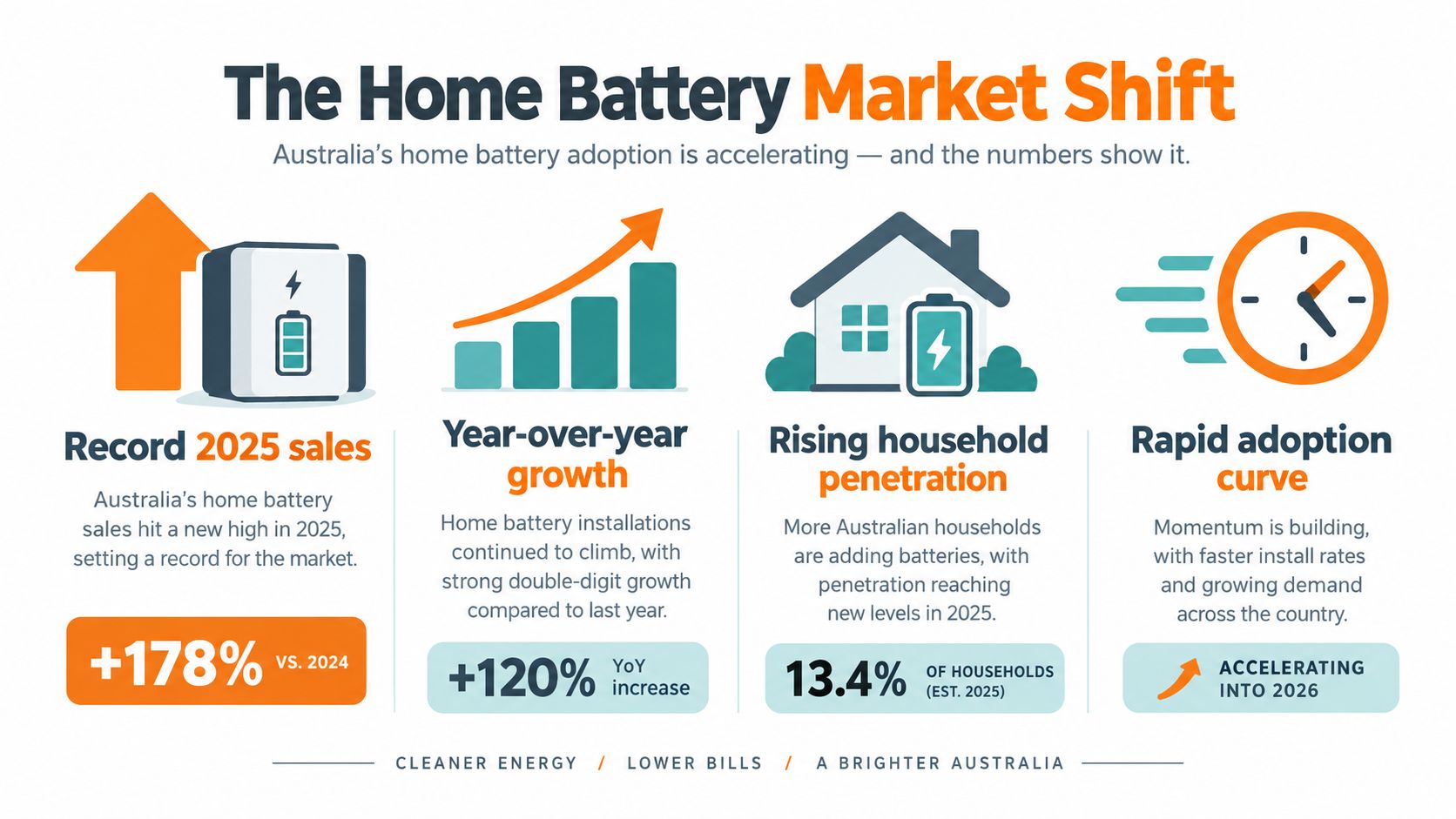
Australia's home battery market has moved decisively beyond the early-adopter phase. The Clean Energy Council reported 183,245 battery units sold in the second half of 2025, a four-fold increase on the same period in 2024, and said that sales equalled 99% of all battery sales made from 2020 to 2024 combined. By the end of 2025, Australian households had 454,753 battery installations.
That changes what “best home battery” means. Availability and basic storage capacity still matter, but the better question is whether a battery can deliver usable power efficiently, meet safety requirements, support your household loads, and create ongoing value through a compatible retailer or Virtual Power Plant. For homeowners in Queensland and New South Wales, hardware is only one part of the decision.
The Home Battery Market Shift
Australia's residential storage market added about 4,790 MWh of new capacity in 2025, according to the Clean Energy Council market update. That scale reflects more than rising sales. Supply chains have strengthened, installers have gained practical experience, and homeowners have more operating data to assess products beyond their advertised capacity.
Independent reporting found that the average system size reached 21.6 kWh, compared with 11.8 kWh in 2024. Larger systems can shift more daytime solar into evening use and provide more meaningful backup, but size alone does not determine value. Conversion losses, discharge timing, tariff settings, and retailer or VPP access can affect electricity bill savings just as much as the amount of energy stored.
Why scale changes the buying decision
A larger installed base gives homeowners more practical evidence about installation quality, monitoring software, service response, backup behaviour, and integration with Australian electricity arrangements. It also makes system fit more important. A battery may cover evening imports yet deliver weaker returns if it charges inefficiently, follows unsuitable tariff settings, or cannot discharge to the circuits that matter.
Battery value comes from its operating pattern. The relevant questions are how much energy reaches the home after conversion losses, when discharge occurs, which household loads the system supports, and whether the owner can join suitable demand-response or VPP services.
Practical rule: Assess the battery as an operating asset, not only as wall-mounted hardware. Its software, inverter, controls, and retail arrangement influence the value delivered each day.
Electric vehicle ownership adds another design consideration. Homeowners comparing solar, storage, and EV charging can understand EV integration with storage before choosing charge schedules or system controls. EV demand may compete with household use, while coordinated settings can direct available solar to the priority load.
The market is now about performance
The right battery depends on the household's load profile and operating goals. Homes running air conditioning, cooking appliances, pumps, or other large loads together may value continuous output more than a small efficiency advantage. Households focused on solar self-consumption or wholesale price arbitrage may place greater weight on round-trip efficiency and flexible controls.
Queensland and New South Wales homeowners should assess network conditions, export limits, tariff design, and VPP eligibility before installation. These factors shape ongoing financial performance, even when two systems have similar nameplate capacity. The best comparison therefore combines hardware capability with the way the retailer and software will operate the system over time.
Comparing Leading Battery Technologies
Battery comparisons often begin and end with kilowatt-hours. That approach misses a central trade-off. Usable capacity tells you how much energy can be stored, continuous power tells you how much load can run at once, and round-trip efficiency tells you how much stored energy survives the charge and discharge process.
The following comparison uses Australian installer comparison figures for three recognised systems.
| Battery system | Usable capacity | Continuous power | Round-trip efficiency | More suited to |
|---|---|---|---|---|
| Tesla Powerwall 3 | About 13.5 kWh | 11.5 kW | About 89% | Larger simultaneous loads and broad backup capability |
| Sungrow SBR HV | About 12.8 kWh | 9.6 kW | About 97% | Solar self-consumption and efficient daily cycling |
| BYD Battery-Box HVM | About 13.8 kWh | 8 kW | About 96% | A balance between capacity and efficiency |
Source: Australian home battery comparison data.
Capacity isn't the whole story
The Tesla Powerwall 3 offers the strongest continuous power figure in this comparison. That can matter in a home where cooking, air conditioning, pumps or other substantial loads operate together. Higher continuous output can reduce the need to manage household behaviour during backup or peak periods, assuming the overall system design supports those circuits.
The Sungrow SBR HV has a lower usable capacity than the BYD Battery-Box HVM in the comparison, but its reported efficiency is higher. That difference matters when the battery repeatedly charges from solar and discharges into household demand. Less energy is lost during the cycle, which can support stronger solar self-consumption and arbitrage outcomes over the operating life of the system.
BYD sits between the other two on capacity and offers a lower continuous power figure than Tesla. It may suit households that want efficient energy shifting but don't expect to run several large loads simultaneously. The right decision depends on the load profile, not the product ranking alone.
Match power to real household demand
Start with the loads you expect to run together. A battery that has ample capacity but insufficient continuous power may still rely on the grid when several appliances operate at once. Conversely, a high-power battery can be inefficiently sized if the household rarely creates large simultaneous demand.
Ask the installer or system designer to clarify:
- Usable capacity: How much energy can the household access after reserve settings and operating limits?
- Continuous output: Which household circuits can run together without grid support?
- Backup configuration: Does backup cover essential circuits or the broader home?
- Expansion path: Can storage be expanded without replacing major system components?
- Control compatibility: Can the system communicate reliably with the intended retailer or VPP platform?
Battery installation also depends on the connection between solar generation, inverter equipment and storage controls. A practical solar battery connection guide can help homeowners understand the components and wiring relationships before they compare offers.
For a deeper explanation of how output affects household performance, review battery discharge rate. The key point is simple: capacity determines duration, while discharge capability determines whether the battery can meet demand at the moment your home needs it.
Efficiency versus power
There isn't a universal winner between efficiency and power. A home with modest evening loads may gain more from preserving solar energy through an efficient battery. A home with electric cooking, substantial cooling demand or multiple backup circuits may place greater value on continuous output.
Don't compare advertised capacity alone. Compare the full operating profile, including usable energy, power delivery, efficiency, backup behaviour, software control and retailer compatibility.
Understanding Safety Standards and Efficiency
Safety and efficiency should be verified independently of sales language. Australian consumers need to assess whether a proposed lithium battery meets applicable product and installation requirements, whether the product is approved for the intended setting and whether the installer understands current technical expectations.
CHOICE's battery storage buying guide says lithium home batteries should usually exceed 90% efficiency. That benchmark is useful because it focuses attention on the energy delivered after charging and discharging, rather than the larger energy figure that may appear in a product brochure.
The relevance of SA TS 5398
The Clean Energy Council notes that Standards Australia published SA TS 5398 in October 2025 as a new technical specification for home batteries, replacing the Battery Safety Guide. For buyers in New South Wales and Queensland, this reinforces the need to ask for current compliance information rather than relying on older marketing documents or general statements about safety.
A compliant installation still requires more than selecting a recognised brand. The site, inverter, isolation equipment, clearances, ventilation, monitoring connection and commissioning process all matter. The installer should explain how the proposed system meets the relevant Australian requirements and what documentation the homeowner will receive.
What to verify before signing
Use a written checklist:
- Approved product status: Confirm that the battery and associated equipment meet the requirements relevant to the installation and any incentive being claimed.
- Efficiency basis: Ask whether the quoted efficiency is round-trip efficiency and whether it reflects usable operating conditions.
- Warranty terms: Read capacity retention conditions, throughput limits, exclusions, software requirements and the process for warranty support.
- Installation responsibility: Establish who is responsible for design, commissioning, fault diagnosis and communication with the manufacturer.
- Connectivity: Check whether internet access is required for monitoring, remote control or VPP participation.
- Operating reserve: Understand how much stored energy remains unavailable for normal use because of backup or battery-protection settings.
Efficiency also has a commercial consequence. Every conversion loss reduces the solar energy available for household use or export. A small difference in a specification won't determine the outcome on its own, but it becomes relevant when a battery cycles regularly and the retailer's control strategy is built around precise charge and discharge decisions.
Safety comes before optimisation. A battery can't create reliable financial value if the installation, compliance record or support pathway is unclear.
Creating Value Through Virtual Power Plants
A Virtual Power Plant, or VPP, links batteries in different homes through software. The batteries stay on each customer's property, while an approved provider coordinates their operation in response to grid conditions, wholesale prices and demand events.
A Bring Your Own Battery VPP, or BYOB VPP, suits households that already have compatible solar and battery equipment. There is no need to buy another battery. The provider checks compatibility, connects the system remotely and manages available capacity while following the household's agreed operating priorities.
How the operating model works
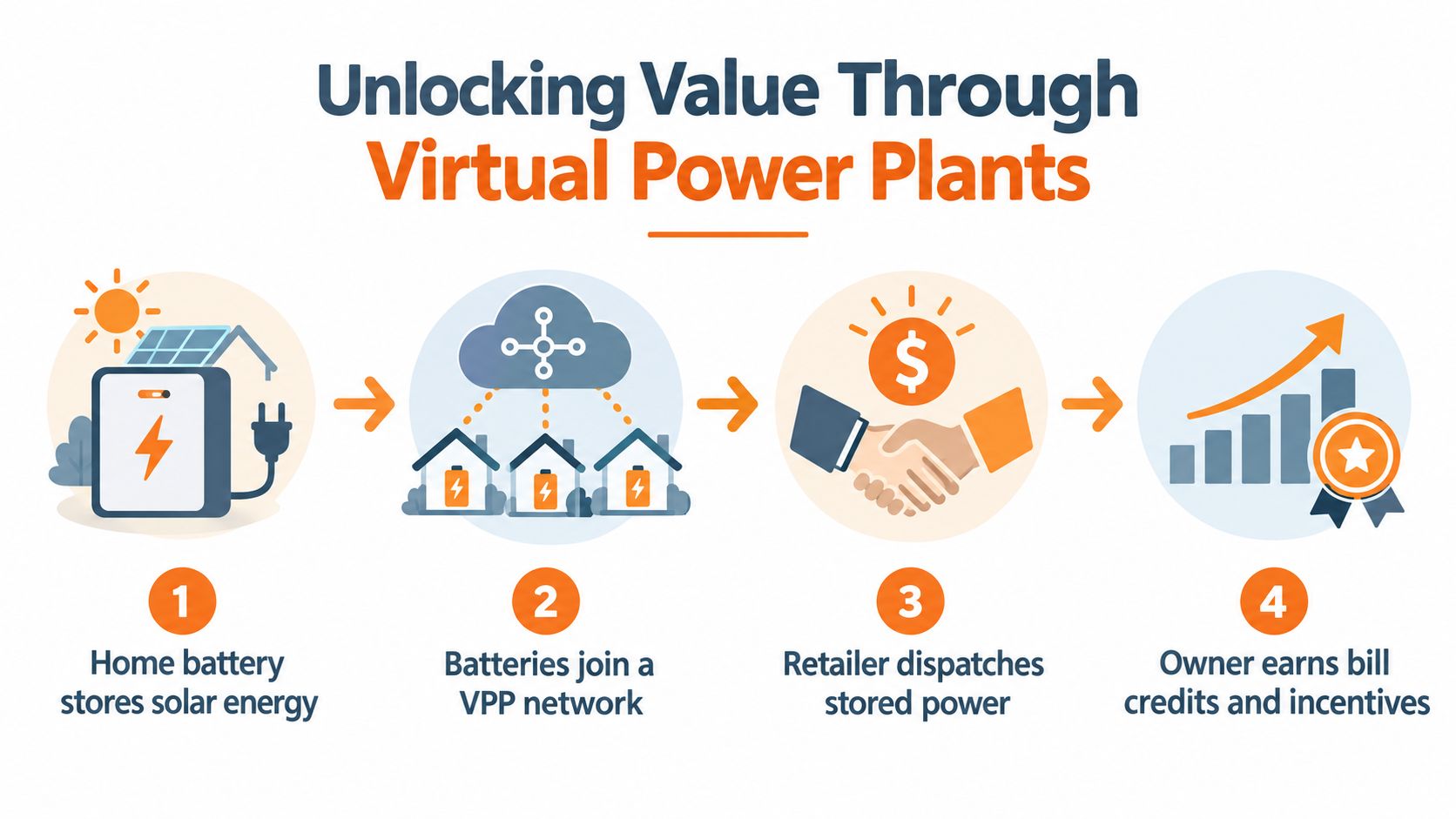
A VPP generally operates through four stages:
- The battery stores energy. Solar generation serves household loads first. Surplus generation can charge the battery, subject to system controls and export arrangements.
- The battery joins a managed network. The VPP provider communicates with compatible inverter and battery equipment through a secure platform.
- The retailer dispatches spare energy. During a demand event or favourable wholesale period, the provider can request discharge within agreed limits.
- The household receives value. Compensation may take the form of bill credits, allowances or another published arrangement.
The NSW Government's VPP guide describes VPPs as battery networks that support the grid and can sell excess stored power during peak demand. This gives a battery a second value pathway beyond self-consumption. It can reduce household grid imports while providing a controlled grid service when spare capacity is available.
Why market conditions matter
Wholesale conditions in the National Electricity Market change with demand events, network constraints and shifts between supply and demand. VPP operators use forecasting and dispatch controls to decide whether a battery should preserve energy for the home, charge from available solar or discharge into the market.
A discharge event is not automatically worthwhile. Poor control can leave the battery empty before the household needs it, add cycling without adequate compensation or reduce backup readiness. A suitable VPP should set clear reserve levels, explain event rules and show customers when their system is being managed.
For an existing system, solar battery Virtual Power Plant participation depends on equipment compatibility and the customer's control settings.
Customers should retain priority use of their battery. VPP participation works best when grid services draw on spare capacity rather than restricting practical access to stored energy.
This video provides a visual introduction to the operating concept:
VPP value versus a traditional feed-in tariff
A standard feed-in tariff pays for electricity exported from the home. A VPP can create another revenue or bill-reduction pathway by coordinating stored energy during valuable periods. The outcome depends on the retailer's tariff, dispatch rules, allowance structure, network conditions and the battery's operating limits.
Review the agreement for:
- Dispatch authority: What can the provider control, and under which conditions?
- Customer reserve: How much energy remains protected for household use or backup?
- Compensation: Is value delivered as a bill credit, allowance or another mechanism?
- Cycling treatment: Does the agreement explain how additional battery operation is managed?
- Exit rights: Can the customer leave the program, and are there lock-in terms or fees?
- Data access: Can the household see live status, forecasts, prices and dispatched energy?
A traditional retailer may only bill consumption and credit exports. A retailer-based VPP can connect billing with battery dispatch, making the value pathway easier to follow. The arrangement still needs clear reporting. “Smart” control has limited value if customers cannot see how it affects their bill, battery availability or long-term system performance.
State Incentives and Retailer Participation
Incentives can change the value equation for a home battery. Eligibility may depend on capacity, approved equipment, the VPP provider and the participating retailer. Rules differ between states, so confirm the current conditions before signing an installation contract or building expected savings into your payback calculation.
New South Wales requirements
The NSW Government VPP incentive covers batteries up to 50 kWh, while the upfront incentive is calculated on the capacity made available to the grid, capped at 28 kWh. Each National Metering Identifier, or NMI, can claim the incentive once.
Eligibility also requires a VPP provider and an electricity retailer that supports VPP participation. A battery can meet the technical requirements yet miss the intended incentive if the proposed retailer, provider or contract does not satisfy the program rules. Check the arrangement before choosing hardware, because retailer participation affects the bill value the system can deliver.
The NSW Government states that households with a compatible battery can join a VPP free of charge. Eligible batteries must sit between 2 kWh and 50 kWh, with a reliable internet connection and an inverter that supports remote management. Origin Energy's VPP arrangement is one example of why retailer selection matters. Review how the retailer controls the battery, credits participation and protects household energy before committing.
Federal VPP capability requirements
Under the federal Small-scale Renewable Energy Scheme, on-grid solar batteries must be VPP-capable at installation to claim small-scale technology certificates. VPP participation itself remains optional.
Off-grid systems more than 1 km from the grid are exempt from the VPP-capability requirement. Systems within 1 km must either be VPP-capable or have written evidence that grid connection would cost more than $30,000, excluding building-extension costs.
Queensland homeowners cannot use the NSW incentive, but they still need to check retailer eligibility, network export arrangements, tariff settings and VPP terms. Network constraints can reduce the practical value of exports or change when a retailer dispatches the battery, particularly where rooftop solar uptake is high.
The NSW battery guide notes that the VPP incentive can be combined with the Australian Government's battery discount. Policy settings can change, so verify current requirements with the relevant government agency, retailer and installer before relying on an incentive in your financial model.
Choosing the Right System and Retailer
The best home battery depends on the outcome you want. Choose higher continuous power if backup coverage and simultaneous loads are the priority. Favour stronger round-trip efficiency if daily solar shifting and electricity bill reduction matter more.
Then assess the retailer. Compare tariff structure, VPP compatibility, customer reserve rules, dispatch compensation, data access and exit conditions. A practical energy tariff comparison should examine the complete bill outcome, not just the advertised feed-in rate.
Most battery owners focus on installation quality. Far fewer focus on ongoing performance and optimisation. High Flow Energy is an electricity retailer built around maximising the full value of your existing solar and battery system. Check your system's eligibility and review its current electricity performance by visiting HighFlow Energy.