


Best Smart Home Energy Monitor: A 2026 Australian Guide
If you already have rooftop solar and a battery, you've probably looked at your inverter app, seen a few graphs, and assumed that was enough. For basic visibility, it often is. For financial optimisation, it usually isn't.
The best smart home energy monitor isn't the one with the prettiest dashboard. It's the one that shows what your home is doing in real time, separates solar, battery, grid import and export clearly, and gives you enough signal to make better operating decisions without adding management overhead. For a time-poor owner in Queensland or New South Wales, that matters more than novelty features.
A good monitor turns your home from a black box into an operating system. You stop guessing when loads spike, when the battery empties too early, or whether daytime solar is being used well. You start seeing where value is being lost, and where control can improve it.
What a Smart Home Energy Monitor Actually Does
A smart home energy monitor is a device that tracks electricity flow and presents it in a usable format, usually through an app. Depending on the setup, it can show whole-home consumption, solar generation, battery charging and discharging, and grid import or export.
At a technical level, most systems read current flow from your switchboard, meter, or connected devices. The useful part isn't just the measurement. It's the context. Good monitoring helps you answer practical questions fast: What is running right now? Is the battery charging from surplus solar or from the grid? Did the hot water system just switch on? Why did imports rise at that time?
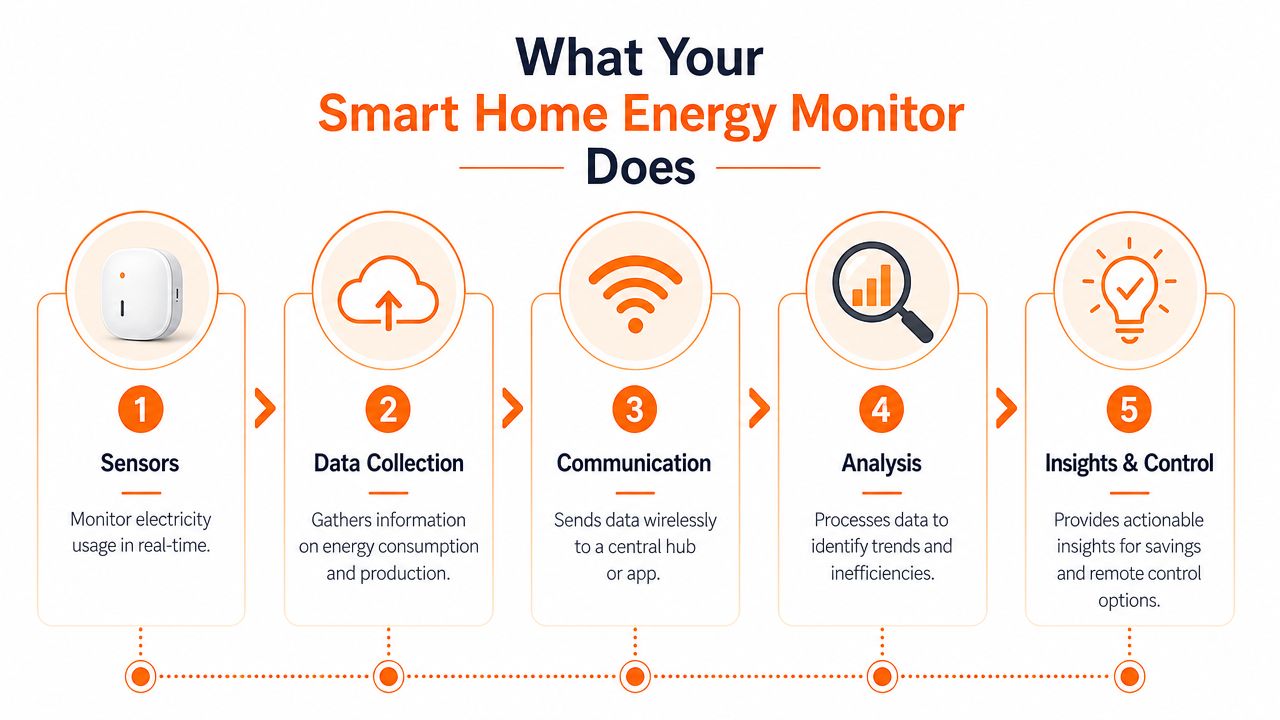
The three main monitoring types
Think of monitoring like layers of visibility.
- Meter-level monitoring gives you the big picture. It tells you how much electricity the house is using overall, and in better systems it also shows solar production and grid interaction.
- Circuit-level monitoring goes deeper. It tracks selected circuits such as air conditioning, pool pumps, EV charging, or electric hot water.
- Plug-level monitoring is the close-up lens. Smart plugs let you observe individual appliances, which is useful for loads that are hard to identify from whole-home data alone.
If you want a practical analogy, meter-level data is your bank balance, circuit-level data is your spending by category, and plug-level data is the itemised receipt.
What the monitor actually helps you do
The best systems don't just display graphs. They help you act.
- Spot hidden demand by identifying loads that run outside the times you expect.
- Verify battery behaviour so you can see whether stored energy is being reserved, depleted too early, or used at the wrong times.
- Check solar self-consumption rather than relying on generation figures alone.
- Compare app data with billing data so you understand whether your retailer charges align with your actual usage pattern.
If you ever need help understanding what your retailer bill is showing, this guide to utility bill components and data is useful because it breaks down the line items and metering information that often confuse otherwise capable homeowners.
Practical rule: If your monitoring doesn't clearly separate import, export, consumption, and battery flow, it's giving you visibility but not enough control.
A monitor also sits in a broader metering context. If you want the grid-side view of how interval data is recorded and communicated, High Flow Energy's explanation of how smart meters work is worth reading.
Why Monitoring Is Essential for Australian Solar and Battery Owners
A solar and battery system without proper monitoring is an under-observed asset. You've paid for generation, storage, and flexibility, but you can't manage what you can't see properly.
That matters more in Australia because residential value isn't just about how many kilowatt-hours your solar system produces. It's about when your home consumes energy, when the battery charges and discharges, and when grid prices or tariff periods make those decisions financially important. A rough daily total doesn't help much if the expensive imports happen at the wrong time.
Time-of-use changes the value equation
For many homes, the key shift is from passive energy viewing to active timing. Industry explanations of home energy monitors note that they can show electricity use in real time and help households shift usage to cheaper periods while identifying energy-hungry devices. One industry source says some users reduce monthly electricity bills by about 10% after adopting monitoring, which gives a useful sense of the behavioural savings possible when households respond to the data rather than watching it (EnergySage).
That doesn't mean every household gets the same result. It does mean that visibility has direct commercial value when it leads to better timing and better load decisions.
Where battery owners usually leave value on the table
Most underperformance comes from one of these issues:
| Situation | What happens | Why it matters |
|---|---|---|
| Battery discharges too early | Stored energy is used before the higher-value period | You still import later when tariffs or demand are less favourable |
| Solar surplus isn't matched to loads | Export rises while flexible loads run at another time | Self-consumption stays lower than it could be |
| Large loads are poorly timed | EV charging, pool pumps, or hot water run without reference to solar or tariff windows | Battery and solar value gets diluted |
| The owner relies on inverter summaries only | Detail is too coarse to isolate causes | Problems are visible late, or not at all |
A technically savvy owner doesn't need more notifications. They need cleaner operational data.
Good monitoring changes the question from “How much power did I use today?” to “Was my system used in the most valuable way today?”
Why this matters in QLD and NSW
In Queensland and New South Wales, plenty of battery owners already have the hard asset in place. The missed opportunity is operational discipline. Monitoring helps you decide whether to shift consumption into solar hours, hold battery capacity for a later period, or investigate a load that's become more expensive than it should be.
For homes with solar, battery storage, EV charging, electric hot water, ducted air conditioning, or all of the above, the gap between “installed” and “optimised” can be significant. Monitoring is what closes it.
Your Decision Checklist for Choosing the Right Monitor
Choosing the best smart home energy monitor starts with one question. What decision do you need the monitor to support? If the answer is only “I want to see usage”, a basic system may be enough. If the answer is “I want to optimise solar, battery, export, and flexible loads”, you need more than a consumer gadget.
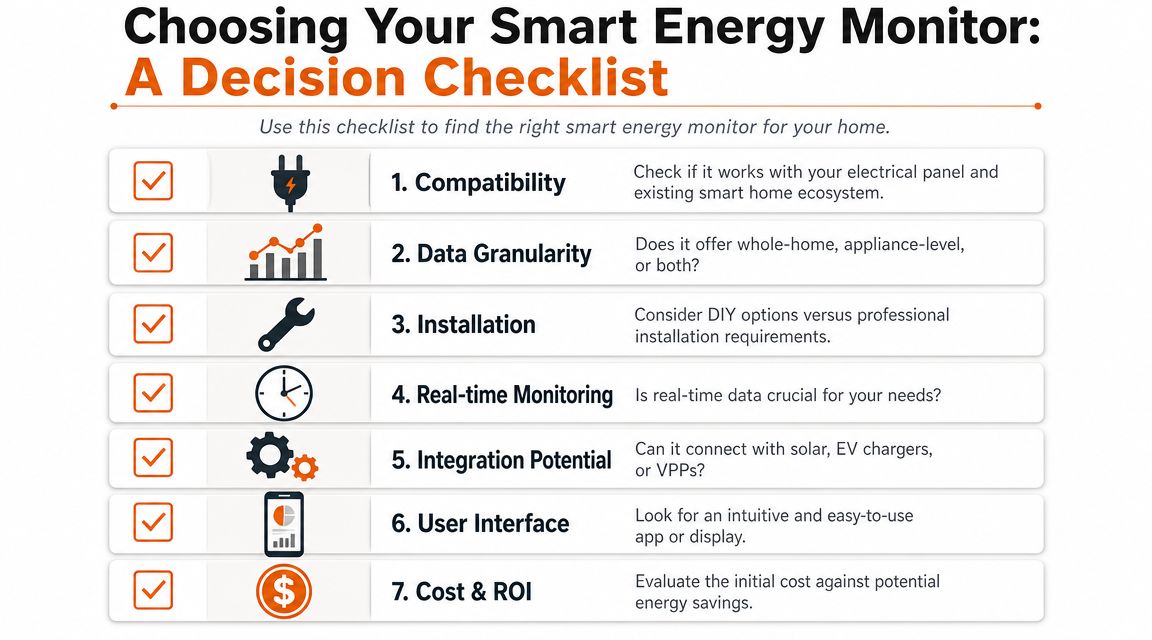
Ask whether it can see your full energy picture
A monitor for a battery home should handle more than household demand.
Check whether it can distinguish:
- Solar generation separately from household consumption
- Battery charge and discharge rather than treating storage as invisible
- Grid import and export with enough clarity to understand flow direction
- Major controllable loads such as EVs, pool equipment, or hot water if those are part of your setup
If it can't show those flows separately, you'll still be left inferring too much.
Decide how much granularity you actually need
Not every home needs circuit-level monitoring. Some do.
A useful way to think about it is by load complexity:
- Simple homes often do well with whole-home plus solar and battery monitoring.
- Mixed-load homes benefit from selected circuits, especially if they have EV charging, ducted air conditioning, or electric heating.
- Hands-on optimisers may want appliance-level data for problem loads, but that only pays off if they'll act on it.
For anyone comparing data views, a quick refresher on kilowatt vs kWh helps because many app screens mix instantaneous demand with energy use over time, and that causes poor decisions.
Check installation complexity before you buy
Many people choose badly. They buy on app screenshots and ignore the switchboard reality.
| Question | Better answer | Warning sign |
|---|---|---|
| Can it be installed safely in your board? | Clear installer guidance and local compatibility | Vague claims about universal fit |
| Does it require a licensed electrician? | Yes, if it connects at board level | DIY framing for hardware that clearly shouldn't be DIY |
| Will it work with your inverter and battery brand? | Confirmed compatibility pathway | “Should work” language without specifics |
A board-level monitor can be excellent, but only if it suits your panel layout, phases, metering arrangement, and communications environment.
Don't ignore the app and data export
You'll use the app more than the hardware. If the app is cluttered, laggy, or unable to show historical trends in a useful way, the monitor won't stay part of your operating routine.
Look for:
- Real-time responsiveness so load changes are visible quickly
- Clear historical views by day, tariff period, or flow type
- Export or integration options if you use home automation or broader energy software
- Alerting that matters rather than generic push noise
Selection shortcut: Buy for the decisions you'll make weekly, not for the features you'll admire once.
Ask if it's ready for a more connected energy setup
A future-proof monitor should fit into a home that may later include broader coordination. That can mean EV chargers, smart appliances, home automation platforms, or services that rely on reliable operational data.
If integration is poor, the monitor becomes an isolated dashboard. If integration is strong, it becomes part of a controllable energy stack.
VPP Integration Unlocking Your Battery's Full Value
A battery becomes more valuable when it does more than sit idle between solar charging and evening household use. That extra value depends on coordination, and coordination depends on data.
For a battery to participate effectively in a Bring Your Own Battery model, the system needs visibility into household conditions, battery state, import and export behaviour, and timing. A monitor can provide part of that operating picture. It turns the home from a passive endpoint into a site that can respond intelligently.
Why visibility matters in a VPP context
In a VPP setting, the key question isn't just whether the battery has energy. It's whether that energy is available at the right time, without compromising the household's own needs.
A useful monitor helps establish:
- What the home is consuming now
- Whether solar is covering current demand
- How much flexibility the battery may have
- Whether export constraints or local conditions are limiting value pathways
That information supports better dispatch logic. Without it, the operator has a weaker picture of what the site can do safely and efficiently.
What a monitor adds beyond a standard inverter view
Many inverter apps are good at reporting their own equipment. They're less reliable as whole-home optimisation tools because they often centre on the inverter's perspective rather than the household's full operating profile.
For VPP-aligned optimisation, the useful layer is broader:
| Data view | Why it matters for battery value |
|---|---|
| Household demand | Helps avoid discharging in ways that clash with onsite needs |
| Battery behaviour over time | Shows whether storage is being used strategically or reactively |
| Import and export patterns | Reveals when the home is leaning on the grid unnecessarily |
| Flexible load timing | Identifies where shifting consumption can preserve battery value |
That's why monitor choice matters more once you care about operational performance rather than passive observation.
A battery owner doesn't need more charts. They need enough live data to decide when stored energy should serve the home, when it should stay available, and when coordination can create extra value.
If you want a plain-English overview of the model itself, this explanation of what is a Virtual Power Plant covers the mechanics clearly.
The practical trade-off
More visibility isn't automatically better if the system is hard to maintain or interpret. The right monitor in a VPP pathway is the one that provides dependable, structured data with minimal friction. Fancy appliance detection is less useful than accurate energy flow visibility that holds up over time.
Common Setup and Troubleshooting Tips
Most smart energy monitor issues aren't hardware failures. They're setup problems, communications problems, or interpretation problems.
That's good news because those are usually fixable.
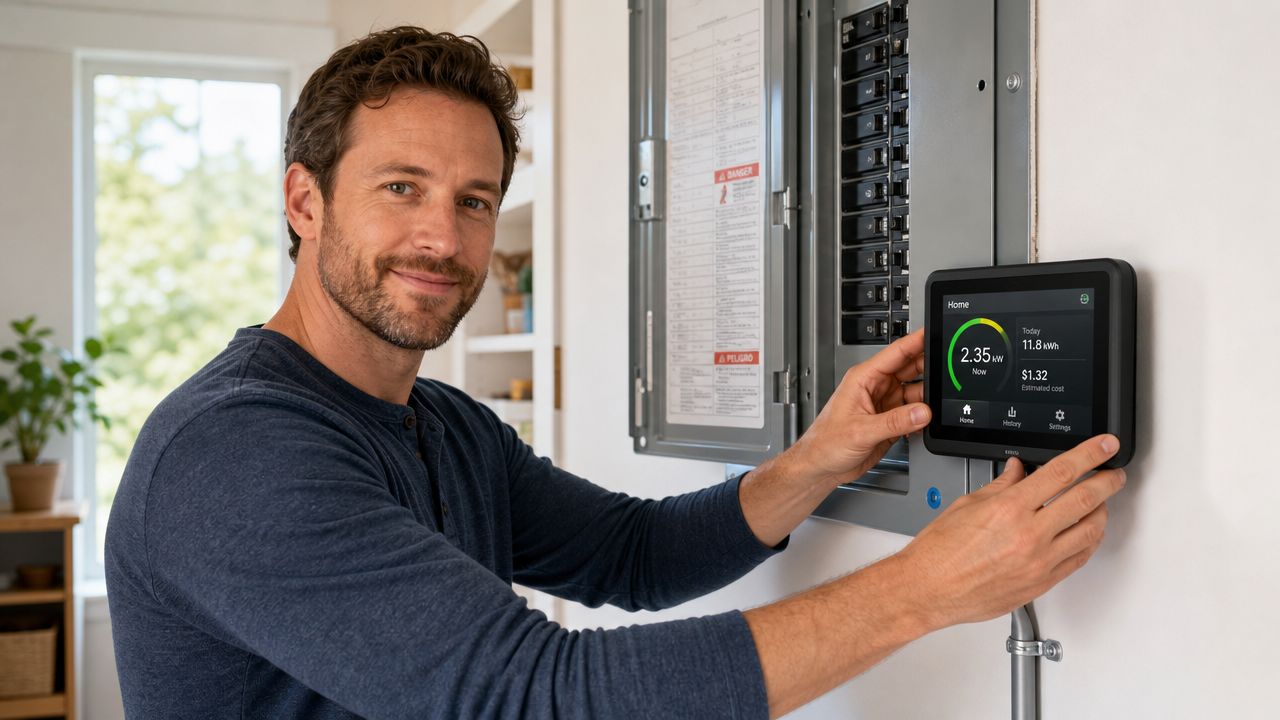
Installation choices that usually work best
Plug-level devices are often straightforward. Board-level monitors are not a casual DIY task. If the unit uses CT clamps inside the switchboard or interfaces with fixed electrical infrastructure, a licensed electrician is usually the right path.
A clean installation depends on three things:
- Correct clamp placement so the direction of flow reads properly
- Accurate circuit mapping so the app labels make sense later
- Stable communications between the monitor, gateway, and home network
If any of those are wrong, the data may look plausible while still being misleading.
When the app data looks wrong
The most common complaint is that the monitor doesn't seem to match the bill or inverter app. Before assuming the device is faulty, check the comparison itself.
These systems often measure different things:
- Your retailer bill may reflect billing intervals, tariff structures, and meter data timing.
- Your inverter app may show inverter-side production or battery data but not all household loads.
- Your energy monitor may be showing live household flow, which won't line up perfectly with a billing summary screen at every moment.
Field note: Compare like with like. Match the same date range, the same unit, and the same flow type before concluding that the monitor is inaccurate.
Quick fixes for the usual faults
| Problem | Likely cause | First action |
|---|---|---|
| Live data drops out | Weak Wi-Fi or hub communication issue | Move the gateway, improve signal, or check local network stability |
| Import and export look reversed | Clamp orientation or configuration error | Ask the installer to verify CT direction and phase assignment |
| Solar appears too low or too high | Wrong channel mapping | Review setup labels and inverter pairing |
| App lags behind reality | Cloud sync delay or app refresh issue | Check firmware, refresh intervals, and local connectivity |
A simple operating routine
Once the monitor is installed, don't stare at it all day. Use a short review routine instead.
- Morning check for overnight imports and battery reserve behaviour
- Midday glance to see whether solar surplus is being used well
- Evening review to confirm whether large loads were timed sensibly
- Weekly look-back for repeated patterns, not random one-off spikes
That cadence usually gives enough insight to improve performance without turning the system into a hobby.
FAQs for QLD and NSW Homeowners
Is an inverter app enough, or do I need a separate monitor
Often, the inverter app isn't enough if you care about full-home optimisation. It usually reports well on the inverter and battery, but it may not show circuit-level demand, appliance-specific loads, or the broader interaction between household consumption and grid timing. If you want operational clarity, a separate monitor is often the better tool.
Do I need an electrician to install a smart energy monitor
If the device connects at the switchboard or uses CT clamps around mains or circuits, that usually calls for a licensed electrician. Smart plugs and some simpler consumer devices are different. The safe rule is to treat board-level monitoring as electrical work, not gadget setup.
Will a monitor work if I already have solar and a battery installed
Usually yes, but compatibility matters. Check phase configuration, inverter brand support, communications method, and whether the monitor can distinguish battery flow from general household demand. A monitor that can't see storage properly won't tell you much that's useful.
Can a smart energy monitor help with time-of-use tariffs
Yes. The practical value is visibility. You can see when expensive imports occur, which loads are creating them, and whether those loads can move into better periods. That matters far more than a simple daily total.
Do smart plugs replace a whole-home monitor
No. Smart plugs are useful for selected appliances, but they don't give you a system-wide view. They work best as a supplement when you already know which devices need closer tracking.
What should QLD and NSW homeowners prioritise first
Start with compatibility, then data clarity, then installation quality. Fancy analytics don't help if the underlying readings are incomplete or badly configured. For most homes, clean whole-home, solar, battery, and grid visibility is the priority.
Will monitoring alone maximise my battery value
No. Monitoring creates visibility. Value comes from acting on that visibility, whether that means changing load timing, adjusting operating habits, or connecting the battery into a structure that uses spare capacity more intelligently.
Most battery owners focus on installation quality. Far fewer focus on ongoing performance and optimisation. HighFlow Energy is an electricity retailer built around maximizing the full value of your existing solar and battery system.
If you'd like to understand whether your battery is underperforming financially, request an eligibility assessment today.