

Electricity Bill Relief NSW: Rebates and Long-Term Savings
The 2025-26 National Energy Bill Relief gives up to A$150 per NSW household, usually as two quarterly A$75 credits on the electricity bill. That is real help, but it is still a temporary offset, not a permanent fix for electricity costs.
For NSW households searching for electricity bill relief nsw, the key issue is not whether a credit exists. It is whether that credit changes the underlying cost of power. It usually doesn't. The rebate reduces what you pay for a period of time, then the bill structure underneath it remains the same. That distinction matters most for solar and battery owners, because a flat government credit is very different from a structural way to lower ongoing grid reliance.
How NSW Electricity Bill Relief Works in 2025-26
The headline number is simple, up to A$150 per household in NSW for 2025-26, delivered as two quarterly A$75 credits on the electricity bill Service NSW. For many households, that will arrive as a visible line item on a retail bill rather than as cash in a bank account. For embedded-network customers, the mechanism changes, because the credit must be claimed rather than automatically applied.
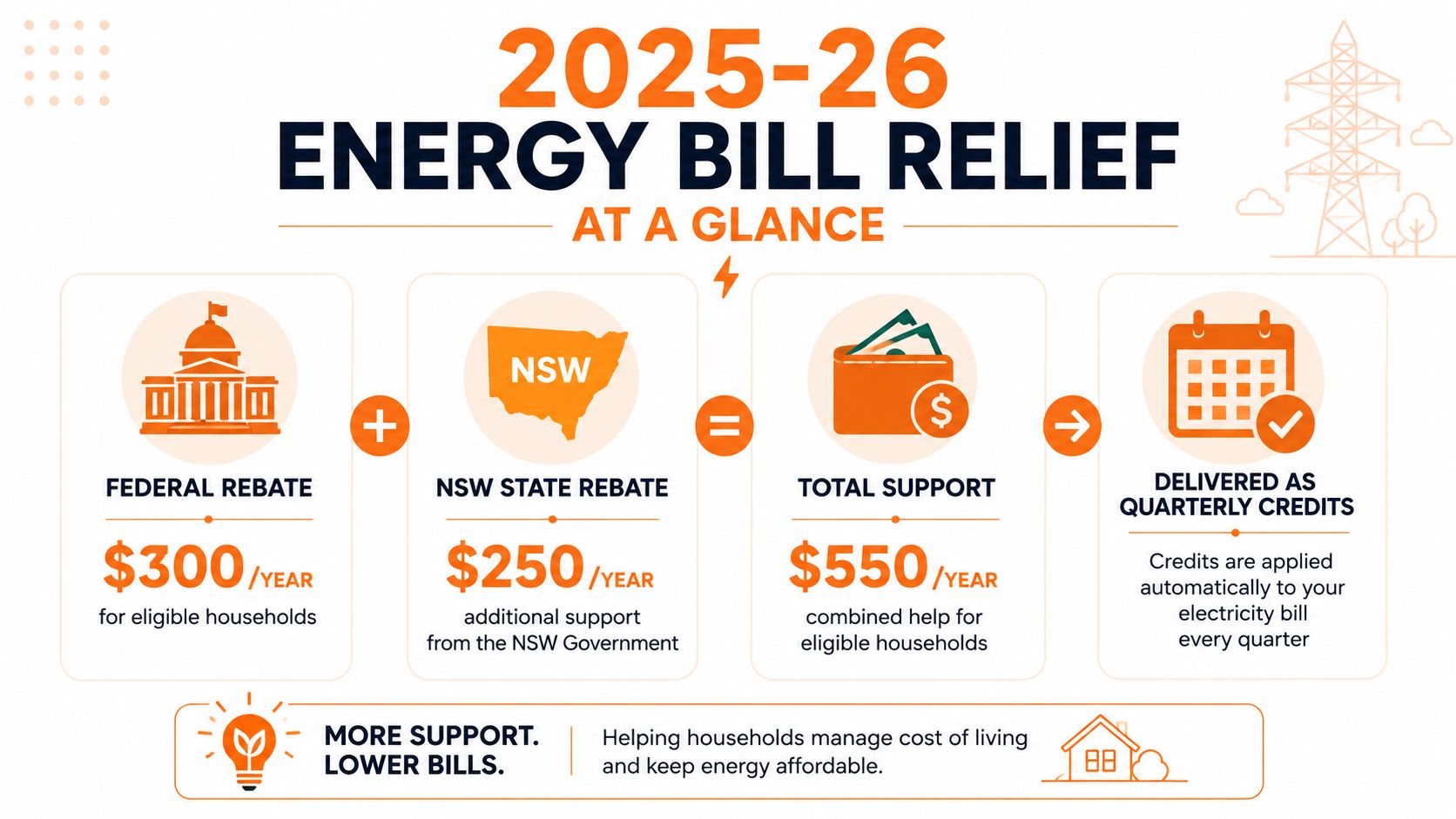
The technical point is more important than the headline. This is a fixed per-account offset, not a usage discount, so it does not rise when your consumption rises and it does not improve because you export more solar. A household with rooftop solar gets the same structure of relief as a household without it, subject to eligibility and account type. The credit is applied through the billing system, which means it reduces the amount due on that account, not the cost of each kilowatt-hour you use.
The earlier 2024-25 NSW extension was larger, with up to A$300 per household and quarterly A$75 credits under the Commonwealth extension arrangement Federal Financial Relations. That matters because it shows the direction of travel. Relief has been scaled back from the peak cost-of-living settings, so households shouldn't confuse a temporary concession with a permanent bill reduction strategy.
Practical rule: if a rebate is a flat credit, it can help cash flow, but it won't fix the bill structure that caused the stress in the first place.
A useful way to read electricity bill relief nsw is as bridge funding. It helps households absorb current pressure, but it doesn't alter network charges, supply charges, or the value proposition of a battery. That's why the policy should be treated as support, not strategy. For a broader policy overview, this NSW-focused relief summary is a relevant reference point.
Eligibility Criteria and Application Pathways
Eligibility depends on how your electricity is billed and whether the account sits in a standard retail setup or an embedded network. For ordinary retail customers, the relief is generally applied through the bill automatically. For households in caravan parks, retirement villages, apartments on on-supply arrangements, and some other embedded-network settings, the process can require a separate claim through Service NSW with a recent electricity bill attached Service NSW. That's the gap most generic explainers miss.
NSW Electricity Bill Relief Eligibility by Customer Type
| Customer Type | Relief Amount | Application Method | Key Requirement |
|---|---|---|---|
| Standard household retail customer | Up to A$150 in 2025-26 | Usually automatic on the bill | Active electricity account in NSW |
| Embedded-network household | Up to A$150 in 2025-26 | Claim through Service NSW | Recent bill or invoice and supporting details |
| Small business retail customer | Up to A$150 in 2025-26 | Usually automatic on the bill | Active ABN and eligible metered supply |
| Small business embedded-network customer | Up to A$150 in 2025-26 | Claim through the state pathway | On-supply arrangement and eligible usage profile |
| Household in hardship | Variable through EAPA | Apply through an approved provider | Short-term hardship, unpaid bill, open account |
Small business relief is more tightly defined than household support. The 2025-26 NSW program applies up to A$150 only if the business has an active ABN, at least 90 days of metered electricity usage, and total consumption of less than 100 MWh per year across all NSW sites NSW Government. That makes the relief relevant to many smaller operators, but it is not broad enough to cover every business profile.
Hardship support sits in a separate lane. NSW's Energy Accounts Payment Assistance, or EAPA, is for households or businesses in short-term financial hardship, crisis, or emergency Energy NSW. To qualify, the applicant must live in NSW, hold an electricity or gas account for a NSW home in their name, have an account that is still open and unpaid, and be unable to pay the most recent bill. That's a different policy tool from the general rebate, and it matters because the wrong program can delay the right help.
If you're unsure whether your home sits in an embedded network, the fastest check is your bill. If the retailer isn't directly billing you, assume the process may be different and document everything before applying.
The Scale and Evolution of NSW Energy Support Programs
NSW energy support has grown from targeted assistance into broad bill relief. In 2021-22, the NSW Energy Social Programs Annual Report recorded 947,800 unique customers receiving one or more energy rebates and EAPA supports NSW Energy Social Programs Annual Report 2021-22. That already represented a large support base, aimed at households under clear affordability pressure.
By 2023-24, the NSW annual report said the National Energy Bill Relief program supported an estimated 1,011,900 unique household customers with total household payments of $446,337,600, which works out to about $441 per household on average NSW Energy Social Programs Annual Report 2023-24. The same reporting says broader Energy Social Programs provided bill support to around 1 in every 3 NSW households in that year. At that point, relief had moved beyond a niche concession and into a mainstream affordability tool.
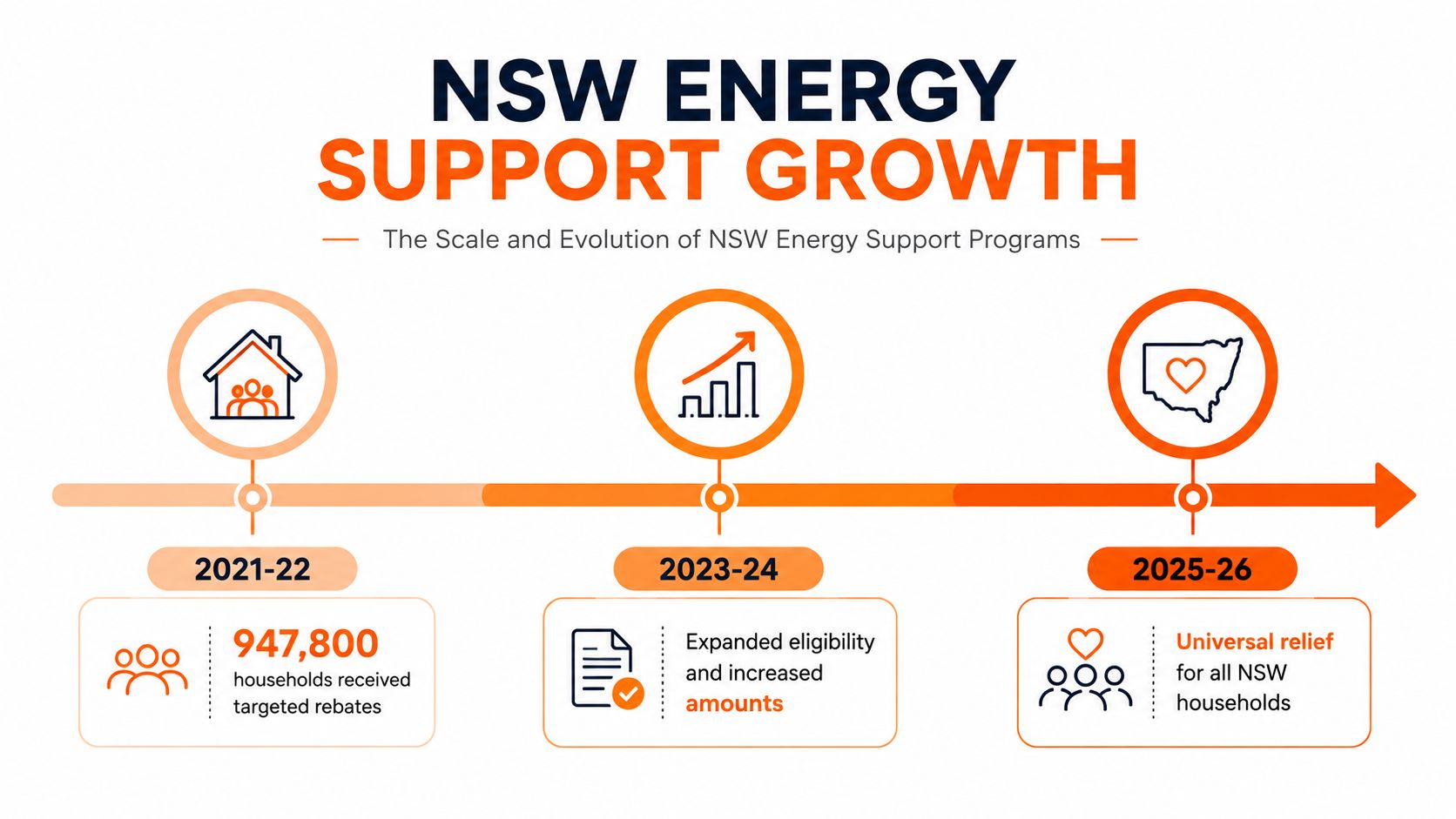
The path also shows what households should not expect from the next round of support. Relief settings were stronger during the cost-of-living spike, then narrowed. That is visible in the shift from larger household bill support in 2023-24 to the smaller A$300 federal extension in 2024-25 and then to A$150 in 2025-26. The policy remains relevant, but it is clearly being pulled back from emergency-scale intervention.
Relief has become part of the household energy system, but it is still temporary support layered on top of the same retail bill structure.
A useful way to read Electricity Bill Relief NSW is as bridge funding. It lowers the final amount owed for a period, but it does not change the underlying bill mechanics that keep costs recurring. A retailer-based virtual power plant, such as the model explained on HighFlow Energy's solar battery virtual power plant page, works differently because it is built around ongoing dispatch, export value, and battery control rather than a one-off credit. For homeowners who want durable savings, that distinction matters more than the headline size of a rebate.
Why Temporary Rebates Do Not Solve Structural Electricity Costs
A government credit can soften a bill, but it doesn't rewrite the economics of power. The credit is flat and time-bound, so it doesn't touch the recurring parts of the bill that keep adding pressure over time. Those include daily supply charges, network costs, and the higher-cost evening periods when homes draw more from the grid.
The most important thing to understand is that the decline in relief amounts does not come with a decline in underlying costs. The support has stepped down from larger temporary settings to smaller ones, but the bill beneath it still reflects the same retail and network structure. That is why a household can feel the rebate in one quarter and still face the same stress the next.
For NSW households trying to understand the bill anatomy, network charges are the part of the invoice many people underestimate. They are not optional, and they are not solved by a general rebate. They're built into the retail bill design, which means temporary support only changes the final amount owed, not the cost drivers themselves.
What Rebates Leave Untouched
- Daily supply charges still apply.
- Network costs still sit inside the retail bill.
- Peak usage still costs more when the household draws heavily from the grid.
- Solar exports don't make a flat rebate larger.
- Battery ownership doesn't automatically improve bill relief eligibility.
That's why analysts keep returning to the same conclusion. Temporary support can buy time, but it doesn't create permanent system-wide benefits on its own. ACOSS has argued that universal rebates do not target households in greatest need and don't deliver lasting structural change, which aligns with the broader policy logic here. If the goal is lower long-term bills, the answer has to change the household's consumption profile, not just the government's contribution to the invoice.
A good rule of thumb is simple. If the support arrives after the bill is issued, it's relief. If the household changes how much grid electricity it needs, that's structural savings.
How a Virtual Power Plant Creates Ongoing Bill Reduction
A retailer-based Virtual Power Plant, or VPP, works differently from a rebate because it creates value from the battery itself. Instead of a one-off credit tied to government funding, the battery can participate in grid support when it has spare capacity. That participation creates a commercial return, which can then be turned into ongoing bill reduction.
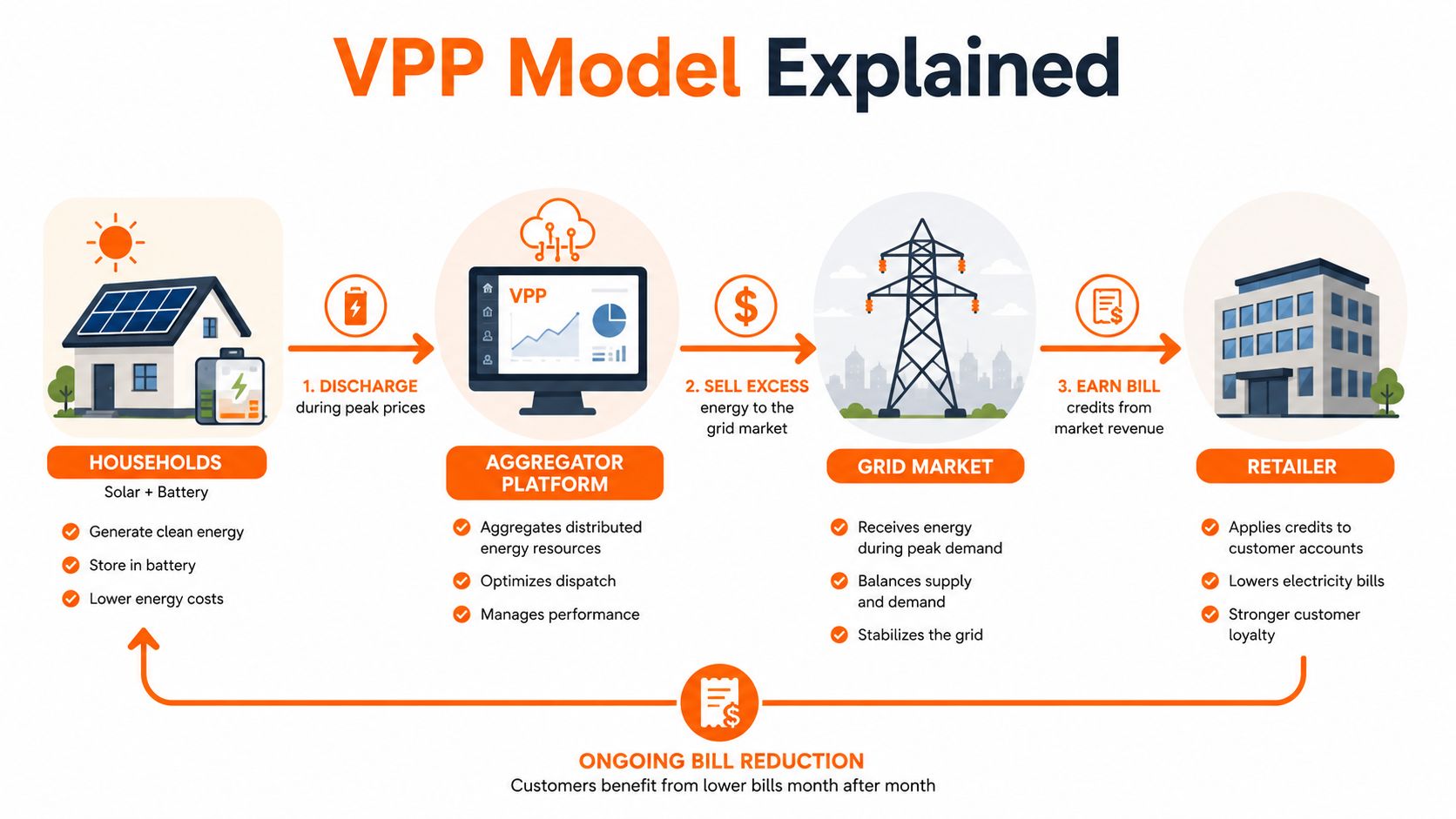
The structure is straightforward. The household's solar and battery system remains in the home, and the retailer or platform coordinates battery participation during periods when the grid needs support. That can happen around peak demand events or other market conditions where distributed batteries are useful. The important part is that household needs stay first. The battery only participates when there's spare capacity available for the program to use.
A battery should serve the home first, then the grid second.
That order matters because it preserves the customer's core benefit. You still use stored energy for the home when needed, but you also derive commercial value from assets that would otherwise sit idle part of the day. In a retail model built around optimisation, that value can be translated into a bill-free electricity allowance rather than a generic discount.
HighFlow Energy is one example of that model in the NSW and Queensland market, using existing rooftop solar and a compatible battery to support grid services when spare capacity is available. The point isn't the hardware. It's the operating model. Customers retain ownership, and the battery is coordinated through a retailer structure rather than treated as a passive backup device.
The difference from government relief is practical, not theoretical. A rebate reduces one bill cycle. A VPP can continue creating value as long as the system is available and correctly configured. That is why battery owners should compare temporary public support with a structural revenue model, not treat them as substitutes.
Practical Steps to Reduce Your NSW Electricity Bill
A bill credit can disappear after one cycle. A structural saving can keep showing up every quarter, so the right order is to claim the support already on offer, then assess the measures that reduce ongoing costs.
Check that your relief is applied. Review your most recent bill for the NSW and Commonwealth credit lines. If you are billed through an embedded network, confirm whether your claim has been lodged correctly with Service NSW and whether the credit has reached the right account.
Confirm concessions and account details. If you hold an eligible concession card, make sure the electricity account is in the correct name and the retailer has current details on file. Small admin errors can block relief, and the lost value adds up quickly in practice.
Review tariff structure. A flat tariff and a time-of-use tariff behave differently. If your evening usage is high, the tariff design can matter as much as the headline rate, because a cheaper unit price is less useful if it applies at the wrong time.
Assess whether the home is losing money through poor energy management. If a battery charges and discharges without regard to bill impact, it may still be operating but failing to cut grid dependence when it counts.
For homes with older design features, the load profile can be uneven in ways that are easy to miss. A house with strong thermal mass, shaded verandas, or 1920s home style features often behaves differently from a newer build, and that changes how heating, cooling, and evening usage show up on the bill. The architectural form can create lower peak demand in some periods and higher reliance on stored or imported power in others, so the house itself affects the economics before any rebate does.
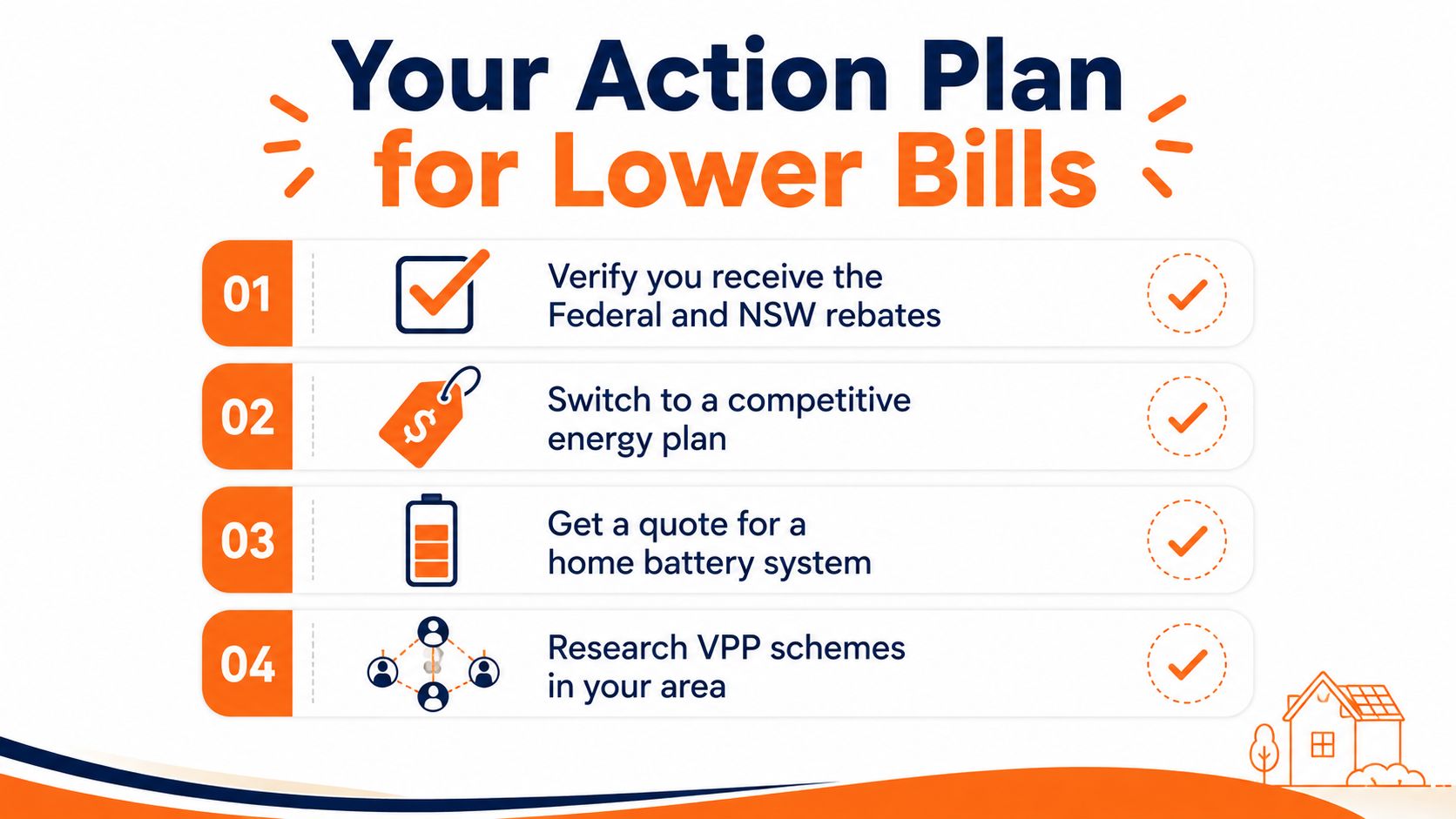
If you want a longer-term pathway, look at whether your existing battery can be placed into a retailer-based program that supports grid services. That model can turn spare battery capacity into recurring bill reduction, while one-off relief only offsets a single statement. HighFlow Energy is an electricity re
Common Questions About NSW Electricity Bill Relief
Do solar and battery owners still qualify for NSW bill relief? Yes, eligibility is tied to the account and program rules, not whether the home has solar. The relief is a bill credit, so having rooftop solar doesn't remove access by itself.
Do embedded-network customers need to apply separately? Often, yes. If your home is billed through a caravan park, retirement village, apartment on-supply, or similar arrangement, you may need to claim through Service NSW with supporting documentation.
Does joining a VPP affect rebate eligibility? Not automatically. A VPP is a separate participation model, while the rebate depends on the program and the billing setup.
What happens when relief ends? The bill reverts to its underlying structure. The temporary credit disappears, but the supply charge, network charge, and usage charges remain.
How do I know if my battery is underperforming financially? Compare your bill outcomes against your usage pattern and the tariff structure. If the battery is running without lowering grid dependence at the right times, it may be leaving value on the table.
Is EAPA the same as the NSW bill relief credit? No. EAPA is a hardship program for people in crisis or emergency. The bill relief credit is a broader temporary support measure.
Most battery owners focus on installation quality. Far fewer focus on ongoing performance and optimisation. HighFlow Energy is an electricity retailer built around obtaining the full value of your existing solar and battery system.
If you want to understand whether your battery is underperforming financially, request an eligibility assessment through HighFlow Energy and compare temporary bill relief with a structural approach to reducing what you owe each cycle.