

Energy Management Process for Solar Battery Owners
Coordinating consumer batteries could avoid about AUD 4.1 billion in additional grid-scale investment, according to AEMO's Integrated System Plan, because aggregated home storage can shift surplus midday solar into the evening peak and supply dispatchable capacity when the system tightens.
That's the system-level case. The household version is narrower and more awkward. Two homes in the same Queensland suburb, with the same battery model and similar roofs, can end up with very different bills. The difference usually isn't the hardware. It's the control mode, the reserve the owner keeps back, and whether anyone reads the bill by settlement component instead of assuming a bigger battery means a smaller account.
The energy management process is the loop that decides all three, and it's worth understanding in operational terms rather than marketing ones. What follows separates what the Australian evidence shows from what remains uncertain, using Queensland and New South Wales market data because that's where most of the coordinated capacity now sits.
Why Households Need an Energy Management Process
Queensland had about 1.1 million rooftop solar installations, New South Wales held roughly 7.5 GW of rooftop capacity, and Australia recorded about 85,000 battery sales in the first six months of 2025, a 191% increase on the same period in 2024, according to the Clean Energy Council's rooftop solar and storage report. With that many systems exporting into the same midday window, default settings stop being neutral.
A battery left on factory logic usually charges when solar is abundant and discharges on a timer, regardless of tariff, forecast cloud cover, network limits or the value of kept-back energy later. The energy management process is the repeating loop that closes that gap. It measures what the household uses and generates, forecasts what is coming, decides when to store, use or export, then checks the result against the plan.
The market context has tightened the same loop. Midday minimum operational demand on the NEM has fallen to record lows in recent years as rooftop solar has grown, which is why coordinated charging and discharging now matter to the market operator as well as the homeowner.
Battery size alone is a weak proxy for the result. The control mode decides which hours count, the reserve decides how much capacity is held back for the evening, and the bill has to be read by settlement component rather than inferred from the nameplate. What remains uncertain for any single home is the tariff, the inverter limits and the household's evening demand, which is exactly why measurement has to come first.
The test: ask whether your battery charges and discharges at times you can explain, or whether it simply fills during the day and empties at an arbitrary hour.
The Five Stages of the Energy Management Process
The process is a loop, not a setup task. Five stages repeat daily, and the output of each becomes an input to the next.
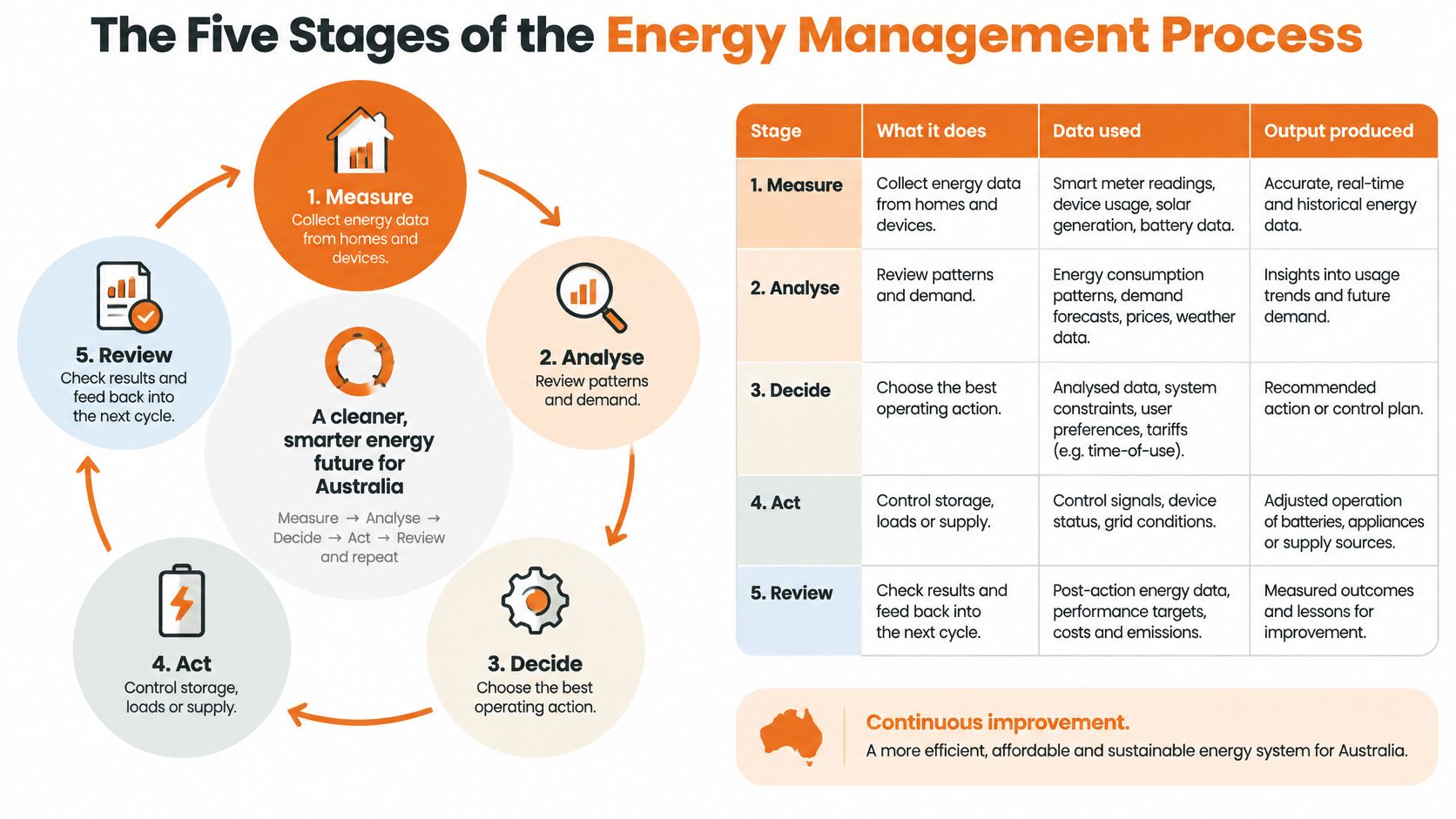
- Measure. Pull metered import and export, solar generation and battery state of charge from the smart meter and inverter, then build a baseline usage profile for the home.
- Forecast. Combine weather, usage history and price expectations to predict solar output, household demand and the periods when avoided import is worth most.
- Plan. Set the reserve the owner wants held back, then build an hour-by-hour charge and discharge schedule around it and around the tariff structure.
- Act. Instruct the battery to charge, discharge or hold, staying inside the inverter's power rating and the site's export limit.
- Review. Compare metered import, export and battery data against the plan, then update the forecast and the settings for the next cycle.
The same five stages map onto what each part of the system does.
| Stage | What Happens | Data Used | Output |
|---|---|---|---|
| 1. Measure | Record household load, solar generation and battery state of charge | Smart meter and inverter data | Baseline usage profile |
| 2. Forecast | Predict solar output, household demand and electricity prices | Weather, usage history and price forecasts | Expected surplus and peak periods |
| 3. Plan | Set an owner-controlled reserve and a charge and discharge schedule | Forecasts, reserve rules and tariff structure | Hour-by-hour battery plan |
| 4. Act | Charge, discharge or export within inverter and network limits | Battery power rating and export limit | Executed dispatch |
| 5. Review | Compare actual performance with the plan and adjust settings | Metered import, export and battery data | Updated forecast and settings |
A Worked Day in the Loop
Take a home with a 10 kWh battery on a mild autumn day. The measure stage shows steady overnight draw of about 0.5 kW, meaning roughly 4 to 5 kWh disappears between evening and morning if nothing changes. The forecast predicts a clear afternoon and a high-price evening peak. The plan holds an owner-set reserve, say 30% of usable capacity, for the evening and any outage, and permits discharge only above that floor. The act stage discharges through the peak within the inverter's limits. The review stage shows metered import landed close to the plan, or didn't, and tomorrow's forecast starts from there.
Where the Loop Usually Breaks
Stale usage data is the most common fault: a plan built on last summer's load shape will over-discharge in winter. Forecasts that miss a cloudy day leave too little charge for the evening, which is why reserve rules beat perfect predictions. Export limits cap how much can leave the site regardless of what the market is paying, so a plan that assumes unlimited export is fiction.
A healthy cycle looks unremarkable. The reserve is still there overnight, the battery carries the peak, and the review shows the plan was broadly followed.
How Price Signals Decide When a Battery Charges
A battery creates value by moving energy from an hour when it's worth little to an hour when it's worth more. The arithmetic is simple until losses and charges are added. The Australian Energy Market Commission's analysis of residential batteries puts it plainly: where a peak electricity price is 50 cents per kilowatt-hour and the solar feed-in tariff is 10 cents, shifting energy from export to peak-period consumption creates a gross 40 cents per kilowatt-hour spread before battery losses, network charges and other costs.
That gross figure is the one most marketing quotes. The net figure is the one that pays.
The trend is what makes the spread urgent. In Ausgrid's network area, average feed-in tariffs fell from 6.8 cents per kilowatt-hour in 2022 to approximately 4 to 5 cents, while the highest peak time-of-use offers rose from 44.8 cents to more than 75 cents, per the same AEMC analysis. Exporting solar is earning less each year. Stored energy used at peak is worth more. The same analysis notes battery installations across the National Electricity Market increased by more than 80% between June 2022 and June 2024, which tells you how many owners have already run this calculation.
The spread that matters: gross cents per kilowatt-hour, minus round-trip losses, minus the cost of the cycle, minus network charges, minus whatever the household would have done with that energy anyway.
Wholesale prices also spike hard on a handful of days each year, which is precisely why a plan shouldn't depend on them. A process that forecasts prices in advance, keeps the battery cycling for ordinary peaks and holds a bigger reserve for event days survives a quiet month. One that waits for spikes doesn't.
Cycling has a cost too. Every charge and discharge carries round-trip losses and some degradation, so a two-cent spread doesn't justify a cycle. Good electricity price forecasting is what separates the cycles worth running from the ones that wear the battery for nothing.
How Virtual Power Plants Add Grid Value
A virtual power plant isn't a larger battery. It's a coordinated operating process across many homes. The Department of Climate Change, Energy, the Environment and Water guidance on batteries defines a VPP as coordinated behind-the-meter solar photovoltaic and battery systems that operate as a single power source and enable energy to be shared, with each home remaining behind its own meter.
Controllability is therefore a hardware property, not a marketing feature. The federal Cheaper Home Batteries Program requires an on-grid battery system, including its inverter, to have the technical capability to participate in a VPP, per the same guidance. If the inverter can't be instructed remotely and report back, the site can't be aggregated.
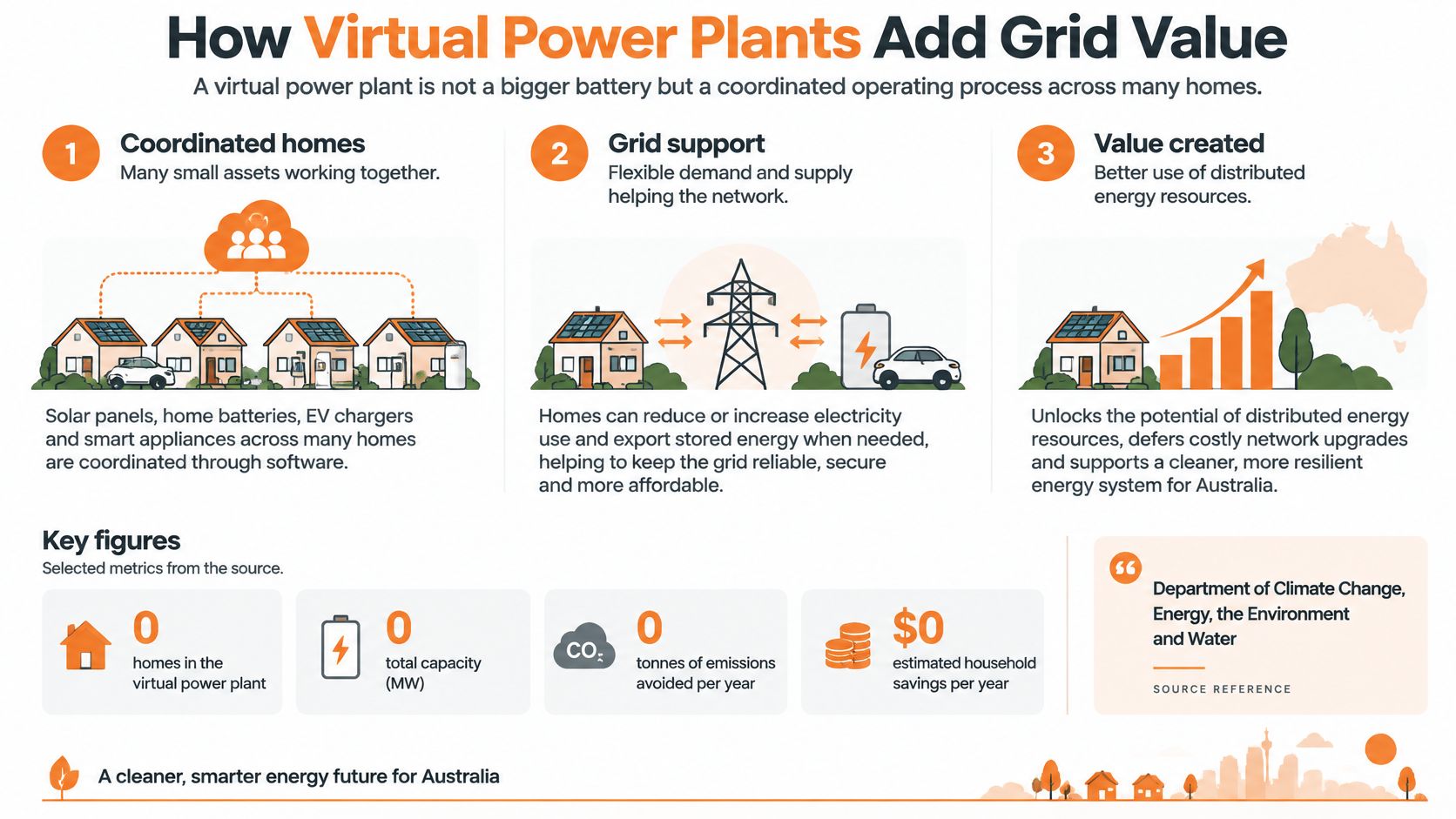
The coordination runs on two very different timescales, and conflating them is where most explanations go wrong. Bill optimisation works over hours, shifting energy out of the solar window and into the evening. Grid services work in seconds. ARENA's battery storage overview notes that batteries can switch on or off in fractions of a second to help maintain grid stability, and independent research commissioned through ARENA found batteries averaged 110 megawatts of quarterly enablement in Australia's very-fast services market, made up of 76 megawatts of raising capability and 33 megawatts of lowering capability.
The retailer sits in the middle of that. YourHome's battery guidance explains that VPP participation requires an energy retailer or other company to collectively control household batteries alongside those of other homes to optimise energy use, support the grid and generate revenue, with actions including charging when demand is low, discharging when demand is high or the grid is stressed, and providing network support such as voltage and frequency services.
That's the operating model behind a solar battery virtual power plant: we use spare battery capacity to charge at optimal times and discharge small amounts to support the grid, coordinating activity across many homes automatically and securely, while each household's own supply stays the first call on the battery.
Control Modes That Keep Household Supply First
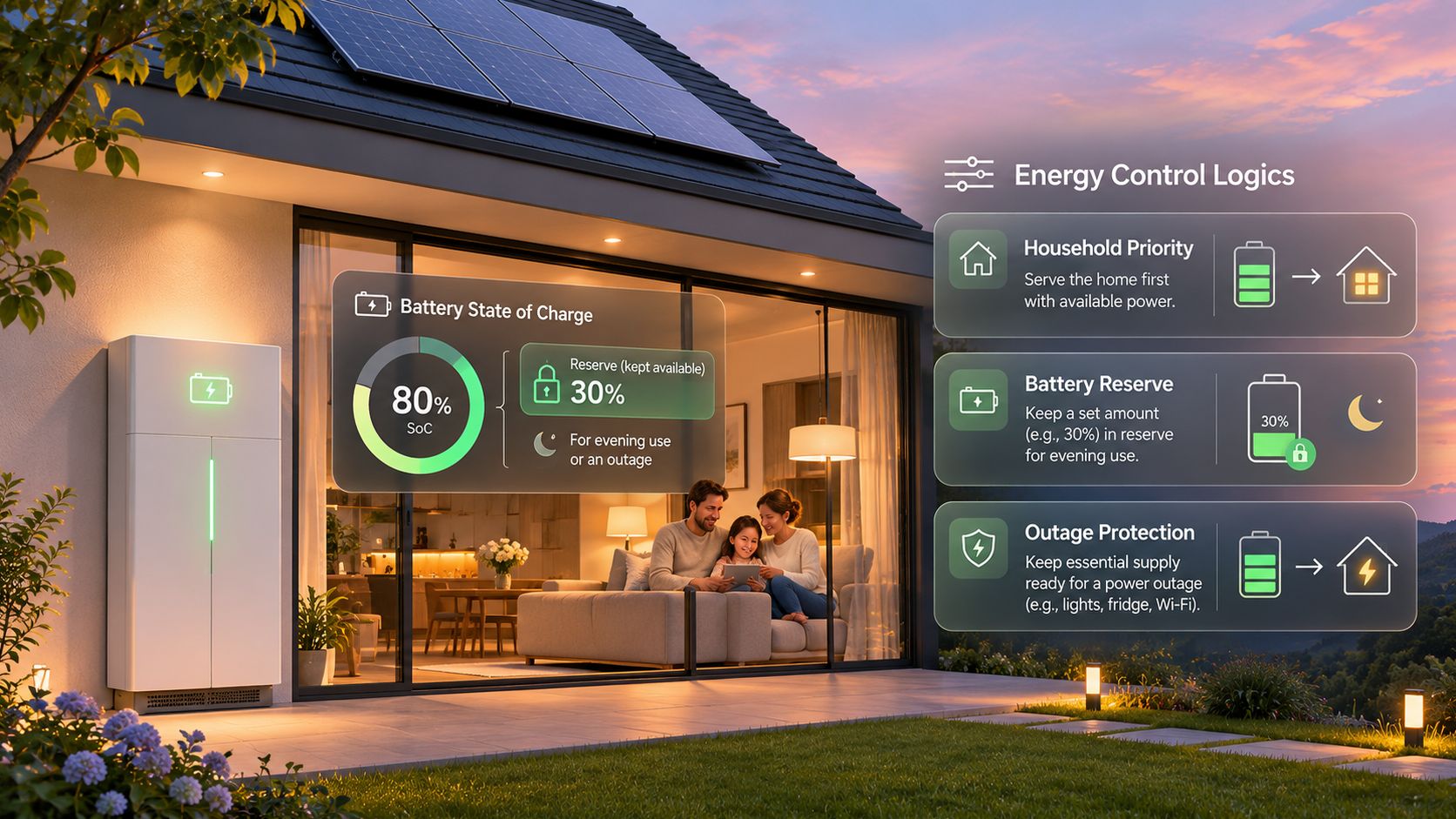
The control mode decides whose signal reaches the inverter first: the household's evening needs, or the grid's next price event. The reserve is the setting underneath that decision. It is the state of charge held back for the home, usually to cover the evening peak or an outage, and it determines whether the battery is a household asset that sometimes supports the grid or a grid asset that sometimes supports the household.
The distinction is material at fleet scale. NSW reported approximately 20,000 batteries connected to VPPs, an estimated 108 MW of potential capacity as of September 2025, and around 18% of newly installed batteries joining VPPs in the most recent quarter, according to the NSW Energy Strategy.
| Control Mode | How Dispatch Is Decided | Backup Reserve | Main Trade-off |
|---|---|---|---|
| Household priority | Home load served first; only spare capacity offered to the grid | Owner-set, highest | Lowest grid revenue, highest resilience |
| Hybrid | Owner-set reserve kept, dispatch allowed only above it | Owner-set floor | Balances bill value and outage cover |
| Grid priority | Market and network signals dispatched first | Lowest | Highest potential grid revenue, least outage cover |
A low reserve makes a battery look bigger on paper, because more capacity is available to sell. It also makes the household more exposed, because the energy assumed to be available may already be gone when solar output drops. A higher reserve lowers the dispatchable pool, but it turns more of the battery into dependable evening supply. Battery size alone cannot rank those outcomes; the same unit can produce a better or worse bill depending on mode and floor.
One scenario shows the trade-off better than any table. An overcast day is forecast ahead of an evening peak. A grid-priority battery may have discharged during a morning price event and then sits near empty when the cloud arrives and the household needs it. A household-priority battery sat through the morning event and covers the evening.
Here's the operational picture behind those settings.
AEMO's VPP demonstration work found fleet responses to high and negative price events were smaller and less predictable than modelling assumed, because customer behaviour, inverter limits, communication latency and state-of-charge constraints all reduce what can be delivered at the exact moment a signal arrives. The practical conclusion is conservative availability estimates, clear reserve settings and an override that is easy to find.
HighFlow's operating rules match that logic: customers stay connected to the grid, remain in control of the battery, and do not need to monitor anything or change behaviour day to day. Household energy use is prioritised before supporting the grid, and the VPP uses only spare capacity, operating automatically in the background.
Measure the result by settlement component, not by battery size: daily supply charges, imported energy, exported energy, network and distribution charges, and any VPP-funded allowance or credit. If those components improve while the reserve still covers the evening, the mode is doing its job.
Practical rule: if the reserve level is hard to see or slow to change, the household has a battery plan in name only. Control has to be visible to be real.
Practical Household Actions That Support the Process
The process works better when daily habits reduce the load the battery has to cover. These four actions each remove a specific problem.
- Run high-energy appliances during daylight. Dishwashers, washing machines and pool pumps should run when solar supplies them directly, which cuts what the battery has to replace after dark.
- Avoid unnecessary grid use overnight. Every kilowatt-hour imported at 9 p.m. is one the reserve can't hold for the morning, and it's usually the most expensive energy of the day.
- Set air conditioning to a moderate range. Around 24 to 26°C in summer and 18 to 20°C in winter keeps heating and cooling from draining the reserve during the hours that matter.
- Turn appliances off at the wall. Standby loads are small individually but constant, and a constant overnight draw is exactly what erodes a reserve.
These aren't separate from the energy management process, they feed it. A lower and better-timed load gives the forecast cleaner inputs and leaves more room for the battery to serve the evening peak.
We also recommend maintaining the solar and battery system according to manufacturer guidelines. A faulty inverter or a degraded battery changes what any forecast can realistically deliver, and no control logic compensates for hardware that isn't performing.
Behaviour changes help, but they don't replace decisions about control mode and reserve level. Those two settings move the bill far more than a shifted dishwasher cycle.
How to Measure Whether the Process Is Working
Two households can run identical batteries and finish the quarter with very different bills, because the result depends on the control mode and the reserve floor each owner kept. A lower total proves little on its own. The working test is whether each settlement component moved in the right direction, and five checks answer that.
- Split the bill into its parts. Daily supply charge, ordinary usage, network charges, export credits and any VPP payment should each appear as a line. A total that falls proves little if you can't see which component moved.
- Compare comparable periods. Use the same months before and after a control mode change, then adjust for weather. A sunny quarter against a cloudy one flatters any setting.
- Check the reserve held. Confirm the battery stayed above the owner-set floor through evening peaks, outages and overcast days. If it dipped below, the mode did something other than what you asked.
- Count high-price events and the response. A plan that works on ordinary days and fails during spikes needs a larger reserve or a different mode.
- Test best, typical and worst cases. Load shape, tariff, battery size, weather and the number of high-price events all change the result, so a single figure is a guess dressed as a forecast.
The evidence on coordination is encouraging but should be read with its limits. Independent NSW material cited in AEMO's 2026 consumer panel response on demand-side factors found VPP customers had median quarterly bills 34% to 72% lower than households with solar and a battery that were not in a VPP.
That range does not prove every household can reach zero bills. It compares groups, not identical homes, and the gap reflects load shape, tariff, battery size, weather, export constraints and the number of high-price events as much as coordination itself.
Queensland adds a volatility warning. The same submission notes that just 11 wholesale spot-price events above $5,000/MWh contributed to a more than 30% increase in the quarterly average price. Automated forecasting earns its keep in that environment, and depending on spikes for returns is a strategy that fails in the quarters between them.
The most reliable scoreboard is your own bill, checked line by line against your usage data. The HighFlow Energy customer portal lets you monitor your electricity usage and consumption patterns, and the performance reporting dashboard lays out the settlement components these checks depend on. We don't guarantee that any specific usage pattern will produce a particular bill outcome, because actual charges depend on usage and the terms of the Energy Plan.
Check Whether Your Battery Is Underused
Five steps settle the question for your own system, using the checks above as the frame.
- Pull twelve months of metered import and export data, or the most recent bills if that's all you have.
- Run the five checks against it, separating supply charge, usage, network charges, export earnings and any VPP payment.
- Note the control mode, reserve level and any outage events in that period. They explain much of the variation between a good quarter and a bad one.
- Confirm the battery and inverter are VPP-capable by checking the manufacturer's documentation rather than the sales brochure.
- Request an eligibility check to assess whether the system and usage suit a coordinated program.
An eligibility assessment can show whether your hardware, connection and consumption pattern are suitable. It can't promise a bill outcome, because usage, plan terms and network charges decide the rest, and no check guarantees zero bills.
HighFlow Energy is a customer-facing electricity brand; electricity retail, billing, compliance and market services are provided by ERC Energy Pty Ltd, an authorised Australian electricity retailer, trading under the HighFlow Energy brand. We'll help you check if your system qualifies before anything changes.
Most battery owners focus on installation quality. Far fewer ever revisit performance. A battery that passed inspection two years ago can still be underperforming financially today.
Frequently Asked Questions About the Energy Management Process
What is the energy management process for a home battery?
It's a repeating cycle: measure household use and solar generation, forecast what's coming, plan when to store, use or export energy, act within inverter limits, then review the result and adjust. In a coordinated program the planning step draws on price, weather, PV and usage forecasts rather than a fixed schedule.
Does a virtual power plant take control of my whole home?
No. Each home stays behind its own meter, and a VPP draws only on spare battery capacity. Under household priority or a hybrid reserve the home's needs are served before any grid dispatch.
Can my battery still provide backup during an outage?
It depends on the control mode and the reserve level you set. A higher reserve keeps more energy available for outages and leaves less to discharge through the evening peak. Confirm both in your app, and check the inverter's backup capability in the manufacturer's documentation.
Does the Cheaper Home Batteries Program require VPP capability?
Yes. The program requires an on-grid battery system, including its inverter, to have the technical capability to participate in a VPP.
How do I know whether my battery is underused?
Split your bill into its settlement components: supply charge, usage, network charges and export earnings. Compare like-for-like periods, then check whether the reserve held through evening peaks and overcast days. If it didn't, the settings are doing something other than what you intended.
Does an eligibility check guarantee savings?
No. It assesses whether your system and usage suit the program. Outcomes depend on usage and plan terms, so battery size alone can't predict the bill.
HighFlow Energy is an Australian energy service built for households that already own solar and a compatible battery, and our VPP uses only your spare capacity while your home's supply always comes first. If you want to know whether your system is set up to earn more than it currently does, request an eligibility assessment and we'll review the settings, the reserve and the bill against what the hardware can deliver. Start with a check at HighFlow Energy and see where your battery sits.