

Net Zero Home Explained: Solar, Batteries and Efficiency
The average existing Australian house scores below 2 stars out of 10 for thermal performance, according to the Australian Government's Home Energy Ratings Disclosure Framework, while heating and cooling can account for up to 50% of household energy use. Those numbers reframe what it takes to build or retrofit a net zero home. Bolting more panels onto the roof or buying a larger home battery rarely solves the underlying problem if the house leaks conditioned air all day.
Australia has committed to cutting emissions by 43% below 2005 levels by 2030 and reaching net zero emissions by 2050. At the household level, reaching net zero isn't a hardware shopping list. It's an annual energy balance managed across three moving parts: how much energy your home demands, how much clean electricity it generates, and how intelligently your storage handles the gap between the two.
What a Net Zero Home Means for Your Household
A net zero home produces or sources as much clean electricity over a full year as the household consumes during that same year. That timeframe matters. The target is an annual balance, not an hourly one, which means a net zero dwelling stays connected to the electricity grid rather than operating off-grid.
Think of the annual balance like a household bank account. Sunny spring afternoons make large deposits when rooftop solar exports surplus electricity into the grid. Winter evenings, overnight heating runs, and wet coastal weeks make withdrawals when your household imports power back from the network. As long as your yearly deposits match or exceed your yearly withdrawals, the house has achieved net zero energy across the twelve-month cycle.
Say a Brisbane family imports 250 kilowatt-hours during a cloudy week in February while running air conditioning, then exports 400 kilowatt-hours across bright mornings in September. They didn't stay self-sufficient every single hour, yet their annual ledger balances out cleanly.
A net zero home relies on the grid as a seasonal buffer, trading midday summer surpluses against winter and overnight imports rather than trying to sever the grid connection entirely.
Energy Balance Versus Emissions Balance
Net zero energy and net zero emissions aren't identical. Your home's carbon footprint depends on the generation mix powering the National Electricity Market (NEM) at the exact hour you draw from the grid. Importing electricity during an evening peak dominated by coal and gas produces higher emissions than importing during a windy overnight period with high renewable supply, and that grid mix keeps shifting as more utility-scale renewables connect.
Residential buildings carry serious weight in Australia's energy system. The Australian Government's NatHERS home energy rating portal reports that homes account for roughly 24% of Australia's electricity consumption and around 11% of national greenhouse-gas emissions. The same government disclosure research found that 81.7% of new homes assessed between 2016 and 2018 were designed only to meet minimum Nationwide House Energy Rating Scheme (NatHERS) rules, while 98.5% of existing housing stock performed below optimum economic and energy performance.
A Twelve-Month Self-Test for Your Bills
You can check how close your home sits to net zero right now using your last twelve months of electricity bills or smart-meter portal exports. Add up your total annual grid imports in kilowatt-hours, then compare that figure against your total annual solar exports in kilowatt-hours.
If both totals sit close together, your household is approaching an annual net zero energy balance. Treat this check as an energy approximation, not a financial guarantee. Retail import tariffs usually cost far more per kilowatt-hour than feed-in tariffs pay for exports, so a zero energy balance still leaves most households paying a regular electricity bill unless they actively optimise how and when energy is used.
How Efficiency, Solar and Batteries Share the Load
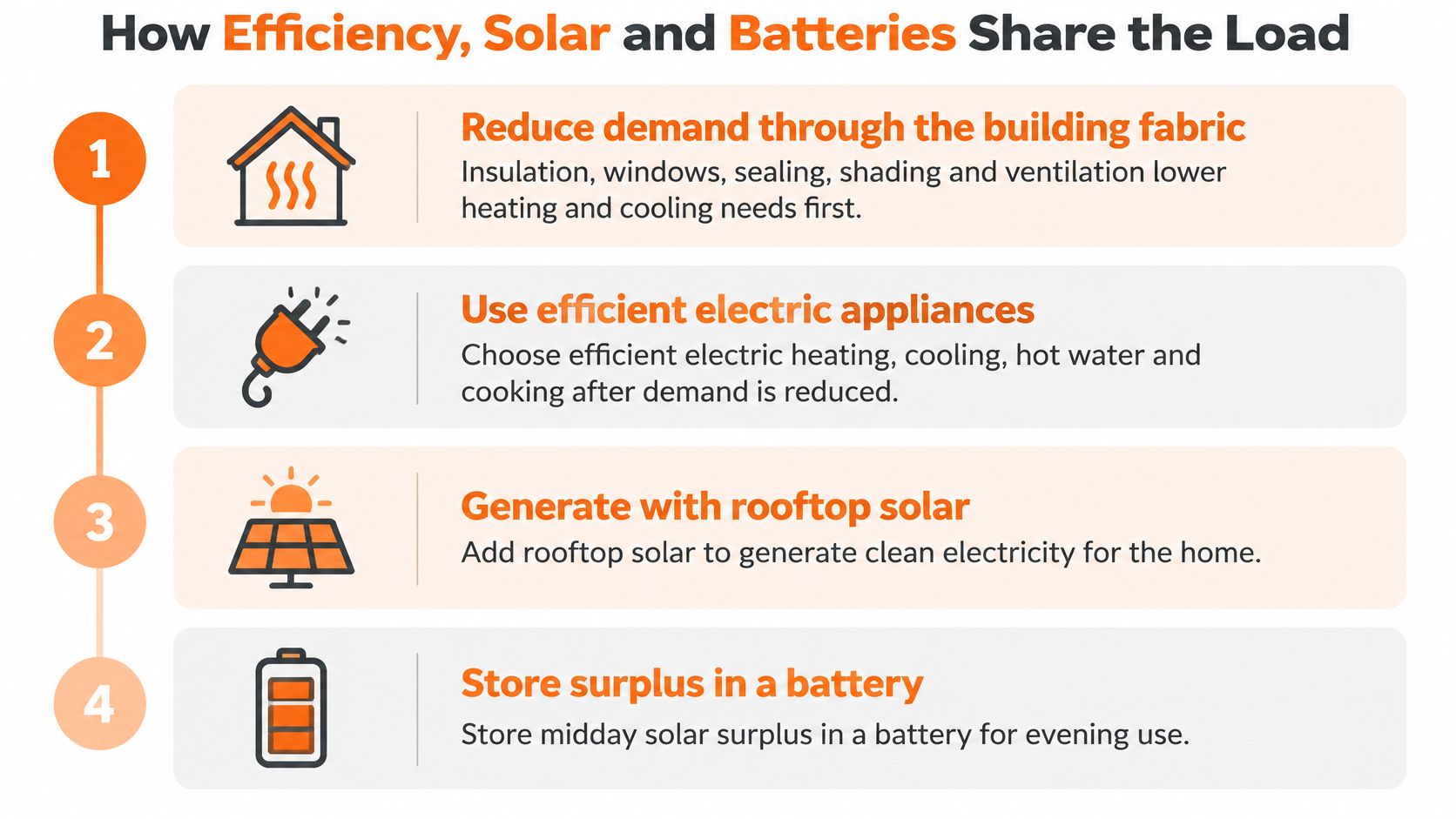
Building toward net zero works best in a strict four-step hierarchy: tighten the building fabric, switch to efficient electric appliances, generate clean electricity on the roof, and store midday surplus in a battery. Skipping ahead to a larger battery while ignoring heat gain or inefficient appliances forces your hardware to work harder than it should.
The infographic below maps out these four levers in the exact sequence that delivers the strongest return per dollar spent.
Why Timing Creates the Core Mismatch
Rooftop solar output peaks around midday, right when many Queensland and New South Wales households are at work or school. Household electricity demand usually spikes in the morning and again between late afternoon and mid-evening. A home battery bridges that daily gap by holding midday generation for evening use, yet storage can't rescue a house with an uncontrolled baseline load.
Regional climates sharpen this mismatch. A Queensland home running ducted air conditioning through humid summer afternoons faces steep late-day cooling loads just as solar generation begins tapering off. A New South Wales household in Canberra, the Southern Highlands, or western Sydney running electric heating through crisp winter mornings and nights deals with shorter days and weaker solar output.
Electrifying appliances early pays off even before you look at generation or storage. Energy Consumers Australia projected that by 2030, the average annual difference in total energy costs between a typical fossil-fuelled home and an all-electric home without solar or a battery would reach approximately $2,250, including transport costs. Each lever cuts the workload of the next: a tighter home needs smaller heating and cooling equipment, which needs a smaller solar array, which leaves a cleaner surplus profile for your battery.
Keeping existing panels performing properly matters just as much as array design. Dust, salt spray, and bird droppings drag down midday yields, so following a practical schedule for solar panel cleaning and maintenance helps protect the generation layer before you spend money on extra hardware.
Energy Levers and Their Role in a Net Zero Home
| Lever | Job in the balance | Typical limit |
|---|---|---|
| Building fabric | Reduces heating and cooling loads | Fixed once built, costly to retrofit |
| Efficient electric appliances | Delivers the same service with less electricity | Savings depend on use patterns |
| Rooftop solar | Generates electricity in daylight | Output falls in winter and cloudy periods |
| Home battery | Stores surplus for evening and night use | Limited capacity; cycling wears the battery |
Match Your Bill Pattern to the Right Lever
Before adding or adjusting any equipment, check your last four quarterly bills or monthly smart-meter graphs to spot your primary bottleneck:
- High daily baseline use: Constant overnight and midday consumption points to ageing fridges, inefficient pool pumps, resistive electric hot water, or poor building insulation rather than a solar shortage.
- Heavy evening grid imports with large midday exports: Your solar array produces plenty of power, so the gap lies in shifting flexible loads into daylight hours or optimising your battery discharge window.
- Low daytime exports alongside high total imports: Your building envelope and major appliances are soaking up generation faster than the roof can supply it, making thermal upgrades and appliance efficiency the first priority.
Cutting Demand Before You Add Generation
Your building shell decides how much energy your home will demand for the next several decades. In August 2022, the Australian Government announced National Construction Code (NCC) updates raising the minimum NatHERS thermal performance standard for new homes from 6 to 7 stars out of 10, with state and territory transitions starting from October 2022. Because Australia builds more than 150,000 new homes each year, lifting that floor permanently shrinks future heating and cooling loads across the housing fleet.
The diagram below highlights the passive design elements that work together to keep indoor temperatures stable before an air conditioner or heat pump ever switches on.
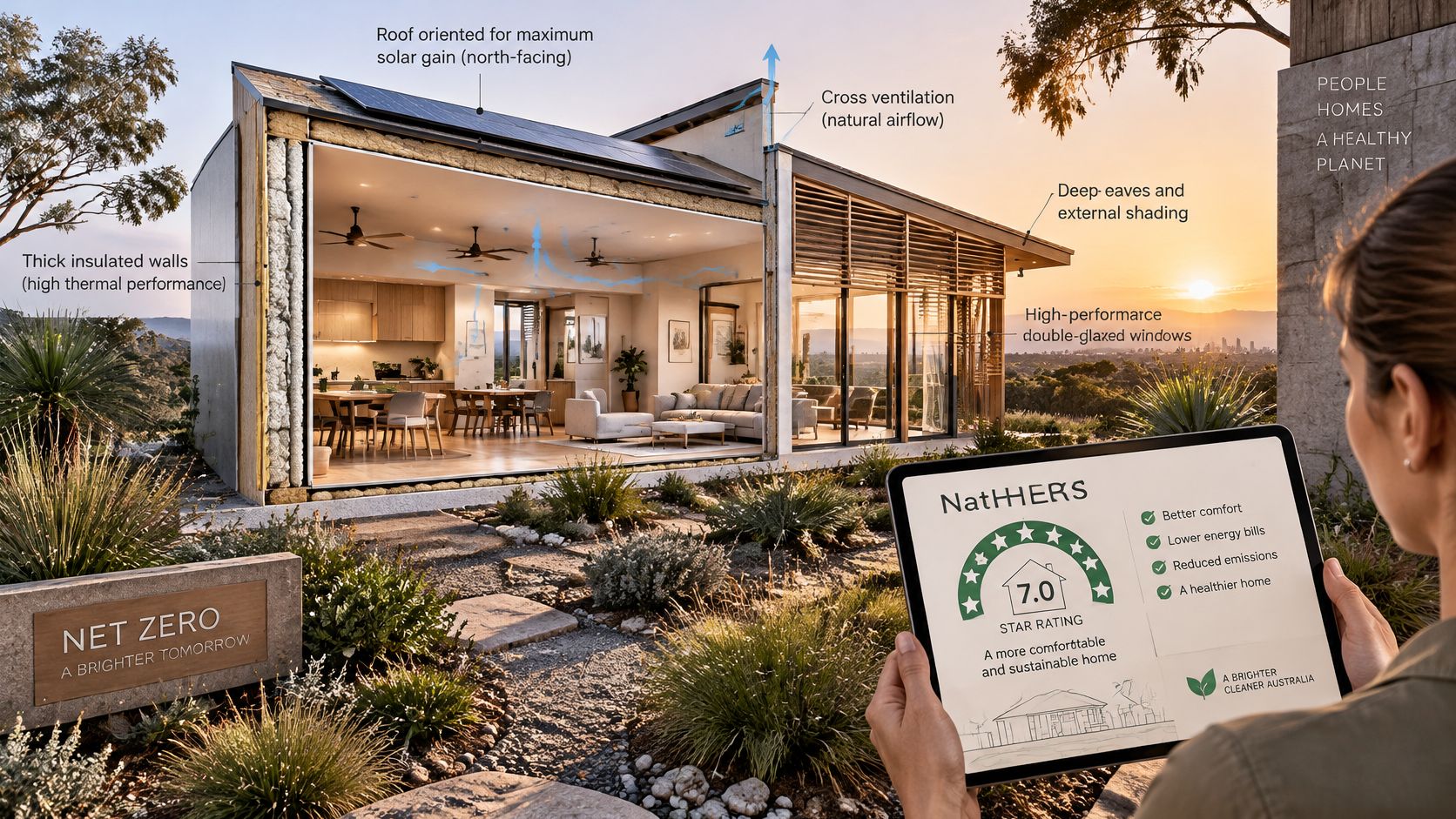
A 7-star benchmark isn't just thicker ceiling batts. As the Australian Building Codes Board explains, NatHERS evaluates how orientation, glazing, external shading, wall and roof insulation, air movement, and thermal mass interact to cap heating and cooling demand. Completing NatHERS modelling before finalising window sizes and HVAC capacity stops builders from oversizing air conditioners, which short-cycle, waste electricity, and inflate evening peak demand.
Climate Priorities Across Queensland and New South Wales
Design choices should match your local climate zone rather than copying a generic template:
- Warm and humid Queensland zones: Prioritise external window shading, roof reflectance, solar-control glazing, and cross-ventilation paths that flush trapped afternoon heat without relying solely on air conditioning.
- Cooler New South Wales regions: Focus on airtight construction, high-performance double glazing, well-sealed doors, and controlled winter solar gain through north-facing windows so warmth stays indoors overnight.
For new builds, NCC 2022 also introduced a whole-of-home annual energy-use budget, detailed in the ABCB residential energy efficiency overview. That budget assesses space heating and cooling, hot water, artificial lighting, and swimming-pool or spa pumps alongside onsite rooftop solar generation. Scheduling a heat pump hot-water system to run during midday solar production shifts a major daily load directly into free sunlight instead of draining your battery after dark.
Practical rule: Fix heat leaks before you buy extra kilowatt-hours of storage. Every unit of thermal demand you eliminate saves energy every day of the year without degrading like a battery cell.
Retrofit Order for Existing Homes
Owners of established houses get the best value by tackling upgrades in sequence. Start with ceiling insulation top-ups and basic draught sealing around doors, skirtings, and exhaust fans. Add external blinds, awnings, or window upgrades next; if your frames or panes are due for renewal, the Breaking Glass Co. replacement planning guide outlines how glazing performance affects thermal loss and comfort.
Once the envelope holds its temperature, replace legacy resistive hot-water tanks and gas heaters with efficient heat pumps and reverse-cycle units. Before locking in solar or battery sizing, book a NatHERS assessment or complete a structured household energy audit so every equipment decision is grounded in your real thermal load.
Sizing Solar and Batteries to Your Household Load
Australia passed four million rooftop solar installations under the Small-scale Renewable Energy Scheme in December 2024, and the Australian Government's National Consumer Energy Resources Roadmap update%20Roadmap%20Implementation%20Plan%20Update%20August%202025.docx) shows average system sizes climbed from 9.3 kilowatts in Q1 2024 to 9.9 kilowatts in Q1 2025. Larger roofs can easily fit bigger panels, yet extra daytime generation delivers weak returns if your household can't consume it, store it, or export it at a fair price.
The same logic applies to storage. Adding a bigger battery is often the wrong first move when a household generates limited midday surplus or leaves existing capacity sitting idle overnight. Oversized batteries add upfront cost without filling daily cycles.
Five Steps to Match Hardware to Real Demand
- Pull twelve months of interval data. Download half-hourly or hourly smart-meter readings from your retailer or distributor portal so you see seasonal swings rather than a single summer or winter snapshot.
- Split daytime from evening consumption. Calculate how many kilowatt-hours you burn between 9 am and 4 pm versus after sunset. A household working from home absorbs far more direct solar than a commuting family whose meter barely moves until 6 pm.
- List major flexible loads. Record the daily draw of heat-pump hot water, pool filtration, induction cooking, ducted air conditioning, and any planned electric vehicle charging, noting which loads can run on midday timers.
- Decide your outage backup reserve. If keeping fridges, lighting, and NBN hardware online during storms matters to your household, reserve a portion of usable battery capacity for emergencies and check whether your inverter supports backup circuits. Reading a clear breakdown like the home energy storage guide by Premier Builders can help you compare usable capacity, inverter limits, and backup expectations.
- Check your network export limit. Queensland and New South Wales distribution networks often cap single-phase exports at fixed limits or dynamic envelopes. Confirming your connection's export allowance stops you paying for panels that get curtailed at noon.
Sizing Priorities by Household Pattern
Use the matrix below to match your daily routine to the right generation and storage priority, or review dedicated solar system sizing principles before making hardware changes.
| Household pattern | Sizing priority | Battery role |
|---|---|---|
| Home during the day (home office, carers) | Match solar output to daytime load | Covers the evening peak with a modest reserve |
| Out all day, high evening use | Store midday surplus for evening loads | Battery is the main evening supply |
| Queensland summer, high cooling load | Size for afternoon heat and long cooling runs | Supports the peak cooling window; check the reserve |
| NSW winter, electric heating | Account for low winter solar output | Supplements limited winter generation; heating stays grid-dependent |
| EV charging at home | Plan a separate daily energy budget | Shifts charging away from peak tariff windows |
The right system isn't the maximum array your roofline can hold or the heaviest battery on the brochure. It's the combination that fits your twelve-month load curve cleanly without stranding capital in unused capacity.
How to Manage Your Battery Hour by Hour
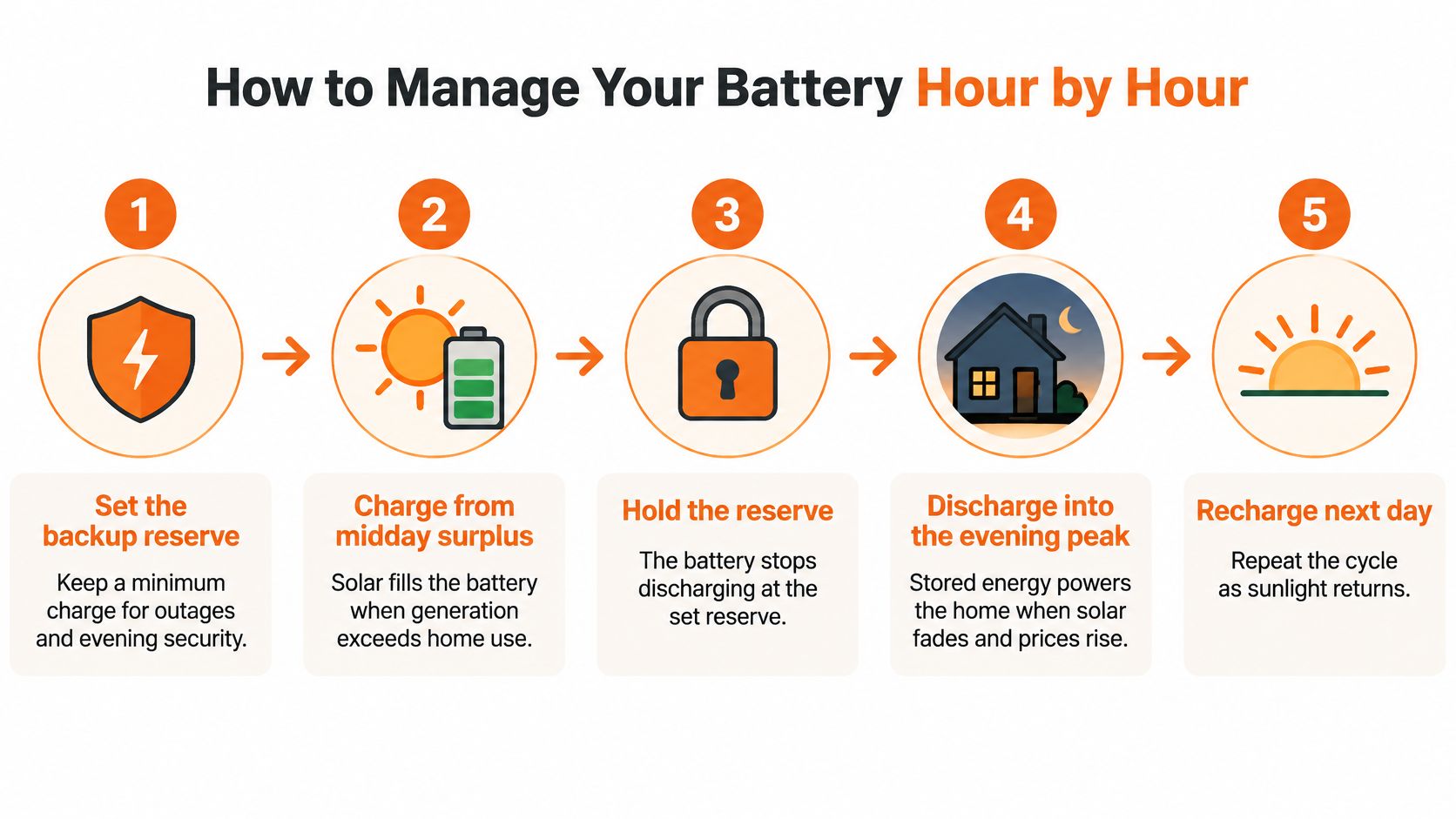
Owning a battery changes your energy bill only when its daily schedule matches both your household routine and your tariff structure. On a typical clear day, the system charges from midday solar surplus, holds a protected backup reserve, and discharges through the late-afternoon and evening peak when grid electricity costs the most.
The process diagram below shows how that twenty-four-hour cycle repeats from morning generation through overnight protection.
Six Daily Settings That Control Your Outcome
- Set your backup reserve for outage risk. Lock in a minimum state of charge that stays untouched during normal operation, such as keeping enough buffer for essential circuits overnight. Holding a higher reserve gives stronger storm security, yet it leaves less usable capacity for daily bill reduction.
- Align charging with midday surplus. Configure the inverter so rooftop solar covers daytime household appliances first, then fills the battery before exporting to the grid. If you sit on a time-of-use tariff with cheap off-peak windows in winter, scheduled grid top-ups can help on cloudy days, though conversion losses eat into thin price spreads.
- Target the evening peak for discharge. Release stored electricity during late afternoon and early evening when retail import prices peak and solar output drops to zero. Discharging too early into a shoulder period can empty the pack before dinner and force expensive grid imports at 7 pm.
- Map settings to your exact tariff windows. Check when peak, shoulder, and off-peak periods start and end across weekdays and weekends in your Queensland or New South Wales network area. Misaligned clock settings or outdated daylight-saving schedules erode battery value.
- Review export rules against feed-in value. Exporting stored energy makes financial sense only when the export return beats both your avoided import cost and battery wear. Every full charge-and-discharge cycle gradually degrades lithium cells, so warranty cycle limits should guide how aggressively you trade energy.
- Audit monthly performance against your bill. Compare your battery app's self-sufficiency and export totals against your actual retailer statement every month. Software firmware updates or seasonal weather shifts can knock carefully tuned schedules off course if you never check the output.
The short walkthrough below illustrates how battery inverters, solar arrays, and household loads interact across a real daily cycle.
How Coordinated Batteries Support the Grid
A single residential battery acts as a private buffer, whereas a Virtual Power Plant (VPP) links thousands of distributed home batteries into one coordinated, price-responsive resource. The Australian Government's National Electricity Market wholesale-market settings review cites Australian Energy Market Operator (AEMO) projections that distributed storage capacity could expand from 1 gigawatt to 7 gigawatts by 2029-30 and reach 34 gigawatts by 2049-50.
Australia already has working proof of this model at scale. The same federal review highlights the South Australian Virtual Power Plant, established in 2018, which aggregated roughly 7,000 home batteries across social and community housing to support grid stability and market efficiency. In a well-structured Bring Your Own Battery VPP, each battery stays physically on the homeowner's wall, household consumption comes first, and coordinated dispatch draws only on spare capacity during high-value grid events.
One clear test tells you whether your hour-by-hour settings are working: your battery should cover your evening peak cleanly while leaving enough buffer to match your household's outage tolerance.
Trade-offs Between Self-Use, Tariffs and Grid Services
Queensland already hosts more than 1.19 million rooftop solar systems, while New South Wales sits at roughly 1.17 million systems representing about 8 gigawatts of installed capacity, according to BuildStreet's solar and battery uptake report. Nationally, rooftop solar reached 4.3 million households alongside 454,753 household batteries by the end of 2025, with storage momentum accelerating further after home batteries became eligible under the federal Small-scale Renewable Energy Scheme in July 2025, as documented by EcoGeneration.
Despite that rapid adoption, three common assumptions still cost Australian battery owners money every quarter:
- Solar plus a battery eliminates every bill automatically: Daily supply charges, winter shortfalls, and high evening cooling spikes still produce quarterly bills unless tariff structure and battery dispatch are actively managed.
- A bigger battery always delivers faster payback: Extra kilowatt-hours sit unused if your roof doesn't generate enough surplus or if your tariff offers little spread between daytime and evening pricing.
- Default installer settings optimise financial value: Standard self-consumption mode ignores wholesale price spikes, network congestion events, and seasonal tariff shifts, leaving spare battery capacity underutilised.
Battery Strategies Compared
Each operating mode carries a distinct trade-off. Comparing your current tariff options through structured energy tariff comparisons helps clarify which strategy matches your meter data.
| Strategy | Main gain | Main trade-off | Best fit |
|---|---|---|---|
| Self-consumption | Uses solar generation on site | Limited value when export rates are low | Homes with high daytime use |
| Time-of-use optimisation | Shifts use to cheaper windows | Relies on tariff structure and forecast accuracy | Homes on time-varying tariffs |
| Reserve-first backup | Holds capacity for outages | Less capacity available for export or arbitrage | Homes with outage-sensitive needs |
| Virtual power plant participation | Earns grid-service value from spare capacity | Reserve and cycling settings must be managed | Owners who want more value from an existing battery |
Traditional Feed-in Tariffs Versus VPP Value
A traditional feed-in tariff pays a flat, modest rate for every kilowatt-hour you export, regardless of whether the grid is flooded with cheap midday solar or straining through a heatwave evening peak. Network export limits can cap what you send out right when your panels produce the most.
By contrast, a retailer-based VPP captures value when electricity is scarce. During wholesale price volatility or demand response events on the NEM, coordinated batteries discharge small amounts of spare capacity to stabilise the grid and earn grid-service revenue. Because wholesale market conditions shift from year to year, a setting that worked well last summer may underperform next winter, making ongoing automated optimisation far more effective than static defaults.
Commercial reality: Treat any projected saving from battery optimisation or VPP participation as a range grounded in your own twelve-month interval data, never as a flat guarantee, and read the program's allowance and dispatch terms before committing.
Homeowners retain priority access to stored energy for their own loads, so VPP value comes from idle capacity rather than sacrificing household comfort. The right strategy is the one whose trade-off fits your household priorities, especially if reliable backup reserve sits at the top of your list.
Frequently Asked Questions About Net Zero Homes and Batteries
Can a net zero home exist without a battery?
Yes, on an annual energy basis. If building efficiency and rooftop solar generate as much electricity over twelve months as the household consumes, the annual energy balance reaches zero. A battery mainly changes when you use your solar energy, lifting evening self-sufficiency and financial control rather than defining net zero status by itself.
Is a net zero home the same as an off-grid home?
No. A net zero home stays connected to the electricity network so it can export daytime surpluses and import power at night, in winter, and during extended cloudy spells. Going fully off-grid usually requires oversized solar arrays, much larger storage banks, and backup generation to survive worst-case winter weeks.
Does a bigger battery always save more?
No. Extra storage capacity creates value only when your solar array produces enough surplus to charge it and your household or VPP schedule has a productive use for that energy. Buying more kilowatt-hours than your daily load profile can cycle extends payback time.
Will a virtual power plant drain my battery during an outage?
Well-designed VPP programs prioritise household energy needs and operate using spare capacity rather than emptying your home's day-to-day supply. However, VPP participation does not guarantee backup power during a network outage. Set your backup reserve to reflect local outage risk and verify how your inverter behaves when the grid drops out.
Do I need a NatHERS assessment before adding solar to an existing home?
Yes, getting a NatHERS assessment or a detailed retrofit energy audit is a smart step before sizing panels or storage. Your building fabric sets the heating and cooling load your equipment must carry. Tightening insulation, shading, and draughts first prevents you from paying for oversized hardware.
Does net zero energy mean net zero emissions?
Not automatically. Generating the same annual kilowatt-hours you consume balances total energy volume, yet actual emissions depend on the carbon intensity of grid electricity during the exact hours you import power. Shifting consumption toward daytime renewables and supporting grid storage brings energy balance and emissions balance closer together.
Check Whether Your Battery Is Underused
Pulling every layer together comes down to four grounded facts:
- Net zero is an annual balance: Generation, imports, and exports work across all four seasons rather than hour by hour.
- Building efficiency sets the load: Insulation, glazing, shading, and efficient electric appliances shrink the energy your roof and battery must cover.
- Sizing follows usage data: Twelve months of interval readings beat guesswork when matching solar and storage to your routine.
- Active settings maximize battery value: Left on factory defaults, most residential batteries leave spare capacity sitting idle during high-value grid periods.
Eligibility Inputs to Gather First
Before reviewing a Bring Your Own Battery VPP retailer, pull together four practical details:
- System compatibility: Confirm your existing solar inverter and home battery model are supported by the program.
- Twelve months of bills and exports: Gather recent statements or portal data so your annual usage and surplus patterns are clear.
- Battery internet connection: Check that your battery stays reliably connected online for automated monitoring and optimisation.
- Outage protection preferences: Note any medical, refrigeration, or storm-resilience priorities that guide how much reserve capacity you want held back.
Most battery owners focus heavily on installation quality, yet far fewer check ongoing financial performance once the installer leaves. HighFlow Energy operates a Bring Your Own Battery Virtual Power Plant designed for eligible residential homeowners in Queensland and New South Wales who already have rooftop solar, a compatible home battery with an internet connection, and still receive electricity bills.
We don't sell or install solar panels or batteries. Your battery remains physically in your home, your household's energy use always comes first, and our program coordinates only spare capacity to fund a monthly Bill-Free Electricity Allowance with $0 daily supply charges and $0 usage charges within your confirmed allowance. You still receive a monthly electricity bill (which may be $0 within your allowance, with standard rates applying to excess usage), there are no fixed-term contracts or exit fees, and participation in the HighFlow Virtual Power Plant does not guarantee backup power during a network outage.
If you already own solar and a home battery in Queensland or New South Wales and want to know whether your system is underperforming financially, our team can review your setup against your real usage profile. HighFlow Energy is an authorised electricity retailer built around helping existing battery owners get stronger ongoing value from their hardware without lock-in contracts or new equipment. Request an eligibility assessment today at HighFlow Energy to see what your spare battery capacity could earn.