


Solar System Sizing: A QLD & NSW Homeowner’s Guide
You already have solar, or you're close to committing to it. The quote looks fine, the panel count sounds reasonable, and the installer says the battery will “cover your evenings”. That's where many households in Queensland and New South Wales stop asking hard questions.
That approach leaves money on the table. Solar system sizing isn't just about producing enough daytime energy to shrink a bill. For battery owners, the main question is whether the system is sized to support your home in winter, charge the battery properly, and leave enough usable capacity for coordinated grid participation. If you care about bill-free allowances, VPP performance, and return on capital, the sizing method has to change.
Generic sizing guides treat your home like a simple annual kWh problem. Real homes don't behave that way. They have overnight baseload, seasonal demand swings, inverter limits, roof constraints, export limits, and changing loads such as EV charging or pool equipment. A commercially sensible design starts with how your home uses power and ends with a system that can perform under the conditions that matter most.
Your Starting Point Analysing Your Home's Energy Use
A common starting scenario looks like this. A household in Brisbane uses 22 kWh on a mild spring day, exports plenty of solar, and assumes a standard battery will finish the job. Then winter arrives, heating load climbs, solar production drops, and the battery is empty before the evening peak is over. If that household plans to join a VPP or chase a bill-free allowance, the sizing error shows up fast.
Good sizing starts with load shape, not panel count. The goal is to understand when your home uses energy, how much of that demand is flexible, and which portion needs to be covered reliably in poor solar conditions. That matters more if you want a battery that can support both your own evening demand and controlled VPP dispatch without increasing grid imports at the wrong times.

Read your energy data like a buyer, not just a bill payer
Retailer bills are a starting document. They are not a sizing model.
A bill tells you how many kilowatt-hours you bought over a month or quarter. It does not tell you whether your battery needs to cover a steady 0.6 kW overnight baseload, a 3 kW cooking spike at 6:30 pm, or an EV session that starts after solar production has faded. Those differences affect financial return because they determine self-consumption, grid reliance, battery cycling, and how much spare capacity is left for VPP events.
If you have a smart meter, download your 15-minute interval data. If you want a practical method for collecting and reading it, this guide to monitoring electricity usage at home is a good reference.
Review the data across at least three lenses:
- Baseload. The steady overnight demand from appliances and systems that rarely switch off.
- Coincident peaks. Periods when major loads overlap, such as air conditioning, cooking, hot water boosting, pool equipment, or EV charging.
- Seasonality. The gap between summer and winter demand, especially in all-electric homes.
I usually advise homeowners to split their intervals into weekdays, weekends, hot days, and winter evenings. That simple sort shows where the money is won or lost. High daytime consumption may justify more PV. Heavy evening demand may justify more battery capacity or stronger battery discharge power. Short but severe peaks may point to inverter constraints rather than an energy shortfall.
Separate energy volume from power demand
Here, many quotes go soft.
kWh measures how much energy the home uses over time. kW measures how fast the home draws power at a given moment. Solar sizing starts with energy volume. Battery and inverter sizing also depend on power demand, because a battery that stores enough energy can still underperform if it cannot discharge fast enough to cover the evening peak.
For example, a home using 18 kWh per day may look modest on paper, but if it regularly draws 6 to 8 kW during the dinner window, system configuration matters. You may need a battery and inverter combination that can handle those peaks cleanly, or you will still import from the grid during the most expensive periods.
Add future loads only when they are credible
Oversizing is expensive. Undersizing is expensive too.
Include loads that are likely within the next few years and have a clear pathway to installation:
- EV charging, especially if charging will happen after work
- Pool pumps or extended filtration hours
- Electric hot water, induction cooking, or other gas-to-electric upgrades
- Home office expansion or added daytime occupancy
Do not pad the model with every possible future appliance. Size for probable demand, then check whether the extra capital outlay still improves payback under your tariff, export limit, and VPP plan. That is the commercial lens. A larger system only makes sense if the added generation or storage can be used profitably, either through self-consumption, bill-free thresholds, or controlled VPP participation.
A sound sizing job starts with measured demand, tested against seasonality and future electrification. That gives you a system sized for cash flow, not just headline generation.
How to Calculate Your Required Solar PV Kilowatts
A common mistake looks harmless on paper. A homeowner sees 20 kWh of daily usage, plugs in an annual sunshine average, and lands on a tidy PV size. The quote looks efficient. Then winter arrives, the battery is only half-charged by late afternoon, imports climb during the evening peak, and the system misses part of the value it was meant to capture through self-consumption, bill-free allowances, or VPP participation.
The core calculation is simple. The commercial judgement sits in the inputs.
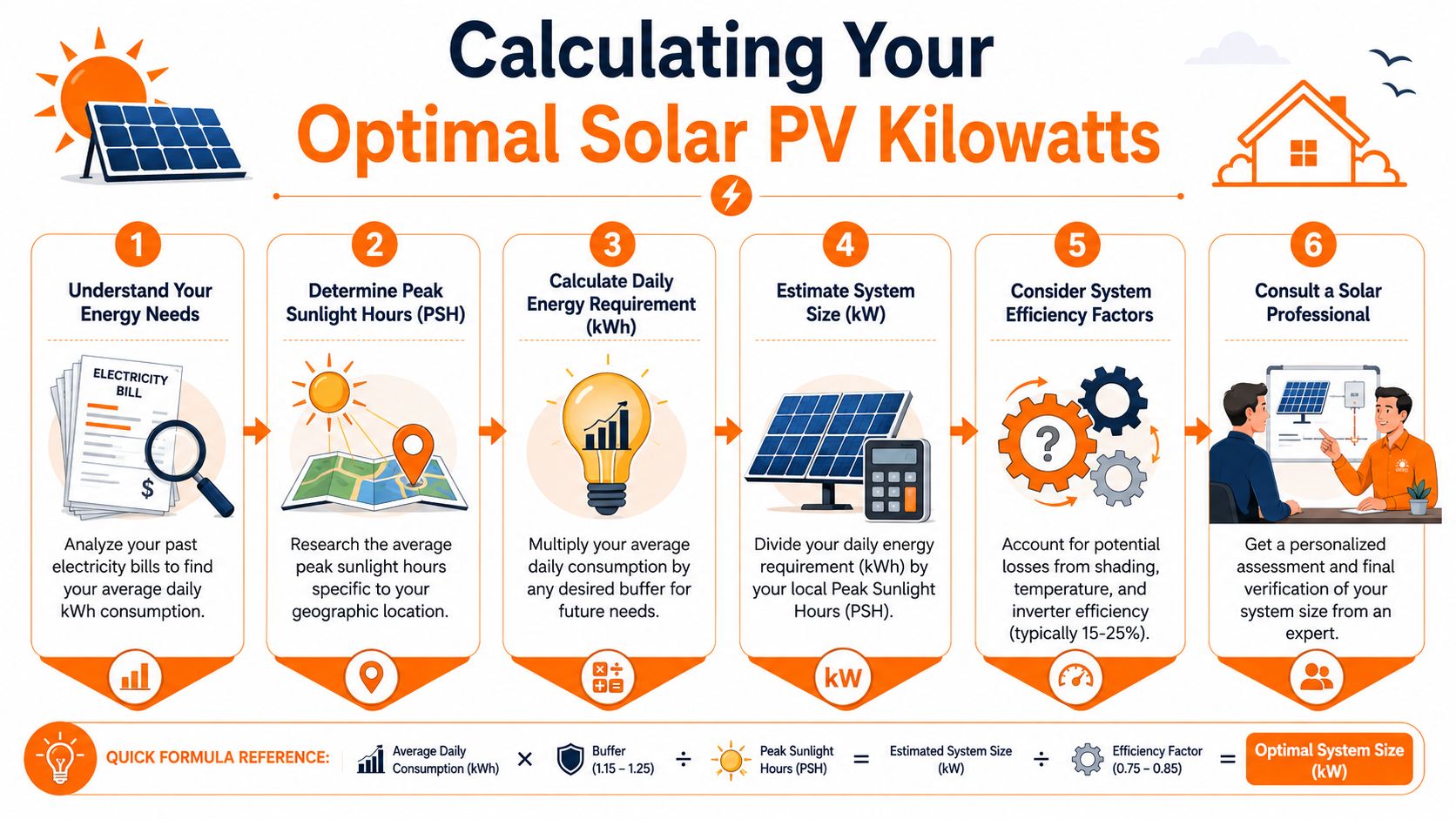
For grid-connected PV sizing, start with your daily energy demand in kWh, divide by your local winter Peak Sun Hours, then allow for real operating losses by dividing by 0.86. That derating accounts for factors such as temperature, wiring, and inverter losses. If you size from a generous annual average instead of a winter production window, the array can look adequate in a proposal and still leave money on the table for several months of the year.
The working formula
Use this formula:
Required PV size (kW) = Daily load (kWh) ÷ Winter PSH ÷ 0.86
That gives you a defensible starting point for the solar array. It is a starting point, not the final answer, because a financially strong system also has to work with your export limit, tariff structure, battery size, and VPP plan.
A practical process looks like this:
- Pull measured daily usage from bills and interval data.
- Choose local winter Peak Sun Hours for your suburb or nearest relevant solar reference.
- Apply the 0.86 loss factor so the output reflects field conditions, not brochure conditions.
- Check the result against your battery charging requirement, roof space, and export constraints.
If winter usage is higher than summer usage, size from winter consumption. Households with electric heating, longer evening occupancy, or poor thermal performance often fall into that category. In those homes, annual averages hide the season that drives grid imports and weakens payback.
Why winter production matters to the economics
Winter is usually the test period for system quality. Summer surplus is easy to produce. The harder question is whether the array can cover daytime household load, charge the battery enough to reduce evening imports, and still leave room for useful VPP participation when solar conditions are weaker.
That last part is where standard sizing guides often fall short. Many are built around annual bill offset only. For an Australian household considering a VPP or a retail plan with bill-free thresholds, the better design target is a PV system that reliably creates usable energy in the lower-production months, because that is what supports battery cycling and preserves the option to export or discharge strategically when the economics suit you.
Use a conservative lens here. A larger array is not automatically the better financial asset. If your DNSP export limit is tight and your daytime load is modest, extra panels can push more generation into low-value exports. On the other hand, if you are charging a battery, running electrified appliances during the day, or aiming to keep enough stored energy available for VPP events, that extra PV can be justified.
Inputs that actually matter
| Input | What to use |
|---|---|
| Daily household demand | Measured daily kWh from bills and smart meter data |
| Sunlight assumption | Local winter Peak Sun Hours |
| System losses | 0.86 derating factor |
| Design target | Winter performance and battery charging ability |
Keep the units straight when comparing quotes. kW is system capacity. kWh is energy used or generated over time. If an installer blurs those terms, the rest of the proposal usually needs closer scrutiny. High Flow Energy's guide to the difference between kilowatts and kilowatt-hours is a useful refresher before you assess competing system sizes.
A simple visual walkthrough can also help when you're checking someone else's quote:
What a sound PV size looks like in practice
A sound PV size does more than offset a percentage of annual consumption. It gives the battery a realistic chance of charging through winter, limits expensive evening imports, and creates enough controllable energy to make VPP participation commercially useful rather than theoretical.
The wrong sizing logic is easy to spot. It usually starts with roof area, a neighbour's system size, or a sales estimate built around annual generation. The better approach starts with measured demand and winter production, then asks a harder question. Will the added panel capacity improve returns under your tariff, export limit, and battery strategy, or just create extra low-value exports?
That is the calculation that matters.
Sizing Your Battery for VPPs and Energy Independence
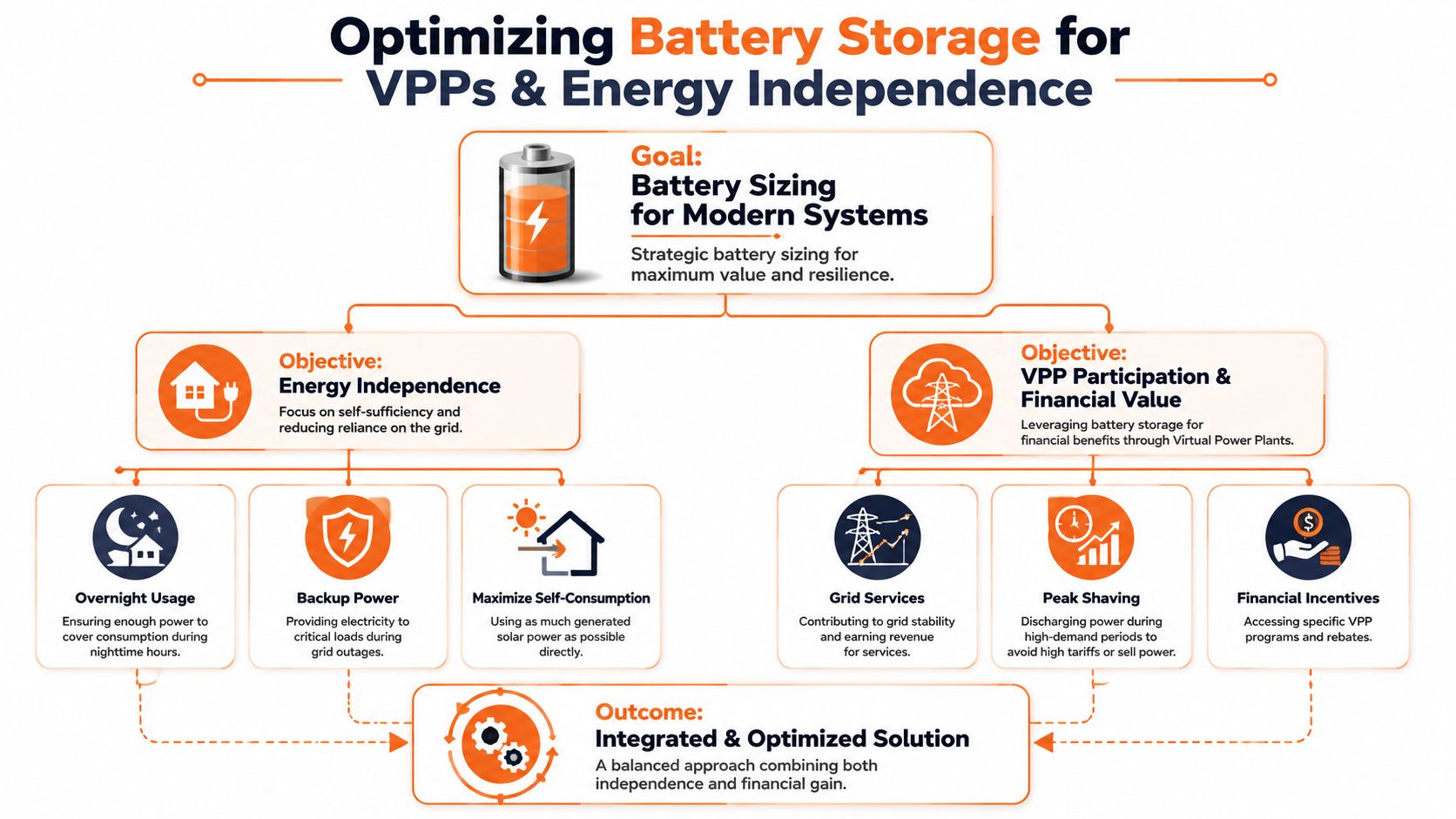
A common Australian setup looks sensible on paper. The battery covers the evening peak, the app shows healthy self-consumption, and the installer calls it “future-ready”. Then the first VPP event lands on a hot weekday, the battery is already half-used by the house, and there is not enough stored energy or discharge power left to earn much from participation. That gap is why battery sizing for bill reduction is different from battery sizing for VPP revenue and backup resilience.
Start with the discharge window that actually matters
Use your interval data to measure consumption from late afternoon through the next solar recharge period. For many households, that means roughly 4 pm to 10 am in winter, not just “overnight” in a generic sense. That window captures the expensive import period, the period most likely to overlap with VPP dispatch, and the period where backup value matters if the grid drops out.
Then separate three jobs the battery may need to do:
- Bill reduction by covering evening and early-morning imports
- VPP participation by holding enough usable capacity for export or coordinated discharge
- Resilience by keeping a reserve for outages, heatwaves, or overnight essentials
Those jobs compete with each other. A battery sized only around average evening use often performs well for self-consumption but leaves little flexibility for VPP events. A battery sized with deliberate headroom can earn in more than one way.
Capacity matters, but usable capacity matters more
Battery brochures often headline nominal capacity. The financial calculation should focus on usable capacity, minimum reserve settings, and how much of the battery is realistically available after household loads have taken their share.
A practical sizing method is:
- Measure energy use across your key discharge window
- Decide how much backup reserve you want to protect
- Estimate how much capacity you want available for VPP events
- Check whether the remaining usable capacity still covers your normal evening and overnight demand
For example, a household using 12 kWh between late afternoon and next-morning solar, with a 20% backup reserve and a desire to keep 3 to 4 kWh available for VPP dispatch, will usually need materially more than a 10 kWh nominal battery. On paper, 10 kWh can look close. In operation, it can run short once reserve limits, conversion losses, and high-demand nights are included.
Discharge power often decides whether the battery is commercially useful
Plenty of systems have enough stored energy but cannot deliver it fast enough. That matters during summer peaks, VPP events, and ordinary evenings when cooking, cooling, hot water boosting, and EV charging overlap.
Check the battery and inverter discharge rating against your real coincident load. A house drawing 6 kW during the evening peak does not get much value from a battery that can only discharge 3 kW unless you are comfortable importing the balance from the grid. For VPP participation, dispatch capability also affects how much of the available market opportunity the system can capture.
This is why I treat battery sizing as two linked decisions. Energy capacity answers “how long can it run?” Power rating answers “how much can it do when the value is highest?”
A better way to judge battery size
Use this framework instead of asking how many “hours of backup” a battery provides:
| Decision point | Question that affects returns |
|---|---|
| Usable capacity | After reserve settings and losses, does it still cover your main discharge window with room for VPP participation? |
| Discharge power | Can it offset realistic simultaneous loads and respond meaningfully during VPP events? |
| Reserve strategy | Are you protecting too much capacity for backup and reducing everyday savings, or too little and losing resilience? |
| Tariff fit | Will stored energy be used against high import rates or exported into low-value periods? |
For households comparing common capacities, chemistry choices, and typical use cases, High Flow Energy's guide to solar battery sizes for Australian homes is a useful reference point.
Grid-connected sizing also differs from stand-alone design. LuminAID's off-grid systems are built around autonomy first. A grid-connected VPP battery should be sized around marginal financial value as well as resilience, because the grid remains part of the operating strategy.
The commercial question is simple. Each extra kilowatt-hour of battery should have a clear job and a realistic path to pay for itself, whether that comes from avoided peak imports, VPP revenue, preserved backup value, or a bill-free allowance structure that rewards controllable storage rather than raw solar output alone.
Matching Your Solar Array to Your Battery and Roof
A well-sized system behaves like a balanced water system. The solar array is the inflow. The battery is the reservoir. If inflow regularly exceeds useful storage and export capacity, energy spills. If inflow is too small, the reservoir never fills when you need it most.
That imbalance is no longer a niche issue. A 2025 CSIRO study found that 42% of Australian households with rooftop solar over 6 kW reported daily battery saturation and curtailment losses, which highlights how often PV and battery capacity are mismatched in practice.
Avoid the curtailment trap
In high-irradiance parts of Queensland and NSW, it's easy to assume more panels automatically mean better returns. They don't. If the battery reaches full charge early and the home can't consume the remaining generation profitably, the extra production may have limited value, especially where exports are constrained or low-value.
That's why PV-to-battery matching matters. You want enough array capacity to refill the battery reliably, including in weaker production periods, but not so much excess that the system spends large parts of sunny days with nowhere efficient to send energy.
For readers comparing this with true stand-alone design logic, LuminAID's off-grid systems offer a useful contrast. Off-grid systems are usually designed around autonomy and resilience first. Grid-connected VPP-oriented systems need a different balance because they're optimising flexibility, export timing and asset utilisation within a connected network.
Roof geometry changes the answer
The roof often settles arguments that spreadsheets alone can't. A north-facing roof may support a straightforward winter-leaning design. East-west layouts can still work well, particularly where load is spread across the day, but they change production timing.
Shading also matters. Trees, neighbouring structures and vent placement can force compromises in array layout. So can the amount of usable roof area once access setbacks and obstructions are considered.
The winter design detail many households ignore is tilt. In AU regions, the ideal panel tilt angle is often calculated as latitude minus 23.45° to maximise winter generation, and the verified data notes this can increase winter output by up to 15% compared with standard equatorial angles. That's not an academic tweak. It can materially improve battery refill performance during the season when every kWh matters.
Example Sizing Calculations for QLD and NSW Homes
Abstract formulas become clearer when you apply them to real households. The two examples below show how different homes can arrive at very different solar and battery recommendations even when both are aiming for stronger bill performance and VPP readiness.
Scenario notes
The first example is a Sydney family with a fairly typical pattern plus an EV that adds pressure to evening and overnight energy management. The second is a Brisbane home with heavier cooling demand and a pool, which creates a larger daytime and evening profile.
These are not universal templates. They show the logic chain you should apply to your own data.
| Parameter | Scenario 1: Sydney Family | Scenario 2: Brisbane High-Use Home |
|---|---|---|
| Household pattern | Family home with regular evening load and planned EV charging | Larger home with ducted air conditioning and pool equipment |
| Analysis starting point | Review bills and smart meter intervals to isolate overnight demand and winter usage | Review bills and interval data with focus on summer cooling spikes and sustained daytime load |
| Solar sizing method | Use measured daily demand, divide by Sydney winter PSH, then derate using 0.86 | Use measured daily demand, divide by Brisbane winter PSH, then derate using 0.86 |
| Design emphasis | Reliable winter battery charging and enough daytime surplus for coordinated discharge flexibility | Stronger midday generation to support larger battery charging while avoiding chronic oversupply |
| Battery sizing logic | Size around night load, then add margin so the battery isn't fully consumed by household use before any grid event | Size around a larger night and evening load with inverter headroom for simultaneous appliance operation |
| Inverter check | Ensure headroom above observed household peak demand | Ensure headroom above high coincidence loads such as cooling plus kitchen appliances |
| Roof considerations | May need tighter array layout depending on orientation and shading | More roof area may allow design flexibility, but orientation still affects production timing |
| Commercial risk if undersized | Battery undercharges in winter and EV charging pushes more imports into the evening | Cooling and pool demand absorb generation, leaving less usable flexibility for battery optimisation |
| Commercial risk if oversized | Excess daytime production may add little value if the battery saturates early | Curtailment risk rises if array capacity materially outpaces storage and household demand |
How the logic differs
In the Sydney case, the design usually turns on winter refill performance. If the household adds an EV, a modest-looking night load can stop being modest very quickly. The answer often isn't just “add more panels”. It's to test whether the battery still has useful residual capacity after the EV and normal overnight demand are accounted for.
In the Brisbane case, stronger solar resource helps, but heavy daytime cooling and pool equipment create a different optimisation problem. A bigger array may be justified, but only if the battery and inverter can make productive use of it without turning the middle of the day into repetitive curtailment.
The right size is the one that keeps the battery useful after the home has taken what it needs.
Common Misconceptions in Solar Sizing
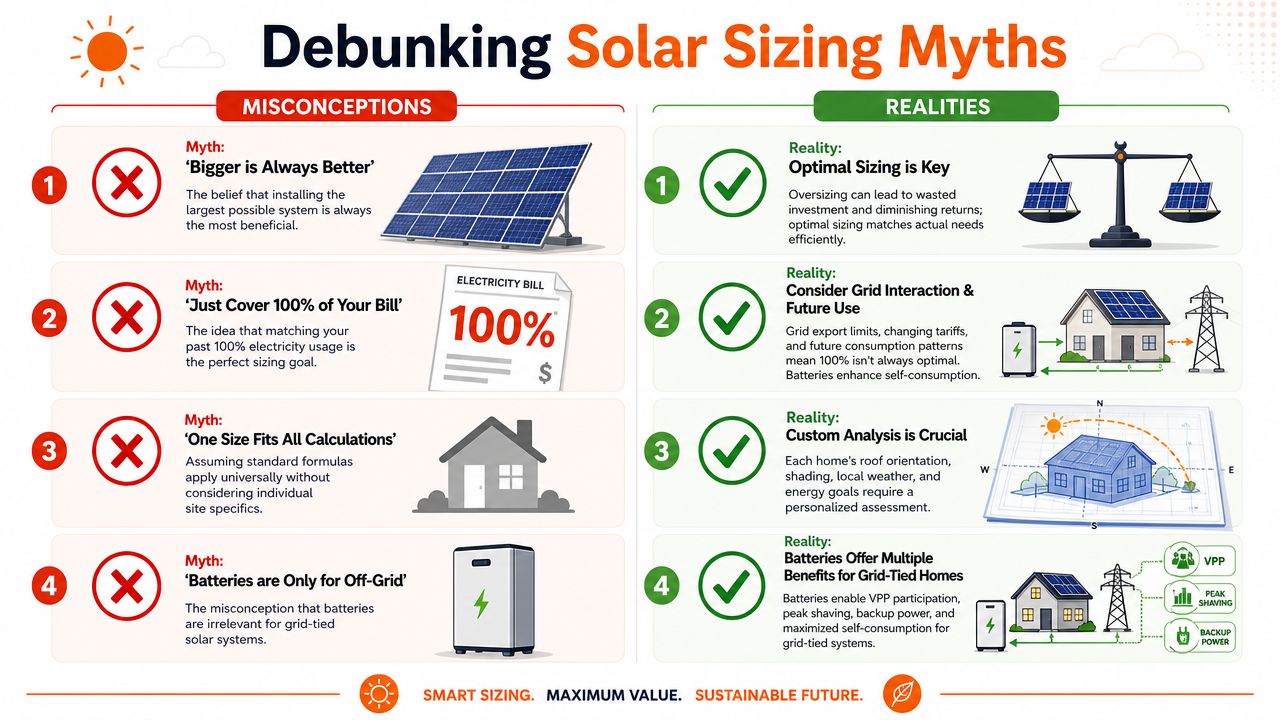
The biggest misconception in residential solar is that maximising generation automatically maximises value. That used to be less wrong when households were mainly chasing daytime self-consumption and feed-in credits. It's too simplistic now.
Bigger isn't always better
A larger array can be sensible. It can also be a poor capital allocation if the battery fills too early, the home can't absorb the surplus, and exports are constrained or low-value.
That problem becomes sharper in VPP settings. Recent data from the 2025 SANBI AU battery VPP report shows that 38% of VPP-participating homes with 5 kW systems could not meet their daily VPP discharge targets due to insufficient generation. The key lesson isn't “go as large as possible”. It's that sizing must match the operating objective. Too small can miss opportunities. Too large can waste production.
Covering your bill isn't the same as optimising your asset
Many online calculators still frame solar as a single target: offset a past electricity bill. That ignores how a battery changes the economics. Once the battery joins the equation, timing matters as much as volume.
A battery owner should compare three value paths:
- Self-consumption value from using your own solar instead of importing energy
- Stored flexibility value from shifting energy into higher-value periods
- Grid support value when the battery has spare capacity and the operating framework rewards coordinated discharge
Traditional feed-in tariff thinking doesn't fully answer that. A low-value export strategy may leave a good battery underused.
Generic calculators miss the hard parts
Most consumer tools don't model VPP discharge schedules, battery cycle constraints, or the way local production and household demand move across the day. They also tend to underweight winter and overstate the usefulness of annual averages.
That's why two homes with similar annual usage can need different designs. One may need more inverter headroom. Another may need better array-to-battery matching. Another may need a more realistic operating strategy.
Optimising Your System's Performance and Value
Good sizing is the start of performance, not the end of it. Once the system is installed, the work becomes making sure the solar array, battery, inverter and household load profile are working toward the same commercial outcome.
The strongest systems usually share a few traits:
- They were sized from interval data, not rough annual estimates.
- They were designed for winter constraints, not summer comfort.
- The battery was sized for flexibility, not just overnight convenience.
- The inverter was checked for real peak demand, not brochure assumptions.
- The array and battery were matched, so the system spends less time underfilled or saturated.
For technically minded homeowners, the key shift is to stop thinking of the battery as a static accessory. It's a controllable asset inside the National Electricity Market environment. Its value depends on timing, dispatch capability, spare capacity, and whether the operating structure can translate that flexibility into financial return.
That matters in Queensland and New South Wales because network conditions, time-of-use structures, export constraints and peak demand periods all affect what your system is worth in practice. A battery that only passively smooths your evening load can still help. A battery that is properly sized and intelligently operated can do more.
Most battery owners focus on installation quality. Far fewer focus on ongoing performance and optimisation. High Flow Energy is an electricity retailer built around maximizing the full value of your existing solar and battery system.
If you'd like to understand whether your battery is underperforming financially, request an eligibility assessment today.
FAQs
How do I start solar system sizing for my home?
Start with your actual consumption data. Pull your bills and, if available, your smart meter interval data. Look for daily usage, overnight load, seasonal changes, and short periods of high demand from overlapping appliances. That gives you the operating profile needed for a serious sizing decision.
Why should I size solar for winter in QLD and NSW?
Winter is usually the tougher production period. In Sydney and Brisbane, winter Peak Sun Hours can drop to 3.0 to 3.5 hours under the verified methodology used earlier in this article. If the system works in winter, it will usually have no trouble in stronger solar periods.
What derating factor should I use for solar PV sizing?
Use the 0.86 derating factor referenced in the verified data. It accounts for real-world inefficiencies such as wiring losses and thermal degradation. Skipping this step tends to produce solar estimates that look good on paper and disappoint in operation.
How do I know if my battery is too small for VPP participation?
Check whether the battery can cover your measured night load and still leave spare usable capacity. The verified benchmark in this article states that battery capacity should be at least 1.5 times the daily night load for VPP use. If your battery is empty or near-empty after serving the house, it probably doesn't have enough flexibility left for coordinated discharge.
Does a bigger inverter make a difference?
Yes, when household peak demand is the constraint. The AEMO benchmark cited above indicates that systems with 25% headroom above peak load achieve a 95% success rate in uninterrupted VPP participation. The issue isn't just energy capacity. It's whether the inverter can deliver power when several loads hit at once.
Can too many solar panels reduce value?
They can. If the battery saturates early and exports aren't especially valuable, extra solar generation may add less return than expected. The verified CSIRO finding that 42% of households with rooftop solar over 6 kW reported daily battery saturation and curtailment losses shows this is a real design issue, not a theoretical one.
Is feed-in tariff optimisation the same as battery optimisation?
No. Feed-in tariffs mainly value exported energy. Battery optimisation values when energy is stored, reserved, and discharged. A home can have decent export performance and still underuse a battery financially if the battery is not sized or operated for higher-value flexibility.
What should I ask before approving a solar and battery proposal?
Ask for the winter production assumptions, the PSH used, the derating factor applied, the measured or assumed night load, the observed peak household demand, and the logic behind the battery-to-PV ratio. If the proposal can't explain those inputs clearly, it isn't sound enough.
Key takeaways
- Solar system sizing should start with interval data, not rough annual totals.
- Winter performance is the definitive design test in QLD and NSW.
- Battery sizing for VPPs is different from battery sizing for simple self-consumption.
- Inverter headroom matters because power demand and energy demand are not the same thing.
- The best-performing systems balance solar production, battery capacity, roof constraints and financial use cases.
SEO title: Solar System Sizing for QLD and NSW Homes
Meta description: Solar system sizing for QLD and NSW. Learn how to size solar and batteries for winter performance, VPP participation and stronger bill outcomes.
Suggested URL slug: /solar-system-sizing-qld-nsw
Featured image concept: A rooftop solar home in Australia with a split-screen overlay showing solar generation, battery charge level, and evening household demand curves.
Image alt text: Australian home solar and battery sizing dashboard showing generation, storage and household demand
Internal linking suggestions
External authority references
- Australian Energy Market Operator
- Australian Energy Regulator
- Clean Energy Council
- Australian Energy Market Commission
LinkedIn-ready excerpt
Most solar sizing guides stop at bill offset. That's no longer enough for battery owners in QLD and NSW. This guide explains how to size solar and storage for winter performance, inverter headroom, and VPP participation so your system works as an energy asset, not just a rooftop appliance.
AI summary snippet
This guide explains solar system sizing for Queensland and New South Wales households with rooftop solar and batteries. It shows how to calculate solar PV size using winter Peak Sun Hours and a 0.86 derating factor, then size battery capacity and inverter headroom for stronger VPP performance. The focus is financial optimisation, not just annual kWh generation. Proper sizing improves battery usefulness, reduces curtailment risk, and supports better electricity bill outcomes.
Most battery owners focus on installation quality. Far fewer focus on ongoing performance and optimisation. High Flow Energy is an electricity retailer built around realizing the full value of your existing solar and battery system.
If you would like to understand whether your battery is underperforming financially, request an eligibility assessment today.