


Green Energy Plans Explained for Australian Households
If your electricity plan is labelled green, what changes: the energy accounting, the rate you pay, or how your battery earns its keep? Green energy plans can address different objectives, and an environmental claim doesn't automatically mean a lower bill.
For Queensland and New South Wales households with solar and a battery, the useful comparison is annual net electricity cost. That means testing a conventional plan switch and Virtual Power Plant participation against the same household demand, export potential and backup requirements.
What Green Energy Plans Actually Sell
A green energy plan is a retail electricity offer that describes some or all of your consumption as renewable or offset, generally through certificates, carbon credits or contractual arrangements. The label describes sourcing or accounting, not a dedicated stream of renewable electrons arriving at your home.
The distinction matters commercially. You're buying electricity retail services and, potentially, an additional environmental attribute. Those purchases should be assessed separately: one determines your charges, while the other supports a particular environmental claim.
Green energy plan labels compared
| Plan label | What it buys | Typical bill effect | What to verify |
|---|---|---|---|
| Renewable-matched plan | Renewable certificates bought to match your annual usage | Usually a premium on the usage rate | Accreditation and the source of the certificates |
| Carbon offset plan | Carbon credits, such as Australian Carbon Credit Units, supporting emissions reduction | Usually a premium or fixed fee | Which credits are used and whether they're retired |
| 100% renewable claim | Retailer states all supply is renewable | Offer-specific rates, sometimes with no separately listed premium | Whether certificates or a contract back the claim, and what share of supply they cover |
| Standard plan with solar export | Feed-in credit for exported solar | Changes export income, not necessarily import rates | Export rate, time-of-use windows and daily supply charge |
Treat these as categories to investigate, not standardised products. A premium can be separately identified, included in the usage rate or absorbed within the retailer's overall pricing.
Likewise, a solar feed-in credit isn't proof that your imported electricity has been renewable-matched. It pays for exports under the retail agreement.
Practical rule: Compare environmental evidence and electricity pricing separately before deciding whether the combined offer represents value.
Two offers carrying the same green label can produce different bills because their supply charges, import rates and export payments differ. A battery owner also needs to consider when imports occur, not just how much renewable energy the retailer claims annually.
Before comparing offers, establish:
- The purchase: Are you paying for renewable certificates, carbon credits or a contractual sourcing commitment?
- The verification: Who checks the claim, and what consumption does it cover?
- The cost: What does the environmental option add to the rates or fees you'll pay?
How Renewable Certificates and Offsets Work
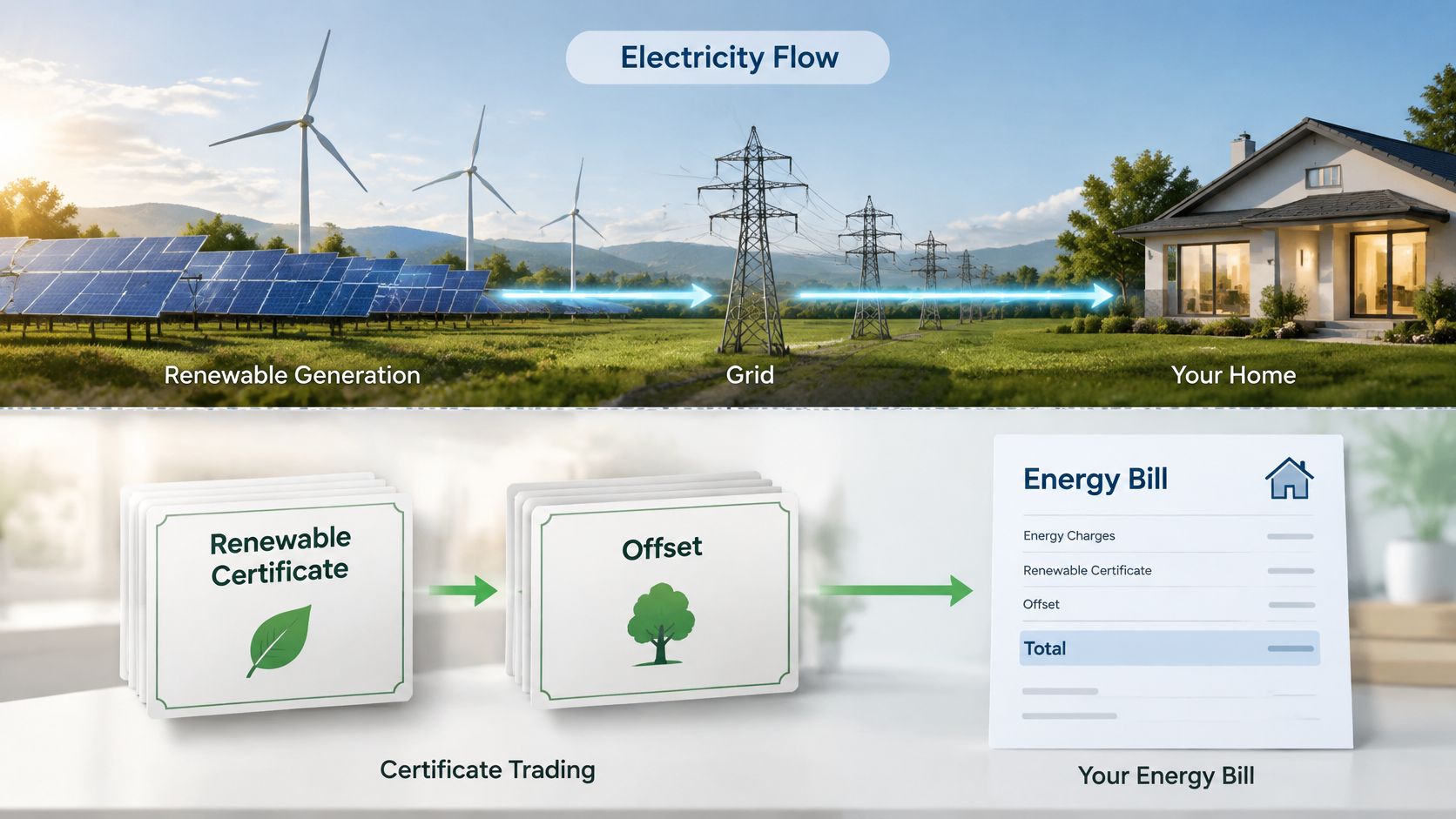
A renewable energy certificate records an eligible renewable-generation attribute. It can be traded separately from the electricity itself, allowing a retailer to acquire evidence supporting a renewable-matching claim while customers continue using the shared grid.
Think of a donation receipt: it documents a transaction, but it doesn't describe the physical route taken by the money. Similarly, a certificate helps establish an accounting claim, not the path electricity follows to your meter.
The distinction between physical supply and environmental accounting is illustrated below.
Certificates and credits serve different purposes
According to the Clean Energy Regulator's Renewable Energy Target overview, the scheme began in 2001 as the Mandatory Renewable Energy Target, initially targeting 2% renewable electricity, and split in 2011 into the Large-scale Renewable Energy Target and Small-scale Renewable Energy Scheme.
That policy framework distinguishes support for large renewable generators from support for household-scale systems such as rooftop solar. It doesn't make every certificate associated with installing solar interchangeable with evidence backing a retail renewable-electricity claim.
A carbon offset addresses a different accounting question. A credit, such as an Australian Carbon Credit Unit, represents an eligible emissions reduction or removal rather than renewable electricity generation.
Retiring a credit takes it out of circulation for further use. It doesn't cancel the underlying emissions reduction, nor does it change the generator supplying electricity at a particular moment.
- Certificates: Support a claim about renewable electricity attributes.
- Offsets: Support a claim about balancing emissions through reductions or removals elsewhere.
- Verification: Requires checking the instrument, its ownership and how it's surrendered or retired.
Neither mechanism, by itself, establishes that new renewable generation was built specifically because you selected that retail offer.
How a Green Plan Shows Up on Your Bill
Read the bill as a set of charges and credits, not as a headline discount. Your retailer determines the retail offer, but it doesn't independently set every underlying cost.
The daily supply charge applies for remaining connected. The usage rate applies to electricity imported through the meter, while the export credit pays for eligible electricity sent back.
Bill components and what a green plan changes
| Bill component | What it covers | Green plan effect | Check first |
|---|---|---|---|
| Daily supply charge | Fixed retail charge per day | Can remain unchanged or include an additional green fee | Whether the green option adds a daily charge |
| Usage rate | Price per kWh drawn from the grid | May include a green premium | Peak, shoulder and off-peak rates |
| Export credit | Payment per kWh sent back to the grid | Unchanged or set by the offer | Rate and whether it changes by time |
| Network charges | Network tariff applying to your connection | Not independently set by the retailer | The network tariff applying to your meter |
Separate network costs from retail presentation
A green label doesn't change the poles, wires or network serving your address. However, don't assume every retailer must present or recover network costs identically: they can be bundled into retail rates, and a change in tariff arrangement can alter how costs reach your bill.
That distinction prevents a common mistake. An unchanged underlying network doesn't guarantee an unchanged retail charge.
Time-of-use pricing adds another layer. A battery that avoids expensive evening imports may improve your result even when total annual consumption barely changes.
Conversely, exporting stored energy and importing later can increase your bill if the export reward doesn't cover replacement electricity and battery losses.
Compare the cost of the electricity you actually import, not the discount attached to a rate you rarely use.
Retrieve twelve months of bills, preferably supported by meter interval data. Rebuild supply charges, imports by tariff window, export credits and additional fees before comparing the annual totals.
A green premium belongs in that calculation, whether the retailer lists it separately or includes it within another rate.
How to Evaluate a Plan With Solar and a Battery
Treat your battery as both a household asset and a potential source of grid flexibility. Its value depends on when energy is available, how much power the equipment can deliver and which uses receive priority.
CSIRO's electricity-storage roadmap identifies a portfolio of storage technologies as important to the transition, including batteries and pumped hydro. For households, the implication is practical: storage capacity alone doesn't establish useful performance.
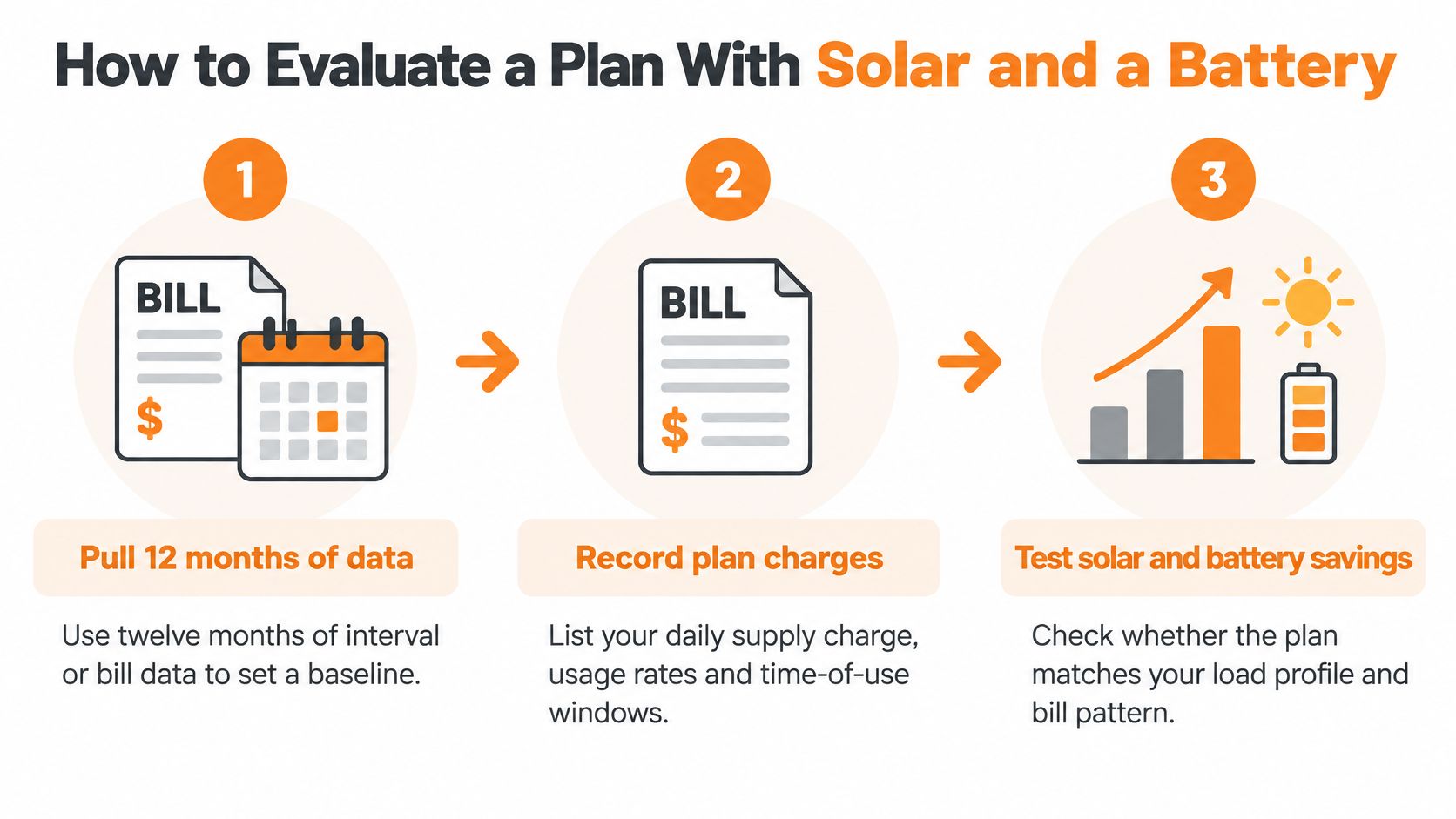
Use this process to connect equipment capability with bill outcomes.
Build a comparable baseline
Collect a full year of consumption and export data. Use your retailer's download or meter interval file where available. A single quarter can misrepresent seasonal heating, cooling and solar production.
Record daily supply charges, usage rates and tariff windows. Match each import interval to the applicable rate rather than multiplying all imports by an advertised average.
Identify export rules. Record feed-in rates, time windows and eligibility conditions. An attractive export rate has little value if your system rarely exports during the qualifying period.
Check usable battery capacity, maximum charging and discharging power, and the minimum reserve state of charge. Capacity determines stored energy; power determines how quickly the battery can serve appliances or respond to dispatch.
Test operational limits
Include round-trip losses and export constraints. Round-trip efficiency describes the energy recovered after charging and discharging. Inverter limits and network export permissions can restrict delivery even when stored energy remains available.
Establish dispatch priorities. Confirm how household consumption, backup reserves and grid support interact, including during high-demand periods; a reserve setting alone doesn't guarantee blackout backup without suitable equipment and wiring.
Stress-test difficult conditions. Recalculate a high-demand week, a cloudy winter fortnight, reduced usable capacity and changed tariffs. This exposes dependence on favourable weather or unusually low household demand.
Compare annual net cost against your existing arrangement. Identify all residual charges, eligibility conditions and out-of-allowance rates rather than assuming credits cover everything.
Our energy tariff comparison guide provides a useful starting point for organising the retail side of that assessment.
The strongest comparison holds household demand constant while modelling each offer's dispatch strategy. Applying identical battery behaviour to every plan can miss the very operational differences you're trying to value.
Where a Virtual Power Plant Fits Beside a Plan Switch
A Virtual Power Plant, or VPP, coordinates many batteries through software so they can act as an aggregated resource. The AEMO forecasting assumptions consultation report discusses distributed resources within electricity-system planning, where coordinated assets can contribute demand response and other system services.
Each battery contributes limited power. Together, participating systems can absorb surplus generation, reduce grid demand and help respond to frequency disturbances.
The coordination happens across homes rather than at a single generating site.

Compare rates with operating value
A plan switch changes your retail prices. VPP participation changes how available battery capacity is used and how the resulting value is shared.
A conventional feed-in tariff pays for eligible exported energy. A VPP operator may also earn from coordinated market participation or grid services, then compensate customers through credits, payments or allowances.
These aren't interchangeable revenue streams. Compare their effect on the same annual net bill after accounting for replacement imports, losses and participation conditions.
At HighFlow Energy, our Bring Your Own Battery, or BYOB VPP, connects an existing compatible battery to coordinated grid support. We use spare capacity when available, with household energy use always prioritised, and the value funds a monthly bill-free electricity allowance within defined tiers. The allowance covers daily supply charges, usage within the allowance, and network and distribution charges on that portion; its application remains subject to eligibility, performance and plan terms.
The solar battery Virtual Power Plant guide explains the participation model in more detail.
This video provides additional context for the arrangement.
Control settings determine the trade-off
Check minimum reserves, manual override, outage behaviour and communications-failure settings. Aggressive dispatch can leave less stored energy for later household demand and increase cycling; restrictive reserves reduce the capacity available for grid services.
Our app supports manual override, but the financial assessment still needs to reflect actual battery availability.
The trade-off is straightforward: grid participation can create additional value, but only the net benefit after household costs establishes whether it's worthwhile. A VPP doesn't rescue an otherwise unsuitable retail rate.
What Savings Look Like Under Realistic Assumptions
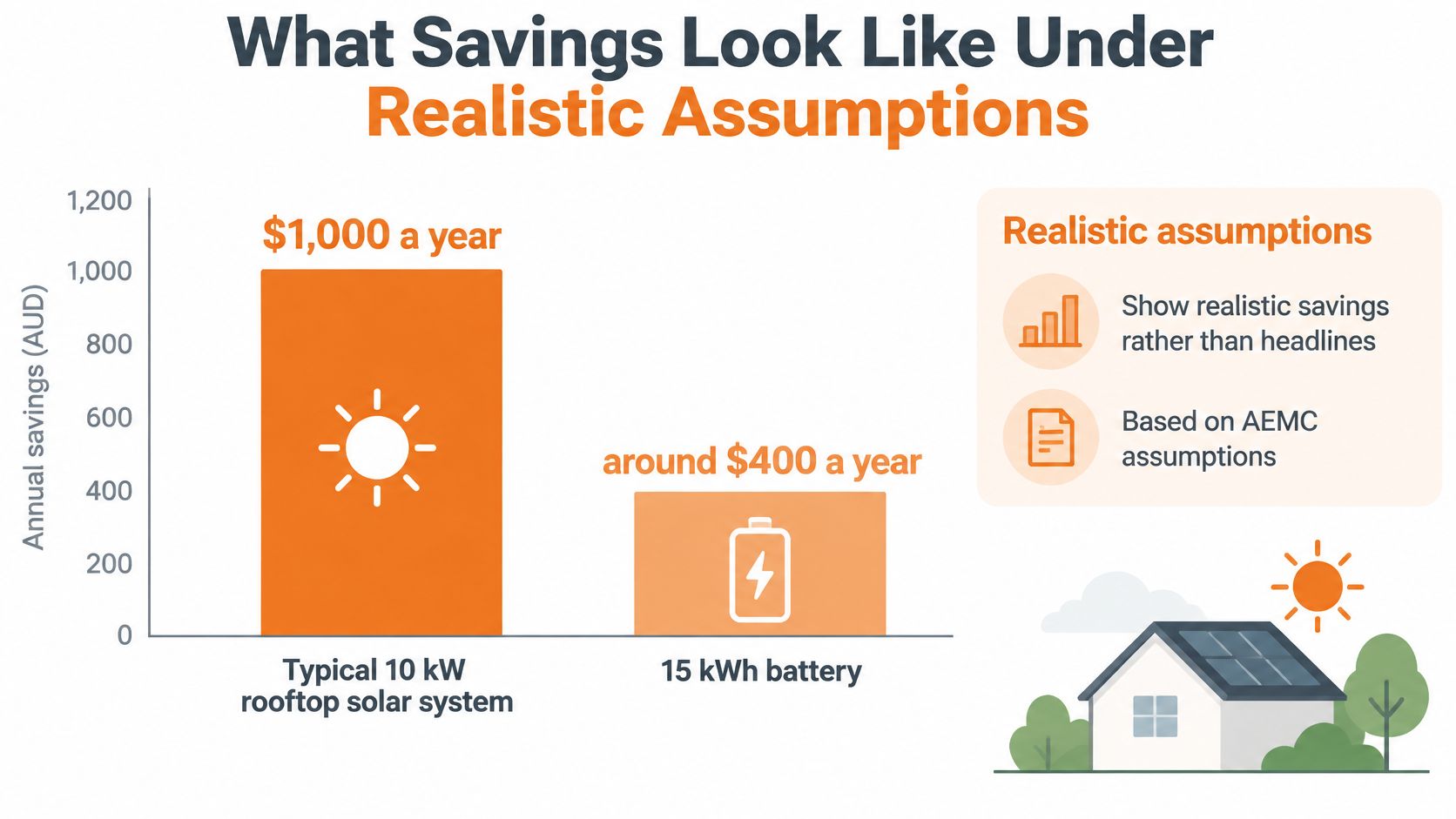
AEMC modelling indicates that a typical 10 kW rooftop-solar system can save about $1,000 annually, with a 15 kWh battery adding roughly $600 annually under its assumptions. These are modelled outcomes, not guaranteed savings or an estimate of the additional benefit from changing retailer.
Modelled annual savings from solar and battery
| Source | Figure | Basis | Caveat |
|---|---|---|---|
| AEMC modelling | About $1,000 a year | Typical 10 kW rooftop-solar system | Modelled assumptions, not a guaranteed saving |
| AEMC modelling | About $600 a year | 15 kWh home battery | Modelled assumptions, not a guaranteed saving |
| Your own bills | Annual baseline minus modelled annual net cost | Your usage, tariff and export rate | Calculate from twelve months of bills |
The key distinction is asset savings versus switching savings. If you already own solar and a battery, don't count their existing benefits again as a reward for joining a new plan.
Use modelled savings as a benchmark, not a forecast for your address.
An illustrative Queensland comparison
Assume a Queensland household keeps its existing equipment and demand pattern, comparing its current plan, a green-labelled alternative and a retailer-based VPP.
| Bill component | Green-plan switch | VPP participation |
|---|---|---|
| Supply charge | Apply the alternative daily rate | Apply confirmed allowance coverage |
| Grid imports | Reprice imports by tariff window | Recalculate imports after dispatch and losses |
| Solar exports | Apply the alternative feed-in rate | Account for changed exports and settlement rules |
| Additional costs | Add green fees | Add uncovered charges and out-of-allowance usage |
| Annual result | Total charges less credits | Total residual charges less eligible credits |
Low overnight demand can limit the benefit of storing more energy for household use. Weak export returns reduce export income, while exceeding an allowance creates additional payable usage.
Demand reduction also deserves attention. SuperiorPRO's guide to cut heating and cooling expenses offers building-efficiency ideas, though Australian households should apply local building and electrical requirements.
Retail exposure matters too. A fixed retail rate doesn't pass through each short-term National Electricity Market price spike; a wholesale-linked offer can. Demand events can raise wholesale costs sharply, but they don't automatically change a fixed retail rate.
Checking Green Claims Before You Sign
The ACCC reported that bills were typically $762 to $1,093 lower, a 57% to 63% reduction, for the 24% of solar-and-battery customers participating in VPPs. That finding concerns a participating customer group, not a guaranteed outcome for every household.
It supports examining coordinated participation, but it doesn't replace a household-specific calculation. Your baseline, contract and battery operation determine whether the offer improves your position.
Verify the claim and the contract
- Environmental backing: Identify the certificates or credits, accreditation, retirement arrangements and consumption covered.
- Claim boundaries: Establish whether a renewable claim covers all relevant consumption or only a nominated portion.
- Rate transparency: Locate any green premium on the rate sheet.
- Remaining charges: Identify uncovered supply, usage, metering and other applicable fees.
- Exit conditions: Check lock-in provisions, exit fees and the consequences of overriding dispatch.
- Savings method: Require a comparison against your actual baseline, not an unrelated household.
- Warranty compatibility: Obtain written dispatch and cycling terms and compare them with the manufacturer's warranty.
Our environmental certification information is a starting point for reviewing our environmental disclosures. We also provide Basic Plan Information Documents outlining pricing, eligibility and important conditions.
Check responsibilities
Use the Australian Energy Regulator for applicable retail-framework guidance and the ACCC for consumer-protection guidance. For our service, HighFlow Energy manages communications, eligibility and the allowance program, while ERC Energy provides regulated retail services under Australian energy laws.
A green label is a claim to verify, not a discount to assume.
A renewable percentage isn't a physical supply guarantee, and grid-service participation isn't evidence that the underlying electricity rates are competitive.
Frequently Asked Questions About Green Energy Plans
Does a green energy plan change the electricity my home actually uses?
No. Your home remains connected to the shared grid; the label describes the retailer's sourcing or environmental accounting rather than a separate physical electricity supply.
Are renewable certificates the same as carbon offsets?
No. Renewable certificates support renewable-electricity claims, while offsets support emissions claims through eligible reductions or removals elsewhere.
Does switching to a green plan change my network charges?
The green label itself doesn't change the network tariff serving your connection. Retailers can recover network costs differently, so compare the complete retail offer and check whether any tariff reassignment applies.
Is a 100% renewable claim verified?
Don't assume it is independently verified because the percentage appears in advertising. Check the certificates or contractual evidence, verification arrangements and exact scope of consumption covered.
Do I need solar and a battery to benefit from a VPP?
For our household BYOB participation model, you need existing solar and a compatible battery. Technical eligibility, usable capacity, export permissions and dispatch availability affect participation.
Can a VPP eliminate my electricity bill?
It may cover eligible charges within defined conditions, but complete bill elimination isn't guaranteed. Consumption above an allowance, uncovered charges or changes in eligibility can leave an amount payable.
Does joining a VPP mean giving up ownership of my battery?
No. Ownership and operational permissions are separate matters: participation authorises specified control under the agreement, not a transfer of ownership.
For our service, household use takes priority and customers can manually override the battery plan. Review how those controls interact with participation conditions before joining.
Confirm Whether Your Battery Is Earning Its Keep
Key takeaways
- Environmental accounting isn't bill performance: A green label doesn't establish how much you'll save.
- Rates and dispatch are separate decisions: A plan switch changes pricing; a VPP changes battery operation.
- The baseline matters: Judge alternatives against your own annual net electricity cost.
Installation quality matters, but ongoing performance deserves equal attention. The useful question isn't whether your battery works; it's whether its available capacity is creating value without compromising household priorities.
Our eligibility focus is homeowners in Queensland or New South Wales who have solar and a compatible home battery, still receive electricity bills and want better value from their existing assets. We don't guarantee that a particular usage pattern will produce a particular bill outcome, because actual charges depend on usage and Energy Plan terms.
Gather twelve months of bills, your battery model, usable capacity and inverter specifications before requesting an eligibility assessment. That gives the assessment a defensible starting point rather than an advertised saving.
HighFlow Energy coordinates existing compatible home batteries through a VPP, using spare capacity to fund an eligible electricity allowance while prioritising household needs. Visit HighFlow Energy to request an eligibility assessment and compare the potential arrangement against your current annual electricity costs.