


Off Peak Electricity Times Victoria: Save More in 2026
Individuals searching for off peak electricity times victoria want a timetable. That’s useful, but it’s not the key decision point. For battery owners, the timetable only matters because it determines when your stored energy is cheap, when grid energy is expensive, and when your asset can earn more than a standard solar export.
That distinction changes the economics. A household without a battery uses off-peak windows to run appliances more cheaply. A household with solar and a battery can use the same windows to decide when to charge, when to hold energy, and when to discharge. If you already own the battery, tariff timing becomes an asset optimisation problem, not just a bill-management habit.
Introduction Understanding Victoria's Peak and Off-Peak Electricity
What are you buying when you search for off peak electricity times victoria. A timetable, or a set of price signals that can change the return on a home battery?
Victoria does not run on one universal off-peak schedule. The answer depends on your tariff type, meter setup, and sometimes the distribution network behind your address. Two households on the same street can face different import prices at the same hour, even if their consumption pattern looks identical.
For battery owners, that detail has direct commercial consequences. A battery does not create value solely because it stores energy. It creates value when the spread between a low-cost charging period and a high-cost avoidance period is wide enough to cover round-trip losses, battery wear, and any retailer rules that limit how the system operates.
The standard peak window many Victorian households recognise is the late afternoon and evening period, but that general pattern is only the starting point. Retail plans package those hours differently, and some tariffs matter far less to battery economics than marketing material suggests.
Practical rule: Clock times matter. Margin matters more.
That is why a passive battery strategy often underperforms. If the system only soaks up surplus solar and serves household load after sunset, it may reduce grid purchases without capturing the full value available from tariff arbitrage, managed exports, or participation in a virtual power plant. The better question is not just when power is cheap. It is whether your tariff and retailer let your battery shift energy into the hours where avoided imports, export incentives, or grid service payments are highest.
Decoding Your Electricity Tariff Time of Use vs Controlled Load
A battery owner who treats every low-rate period as interchangeable usually leaves money on the table. The key question is not whether your bill mentions off-peak pricing. It is which tariff applies to which circuit, and whether your battery can respond to that price signal.
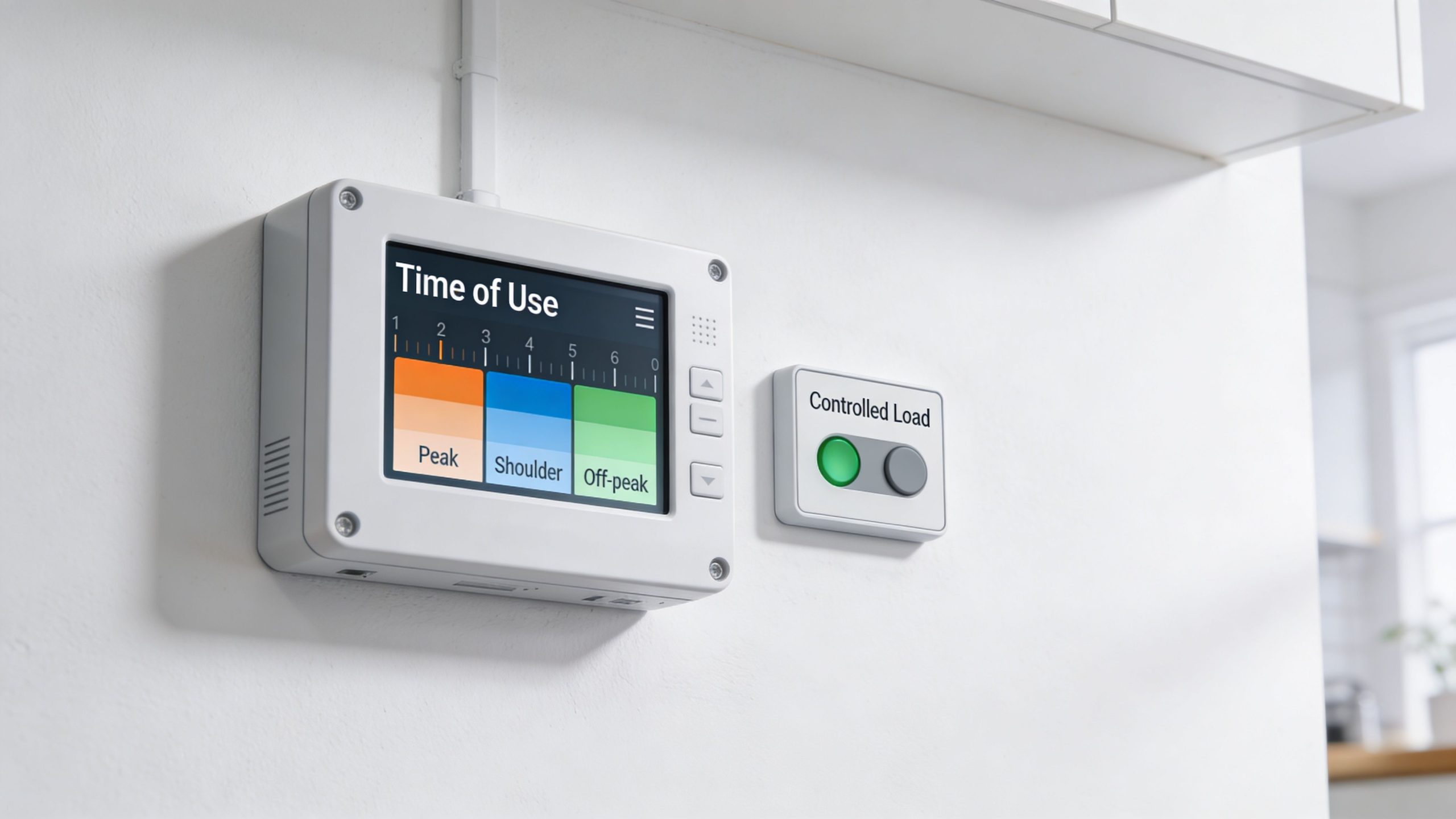
Time of use tariffs
A time-of-use tariff changes your import price by time period across general household consumption. Depending on the meter and retail plan, that usually means a mix of peak, shoulder, and off-peak rates. The pricing logic comes from network cost allocation and retailer hedging. Power consumed during high-demand intervals costs more to serve, so those hours carry a higher retail price.
For battery owners, this tariff creates a direct arbitrage mechanism. Charge when import rates are low, discharge when avoided grid purchases are expensive, and the spread becomes the starting point for value. The important qualifier is that the spread must still exceed round-trip efficiency losses, battery degradation, and any retailer restrictions on charging behaviour.
Controlled load tariffs
A controlled load tariff is narrower. It usually applies to a separately metered or dedicated circuit, most often electric hot water or slab heating, rather than the whole home. EnergyAustralia’s explanation of single rate, time of use and controlled load tariffs makes that distinction clear.
A controlled-load rate often looks attractive on paper, yet its relevance to battery strategy is limited. If your battery is not wired to that circuit, it cannot charge against that tariff window. A household may see “off-peak” on the bill and assume the battery can access it, when in practice the discounted rate is confined to one appliance and unavailable for general load shifting or tariff arbitrage.
For VPP participants, that distinction is even more important. A battery connected to the main switchboard can respond to whole-of-home import pricing and export events. A controlled-load circuit cannot substitute for that flexibility.
Single rate tariffs
A single rate tariff applies one usage price at all times. The simplicity suits households that value bill predictability, but it removes most of the timing signal that helps a battery earn extra value from import avoidance.
That does not make single-rate plans irrelevant. They can still work for batteries if solar self-consumption is the main objective or if a VPP pays enough for dispatch rights. But the economics shift. Instead of price-based cycling between cheap and expensive intervals, the battery’s value depends more heavily on solar capture, peak demand reduction, backup preferences, and export arrangements such as Victorian solar feed-in tariff structures.
A simple way to think about it
| Tariff type | What it applies to | Why it matters for battery owners |
|---|---|---|
| Time of Use | Whole-home consumption timing | Supports price-based charging and discharge decisions if the tariff spread is wide enough |
| Controlled Load | Specific appliance or circuit | Can reduce the cost of dedicated loads, but usually does little for battery arbitrage |
| Single Rate | All usage at one rate | Simplifies billing, but limits the financial upside from time-based battery scheduling |
Victoria's Off-Peak Electricity Times by Distributor
Which Victorian battery owners profit from off-peak timing. The ones who treat distributor schedules as an operating constraint, not as the whole pricing strategy.
Across Victoria, residential time-of-use tariffs often cluster around a familiar pattern: an evening peak from 3:00 PM to 9:00 PM, with cheaper periods sitting outside that window on simpler two-rate plans, as noted earlier. That consistency makes comparison easier, but it also hides the commercial detail that matters. The distributor sets the network timing framework. Your retailer decides how that framework appears on the plan, the meter configuration, and the rates attached to each period.
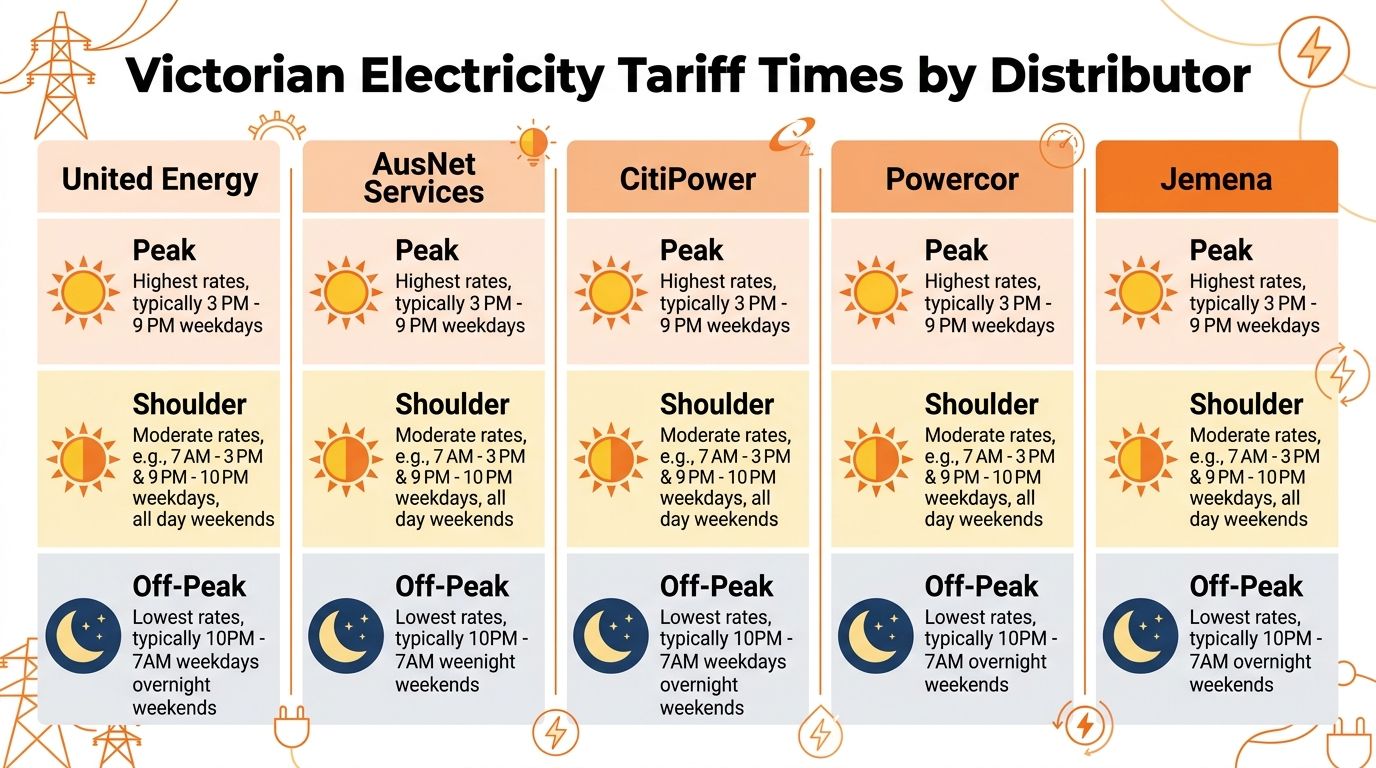
Typical residential timing patterns
| Distributor | Peak | Shoulder | Off-Peak |
|---|---|---|---|
| AusNet Services | Commonly 3:00 PM to 9:00 PM daily on residential time-of-use plans | May apply on some tariff structures, depending on the plan and meter setup | Commonly outside the peak window on simpler two-period plans |
| CitiPower | Commonly 3:00 PM to 9:00 PM daily on residential time-of-use plans | May apply on some tariff structures, depending on the plan and meter setup | Commonly outside the peak window on simpler two-period plans |
| Jemena | Commonly 3:00 PM to 9:00 PM daily on residential time-of-use plans | May apply on some tariff structures, depending on the plan and meter setup | Commonly outside the peak window on simpler two-period plans |
| Powercor | Commonly 3:00 PM to 9:00 PM daily on residential time-of-use plans | May apply on some tariff structures, depending on the plan and meter setup | Commonly outside the peak window on simpler two-period plans |
| United Energy | Commonly 3:00 PM to 9:00 PM daily on residential time-of-use plans | May apply on some tariff structures, depending on the plan and meter setup | Commonly outside the peak window on simpler two-period plans |
What stays consistent, and what changes the economics
The evening peak is the part that tends to stay consistent. For battery owners, that period usually carries the highest avoided import value because it aligns with both stronger household demand and higher tariff exposure.
The variation sits around the edges. Some plans insert a shoulder period. Some simplify the structure into peak and off-peak only. Some retailers apply pricing differences that make the nominal off-peak window less important than the actual cents-per-kWh spread. A battery scheduled purely around clock times can miss value if the retailer has narrowed the spread or introduced conditions that weaken arbitrage.
A practical rule applies here. The tariff table gives you the likely discharge window. The bill gives you the monetisable one.
Residential and small business schedules can diverge
Small business time-of-use structures in Victoria often follow a broader weekday peak window than residential plans, as noted earlier. That changes battery dispatch logic materially for shops, workshops, and mixed-use premises. A system facing daytime commercial loads may get more value from reducing imports across business hours than from holding most of its capacity for the residential evening peak.
That difference also matters for virtual power plants. A VPP aggregating residential batteries usually wants reliable capacity through the evening. A VPP working with small commercial sites may see value in a different dispatch profile because the tariff exposure and site demand shape are different.
Why the distributor list still matters
Distributor names are not just administrative labels. They tell you which network area your meter sits in and which underlying tariff framework your retailer is working from. That matters when you compare plans, assess whether a shoulder period exists, or estimate whether a battery should reserve charge for late afternoon, cycle earlier, or stay available for a VPP event.
For a Victorian battery owner, the commercial takeaway is straightforward. Start with the distributor timing pattern, then verify the retailer schedule and rates before setting automation rules. The spread between periods, not the label alone, determines whether off-peak charging produces a worthwhile return.
Why Tariff Times Matter for Victorian Battery Owners
What turns a home battery from a backup device into an energy asset that can materially change a power bill?

The answer is not the battery on its own. It is the spread between tariff periods, the site’s demand profile, and the control logic deciding when stored energy is held or discharged. Off-peak windows matter because they create one side of that spread. Peak windows matter because they determine when each stored kilowatt-hour avoids the highest import cost.
For a Victorian battery owner, tariff timing is really a revenue hierarchy. The first layer is simple bill reduction. Charge from excess solar or lower-cost periods, then discharge during higher-cost intervals. The second layer is operational discipline. A battery that empties too early can miss the most expensive part of the day. The third layer is market participation through a virtual power plant, where the same battery may also be called on for grid support if the control platform sees more value there.
Arbitrage depends on spread, not labels
A tariff called off-peak is only useful if the difference between charging cost and avoided import cost is wide enough to cover battery losses and leave a margin. That is why battery owners should focus less on the names of tariff periods and more on the commercial spread between them.
A practical example makes the point. If a battery charges overnight from the grid, some energy is lost in the charge and discharge cycle. If the retailer’s off-peak and peak rates are close together, that cycle can produce little financial gain. If the gap is wider, the same battery behaviour becomes more valuable. The schedule matters, but the rate differential decides whether the strategy is worth using.
If you want a broader reference point on how tariff periods interact with battery charging strategy, High Flow Energy’s guide to off-peak electricity and battery timing sets out the core mechanics clearly.
Passive battery settings often miss the highest-value interval
Many home batteries are configured around self-consumption first. That works reasonably well for reducing exports and covering evening demand, but it is not always the best commercial setting under Victorian time-of-use tariffs. A battery that starts discharging as soon as solar production fades may cover moderate-priced consumption, then sit empty when prices are at their highest.
The stronger approach is controlled restraint. Hold enough charge for the intervals with the highest avoided import cost, and only release earlier if the tariff spread justifies it or the site has a specific load spike to manage.
This short explainer gives a useful visual overview of why timing changes battery value.
Battery owners should think like asset operators
The household version of the question is usually about appliance timing. Battery economics are different. The more useful question is whether each kilowatt-hour should be absorbed, reserved, discharged to avoid imports, or kept available for a VPP event.
That distinction matters because a battery can serve more than one objective. It can reduce peak-period imports, support backup preferences, absorb midday solar that would otherwise be exported cheaply, and participate in coordinated dispatch through an aggregator. Those options compete for the same stored energy. Once you see the battery as a finite, tradeable resource, tariff times stop looking like a timetable and start looking like a decision framework.
A battery creates value when its charge and discharge profile matches the highest-value use of stored energy at each point in the day.
How to Check Your Tariff and Distributor in Victoria
How much is your battery earning or saving under your current tariff? Many Victorian households cannot answer that because they have never verified the tariff name, meter setup, or distributor tied to the property.
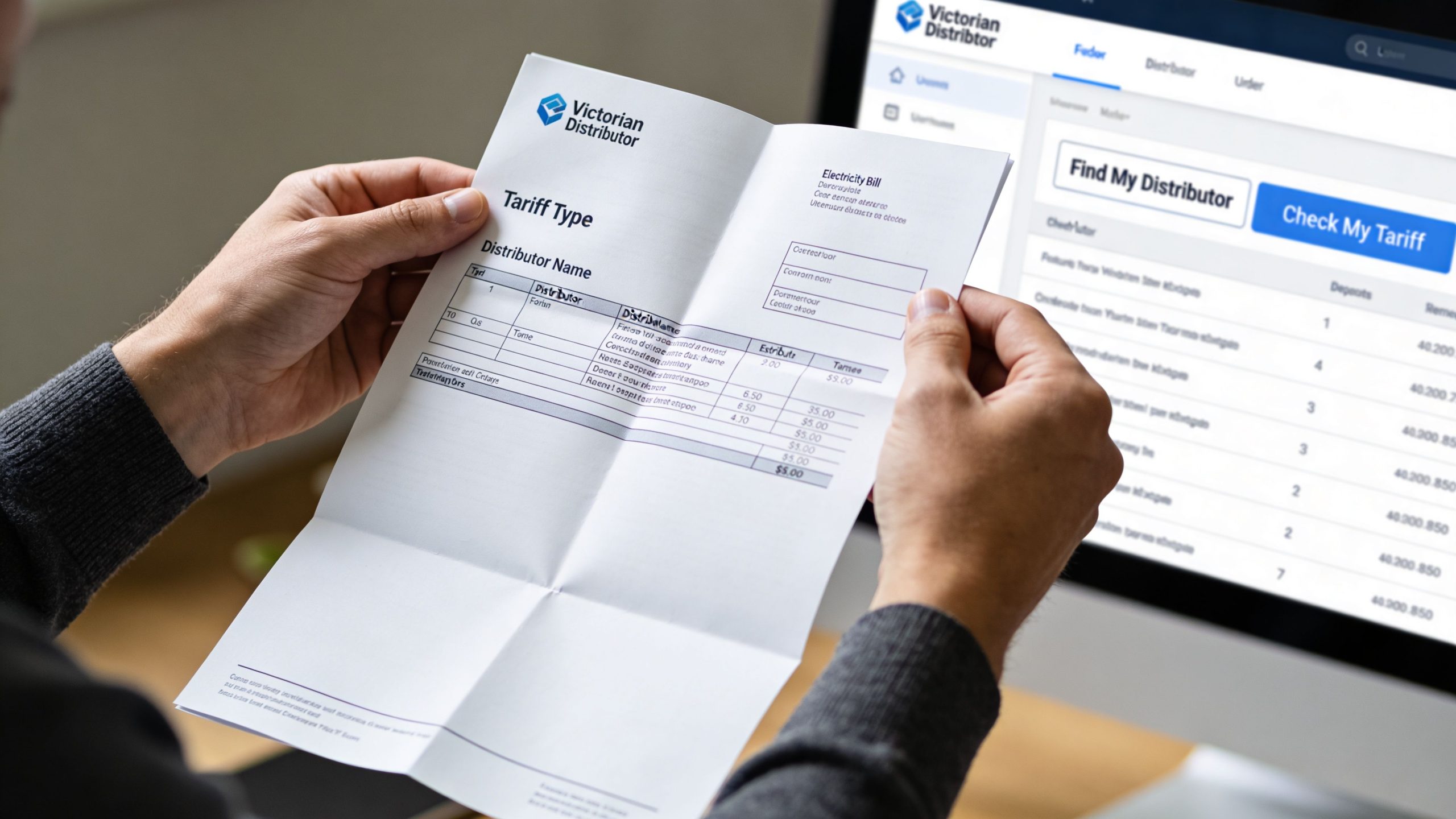
That gap matters. A battery strategy built on the wrong tariff assumption can shift charging into the wrong window, miss a controlled load arrangement entirely, or overestimate the value of overnight imports. For households considering VPP participation, poor tariff visibility also makes it harder to judge whether retailer-led dispatch is adding value or only cycling the battery without enough compensation.
Check these three items first
Find the distributor name
Look on the bill for AusNet Services, CitiPower, Jemena, Powercor, or United Energy. It may sit under network charges, supply details, or service information rather than the front-page account summary.Identify the tariff label
Search for terms such as Time of Use, TOU, Single Rate, Two Rate, Controlled Load, or Dedicated Circuit. The tariff label tells you whether time bands exist at all.Review how usage is billed
If the bill splits consumption into peak, shoulder, and off-peak categories, the property is on a time-based structure rather than a flat single rate.
Meter configuration decides what pricing you can access
In Victoria, tariff access is tied to metering capability as much as retailer plan design. A smart or interval meter can record usage across different time bands. A two-rate setup can bill usage under separate windows. A dedicated circuit can apply to specific controlled appliances. A single-rate meter generally does not support time-based import pricing.
That distinction has direct commercial consequences for battery owners. If the meter cannot record interval usage properly, the retailer cannot settle your imports against peak and off-peak periods in the way many battery optimisation models assume. The result is simple. The battery may still improve self-consumption, but the tariff arbitrage case becomes weaker.
If the bill is unclear, ask for written confirmation
Retail bills are not always presented cleanly, and some plans hide the useful detail in supporting pages or online account menus. If the label is vague, ask the retailer to confirm three things in writing:
- The exact tariff name
- The meter type or configuration at the property
- Whether the plan includes time-of-use, controlled load, or single-rate billing
Written confirmation gives you a usable baseline for analysis. It also makes retailer comparisons more reliable, because a battery owner should compare actual billing structures, not marketing plan names that sound similar but settle energy differently.
For a Victorian battery owner, this is basic asset due diligence. Without the tariff label, distributor, and meter setup, you cannot assess whether stored energy should be reserved for peak avoidance, shifted into a lower-cost charging window, or left available for VPP dispatch.
Optimising Your Battery Beyond Simple Off-Peak Charging
Charging a battery during lower-cost periods and discharging it during higher-cost periods is sensible. It’s also basic. The larger opportunity comes from treating the battery as a flexible energy asset instead of a fixed daily routine.
Why simple scheduling isn’t enough
A fixed “charge overnight, discharge at dinner time” rule ignores how messy real energy value can be. Your home’s demand changes. Solar output changes. Export limits can cap what leaves the property. Retail tariffs only tell part of the story.
Battery owners often start with appliance timing because that’s familiar. General household guidance on how to reduce electricity bills can help at that level. But a battery changes the game because it can store, delay, and redirect electricity rather than consume less.
The next layer is coordinated optimisation
A more advanced model looks beyond static tariff windows. It considers:
- Household priority first so stored energy remains available when the home needs it
- Charge timing based on low-cost windows and available solar
- Discharge timing based on the value of avoiding imports or supporting grid activity
- Export constraints that make “just send it to the grid” a weaker option than many owners expect
If you’re tracking performance, a dedicated home energy monitoring setup makes these patterns much easier to see. Without visibility, underperformance often looks normal.
Where VPP participation changes the equation
A Virtual Power Plant offers distinct commercial advantages. A VPP can coordinate many batteries at once and respond to conditions an individual household can’t realistically monitor or act on manually. That creates a path to value beyond standard self-consumption and basic tariff arbitrage.
The important insight is that off-peak timing is only one layer of battery economics. A battery can reduce bill pressure through tariff timing, but it may also have wider grid value when coordinated properly. Owners who stop at “charge cheap, use later” often leave that second layer untouched.
Standard tariff logic helps a battery save money. Coordinated market participation can help the same battery do more than bill shifting alone.
Common Misconceptions About Victorian Energy Tariffs
A surprising number of Victorian tariff mistakes come from treating time periods as the whole story. For battery owners, the bigger issue is how tariff design changes the value of each stored kilowatt-hour, and whether the battery is being used for bill reduction only or for wider grid revenue as well.
Misconception one that off-peak times fit solar perfectly
Off-peak periods and solar production often line up poorly from a commercial perspective. Solar generation is strongest in the middle of the day, but daytime exports are frequently paid at relatively low feed-in rates and can be constrained by export limits. That means a battery owner may get more value by storing surplus solar for later use than by exporting it as it is generated.
The missed point is margin. A household that focuses only on cheap overnight charging can overlook a second source of value, which is capturing low-value daytime solar and shifting it into a higher-value evening period. For VPP-ready systems, that stored energy may also carry value if the battery is available for coordinated dispatch rather than locked into a fixed charge-discharge routine.
Misconception two that controlled load and off-peak mean the same thing
Controlled load and off-peak are different billing mechanisms. Controlled load usually covers a specific circuit, such as electric hot water, and the retailer or distributor may switch that load according to its own schedule. A time-of-use tariff applies time-based prices to broader household consumption recorded by the meter.
That distinction affects battery economics. A battery can shift whole-of-home imports away from expensive periods on a time-of-use plan. It usually cannot rewrite the commercial logic of a separately metered controlled load circuit unless the system has been configured for that purpose.
Misconception three that all retailers interpret the same network timing the same way
Network time bands do not guarantee the same customer outcome. Retailers still decide how they package rates, whether they include a shoulder period, how large the spread is between peak and off-peak prices, and which meter types are eligible.
For a battery owner, the spread matters more than the label. A tariff with a narrow gap between peak and off-peak may produce less arbitrage value than a plan with a sharper differential, even if both use familiar Victorian time windows. The same battery can produce materially different savings under two plans that look similar at first glance.
Misconception four that battery participation means losing control
The issue is contract design and operating rules. Some programs reserve household backup, set minimum state-of-charge limits, and make dispatch conditions clear. Others are less transparent.
A commercially sensible VPP arrangement should state who controls dispatch, what happens during peak events, how bill savings are balanced against grid services revenue, and what protections apply to household supply. Battery participation is not necessarily a loss of control. Poor visibility is.
If your battery follows the same routine every day, it may be reducing bills, but it may also be missing higher-value opportunities created by tariff spreads, export constraints, and coordinated grid events.
Key Takeaways for Victorian Battery Owners
- Victoria’s common residential peak window is 3:00 PM to 9:00 PM daily on many time-of-use tariffs.
- Off-peak periods often cover most of the week, which creates room for deliberate battery scheduling.
- Your actual billing outcome depends on your tariff, meter, and retailer plan, not just your suburb.
- Time of Use, Controlled Load, and Single Rate are not interchangeable terms.
- A smart or interval-capable meter is central to accessing time-based pricing structures.
- Peak and off-peak pricing spreads matter more when you own storage, because a battery can shift energy between time periods.
- Low daytime feed-in tariffs and export limits can reduce the value of simple solar exports for Victorian households.
- Basic off-peak charging is only the first layer of optimisation. Coordinated battery management can enable broader value.
- Your bill is the fastest place to confirm your distributor and tariff type.
- Battery owners should judge performance by financial operation over time, not just whether the battery turns on every day.
Why Your Choice of Retailer Matters More Than Your Tariff
A tariff tells you the price windows. Your retailer determines how intelligently those windows are used.
Traditional retailers mainly bill consumption. They don’t necessarily have a strong reason to optimise the performance of your existing battery. If your system underperforms, the household often carries that opportunity cost without seeing it clearly on the bill.
That’s why the retailer model matters more than many owners realise. A technology-enabled retailer can treat the battery as an active asset, not a passive add-on. That includes clearer operating visibility, stronger alignment between tariff timing and battery dispatch, and a better framework for participation in coordinated energy services.
High Flow Energy currently serves households in Queensland and New South Wales, not Victoria. Even so, the underlying principle applies nationally. Victorian battery owners should expect the same standard from any retailer they consider. The benchmark isn’t whether the retailer offers electricity. The benchmark is whether the retailer can help the battery perform as an asset rather than sit in a default mode that leaves value on the table.
Frequently Asked Questions
Are off-peak times the same across all Victorian homes?
No. Many residential time-of-use plans follow a common evening peak pattern, but your exact outcome depends on the tariff on your bill, your meter type, and how your retailer structures the plan.
Is off-peak always better for charging a battery?
Not automatically. Off-peak pricing can help, but battery charging should also take account of expected solar production, evening demand, and whether preserving capacity for later is more valuable than charging immediately.
Can a single-rate customer benefit from off-peak timing strategies?
Not in the same direct way. Single-rate customers don’t receive time-based pricing signals, so they miss the tariff spread that makes timing strategies commercially useful.
Does a controlled load help my whole home access cheaper electricity?
Usually no. Controlled load arrangements generally apply to a specific appliance or dedicated circuit, not broad household consumption.
Why can solar exports still feel underwhelming?
Because daytime exports may be constrained and rewarded at relatively low feed-in tariff levels. For some battery owners, storing or using that energy strategically is more valuable than exporting it passively.
What should I check first if I want to optimise my battery?
Start with three things: your distributor, your tariff type, and your meter configuration. Without those, it’s difficult to tell whether poor battery value comes from the plan, the operating setup, or both.
Does joining a VPP mean I lose access to my battery?
It shouldn’t. A credible VPP structure should keep household needs as the first priority and make the operating rules understandable.
Most battery owners focus on installation quality. Far fewer focus on ongoing performance and optimisation. High Flow Energy is an electricity retailer built around harnessing the full value of your existing solar and battery system.
If you’d like to understand whether your battery is underperforming financially, request an eligibility assessment today.