


V2H Compatible Cars Australia: Your 2026 Guide
If you’re searching for v2h compatible cars australia, you’re probably already past the novelty stage. You’ve got rooftop solar or you’re planning around it. You understand that an EV battery is much larger than most home batteries. And you want to know whether your car can do more than commute.
That’s the right question. In Australia, the gap isn’t just technical capability. It’s commercial readiness. A vehicle might have bidirectional hardware, but that doesn’t automatically mean you can legally, safely, and profitably use it to power your home in Queensland or New South Wales.
For a homeowner, that distinction matters more than the marketing term on a brochure. The core issue is whether a car, charger, network approval, and warranty position all line up well enough to justify the investment.
The Definitive List of V2H Compatible Cars in Australia 2026
You buy an EV expecting it to cover peak tariffs, support your solar, and keep key circuits running in an outage. Then the real filter appears. The car needs local charger support, network approval, and a manufacturer position that does not leave you arguing over warranty coverage later.
That narrows the Australian field sharply.
Based on the same market review cited earlier, only a small group of models had a credible pathway to full bidirectional use in Australia as of early 2025. For homeowners, the useful distinction is not just "can the battery discharge?" It is whether the vehicle is far enough along the approval and installation chain to be treated as a financeable household energy asset rather than a trial product.
Current compatibility snapshot
| Vehicle model | V2H status | Connector type | Max V2H power |
|---|---|---|---|
| Nissan LEAF | Confirmed for full bidirectional charging in Australia | CHAdeMO | 6.6 kW |
| Mitsubishi Outlander PHEV | Confirmed for full bidirectional charging in Australia | CHAdeMO | 2.3 kW continuous |
| BYD Atto 3 | Limited Australian testing, not broadly confirmed | CCS2 | 5.9 kW peak in testing |
| Hyundai Kona | Limited Australian testing, not broadly confirmed | CCS2 | 6.5 kW in testing |
The models with a practical path today
The Nissan LEAF remains the clearest option if your goal is to install V2H now rather than wait for broader CCS2 maturity. Its position is unusual. The older CHAdeMO connector is no longer the direction of the wider EV market, yet it has been the most established route for bidirectional hardware. For a homeowner making a near-term decision, that creates an awkward but commercially relevant conclusion. The least future-aligned connector has been one of the most usable for V2H.
The Mitsubishi Outlander PHEV also belongs in the confirmed group, but the economics are different. A 2.3 kW continuous discharge rate can cover selected circuits and reduce some evening grid use. It is less suited to whole-home support, high-load appliances, or aggressive energy arbitrage. If your aim is backup for refrigeration, lighting, internet, and a few controlled loads, it can still be useful. If your aim is to replace a larger stationary battery function, the lower output matters.
The models that look promising, but are not yet easy to underwrite
The BYD Atto 3 and Hyundai Kona are more interesting on paper than in a signed installation contract. Australian testing has shown meaningful discharge capability, and those power levels are commercially relevant for household use. The constraint is not basic electrical potential. The constraint is whether approved hardware, software settings, certification, installer confidence, and manufacturer support are all available together.
That is the point many compatibility lists miss.
A vehicle can be technically capable and still be commercially premature. For a homeowner comparing payback periods, VPP participation, and outage value, that gap is expensive. It can delay installation, limit export options, or create uncertainty over whether bidirectional operation remains supported after software updates or warranty assessment.
Why this shortlist matters more than buyers expect
A short list does not just affect choice. It affects pricing power, installer availability, and your ability to join future revenue programs.
If only a handful of vehicles are treated by the market as deployable for V2H, the owner has less flexibility on charger selection and less room to shop for competitive installation quotes. The upside is that early compatible models may gain access to VPP or tariff opportunities before the broader market catches up. The downside is concentration risk. If a charger vendor exits, if a DNSP changes requirements, or if a manufacturer takes a narrower view of battery use than expected, the homeowner carries more of the downside than the brochure suggests.
For that reason, the best V2H car in Australia is not automatically the one with the highest discharge figure. It is the one with the clearest path across four tests at once. Proven local hardware support, approval potential, useful household power output, and a warranty position you can live with.
Understanding V2H V2G and V2L Technology
Bidirectional charging is one category with three very different use cases. Mixing them up leads to expensive assumptions.
V2H means your EV powers your house
Vehicle-to-Home (V2H) lets your car discharge electricity into your home’s electrical system through approved hardware. In plain terms, the EV acts like a large battery connected to the house.
That’s the setup homeowners usually mean when they ask whether their car can “run the home at night” or help during an outage.
V2G means your EV exports beyond the home
Vehicle-to-Grid (V2G) goes one step further. Instead of stopping at household loads, energy can be exported to the grid through an approved connection. That matters financially because export capability creates access to grid support and energy trading opportunities that simple backup power does not.
For a commercially minded homeowner, the conversation then shifts from resilience to asset performance.
V2L is different again
Vehicle-to-Load (V2L) is the simplest form. It powers individual appliances directly from the vehicle, usually through a dedicated outlet or adapter. You can think of it as a mobile powerboard built into the car.
V2L is useful. It’s also often overstated. Running a fridge, tools, or camping gear from the car isn’t the same as integrating the vehicle into your home switchboard.
Why the distinction matters
A lot of Australian buyers see “bidirectional” in overseas marketing and assume that means immediate home integration. It doesn’t.
Use this rule of thumb:
- V2L is appliance-level power
- V2H is house-level power
- V2G is market-facing power
Practical rule: If the goal is bill reduction and coordinated energy management, V2H and V2G matter far more than V2L.
That’s also why charger choice, network approval, and warranty terms become decisive. A car with V2L may already be handy. A car with genuine V2H or V2G potential can become part of a broader home energy strategy.
Essential Hardware for a V2H Setup in Australia
A homeowner might buy an EV marketed as bidirectional, budget for a charger, and still find the project blocked by network approval, switchboard limits, or missing Australian software support. In practice, the hardware decision is less about owning a compatible car and more about building a grid-compliant system that an installer, DNSP, and manufacturer will all stand behind.
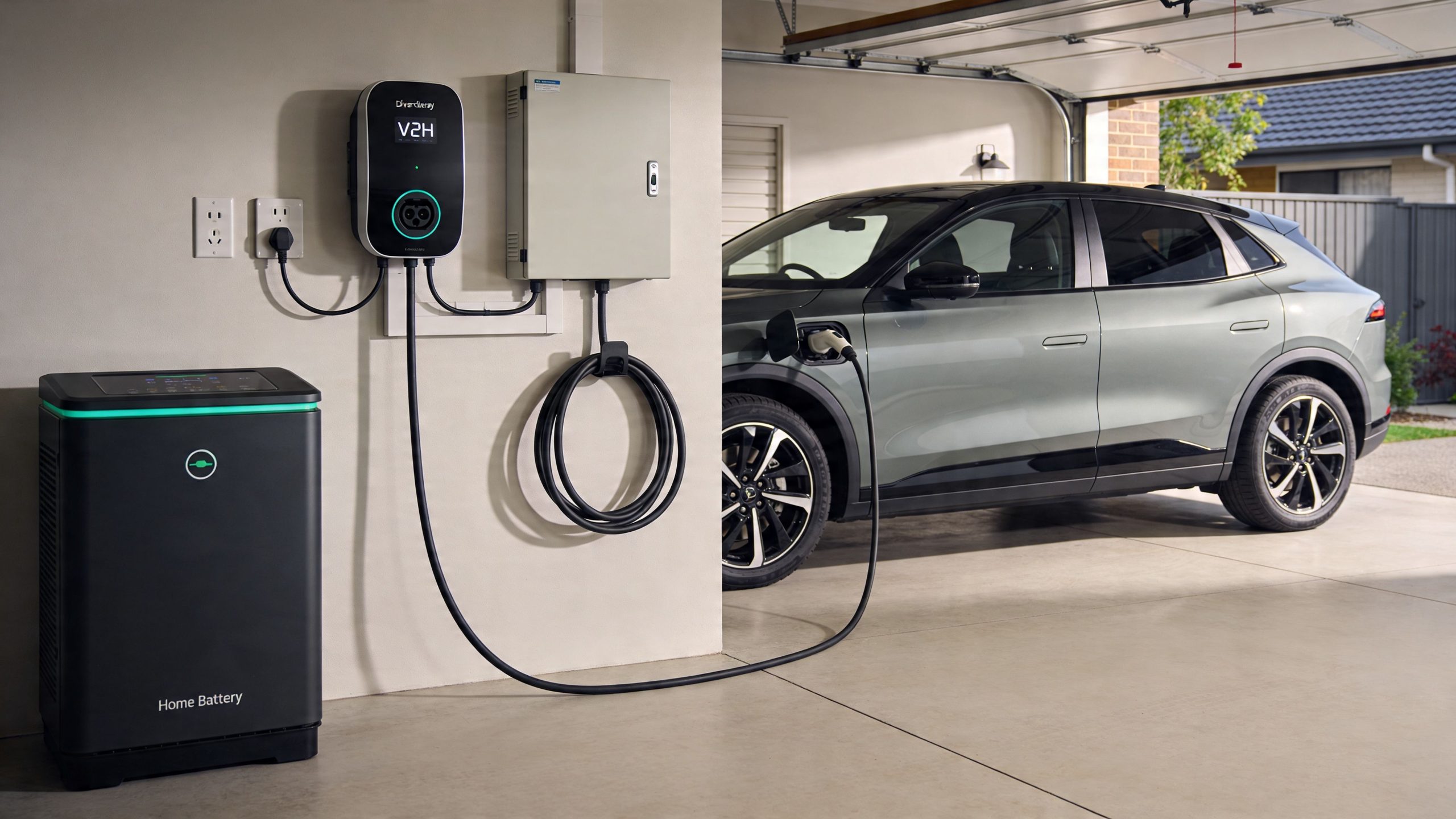
The Required Hardware Stack
The minimum hardware set is straightforward on paper, but each component has to match the others.
- A vehicle with Australian-supported bidirectional functionality. Overseas capability does not guarantee local approval, firmware support, or charger interoperability.
- A certified bidirectional charger. This is the control point that manages battery discharge, grid synchronisation, and protection logic.
- A switchboard that can accommodate bidirectional energy flow. Some homes need rewiring, new protection devices, or board upgrades before approval is possible.
- Isolation, metering, and protection equipment. Anti-islanding, export control, and safe disconnection are part of the system design, not optional extras.
- An installer with grid-connected inverter experience. Standard EV charger work is useful, but V2H sits closer to solar and battery integration than to a routine AC charger install.
The commercial point is simple. V2H hardware is only valuable if the full system can be approved, commissioned, and kept within warranty.
Standards determine what can actually be installed
Australian V2H projects are shaped by inverter standards, DNSP connection rules, and product certification. AS/NZS 4777.2:2020 is part of that framework, because the charger has to behave like a controlled grid-interactive device rather than a basic EV accessory. The practical result is that hardware selection starts with compliance pathways, not brochure claims.
A cited industry explainer on Australian V2H standards and approvals highlights why this remains an early-stage market. Some charger and vehicle combinations have clearer approval pathways than others, and current network settings can limit how much power a single-phase home is allowed to export or discharge through the connection.
That matters financially. A system with constrained export settings may still help with backup power and self-consumption, but the economics change if the owner expects future VPP income or broader energy trading participation.
Charger cost changes the investment case
Bidirectional chargers in Australia are still priced more like specialist energy infrastructure than mainstream EV accessories. That raises the threshold for a positive payback outcome, especially for households that already have rooftop solar, a fixed battery, or both.
For that reason, charger selection should be assessed alongside the rest of the home energy architecture. If the property already has storage or is likely to add it, the interaction between the EV, inverter, and battery topology becomes commercially relevant. High Flow’s guide to AC-coupled battery system design is useful background for understanding where an EV-based discharge system may complement, duplicate, or complicate an existing setup.
A conventional EV charger install is a much simpler job. For a baseline comparison of what standard charger work looks like before bidirectional controls and switchboard integration are added, see this guide to Tesla EV charger installation.
CHAdeMO versus CCS2 is still a hardware strategy decision
This is one of the most important purchasing decisions for Australian buyers considering V2H.
| Standard | Current V2H position in Australia | Strategic implication |
|---|---|---|
| CHAdeMO | More established for certified V2H today | Clearer near-term pathway, but weaker long-term market direction |
| CCS2 | Dominant connector direction in Australia | Better alignment with the broader EV market, but bidirectional support is still uneven |
The trade-off is commercial, not just technical. CHAdeMO can offer more immediate V2H certainty today. CCS2 may fit the future vehicle market better, but that does not always help a homeowner who wants a working V2H system now.
Later-stage system integration also depends on how the charger and vehicle communicate. This overview shows why the charger does much more than move energy:
The V2H Home Setup and Installation Checklist
V2H projects go wrong when owners buy the charger first and ask questions later. The better sequence is to treat it like a grid-connected energy project with vehicle dependencies.
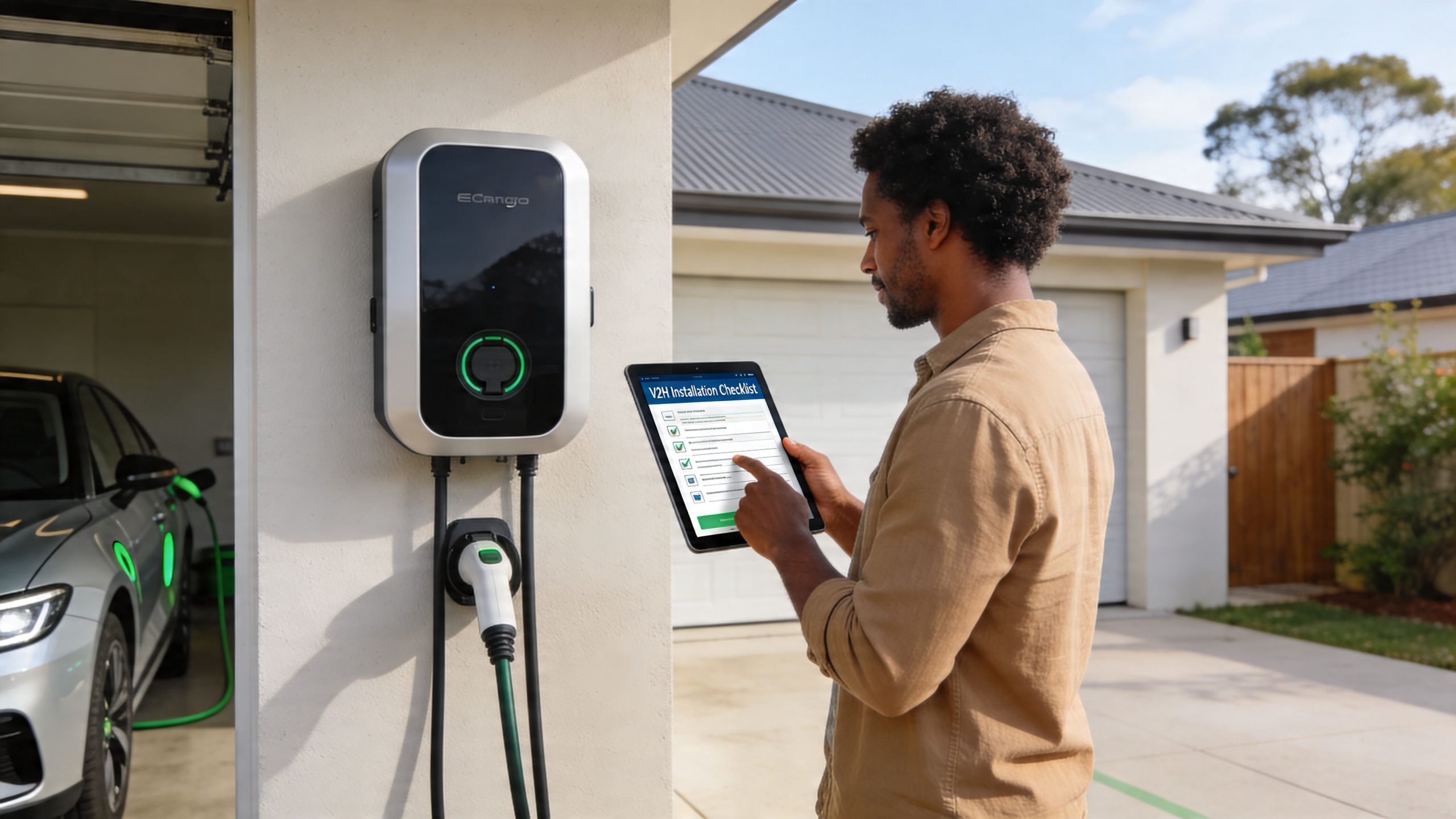
Pre-purchase checks
Confirm the exact vehicle variant
Check model year, connector type, and whether Australian firmware or manufacturer support exists for bidirectional operation. “Hardware capable” isn’t enough.Check the charger pathway
Make sure there is an available bidirectional charger that matches both your vehicle and local network conditions.Review your switchboard and site conditions
Homes vary. Some already have suitable infrastructure, while others need rework before any V2H equipment can be approved.
Installation planning
A practical next step is to speak with electricians who already deal with EV infrastructure and know the limits of standard charger installs. If you want a benchmark for what a conventional charger installation process looks like before stepping into bidirectional complexity, this guide to Tesla EV charger installation is a useful reference point.
You should also line up an installer network that understands broader battery and energy system integration. For homeowners comparing qualified providers, High Flow’s directory of solar battery installers can help frame the conversation.
Approval sequence
Use this checklist before signing off on any quote:
- Vehicle confirmation. Obtain written confirmation of compatibility where possible.
- Charger specification. Confirm the exact approved model and its local network pathway.
- Electrician credentials. Use a licensed installer familiar with bidirectional systems.
- DNSP process. Submit the required application or notification to your network.
- Operating settings. Confirm export limits, protection settings, and backup behaviour.
- Warranty review. Read the vehicle warranty position before energisation, not after.
If your installer can’t clearly explain the DNSP approval path, you’re still too early in the process.
What experienced homeowners do differently
They treat V2H as an integrated energy project, not an EV accessory. That changes the order of decisions. Vehicle first. Approval path second. Charger third. Installation last.
Australian V2H Regulations and Network Rules
Australian V2H compliance sits across several layers. National standards define the technical framework. Networks decide connection conditions. Installers work within both.
For homeowners, the practical question is simpler than the regulatory map. Can your setup connect safely and legally without creating export, protection, or warranty problems?
The standards and market bodies that matter
The main institutions are different, but their roles are distinct:
- Standards Australia sets technical standards that hardware and installations must meet.
- The Clean Energy Council plays a certification and listing role for equipment pathways.
- AEMO oversees power system operation across the National Electricity Market.
- The AER regulates parts of the retail and network environment.
- DNSPs such as Ausgrid and Energex decide the local connection conditions for your property.
This is why a system can be technically capable but still not deployable at your address. The network connection is local, not abstract.
What homeowners feel in practice
Most homeowners don’t need to memorise standards numbers. They do need to understand the outcomes those rules create:
| Regulatory issue | What it means at home |
|---|---|
| Export limits | Your charger may be capped below its theoretical output |
| Anti-islanding | The system must prevent unsafe backfeed during outages |
| Approved hardware | Not every charger can be connected, even if it works overseas |
| DNSP approval | Your local network still has a say before connection |
Why Queensland and NSW need extra attention
Queensland and New South Wales are the two states where many early V2H discussions are most commercially relevant, but they’re also states where network constraints and approval pathways shape what is possible. A homeowner may own a suitable EV, have solar, and still face a more conservative export outcome than expected.
A V2H project is approved at the address level, not just at the product level.
That’s the important insight. Marketing materials talk in national terms. Installations succeed or fail based on local network conditions, switchboard design, and the specific combination of charger and vehicle.
Compliance is also a financial issue
Network rules affect value, not just legality. If export is tightly limited, the system may still provide backup and self-consumption benefits, but its market participation potential can narrow. That shifts the investment case.
For a commercially savvy homeowner, regulation is part of the cashflow model. It determines whether the EV behaves like a premium backup device, a meaningful bill-reduction asset, or a grid-responsive energy resource.
The Financial Case For V2H with a Virtual Power Plant
The biggest mistake in V2H economics is valuing the EV only as backup power. Backup matters, but it’s an occasional benefit. The stronger commercial logic is that a parked EV can function as a dispatchable energy asset when coordinated properly.
That doesn’t mean every household should rush in. It means the right question is not “Can my car power the home?” It’s “Can my car improve the financial performance of my broader energy system?”
Where V2H starts to make commercial sense
A standard solar household often exports surplus energy cheaply and buys power back later at a higher retail rate. V2H improves that position by shifting more stored energy into the expensive periods at home.
The financial case becomes stronger again when the system is coordinated with market signals rather than used passively. High-value moments in the grid don’t arrive on a neat daily schedule. They depend on wholesale conditions, local demand, and export capability.
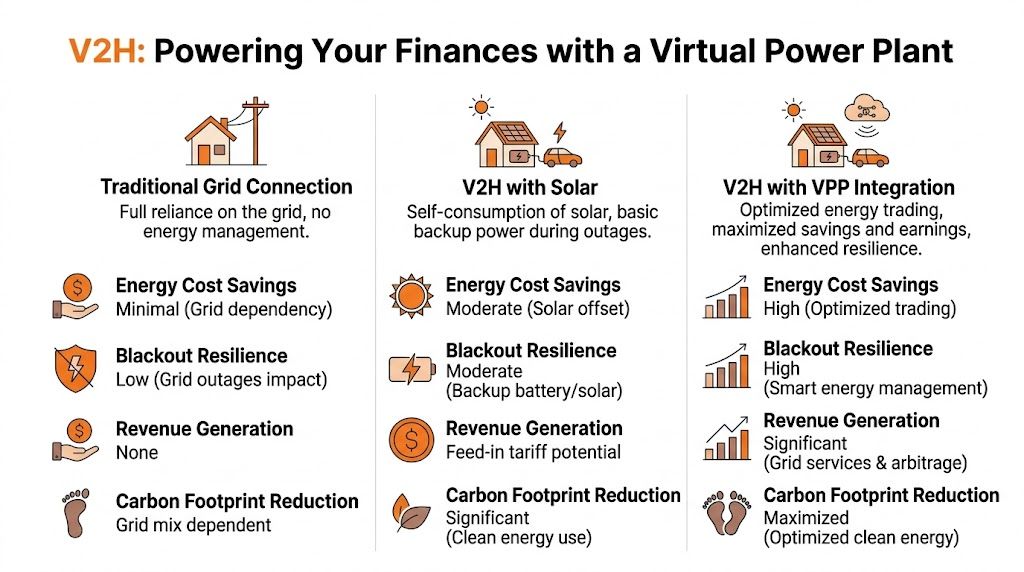
What the current data supports
Verified Australian data says ARENA projects 300,000 V2G/V2H-capable EVs in Australia by 2030, and that practical VPP integration can yield $200 to $400 per month in credits from grid services and feed-in tariffs, according to the cited Australian bidirectional charging market analysis. The same verified source says an Ioniq 5 in V2H trials can power a 5 kW home load for 10 hours, and in high-cost Queensland networks that can offset 100% of daily supply charges.
Those are not universal household outcomes. They are still meaningful because they show where value emerges. Not from owning hardware alone, but from coordinated dispatch.
Three different value models
| Setup | Main value source | Financial profile |
|---|---|---|
| Grid only | Standard import and export arrangements | Lowest control over timing and value |
| V2H with solar | Self-consumption and backup support | Better bill management, limited market upside |
| V2H with VPP coordination | Self-consumption plus grid-responsive dispatch | Highest value potential if the system is compatible |
The homeowner insight most guides miss
Your EV battery may be much larger than your fixed battery. But it is also a conditional asset. It’s only useful for home energy if the car is parked, connected, approved, and available within the operating rules you set.
That creates a different asset profile from a dedicated home battery. The EV can be more powerful in storage terms, but less predictable in availability. Good financial outcomes depend on software, operating discipline, and realistic household routines.
The commercial value of V2H comes from control, not just capacity.
The role of tax and property context
Some homeowners also need to consider how electrical upgrades are treated within a broader property or investment structure. If the installation relates to an income-producing property or a more complex ownership arrangement, this guide to capital works deduction is a useful starting point for discussing treatment with an accountant.
For readers comparing energy participation models, High Flow’s explanation of virtual power plants in Australia gives a good framework for how coordinated battery dispatch can outperform passive ownership.
The conclusion a lot of households won’t reach on their own
For many homes, V2H on its own is not yet the most efficient first dollar spent. If you don’t have strong compatibility and a clear operating plan, a fixed battery may still be simpler.
But once a household already has solar, storage awareness, and a compatible EV pathway, the car stops being just transport. It becomes a second-tier energy asset with economic value that standard retail structures usually leave underused.
V2H Limitations and Critical Warranty Considerations
Most V2H content focuses on capability lists. The more important question is who carries the downside if something goes wrong.
The answer, in many cases, is the homeowner.
Warranty is the market’s weak point
A major gap in the Australian market is that many EV brands with bidirectional hardware have not publicly confirmed V2G or V2H compatibility under Australian warranties, according to the cited discussion of warranty risk in the local market. The verified data specifically highlights brands such as Kia, Hyundai, MG, and Volvo as examples where uncertainty can leave owners exposed.
That changes the whole risk profile. A technically capable car is not the same thing as a financially protected one.
Why this matters more than most buyers expect
A homeowner might reasonably assume that if a charger is approved and the car can discharge, the manufacturer stands behind that use case. That assumption can be expensive.
Warranty language matters because V2H changes how the vehicle battery is used. It introduces extra cycling, different duty patterns, and software interactions that may not sit neatly inside a conventional driving-focused warranty framework.
The practical risk categories
Use this lens before committing:
- Technical risk. The charger and vehicle may work in testing but still have edge-case issues in live use.
- Warranty risk. The manufacturer may decline support if bidirectional use wasn’t explicitly approved.
- Approval risk. A DNSP or installer may limit the operating mode more than expected.
- Utilisation risk. If the car isn’t home when needed, much of the value case disappears.
- Obsolescence risk. Early hardware pathways may not be the ones that dominate later.
Battery wear is not just a chemistry question
It’s tempting to reduce the battery issue to “EV batteries can handle lots of cycles”. That’s too simplistic for a homeowner making a five-figure infrastructure decision around a vehicle they still need for transport.
The commercial issue isn’t only degradation. It’s who pays if degradation becomes disputed. If the OEM supports the use case, the risk is easier to price. If the OEM remains non-committal, the owner carries a harder-to-measure liability.
Commercial caution: Don’t treat V2H as mature just because the hardware exists. Treat it as mature when the warranty, standards, installer pathway, and network approval all line up.
A more realistic homeowner stance
For many households, the best approach today is selective optimism. Follow the technology. Watch the OEM positions. Prefer documented compatibility over implied capability.
That stance is less exciting than broad “your EV can power your house” messaging. It’s also much closer to what a careful homeowner in NSW or Queensland should do.
Key Takeaways for Australian Homeowners
If you want the short version, it’s this:
- The list of v2h compatible cars australia is still short. Confirmed options remain limited, even though more models show technical promise.
- Certified hardware is the gating item. A compliant bidirectional charger, suitable switchboard, and local network approval are essential.
- Connector type matters commercially. CHAdeMO has the clearer current pathway. CCS2 has the stronger long-term market direction.
- V2H is not just a backup feature. It can improve energy economics when integrated into a broader operating strategy.
- The financial upside depends on coordination. Passive ownership captures less value than an actively managed system.
- Network rules shape returns. Export limits and local DNSP conditions can change the business case materially.
- Warranty risk is not a side issue. It’s one of the most important unresolved constraints in the current Australian market.
- Early adopters should think like asset managers. Don’t assess the car in isolation. Assess the whole stack of vehicle, charger, site, network, and operating model.
For most households, V2H is no longer theoretical. But it is still selective, conditional, and highly dependent on execution quality.
Unlocking Your EV's Value with High Flow Energy
A homeowner can spend heavily on a V2H-capable car, compliant charger, switchboard work, and approvals, then still capture mediocre returns. The reason is operational, not technical. Value depends on when the battery charges, when it discharges, how the home imports and exports power, and whether those decisions align with tariff structures and grid events.
High Flow Energy focuses on that operating layer. Its model is aimed at households that already have solar and a compatible battery and want a retailer structure that puts those assets to work through Bring Your Own Battery participation. For a V2H household, that matters because the EV is only one part of the stack.
The commercial question is straightforward. Will the vehicle reduce evening grid imports, or will it be coordinated with the home battery, solar production, and Virtual Power Plant signals in a way that improves total site economics?
That distinction affects payback. A poorly managed asset can sit full during high-value periods, discharge too early, or cycle in ways that add wear without enough revenue in return. A well-managed asset is more likely to treat battery capacity as a flexible energy resource rather than a passive backup feature.
For homeowners considering V2H, the relevant comparison is not just car A versus car B. It is self-managed operation versus coordinated operation, and hardware ownership versus real-world revenue performance under Australian retail and network conditions. High Flow Energy’s proposition sits in that gap.
Frequently Asked Questions about V2H in Australia
Can any electric car power a house in Australia
No. A car may have bidirectional hardware and still not be practically usable for home integration in Australia. The relevant test is whether the vehicle, charger, local approval pathway, and warranty position all align.
Is V2L the same as V2H
No. V2L powers individual devices directly from the vehicle. V2H connects the EV into your home’s electrical system through approved hardware. They solve different problems.
Can I use V2H during a blackout
Potentially, but only if the system has been installed to support backup operation safely. The key issue is controlled isolation from the grid. Your installer needs to confirm how the system behaves under outage conditions.
Will V2H damage my EV battery
Battery wear is part of the consideration, but it’s not the only issue. The bigger commercial question is whether the manufacturer explicitly supports that operating pattern under Australian warranty terms. If they don’t, the risk becomes harder to quantify.
Do I need a special charger for V2H
Yes. A standard one-way EV charger is not enough. You need a bidirectional charger approved for the relevant use case and suitable for your vehicle and local connection conditions.
Can any electrician install a V2H charger
No. Bidirectional charging involves more than ordinary EV charger installation. The installer must understand switchboard integration, protection settings, network approvals, and the specific charger-vehicle combination.
Does V2H work better with solar and a home battery
Usually, yes. Solar improves charging economics. A home battery can add flexibility because it’s always on site, unlike a vehicle that may be away during the day or evening. The strongest outcomes usually come from coordinated operation across multiple assets rather than treating the EV as a standalone solution.
Should I buy an EV based on future V2H promises
Only with caution. If V2H is central to your decision, prefer vehicles with the clearest Australian pathway rather than relying on future firmware or warranty updates. For most homeowners, documented local readiness is more valuable than implied future capability.
A homeowner can install compliant hardware, pass network approval, and still see weak returns from V2H. The gap usually sits in operations. Charging windows, discharge timing, tariff structure, export limits, and VPP participation determine whether the asset reduces bills meaningfully or adds complexity.
High Flow Energy focuses on that commercial layer. Its retail model is built around improving the financial performance of existing solar and battery systems, particularly where households want coordinated battery participation rather than passive self-consumption alone.
If you want to test whether your current battery setup is earning enough relative to its cycling and tariff exposure, request an eligibility assessment with High Flow Energy.