

Optimal Angle for Solar Panels: Maximize Yield
You’ve already done the hard part. You paid for rooftop solar, added a battery, and turned your home into a small energy asset. Then the practical questions start. Is the system producing what it should? Is the battery filling as early as it could? Is the roof helping or holding the whole setup back?
That’s where panel angle stops being a design detail and starts becoming a financial one. The optimal angle for solar panels affects how much usable energy your system captures across the year, how reliably your battery charges, and how much flexibility you have when tariffs, export conditions, and grid opportunities shift.
For many homeowners in Queensland and New South Wales, the system is “working” but not necessarily optimised. A roof pitch that looked close enough during installation may still leave value on the table. A direction that suits the building may be fine for self-consumption but weaker for battery charging depth. And once a battery enters the picture, panel angle matters for more than total generation. It influences whether your stored energy is available when it’s most useful.
Introduction Are Your Solar Panels Working as Hard as They Could Be
A common pattern goes like this. A household installs solar, watches the first few lower bills come in, then adds a battery to keep more of that energy at home. For a while, the focus is simple. Is the app showing generation? Is the battery charging? Is grid import down?
Those are sensible checks, but they don’t answer the bigger question. Is the system configured to produce the most valuable energy profile for your home?
Panel angle sits at the centre of that question. Two systems with similar panels and inverters can perform very differently if one array is better aligned to the local sun path. That difference isn’t just technical. It can mean a battery reaches a useful state of charge earlier in the day, or doesn’t. It can mean more solar is available for evening household demand, or less. It can mean the household exports from strength, or imports because the battery never quite got full enough.
Practical rule: A battery can only optimise the energy it receives. If the array underperforms, the battery has less to work with.
Homeowners often assume angle is a set-and-forget installer choice. In reality, it’s one of the clearest examples of how physical system design and financial performance are linked. If you want better self-consumption, stronger battery utilisation, and more optionality in how your energy is used, the angle of the array deserves attention.
The Fundamentals of Solar Panel Angle and Orientation
The two terms that matter most are tilt and orientation.
Tilt is the angle of the panel relative to horizontal. A flat panel has almost no tilt. A steeper panel has more.
Orientation is the compass direction the panel faces. In Australia, the benchmark for annual solar production is generally north-facing, because we’re in the Southern Hemisphere.
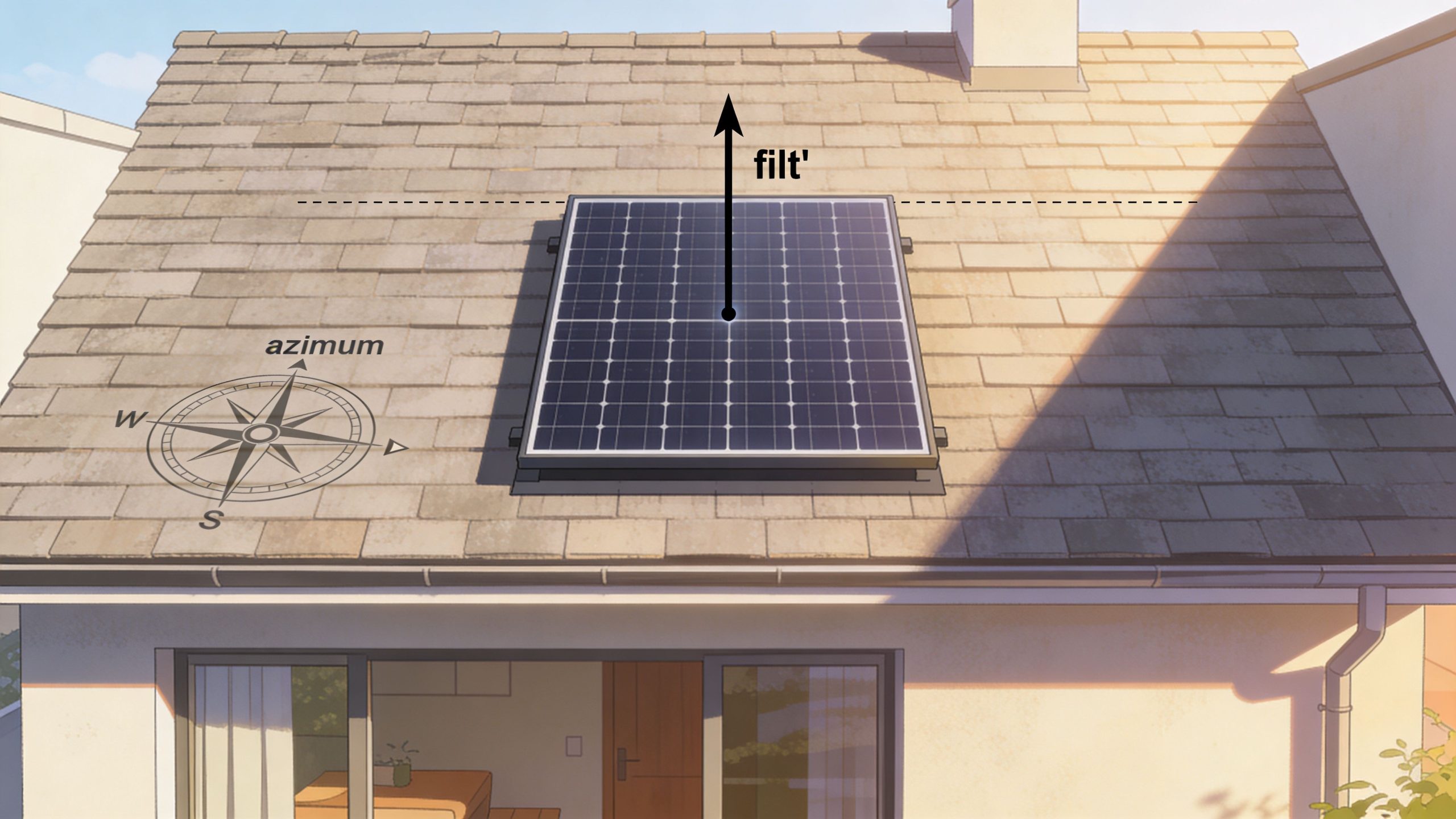
Tilt is about how directly sunlight hits the panel
A simple way to think about it is a bucket catching rain. If the bucket is positioned well, it catches more. If it’s angled poorly, some of that resource misses. Solar works similarly. Panels produce best when sunlight strikes them more directly.
The sun doesn’t sit in one spot. It moves across the day and sits higher in summer than in winter. That’s why there isn’t a perfect single angle for every hour of every season. There is, however, a practical annual setting that captures strong production across the year.
For homeowners, that usually means aiming for a fixed tilt close to local latitude. It’s a rule of thumb because it works well in practice and avoids unnecessary complexity.
Orientation is about when production arrives
North-facing panels usually give the strongest all-round annual yield in Australia. East-facing panels tend to shift production earlier. West-facing panels tend to shift it later. That can matter if your household load has a clear morning or late afternoon pattern.
Still, “best for annual yield” and “best for your home” aren’t always identical. Homes without batteries sometimes benefit from broader day-shape production. Homes with batteries often care more about charging quality and total harvest.
If you’re designing the whole house, the roof itself matters as much as the panel layout. Good building form can reduce cooling load and support stronger solar outcomes. This practical guide to solar passive home designs is useful because it connects roof orientation, shading and thermal performance rather than treating them as separate decisions.
Why latitude matters
Latitude tells you how far a location sits from the equator. That matters because it changes the sun’s path through the sky over the year. The further south you are in Australia, the lower the sun sits on average, so panel tilt generally increases.
That’s why Brisbane and Sydney don’t share exactly the same ideal fixed tilt. The principle is the same, but the local geometry changes.
A short visual can help if you want to see how tilt and orientation interact on a roof:
The best panel angle isn’t the one that looks neat on the roof. It’s the one that captures the most useful sunlight for the way your home consumes and stores energy.
The practical takeaway
For most Australian homes, start with three checks:
- Direction first: If you have a choice, prioritise a north-facing section of roof.
- Then tilt: Match the panel tilt as closely as practical to local latitude.
- Then constraints: Work around shading, roof structure, access, and mounting cost.
That order matters because angle optimisation only makes sense inside real-world limits. A theoretically perfect tilt on a shaded roof section won’t outperform a slightly less ideal angle with better solar access.
Optimal Angles for Queensland and New South Wales
Queensland is where the strongest verified data in this article sits. In Brisbane at about 27.5°S, the optimal fixed tilt is around 25 to 28 degrees facing north, and that setup can capture up to 98% of maximum possible annual irradiance according to the verified data supported by SDEWES research. The same verified data shows a 27° tilt in Brisbane yields an average of 4.8 to 5.2 kWh/kWp daily, compared with 4.2 kWh/kWp at 15°, which is a 14 to 20% improvement.
That’s not a minor difference. On a solar-plus-battery home, it affects how often the battery gets fully charged and how much spare stored energy is available after household demand is covered.
Recommended Solar Panel Tilt Angles for QLD & NSW
The table below gives practical guidance for fixed annual tilt and seasonal adjustment ranges. Queensland figures are anchored by the verified Brisbane data above. New South Wales entries are presented as practical latitude-based guidance rather than as separately cited numerical performance claims.
| Location | Latitude | Optimal Annual Tilt | Optimal Summer Tilt | Optimal Winter Tilt |
|---|---|---|---|---|
| Brisbane | 27.5°S | 25-28° | 15° | 40° |
| Gold Coast | Similar to south-east QLD | Mid-20s facing north | Flatter than annual tilt | Steeper than annual tilt |
| Sunshine Coast | Similar to south-east QLD | Mid-20s facing north | Flatter than annual tilt | Steeper than annual tilt |
| Sydney | Higher latitude than Brisbane | Around local latitude facing north | Lower than annual tilt | Higher than annual tilt |
| Newcastle | Similar pattern to coastal NSW | Around local latitude facing north | Lower than annual tilt | Higher than annual tilt |
What works in Queensland
Queensland homeowners often ask whether being a few degrees off really matters. The verified data says a ±10° deviation incurs less than 1.5% relative error in energy gain in stable irradiation conditions. That means you don’t need to chase absolute perfection if your roof pitch lands close enough.
What does matter is avoiding clearly shallow settings when the goal is annual production. The Brisbane comparison between 27° and 15° makes that point clearly. A flatter setup may suit summer-biased conditions, but it leaves annual value behind.
What to do in New South Wales
For NSW homes, the same decision logic applies even where this article doesn’t cite location-specific numbers. Use local latitude as the baseline for a fixed annual tilt, favour north where possible, and treat seasonal adjustment as optional rather than necessary.
If your roof can’t deliver an ideal north-facing, latitude-matched array, the next best decision is usually to maximise unshaded roof area and use the most productive available orientation rather than forcing an awkward mounting design that adds cost without enough value in return.
A quick homeowner test
If you want a rough sense of whether your angle is likely reasonable, ask:
- Is the array north-facing or close to it?
- Does the roof pitch look roughly aligned with local latitude?
- Is the battery usually filling when the weather is good?
If the answer to all three is yes, your system is probably in a strong position. If not, there may be a meaningful optimisation issue hiding behind “normal operation”.
Annual vs Seasonal Optimisation The Strategic Trade-offs
A fixed angle is the standard choice for a reason. It’s simple, durable and usually commercially sensible for rooftop systems. Seasonal adjustment can produce more energy, but the extra yield only matters if it outweighs the hassle, access limits, and hardware cost.
Fixed angle works because it’s efficient enough
The verified data states that latitude-matched fixed tilts capture 95 to 98% of maximum possible irradiance year-round, and fixed latitude tilts remain standard for 95% of installations because they’re cost-effective. That’s the core reason most homes should treat fixed tilt as the default.
For a roof-mounted residential system, “good all year” usually beats “slightly better if someone adjusts it regularly”.
Best default: If your array is fixed, aim for a north-facing tilt close to local latitude and spend your effort on reducing shading, improving monitoring, and optimising when stored energy is used.
Seasonal adjustment can help, but it changes the job
The verified data also notes that moving to 15° in summer and 40° in winter can boost output by up to 6.9% in validated models. That’s real, but it doesn’t automatically make adjustment worthwhile.
The key trade-offs look like this:
| Approach | Strength | Limitation | Best fit |
|---|---|---|---|
| Fixed annual tilt | Simple, low-maintenance, strong year-round performance | Doesn’t perfectly match every season | Most rooftop homes |
| Seasonal adjustment | Better alignment to changing sun height | Requires access, labour, and suitable mounting | Accessible ground arrays or specialist setups |
For many households, the more valuable optimisation sits elsewhere. Better tariff timing, better battery dispatch, and lower reliance on peak imports can matter more than chasing a modest mechanical gain. If you’re reviewing how time-based pricing affects battery strategy, this guide to off-peak electricity is worth reading alongside the physical design question.
The commercial decision
Seasonal adjustment makes the most sense when the array is easy to reach and designed for it. Ground-mounted systems fit that description more often than suburban rooftops. On a typical tiled or sheeted roof, access and safety quickly become part of the cost equation.
The right question isn’t “Can I improve output?” It’s “Will this improvement create enough value to justify the extra complexity?” For most owner-occupied homes, fixed tilt wins that test.
Real-World Constraints Shading Roof Pitch and Your Roof
The ideal angle on paper often loses to a better practical setup on the house. Roof geometry, obstructions, and structural limitations decide a lot of what’s possible.
Shading usually matters more than chasing perfect tilt
Homeowners often focus on a few degrees of angle while ignoring the bigger issue. A tree, vent, neighbouring roofline or chimney can drag performance down far more than a modest tilt mismatch.
That’s why an unshaded north-east or north-west roof face may outperform a theoretically better north-facing section that receives recurring shadow. If the array sits on a string inverter configuration, even partial shading can affect more than a single panel.
Roof pitch is often “good enough”
Many houses don’t have a roof pitch that perfectly matches local latitude. That isn’t automatically a problem. If the roof is close enough, accepting the existing pitch is often the better commercial decision than adding tilt frames purely to narrow a small performance gap.
The situations that deserve closer review are usually these:
- Very shallow roof planes: These can underdeliver on annual yield if the angle is materially flatter than the local sweet spot.
- Poor orientation plus low pitch: A weak combination can leave the battery undercharged more often than expected.
- Complicated multi-face roofs: Generation may be split in ways that help some load profiles and hurt others.
If you want to understand whether your issue is array design or battery behaviour, detailed visibility matters. A proper home energy monitoring setup helps separate generation limits, load timing, and battery performance instead of guessing from one app screen.
When racking makes sense
Extra mounting hardware can be justified, but only in specific cases. It tends to make more sense on flat roofs where tilt would otherwise be too low, or where orientation flexibility opens up a stronger panel layout.
It makes less sense when:
- The roof pitch is already near the right range
- Wind loading and structural complexity increase the install challenge
- The gain is small compared with the added cost and maintenance considerations
A slightly imperfect array on the best available roof section usually beats a mathematically perfect layout that introduces shading, complexity, or structural compromise.
A practical homeowner checklist
Before changing anything, assess four things in order:
- Shade pattern across the day
- Roof orientation
- Existing pitch
- Battery charging behaviour on clear days
That sequence keeps the focus where the biggest performance losses usually sit. Most systems don’t need theoretical perfection. They need sensible compromises in the right order.
The VPP Connection Why Panel Angle Matters for Battery Optimisation
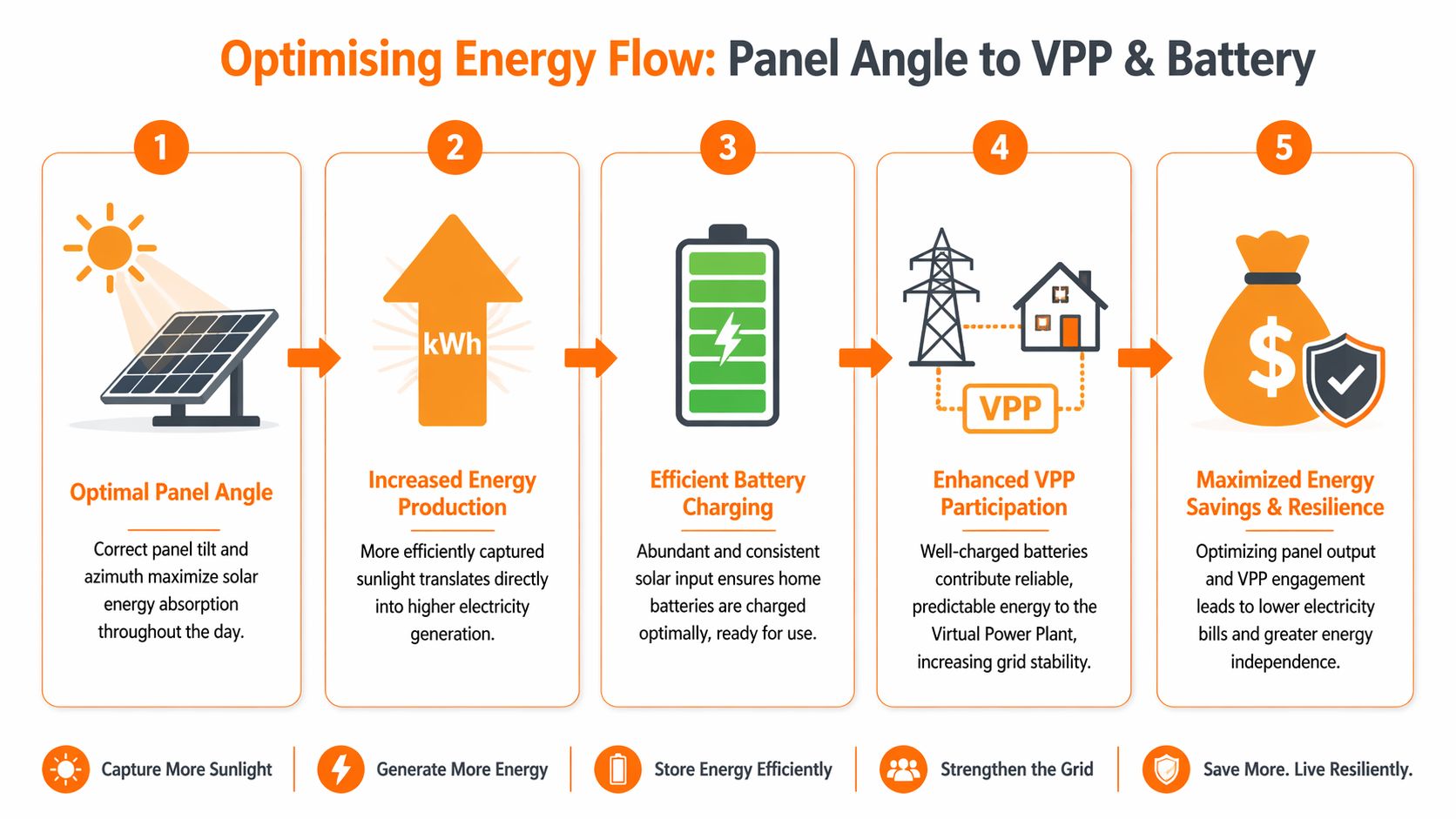
Most articles stop at energy yield. Battery owners need to go further. The key question isn’t just how many kilowatt-hours the panels produce. It’s how panel angle changes the quality and timing of energy available to the battery.
More solar harvest means more charging opportunity
When the array is better aligned, it captures more useful sunlight. In Brisbane, the verified data shows that a 27° tilt produces 4.8 to 5.2 kWh/kWp daily, compared with 4.2 kWh/kWp at 15°, with a 14 to 20% production gap. For a battery owner, that gap can be the difference between “battery partly charged” and “battery comfortably available after household daytime use”.
That changes what the battery can do later. If daytime solar barely covers daytime consumption, the battery enters the evening with less stored energy. If the array is stronger, the battery reaches a higher state of charge earlier and stays more flexible.
Timing matters as much as volume
A battery doesn’t create energy. It shifts it. So the value of the battery depends on how much excess solar exists after household needs are met.
That’s where panel angle connects directly to higher-value outcomes:
- Household first: Better solar capture improves the chances that daytime load is covered without grid import.
- Battery next: Once household demand is met, surplus generation can charge the battery more fully.
- Grid opportunity after that: A battery with spare stored energy has more optionality when the grid needs support.
The same logic applies to system design choices like inverter and battery topology. If you’re comparing how solar and storage interact electrically, this guide to an AC coupling battery is a useful companion read.
Why this matters financially
For a battery owner, panel angle influences at least three financial outcomes.
First, it affects self-consumption quality. More productive solar reduces imported electricity when the sun is up.
Second, it affects battery utilisation. A better-fed battery can displace more evening grid use.
Third, it affects asset optionality. When household demand is already covered and the battery still has spare capacity, the system is in a stronger position to support broader optimisation strategies rather than merely catching up.
The battery’s value starts on the roof. If the array underdelivers, every downstream optimisation has less room to work.
The bigger point
This is why panel angle shouldn’t be treated as a stand-alone solar topic. For a home with storage, it’s part of a chain. Better angle can mean better generation. Better generation can mean stronger battery charging. Stronger charging can mean more flexibility in how stored energy is used later.
That is the difference between a system that merely operates and a system that performs.
Key Takeaways for System Optimisation
- Start with north and local latitude: For most Australian homes, the best fixed annual setup is a north-facing array tilted close to the site’s latitude.
- In Brisbane, the benchmark is clear: Verified data supports 25 to 28 degrees facing north, with 27° showing materially stronger output than 15° in annual conditions.
- Don’t chase perfection if the roof is already close: A modest deviation can still perform well, especially if the roof section is unshaded.
- Shading often matters more than fine angle tuning: Fix the biggest performance constraint first.
- Seasonal adjustment is optional, not standard: It suits accessible systems more than typical rooftops.
- Battery owners should think beyond total generation: The best angle improves not just energy harvest but battery charging quality and downstream flexibility.
- The financial outcome matters: Better panel positioning can support stronger self-consumption, deeper battery use, and better overall system value.
Frequently Asked Questions
Does the optimal angle for solar panels change if I have a battery?
The physical solar geometry doesn’t change because you added a battery. What changes is the value of getting the angle right. A battery magnifies the benefit of stronger daytime generation because extra solar can be stored and used later instead of being lost as missed charging potential.
How much does it matter if my panels are slightly off the ideal tilt?
In Queensland conditions covered by the verified data, a ±10° deviation results in less than 1.5% relative error in energy gain. That means a system that is close to the target angle is often fine in practice. The bigger concerns are usually shading, poor orientation, or a clearly suboptimal shallow tilt.
Is east-west ever better than north-facing?
It can be better for some household load shapes, especially where power use is concentrated in the morning and late afternoon. But if your priority is strongest annual production and effective battery charging, north-facing usually remains the benchmark in Australia. The right answer depends on whether you’re optimising for total yield, timing of production, or roof practicality.
Should I pay to change the angle of an existing rooftop system?
Only sometimes. It can make sense if the existing layout is clearly underperforming because the tilt is materially wrong and the roof allows a straightforward correction. It makes less sense when the current pitch is reasonably close and the cost of remounting or added racking would outweigh the performance improvement.
Can software make up for poor panel angle?
Software can improve how energy is used, stored and shifted. It can’t create solar generation that the roof never captured. A smart control strategy helps you get more from the system you have, but it works best when the underlying array is already producing well.
Does a flatter angle help in summer?
Yes, seasonally. The verified data notes that 15° in summer and 40° in winter can improve seasonal alignment versus a single fixed angle. But that doesn’t mean a flatter angle is best for annual performance. A fixed annual setting near local latitude usually remains the stronger all-round choice.
If my roof pitch isn’t ideal, should I worry?
Not automatically. Many roofs are close enough to perform well without adjustment. If the array is unshaded, faces a productive direction, and the battery charges properly on clear days, the system may already be doing its job.
Unlock Your Battery's True Value with High Flow Energy
Most battery owners focus on installation quality. Far fewer focus on ongoing performance and optimisation. That’s where the long-term value sits.
A well-positioned solar array does more than generate electricity. It sets up the battery to perform properly. That means better charging behaviour, stronger self-consumption, and more flexibility in how your stored energy is used over time. If the roof underdelivers, the battery can’t fully compensate.
High Flow Energy is an electricity retailer built around maximizing the full value of your existing solar and battery system. The focus isn’t on selling hardware. It’s on helping battery owners in Queensland and New South Wales understand whether their system is underutilised financially, and whether a better operating model could improve performance.
If you'd like to understand whether your battery is underperforming financially, request an eligibility assessment with HighFlow Energy.