

Zero Energy Group: A Guide for AU Battery Owners
Most advice about a home battery is too narrow. It treats the battery as a private appliance whose job ends once it lifts self-consumption inside the home. That view made sense when export income still looked attractive and grid participation was niche. It makes less sense for battery owners in Queensland and New South Wales who already have the hardware and want better returns from it.
The more useful question isn't whether your battery stores midday solar. It does. The better question is whether it's being operated as a financial asset as well as an energy asset. For many households, that’s where the gap sits.
What a Zero Energy Group Means for Australian Battery Owners
The phrase zero energy group arrives with the wrong baggage for Australia. In US search results, it usually refers to high-performance buildings and net-zero design standards. For a battery owner in Queensland or New South Wales, the more commercially useful meaning is a group of homes whose solar and batteries are coordinated to participate in the power market.
That distinction only needs to be made once. What matters after that is the business model.
For Australian households that already own solar and storage, a zero energy group is best understood as a retailer-led or VPP-led community of distributed batteries. The home still consumes, stores and exports energy in the usual way. The difference is that spare battery capacity is no longer treated as idle hardware. It becomes dispatchable capacity that can be scheduled, traded, or reserved for specific grid and price events through a platform such as a Virtual Power Plant for Australian energy users.
A market definition, not a building definition
The Australian value stack sits inside the National Electricity Market, not inside a design certification framework. Battery economics in QLD and NSW are shaped by export limits, retailer tariffs, wholesale volatility, evening peaks, and local network conditions. A household that already has a battery does not need another explanation of efficient construction. It needs to know whether the asset can earn more by being coordinated.
That leads to a clearer commercial view:
- Your battery still serves the home first. Bill reduction through self-consumption remains the starting point.
- Coordination adds a second layer of value. The operator can use available capacity when market conditions justify it.
- The retailer's role changes. A capable retailer is not only billing usage. It is managing dispatch, timing, and market access to improve battery returns.
A standalone battery reduces imports. A coordinated battery can also produce network and market value.
That is the modern Australian meaning of a zero energy group. It is less about whether a home offsets annual consumption on paper, and more about whether many small assets can perform like one flexible energy portfolio. For existing battery owners, that shift is where the next gains usually sit.
How a Coordinated Battery Network Creates Value
A coordinated battery network creates value by changing what the market sees. On its own, a household battery is a bill management asset. In a coordinated portfolio, that same battery becomes part of a flexible resource that can respond to price signals and grid events across many homes.
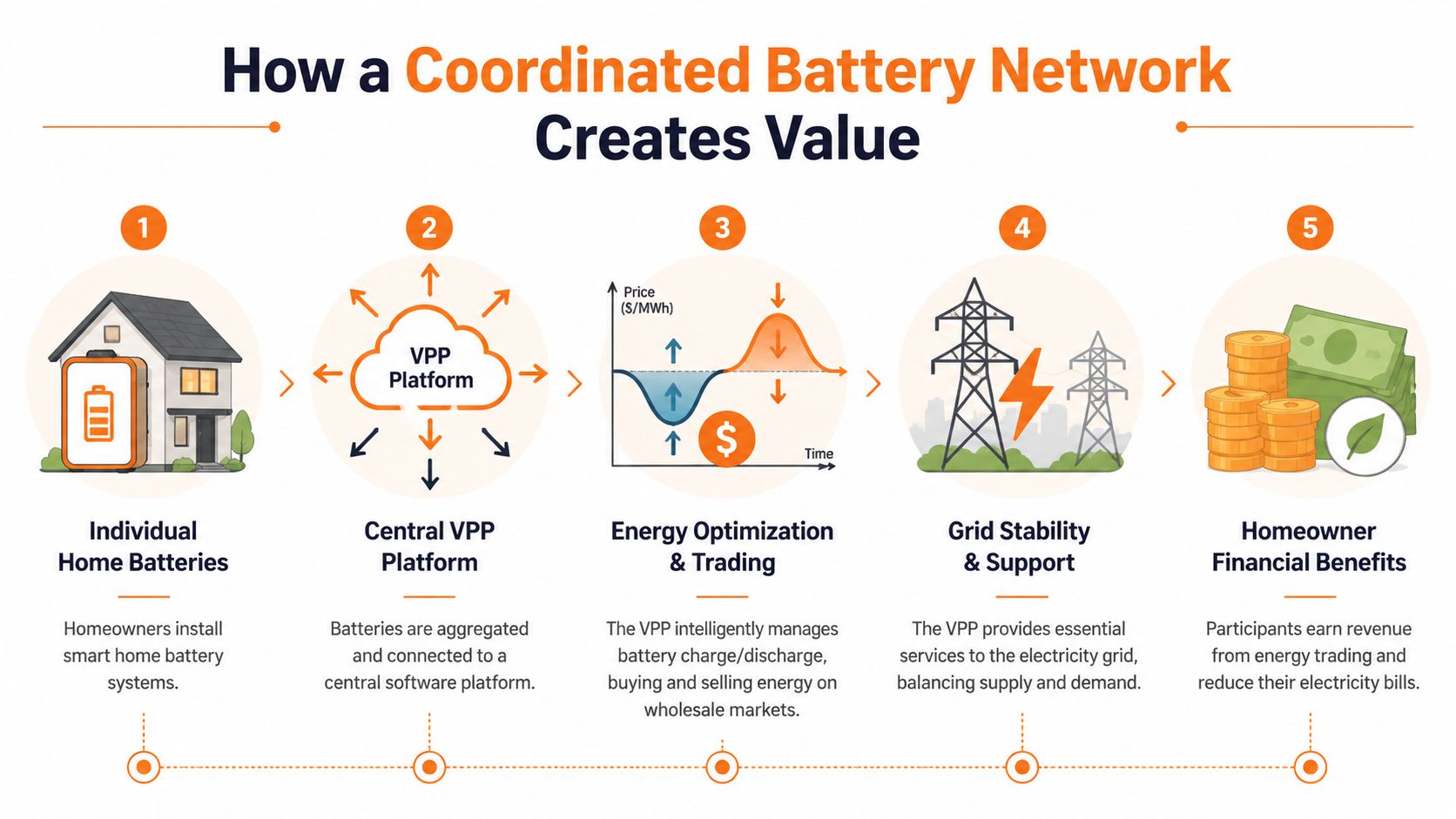
Five commercial steps
Homes supply the installed asset
The customer already has the solar, battery and inverter. In a BYOB model, the starting point is existing hardware, not a new system sale.The VPP platform aggregates capacity
Software connects compatible batteries into a single operating pool. Aggregation matters because energy and network markets value scale, predictability and response speed.The operator selects high-value dispatch windows
Those windows are usually tied to evening peaks, wholesale price volatility, local network constraints or other periods when flexibility has more value than a standard daytime export.Only available capacity is used
The operator does not need every battery to discharge at once, and it does not need to cycle each asset constantly. It needs enough enrolled capacity, plus reliable control, to deliver a measurable response when required.Market value is shared with the customer
The return can appear as bill credits, fixed participation payments, tariff benefits or a retailer-specific credit structure linked to account performance.
Why coordination attracts higher-value revenue
The market does not pay a premium for stored electricity alone. It pays for electricity delivered at the right time, at the right speed, and in a form the system operator or retailer can depend on.
That distinction matters for battery owners in QLD and NSW. Daytime solar exports often compete with abundant rooftop generation, which pushes down their marginal value. Stored energy held for a later interval can have a stronger commercial outcome if a VPP operator dispatches it into a tighter part of the trading day.
This is the core shift from a standalone battery to a zero energy group in the Australian sense. The household still gets the self-consumption benefit. The coordinated network adds a second earnings channel based on timing and controllability.
A VPP does not create value simply because many homes own batteries. It creates value because the retailer or operator can coordinate those batteries as a dispatchable portfolio.
What smart battery owners should focus on
For the homeowner, the key variable is not maximum cycling. It is useful availability. An underused battery has latent value. A well-managed battery can keep serving the home while also making part of that spare capacity available for revenue events.
That is why retailer-based BYOB VPPs have become commercially more interesting than the older "export whatever you can" model. The retailer already sits at the point where wholesale exposure, tariff design, customer billing and battery dispatch meet. If that retailer can coordinate batteries well, it can convert market value into a clearer household benefit than a feed-in tariff alone. High Flow Energy explains that broader model in its overview of Virtual Power Plants driving Australia’s renewable energy revolution.
The practical takeaway is simple. A coordinated battery network earns more than a static asset when it is enrolled in a program that values responsiveness, protects household backup needs, and shares revenue in a way the customer can measure on the bill.
The Financial Case for VPPs in QLD & NSW
For existing solar and battery owners in Queensland and New South Wales, the core financial question is no longer whether a battery can increase self-consumption. It can. The sharper question is whether the battery is being used in the highest-value way available in the current retail market.
That matters because the economics of a standalone solar-and-battery system have tightened. Retail bills still carry daily supply charges, export payments are often weak during the middle of the day, and households with spare battery capacity often have no direct path into higher-value grid services unless a retailer coordinates that participation.
Why bill reduction has become a portfolio problem
The old household model treated the battery as a private optimisation tool. Charge from rooftop solar, discharge into evening load, and export any surplus. In QLD and NSW, that still improves energy independence and reduces imports, but it does not fully address the parts of the bill that sit outside simple self-consumption.
A retailer-based BYOB VPP changes the economics because it turns part of the battery into a market-facing asset, not just a household one. The value does not come from exporting more kilowatt-hours at a low feed-in tariff. It comes from coordinated dispatch at times when flexibility is worth more.
For battery owners who want a clearer baseline before comparing VPP offers, good home energy monitoring for battery and solar performance helps identify how much usable capacity is available after household needs are met.
Where the financial model changes
The commercial difference is easiest to see in the value stack.
| Value Source | Standard Solar & Battery | VPP Participant (e.g., High Flow Energy) |
|---|---|---|
| Self-consumption | Reduces imported electricity by using stored solar at home | Still available |
| Solar exports | Relies on feed-in tariff income | Less central to the value model |
| Daily supply charges | Usually still payable | Can be partly offset if VPP revenue is returned through bill credits or allowance structures |
| Network cost pressure | Passed through indirectly in retail pricing | Can be moderated if coordinated battery revenue improves the customer’s net bill position |
| Market participation | Little or no access to coordinated grid services | Access to value created by aggregated dispatch |
| Battery value visibility | Often measured only by backup and self-use | Measured as household support plus market-responsive performance |
This is the important shift. A standard battery strategy mainly arbitrages your own retail import price. A VPP strategy can add a second layer of earnings linked to timing, responsiveness, and control.
That distinction matters more in QLD and NSW than many households expect. Both markets have high solar penetration, which puts pressure on daytime export value. That makes static export income less attractive and raises the value of flexible battery participation managed by a retailer with wholesale exposure.
What financially literate battery owners should test
The best VPP offer is not the one with the biggest headline credit. It is the one that produces a better annual bill outcome after accounting for dispatch rights, customer protections, reserve settings, and how consistently the retailer can turn aggregated battery capacity into revenue.
Three questions usually separate a marketing offer from a commercially sound one:
- How is customer value paid? Bill credits, fixed allowances, and revenue-share models have very different risk profiles.
- How much battery capacity is available to the VPP? A low reserve floor can improve market participation but weaken backup protection.
- How transparent is performance? If customers cannot see event history, battery availability, and bill outcomes, it is hard to judge whether the program is working.
A useful commercial test is straightforward. If your battery only offsets imported consumption and sits idle during higher-value market intervals, part of the asset’s earnings potential remains unused.
For Australian battery owners, that is the modern meaning of a zero energy group. It is not a US-style building definition carried over unchanged. It is a coordinated VPP community where existing household assets are used to reduce personal energy costs and create additional value through collective market participation.
How to Join a Zero Energy Group in Australia
Joining a zero energy group in Australia is usually a retail and software decision, not a hardware project. For battery owners in QLD and NSW, the practical question is whether an existing solar and battery system can be enrolled into a retailer-led BYOB VPP without weakening household control or bill outcomes.

Check the asset before you compare the offer
Start with the equipment already on site. Battery brand, inverter model, communications gateway, metering setup, and retailer compatibility all affect whether a VPP can control exports and verify performance accurately.
If your system already reports through an app, portal, or gateway, that is a useful indicator that the battery has the digital connection needed for coordination. If you want to confirm what your system can already report before applying, High Flow Energy’s guide to home energy monitoring explains the monitoring layer that often sits behind VPP participation.
Compatibility is only the first filter. Commercial fit matters just as much.
Review the VPP terms like an asset owner
A strong offer should explain how value is created and how much of that value reaches the customer. In a retailer-based BYOB model, your battery is being used for more than self-consumption. It may be dispatched to reduce wholesale exposure, support peak periods, or respond to price volatility. The offer should make those rights clear.
Focus on five points:
- Dispatch rules. What reserve level is protected for household use?
- Customer payment. Is value paid as a fixed bill credit, variable benefit, or a mix of both?
- Control visibility. Can you see event history, battery status, and bill impact?
- Hardware requirements. Is new equipment required, or can the current system be integrated?
- Contract terms. How easy is it to exit if the plan underperforms?
Offers typically differ based on specific needs. A bundled battery plan can suit a new installation. A BYOB VPP is often the better fit for households that already own a functioning battery and want higher utilisation from that asset.
What joining usually looks like
The process is generally straightforward, but each step affects the economics:
Eligibility assessment
The provider checks battery and inverter compatibility, communications capability, and site suitability.Plan and VPP review
You assess the retail tariff, VPP terms, dispatch conditions, and how customer benefits are paid.Retail account transfer
If the VPP is tied to a specific retailer, your electricity account is transferred to that retailer.System connection and configuration
The operator links the battery to its control platform and sets operating parameters such as reserve limits.Performance monitoring
Early results matter. Check whether the promised bill benefit appears in practice and whether battery behaviour matches the agreed settings.
A short explainer can help if you want to see how battery participation is framed in practice.
Keep the decision criteria commercial
Battery owners do not need to trade the market themselves. They do need to assess whether a retailer can use their battery more profitably than the battery can operate in stand-alone mode.
That is the modern Australian version of joining a zero energy group. You are not signing up to a building definition imported from the US. You are joining a coordinated VPP community that combines household storage with retailer market access to improve the financial output of an existing energy asset.
Addressing Common VPP Myths and Trade-offs
Scepticism is rational here. A battery is a capital asset, and a VPP changes how that asset is used. The right test is not whether coordination sounds clever. It is whether the program improves bill outcomes after allowing for battery wear, export timing, and retail plan quality.
Myth one it will drain the battery before I need it
That risk depends on dispatch rules, not on the VPP label itself.
Well-designed retailer VPPs in Australia generally reserve part of the battery for household use and only call on surplus capacity when market conditions justify it. For an existing solar and battery owner in QLD or NSW, the commercial issue is simple. If the battery is emptied into a low-value event and leaves the home buying expensive grid power later, the program is poorly designed. If dispatch is limited to periods where the combined value of avoided imports, export revenue, and VPP credits is higher, the model can improve total return.
Practical rule: Ask what minimum reserve is kept for the home, how often dispatch occurs, and whether you can see those events in the app or bill summary.
A zero energy group in the Australian sense is a coordinated battery community, not a building definition. That means operating logic matters more than branding.
Myth two more cycling automatically makes the battery uneconomic
Extra cycling has a cost. The commercial question is whether the added revenue exceeds that cost over time.
Battery owners should assess three things:
- Warranty treatment
Check whether the manufacturer allows VPP participation and how throughput limits are defined. - Dispatch quality
A good operator targets higher-value intervals instead of moving energy for marginal benefit. - Settlement design
Credits, bill reductions, and tariff settings need to be clear enough to measure against stand-alone operation.
Many comparisons are flawed. Owners often focus on cycle count in isolation, even though a lightly used battery on a weak tariff can produce a worse financial outcome than a moderately used battery in a disciplined VPP. In QLD and NSW, where feed-in tariffs are often modest and evening import prices carry more weight, value usually comes from timing and control, not from preserving every possible cycle.
Myth three joining means losing control of the system
Control is not a yes or no question. It sits on a commercial spectrum.
Some programs offer little visibility beyond a bill credit. Others provide event history, operating parameters, and clear reserve settings. Savvy battery owners should prefer the second model because it makes performance easier to verify. If a retailer cannot explain when it dispatches, what it optimises for, and how benefits are shared, the customer is being asked to accept blind optimisation.
That is a weak offer.
The honest trade-off
A battery used only for self-consumption is simpler to understand, but simplicity is not the same as maximum value. A battery enrolled in a well-run BYOB VPP gives the retailer controlled access to part of the asset in exchange for additional earnings potential.
The trade-off is operational autonomy versus higher asset productivity. For many existing battery owners, especially in markets where solar export alone no longer carries the economics, the better question is whether the retailer can use spare battery capacity more profitably than the household can on its own. If the answer is yes, VPP participation is not a loss of control. It is a shift from passive ownership to managed optimisation.
Better battery economics usually come from better operating rules, transparent settlement, and a retail structure that shares market value fairly.
Key Takeaways for Smart Battery Owners
The strongest insight from the zero energy group idea isn't architectural. It's operational. Australian battery owners already hold assets that can do more than store surplus solar.
What matters most
- Your battery can be two things at once. It can support household self-consumption and also participate in coordinated grid value creation.
- Low export tariffs weaken the old model. Relying on daytime exports alone is a thinner strategy when export rates are under pressure.
- VPP participation changes the value stack. It can help address parts of the electricity bill that self-consumption alone doesn't tackle well.
- Good program design matters more than marketing language. Household-first dispatch logic, visibility, and clear retail terms are true quality signals.
- A zero energy group in Australia is best understood as a coordinated battery community. That is more useful for homeowners than the imported building-code definition.
The overlooked conclusion
Many battery owners focus heavily on installation quality and too lightly on post-install optimisation. That’s a mistake. Once the hardware is on the wall, the next question is how intelligently it’s being used.
Why High Flow Energy Is Built for Your Battery
High Flow Energy is built around a commercial reality many battery owners already understand. The hardware decision has been made. The remaining question is whether the retailer can turn that installed battery into a better-performing energy asset.
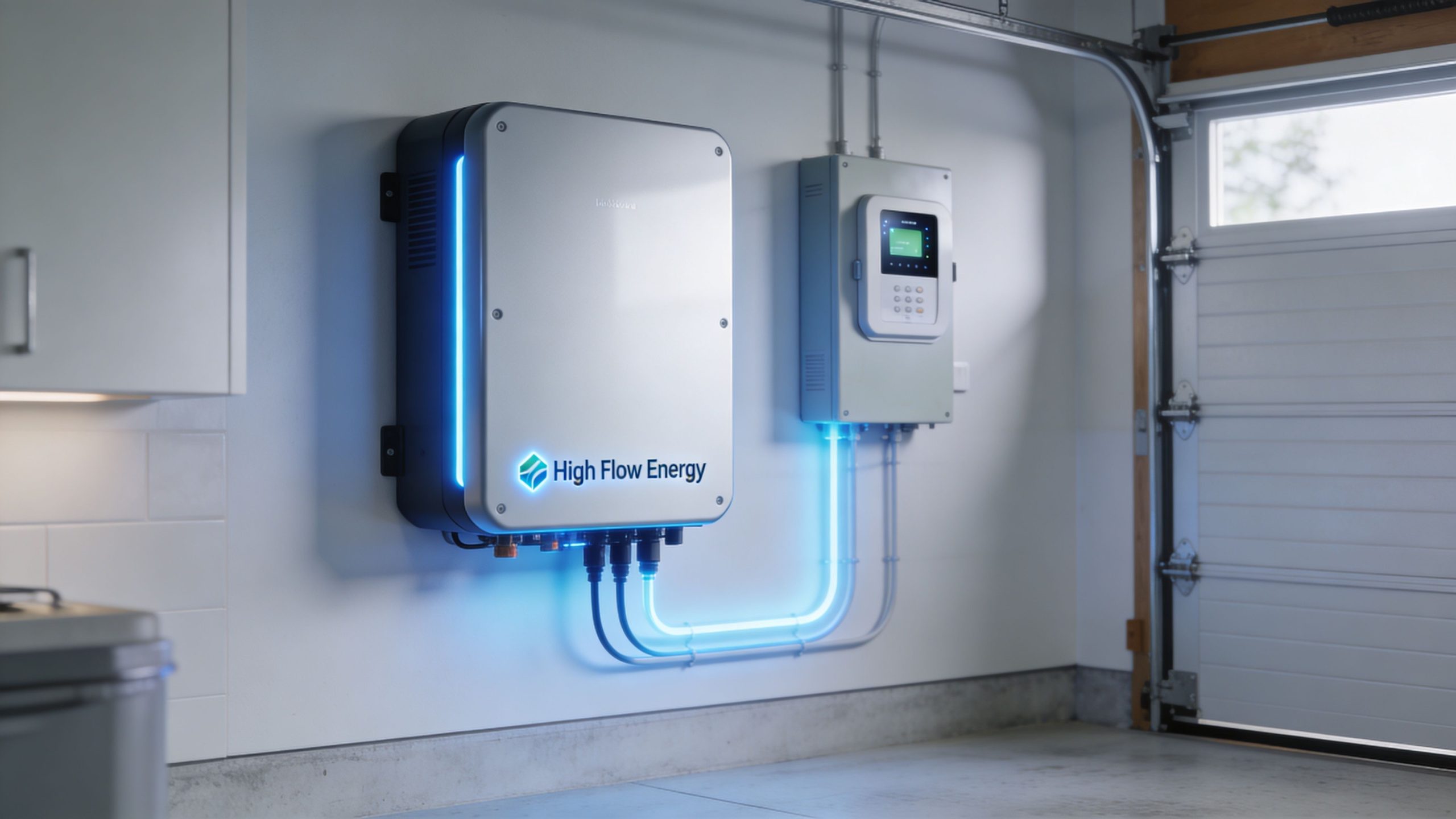
That matters in QLD and NSW because a battery's value now depends less on simple solar shifting and more on how intelligently it is dispatched against changing retail and grid conditions. A retailer-led BYOB VPP is well suited to that job. It starts with the customer asset base already in the field, then uses software and retail integration to improve how that capacity is used.
High Flow Energy's model is designed around three practical strengths:
- Bring Your Own Battery alignment keeps the offer focused on households that already own solar and storage, rather than bundling value creation to a new hardware sale.
- Dispatch built around performance means the battery can respond to higher-value operating windows instead of sitting in passive reserve for most of the year.
- Customer visibility gives households a clearer view of how the battery is operating, which matters because VPP value is only credible when the rules and outcomes are visible.
The strategic point is easy to miss. Battery optimisation is no longer only a hardware question. It is a retail product design question, a software control question, and a fleet orchestration question. Operators that treat those elements as one system are better placed to improve bill outcomes than providers that only connect batteries and hope occasional events do the rest.
That is also why future battery chemistry matters to VPP economics. Different chemistries affect cycle life, operating profile, and fleet scalability. High Flow Energy examines that issue in its article on sodium-ion batteries for Australian virtual power plants.
Frequently Asked Questions About Zero Energy Groups and VPPs
Is a zero energy group the same as a Virtual Power Plant
Not exactly. In Australian household energy use, zero energy group is a useful way to describe a coordinated community of homes with distributed energy assets. A Virtual Power Plant is the operating mechanism that connects and dispatches those assets.
Do I need to buy a new battery to participate
Not always. Many VPP models, especially BYOB structures, are designed for households that already own a compatible battery and inverter. The key issue is compatibility and software integration, not whether the battery is brand new.
Does a VPP replace self-consumption
No. Self-consumption remains a core use case for the battery. In a well-designed model, the operator monetises capacity that is available after household needs are considered.
Is this only relevant for very large homes
No. The core issue isn't house size. It's whether the household has a compatible battery and whether the retail structure converts battery flexibility into a meaningful bill outcome.
What should I compare when reviewing VPP offers
Focus on operating rules and retail economics, not just headline messaging.
Look closely at:
- Battery priority settings and whether home use comes first
- Retail terms including exit conditions
- Visibility tools such as apps and usage data
- Bill structure and how any allowance is applied
- Compatibility requirements for your current system
How is this different from a standard feed-in tariff arrangement
A feed-in tariff pays mainly for exported electricity. A VPP can create value from coordinated participation in grid services and market events. That broadens the economic role of the battery.
Will I need to understand wholesale trading
No. You need to understand the commercial model, not run the dispatch yourself. The retailer or VPP operator handles market participation. Your task is to decide whether the terms, controls, and expected value model fit your household.
What’s the clearest sign my battery may be underutilised
A simple indicator is this: if your battery mostly shifts your own solar but has no structured pathway to earn value from coordinated grid participation, it may be doing less than it could.
Most battery owners focus on installation quality. Far fewer focus on ongoing performance and optimisation. High Flow Energy is an electricity retailer built around optimizing the full value of your existing solar and battery system.
If you'd like to understand whether your battery is underperforming financially, request an eligibility assessment today.
SEO title: Zero Energy Group for Australian Battery Owners
Meta description: Zero energy group explained for Australian battery owners. Learn how VPPs can optimise battery value in QLD and NSW.
Suggested URL slug: /zero-energy-group-australia-battery-owners
Featured image concept: Australian family reviewing home battery and VPP performance with a tablet, showing the shift from solar self-consumption to coordinated battery value.
Image alt text: Australian homeowners reviewing battery performance and Virtual Power Plant options at home
Internal linking suggestions:
- Virtual Power Plants driving Australia’s renewable energy revolution
- Home energy monitoring
- Why sodium-ion batteries are vital for virtual power plants in Australia
External authority references:
- New Buildings Institute zero energy context
- ICCSafe discussion citing Australian market dynamics
- Zero Energy Group residential systems in Victoria
LinkedIn-ready excerpt:
Most Australian content around “zero energy group” still points to North American building design. That misses the more relevant question for battery owners in QLD and NSW: how do you turn an installed battery into a better-performing financial asset? This article reframes zero energy group as a coordinated VPP community and explains why retailer-led optimisation matters when export tariffs are weakening and network costs are rising.
AI summary snippet:
A zero energy group is more useful to Australian battery owners when defined as a coordinated community of homes participating in a Virtual Power Plant, not as a net-zero building concept. The financial case is strongest in QLD and NSW, where rising network costs and weaker export tariffs reduce the value of a self-consumption-only strategy. A retailer-based BYOB VPP can derive value from spare battery capacity while preserving household priority use. The key decision factors are compatibility, control rules, retail structure, and transparency.