

Power Outage Queensland: A Homeowner’s Guide
You're in a Fortitude Valley apartment, it's 6pm on a stormy Friday, and the lights have just gone out. The fridge has stopped, the lift is unavailable, mobile coverage is patchy, and the first question is simple: is this a local power outage, a weather-related event, or a wider Queensland grid problem?
The fastest answer comes from your local distribution network, not your electricity retailer. For battery owners, the next question matters just as much: will your solar and battery keep the home running, or will the system shut down with the grid? This guide separates routine network faults, severe-weather outages and upstream generation events, then explains what your equipment and a Virtual Power Plant can and can't do.
Checking the Current Power Outage Status in Queensland
Start by identifying the distributor for your address. Energex covers South East Queensland, while Ergon Energy covers the rest of Queensland, including regional and remote communities. Queensland Government guidance lists Energex's outage contact as 13 62 62 and Ergon Energy's as 13 22 96. For fallen powerlines, use 13 19 62 in Energex areas or 13 16 70 in Ergon areas. Queensland Government outage contacts should be saved before storm season.
Use the online outage map first. Enter your suburb or National Metering Identifier, where the service allows it, to narrow the result to the affected network area or feeder. A map result can confirm that your outage is already known, show whether the event is planned or unplanned, and provide an estimated restoration time.
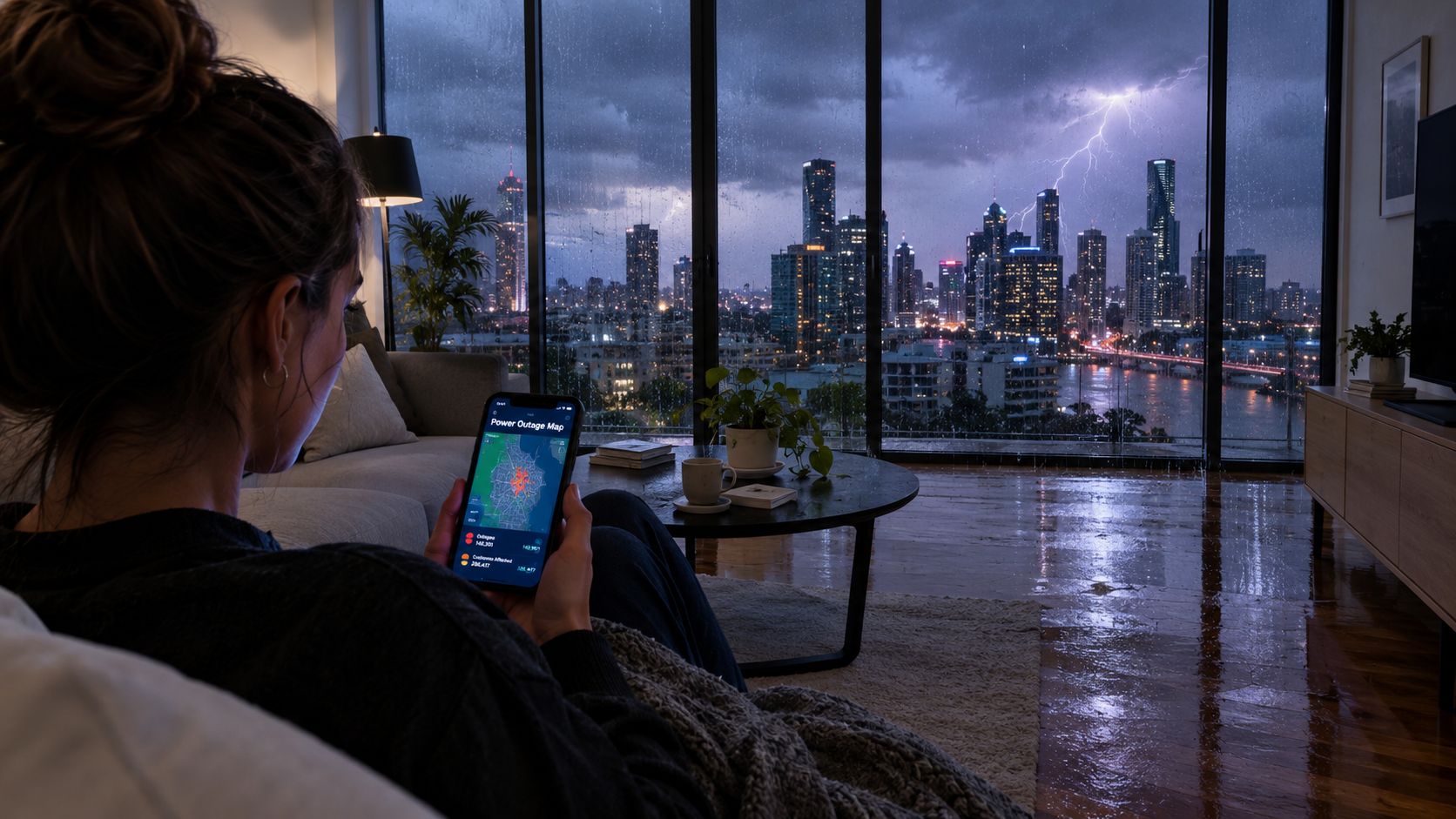
If the map doesn't show your address, check your switchboard. A tripped main switch or safety switch points to a household fault, although you shouldn't reset equipment if there's water, smoke, burning odours or visible damage. If neighbours are also without supply, report the outage to the distributor even if the map is delayed.
What the phone line can tell you
The automated fault line will generally ask for identifying details such as your address, customer information or NMI, plus information about what you can see or hear. Describe downed lines, damaged poles, sparks, smoke and flooding clearly. During a mass outage, the distributor may not provide an individual callback immediately because crews are prioritised by safety risk and network impact.
A restoration estimate is a working assessment, not a promise. “Fault assessment pending” means the network operator has received the event but hasn't confirmed the cause, access conditions or repair requirements. “Crew dispatched” means a field crew has been assigned, but it doesn't necessarily mean the fault has been reached or made safe.
Households with smart meters can also use interval data to identify when supply stopped and returned. Understanding how smart meters work makes it easier to distinguish a network interruption from a problem isolated to your switchboard or inverter.
Why Outages Happen and How Queensland Tracks Reliability
Queensland's electricity distribution system is split between two major providers. Energex serves South East Queensland, while Ergon Energy Network serves the remainder of the state, creating very different operating conditions between dense urban feeders and long rural lines.
Reliability is measured using two standard indicators. SAIDI records outage duration, expressed as the time customers are without supply over the reporting period. SAIFI records interruption frequency, showing how often customers lose supply. Queensland parliamentary reporting says Energex and Ergon supply electricity to nearly all Queensland customers, and that these measures are published annually in Distribution Annual Planning Reports. Queensland parliamentary reliability reporting also records that Queensland distribution customers historically experienced outages about two to three times a year, compared with around twice a year across the National Electricity Market overall.
The feeder class matters more than a postcode headline. Queensland's minimum service standards cap Energex urban feeders at 106 SAIDI minutes per customer and 1.26 SAIFI interruptions per customer, while Ergon long-rural feeders are capped at 964 SAIDI minutes per customer and 7.40 SAIFI interruptions per customer. Queensland minimum service standards shows why a remote customer and an inner-city customer shouldn't be judged against the same reliability expectation.
| Attribute | Planned outage | Unplanned outage |
|---|---|---|
| Typical trigger | Asset replacement, maintenance or vegetation work | Equipment fault, vehicle collision, wildlife contact or severe weather |
| Customer notice | Providers must give at least four business days' notice | Notice usually follows the event |
| Restoration planning | A scheduled window and expected duration are supplied | Crews assess damage before a reliable estimate is available |
| Household response | Arrange work, backup power and medical support in advance | Check safety, report hazards and monitor updates |
A suburban fuse or switch can be isolated and repaired quickly. A damaged rural feeder may require patrols, access checks, replacement equipment and multiple safety clearances. Transmission outages add another layer, because the fault may sit well away from the home but still constrain how electricity reaches a region.
For market-facing updates, AEMO market notices can provide useful context around operational conditions, but they aren't a substitute for the Energex or Ergon outage map when your home is already without supply.
Staying Safe and Prepared During a Power Outage
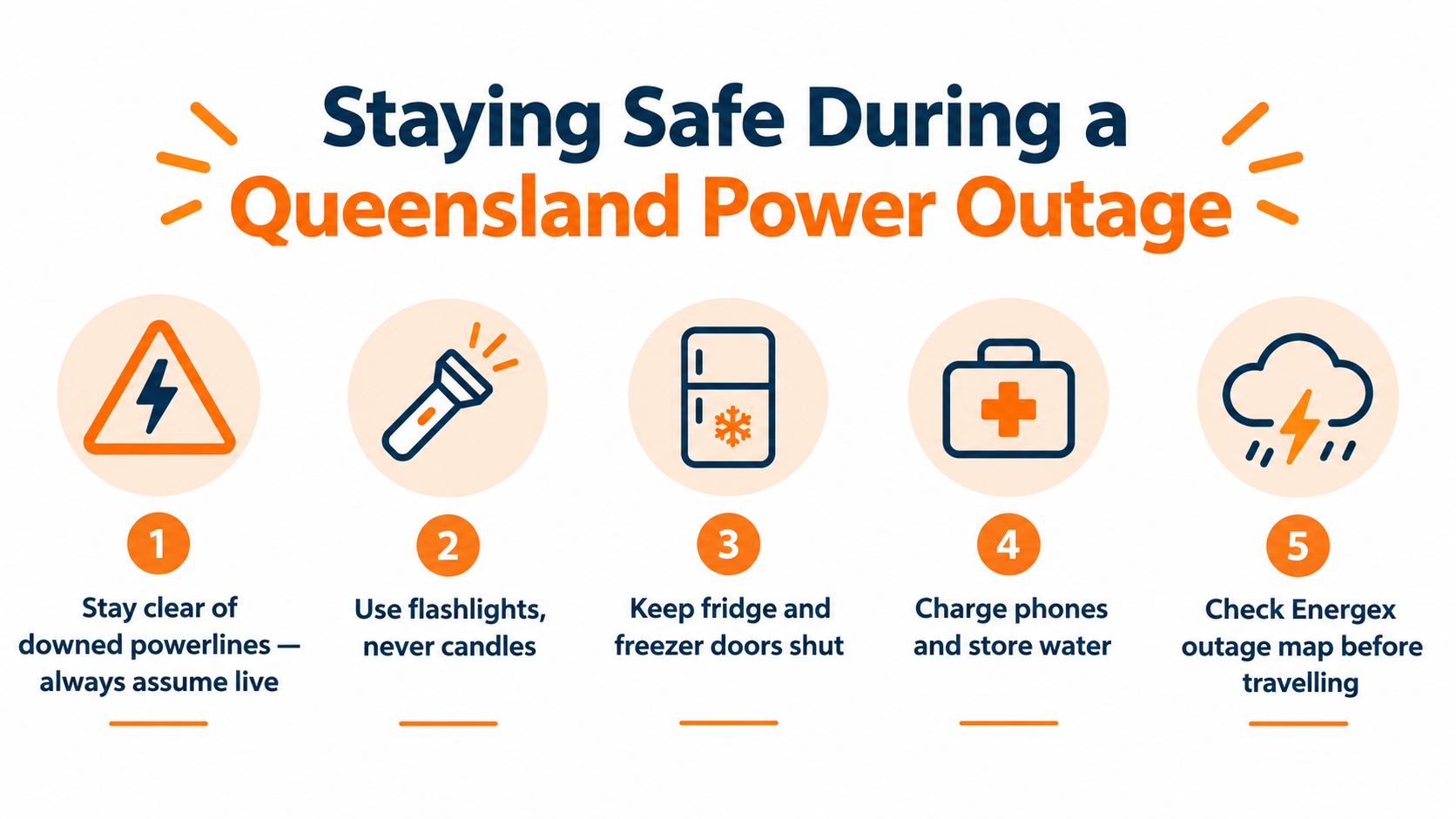
Treat every fallen powerline as live, even when the surrounding streets are dark. Stay well clear, keep children and pets away, and call 000 if there's immediate danger. Report sparking lines, damaged poles and other network hazards to the relevant distributor's emergency line.
Floodwater changes the risk. Don't drive through a flooded crossing just because traffic signals are operating or the road appears familiar. Water can conceal live electrical equipment, wash away road surfaces and make access unsafe for emergency crews.
Protect the home before supply returns
Switch off sensitive electronics, including computers, televisions, networking equipment and heat-pump controls. When power returns, voltage disturbances can damage equipment that remained connected, especially if the outage involved storm damage or repeated restoration attempts.
Keep refrigerator and freezer doors shut. Opening them repeatedly lets cold air escape and makes food spoil faster. Use a torch rather than candles, particularly near a solar inverter, battery enclosure, curtains or stored fuel.
Generators need disciplined installation and operation. Run one outdoors, in a dry and well-ventilated position, away from doors, windows and vents. Never connect a portable generator to a wall socket. That can backfeed the network, endangering workers and damaging household wiring. A compliant changeover arrangement must be installed by a licensed electrician.
Keep a short outage kit ready
- Light: Store charged torches where everyone can reach them.
- Communications: Keep a charged power bank and a printed list of distributor contacts.
- Food and water: Maintain supplies that don't rely on refrigeration or electric cooking.
- Transport: Keep your vehicle ready if local conditions may deteriorate.
- Extended events: Use this practical guide to prepare for extended blackouts, particularly if someone in the household relies on powered medical equipment.
If your household depends on life-support equipment, don't wait for the outage map to update. Speak with your distributor and healthcare provider about an individual backup plan, because a battery that protects selected appliances may not support medical equipment indefinitely.
How Weather and Generation Stress Are Reshaping Outage Risk
A Queensland power outage can start with a tree, a failed component or a damaged pole. It can also reflect pressure elsewhere in the system. A generation unit may be unavailable, a transmission corridor may be undergoing maintenance, or extreme heat may push demand higher while network equipment operates under harsher conditions.
AEMO's network outage submission statistics recorded 1,523 Queensland outages in 2024/25 within the reported series. The same dataset records 2,604 completed outages across the 2019 to 2025 series, 1,231 outages affecting primary plant taken out of service, and 1,188 outages requiring permission to proceed from AEMO. Average outage duration reached 295 hours in 2024/25 in that transmission reporting dataset. These figures describe operational network events, not the length of time an individual household necessarily loses power, but they show the scale of the planning problem. AEMO network outage submission statistics provides the underlying context.
Generation stress can affect households indirectly. If available supply tightens during a high-demand period, network operators and market bodies have fewer options when another asset fails. That doesn't mean every coal-unit outage causes a suburb blackout. It means the system has less operational slack, so a separate local fault can become harder to manage.
Weather is not just another outage category
The Queensland Household Energy Survey found that 52% of households experienced a power outage in the prior six months in 2026, down from 64% in 2025. It also found that 57% reported outage impacts from extreme weather or disasters in 2026, down from 71% in 2025. The 2026 Queensland Household Energy Survey matters because it separates household experience from network statistics.
A routine feeder fault, a cyclone-damaged regional line and an upstream generation constraint demand different responses. A battery may handle a short interruption well but struggle during a prolonged weather event if it can't recharge, while a VPP may optimise normal market conditions without guaranteeing backup during every emergency.
That distinction should shape your investment decisions. Battery resilience depends on islanding hardware, reserve settings, critical-load design and the ability to recharge, not just on battery capacity or the presence of rooftop panels.
What Happens to Your Solar and Battery During an Outage
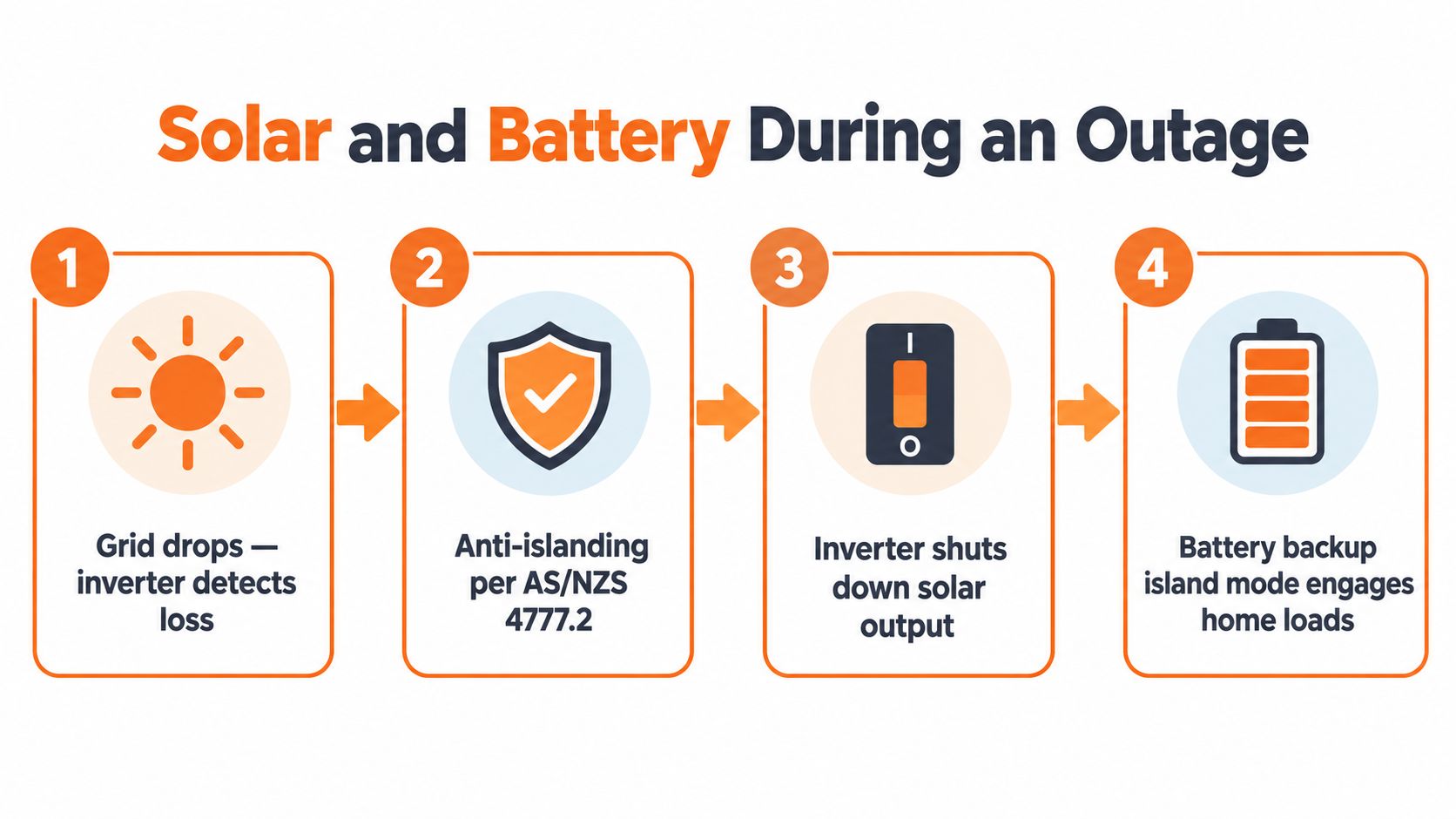
Most rooftop solar systems shut down when the grid fails. That behaviour is intentional. Under AS/NZS 4777.2 anti-islanding requirements, the inverter must stop energising the network when it detects a loss of grid supply. Without that protection, a supposedly isolated line could remain live while crews work on it.
The sequence is straightforward:
- Grid loss: The inverter detects that supply voltage or frequency has moved outside its permitted operating conditions.
- Isolation: The system disconnects from the network to prevent islanding.
- Solar shutdown: Rooftop panels stop supplying the household because the standard grid-following inverter no longer has a stable grid reference.
- Backup decision: A compatible battery inverter and backup gateway may form a private electrical island for selected loads.
Full backup is different from partial backup
A partial-backup system powers a defined circuit group, such as refrigeration, lighting, internet equipment and selected power points. High-load appliances may be excluded because they can drain the battery rapidly or exceed the backup inverter's output.
A whole-home system can energise more of the switchboard, but it still has limits. Air-conditioning compressors, electric hot-water systems, induction cooktops and pool pumps can create large starting loads. The installer must confirm inverter output, phase configuration, battery state of charge and the home's circuit arrangement.
Solar panels won't keep producing useful outage power unless the battery system includes a grid-forming inverter or equivalent islanding capability. The battery or gateway creates a controlled local grid, allowing compatible solar equipment to operate without reconnecting to the public network.
The black-start feature also matters. Systems such as Tesla Powerwall 3, Sungrow SBR and BYD Premium HVS or HVL may support backup configurations, but compatibility depends on the installed inverter, gateway, firmware, wiring and commissioning settings. Don't assume a product name proves your home has backup.
Practical rule: If your installer can't show you which circuits remain live during a blackout, you don't yet have a usable backup plan.
Before the next storm, verify:
- Backup circuits: Identify the exact outlets and appliances connected to backup.
- Reserve level: Confirm the minimum battery state of charge for emergency use.
- Restart behaviour: Ask whether the system can black-start after a long outage.
- Solar recharge: Check whether solar can recharge the battery while the home is islanded.
- Testing: Request a controlled backup test from a licensed installer.
- Documentation: Keep the gateway model, inverter model and emergency shutdown instructions accessible.
For households comparing equipment specifications or procurement pathways, an Evright Industrial renewable energy procurement guide can help clarify the difference between equipment selection and a complete, compliant backup installation.
Using a VPP to Get More Value From Your Battery
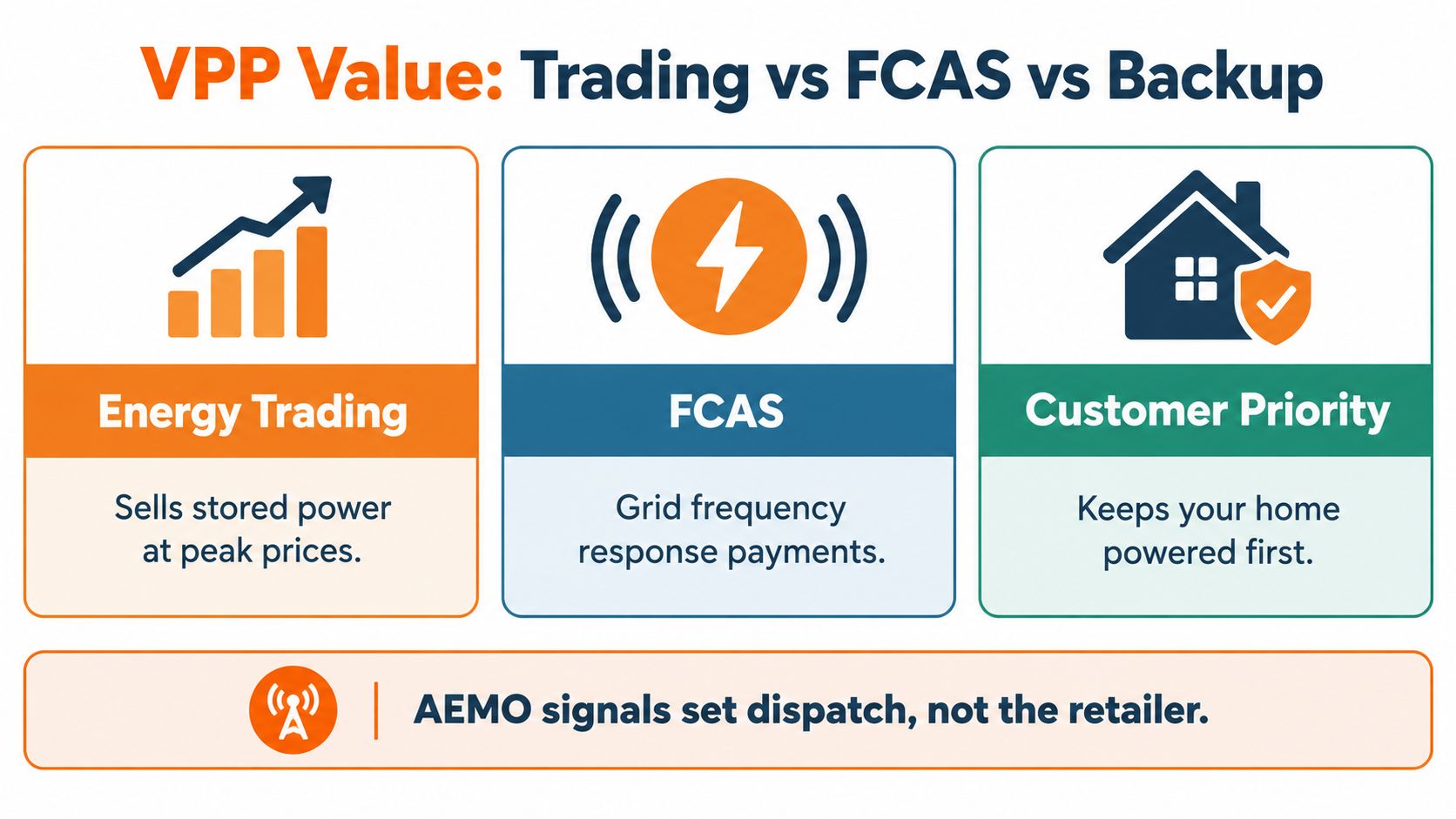
A Virtual Power Plant coordinates many distributed batteries as one flexible resource. In normal operation, the operator may charge or discharge participating batteries in response to wholesale price volatility, demand events or grid-support requirements. The commercial value can come from energy trading, frequency-control services and retail arrangements, but each use case has a different effect on battery availability.
A VPP doesn't turn a standard solar battery into blackout backup. Backup depends on physical islanding equipment and the circuits wired to it. VPP participation changes how the battery is managed while the grid is operating. It shouldn't override a customer's agreed backup reserve during a declared outage or an emergency operating condition.
The three value streams
| VPP activity | What the battery does | Main household trade-off |
|---|---|---|
| Energy trading | Discharges when market or retail conditions make stored energy valuable | Less stored energy may remain for later self-consumption |
| FCAS participation | Responds quickly to frequency-related signals within operating limits | Dispatch may be constrained by reserve and battery settings |
| Customer priority | Retains energy for the household's defined use and backup needs | A higher reserve can reduce market participation |
Dispatch is normally coordinated through the VPP platform and market arrangements, not by a homeowner manually reacting to every price movement. Good settings preserve a minimum state of charge, respect export limits and account for forecast weather. A household facing a severe weather warning may reasonably increase its reserve or pause non-essential participation, where the platform and contract allow it.
HighFlow Energy operates as an Australian retailer for eligible existing solar and battery owners through a Bring Your Own Battery VPP. Its stated structure uses grid-service value to fund a monthly electricity allowance, while customers retain priority use of stored energy, can review system performance through an app and can override automated plans where available. Eligibility, equipment compatibility, network settings and retail terms still need to be checked before joining.
The important comparison isn't just feed-in tariff versus VPP payment. Ask what happens to your battery at a demand event, how much reserve is retained, who controls dispatch, how cycling is treated, what warranty conditions apply and whether extra usage is billed at standard rates. A transparent retailer should explain the allowance, network charges, export constraints and exit conditions in plain language.
Key Takeaways and Common Questions for Queensland Battery Owners
Five actions will improve your response to a Queensland outage:
- Check the network first: Use the Energex or Ergon Energy Network outage map before calling.
- Treat lines as live: Never approach fallen or damaged electrical infrastructure.
- Test backup properly: Rooftop solar normally shuts down unless a compatible islanding system is installed.
- Separate resilience from trading: A VPP manages battery value while the grid operates, but physical backup hardware determines whether your home stays powered.
- Protect your reserve: Set outage priorities before severe weather, and confirm how your VPP handles emergency conditions.
How long will a 10 kWh battery run a Queensland home?
There isn't one honest answer. Runtime depends on the usable battery capacity, inverter output, starting loads, household demand, backup circuits, weather and whether solar can recharge the system. A home running refrigeration, lighting and internet equipment will last longer than one operating air-conditioning, electric cooking and hot water.
Can a VPP event use my backup reserve?
It depends on the retailer's controls and your agreement. Ask how the minimum state of charge is enforced, whether you can raise it before a storm, and whether the platform provides an app override. Your priority use settings should be documented, not assumed.
What should I tell the distributor about my battery?
Provide accurate information about the installed inverter, battery, backup gateway and connection arrangement when requested. Your distributor needs to know the system's approved connection and operating characteristics, particularly if it can operate in island mode.
Will joining a VPP change my insurance premium?
Don't assume either outcome. Ask your insurer whether participation, automated dispatch, battery cycling or changes to the system's operating profile require notification. Keep installation certificates, compliance documents and retailer terms with your insurance records.
Queensland's rules also provide formal reporting and complaint pathways. Distribution entities submit quarterly incident records, and the Electricity Distribution Network Code requires quarterly reporting on guaranteed service levels, including claims and payments. For planned interruptions, customers must receive at least four business days' notice with the date, time and expected duration. The Energy and Water Ombudsman Queensland outage complaint service can assist when a supply issue remains unresolved.
HighFlow Energy connects eligible existing solar and compatible battery systems to a retailer-operated VPP, using coordinated grid services while preserving customer priority use and providing an electricity allowance under its retail structure. Visit HighFlow Energy to check eligibility, review how your battery performs during Queensland outage conditions, and assess whether your existing system is being underutilised.