

Utility Bill Assistance Australia: Rebates & Savings 2026
Utility bill assistance is typically sought to solve an immediate problem: a power bill that keeps landing harder than it used to. That's a rational response. In Australia, energy bill stress isn't a niche issue. It's a mainstream household pressure point.
For solar and battery owners, though, there's a second question worth asking. If government help is designed to reduce the next bill, what reduces the bill after that, and the one after that? For many households in New South Wales and Queensland, the answer isn't only about rebates. It's about whether an existing battery is being used as a passive backup device or as an actively managed energy asset.
Understanding Australian Utility Bill Stress
In the first half of 2024–25, 11.1% of residential electricity customers on Victorian default offers were receiving some form of energy concession, and 9.8% were on payment plans or hardship arrangements, according to the Australian Energy Regulator data referenced here. That tells you something important. A meaningful share of households still need utility bill assistance, even before you get into debates about retail competition or plan switching.
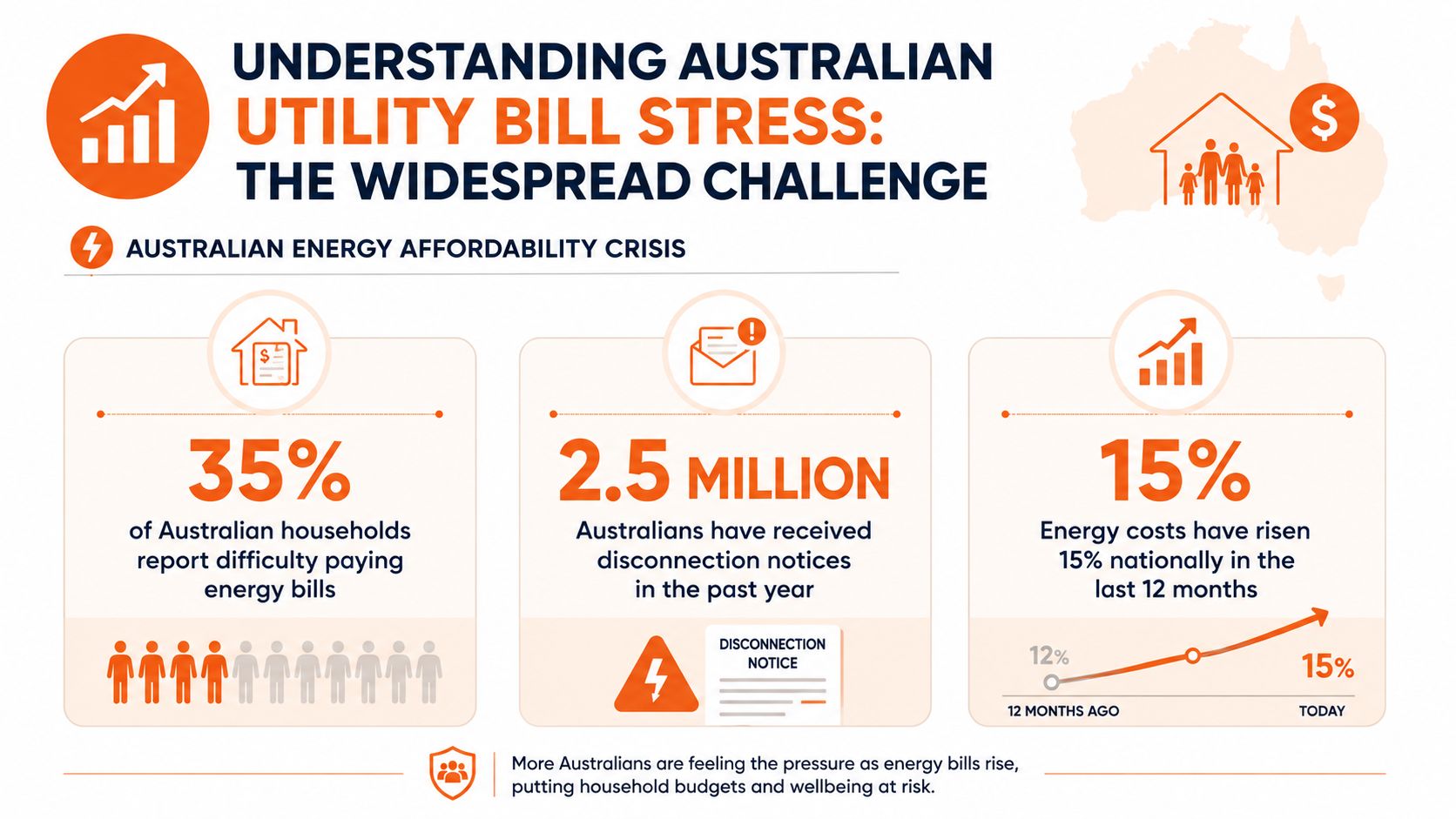
Energy stress usually doesn't come from one single failure. It comes from a combination of fixed supply charges, usage during expensive periods, seasonal cooling loads, and the simple fact that many households have electrified faster than their bill strategy has evolved. If you're also dealing with general inflation pressure, broader household budgeting becomes part of the same problem. That's why a cost-of-living view, such as this guide from EndureGo Tax on cost of living, is relevant alongside energy-specific advice.
Two different responses to the same problem
Many individuals begin with the traditional path:
- Government concessions for eligible households
- Retailer hardship arrangements when bills become difficult to manage
- Rebates or credits applied to reduce the amount owing
That path matters. It helps many households keep the lights on.
But solar and battery owners also have a second path:
- Reduce structural exposure to grid imports
- Use the battery more intelligently
- Create bill offsets from the asset itself, rather than relying only on external support
Utility bill assistance helps with affordability. Asset optimisation helps change the bill you're exposed to in the first place.
That distinction matters because the best answer depends on your position. If you don't have distributed energy resources, assistance may be the main lever available. If you already own solar and a compatible battery, the conversation should be wider.
How Government Concessions and Rebates Work
The practical shape of utility bill assistance in Australia is usually simpler than people expect. It is commonly delivered as a bill credit or rebate, not as cash paid separately after the bill has already been settled. In New South Wales, the Low Income Household Rebate is applied as a deduction on an eligible residential electricity bill, reducing the billed amount at settlement rather than reimbursing the customer later, as described in this explanation of bill-credit style utility assistance.

What that means on your bill
A concession or rebate generally works as a fixed reduction to the balance owing. That matters for two reasons.
First, it gives immediate relief. You see the adjustment on the statement rather than waiting for reimbursement.
Second, it doesn't change the underlying tariff mechanics. If your household uses more power, faces higher supply charges, or sits on a time-of-use plan with expensive peak periods, those pricing structures still apply. The rebate lowers the net bill. It doesn't redesign the bill.
Who usually qualifies
Across Australian state programs, assistance is typically means-tested and periodic. Eligibility is usually tied to some combination of household composition, income thresholds, payment difficulty, and concession-card status. In practice, that means these schemes are designed to target households with genuine payment stress while leaving ordinary tariff signals in place for the broader market.
For NSW and QLD households, the practical checks usually include:
- Concession status. Many programs require an eligible concession card or a specific category of household support status.
- Residency details. The electricity account often needs to match the applicant's primary place of residence.
- Retail account information. The rebate generally attaches to the electricity account, so name matching and account details matter.
- Program timing. Some schemes are recurring, some are seasonal, and some are one-off relief measures.
A useful starting point is a dedicated guide to concessions, rebates and relief schemes, which brings the common pathways into one place.
How to apply without wasting time
Most successful applications follow the same pattern:
Confirm the program applies in your state
NSW and QLD programs differ, so start with your state-specific eligibility rules.Gather the account and identity documents first
Delays usually come from incomplete account details, not from the form itself.Check whether your retailer can process it directly
Some rebates can be linked to the retail account workflow, while others need a state application.
After you've checked the basics, this explainer may help with the broader application mindset:
What works and what doesn't
Here's the practical reality.
| Approach | What it does well | What it doesn't fix |
|---|---|---|
| Concession or rebate | Reduces the amount due on the bill | Doesn't reduce tariff exposure |
| Payment plan | Spreads cash flow pressure | Doesn't lower the underlying cost |
| Hardship support | Helps avoid escalation when payment becomes difficult | Doesn't improve battery performance, solar usage timing, or fixed charges |
Practical rule: apply for every concession you're genuinely entitled to. Just don't mistake a credit on the bill for a permanent redesign of your electricity costs.
Why Rebates Are a Short-Term Fix
Government support is necessary. For some households, it's the difference between coping and falling behind. But it's still a short-term tool if the bill problem is structural.
Recent policy and market reporting in Australia points to pressure being concentrated in households using more electricity for cooling, appliances and EV charging, while relief in 2024–25 has been driven partly by rebates rather than lasting bill reductions, as summarised in this discussion of temporary relief versus permanent bill reduction. That's why the more useful question often isn't “Am I eligible for help?” but “Which parts of my bill can I permanently reduce?”
The bill components that keep coming back
A rebate can reduce this quarter's statement. It doesn't remove the drivers that rebuild the next one.
Those drivers often include:
- Daily supply charges that continue whether you import a lot or a little
- Network and tariff settings that shape what power costs at different times
- Seasonal usage spikes from cooling and other high-demand household loads
- Electrification growth as homes add EV charging, induction cooking, or more electric appliances
For households with no solar or battery, that can leave limited room to move beyond efficiency and retailer choice.
Why this matters even more for battery owners
Battery owners can fall into a misleading middle ground. They don't fit the classic hardship picture, yet they can still face stubborn bills because the battery isn't being used in a way that targets the underlying cost drivers. A battery that mostly sits there for backup value may be technically sound and financially underused at the same time.
A rebate treats the symptom. A well-run battery strategy can address part of the cause.
That doesn't mean assistance is irrelevant. It means assistance and optimisation solve different problems. If you qualify for support, use it. If you already own energy assets, don't stop there.
Beyond Assistance to Asset Optimisation
For solar and battery owners, the more important shift is mental before it's technical. Stop looking at the battery only as stored energy. Start looking at it as a controllable financial asset.
A major gap in Australian utility bill assistance content is that it rarely explains what battery-owning households should do when the problem is bill structure, not just total consumption. Public guidance tends to focus on concessions and emergency relief, while retail market data shows bills remain heavily shaped by supply charges, network costs and tariff design, which creates a separate problem for households with distributed energy resources. That gap is described in this discussion of battery owners and bill-structure optimisation.

The wrong way to think about a battery
A lot of households judge battery performance too narrowly. They ask:
- Did it store my midday solar?
- Did it keep some evening loads off the grid?
- Will it help in an outage?
Those are valid questions. They're just incomplete.
If your electricity bill is still being driven by fixed charges, tariff timing and periods when importing from the grid is expensive, then the battery should also be evaluated against those outcomes. That's where many systems are underperforming financially, even when the hardware is working exactly as installed.
The more useful framework
A battery owner should assess value through four lenses:
| Lens | What to look at |
|---|---|
| Self-consumption | Whether solar generation is being used at home instead of exported cheaply |
| Tariff timing | Whether discharge happens when grid power is most costly |
| Bill structure | Whether the strategy helps offset both usage and the harder-to-avoid fixed components |
| Market participation | Whether spare battery capacity can create additional value through coordinated grid support |
One of the better consumer-level starting points for this broader perspective is a guide to energy bill relief for battery owners, especially if you're trying to understand the difference between one-off help and an ongoing operating strategy.
What actually changes when you optimise an asset
The household stops acting like a passive bill payer.
Instead, the owner starts asking operational questions:
- When should the battery charge from excess solar?
- When should it hold energy back?
- When should it discharge for household use?
- When is export value weak compared with other uses of stored energy?
- Can spare capacity support the grid and create bill offsets without compromising household needs?
That's a different posture from applying for assistance. One asks for support. The other manages an asset to reduce dependence on support.
How Virtual Power Plants Reduce Electricity Bills
A Virtual Power Plant coordinates many individual batteries so they can respond in an organised way to grid conditions. In plain English, that means batteries in homes can do more than support the house they sit in. When there is spare capacity, they can also contribute to wider system needs.
For a battery owner, the key point isn't the label. It's the mechanism. A coordinated battery can create value that a standard feed-in tariff often doesn't capture well enough.
Where the bill reduction comes from
Across Australian assistance frameworks, support is best understood as a fixed bill offset or credit equivalence against supply and usage charges, rather than as a real-time consumption subsidy. That same modelling logic matters for retailer and VPP design when estimating how much solar-plus-battery value is needed to erase a bill, as explained in this discussion of fixed bill offsets and VPP-style products.
For a household, that translates into a practical comparison:
- A traditional rebate reduces the bill because a government program credits the account.
- A VPP-style arrangement can reduce the bill because the battery creates value through coordinated operation, and that value is applied against bill components.
That distinction matters because solar alone often struggles to deal with the parts of the bill that don't disappear just because your panels generate well in the middle of the day.
Why solar exports alone usually aren't enough
Exporting excess solar can help, but it has limits.
A feed-in tariff rewards exported energy. It doesn't necessarily maximise the full value of a battery, especially when the battery could instead be timed around household demand, tariff windows or coordinated grid events. In practice, relying only on exports can leave money on the table if the battery has spare capability that isn't being orchestrated.
What a retailer-based VPP changes
A retailer-based model can connect battery behaviour directly to the customer bill. That matters because the objective isn't only to optimise battery dispatch in the abstract. It's to turn battery performance into something visible and useful on the electricity account.
If you want a deeper explanation of the operating model, this overview of a Virtual Power Plant in Australia is a useful reference.
The most effective VPP structures don't ask owners to give up their battery. They use spare battery capability more intelligently while keeping household energy needs in view.
Trade-offs to assess before joining any VPP
Not every VPP is equal. Battery owners should test the offer against practical questions:
- Household priority. Does the program preserve the home's access to stored energy when needed?
- Transparency. Can you see how value is created and how it appears on the bill?
- Tariff interaction. Does the model help with supply charges and imported usage, or only one part of the bill?
- Control settings. Can the owner override or understand operating logic?
- Warranty alignment. Is the dispatch strategy consistent with sensible cycling and manufacturer conditions?
A good VPP doesn't just aggregate batteries. It translates technical coordination into a cleaner bill outcome for the homeowner.
Your Utility Bill Reduction Checklist
There isn't one right path for every household. The right path depends on whether you need immediate support, structural bill reduction, or both.

Path A for households seeking immediate assistance
Start here if you don't have solar and a battery, or if cash flow pressure is the urgent issue.
- Check state rebates first. NSW and QLD program rules differ, so confirm eligibility through the relevant government and retailer channels.
- Ask for hardship options early. Retailers can often discuss payment arrangements before debt escalates.
- Review your plan settings. A tariff mismatch can keep bills higher than necessary.
- Track your bills in one place. If you want to master your finances, a monthly bill tracker can make seasonal pressure and repeat cost spikes easier to spot.
Path B for solar and battery owners
If you already own the hardware, the first question isn't only “Can I get assistance?” It's “Is my asset underperforming?”
Use this shortlist:
Review when your battery charges and discharges
If discharge timing isn't aligned with the expensive parts of your bill, value is being lost.Check whether fixed charges remain stubbornly high in the net bill outcome
A system can have good solar production and still leave an unsatisfying retail bill.Compare export behaviour with household demand patterns
Heavy daytime exports paired with evening imports often signal untapped optimisation potential.Assess VPP suitability
If the battery has spare capacity and compatible operating windows, coordinated participation may improve the financial return on the asset.
If you already own solar and a battery, the objective should be bill reduction by design, not just relief by application.
Unlock Your Battery's Financial Potential with High Flow Energy
Most battery owners focus on installation quality. Far fewer focus on ongoing performance and optimisation. High Flow Energy is an electricity retailer built around maximizing the full value of your existing solar and battery system.
For households in NSW and QLD with compatible battery systems, the core idea is simple. Instead of treating the battery as a passive household appliance, the service treats it as an active energy asset that can support your home first and contribute additional value when spare capacity is available. That matters if you're trying to move beyond short-term utility bill assistance and toward a more durable bill-reduction strategy.
High Flow Energy specialises in Bring Your Own Battery VPP participation, app-based visibility, and retailer-aligned bill optimisation. The focus isn't on selling hardware. It's on helping existing battery owners understand whether their current setup is delivering the financial performance it should.
If you would like to understand whether your battery is underperforming financially, request an eligibility assessment today.
Frequently Asked Questions About Utility Assistance and VPPs
Can I still receive government concessions if I join a VPP
In many cases, a concession and a VPP address different parts of the same problem. A concession is government support tied to eligibility. A VPP is an operating model for your battery. Whether they can coexist depends on the retailer structure, account setup and the specific concession rules that apply to your household. Check the retailer terms and the state program conditions before making changes.
Is a VPP the same thing as a feed-in tariff
No. A feed-in tariff pays for exported solar electricity. A VPP coordinates battery behaviour to create broader value from stored energy and spare capacity. They can sit alongside each other, but they are not the same mechanism and they shouldn't be evaluated the same way.
What if my household uses more electricity than the VPP-related bill offset covers
You'll still pay for usage beyond whatever allowance, offset or benefit structure applies under your retail arrangement. That's why it's important to read the tariff and billing terms carefully. The best programs are transparent about what is covered and what happens when household consumption goes above that level.
Will joining a VPP stop me using my battery for my own home
A well-designed VPP should preserve household priority settings and make its operating logic clear. The battery shouldn't become a black box that the owner can't understand. Before joining, check how the program handles reserve levels, overrides and household consumption needs.
Does VPP participation affect battery warranties
It can, depending on how the program operates and what the battery manufacturer allows. The right question isn't whether the battery cycles more. The right question is whether the dispatch profile remains within sensible operating conditions and the warranty framework for that product. Always check both the VPP terms and your battery warranty documentation.
Is utility bill assistance still worth applying for if I own solar and a battery
Yes, if you're eligible. Assistance and optimisation aren't mutually exclusive. The practical mistake is assuming assistance alone is the end of the job. For battery owners, it usually isn't.
Who benefits most from a retailer-based VPP
Households that already have rooftop solar, a compatible home battery, and a retail bill that still feels too high are usually the strongest candidates. That's especially true when the battery is technically working but not clearly improving the overall economics of the electricity account.
What should I review before switching to any VPP offer
Look at five things: billing structure, household priority settings, contract flexibility, visibility through the app or portal, and how battery value is translated into bill outcomes. If any of those points are vague, ask more questions before proceeding.
High Flow Energy helps NSW and QLD battery owners turn existing solar and storage into a stronger bill-reduction strategy through a transparent Bring Your Own Battery VPP model. If you want to see whether your current setup is underutilising your battery, visit HighFlow Energy and request an eligibility assessment.