

Do I Have to Have a Smart Meter? a Guide for NSW & QLD
Do you need a smart meter because the rules say so, or because your solar and battery stop paying back properly without one?
A smart meter is not universally compulsory in Australia today. The direction of policy and retailer practice is clear, though, with a target for an accelerated rollout to all National Electricity Market customers by 30 November 2030. For homeowners in New South Wales and Queensland, that matters less as a compliance question than as an income and cost question.
An older meter can limit far more than meter reads. It can restrict access to time-based tariffs, reduce visibility over exports, and block participation in programs that depend on interval data, including Virtual Power Plants. If you have already spent money on rooftop solar or battery storage, that can weaken the return on those assets.
That is why the practical question is not merely, “Do I have to have a smart meter?” It is whether your current meter is preventing your system from being measured and rewarded properly. Retailers and energy programs need granular import and export data to settle bills, apply tariff structures, and verify when a battery discharged at a high-value time. Without that data, your household may be stuck on a less flexible setup even if the hardware on your roof is capable of more.
For households in NSW and QLD, the smart meter decision usually comes down to three commercial issues:
- Regulatory position: whether your retailer can require a meter upgrade in specific circumstances
- Tariff access: whether your current meter limits the plans available to you
- Asset return: whether solar and battery value is being left on the table because interval data is missing
If you need a quick technical refresher before assessing your site, High Flow Energy's guide on what a smart meter is for electricity explains the meter types and how they work in practice.
Introduction Is a Smart Meter Mandatory in Australia
Do you need a smart meter, or only when your retailer says you do?
For most Australian households, the answer sits between those two positions. A smart meter is not already compulsory in every home today, but the market is clearly shifting toward smart metering as the default for residential electricity. That matters because metering no longer affects only how your bill is read. It affects which tariffs you can access, how accurately imports and exports are recorded, and whether solar and battery systems can participate in newer revenue models.
Victoria showed early where the market was heading. Its rollout established smart meters as standard infrastructure rather than a niche upgrade, and the national metering reforms that followed were built around interval data, remote reads, and tariff structures tied to when electricity is used.
That policy direction has practical consequences.
A basic accumulation meter can still support a conventional household. It is far less useful for a home trying to improve the return from rooftop solar or a battery. In NSW and QLD especially, the smart meter question matters because these households are no longer just buying electricity. They are increasingly trying to trade it, shift it, store it, and export it at the right time.
Why Performance is the Core Issue
For solar and battery owners, the meter determines whether the value of those assets can be measured and paid for. Time-based import charges, export tracking, demand response events, and Virtual Power Plant participation all rely on interval data. If the meter cannot provide that data, the hardware may still work, but its commercial potential is reduced.
That is the missed link in many guides on smart meters. The choice is not only about compliance or convenience. It is about whether your home can qualify for the tariff structures and energy programs that improve asset payback.
A battery may perform perfectly at 6 pm, but without the right metering, a retailer or aggregator may have no usable record of that response.
The practical Australian answer
If your question is whether you can avoid a smart meter indefinitely, that is becoming less likely. If your question is whether a smart meter improves the financial case for solar, batteries, and flexible tariffs, the answer is usually yes.
For homeowners who want a technical primer before assessing their own setup, High Flow Energy's guide on what a smart meter is for electricity explains the main meter types and how they work in practice.
In other words, this is not just a metering decision. For many NSW and QLD households, it is an asset optimisation decision.
The Official Rules for Smart Meters in NSW and QLD
Do the rules still leave this as a genuine household choice in NSW and QLD, or only until your meter setup changes?

In practice, the answer depends less on your preference and more on the event that triggers meter work. The National Electricity Rules have shifted the market toward smart meters, and the AER has noted a target for an accelerated rollout across National Electricity Market customers by 30 November 2030. The key practical point is simpler. Once a retailer is arranging certain types of metering work, keeping or reinstalling an older basic meter becomes much less likely.
That distinction matters for solar and battery owners in particular. A household asking "do I have to have a smart meter?" is often also deciding whether future tariff options, export measurement, or VPP participation stay available or get narrowed by legacy metering.
The events that usually trigger a smart meter
For NSW and QLD households, smart meters usually become difficult to avoid when one of these change events occurs:
- New connection: New supply setups generally use current metering standards.
- Fault or replacement: If a basic meter fails and needs to be replaced, the replacement is commonly a smart meter.
- Meter reconfiguration: Changes to the way the service is metered can lead the retailer or metering provider to require a smart meter.
- Retail product changes: Some tariffs and energy products depend on interval data, which older meters cannot provide.
- DER upgrades: Adding solar, a battery, or controlled load changes can create metering requirements that basic meters handle poorly or not at all.
A house can still have an older meter on the wall today. That only shows no trigger event has forced the issue yet.
What the rules mean in NSW and QLD
NSW and QLD both sit inside the National Electricity Market, so the same broad metering framework applies. The difference for homeowners is operational. If nothing changes, a legacy meter may stay in place for now. If you renovate, reconnect, replace a failed meter, alter your tariff, or add equipment that needs interval measurement, the retailer's process starts to matter more than your original preference.
That is why retailer-specific guidance is useful. This overview of EnergyAustralia smart meter rules in NSW shows how the formal rules are translated into actual customer pathways, appointments, and approval steps.
A similar logic applies outside metering itself. Households trying to optimise Sydney hot water costs also run into tariff structure and controlled-load rules that depend on how the site is configured and measured.
Legal position versus real-world outcome
The legal position is still qualified. The practical outcome is more predictable.
| Scenario | Likely outcome for homeowners |
|---|---|
| Existing basic meter, no fault, no service change | It may remain in place for now |
| Meter fault or replacement event | Smart meter is usually installed |
| New connection or major metering change | Smart meter is generally the default |
| Solar, battery, VPP, or interval-based tariff plans | Legacy meters become a commercial limitation |
For NSW and QLD households, that last row is the one generic guides often miss. The metering decision is tied to asset returns. If your goal is to get more value from solar exports, battery dispatch, or flexible tariffs, the rules around smart meter installation are not just a compliance issue. They shape whether your energy assets can be measured in a way retailers and aggregators can bill, reward, or control.
Benefits and Downsides for Your Household
Will a smart meter improve your household economics, or just change how your usage is billed? For most NSW and QLD homeowners, the answer depends less on the meter itself and more on whether your home can respond to time-based pricing, export measurement, and flexible energy programs.

A smart meter changes the commercial options available to your property. It can support remote reads, interval billing, faster fault detection, and access to tariffs that vary by time of day. For households with predictable daytime solar output, controllable appliances, or plans to add storage, those features can affect annual bill outcomes more than the meter replacement itself.
The practical benefits are clearest in four areas:
- Remote meter reads: Fewer estimated bills and less need for manual access.
- Interval-based billing: Your retailer can bill electricity based on when you used it, not just how much.
- More tariff choice: Time-of-use and other usage-based products become available where the retailer offers them.
- Better site visibility: Usage patterns are easier to identify, which helps households assess whether load-shifting is worth the effort.
Those benefits do not automatically translate into lower costs.
A smart meter creates pricing precision. That can work in your favour if you can move demand away from expensive periods, charge an EV overnight, run appliances in solar hours, or pair the meter with a battery strategy. If your usage is concentrated in high-price periods and you cannot shift it, a more detailed tariff can expose costs that a flat structure previously hid.
That is why the downside discussion matters.
| Concern | What it means in practice |
|---|---|
| Privacy | More granular records of when electricity is imported or exported |
| Installation disruption | A site visit, coordination with the metering provider, and a short interruption during the exchange |
| Cost allocation | Customers often need to ask whether any metering charge is embedded in the retail plan or passed through separately |
| Tariff risk | Time-based pricing can increase bills if household routines are fixed in peak periods |
For a standard household with no solar, no battery, and little flexibility in appliance timing, the upside may be modest. Billing becomes more accurate, but the financial gain can be limited unless the retailer offers a tariff that suits the home's usage profile.
For a solar household, the calculation is different. Metering quality affects how clearly imports, exports, and timing can be recorded, which feeds directly into bill design and asset payback. This guide to the link between a smart meter and solar economics explains why the meter choice often becomes part of the return-on-investment calculation rather than a simple equipment upgrade.
Load flexibility is the dividing line. Hot water systems, pool pumps, EV charging, and some battery settings can be scheduled. Households trying to optimise Sydney hot water costs are already dealing with the same underlying issue, which is that timing changes the value of each kilowatt-hour.
The short version is simple. A smart meter gives your household more pricing options, more measurement detail, and better compatibility with modern energy products. Whether that helps financially depends on how well your consumption pattern, solar exports, and controllable loads line up with those options.
Why Your Smart Meter Is Critical for Solar and Battery Value
For a solar-and-battery household, the meter isn't a background device. It's the gatekeeper.
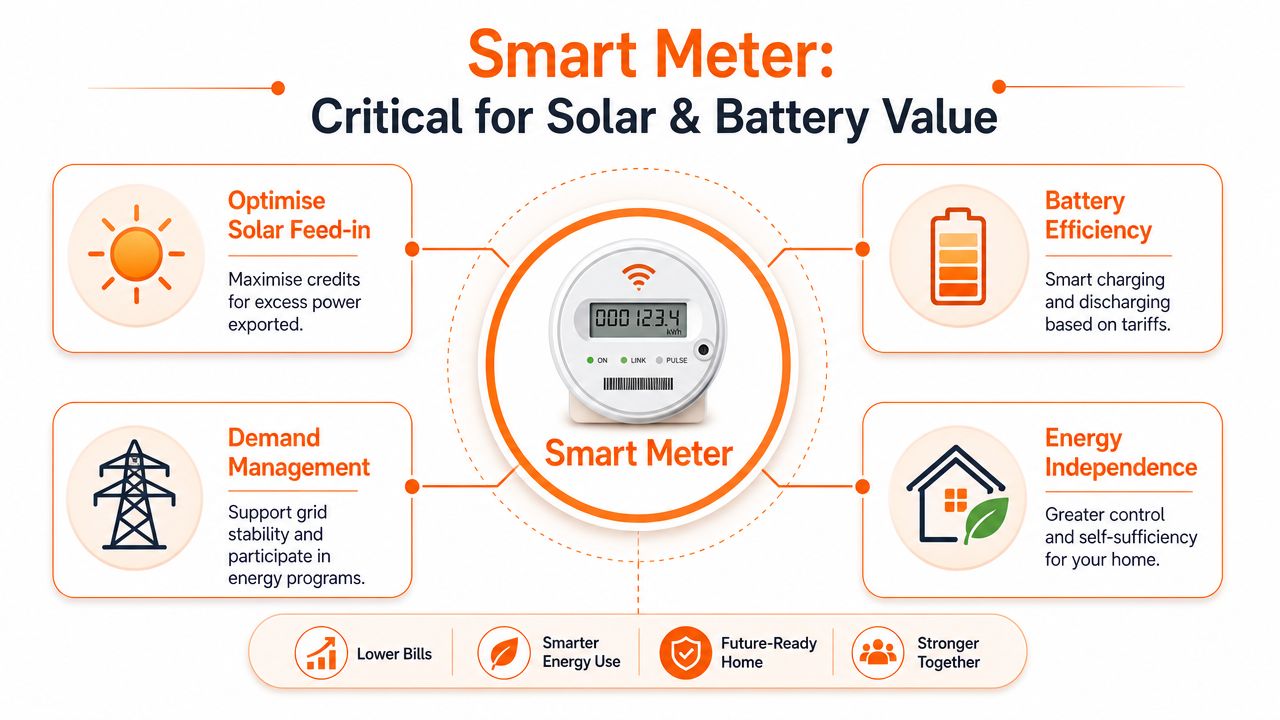
Older meters can record total consumption. They generally can't provide the interval-level picture needed to determine when energy moved in each direction and how that aligns with tariff periods or grid events. That limitation matters far more once you have rooftop generation and storage.
The central commercial fact is this: for Australian solar and battery owners, a smart meter is operationally necessary for export tracking, time-of-use billing, and VPP participation, because those capabilities depend on interval data older meters can't provide. That's the key point highlighted in this discussion of whether households have to get a smart meter.
Export tracking is not a side issue
Many generic articles treat export measurement as a detail. It isn't. If your home exports surplus solar, the system needs to distinguish imported electricity from exported electricity accurately and on the right timing basis.
That affects:
- Solar export accounting: Your retailer needs a reliable record of what went back to the grid.
- Time-based pricing: If the value of electricity changes through the day, timing matters.
- Battery strategy: Charging and discharging decisions depend on when import and export economics are favourable.
If your meter can't support that framework, your solar system still generates power. But the household's ability to monetise it intelligently is weaker.
Batteries need interval data to earn properly
A battery creates value in several ways. It can reduce evening imports, absorb daytime solar, respond to tariff windows, and participate in flexibility programs when the retailer or VPP platform can coordinate it.
None of that works well with blunt measurement.
That's why pages like High Flow Energy's explanation of the link between a smart meter and solar performance are worth reading. The practical issue isn't whether the battery exists. It's whether the market can see what the battery is doing well enough to reward it.
If your battery is a financial asset, the smart meter is the instrument panel that proves when that asset created value.
A short overview of how these systems connect in practice is below.
Why this matters more in NSW and QLD
NSW and QLD households are increasingly exposed to product structures that rely on flexible load, interval billing, and better coordination of distributed energy. That doesn't mean every tariff is automatically better. It means the most advanced options generally require metering that can support them.
For battery owners, the commercial divide is no longer solar versus no solar. It's visible flexibility versus invisible flexibility.
Here's the difference:
| Household setup | Commercial consequence |
|---|---|
| Solar and battery with old metering | Limited visibility, weaker access to modern energy products |
| Solar and battery with smart metering | Better eligibility for export tracking, interval tariffs, and coordinated battery programs |
One retailer-based example is High Flow Energy, which operates as an electricity retailer and BYOB VPP provider for eligible battery owners in NSW and QLD. The relevant point here isn't promotion. It's structure. A retailer-based VPP can only coordinate billing, battery dispatch, and household energy participation effectively when the metering layer supports interval data.
The hidden cost of saying no
If you refuse a smart meter, you may feel like you're preserving control. In one sense, you are. But you may also be preserving a setup that can't fully support the economics of your own solar and battery system.
That's the trade-off many homeowners don't see at first. The decision isn't “accept smarter measurement” or “keep things simple”. It's often “realize your asset's full market value” or “keep operating with reduced visibility”.
Understanding Data Privacy and Security
Privacy concerns are legitimate. A smart meter can send readings as frequently as every half hour, and more granular data naturally raises the question of who can see what.
The more useful framing is not whether data exists, but how it's used and what you gain from it. Ofgem's guidance notes that smart meters can send readings every half hour and that consumers may have rights around reading frequency in some cases, as explained in its page on getting a smart meter. The important principle for Australian homeowners is the same one driving modern energy products: interval data is what makes load-shifting and demand response economically meaningful.
What the meter actually reveals
A smart meter doesn't tell a retailer what appliance you switched on by name. It records electricity usage in intervals. That can still reveal patterns. You may not like that. But those same patterns are also what allow you to understand whether your household is consuming heavily at expensive times, whether your battery is offsetting evening demand, and whether your exports align with your expectations.
For a solar-and-battery owner, that information is not just operational data. It's financial evidence.
A better question to ask
Instead of asking only, “Does this collect more data?”, ask:
- Can I access the data in a useful form?
- Can I compare tariff performance against actual usage timing?
- Can I verify whether my battery strategy is working?
- Can I decide whether a demand-response or VPP product is worth joining?
The households that benefit most from smart metering are often the ones that treat energy data as an asset, not just a compliance issue.
Control matters more than avoidance
Trying to avoid interval data altogether can leave you with less pricing flexibility and less visibility over your own system. A better approach is to choose a retailer or program with transparent data handling, clear billing logic, and tools that let you see how your home is performing.
That shifts the conversation from suspicion to accountability. If a product claims to optimise your battery, interval data gives you a way to test whether it does.
Your Smart Meter Action Checklist
Could keeping an older meter cost more than replacing it? For many households in NSW and QLD, especially those with solar or a battery, that is the practical question.
The decision is about access. A smart meter affects which tariffs you can join, how accurately imports and exports are measured, whether a battery can participate in retailer programs, and how much evidence you have when checking if your system is earning its keep. For homeowners with energy assets on the roof or in the garage, metering can influence returns long after the installation is finished.
Key takeaways
- Treat metering as an asset decision: The meter affects billing accuracy, tariff access, export measurement, and program eligibility.
- Check trigger points early: A meter replacement, solar upgrade, battery installation, or tariff change can change your options quickly.
- Interval data has direct financial value: It supports time-based tariffs, clearer export visibility, and battery strategies that depend on measured performance.
- Older meters can hide opportunity cost: The loss may come from missed product access, poor measurement, or weak visibility into system performance.
- Retailer capability matters: Two retailers can quote similar rates but offer very different support for batteries, exports, and data access.
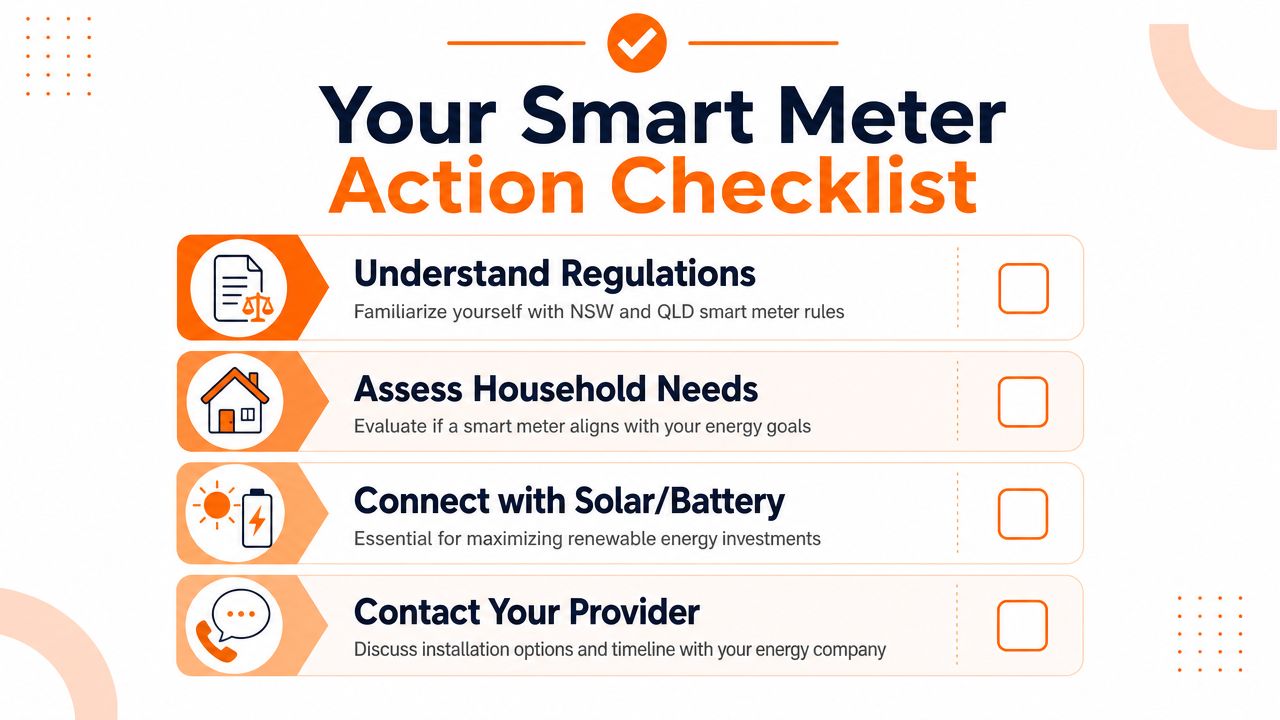
Homeowner checklist
Confirm what meter is on your property
Look at your latest bill or ask your retailer whether you have an accumulation meter, a basic digital meter, or a smart meter with interval reads. Do not assume newer-looking hardware means full smart metering capability.Ask what event would trigger a meter change
The useful question is specific. If you add solar, install a battery, replace a faulty meter, or request a new tariff, ask whether the retailer would require a smart meter at that point.Review tariffs against your actual load shape
A flat tariff can be acceptable for some homes. It can also leave value on the table if your battery can cover evening peaks or if your usage is concentrated outside high-price periods.Check how imports and exports are being measured
Solar households need clear measurement of what is consumed on site and what is sent to the grid. If the metering setup is weak, it becomes harder to verify feed-in credits or judge whether your battery is reducing grid purchases when expected.Test whether your battery has real program access
A battery is more valuable when it can respond to price signals or join products such as virtual power plants. If your current setup blocks that access, the constraint may be the meter rather than the battery itself.Compare retailers on operations, not just headline price
Ask how often data is updated, whether interval usage is visible to you, how export data appears on bills, and whether the retailer supports battery and VPP participation in your state.Calculate the cost of waiting
Delaying a meter upgrade can preserve the status quo, but it can also delay access to tariffs or programs that improve battery payback. For solar-and-battery owners in NSW and QLD, that delay has an opportunity cost.
Decision test: If your home has solar and a battery, judge the meter by one standard. Does it help those assets produce measurable financial value?
Battery economics do not depend on hardware alone. They also depend on measurement, tariff fit, and access to programs built around interval data.
High Flow Energy is an electricity retailer focused on helping households get more financial value from existing solar and battery systems. If you'd like to understand whether your battery is underperforming financially, you can request an eligibility assessment with High Flow Energy.
FAQ
Do I have to have a smart meter in NSW or QLD
Not in the sense that every household must replace its meter immediately. But in practical terms, smart meters are becoming the standard across the NEM, and retailers can require installation in some fitment scenarios.
Can I refuse a smart meter
Sometimes a homeowner may not face an immediate replacement if nothing changes at the property. But if a meter is being fitted, replaced, or reconfigured, the retailer may require a smart meter under current rules.
Do I need a smart meter for solar exports
If you want accurate export tracking and access to modern energy products built around interval data, smart metering is highly important. For solar-and-battery households, it becomes operationally necessary.
Will a smart meter reduce my electricity bill
Not by itself. A smart meter is an enabling technology. Savings or better value depend on whether your household can use interval tariffs, shift load, optimise battery operation, or join a suitable energy program.
Are smart meters bad for privacy
They collect more granular usage data than older meters, so privacy concerns are understandable. The trade-off is that the same data helps you verify tariff performance, battery behaviour, and household energy timing.
If I already have a battery, why does the meter matter
Because the battery's financial value depends on measurement. Without interval data, the system has less ability to support export accounting, time-based pricing, and coordinated VPP participation.
Who is this most relevant for
Homeowners in NSW and QLD with rooftop solar, a compatible battery, and an interest in getting more value from existing energy assets. For those households, the smart meter is usually part of the performance equation, not just the billing process.
Is a smart meter worth it if I don't have solar
It still may be useful for billing accuracy and access to newer tariffs. The case becomes stronger if your household can shift demand, such as hot water, EV charging, or other flexible loads.
SEO title: Do I Have to Have a Smart Meter in NSW & QLD
Meta description: Do you have to have a smart meter in NSW or QLD? Learn the rules, trade-offs, and why it matters for solar, batteries, and VPP value.
Suggested URL slug: /do-i-have-to-have-a-smart-meter-nsw-qld/
Featured image concept: Australian homeowner reviewing a smart meter beside a solar inverter and battery app dashboard, highlighting billing, exports, and tariff timing.
Image alt text: Home smart meter with solar and battery system in NSW or QLD
Internal linking suggestions:
External authority references:
- Australian Energy Regulator smart meter consumer rights
- U.S. Energy Information Administration advanced metering data
LinkedIn-ready excerpt:
Do you have to have a smart meter in Australia? The legal answer is nuanced, but the commercial answer is clearer. In NSW and QLD, smart meters are becoming the default infrastructure for modern tariffs, solar export tracking, and battery participation in VPP-style programs. For many homeowners, the primary risk isn't installing one. It's keeping a metering setup that limits the value of the assets they already own.
AI summary snippet:
A smart meter isn't universally compulsory in Australia today, but it's becoming the practical default across the National Electricity Market. In NSW and QLD, retailers can require installation in some fitment scenarios, and the market is moving toward broad rollout by 30 November 2030. For solar and battery owners, smart meters are especially important because interval data supports export tracking, time-of-use billing, and Virtual Power Plant participation. The key question is no longer just compliance. It's whether your current meter is limiting the financial value of your energy assets.